

The Boundaries of Natural Science
GA 322
29 September 1920, Dornach
Translated by Steiner Online Library
Third Lecture
[ 1 ] We have seen that human beings, so to speak, come to two boundaries when they attempt, on their own initiative, either to penetrate more deeply into natural phenomena, or when they attempt, from the standpoint of their ordinary consciousness, to delve more deeply into their own being, precisely in order to discover the true nature of consciousness. We already hinted yesterday at what happens at one boundary of our cognition. We have seen that human beings awaken to full consciousness through their interaction with external physical-sensory nature. Human beings would be, more or less, sleepy beings—beings with a drowsy soul—if they could not awaken through their interaction with external nature. And, in essence, what takes place in the course of humanity’s spiritual development is nothing other than the gradual unfolding—through the acquisition of knowledge about the external natural world—of what occurs every morning when, emerging from sleep or from dream-like slumber, we are stirred by the external world into full, waking consciousness. In the latter case, we are dealing, so to speak, with a moment of awakening. In the course of human development, we have been dealing with a gradual awakening—in a sense, with a stretching out of the moment of awakening.
[ 2 ] Now we have seen that a kind of inertial force of the soul very easily comes into play at this boundary, so that, in a sense, where we come into contact with the expansive world of phenomena, we do not—as phenomenalism in the Goethean sense would have it—remain on the outside and merely summarize the phenomena according to our acquired clear mental images, concepts, and ideas—systematically and rationally describing them, and so on—but rather that we roll on for a while beyond the phenomena with our concepts and ideas, thereby arriving at the establishment of a world—for example, a world of subatomic particles, molecules, and so on—which, when conceived in this way, is essentially a world of the imagination, a world behind which doubt immediately creeps in, so that we once again unravel what we had first spun as a theoretical web. And we have seen that it is possible, through the pure working through of the phenomena themselves—through phenomenalism—to guard ourselves against such a crossing of the boundary of our knowledge of nature in this direction. But we have also had to point out that at this stage of our cognition, something emerges that presents itself for use with an immediate necessity of life: namely, mathematics and that which, for example, can be understood in mechanics without empiricism—that is, the entire scope of so-called analytical mechanics.
[ 3 ] When we consider everything that mathematics encompasses, everything that analytical mechanics encompasses, we arrive at the most reliable conceptual frameworks with which we can delve into phenomena. Yet one cannot deny—as I already pointed out yesterday —that the entire way in which we form mathematical images and also mental images of analytical mechanics—that this inner mental work is entirely different from the kind we perform when, drawing on experience—on sensory experience—we experiment or observe and summarize the facts of the experiments or the results of the observations, that is, when we gather external empirical knowledge. In order to achieve complete clarity in these matters, one should reflect deeply, for there is no other path to clarity in this field than that of deep reflection.
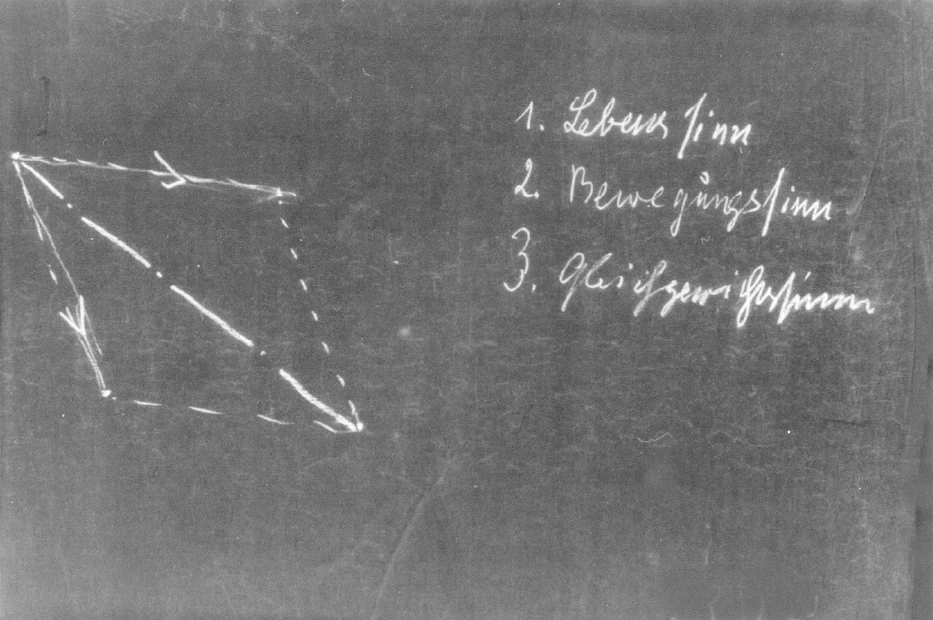
[ 4 ] What is the difference between acquiring empirical knowledge—for example, in the Baconian sense—and the way of grasping things internally, as is the case in mathematics and analytical mechanics? One can draw a sharp distinction between the latter and that which is not grasped in such an internal manner simply by clearly defining the concept of the parallelogram of motion and then the concept of the parallelogram of forces. The fact that two motions diverging from one another at an angle result in a resultant motion is a theorem of analytical mechanics. The fact that, when (a) a force of a certain specified magnitude acts here and (b) a force of a certain specified magnitude acts there, a resultant force arises that can also be determined using this parallelogram—these are two entirely different conceptual frameworks. The parallelogram of motion belongs, in the strict sense, to analytical mechanics, for it can be proven internally like any theorem in mathematics, such as the Pythagorean theorem or any other. The existence of the parallelogram of forces can only be a result of experience, of experimentation. Here we introduce into what we process internally something—force—that can only be given to us externally through experience, through empiricism. Thus, we are already dealing with empirical mechanics, no longer with purely analytical mechanics. You see, here one can draw a strict line between what is still mathematical in the proper sense—as mathematics is still understood today—and what leads over into ordinary sensory experience.
[ 5 ] Now we are faced with this fact of mathematics as such. We grasp mathematical truths. We trace mathematical phenomena back to certain axioms. We then construct the entire fabric of mathematics from these axioms, and we find ourselves, as it were, before an architecture apprehended through contemplation—but an inner contemplation. And if we are able, through deep reflection, to draw a sharp boundary between this and everything that can be experienced externally, we must see in this mathematical fabric something that arises through a completely different activity of the soul than that through which we experience and perceive externally through the senses. The fact that we—I would say—can once again discern this difference precisely through an inner experience is, in essence, of immense importance for a satisfying understanding of the world. We must therefore ask: Where does mathematics come from? And this question is still not being posed with sufficient clarity at present. People do not ask: How does this inner mental activity—which we need in mathematics, in the structure of mathematics, in this marvelous architecture—differ from the mental capacity through which we perceive physical, sensory nature via our external senses? And this question is neither posed nor answered sufficiently today, because the tragedy of the materialistic worldview is that, while on the one hand it is driven toward sensory -physical experience, on the other hand it is driven—without realizing it—into an abstract intellectualism, into an abstract entity that actually distances us from a genuine grasp of the facts of the material world.
[ 6 ] What, then, is it that we cultivate as a skill by applying mathematics? Let’s ask ourselves this question. If we are to answer this question, I believe there must be something that has become fully integrated into our understanding. On the one hand: We must also take the concept of becoming seriously in human life; that is, we must start from what is particularly disciplining about modern natural science, we must educate ourselves through it and, in a sense, take what we have instilled in ourselves in terms of rigorous method and scientific discipline in modern natural science—we must know how to carry this beyond natural science itself, so that we ascend to higher realms with the same mindset we have in natural science, but by extending these methods to entirely different fields. That is why I do not believe—and I say this quite plainly—that anyone who has not acquired a scientific discipline in the strict sense of the word, who has not learned to research and think in laboratories and through the methods of modern natural science, can attain true Spiritual Science knowledge. Least of all does Spiritual Science have any reason to underestimate modern natural science. On the contrary, it fully appreciates it. And as for myself—if I may make this personal remark—many people take great offense at the fact that, before I actually published anything in Spiritual Science, I first wrote quite a bit specifically about problems in natural science from the perspective that seemed necessary to me. So the point is that, on the one hand, we must adopt this scientific mindset so that it continues to influence us as we move beyond the boundaries of scientific knowledge. And secondly, we must take the quality of this scientific knowledge—or rather, the results of this scientific knowledge—very seriously indeed.
[ 7 ] You see, if we take the very simple phenomenon of rubbing one body against another and heat being generated, in the natural sciences we do not say, in response to such an observable partial phenomenon: “This heat arose out of nothing,” or “This heat is simply there”—rather, we look for the conditions under which this heat was latent beforehand and then, so to speak, came to light through the bodies. We move from one phenomenon to another and take the process of becoming seriously. We must do the same when we wish to introduce a concept into the Spiritual Science. And so we must first ask ourselves: Is the act of mathematizing always present in human beings, insofar as they live out their existence between birth and death? — No, it is not always present. Mathematical thinking only awakens. And in fact—while still remaining within the realm of empirical observation of the external world—we can observe quite precisely how, little by little, those soul faculties awaken, as it were, from the dark depths of human consciousness, faculties that then express themselves precisely in mathematical thinking and in similar activities—such as those we will discuss shortly—that are akin to mathematical thinking. This point in time—if one is only able to view it precisely and systematically, if one treats it in the same way that natural science, for example, treats the phenomenon of the melting point or the boiling point—occurs roughly during that stage of life when the child is losing its baby teeth and the permanent teeth are coming in. One need only view such a point in life’s development with the same mindset as one has learned, for example, in physics, to treat the melting point or the boiling point. One must acquire the ability to apply this rigorous inner discipline—which can be gained by observing simple physical phenomena in the spirit of modern science—to the complexities of human life. And when one does this, one sees that in human development—from birth, or rather from conception, up to this point of tooth replacement—the soul faculties that will later enable mathematical thinking do indeed gradually emerge from within the organism, but they are not yet present. And just as we say that heat, which is latent in a body and manifests itself in a certain state, it must have previously been at work within the body, in the body’s inner structure—so we must be clear that what emerges particularly strongly as the ability to think mathematically during the period of tooth replacement, and gradually in a certain other sense, must have previously been at work within the human organism. And so we gain a remarkable, significant understanding of this mathematical thinking—in the broadest sense, of course. We come to understand that what we, as human beings, apply as a soul capacity after the change of teeth is something that previously worked within us in an organizing way. Indeed, in the child up to about the age of seven, there is an inner mathematics—an inner mathematics that is not as abstract as our external mathematics, but is imbued with power; one that, if I may use Plato’s expression, can not only be contemplated but is actively alive. Up to this point, there exists within us something that mathematizes, that permeates us internally with mathematics.
[ 8 ] If we begin—I would say—by asking quite superficially what becomes empirically apparent to us when we look, so to speak, at the latent mathematics within the young child’s body, then we are led to three things that are, inwardly, akin to the senses. We will see in the course of these lectures that we can indeed speak of senses in this context. Today I merely wish to suggest that we are encountering something that develops, inwardly, a capacity for perception that remains unconscious to us only during the early years—just as the eyes and ears develop a life of perception outwardly. And if we look into our inner being—but into the inner workings of the organism—not according to the model of the nebulous mystics, but with full power and insight into this human inner life, then we can find, I would say, three sense-like functions through which an activity is exercised—in a certain sense, a mathematizing activity—especially in the first years of life. First is what I would like to call the “sense of life.” This sense of life manifests itself later in life as an overall sensation of our inner being. We feel, in a certain way, at ease or uneasy. We feel comfortable or uncomfortable; just as we have a capacity for perception directed outward through the eyes, so too do we have a capacity for perception directed inward. However, this faculty of perception is, so to speak, directed toward the entire organism; it is therefore dull and obscure, but it is there. We will have more to say about this later. For now, looking ahead to what I will discuss later, I would like to say that this sense of life—if I may use the tautology—is particularly active in the child’s vitality up until the time of tooth replacement.
[ 9 ] And a second thing we must take into account when we look into the inner being of a human being in this way is what I would like to call the sense of movement. We must form a clear mental image of this sense of movement. When we move our limbs, we are aware of it not only by observing ourselves from the outside, but we also have an inner perception of the movement of our limbs. Even when we walk, we are not only aware of our walking because we pass by objects and the view of the outside world changes for us; rather, we have an inner perception of the movement of our limbs, of changes within us as we move. We simply do not usually pay attention to this because the intensity of the impressions from the external world causes us to overlook what is happening internally in parallel—our inner experience and inner perception—just as a small light is extinguished by a large one.
[ 10 ] And a third, inward-directed sense is the sense of balance.
[ 11 ] 1. Sense of purpose
2. Sense of movement
3. Sense of balance
[ 12 ] This sense of balance is what allows us to position ourselves in the world in a certain way, to stay upright, and to perceive, in a certain way, how we bring ourselves into harmony with the forces of our surroundings. And we perceive this bringing ourselves into harmony with the forces of our surroundings inwardly. So that we can truly say we carry within us these three inner senses: the sense of life, the sense of movement, and the sense of balance. They are particularly active during childhood, up until the change of teeth. Their activity begins to wane as the change of teeth approaches. But observe—just to take one example—the sense of balance; observe how the child, at the very beginning of life, has absolutely nothing that would enable it to attain the balance it needs for life. Consider how the child gradually finds its footing, how it first learns to crawl on all fours, how it only gradually, through the sense of balance, comes to stand and walk, and how it comes to maintain its own balance.
[ 13 ] If you now take in the full scope of what takes place between conception and the loss of baby teeth, you will see in it the intense activity of these three inner senses. And when you then gain insight into what is happening there, you will realize that in the sense of balance and the sense of movement, nothing else is taking place but a living form of mathematics. And because it is alive, the sense of life is present to animate it. Thus, we see, as it were, a whole system of mathematics at work within the human being in a latent form; this does not completely cease with the change of teeth, but it becomes significantly less evident in later life. What is at work within the human being through the sense of balance, the sense of movement, and the sense of life becomes free. Latent mathematics becomes free, just as latent heat can become free heat. And we then see how that which, as a soul element, initially interwove with and animated the organism, becomes free as soul life; how mathematics rises as an abstraction from the state in which it first operated concretely within the human organism. And we then proceed from this mathematics—since, in terms of spatial and temporal relationships, we as human beings are entirely embedded in the totality of existence—we then, having liberated this mathematics, approach the external world with it and grasp the external world through that which has been at work within us until the change of teeth. You see, what emerges here is not a denial of the natural sciences; it is merely a further development of the natural sciences—if one correctly considers what is meant to live in Spiritual Science as a disposition and as a will.
[ 14 ] And so now we carry beyond the limits of sensory perception that which comes from within ourselves. We observe the human being as he or she is becoming. We do not simply look at mathematics on the one hand and sensory experience on the other, but rather we observe the emergence of mathematics within the human being as he or she is becoming. And now, however, I come to what truly leads us into the realm of Spiritual Science. You see, we must acknowledge that what we are working out from within—this process of mathematizing—ultimately becomes an abstraction. Yet it need not remain an abstraction for our experience. In our time, however, there is little opportunity to see the experience of mathematics in its proper, true light. Yet at a significant point in our Western civilization, something of this sense of a special spirit in mathematics does come to light. This is where Novalis—the poet Novalis, who had, after all, acquired a solid mathematical education during his academic training—speaks about mathematics—as you can read in his fragments. He calls mathematics a great poem, a wonderful, great poem.
[ 15 ] One must have experienced what can drive one from the abstract grasping of geometric forms to the admiring sense of inner harmony that lies in this mathematical process. One must have had the opportunity to struggle through that cold, sober activity—which many even hate about mathematics—I would say in the manner of Novalis, to arrive at an admiration for the inner harmony and—if I may use the expression, which you have now heard here more often in a completely different context—the melos of mathematics.
[ 16 ] Something new intermingles with the mathematical experience. Something intermingles with the mathematical experience—which is otherwise purely intellectual, figuratively speaking, concerned only with our minds—something that now engages the whole person and which, in essence, for minds that have remained youthful like Novalis’s, is nothing other than a sense of the fact: What you perceive there as mathematical harmonies, with which you interweave the phenomena of the universe, is, after all, nothing other than what wove you together during the earliest days of your childhood development here on Earth. — That means, in concrete terms, feeling the connection between the human being and the cosmos. And when one works one’s way through such an inner experience—which some regard as a mere figment of the imagination because they have not actually gone through it themselves—when one forces oneself through such an experience, then one gains a sense of what the spiritual researcher experiences when, through that inner development—about which I will also offer hints, and which you will find described in full in my book How Does One Attain Knowledge of the Higher Worlds?—when, through such an inner sensation, he rises to a broader inner grasp of this mathematical thinking. For then the soul capacity that expresses itself in this mathematical thinking transforms into a much more comprehensive one. It then becomes something that remains as precise as mathematical thinking, but which no longer arises solely from intellectuality or from intellectual contemplation alone, but rather from the whole human being. Then, in this way—but always working inwardly, engaged in a more rigorous inner labor than that performed in the laboratory, at the observatory, or in any other scientific setting—one learns to recognize what underlies mathematics, this simple fabric of the human soul, which can, however, be expanded and become something far more comprehensive. Through mathematics, one learns to recognize what inspiration is. One learns to recognize the difference between how mathematics lives within us and how external empiricism lives within us. In external empiricism, we have the sensory impressions that fill the empty concepts with content. With inspiration, we have an inner spiritual element that already permeates mathematics—if only we grasp it correctly—an element that is alive, that lived through and interwove our childhood years as an organizing spiritual force. It remains within the human being. But we experience it, in a specific subfield, through the act of doing mathematics. We come to understand that the way we master mathematics is based on inspiration, and we can then experience this inspiration ourselves through spiritual research. We receive content into our mental images and concepts in a way other than through external experience. We can draw inspiration from that which, in the spiritual world, works within us during our childhood years. That which works within us during our childhood years is spirit. But it is embedded in the human body, and it must be perceived in the human being through the human body. It can be perceived in its pure, free form when, through the power of inspiration, one not only learns to think in mathematical concepts but also to perceive that which lives as a reality, organizing us through and through until our seventh year. And—as I said, I will speak further about the methods of Spiritual Science—one can perceive what lives in a specific branch of mathematics, and what reveals itself to us in a much broader field through inspiration. When one ascends to this inspiration, one not only acquires new insights to add to one’s existing powers of cognition, but also gains the ability to perceive things anew. One gains new, inspiring insights. The development of humanity has been such that these inspiring powers of insight have receded somewhat over time, after having once been present to a very high degree within human evolution. For once one has learned to recognize how that which is inspiration arises within the inner human being—which, for us in the West, has in a certain sense remained diluted to the point of intellectualism, confined to mathematics, but which can be expanded when one fully comprehends it inwardly— only then does one understand what was alive in that worldview, the remnants of which actually reach us only from the East, remnants that are so difficult for Westerners to comprehend—what was alive in Vedanta philosophy and in the other philosophies of the East. For what, in fact, was it that was alive in these philosophies of the East? It was something that came about through soul faculties of a mathematical nature. It was an inspiration. It was not mathematics, however; rather, it was something that had been inwardly and spiritually attained following the pattern of mathematical thinking. Therefore, I would like to say: The mathematical atmosphere that flows from the thoughts of Vedanta philosophy and similar philosophical worldviews of the ancient East—which, however, to recognize this, one must grasp it from the perspective one acquires when one oneself flows into inspiration, when one brings to life within oneself that which is unconsciously driven in mathematical reasoning and in the mathematical natural sciences, and can carry it over into a broader realm—this mathematical atmosphere was what Goethe envisioned. — Goethe modestly admitted that he lacked a mathematical education in the conventional sense. Goethe explored his relationship to mathematics in very interesting essays, which you can read in his scientific writings in the series of essays titled “Relationship to Mathematics.” Extremely interesting! For even though Goethe modestly admits that he does not possess—and has not acquired—a true mathematical skill in handling mathematical concepts and perspectives, he nevertheless demands one thing: he demands a phenomenology, as he practiced it in his scientific observations. He demands a return from the secondary phenomena that first present themselves to us in the external world to the primordial phenomenon. But what kind of return does he demand? He demands a return to the primordial phenomena of the kind practiced by the mathematician when he moves from the more complex structures of external perception back to the axiom. The primordial phenomena are to be the empirical axioms, the axioms that can be experienced.
[ 17 ] And so Goethe, precisely with a genuine mathematical spirit, calls for an inner integration of mathematics into phenomena. And he expresses this by saying: We seek the primordial phenomena, being conscious that we must seek them in such a way that, in the strictest sense, we can account for our approach to the mathematician according to his mindset. — What Goethe seeks, then, is a modified, a metamorphosed form of mathematization—an integration of mathematization into the phenomena. He demands this as a scientific activity.
[ 18 ] In doing so, Goethe has shed some light on one pole, which otherwise appears so dark when we adhere to the mere concept of matter. We will see how Goethe arrived at this one pole, but as modern thinkers we must strive to reach the other pole—the pole of consciousness. On the other hand, we will now likewise have to investigate how the faculties of the soul manifest themselves in the human being, how they grow out of human nature and express themselves outwardly. We will have to investigate this. We will then see that Goethe’s phenomenology—as a grasp of the external world—must be contrasted with an equally comprehensive grasp of the world of human consciousness, a grasp that, in the strictest sense, seeks to give an account just as Goethe did with regard to mathematics—a grasp that I have modestly attempted in my Philosophy of Freedom .
[ 19 ] Thus, at the pole of matter are those findings that stem from Goetheanism, and at the pole of consciousness are those findings that can be arrived at through the methodological approach by which I attempted, in a modest way, to construct my Philosophy of Freedom.
[ 20 ] We'll talk more about that tomorrow.