

The Boundaries of Natural Science
GA 322
30 September 1920, Dornach
Translated by Steiner Online Library
Fourth Lecture
[ 1 ] Our reflections yesterday led us to the conclusion that a certain understanding must take place within the limits of our knowledge of nature, that we must remain within the realm of phenomena and penetrate these phenomena—in a sense, interpret them—using what is kindled in our consciousness by these phenomena, using our concepts, ideas, and so on. Mathematics and analytical mechanics have revealed themselves to us as the purest, most transparent realm of these ideas, and we ultimately had to bring our reflections to a climax in the realization that a true self-reflection showed how everything that becomes present in our soul as mathematical content, as the content of analytical mechanics, is essentially based on inspiration, and we were then able to point out how the spread of this inspirational impulse can be discerned in the ancient Eastern Vedanta philosophy, and how the refined insight of Vedanta philosophy was gained from the very same spirit from which, in our own context, only mathematics and analytical mechanics actually spring. And we were then able to point out how Goethe, in establishing his own form of phenomenalism, strives for primordial phenomena within phenomena, and that his path from complex phenomena to primordial phenomena is, in a spiritual sense, the same path as that in mathematics from more complex conceptions to axioms. Thus Goethe, who said of himself that he had no formal mathematical training, nevertheless perceived the essence of mathematics so clearly that he demanded, for his phenomenology, that the establishment of the primordial phenomena be carried out in such a way that one could give an account to even the most rigorous mathematician. This is, after all, what makes Vedanta philosophy so appealing to the Western mind: that in its inner structure, in its progression from one insight to the next, it reveals itself just as strictly internal necessity reveals itself in mathematics and in analytical-mechanical thought. The fact that these things do not really come to light within our official study of Vedanta philosophy stems simply from the fact that there are not enough universally educated people in our time. Those who are mostly engaged in what then leads them into Eastern philosophy have too little insight—as I said, Goethe had it—into the actual structure of mathematics. They therefore cannot comprehend what the very lifeblood of this Eastern philosophy is. And so we were able to point out, from the material side of things, how the spiritual realm must first behave if we do not wish to preserve that Penelope-like web that has been spun over the last few centuries as a scientific worldview, but rather if we wish to preserve something that stands firm in itself, that, so to speak, has its center of gravity within itself.
[ 2 ] On the other hand, as I already hinted at yesterday, there is the problem of consciousness. If we wish to explore the content of this consciousness simply by brooding over our inner psychological world—as the vague mystics do—then, in essence, we arrive at nothing other than the reminiscences within this consciousness that have accumulated over the course of our lives since birth, since our childhood. This can easily be demonstrated empirically. One need only consider how a man well-educated in the natural sciences describes—precisely to hint at the reminiscence-like nature of this so-called inner life—how he once stood in front of a bookstore. He saw a book in that bookstore. It caught his eye because of its title. It was about lower animals. And lo and behold, as he looked at this book, he couldn’t help but smile. Now imagine how astonished he himself must have been—a serious professor of natural science who sees a serious book title in a bookstore, about lower animals no less, and who can’t help but smile! Then it occurred to him to wonder where this smile might actually be coming from. At first, he couldn’t think of anything. Then it occurred to him: I’ll close my eyes. - And lo and behold, when he closed his eyes and it was dark around him, he heard a musical motif in the very distance, and this musical motif—only now, at that very moment—reminded him of that dance music which he—he was already a young man at the time he made this observation—had once heard when he performed his first little dance. And it then occurred to him that, of course, not only does this musical motif live on in his subconscious, but so too, to some extent, does the partner with whom he had once pranced about, and how what he had long since forgotten in his ordinary consciousness—what he had never even absorbed strongly enough, in his view, to have been destined to last a lifetime—how the whole thing emerged as a complex of images. And at the very moment he was looking at a serious book, it did not even occur to him that a barrel organ was playing in the distance. Even the sounds of that barrel organ remained in his subconscious at that moment. Only when he closed his eyes did they surface.
[ 3 ] Well, this is how certain things emerge that exist in our consciousness merely as memories of life. And then sometimes the nebulous mystics come along and tell us how they perceive within themselves a deep connection with the divine primordial principle of all things, how a higher experience, a rebirth of the human soul, resounds from within them. And so mystical webs are spun, and it is nothing other than the forgotten melody of the barrel organ. You can attribute a large percentage of mystical literature to this forgotten melody of the barrel organ.
[ 4 ] This is precisely what we need in a true Spiritual Science: enough level-headedness and precision so that we do not proclaim every possible thing that surfaces from the subconscious as mere reminiscence to be mysticism—or as something that could claim any kind of objective validity. It is precisely the scholar of Spiritual Science who, if he wishes to arrive at truly fruitful results in this direction, needs the highest degree of inner clarity; he needs inner clarity precisely when it comes to descending into the depths of consciousness in order to draw out insights into what this consciousness actually is. One must indeed descend into the depths of this consciousness, while at the same time not being a dilettante in this field, but possessing full expertise in everything that psychopathology, psychology, and physiology have produced to date, so that one may distinguish between that which unjustifiably claims to be established as a Spiritual Science and that which emerges from the same discipline, such as, for example, mathematics or analytical mechanics.
[ 5 ] To this end, I attempted as early as the last century to modestly characterize the other pole—the pole of consciousness as opposed to the pole of matter. The pole of matter required a further elaboration of Goethe’s view of nature. The pole of consciousness was not so easily accessible simply through Goetheanism, for the simple reason that Goethe was no trivial figure—nor was he a trivial figure of sentiment when it came to advancing toward knowledge—but because he possessed all the reverence necessary for approaching the true sources of knowledge. And so Goethe, who was more attuned to external nature, felt a certain hesitation precisely toward that which is meant to lead down into the depths of consciousness itself—toward thinking driven to its highest, purest form. Goethe attributed it to his good fortune that he had never thought about thinking. One must understand this statement, for in reality one cannot actually think about thinking. One cannot, in essence, think about thinking any more than one can make iron iron or wood wood. But one can do something else. One can try to follow the paths that are laid out in thought—paths that are revealed as thought becomes ever more rational—and to continue along them as one begins through the discipline of mathematical thought. If one does this, one simply enters, through a natural inner guidance, into that region which I attempted to examine in my Philosophy of Freedom. There, one does not arrive at a thinking about thinking. At most, one can speak figuratively of a thinking about thinking. But one arrives at something else; one arrives at a contemplation of thinking. However, in order to arrive at this contemplation of thinking, it is necessary to have first truly acquired an intense mental image of what pure, senseless thinking is. One must have driven the inner work of thinking so far that one then arrives at a state of consciousness in which, simply by grasping the non-sensory thoughts—by contemplating the non-sensory thoughts—one knows that one is now dealing with non-sensory thoughts.
[ 6 ] That is the path I have attempted—as I said, in a modest way—in my Philosophy of Freedom. I would like to say that an attempt was made there to present thought to consciousness—after it had first been freed from sensibility—in the same way that mathematical reasoning or the mental faculties and powers of analytical mechanics lie before consciousness when one devotes oneself to these sciences with complete discipline.
[ 7 ] Perhaps I may insert another personal remark here. By positing this thinking free of sensuality—by presenting it simply as a fact, but as a fact that is strictly provable insofar as it can be compelled just as a mathematical construct is in inner experience—I came into conflict with all manner of philosophers of the 1880s and 1890s. Time and again, I was told: Yes, with this kind of thinking, one is not grounded in any kind of reality. — But as early as in my “Outlines of an Epistemology of Goethe’s Worldview” in the first half of the 1880s, I had to point to the experience of this pure thinking, in the presence of which one simply knows: You are now living in an element that no longer contains any sensory impressions and yet reveals itself in inner activity as a reality. — I had to say, for example, about this thinking: In it we have the true spiritual communion of the human being, the union with true reality. We feel, as it were, at the very edge of worldly existence how we, as souls, are connected to this worldly existence. — I felt compelled, so to speak, to protest vigorously against what was emerging in philosophy at the time, which Eduard von Hartmann espoused when he wrote as the motto for his Philosophy of the Unconscious (1869): “Speculative results according to the inductive method of natural science.” This was a philosophical homage to the natural sciences. To protest against the pursuit of an insubstantial metaphysics—which arises solely from allowing thought, in the sense described, to roll on beyond the veil of the senses out of inner inertia—I wrote as the motto for my Philosophy of Freedom: “Psychological observational results according to the scientific method.” I pointed out that everything that constitutes the content of a philosophy is not contrived, but is, in the strictest sense, a result of inward observation, just as color and sound are results of outward observation. And by living within this—admittedly, the human essence as elements of pure thought that are as chilling as a cold—one makes a discovery. One discovers that, although people can speak instinctively of freedom, and although there are impulses within the human being that certainly tend toward freedom, these impulses remain unconscious instinctive until one rediscovers freedom by realizing that, from thinking free of sensuality, impulses can flow for our moral action; and because we have grasped a form of thinking that itself no longer contains any sensuality, these impulses are then not determined by sensuality but by pure spirituality. And one experiences pure spirituality by observing—purely observing—how the power of the moral flows into thinking free from sensuality. And the best result one achieves from such an endeavor is, first of all, that one can say “goodbye” to all mystical superstition, for it leads to something that is in some way veiled and is accepted solely on the basis of some obscure feeling. One can bid it farewell because one now experiences in one’s consciousness something that is inwardly transparent, something that is no longer impulsed from the outside but is filled with spirituality from within. One has grasped world existence at a single point by making oneself merely the scene of cognition; one has grasped how world existence unfolds in its true form and—if we submit to this inner observation—then reveals itself to us. I would like to say: At a single point alone do we grasp what the essence of worldly existence actually is, and we grasp it as a reality, not as abstract thought, when moral impulses flow into the fabric of non-sensual thought—impulses that appear free because they now live no longer as instincts but in the guise of non-sensual thought. We experience freedom—admittedly, a freedom of which we know at the same time that human beings can only approach it in the same way that a hyperbola approaches its asymptote—but we know that this freedom lives within human beings to the extent that the spiritual lives. We first grasp the spiritual from the element of freedom.
[ 8 ] And this brings us to something that is woven together at the very core of the human being: the impulse behind our moral and social actions—freedom—with knowledge, with that which we ultimately attain through science. We experience this by grasping freedom in thinking free from the senses, by understanding how this grasping takes place only in true spirituality, how we live within spirituality as we carry this out; we experience a form of knowledge that simultaneously proves to be an inner activity, one that can become an inner activity directed toward the outer world—and thus can inevitably spill over into social life. At that time, I tried to point out two things with the utmost clarity. Yet little was understood back then. Above all, I tried to point out how, in pursuing such a path of knowledge, the essential element is the inner education we thereby bestow upon ourselves. Indeed, it is quite something to walk this path toward thinking free from sensuality. One must go through much inwardly. One must overcome challenges of which one usually has no inkling in one’s outer life. And as one overcomes these challenges, as one ultimately finds oneself in a soul experience that can scarcely be grasped—because it so easily eludes the ordinary faculties of the human being—and as one immerses oneself in this essence, one does not immerse oneself in an unclear, nebulous, or mystical way, but rather in a bright clarity; yet one immerses oneself in spirituality. One becomes acquainted with spirituality. One knows what spirit is, and one knows it by having found the spirit on the path that the rest of humanity also walks—a path they simply do not complete—but which must be walked for the sake of our present intellectual and social aspirations by all those people who wish to be active in some way in intellectual and social life. That is the one thing I sought to convey through my Philosophy of Freedom.
[ 9 ] The other point I hinted at there is that, now that we have discovered freedom as the bearer of what is truly moral in thinking free from sensuality, we cannot then, in some way, by drawing analogies from natural phenomena, derive moral concepts or moral precepts; that we must abandon everything that leads us to moral content through the natural sciences; that this moral content must arise freely, must arise in supersensible experience. And at that time I ventured a term that has been little understood, but which must absolutely be established if one is to enter this realm and if one wishes to understand freedom at all. I used the expression: The moral world unfolds before us in our moral imagination. — And I used the expression “moral imagination” with full awareness; I used it to indicate that—just as with the process of imagination—the spiritual work involved takes place within the human being, apart from the external world; and, on the other hand, to indicate that, at first, that which gives the world its ethical and religious value—namely, the moral precepts—can be grasped only in this realm, which remains free from external impressions and is based on the inner work of the human being itself. At the same time, however, I already pointed out clearly in my Philosophy of Freedom that, while we remain within the human realm, the moral content does indeed reveal itself to us as the content of moral imagination; yet when we examine more closely this content—which reveals itself to us as that which we bring over from a spiritual world— we become integrated into the external sensory world.
[ 10 ] If you truly study this philosophy, you will clearly recognize the gateway through which this philosophy offers a path into the spiritual realm; it’s just that in this philosophy I proceeded in such a way that I could have accounted for the course of my investigations to any analytical mechanist, and that I attached no value whatsoever to whatever approval of a path into the spiritual realm might come from all the rambling that originates from some spiritualist or mystically nebulous quarter. From such quarters, one can easily gain approval by speaking of all manner of spiritual matters, but one avoids precisely the path that I attempted to follow at that time. I sought certainty and assurance regarding the spiritual, and I was utterly indifferent to the approval of all those ramblers who advocate for the spiritual from whatever nebulous, mystical backgrounds they may come. But at the same time, something else was gained.
[ 11 ] Precisely when one delved into these two directions—which I identified in The Philosophy of Freedom as true observations of consciousness—precisely then, when one goes even further, when one takes the next step—what then? When one arrives at those inner experiences that lie within the sphere of pure thought, at those inner experiences that ultimately reveal themselves as the experience of freedom, then one arrives at a metamorphosis of cognition with regard to the inner world of consciousness. Then concepts and ideas are no longer merely concepts and ideas; in this respect, Hegelianism is no longer Hegelianism; abstractness is no longer abstractness; and in this direction, one first enters the real realm of spirituality. Then the next stage one enters is no longer the mere “concept,” the mere “idea,” no longer something that constitutes the entire content of Hegel’s philosophy; no, then concept and idea are transformed into image, into imagination. One immediately discovers the higher stage, which at first had projected itself only into moral imagination; one discovers the cognitive stage of imagination. Just as one is still caught up in a self-created reality through philosophy, so too, once one has allowed oneself to be guided inwardly along the path laid out by the Philosophy of Freedom, once one has ventured beyond this realm of imagination, one finds oneself in a world of ideas—which are no longer dream images, but which point just as much to realities—namely, spiritual realities—as colors and sounds are anchored in sensory realities. Now one enters the realm of pictorial, imaginative thinking. One arrives at those imaginations that are real, through which one stands in a world, no longer merely within oneself; one arrives at the inspiration that can be experienced when one engages in mathematics in the true sense, when the act of doing mathematics itself becomes an experience, and can then, in a sense, transcend oneself to reach what has been revealed, for example, in Vedanta philosophy. On the other hand, imagination joins this inspiration. And through this imagination, one then discovers what makes human beings comprehensible in the first place. One discovers in imaginations, in pictorial mental images, in mental images that have a more concrete content than abstract thoughts—one discovers in these pictorial mental images what makes human beings comprehensible from the perspective of consciousness. One must have the resignation not to want to go any further once one has reached this point—not to want to proceed any further, not to simply let this non-sensory thinking roll on out of inner inertia and believe that through this non-sensory thinking one will descend into the mysteries of consciousness—but rather, one must have the resignation to stop right there and, as it were, to confront the spiritual outer world from within. Then one will not spin thoughts into consciousness that cannot comprehend it anyway, but one will receive the imagination through which consciousness can now be grasped. Just as one must stop at the outer boundary of the phenomenon and find that thoughts are what can systematically organize these phenomena in cognition—just as one necessarily needs this resignation there and thereby arrives at the spirituality of intellectuality—so one must search inward, have the resignation to hold one’s thoughts still, to bring them, so to speak, into inner reflection, in order thereby to approach the images that only now unfold the inner life of the human being. I would like to say that when I depict the human inner world here (see drawing) and approach this inner world through self-contemplation and pure thinking, I must not allow my thinking to run away with me again, for there I enter a realm where pure thinking finds nothing more, but can only present vivid images or, indeed, reminiscences of life. I must have the resignation to turn back. But then, at that point of reflection, imagination will reveal itself to me. Then the inner world will reveal itself to me as an imaginative world.
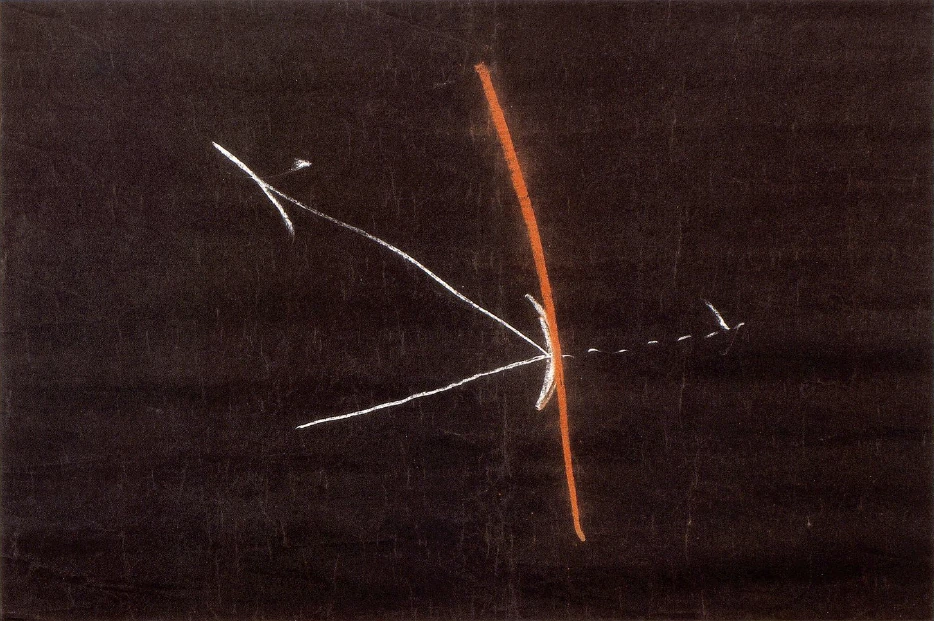
[ 12 ] You see, this brings us to two poles within ourselves. We arrive at the pole of inspiration toward the external world, and at the pole of imagination toward the inner world. But once one has grasped this imagination, one can synthesize from these imaginative images—just as one synthesizes knowledge of nature in the external world through concepts and experiments—one can then synthesize inwardly that which is real, that which initially reveals itself not as a physical body but as an etheric body permeating the human being, naturally throughout his entire life, but in a particularly intense way during the first seven years of life, which then takes on a different form during the change of teeth, as I described to you yesterday. But through this, one acquires the ability to observe how this etheric or Life-Body functions within the physical human organism.
[ 13 ] It is easy to say, from the perspective of any philosophical theory of knowledge: Yes, if a person wants to remain within clear logic, then they must remain within the realm of concepts; they must remain within that which can be discursively justified and proven in the ordinary sense. Fine. One can continue to theorize about epistemology like this for as long as one likes. But no matter how strongly one believes in such an epistemological framework, no matter how logically sound it may be, reality does not reveal itself to me; reality does not live in what we construct so logically. Reality lives precisely in images. And if we do not resolve to grasp images or imaginations, then we simply do not grasp human reality. And it is not at all a matter of us externally declaring, out of a certain preference, what knowledge must look like in order to be genuine; rather, it is a matter of asking reality through what it wishes to reveal itself to us. This brings us to imagination. Thus, what lives in the moral imagination proves to be a projection into ordinary consciousness from a higher spiritual world—a world that we can, however, grasp through our imaginations.
[ 14 ] And so, my esteemed audience, I have guided you—or at least attempted to guide you—to the two poles of inspiration and imagination, which we now intend to explore in greater depth and detail from a Spiritual Science perspective over the next few days. In a sense, I first had to lead you to the gate so that you could see that this gate is well-founded in the ordinary scientific sense. For only when we have established the foundation of this gate can we then proceed to lay the foundation of the edifice into which we enter through this gate—the edifice of Spiritual Science itself. However, in undertaking this entire journey—which I had to describe to you today as, I would say, a very difficult epistemological path, one that some might say is hard to understand—in undertaking this journey, one must have the courage to engage not only with Hegel, but also, I would say, with the “anti-Hegel.” After describing Hegelianism as I attempted to do in my Riddles of Philosophy, one must also do justice to Stirner and describe him as I attempted to do in my Riddles of Philosophy; for in Stirner lies that which emerges from consciousness and reveals itself as the “I.” And if one simply takes this Stirnerian “I,” which arises from instinctive experiences, just as it is—without penetrating it with what pertains to moral imagination and the imagination—then it represents something antisocial. But what the Philosophy of Freedom sets in place of Stirnerianism, as we have seen, is in truth a social force. One must also have the courage to pass through the instinctive “I” in the Stirnerian sense in order to arrive at imagination, and one must have the other kind of courage to look into the face of the psychology of association, which stems from Mill, from similar minds, from Spencer, and so on—those who would like to grasp consciousness with a mere concept but cannot. One must have the courage to recognize that the opposite path must be taken today. The ancient Eastern thinker followed a path that is no longer viable today, having introduced mathematical reasoning into Vedanta philosophy. The Western thinker no longer follows this path. Humanity is evolving. It has progressed. Another path must be sought. But it is still in its infancy, and its beginnings are best revealed when one regards this psychology of association—which systematically links inner mental images in the same way that one otherwise links external natural phenomena—as that which, out of inertia, seeks to break through and actually ends up in nothingness; and if one first understands how to grasp this psychology of association, but then knows how to lead it, through intuition, into the realm of the imagination. Just as the East once saw in primordial mathematical thinking the path into the spirituality of the external world—the thoughts of Vedanta philosophy—so must we, through the tasks set before us today, by looking inward, have the courage to move from mere concepts and ideas to imaginations, to visions, and thereby rediscover this spirituality first within ourselves. Then we will be able to carry it out into the outer world. Then we will possess spirituality, imbued with the inner essence of the human being, with the possibility of carrying it out into social life. In reality, this social life awaits nothing other than such an insight, which can at the same time be social. We will see in the coming hours that this is indeed the case.