

Naturalistic Observation, Experimentation, Mathematics
and the Stages of Knowledge in Spiritual Science
GA 324
18 March 1921, Stuttgart
Translated by Steiner Online Library
Third Lecture
[ 1 ] Yesterday I attempted, as a starting point, to consider some of the factors that may lead to the origin of the mental image of dimensionality within the human being. I would now like to set aside for the moment what I took the liberty of presenting to you yesterday. For in Spiritual Science considerations, it is particularly important—when they are to be illuminated, so to speak, from the other side, from the physical-empirical side— it is essential to approach them from various angles, and that is what I intend to do in these lectures; however, today I would like to add a few points to what I said yesterday from a different perspective, so that we may ultimately synthesize the individual considerations into a whole and elevate them to the level of Spiritual Science reflections.
[ 2 ] It is very often said that considerations in Spiritual Science are really only of concern to those who can themselves, in some way, relate to the particular form of perception that underlies the presentation of such findings in Spiritual Science. One can admit, in a certain limited sense—but only in a very limited sense—that someone might have this feeling. However, the question will always be whether what is presented on the basis of research in Spiritual Science can be understood in its general content—without one having to rise to a particular level of perception—or not; and that is precisely what I would like to make comprehensible to a certain degree in these lectures: that the results of research in Spiritual Science can indeed be understood by common sense. But for this to happen, it is necessary to truly engage with what Spiritual Science has to say in its own defense from a wide variety of perspectives. And among the arguments that might be cited to reject Spiritual Science, so to speak, does not belong the objection that would consist, for example, in saying: “If we consider the nature that surrounds us, as it is initially given to us in external experience, then it is self-explanatory, and there is no way to ascend from this self-explanatory nature to any other essential presuppositions that are supposed to make fully understandable what also surrounds us in the sensory world.” — For I myself will always be the first to emphasize that, from a certain point of view, the sensory world around us is self-explanatory. I once made this clear in a comparison—which, I admit, went only slightly beyond the trivial—to illustrate what I mean. I once said: If someone examines the mechanism of a watch, he has no need to resort to any explanatory reasons from the world outside the watch if he wishes to explain the watch’s mechanism on its own terms. From a certain point of view, the clock is entirely self-explanatory. But that does not prevent the fact that, from a certain other point of view, in order to fully understand what one actually has in one’s hand when holding the clock, one still needs the watchmaker’s understanding and the like—that is, something that is entirely outside the clock. Certain things simply cannot be figured out as quickly as one usually thinks, and that is why it is necessary that, if one wishes to assess the entire structure—the very essence—of spiritual scientific investigations, one must also engage with the details of the presentation; one must consider how this Spiritual Science itself applies what it intends to bring to light in its supersensible realm to the ordinary sensory, empirically given field of observation. Today I would like to speak to you a bit about this topic.
[ 3 ] I must first make a certain assumption, which I will explain in more detail over the next few days, including how it came about. I must first assume that the actual investigation of the field of Spiritual Science initially leads to a different mode of cognition—I might also say, to a different state of mind toward reality—than is present in ordinary daily life or in ordinary science. I have called the first stage of this—if you will, one might call it that—supersensible cognition the imaginative stage. I will return later to how this imaginative stage of cognition is attained through certain activities of the human soul. Today, however, I would like to explore what this imaginative stage of cognition actually is in its very essence, and to do so, we must once again look back at the reflection I have offered here—not so much on the nature of mathematics as on the nature of “mathematizing.”
[ 4 ] I have attempted to characterize the difference that exists in the content of our consciousness when, on the one hand, we immerse ourselves in something presented to us by the external sensory world—which we then process internally through our intellectual operations, and, for the sake of completeness, I will add, through emotional and volitional impulses as well— and, on the other hand, with mathematical cognition. And we can easily see that what takes place in the human soul in the former case is, expressed purely in external terms, a kind of interaction—an immediate interaction between the human being and an external world of some sort. Please take what I am saying here only for its actual content. I do not intend to put forward any hypotheses. I do not intend to say anything about a reality lying behind the matter, but I merely wish to indicate, for the time being, what is present in the very ordinary content of our consciousness when we face the external world in this cognitive manner. This insight would have no meaning at all if we did not assume that we are in direct interaction with some external world.
[ 5 ] In mathematical cognition—or rather, in first-order mathematical cognition, that is, in pure mathematization—the situation is different. I mean this difference in the case where, without addressing any external, sensory, concrete content, we live and deduce purely within the geometric or within the arithmetic-algebraic realm. That which we present to our minds in inner visual clarity within the arithmetic-algebraic-geometric realm—whether it be the Pythagorean theorem in the elementary realm or something from higher function theory— is something that, at first, lives entirely within what I might call “soul-construction”—that is, it is experienced through continuous activity and the contemplation of one’s own activity. This “mathematizing”—as I said, if I may put it that way—of the first order, which takes place entirely within the inner experience, we then apply to the external world in the mathematical natural sciences or perhaps also in other areas of life, and we simply find, in the course of our work, that what we first experienced purely inwardly is applicable to our sensory external world. The very fact that it is applicable to the external sensory world shows that it must have a purely pictorial character—a character that can be described as follows: what we experience mathematically has, as such, no content yet—not any of the content we find outside within our surroundings. In this respect, what is contained in mathematical thinking is entirely devoid of content; that is to say, it is a mere image. — To what extent the spatial, which is merely an image in mathematics, nevertheless relates to reality, I demonstrated yesterday in connection with the concept of dimensionality. But within mathematics itself, what we develop is entirely a mere image. If it were not an image, then we could not carry out the method of treatment we employ when, for example, we engage in mathematical natural science. For then a reality—and not merely an image—would have to converge within the act of cognition. But the fact that a reality does not converge with the act of cognition becomes clear to us precisely when we actually carry out this act of cognition.
[ 6 ] Now, if we recognize this pictorial character of mathematics on the one hand, but on the other hand are aware that we experience these mathematical images, then we have—admittedly, at first without any specific real content—a content of consciousness that we can certainly experience in its pictorial nature; indeed, it can be experienced in its pictorial nature precisely because we fully understand how, I might say, certain things remain hidden—things we must nevertheless suspect exist in what presents itself to our senses—in contrast to what we experience when doing mathematics. When doing mathematics, we are completely immersed in what is actually taking place. When doing mathematics, we can say that we are utterly and completely connected to what is taking place. This, in conjunction with the pictorial nature of mathematics, allows us to form a quite clear mental image within our consciousness of what we actually experience when doing mathematics; and it is on this basis that one has such extraordinary certainty when engaging in mathematics—that one actually knows, by doing mathematics, that one is moving within a field where certainties of knowledge prevail. Perhaps some who have engaged with these matters have noticed the difference that exists in one’s studies between dealing with external, sensory realities and dealing with what lies within the field of pure mathematics. Above all, when one engages in mathematics, one can be certain that one is constantly following everything one does with full, lucid, and clear consciousness, and I believe it is no exaggeration to say that one can even gauge the clarity of consciousness by taking mathematics as that in which this clarity of consciousness is most clearly expressed. We cannot really doubt in any way that every single operation—if I may use this expression figuratively—that we perform when we engage in mathematics is, at the same time as being internally vivid, also accompanied by our inner voluntary activity. We are, so to speak, completely in control of ourselves when we engage in mathematics.
[ 7 ] See what is present in the state of consciousness in mathematics; this is what the person who wants to strive upward toward what I call “imaginative mental images” is aiming for. When we engage in mathematics, the content of our soul consists of the numerical—which I will discuss later—as well as the spatial and similar elements. We thus have a certain field of very specific imagery within our soul. To strive for a different kind of imagery within a very similar state of mind—that is what lies at the heart of the development toward imaginative cognition, and this brings me to the following.
[ 8 ] When we apply mathematics to the external natural world, we cannot help but—especially if we have worked extensively in this direction—apply this mathematical treatment of the external natural world, at first, only to what we call the mineral world within that external natural world. The mineral world presents us with that which, in a certain sense, is entirely amenable to a purely mathematical approach. The moment we ascend from the purely mineral realm to the vegetable realm, and to the other kingdoms of nature, the mathematical approach, as we are accustomed to it, fails us. Now, anyone who wishes to rise to the imaginative mode of perception seeks to gain something in their inner life that encompasses not merely geometric forms or numerical relationships, but rather forms that live in the soul in exactly the same way as these mathematical forms, yet whose content goes beyond the mathematical. They wish to gain forms that they can then apply to the plant kingdom just as they apply mathematical forms to the mineral kingdom. Therefore—as I said, I would like to speak later about the individual methods that lead to imaginative cognition—the first aim must be that everything leading to imaginative cognition take place in a state of mind that is entirely equivalent to that of mathematical cognition. The point is that the best way to prepare for the development of imaginative cognition is to have engaged as much as possible with mathematics—not so much to arrive at specific mathematical insights, but to gain a clear experience of what the human soul actually does when it moves within mathematical structures. This activity of the human soul—this fully conscious activity of the human soul—is now to be applied to another realm; it is to be applied in such a way that, just as we do in mathematics, we construct—from our inner structures, if I may now use the term in a broader sense— construct further structures through which we can penetrate plant life or permeate plant life in the same way that we can permeate the mineral realm, the chemical-physical realm, and so on with mathematical structures.
[ 9 ] I must emphasize this particularly strongly for the following reason: because when the term “clairvoyance” is used in a trivial sense to refer to what is termed “super-sensory perception” in Spiritual Science, this term “clairvoyance” actually encompasses quite a lot of confusion; and because, in particular, what is — words are not important here — can certainly be described as clairvoyance is very easily confused with everything that arises in the human constitution when the functions of consciousness are lowered, so that they fall, as it were, below the surface of what constitutes everyday consciousness, as in hypnosis, under the influence of suggestive mental images, and the like. This dimming, this penetration into the subconscious, this dampening of consciousness has absolutely nothing to do; rather, it involves an elevation of consciousness, a moving with consciousness in precisely the opposite direction from that sought in what is commonly called “clairvoyance.” What is commonly called “clairvoyance” in the trivial sense is actually always “dark-seeing,” and it would indeed be accurate to say, without being misunderstood, that the striving toward imaginative cognition is a true striving for clairvoyance. You need only compare what I have just called “dark-seeing” with what I have characterized for you here in a few words. In everything you encounter during a more or less mediumistic state of mind, you see a dimming of consciousness—whether because consciousness is artificially dimmed, or because the person being used as a medium is, from the outset, somewhat mentally deficient, and that their consciousness can very easily be lowered somewhat. It always involves something that you certainly cannot compare to a state of mind that proceeds with such luminous clarity as only a mathematically attuned state of mind can. What is often called clairvoyance today—as you will have experienced—has extraordinarily little to do with striving for a state of mind characterized by mathematical clarity; on the contrary, the aim is usually to plunge as deeply as possible into the darkness of confusion. In a completely opposite way, what I am now going to describe to you step by step as “imaginative vision” seeks to manifest itself.
[ 10 ] Well, this imaginative perception is certainly, at first, something that lives within the soul in such a way that it can only become present in that soul by being developed. After all, a five-year-old child is not yet a mathematician. Mathematical imagery must first be developed, and it is not at all surprising that what progresses from the pre-mathematical state to the state of the soul that finds its expression in mathematics can, in a certain sense, be continued—that is, that what I have already brought to a certain luminous clarity of inner experience in mathematics can be carried even further. The question now is whether the person who says, “Yes, but connections must be established with what constitutes ordinary sensory observation,” is correct. In a certain sense, he is absolutely right, and the task is to actually trace these connections in detail.
[ 11 ] To this end, let us once again consider what I referred to yesterday as the human nervous-sensory system. This human nervous-sensory system is primarily concentrated in the human head, although, as I already mentioned yesterday, what is located in the human head only in the main extends throughout the entire human organism. However, one can also view this organization of the head in the following way. Let us begin with something that has, over a long period of time, posed certain difficulties for modern science. I have addressed these difficulties in my book The Riddles of Philosophy in the chapter I titled “The World as Illusion.” For modern thinking, there is indeed a major difficulty in establishing a relationship between the impressions made on a person by the external sensory world and what is actually experienced within the person in the realm of a mental image or, let us say, simply in the content of sensation. This difficulty has led to the assertion that what takes place out there, outside of us, cannot at all become the content of our consciousness; rather, what becomes the content of our consciousness is, in essence, produced by the soul as a reaction to the impression from the external world. For the impression from the external world essentially remains beyond the realm of the perceptible. Within the realm of the perceptible, there is actually only that which emerges from the soul as a reaction to the perceptible. — For a time, people had a mental image of the matter in a somewhat crude way, saying—and many still say this today—: Out there in the world there are vibrations of some medium, vibrations of very great speed, and what exists out there as vibrations makes an impression on us in a certain way; the soul reacts to them, and we conjure up from the soul the entire colorful world—the whole world that we might call the world of our eyes. What we have spread out around us for our consciousness—the entire world of color—actually represents nothing more than the soul’s reaction to what lies entirely in the unknown out there as some kind of vibrations of a medium that fills space. — I am citing this merely as an example of how one might create a mental image of such things, and I would now like to address what is intended, for the time being, merely to illustrate another way of looking at the matter.
[ 12 ] If, on the other hand, you start with what I took as my point of departure yesterday—the consideration of the total act of seeing, the act of seeing in general—then you will have a foundation from which to consider the same process for the other senses as well. What, then, is actually at work when we look at what external sensory perception represents for human beings? To illustrate this, let us first consider the world of the eye. It cannot be overlooked—I am proceeding purely descriptively here—that when we observe the eye, despite the fact that we must regard this eye as a living part of our entire living organism, we nevertheless observe processes within the eye during the act of seeing that we can track just as we can track the processes in the external, so-called “mineral” reality in the broadest sense. “Even though the eye is a living entity, we can conceptualize how light enters the eye, how a certain arrangement of the eye’s structure produces something similar to what happens when we allow light to enter through a slit onto a wall and create an image. In short, one can, to a high degree, extend within the eye the very process that one feels entitled to construct within the external mechanical, mineral world. One can, so to speak, extend this process of conceptualization from the external mechanical-mineral realm into the human organism. Even though the situation is somewhat different for the other senses than it is for the eye, we can still regard the eye as a representative of a corresponding series of facts that is relevant here. You see, what is taking place there—and what we are tracing through our reconstructions—actually takes place entirely within the eye and thus within our organism; and the question now is whether we can somehow gain access to what is actually taking place within our organism. If one remains at a purely external level of observation, one might say something like this: Well, some unknown external world exerts an impression on the eye. Something happens within the eye, which in turn exerts its effect back on the optic nerve and so on, all the way to our central organs. Then, in some way unknown to us, the soul’s reaction comes about. We conjure up from the soul the entire colorful world of colors as a reaction to this impression.
[ 13 ] All of this is, in fact, a line of reasoning that leads into an abyss, and indeed, numerous researchers today already admit that with such a method of investigation—in which we first simply observe externally what is before the eye, then the processes within the eye, and the processes, as far as is possible today, further back in the brain and so on—that even if we could go all the way to the very end, we would still arrive only at material processes or perceptions, and that the point at which the soul’s reaction to this external impression actually occurs could never be found by this method, so that through this approach we will never get to the heart of what we actually experience in the external world. We can approach the matter in this way, but we will never come close to what we actually experience in the external world.
[ 14 ] When the researcher of the spirit develops within himself what I call imaginative cognition, the entire problem takes on a different character for him. Then he comes to the point where he no longer has to see within the eye merely what is modeled after the external physical-mineral world, but rather he comes to actually perceive within the eye something that can be penetrated by him once he has developed the power of imagination. Isn’t it true that, on the one hand, in mathematical imagination as it relates to the physical-mineral external world, we penetrate this external world with what is geometric and what is arithmetic, and we feel how, in our mode of observation, what we have first worked out within our field of consciousness through mathematical thinking merges with external processes? But for the person who has developed imagination, what takes place in the eye not only immediately coincides with what he mathematizes, but also with the mental images he creates, following the pattern of mathematizing. In other words: When observing with the eye, the person using imagination has this additional content, and this content is such that the individual now also knows: I perceive a reality through my imagination, just as I otherwise perceive a reality through my mathematizing when confronted with external physical-mineral nature.
[ 15 ] So, let’s be clear: In spiritual research, one first applies to the world of the eye those methods that are otherwise used externally in natural science with the aid of mathematics. But once one has developed imaginative mental images, one sees that one faces a reality with the eye that one does not have when one is confronted only with the external physical-mineral world. For those who have progressed to imaginative mental images, external physical matter is, at first, nothing other than what it is for ordinary consciousness. Let us bear this firmly in mind: No matter how keenly you may have developed mental images within yourself, if you have developed them correctly and if you know what the proper state of mind is for mental images, you will not be able to admit that in what you perceive as a physical process, as a chemical process, or even as something taking place in the purely mechanical realm, you initially see more in it than someone with sound senses and sound reason does. And anyone who claims, with regard to the next vision, that they see something different within the inorganic realm than the one who does not see—such a person is on a slippery slope in spiritual knowledge, not on the right path in spiritual knowledge. Such a person may see all manner of ghosts, but the spiritual entities of the world will not reveal themselves to him in their true form. In contrast, the moment one includes the human eye in one’s field of observation, one has exactly the same experience with one’s imagination as one otherwise has with mathematical reasoning in relation to external nature. In other words: When we look at the living human eye, when we make it an object of observation, when we include it in our observation, it is only once we have developed our imagination that we know we are facing a full reality—not merely when we can extend mathematical construction to the eye, but when we can also extend imaginative construction to this eye.
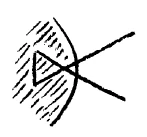
[ 16 ] What follows from this? It follows that I can, for my own purposes, construct in my mind a process entirely modeled on mathematical constructions within the empirical material realm. I know that this process in the eye can certainly be constructed in the same way as anything in a darkroom or the like, in the external mineral-mechanical world. But I also know that this entire field in which I am constructing contains something else as well, which—if I wish to proceed in the same way as I usually do with mathematics in relation to inorganic nature—I can penetrate only through imaginative cognition. But what does that mean? There is something in the human eye that is not present in inorganic nature, and what is present in the human eye—that which is absent in inorganic nature—is recognized as a reality only when one unites with it in the same way that one unites with the inorganic through mathematics. Once this act has been accomplished, one says: one has penetrated as far as the human etheric body. Through imagination, one has grasped the etheric nature of the human being in the same way that one otherwise grasps the inorganic nature outside through mathematics.
[ 17 ] So one can specify in a very precise way how to behave in order to discover the etheric through imagination in a sense organ. It is by no means the case that one arrives at the mental image of a human etheric body in some confused, fanciful way; rather, one arrives at this mental image by first developing the power of imagination and then, using an object suitable for this purpose, demonstrating—first to oneself—that the content of imaginative conception can fuse with the objective just as mathematics otherwise fuses with its object.
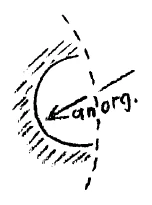
[ 18 ] But what does this imply for the human constitution? It implies that we must allow something that lives within us—the human etheric body—to move forward in a certain way, so that it coincides with what constitutes external, inorganic nature. And what we can say about the eye also applies, albeit in a modified form, to the other senses. We can therefore say: In fact, with one of our senses, we are dealing with a situation where we must first, so to speak, reckon with a kind of cavity—if I may put it crudely—within our organism. —- So, in the case of the eye, the organism would be that which is connected to the eye in the brain and in the facial regions. — Into this organism are incorporated, so to speak, inlets from the external world, if I may put it that way. Just as the sea carries inlets into the land, so the external world carries such inlets into our organism, and this external world simply continues its processes—the processes of the inorganic—within these inlets. There we can reconstruct what takes place as the inorganic. We do not merely construct the inorganic outside the eye; we rightly construct it within the eye. Thus, something splits off within our eye that we can construct in exactly the same way as we construct mathematically in the inorganic realm. But what is now grasped through imagination does indeed coincide with this up to the outer limit of the eye and even beyond—I do not wish to speak of that today. So what flows in, as it were, in a wave from the true nature of the external world, converges here with a component of the human organization that, while not initially composed of flesh and blood, certainly belongs to the human organism and can be recognized and perceived through imaginative perception. In the eye and the other senses, our etheric organization permeates that which flows into these waves from the external world. - There is indeed an encounter between a higher supersensible realm—I will use this term for now; I will explain all of this in greater detail later—and what enters us from the external world; there is truly a confluence between what one might call the etheric organization and what enters us from the outside. We become one with this process in our eye, which we can reconstruct purely geometrically. We truly experience the inorganic within the realm of our senses.
[ 19 ] This is the significant insight to which imaginative cognition initially leads. It certainly leads to the resolution of a problem that is a crux for modern physiology and for what is often referred to as the theory of knowledge, because within physiological and other investigations, one is unaware that there is still an etheric organism present in the human being—one that can only be grasped through imaginative cognition—and that this organism interacts with what the external world actually imposes upon us and completely permeates whatever is imposed upon us. As a result, the entire problem will take on a different aspect. Just imagine if a person were equally capable of projecting their etheric body through a photographic camera; they would then view what takes place in the camera in relation to their own being in much the same way as they view what takes place in the eye in relation to their own being.
[ 20 ] The problems with which serious, anthroposophically oriented Spiritual Science deals are truly not fanciful ones; rather, they are precisely those problems that, if I may use the expression, can cause one to, in a certain sense, bleed to death inwardly if one relies solely on what modern science is able to offer in this field. Anyone who has ever truly experienced in their inner life what one can go through when one truly confronts the soul with the fact that the external world becomes illusory in the act of cognition; anyone who has suffered from the uncertainty that immediately sets in when one attempts, from a purely physical perspective, to comprehend what takes place in the process of sensory perception, anyone who has ever lived through this question of knowledge—only such a person knows what powerful forces draw one toward what I would like to call, and what I will discuss in more detail in the following lectures: the striving for a higher development of the faculty of knowledge.
[ 21 ] Today I spoke of the first stage of this process of imagination, and I did so only to the extent that I wanted to characterize its similarity to—and yet also its difference from—mathematical reasoning. But what is experienced in this way is clearly reflected in those things that confront us as the limits of knowledge in today’s mainstream science. If we truly approach existence and the entire world—insofar as it presents us with mysteries—with inner conscientiousness, if we have recognized just how helpless ordinary logic and ordinary mathematics actually are in the face of what is taking place within us at every moment—when we see, hear, and so on—when we see how helpless we remain with this ordinary cognition in the face of what is actually always present in our waking consciousness—then a deep longing can arise for an expansion and deepening of our cognition. And just as, after all, within our modern culture no one claims to be a researcher in any field other than their own, and simply accepts what the trained researcher presents to them, so too might this apply for a time—though only in a limited sense—to the researcher of the spirit.
[ 22 ] But it must be said again and again that the world has, above all, a right to demand that the spiritual researcher explain how he arrives at his conclusions. He can explain in full detail how he arrives at his conclusions. And when I look back on the way I have tried to explain this to the world—for more than twenty years now, even in purely anthroposophical language—then I think I can safely say: If, for my part, I have not yet succeeded in finding a wider resonance in the world for this anthroposophically oriented Spiritual Science; if it has repeatedly become necessary to speak to those who are less able to delve into the details because they lack scientific training; and if it has been difficult to speak to those with scientific training, then, as experience has shown, this is essentially due to those with scientific training. So far, they have been only very reluctant to listen to what the spiritual researcher has to say about his methods. Let us hope that this may change in the future. For it is absolutely necessary that we achieve an ascent through deeper forces rather than through those who clearly demonstrate that they are incapable of doing so, since they have, in essence, led us into a decline of our culture. More on this tomorrow.