

Naturalistic Observation, Experimentation, Mathematics
and the Stages of Knowledge in Spiritual Science
GA 324
17 March 1921, Stuttgart
Translated by Steiner Online Library
Second Lecture
[ 1 ] As I pointed out yesterday in the introductory lecture, when considering the transition of human cognition from the ordinary perception of the external world to mathematical cognition, the first stage of that path emerges—a path which, when pursued further, leads to an understanding and recognition of the method of Spiritual Science as it is meant here. Indeed, my aim in these lectures will be precisely to characterize and justify the Spiritual Science method. Fundamentally, this can only come to light as a result of what I am to discuss in these seven lectures.
[ 2 ] Today I would like to go into a bit more detail about the first stage. I would like to present to you a line of thought that, even today, perhaps surfaces here and there in fragments within scientific thinking, but which does not exist in its entirety; and because it does not exist in its entirety, it also follows that one is then unable to methodically rise from the transformation of science—still free of mathematics—into mathematical science, and from this transformation to the next, which we shall recognize as arising quite appropriately from it: from the mathematical penetration of objectivity to a Spiritual Science-based penetration of real being. As already indicated, I will attempt, step by step and methodically, to reach this final stage through our examination.
[ 3 ] To this end, we will begin today with a consideration of the human being as he experiences himself in the act of perceiving and observing the external world. You will know from lectures that have been given here, or at least from seminar presentations, and then from reading my book On the Mysteries of the Soul, that a complete and adequate understanding of the human being can only be attained by recognizing how the entire human organism is divided into three distinct parts. We are certainly dealing with a unified human being. But this unified human being functions precisely as the most complex organism known to us, in that it is structured—I would say—into three sub-organizations that possess a certain degree of autonomy; yet it is precisely because they develop everything inherent within them through this autonomy and then, in turn, work together to form a whole that they bring about the concrete unity of the human organization. We are dealing here, first of all, with what I have called in my book On the Riddles of the Soul the “nervous-sensory human”—that part of the human organization which finds its most adequate expression, first and foremost, in the human head, but which from there extends throughout the entire human organization. However, just because such a component of human organization permeates the entire organization, we must not overlook the fact that such an independent component exists. We can make a very precise distinction—and we will have more to say about this later—between the “nervous-sensory human” and the rest of the human organization: the nervous-sensory human is the very mediator of our life of imagination. We are imaginative human beings in that we are capable of mediating to ourselves what constitutes the life of mental images through that organ which can be summarized as the senses and the nervous system extending from the senses into the inner organization.
[ 4 ] We are connected to this nervous system through our emotional life, though not in the same way as through our imaginative life. Only the imprecise psychological approach of recent times causes this to be overlooked. The emotional life is not directly linked to the nervous-sensory system, but only indirectly. Emotional life is directly linked to everything we can call the rhythmic system within the human organism, which finds its fullest expression in breathing, the pulse, and blood circulation. The misconception that our emotional life—as a part of our soul life—is also directly connected to the nervous-sensory system arises from the fact that we constantly accompany everything that takes place within us as human beings on an emotional level with mental images. And just as our emotional life is constantly accompanied by mental images in the soul, so too is our rhythmic system—which, after all, extends throughout the entire organism—organically connected to our nervous-sensory system. The relationship between the rhythmic system and the nervous-sensory system in the body is similar to the relationship in the soul between the emotional life and the life of the imagination. However, our emotional life is expressed indirectly through the nervous-sensory system solely because the experience of feeling—which has the rhythmic system as its instrument within the organism—is mediated within our organism; this rhythmic system then exerts a reciprocal effect on the nervous-sensory system, thereby creating the appearance that the emotional life is also directly connected to the nervous-sensory system. In my book On the Mysteries of the Soul, I drew particular attention to the fact that, for example, when studying what takes place in a person during musical perception, one can quite easily come to understand how this relationship, which I have just characterized, exists in human beings.
[ 5 ] In addition to these two systems—the nervous-sensory system, which mediates the life of the imagination, and the rhythmic system, which mediates the life of feeling—we also have the metabolic system. And in these three systems—the nervous-sensory system, the rhythmic system, and the metabolic system—we have fully accounted for all the functional aspects of the human organism. The metabolic system corresponds directly to the soul life of volition, and a true study of the connection between volition and the human organism will only come about when one approaches the matter by investigating what the metabolic process is like when an act of volition—or even just a volitional impulse—takes place. Every metabolic process is, in fact—whether consciously or unconsciously—the physical basis of an act of will or a volitional impulse. Our movements are also connected to metabolism, and because our movements are linked to our metabolism, our physical mobility is in turn connected, on a psychological level, to the exercise of the will. One must be clear about the fact that when we perform a movement in space, this is, I would say, the most primitive act of the will. But—to use this phrase of Goethe’s—in a primordial act of the will, it is precisely that metabolic process underlying a movement within us that serves, as such, as the physical expression of the psychological aspect of an act of the will. And it is only because we, in turn, trace our acts of will through imagination that these acts of will are now also indirectly connected to the nervous-sensory system. Thus, I would like to say this first by way of introduction, we can view the psychological life and also the physical life of the human being as a kind of structure divided into three independent organic and psychological components.
[ 6 ] Today we will try to examine, from a certain point of view and with reference to the observing human being, how these three aspects of the human physical and psychological organization relate to one another. Above all, I would like to present to you the concept of the dimensionality of space. We must delve into these—I would say—more precise, more meticulous matters, because these lectures are intended precisely to demonstrate how Spiritual Science observation is a continuation of ordinary scientific observation. We will first consider what I have called the nervous-sensory organism. This nervous-sensory organism is, as I have already said, contained primarily in the head organization of the human being, and from the head organization—which essentially contains the nervous-sensory human being—the nervous-sensory life then extends throughout the rest of the human organism, permeating it, so to speak. One could say that, from a perspective that does not take the human being from the outside, the head extends throughout the entire human being. If, for example, we have extended the perception of warmth throughout the entire organism within the sensory organization, this means nothing other than that the type of organization which is located mainly in the head for the most important part of sensory life now extends throughout the entire human organism for this specific aspect of the sensation of warmth, so that, in a certain sense with regard to the perception of warmth, the whole human being is head.
[ 7 ] You see, people today take this line of reasoning extremely badly. For they have become so accustomed to external perspectives that they believe when speaking of the three members of the human organism, one must be able to place them side by side in a completely spatially separate manner; and a professor of anatomy who strove for such spatial separation even went so far as to say that, according to anthroposophy, the human being is divided into a head system, a chest system, and an abdominal system. Well, yes, one can attack anthroposophy in an unobjective way with such arguments. But that is certainly not the point; rather, the point is to address these matters properly and to come to understand that, in reality, things are not as spatially separate as is often the case in an amateurish mental image, but that they interlock and and flow into one another—which must be taken into account in particular if one wishes to correctly understand the interplay of the three members of the threefold social organism.
[ 8 ] Well, the mental organization is certainly the one that—as the purely empirical facts show—has the most to do with cognition, at least with mathematical cognition, which first approaches human beings in the external world. With regard to this mental organization, we can now state purely empirically that what we might call dimensionality presents itself to us—I would say—at first only as a fleeting impression. We will best understand what is at stake here if we consider three modes of human activity; the first is what I would like to call the total act of seeing—that is, seeing and observing the world with the eyes. But, as you will soon see, this refers to the total act of seeing, namely, the observation of external objects with our two eyes. Second, although the human arms and hands are attached to the torso and, in a certain sense, are certainly part of the limb system, they also have an intimate relationship with the rhythmic system. Due to their specific attachment near the rhythmic system, they are, so to speak, transformed by life, by the functional aspects of the human being. As limbs, they are adapted to that life which we might call the rhythmic life, and because the arms and hands are located on the outside, we can use them to clarify many things that we might not be able to clarify so easily by looking at the inner parts of the rhythmic system. So, to be clear: the point is that while our arms and hands are indeed limbs, these limbs—because of their specific position within the human organism—are, I would say, adapted to the rhythmic through life itself, through their functional nature. You can trace this rhythmic quality in the arms and hands if you consider how strongly what we feel—that is, what is connected to the rhythmic system—is expressed in gesture and in the free mobility of the arms and hands. In human life, these limbs are, I would say, elevated by an entire level of experience. . They are constituted as limbs, but are by no means put to the same service as in animals—where the limbs simply serve a function—but are liberated from the service of limb life and become, I would say, as if in an invisible language, an expression of human emotional life; they are thus adapted to the rhythmic system. As a third function, I would like to present to you what we can regard as walking—that is, an activity carried out, in the most eminent sense, by the human limb system.
[ 9 ] Seeing, arm movement, and walking—let us now examine them in a truly scientific manner. Seeing with both eyes: When considered in its totality, one realizes that, at first—completely independent of any mental activity—what we see presents itself to us in two dimensions. If I want to illustrate the dimensionality of what we see, I can simply draw the two dimensions here on the board (see drawing) as two perpendicular coordinate axes. I would like to draw them in such a way that they correspond to later derivations, by drawing the two lines as dotted lines. By drawing the two lines as dotted lines, I wish to express that, in fact, this two-dimensionality is not actually taken up by our conscious mind when we see.
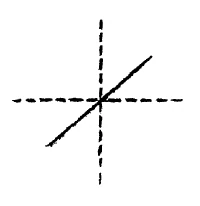
[ 10 ] The situation is different, however, with the third dimension. The third dimension—which we can call the depth dimension, that is, depth as seen from our eyes, the dimension that extends from back to front—does not stand ready before our soul in the same sense, entirely independent of our intellect, for example. It stands before us as that which we accomplish as an inner mental operation when we supplement things—which are otherwise perceived as two-dimensional—with physicality through the depth dimension. What we carry out there, however, eludes our conscious activity in a rather crude way. However, if one examines conscious activity in a more subtle way, one will certainly come to realize that one experiences this depth dimension differently from the other two—which I shall call the height and width dimensions. One can already become aware of how, in a certain way, one estimates—with regard to this depth dimension—how far something is from us. Something is added to ordinary perception—to visual perception—when we supplement the two-dimensionality of the plane in our consciousness with three-dimensionality, so that we can say: As long as we remain within our consciousness, we cannot say how the dimensions of height and width come about. We must simply accept the dimensions of height and width. They are simply given in visual perception. This is not the case with the dimension of depth—that is, the third dimension. I therefore draw it here in perspective as a solid line, by which I wish to indicate that this solid line, as the depth dimension, is already based on an activity that at least faintly enters into consciousness—on a conscious, or let us say, semi-conscious activity—so that we can say: When we consider the act of seeing, the dimensions of height and width are initially given to us purely intellectually—that is, only when we intellectually penetrate the act of seeing. The dimension of depth, however, is already based on an activity of consciousness, on a semi-conscious mental operation. Therefore, as you may have already heard, the anatomical-physiological interpretation of the total act of seeing must proceed in such a way that it actually attributes to seeing alone—that is, to what seeing is even without intellectual activity—the emergence of the perceived spatial extent. In contrast, it must attribute to the activity of the cerebrum—that is, no longer to the activity of the four hills, that organ in the human body on which the visual activity of the eyes depends, nor to the physical behavior involved in seeing—the physical aspects of vision; rather, with regard to the depth dimension, the anatomical-physiological aspects must be attributed to the cerebrum, which also mediates volitional mental operations. We can already, in a certain sense—albeit, I would say, only faintly grasped by consciousness—treat the depth dimension synthetically and analytically. It belongs to the realm of what I would like to call conscious activity through the human head.
[ 11 ] When we now move from the act of seeing to the act that arises from the activity involved in the movement of the arms and hands, we are entering into an element that is, admittedly, still difficult to grasp with our consciousness. But we can at least become aware of what is taking place by observing our emotional life as it unfolds through the free movement of our arms and hands and our gestures; here, too, we can become aware of what a human being actually does, just as we become aware of the activity related to the dimension of depth through the two human eyes. What, then, is it that this dimension of depth actually conveys to us? It is the alignment of the left and right eyes. It is the crossing of the left and right visual axes. Whether this crossing takes place at a greater or lesser distance from ourselves determines our intellectual assessment of depth. The process that actually underlies the perception of this depth dimension is not readily apparent from the outside.
[ 12 ] If we now turn to the movement of the human arms and hands, we find that we can indeed already distinguish quite clearly—even with only a moderate effort of our consciousness—that when we move our arms in a horizontal circle, we can clearly distinguish how this arm movement consciously unfolds in the right-left dimension, that is, in the dimension I would like to call the width dimension. Anyone capable of analyzing human life more closely will know that everything a person judges in relation to this width dimension is, in fact, connected to the feeling we have when we recognize ourselves as a human being who spans the full width dimension with a left and a right arm. We have an emotional experience of what we call symmetry, an experience that takes place primarily in the breadth dimension. We have such an experience above all through the sensation conveyed to us by our left and right arms. However, this sense of our own symmetry is primarily expressed through the corresponding movements of the left and right arms that we feel, so that we experience symmetry in this coordinated movement of the left and right arms. Our sensory perception of the horizontal dimension—primarily through symmetry—translates into our imaginative life, and we then assess symmetry within that imaginative life as well. Yet you cannot fail to see that this evaluation of the symmetries of the horizontal dimension is, in essence, something secondary; and anyone who could merely look at what is symmetrical without feeling anything in the symmetry—in the correspondence of the symmetrical left to the symmetrical right—would experience symmetry as something pale, dry, sober, and purely intellectual. The person who can truly feel symmetry is the one who lives fully within all that symmetry has to say to us. But as human beings, we can only feel symmetry by quietly becoming aware of the interconnectedness of the movements of the left and right arms, or the left and right hands. Everything we can experience in relation to the horizontal dimension is actually based on what we experience there on an emotional level.
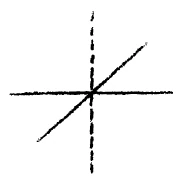
[ 13 ] But even what we previously referred to as the “depth dimension” in relation to the act of seeing becomes, in a certain sense, conscious to us through something that also comes about through our arms. Just as we cross our lines of sight, we also cross our arms, and I would say that crossing our arms is, in a sense, a more tangible expression of the act of seeing. It is precisely through the succession of points we perceive when we cross our arms that we can immerse ourselves in what the depth dimension is, so that when we fully experience what we have in the arrangement of our arms, we certainly do not have the second dimension—the width dimension—fully before us, as we do in the act of seeing; rather, if we wish to symbolically express what arises in terms of dimensionality within the arm and hand organism, I would have to draw it like this: the width dimension, the depth dimension (fully extended lines). And only the height dimension is fully present for what I experience through my arm system (dotted line). As we perform our gestures—as we, so to speak, consciously traverse with our gestures the plane composed of the depth and width dimensions—the height dimension, the third dimension, remains entirely in the unconscious. When does this third dimension actually enter clear consciousness? It enters clear consciousness only when we walk. When we move from one place to another, the line that lies in this third dimension—the height dimension—is constantly changing; and even though intellectual consciousness of this third dimension is exceptionally faint while walking, we cannot overlook the fact that taking this third dimension into account is, in fact, a semi-conscious part of the intellectual process. Certainly, in our coarse, external consciousness, we do not take into account the change in this line in the vertical dimension. But by walking at all and developing walking as an act of will, we are constantly altering this line in the height dimension, and we must tell ourselves: What takes place in this third dimension for walking is just as faintly conscious as what takes place in the depth dimension is for the act of seeing. So if we now want to depict the dimensionality of what happens with the aid of the actual limb organ—which is adapted to nothing other than limb activity—if we study the dimensionality of the act of walking, which is tied to the legs and feet, then we will be able to say: in there, with this joint, we intellectually perceive an activity within all three dimensions, so that I must then draw the joint with three solid lines.
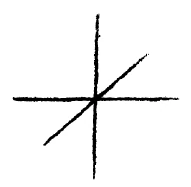
[ 14 ] So we experience—if you look back at what I have said, you will gain a clear awareness of this in the act of seeing, which belongs to a very marked degree to the organization of the head—a fully developed two-dimensionality and an activity aimed at creating the third dimension, depth. In what we have termed the rhythmic system—the movement of the arms and hands—we experience dimensionality in such a way that, in our own action, we fully experience two dimensions, while the third dimension stands just as fully formed in our consciousness as the two dimensions that form a surface do for the head organization in the act of seeing. It is only in the actual limb organism—which thus belongs to the third system, the human metabolic system (which we recognize only when we study the metabolic processes accompanying walking)—that everything which traverses space in its three dimensions is revealed to us.
[ 15 ] Now all you need to do is consider the following, and you will arrive at something extraordinarily important. Everything contained in our imaginative life is, in essence, the sole content of our full waking consciousness. But what is contained in our emotional life does not enter our consciousness with the same distinctness, with the same luminous clarity. As we proceed with these reflections, we will see how actual feelings have no greater intensity in consciousness than dreams do; and just as dreams are then reproduced by daily life—by the fully awakened life of imagination—thereby becoming clear mental images and thus entering into clear consciousness, so too are feelings in waking daily life continually accompanied by the images that express them. As a result, our feelings—which otherwise occur only with the intensity of dream life—are drawn into the clear, bright consciousness of the life of the imagination.
[ 16 ] The actual movements of the will, by their very nature, remain entirely in the subconscious. How do we actually know anything about the will? Strictly speaking, we know nothing about the will itself—in terms of its essential nature—in ordinary cognition, and this is, I would say, also documented and explicitly stated in a psychology such as that of Theodor Ziehen, who, in his Physiological Psychology, essentially speaks only of the life of the imagination. However, the fact that he is unaware of—the one I have just demonstrated to you—namely, that the emotional life is actually bound to the rhythmic organism and merely radiates into the life of imagination—Theodor Ziehen expresses this abstractly by saying: “Actually, as psychologists, we can only observe the life of imagination and find certain mental images to be emotionally charged.” — So, in a sense, emotions would be merely properties of the life of the imagination. All of this stems precisely from the fact that such a psychologist fails to grasp the actual human organization, which behaves exactly as I have just described. Because they are bound to the rhythmic organism, emotions remain in the semi-conscious state of dreaming, while the true nature of acts of will remains entirely in the unconscious. For this reason, they are no longer described at all by ordinary psychologists. If you read Theodor Zieh’s peculiar remarks on volitional activity, you will see that the inner workings of the will—we will come to discuss what they are like—completely elude the observational capacity of these psychologists. In external observation, we have nothing other than what we can see: the result of an act of will. We do not know the inner process that has taken place when a volitional impulse moves our arm. We only see the arm moving; thus, we observe the external fact after the fact. In this way, we accompany the manifestations of our will with mental images, and thereby we regard them—which are otherwise mediated purely organically through the metabolic system and the associated limb system—as also connected to the realm of mental imagery.
[ 17 ] But it is only in this part of the human organism—the metabolic system, which thus physically corresponds to the psychological aspect of the act of will—that three-dimensionality reveals itself to us; it is therefore intimately connected with a human system whose activity takes place essentially unconsciously. This three-dimensionality, in its true reality, cannot actually be accessible to ordinary cognition. As we shall see, it can only be revealed when we look into our life of the will with the same luminous clarity as we otherwise look into our life of imagination. This cannot be achieved through ordinary cognition, but, as we shall see, only through Spiritual Science cognition. Yet it is upon this—upon the total activity of the human being, upon everything that lives in his limb and metabolic systems—that three-dimensionality rests as an experience in the subconscious. And what happens? It is lifted up from the subconscious, first from the sphere of will and limbs into the rhythmic sphere. There it is then experienced only as two-dimensionality, and the third dimension—which is still directly experienced in its reality within the activity of the will—this third dimension, the dimension of height, has already become abstract.
[ 18 ] Here, in human organization, you see reality becoming abstract through human activity itself. You experience this higher dimension in the subconscious. Through human organization, this higher dimension already becomes abstract—a mere drawn line, a mere thought within the rhythmic organization. And in the nervous-sensory organization, what happens there? The two dimensions become abstract. They are no longer experienced. They can only be thought of by the intellect, which approaches the matter after the fact, so that in the organ of our actual, ordinary cognition—the head—we have only the possibility of expressing the two dimensions abstractly through the intellect. Only of the third—the dimension of depth—do we, I would say, still have a faint awareness even in our heads. So you see, because we have this faint awareness of the dimension of depth in our heads, we are still able to know anything at all in ordinary consciousness about the reality of the dimensions. If, due to our organization, this dimension of depth—which we can actually study properly only through the act of seeing—were treated just as abstractly, then we would have only three abstract lines. We would not even think to seek realities for these three abstract lines.
[ 19 ] With this, I have drawn your attention to reality—to the actual state of affairs—regarding what emerges in Kantianism in a manner that is at odds with reality. It is claimed there that space, with its three dimensions, is contained a priori in the human constitution, and that the human constitution actually projects its subjective experiences into space. Why did Kant arrive at this one-sided view? He did so because he did not know that what we experience only as a faint hint of the depth dimension through the nervous-sensory system—but otherwise experience abstractly—is actually experienced in reality within the subconscious, then brought up into consciousness, and thereby reduced to abstraction until only this small remnant of the depth dimension remains. We experience three-dimensionality through our own human constitution. It exists in reality within the system of the will and, physiologically and physically, within the metabolic-limb system. It is initially unconscious to ordinary consciousness and becomes conscious to this ordinary consciousness only in the abstract nature of mathematical-geometric space.
[ 20 ] I wanted to give you an example, first of all, of the way in which Spiritual Science can address human activity—how it does not remain at the level of abstractions, such as the a priori concepts of space and time in the Kantian sense, but rather how it truly and concretely engages with human reality and thereby arrives at an understanding of how things actually relate within the human being. I wanted to give you this particular example because, as I will explain further, this example of the true meaning of space now leads us to a more precise understanding of the nature of mathematics in all its aspects.
[ 21 ] More on that tomorrow.