

The Emergence of Natural Science
in World History
and its Subsequent Development
GA 326
26 December 1922, Dornach
Translate the original German text into any language:
Versions Available:
The Emergence of Natural Science, tr. SOL
Dritter Vortrag
Third Lecture
[ 1 ] Es ist von mir versucht worden, in den beiden letzten Betrachtungen den Zeitpunkt anzudeuten, in dem innerhalb der neueren Menschheitsentwickelung naturwissenschaftliche Anschauung und naturwissenschaftliches Denken, wie wir es heute verstehen, entstanden ist, und ich konnte gestern darauf hinweisen, daß der ganze Charakter dieses naturwissenschaftlichen Denkens, wie er zuerst am deutlichsten hervortritt in der Auffassung der Astronomie durch Kopernikus, daß dieser ganze Charakter des naturwissenschaftlichen Denkens abhängig ist von der Art, wie man allmählich im Laufe der Menschheitsentwickelung die Mathematik, das mathematische Denken in ein Verhältnis brachte zur äußeren Weltwirklichkeit. In der Tat hängt außerordentlich viel für die wissenschaftliche Entwickelung der neueren Zeit davon ab, daß auch in bezug auf das mathematische Denken selber ein Umschwung — man möchte fast sagen: eine Revolution — der menschlichen Anschauung eingetreten ist. In der Gegenwart ist man ja so sehr geneigt, die Art und Weise, wie man selber denkt in dieser Gegenwart, gewissermaßen als etwas absolut Geltendes hinzustellen, und gar nicht das Augenmerk darauf zu richten, wie sich die Dinge verändert haben. Man hat heute eine gewisse Stellung zur Mathematik und wiederum eine gewisse Anschauung über das Verhältnis des Mathematischen zu dem Weltwirklichen. Und man denkt, das sei eben einmal das Gegebene, das richtige Verhältnis. Gewiß, man diskutiert darüber, aber innerhalb gewisser Grenzen betrachtet man das als das richtige Verhältnis und denkt nicht daran, in welch einer uns eigentlich gar nicht so besonders ferne liegenden Vergangenheit über die Mathematik selber von der Menschheit anders empfunden worden ist. Man brauchte sich nur einmal mit einer genügenden Schärfe daran zu erinnern, wie auch nicht lange nach jenem Zeitpunkt, den ich als den bedeutungsvollsten des neueren Geisteslebens bezeichnet habe, bald nach diesem Zeitpunkt, in dem der Kusaner seine bedeutungsvollen Auseinandersetzungen der Welt gegeben hat, wie bald nach diesem Zeitpunkte nicht nur Kopernikus mit einem mathematisch orientierten Denken die Bewegungen des Sonnensystems erklären wollte, mit einem schon so mathematisch orientierten Denken, wie wir es auch heute gewöhnt sind, sondern wie auch Philosophen — Cartesius, Spinoza — geradezu ihr Ideal darinnen gesehen haben, die Art und Weise, wie man in der Mathematik denkt, auf das umfassendste Darstellen des ganzen physischen und geistigen Weltengebäudes anzuwenden.
[ 1 ] In my last two reflections, I have attempted to indicate the point in time during the recent development of humanity when the scientific worldview and scientific thinking, as we understand them today, emerged, and yesterday I was able to point out that the entire character of this scientific thinking—as it first emerged most clearly in Copernicus’s conception of astronomy—depends on the way in which, over the course of human development, mathematics and mathematical thinking were gradually brought into relation with the reality of the external world. In fact, an extraordinarily large part of modern scientific development depends on the fact that, even with regard to mathematical thinking itself, a shift—one might almost say a revolution—in human perception has taken place. Nowadays, people are so inclined to present the way they themselves think—in the present—as something absolutely valid, so to speak, and to pay no attention at all to how things have changed. Today, people hold a certain view of mathematics and, in turn, a certain conception of the relationship between the mathematical and the reality of the world. And they think that this is simply the given, the correct relationship. Certainly, people discuss it, but within certain limits they regard it as the correct relationship and do not consider how, in a past that is actually not all that distant from us, humanity perceived mathematics itself quite differently. One need only recall with sufficient clarity how, not long after that moment—which I have described as the most significant in recent intellectual life—shortly after that moment when Nicholas of Cusa presented his momentous arguments to the world, how soon after that moment not only did Copernicus seek to explain the movements of the solar system with a mathematically oriented way of thinking, with a mode of thinking already as mathematically oriented as we are accustomed to today, but how philosophers—Descartes, Spinoza—also saw it as their very ideal to apply the way of thinking used in mathematics to the most comprehensive description of the entire physical and spiritual structure of the world.
[ 2 ] Spinoza, der Philosoph, legte einen besonderen Wert darauf, seine philosophischen Grundsätze und Forderungen selbst in einem solchen Buche, wie in seiner «Ethik» so darzustellen, daß, wenn auch nicht mathematische Formeln, wenn auch nicht Rechnungen in diesem Buche eine besondere Rolle spielen, eben doch die Art des Schließens, die Art, spätere Gesetze aus früheren herzuleiten, nach dem Muster des Mathematischen geschehe. Das war nach und nach den Zeitgenossen wie etwas Selbstverständliches erschienen, daß man in der Mathematik ein Musterbild für die Erlangung innerer Gewißheit in sich selber trage, und daß, wenn es gelinge, den Weltenverlauf durch Gedanken so auszudrücken, daß diese Gedanken in der haarscharfen Architektonik aneinandergegliedert sind, wie die Gedanken des mathematischen, des geometrischen Systems, daß man dadurch eben etwas erreiche, was der Wirklichkeit entsprechen müsse. Aber die besondere Art, wie man sich zur Mathematik und zum Verhältnis der Mathematik zur Wirklichkeit stellt, die muß, wenn man den Charakter naturwissenschaftlichen Denkens richtig erfassen will, durchaus verstanden werden. Die Mathematik war in jener Zeit allmählich das geworden, was man im Verhältnis zu etwas Früherem, das ich gleich nachher charakterisieren werde, nennen könnte: ein sich selbst genugsames inneres Denkvermögen. Was meine ich damit?
[ 2 ] Spinoza, the philosopher, placed particular emphasis on presenting his philosophical principles and propositions—even in a book such as his *Ethics*—in such a way that, although mathematical formulas and calculations do not play a special role in this book, the method of reasoning—the way of deriving later propositions from earlier ones—follows the pattern of mathematics. Gradually, it had come to seem self-evident to his contemporaries that mathematics provided a model for attaining inner certainty within oneself, and that, if one succeeds in expressing the course of the world through thoughts in such a way that these thoughts are linked together in a meticulously precise architectural structure—like the thoughts of a mathematical or geometric system—one thereby achieves something that must correspond to reality. But the particular way in which one approaches mathematics and the relationship of mathematics to reality—this must be fully understood if one wishes to grasp the nature of scientific thinking correctly. Mathematics had gradually become, in that era, what one might call—in relation to something earlier, which I will characterize shortly—a self-sufficient, inner capacity for thought. What do I mean by this?
[ 3 ] Man kann schon sagen, daß man die Mathematik für die Zeit des Descartes, des Cartesius, für die Zeit des Kopernikus so charakterisieren kann, wie man das annähernd auch noch heute kann. Nehmen wir zum Beispiel einmal den heutigen Mathematiker, der Geometrie darstellt, der innerhalb der geometrischen Vorstellungswelt ja auch seine analytischen Formeln sucht, um diese oder jene physikalischen Vorgänge zu begreifen. Dieser Mathematiker geht als Geometer, zunächst in der Auffassung der euklidischen Geometrie, von dem dreidimensionalen Raume aus oder überhaupt von dem dimensionalen Raum, wenn man etwa auch auf die nichteuklidische Geometrie Rücksicht nehmen wollte, und er unterscheidet im dreidimensionalen Raum drei aufeinander senkrecht stehende, aber im übrigen gleichartige Richtungen. Es ist der Raum, ich möchte sagen, ein sich selbst genügendes Gebilde, das einfach so, wie ich es jetzt beschrieben habe, vor das Bewußtsein hingestellt wird, ohne daß viel gefragt wird: Woher kommt dieses Gebilde, woher kommt überhaupt das ganze geometrische Vorstellen? — Bei der Äußerlichkeit, welche in der neueren Zeit das psychologische Denken allmählich angenommen hat, war es auch natürlich, daß der Mensch nicht in jene Seelentiefen, überhaupt nicht in jene inneren Tiefen hinuntersteigen konnte, aus denen die Grundlagen zum Beispiel des geometrischen Denkens heraufkommen. Der Mensch nimmt einfach sein gewöhnliches Bewußtsein hin und erfüllt dieses gewöhnliche Bewußtsein mit der erdachten, aber nicht erlebten Mathematik. Nehmen wir es im speziellen Fall mit den erdachten, nicht erlebten, drei aufeinander senkrecht stehenden Dimensionen des euklidischen Raumes. Aber niemals wäre der Mensch zu jenem Erdenken der drei aufeinander senkrecht stehenden Dimensionen des euklidischen Raumes gekommen, wenn er nicht in sich erlebte eine dreifache Orientierung.
[ 3 ] One could certainly say that mathematics in the time of Descartes, or Cartesius, and in the time of Copernicus can be characterized in much the same way as it can be today. Take, for example, a mathematician today who deals with geometry and who, within the conceptual framework of geometry, seeks analytical formulas to understand this or that physical process. As a geometer—initially within the framework of Euclidean geometry—this mathematician takes as his starting point three-dimensional space, or more generally, dimensional space, if one were to take non-Euclidean geometry into account as well; and within three-dimensional space, he distinguishes three directions that are perpendicular to one another but otherwise identical. Space is, I would say, a self-sufficient entity that is simply presented to consciousness just as I have now described it, without much inquiry: Where does this entity come from, where does the entire concept of geometry come from at all? — Given the external focus that psychological thought has gradually adopted in recent times, it was also natural that human beings could not descend into those depths of the soul—let alone into those inner depths—from which the foundations of, for example, geometric thought arise. People simply accept their ordinary consciousness and fill this ordinary consciousness with mathematics that is conceived but not experienced. Let us take, as a specific example, the conceived—but not experienced—three mutually perpendicular dimensions of Euclidean space. But human beings would never have arrived at this conception of the three mutually perpendicular dimensions of Euclidean space if they had not experienced within themselves a threefold orientation.
[ 4 ] Die eine Orientierung, die der Mensch in sich erlebt, ist von vorne nach rückwärts. Wir brauchen nur daran zu denken, wie sich in der äußerlichen heutigen anatomisch-physiologischen Betrachtungsweise für den Menschen — ich spreche dabei nur vom Menschen, nicht von den Tieren, das ist in diesem Zusammenhange nicht notwendig —, wie sich für den Menschen, sagen wir zum Beispiel die Nahrungsaufnahme, das Absondern und auch sonstige Vorgänge des Organismus in der Richtung von vorn nach hinten abspielen, und wie diese Orientierung ganz bestimmter Vorgänge im Inneren des Menschen verschieden ist von dem, wenn ich zum Beispiel irgend etwas ausführe mit meinem rechten Arm, und dazu symmetrisch etwas ausführe mit meinem linken Arm. Da sind die Vorgänge orientiert nach rechts und links. Und endlich brauchen wir uns nur zu erinnern, wie mit Bezug auf eine andere Orientierung der Mensch eigentlich erst während seines Erdendaseins in diese hineinwächst: Er kriecht im Anfange und richtet sich allmählich erst so auf, daß eine Orientierung in ihm selber von oben nach unten oder von unten nach oben fließt.
[ 4 ] The one orientation that a person experiences within themselves is from front to back. We need only consider how, in today’s external anatomical and physiological view of the human being—I am speaking here only of humans, not of animals, as that is not necessary in this context—how, for humans, let us say, for example, the intake of food, excretion, and other processes of the organism take place in the direction from front to back, and how this orientation of very specific processes within the human being differs from, say, when I perform an action with my right arm and, symmetrically, perform a corresponding action with my left arm. In that case, the processes are oriented to the right and left. And finally, we need only recall how, with regard to another orientation, human beings actually grow into it only during their earthly existence: At first they crawl, and only gradually do they straighten up in such a way that an orientation flows within them from top to bottom or from bottom to top.
[ 5 ] So wie die Dinge heute stehen, nimmt man diese drei Orientierungen des Menschen recht äußerlich hin, indem man ja nicht innerlich erlebt, sondern von außen anschaut, was Vorgänge im menschlichen Organismus sind, die sich im wesentlichen von vorn nach hinten, oder solche, die sich von rechts nach links oder von links nach rechts, oder solche, die sich von oben nach unten abspielen. Könnte man seelenbetrachtend in frühere Zeitalter zurückgehen mit einer wirklichen Psychologie, so würde man eben wissen, daß für eine ältere Menschenempfindung, ein älteres Menschenerleben diese drei Orientierungen innere Erlebnisse waren. So wie wir heute als innere Erlebnisse, ich möchte sagen, halbwegs noch anerkennen das Gedanken-Haben, Gefühle-Haben, so hatte der Mensch einer früheren Zeit ein richtiges inneres Erlebnis zum Beispiel von dem Von-vorn-nach-Hinten. Für ihn war noch nicht verlorengegangen, sagen wir, die Ablähmung des vorne in der Mundhöhle sich intensiv entwickelnden Geschmacks gegen hinten zu. Das Qualitative, das darinnen lag, daß man den Geschmack intensiv vorne auf der Zunge fühlte, und dann ihn immer schwächer und schwächer empfand, indem er sich zurückzog in der Orientierung von vorne nach hinten und endlich sich ganz verlor, dieses Erleben war einmal für das innere menschliche Erleben etwas ganz Reales, Konkretes. Man verfolgte mit solchen Qualitätserlebnissen die Orientierung von vorne nach hinten. Der Mensch ist eben nicht mehr so innerlich, wie er einmal war. Daher hat er solche Erlebnisse, wie ich sie eben charakterisiert habe, heute nicht mehr. Ebensowenig hat der Mensch heute eine lebendige Empfindung von der Einstellung der Augenachse, um irgendeinen Punkt durch das Übergreifen der rechten Augenachse über die linke zu fixieren. Ebensowenig hat der Mensch heute eine voll konkrete Empfindung von dem, was ihm wird als Mensch, wenn er in der Orientierung rechts-links zuordnet, sagen wir, den rechten Arm und die rechte Hand dem linken Arm und der linken Hand. Und erst recht eine solche Empfindung wie die, daß man sich sagen kann: Im Haupte durchleuchtet mich der Gedanke, er schlägt ein, indem er sich in der Orientierung von oben nach unten bewegt in mein Herz —, eine solche Empfindung, ein solches Erlebnis ist eben mit der Innerlichkeit des Welterlebens für den Menschen verlorengegangen. Aber ein solches Erleben war da. Der Mensch hat zunächst in sich die drei aufeinander senkrecht stehenden Raumorientierungen erlebt. Und diese drei Raumorientierungen, sein Rechts-Links, sein Vorne-Hinten, sein Oben-Unten, die sind die Grundlage des dreidimensionalen Raumschemas. Das dreidimensionale Raumschema ist erst eine Abstraktion dieses Ihnen eben charakterisierten unmittelbaren Erlebens. Wie können wir also sprechen, etwa wenn wir auf ältere Zeiten hinschauen zu der Geometrie, zu diesem Teil der Mathematik? Wir können so sprechen, daß wir sagen, der Mensch früherer Zeiten war sich klar darüber, daß er sich sagen konnte: Durch meine Menschlichkeit offenbart sich mir in meinem eigenen Leben das Mathematische, das Geometrische, und indem ich verlängere mein Oben-Unten, mein RechtsLinks, mein Vorne-Hinten, umfasse ich von mir aus die Welt.
[ 5 ] As things stand today, these three orientations of the human being are accepted in a rather superficial way, since one does not experience them inwardly but rather observes from the outside the processes within the human organism—those that essentially proceed from front to back, those that proceed from right to left or from left to right, and those that proceed from top to bottom. If one could look back into earlier ages with a true psychology, observing the soul, one would know that for an older human sensibility, an older human experience, these three orientations were inner experiences. Just as we today still recognize, to some extent, having thoughts and having feelings as inner experiences—so, too, did people of earlier times have a genuine inner experience, for example, of the “front-to-back” direction. For them, the sensation of taste—which developed intensely at the front of the oral cavity and gradually diminished toward the back—had not yet been lost. The qualitative aspect—the fact that one felt the taste intensely at the front of the tongue and then perceived it growing weaker and weaker as it receded in the direction from front to back, until it was finally lost entirely—this experience was once something quite real and concrete in human inner life. People used such qualitative experiences to follow the path from front to back. Human beings are simply no longer as inwardly attuned as they once were. That is why they no longer have experiences such as the ones I have just described. Nor do people today have a vivid sense of the alignment of the eye axes in order to fix their gaze on any given point by crossing the right eye axis over the left. Nor do people today have a fully concrete sense of what it means to them as human beings when, in orienting themselves from right to left, they align, say, the right arm and right hand with the left arm and left hand. And certainly not a sensation such as the one where one can say to oneself: “The thought shines through my head; it strikes me as it moves from top to bottom into my heart”—such a sensation, such an experience, has simply been lost to human beings along with the inner nature of their experience of the world. But such an experience did exist. Human beings initially experienced within themselves the three spatial orientations that are perpendicular to one another. And these three spatial orientations—right and left, front and back, up and down—form the basis of the three-dimensional spatial schema. The three-dimensional spatial schema is merely an abstraction of this immediate experience I have just described to you. How, then, can we speak—for example, when we look back to earlier times at geometry, at this branch of mathematics? We can speak in such a way that we say: People of earlier times were clearly aware that they could say to themselves: Through my humanity, the mathematical and the geometric reveal themselves to me in my own life, and by extending my up-down, my right-left, and my front-back, I encompass the world from within myself.
[ 6 ] Man muß nur einmal empfinden, was für ein gewaltiger Unterschied besteht zwischen dieser an das menschliche Erleben gebundene mathematischen Empfindung und dem kahlen, öden mathematischen Raumschema der analytischen Geometrie, die irgendwohin in einen abstrakten Raum einen Punkt stellt, drei aufeinander senkrechte Koordinatenachsen zieht und das erdachte Raumschema von allem Erleben abgesondert hat. Aber dieses erdachte Raumschema hat sich der Mensch erst aus seinem eigenen Innenleben herausgerissen. So daß man tatsächlich die Entstehung der späteren mathematischen Anschauungsweise, die dann die Naturwissenschaft ergriffen hat, wenn man sie richtig verstehen will in ihrem selbstgenugsamen Hinstellen ihrer Gebilde, daß man sie ableiten muß aus der erlebten Mathematik einer früheren Zeit. Die Mathematik einer früheren Zeit war eben etwas ganz anderes. Und dasjenige, was einmal vorhanden war in einem, ich möchte sagen, traumhaften Erleben der inneren Dreidimensionalität und was sich dann verabstrahiert hat, das ist heute völlig im Unbewußten vorhanden. In der Tat ist es auch heute beim Menschen noch so, daß er sich die Mathematik aus seiner eigenen inneren Dreidimensionalität herausholt. Aber dieses Herausholen des Raumschemas aus demjenigen, was der Mensch an innerer Orientierung erlebt, geschieht auf völlig unbewußte Weise. Davon kommt nichts ins Bewußtsein herauf. Ins Bewußtsein kommt herauf zum Beispiel das fertige Raumschema, wie überhaupt alle fertigen, von ihrer Wurzel abgelösten mathematischen Gebilde. Ich habe das Beispiel des Raumschemas gewählt. Ich könnte ebensogut irgendeine andere mathematische Kategorie anführen, auch noch mathematische Kategorien aus der Algebra, aus der Analysis, aus der Arithmetik. Sie sind nichts anderes, als aus unmittelbarem menschlichem Erleben ins Abstrakte heraufgeholte Schemata.
[ 6 ] One need only realize for a moment what an enormous difference there is between this mathematical intuition, which is bound to human experience, and the barren, desolate mathematical spatial schema of analytical geometry, which places a point somewhere in an abstract space, draws three mutually perpendicular coordinate axes, and has separated this imagined spatial schema from all experience. But humans first tore this imagined spatial framework away from their own inner life. So that, if one wishes to understand correctly the emergence of the later mathematical perspective—which then took hold of the natural sciences in its self-sufficient presentation of its constructs—one must derive it from the lived mathematics of an earlier time. The mathematics of an earlier time was, in fact, something entirely different. And that which once existed in, I might say, a dreamlike experience of inner three-dimensionality—and which then became abstracted—is today entirely present in the unconscious. In fact, even today, human beings still derive mathematics from their own inner three-dimensionality. But this drawing of the spatial schema from what a person experiences as inner orientation takes place in a completely unconscious manner. Nothing of this rises into consciousness. What does rise into consciousness, for example, is the finished spatial schema—just as, in general, all finished mathematical constructs that have been severed from their roots. I have chosen the example of the spatial schema. I could just as easily cite any other mathematical category, including mathematical categories from algebra, calculus, or arithmetic. They are nothing other than schemata drawn from immediate human experience into the abstract.
[ 7 ] Sehen Sie, wenn man weiter zurückgeht auf die Art und Weise, wie die Menschen über das Mathematische gedacht haben, zurückgeht um etwa ein paar Jahrhunderte vor dem 15., 16. oder 17. Jahrhundert, dann findet man, daß die Menschen wenigstens noch einen Nachklang von Empfindung hatten bei den Zahlen. Sie hätten ja auch nicht in der Zeit, in der die Zahlen schon jenes Abstrakte geworden waren, das sie heute sind, sie hätten ja auch nicht Namen für die Zahlen finden können. Die Namen für die Zahlen sind oftmals so außerordentlich charakteristisch. Denken Sie doch nur an das Wort «Zwei», das deutlich noch einen konkreten Vorgang ausdrückt: entzweien, ja das sogar zusammenhängt mit zweifeln. Aber es ist nicht die Nachbildung eines Äußeren, wenn die Zahl Zwei bezeichnet wird durch das Entzweien, sondern es ist tatsächlich ein im Inneren Erlebtes, das zum Schema gemacht wird, ein aus dem Inneren Heraufgeholtes, geradeso wie das Abstrakte dreidimensionale Raumschema aus dem Inneren herausgeholt ist.
[ 7 ] You see, if you go back even further in the way people thought about mathematics—going back a few centuries before the 15th, 16th, or 17th centuries—then you’ll find that people still had at least a vestige of intuition when it came to numbers. After all, in the era when numbers had not yet become the abstract entities they are today, they would not have been able to come up with names for them. The names for numbers are often extraordinarily characteristic. Just think of the word “two,” which clearly still expresses a concrete process: to divide into two—indeed, it is even connected to the word “to doubt.” But when the number two is described as “splitting in two,” it is not a reproduction of something external; rather, it is in fact an inner experience that has been turned into a schema—something drawn from within, just as the abstract three-dimensional spatial schema is drawn from within.
[ 8 ] Und da kommen wir zurück zu einer Zeit, die in ihrer vollen geistigen Lebendigkeit zum Beispiel vorhanden war noch in den ersten christlichen Jahrhunderten, und deren geistige Eigentümlichkeit schon daraus ersehen werden kann, daß Mathematik, Mathesis mit Mystik fast als eins angesehen wurde. Mystik, Mathesis, Mathematik sind eines, wenn auch nur in gewisser Beziehung. Für einen Mystiker in den ersten christlichen Jahrhunderten ist die eigentliche Mystik dasjenige, was man mehr seelisch innerlich erlebt, die Mathematik ist jene Mystik, die man mehr äußerlich mit dem Körper erlebt, zum Beispiel die Geometrie mit den Orientierungen des Körpers nach vorne-hinten, rechtslinks, oben-unten. Man möchte sagen, die eigentliche Mystik ist eben seelische Mystik, und die Mathematik, Mathesis, ist körperliche Mystik. Man erlebt innerlich die eigentliche Mystik eben in dem, was man sehr häufig Mystik nennt, und man erlebt die Mathesis, die andere Mystik, indem man ein Innenerlebnis des Körperlichen hat, indem man dieses Innenerlebnis noch nicht verloren hat.
[ 8 ] And this brings us back to a time that, in all its intellectual vitality, still existed, for example, during the early Christian centuries, and whose intellectual distinctiveness can already be seen in the fact that mathematics (mathesis) was regarded almost as one and the same with mysticism. Mysticism, *mathesis*, and mathematics are one and the same, albeit only in a certain sense. For a mystic in the early Christian centuries, true mysticism is that which is experienced more inwardly and spiritually, while mathematics is that form of mysticism experienced more outwardly through the body—for example, geometry, with the body’s orientation forward-backward, right-left, up-down. One might say that true mysticism is precisely spiritual mysticism, and that mathematics, or “mathesis,” is physical mysticism. One experiences true mysticism inwardly in what is very often called mysticism, and one experiences “mathesis”—the other form of mysticism—by having an inner experience of the physical, by not having yet lost this inner experience.
[ 9 ] Tatsächlich ist auch der Charakter, wie Cartesius und Spinoza von der Mathematik noch fühlen oder auch von der mathematischen Methode noch fühlen, ganz anders geartet. Man vertiefe sich nur einmal, aber nicht so äußerlich, wie man das heute tut, wo man immer die jetzigen, uns in den Kopf eingehämmerten Begriffe auch bei den alten Denkern finden will, sondern selbstlos aus sich herausgehend, in diese Denker, und man wird finden, daß selbst noch Spinoza etwas von mystischem Empfinden hat, indem er sich der mathematischen Methode hingibt. Schließlich unterscheidet sich die Philosophie des Spinoza von der Mystik eigentlich gar nicht anders als dadurch, daß ein Mystiker von der Art eines Meisters Eckhart oder des Johannes Tauler eben mehr auf dem Gefühlsgrunde seine Weltengeheimnisse zu erleben versucht, während sie ein Spinoza, aber ebenso innerlich, in mathematisch-methodischen Linien, die eben nicht gerade geometrische Linien sind, aber nach mathematischer Methode innerlich erlebt werden, sich konstruiert. In bezug auf die Seelenverfassung und Seelenstimmung im Erleben der mystischen Methode des Meisters Eckhart und der mathematischen Methode des Spinoza ist eigentlich kein Unterschied. Und derjenige, der einen Unterschied macht, der versteht eben eigentlich gar nicht, wie Spinoza richtig mathematisch-mystisch seine «Ethik» zum Beispiel erlebt hat. Da ist noch ein Nachklang bei diesem Philosophen aus derjenigen Zeit, in der Mathematik, Mathesis und Mystik als einerlei Erlebnisse der Seele empfunden worden sind.
[ 9 ] In fact, the way Descartes and Spinoza still perceive mathematics—or even the mathematical method—is of an entirely different nature. One need only delve into these thinkers—not superficially, as is done today, when people always seek to find the current concepts hammered into our heads even in the ancient thinkers, but rather by selflessly stepping outside oneself to engage with them—and one will find that even Spinoza retains something of a mystical sensibility in his devotion to the mathematical method. Ultimately, Spinoza’s philosophy differs from mysticism in no other way than that a mystic of the sort of Meister Eckhart or Johannes Tauler attempts to experience the mysteries of the world more on the basis of feeling, whereas Spinoza—though just as inwardly—constructs his understanding along mathematical-methodological lines, which are not strictly geometric lines but are inwardly experienced according to mathematical method. With regard to the state of mind and mood in the experience of Master Eckhart’s mystical method and Spinoza’s mathematical method, there is actually no difference. And anyone who draws a distinction simply does not understand how Spinoza, for example, truly experienced his *Ethics* in a mathematical-mystical way. There is still an echo in this philosopher of that era in which mathematics, *mathesis*, and mysticism were perceived as one and the same experience of the soul.
[ 10 ] Nun werden Sie vielleicht, meine sehr verehrten Anwesenden und lieben Freunde, sich erinnern, wie ich in meinem Buche über «Seelenrätsel» den Versuch gemacht habe, die menschliche Organisation wiederum in einer dem modernen Denken gemäßen Weise zu finden. Ich muß auf die Stelle dieses Buches «Von Seelenrätseln» verweisen. Dort habe ich die menschliche Organisation, unter der ich zunächst die physische Organisation verstehe, gegliedert in das Nerven-Sinnessystem, in das rhythmische System und in das Stoffwechsel-Gliedmaßensystem. Ich brauche hier nicht besonders darauf hinzuweisen, daß damit nicht etwa, wie das von universitärer Seite aus karikiert worden ist, eine solche Gliederung des Menschen gemeint ist, wo die einzelnen Glieder nebeneinandergestellt werden im Raume. Es wird Ihnen ja aus der Darstellung, die ich in meinem Buche «Von Seelenrätseln» gegeben habe, klar sein, daß diese Glieder ineinandergreifen, daß das NervenSinnessystem, wenn man es Kopfsystem nennt, eben durchaus nur der Hauptsache nach im Haupte, im Kopfe lokalisiert ist, daß es aber eben im ganzen Menschen sich ausbreitet, daß diese drei Systeme ineinandergehen, daß natürlich auch der Atmungs- und Blutrhythmus von dem mittleren Menschen, von dem Brustmenschen herauf sich erstreckt in die Kopfesorganisation und so weiter. Die Gliederung ist also eine funktionelle, sie ist nicht eine lokale. Aber man lernt den Menschen doch durchschauen, wenn man ein inneres Verständnis für diese Gliederung hat.
[ 10 ] Now, perhaps you, my esteemed audience and dear friends, will recall how, in my book *The Riddles of the Soul*, I attempted to redefine the human organization in a way consistent with modern thought. I must refer to the relevant passage in this book, *The Riddles of the Soul*. There I divided the human organism—by which I mean, first and foremost, the physical organism—into the nervous-sensory system, the rhythmic system, and the metabolic-limb system. I need not point out here that this does not mean, as has been caricatured by academic circles, a division of the human being in which the individual parts are placed side by side in space. It will be clear to you from the description I provided in my book *On the Mysteries of the Soul* that these systems are interlinked; that the nervous-sensory system—when referred to as the “head system”—is, strictly speaking, only primarily located in the head, in the head, but that it extends throughout the entire human being; that these three systems merge into one another; and that, naturally, the respiratory and circulatory rhythms also extend upward from the middle human—the chest human—into the head’s organization, and so on. The division is therefore a functional one, not a spatial one. But one does learn to understand the human being when one has an inner understanding of this division.
[ 11 ] Nun wollen wir uns einmal diese Gliederung heute zu einem bestimmten Ziele vor Augen stellen. Fassen wir zunächst einmal das dritte Glied der menschlichen Organisation, den Stoffwechsel-Gliedmaßenmenschen ins Auge. Wir können ja zunächst unser Augenmerk auf dasjenige richten, was uns in diesem Gliede der Menschenwesenheit besonders ins Auge fällt. Wir können das Augenmerk darauf richten, daß der Mensch sein äußeres Leben, insofern er ein Sinneswesen ist, dadurch vollbringt im Erdendasein, daß er dasjenige, was in seinen Gliedmaßen lebt, anschließt an die inneren Erlebnisse, von denen ich einzelne charakterisiert habe, namentlich das innere Orientierungserlebnis nach den drei Raumrichtungen. Das Gliedmaßensystem des Menschen fügt sich gewissermaßen in seinen äußeren Bewegungen, in seiner Einorientierung in die Welt in dasjenige ein, was innere Orientierung in den drei genannten Richtungen ist. Wir fügen uns in einer gewissen Weise in das Erlebnis des Oben und Unten im Gehen ein. Wir fügen uns bei manchem, was wir mit unseren Händen ausführen oder mit unseren Armen, in die Orientierungsrichtung rechts-links ein. Ja wir fügen uns mit unserem Sprechen sogar, insofern das Sprechen eine Bewegung des Luftartigen im Menschen ist, der Richtung vornehinten, hinten-vorne ein. Indem wir uns in der Welt bewegen, stellen wir unsere innere Orientierung in die äußere Welt hinein.
[ 11 ] Now let us consider this structure today with a specific goal in mind. Let us first turn our attention to the third member of the human organization: the metabolic-limb human. We can begin by focusing on what particularly catches our eye in this member of the human being. We can focus on the fact that human beings, insofar as they are sensory beings, carry out their outer life on Earth by connecting what lives in their limbs to the inner experiences I have described—namely, the inner experience of orientation toward the three directions of space. The human limb system, in a sense, integrates its external movements—its orientation toward the world—into what constitutes inner orientation in the three directions mentioned. We integrate ourselves, in a certain way, into the experience of up and down as we walk. In many of the actions we perform with our hands or arms, we align ourselves with the right-left orientation. Indeed, even in our speech—insofar as speech is a movement of the airy element within the human being—we align ourselves with the front-to-back and back-to-front directions. As we move through the world, we project our inner orientation into the external world.
[ 12 ] Sehen wir jetzt einmal den wahren Vorgang gegenüber dem bloß Illusionären in einem bestimmten mathematischen Falle an. Es ist etwas Illusionäres, etwas rein im Gedankenschema Verlaufendes, wenn ich irgendwo im Weltenall einen Raumvorgang finde, und ich gehe dann als analytischer Mathematiker an diesen Raumvorgang so heran, daß ich mir die drei Koordinaten des gewöhnlichen Koordinatenachsen-Systems aufzeichne oder auch denke, und nun irgendeinen äußeren Vorgang, der dem Raum angehört, in dieses rein konstruierte Raumschema des Descartes, des Cartesius einordne. Das ist ja nur dasjenige, was sich, ich möchte sagen, da oben durch das NervenSinnessystem des Menschen in dem Gebiete des Gedankenschematischen abspielt. Zu einem Verhältnis des Menschen zu einem solchen Vorgang im Raume würde man nicht kommen, wenn nicht zugrunde läge das, was man mit seinen Gliedmaßen tut, mit seinem ganzen Menschen übrigens auch tut, daß man nach der inneren Orientierung des Oben-Unten, Rechts-Links, Vorne-Hinten sich hineinstellt in die ganze Welt. Ich weiß, wenn ich nach vorwärts gehe, daß ich mich auf der einen Seite in das Oben und Unten einstelle, um aufrecht bleiben zu können. Ich weiß aber auch, daß ich mich in das Hinten und Vorne mit meiner Gangrichtung hineinstelle, und wenn ich etwa schwimme und die Arme benütze, orientiere ich mich mit dem Rechts-Links hinein in die Welt. Ich habe gar nicht dasjenige, was der Sache zugrunde liegt, wenn ich das Cartesiussche Raumschema nehme, das abstrakte Koordinatenachsen-System nehme. Ich habe dasjenige, was überhaupt dem Menschen den Eindruck der Wirklichkeit gibt, wenn er mit den Raumdingen verkehrt, erst dann, wenn ich mir sage, da oben im KopfNervensystem spielt sich eigentlich das illusionäre Bild ab von etwas, was tief im Unterbewußtsein, nämlich da sich abspielt, wo der Mensch eben nicht mit seinem gewöhnlichen Bewußtsein hinkommt, was sich abspielt zwischen seinem Gliedmaßensystem und der Welt. Und die ganze Mathematik, die Geometrie, ist heraufgeholt aus unserem Bewegungssystem. Wir hätten keine Geometrie, wenn wir nicht nach innerlicher Orientierung uns in die Welt hineinstellten. In Wahrheit geometrisieren wir, indem wir dasjenige, was sich im Unbewußten abspielt, in das Illusionäre des Gedankenschemas heraufheben. Dadurch erscheint es uns als etwas so abstrakt Selbständiges. Das ist aber eben erst dasjenige, was in der neueren Zeit eingetreten ist. In der Zeit, in der die Mathesis, die Mathematik der Mystik noch nahe empfunden wurde, da wurde einem auch das mathematische Verhalten zu den Dingen noch etwas Menschliches. Was ist denn schließlich Menschliches darinnen enthalten, wenn ich einen Nullpunkt, den ich irgendwo in den Raum auch nur gedacht hineinstelle, durchkreuzen lasse von drei aufeinander senkrechten Richtungen, und dieses Raumschema zusammenfallen lasse mit einem Vorgang, den ich im wirklichen Raume wahrnehme? Es ist ja ganz abgesondert vom Menschen, es ist ja etwas ganz Unmenschliches. Dieses Unmenschliche, das eben in der neueren Zeit aufgetreten ist im mathematischen Gedankenbau, dieses Unmenschliche war einmal ein Menschliches. Aber wann war es ein Menschliches?
[ 12 ] Let us now consider the true process as opposed to the merely illusory in a specific mathematical case. It is something illusory—something that takes place purely within the framework of thought—when I find a spatial process somewhere in the universe, and then, as an analytical mathematician, I approach this spatial process by plotting—or even merely imagining—the three coordinates of the standard coordinate-axis system, and then fitting some external process belonging to space into this purely constructed spatial schema of Descartes. That is, after all, merely what takes place—I would say—up there through the human nervous-sensory system in the realm of conceptual schemas. One would not arrive at a relationship between a human being and such a process in space if it were not based on what one does with one’s limbs—and, for that matter, with one’s entire being—namely, that one positions oneself within the whole world according to the internal orientation of up-down, right-left, and front-back. I know that when I walk forward, I orient myself in terms of up and down on one side in order to remain upright. But I also know that I orient myself in terms of back and front in accordance with the direction of my gait, and when I swim and use my arms, for example, I orient myself in the world using left and right. I don’t grasp the very foundation of the matter at all when I take the Cartesian spatial framework—that abstract coordinate-axis system. I grasp what actually gives a person the impression of reality when they interact with spatial phenomena, only then, when I tell myself that up there in the nervous system, the illusory image of something actually unfolds—something that takes place deep in the subconscious, namely where human beings cannot reach with their ordinary consciousness—what unfolds between their system of limbs and the world. And all of mathematics, all of geometry, is derived from our system of movement. We would have no geometry if we did not position ourselves in the world according to an inner orientation. In truth, we engage in geometry by elevating what takes place in the unconscious into the illusory realm of the thought schema. Through this, it appears to us as something so abstractly independent. But that is precisely what has come about in more recent times. In the era when mathesis—the mathematics of mysticism—was still felt to be close to us, the mathematical approach to things was still something human. After all, what is there that is human in it when I take a point zero—which I place even only mentally somewhere in space—and have three mutually perpendicular directions intersect it, and then make this spatial schema coincide with a process that I perceive in real space? It is, after all, completely detached from the human being; it is something entirely inhuman. This inhuman aspect, which has emerged in recent times within mathematical thought, was once human. But when was it human?
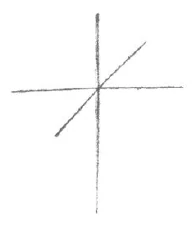
[ 13 ] Nun, die äußere Zeit habe ich Ihnen ja eigentlich angegeben, aber das Innere davon ist noch zu charakterisieren. Wann war es ein Menschliches? Damals war es ein Menschliches, als der Mensch hinter seinen Bewegungen, hinter seinem Einordnen, seiner inneren Orientierung in den Raum nicht nur innerlich noch erlebte: Du gehst von hinten nach vorne und bewegst dich so, daß du dein Gleichgewicht erlebst von oben und unten, und du bildest vielleicht ein anderes Gleichgewicht mit dem Rechts-Links —, sondern als der Mensch auch noch fühlte, daß ja in jedem solchen Gehen, in jeder solcher Geometrie innerlich das Blut tätig ist. Es ist ja immer eine Bluttätigkeit dabei, wenn ich nach vorne gehe. Und was war für eine Bluttätigkeit vorhanden, als ich als Kind mich aufrichtete aus der horizontalen Lage in die vertikale Lage! Hinter den Bewegungen des Menschen, hinter dem Erleben der Welt durch das Bewegen, das ja auch ein innerliches Erlebnis sein kann und es einmal war, hinter dem steht das Blutserlebnis. Denn in der kleinsten und in der größten Bewegung, die ich erlebe, indem ich sie selber ausführe, liegt ja das Blutserlebnis, das damit verknüpft ist. Nur sehen wir heute eben das Blut als dasjenige an, was sich uns darbietet, wenn wir in die Haut stechen und da der rote Saft herausfließt, oder wenn wir uns in ähnlicher Weise äußerlich von dem Dasein des Blutes überzeugen. Aber die Zeit, wo die Mathematik, die Mathesis noch angeschlossen war an die Mystik, wo das Bewegungserlebnis innerlich, wenn auch traumhaft, in Verbindung war mit dem Blutserlebnis, diese Zeit erlebte das Blut innerlich. Das heißt, der Mensch wurde etwas anderes, wenn er verfolgte, wie durch seine Lungenadern das Blut durchrollt, als wenn durch seine Kopfadern das Blut durchrollt. Und er verfolgte das Durchrollen des Blutes beim Aufheben des Knies, beim Aufheben des Fußes, und er durchfühlte sich, durchlebte sich innerlich in seinem Blut. Das Blut hat eine andere Schattierung, wenn ich den Fuß hoch aufhebe, als wenn ich ihn auf den Boden gesetzt habe. Das Blut hat eine andere Schattierung, wenn ich blöde dasitze und faul schlafe, als wenn ich Gedanken durch den Kopf schießen lasse. So kann der ganze Mensch innerlich Gestalt werden, in verschiedenen Nuancierungen Gestalt werden, wenn er das Blutserlebnis hinter dem Bewegungserlebnis hat. Stellen Sie sich lebendig das vor, was ich hier meine. Denken Sie sich, Sie gehen langsam, Schritt vor Schritt; Sie fangen an schneller zu gehen; Sie fangen an zu laufen; Sie fangen an sich zu drehen, in allerlei Weise zu tanzen, und denken Sie, Sie würden nicht mit dem heutigen abstrahierenden Bewußtsein, sondern mit innerlichem Erleben zuerst die ganz langsame Art haben, sich in den Raum hineinzustellen in allen drei Orientierungen; Sie würden das Schnellerwerden haben, Sie würden das Laufen haben, das Drehen, das Tanzen, aber Sie würden dabei immer haben das entsprechende Blutserlebnis. Zuerst jene innere Schattierung, die Sie natürlich nur immer empfindend erleben können, beim Langsamgehen. Beim Laufen, beim Drehen, beim Tanzen wäre es jeweils anders, so daß Sie, wenn Sie recht vom Inneren heraus Ihr Bewegungserlebnis hinzeichnen wollten, vielleicht folgendes hinzeichnen müßten (Zeichnung, weiße Linie). Aber jetzt würden Sie hinzeichnen für jede Lage, in der Sie während dieses Bewegungserlebens waren, ein innerliches Blutserlebnis (rot, blau, gelb).
[ 13 ] Well, I have actually described the external aspect of time to you, but its inner nature still needs to be characterized. When was it a human experience? It was a human experience back then, when human beings not only experienced inwardly—behind their movements, behind their classification, and their inner orientation in space— You walk from back to front and move in such a way that you experience your balance from top to bottom, and you may also establish a different balance with left and right—but also when the human being still felt that, indeed, in every such act of walking, in every such geometry, the blood is at work internally. There is always a flow of blood at work when I walk forward. And what a flow of blood was at work when, as a child, I raised myself from a horizontal to a vertical position! Behind human movements, behind the experience of the world through movement—which can indeed be an inner experience and once was—lies the experience of the blood. For in the smallest and the largest movements I experience—by performing them myself—lies the experience of the blood that is linked to them. Yet today we view blood simply as that which presents itself to us when we pierce the skin and the red fluid flows out, or when we similarly convince ourselves externally of the existence of blood. But in the time when mathematics, the Mathesis, was still connected to mysticism—when the experience of movement was inwardly, albeit dreamlike, linked to the experience of blood—in that time, blood was experienced inwardly. That is to say, a person became something different when observing how blood flowed through their pulmonary veins than when observing how it flowed through their cerebral veins. And they observed the flow of blood as they lifted their knee, as they lifted their foot, and they sensed themselves, lived themselves inwardly within their blood. The blood has a different nuance when I lift my foot high than when I have set it on the ground. The blood has a different hue when I sit there idly and sleep lazily than when I let thoughts race through my head. In this way, the whole person can take shape inwardly, take shape in various nuances, when the experience of the blood underlies the experience of movement. Imagine vividly what I mean here. Imagine you are walking slowly, step by step; you begin to walk faster; you begin to run; you begin to turn, to dance in all sorts of ways—and imagine that, rather than with today’s abstracting consciousness, you would first, through inner experience, have that very slow way of positioning yourself in space in all three orientations; you would experience the acceleration, you would experience running, spinning, and dancing, but you would always have the corresponding sensation in your blood. First, that inner nuance—which, of course, you can only ever experience through sensation—while walking slowly. While running, turning, or dancing, it would be different in each case, so that if you wanted to sketch your experience of movement accurately from within, you might have to sketch the following (drawing, white line). But now you would sketch an inner sensation of blood flow (red, blue, yellow) for every position you were in during this experience of movement.
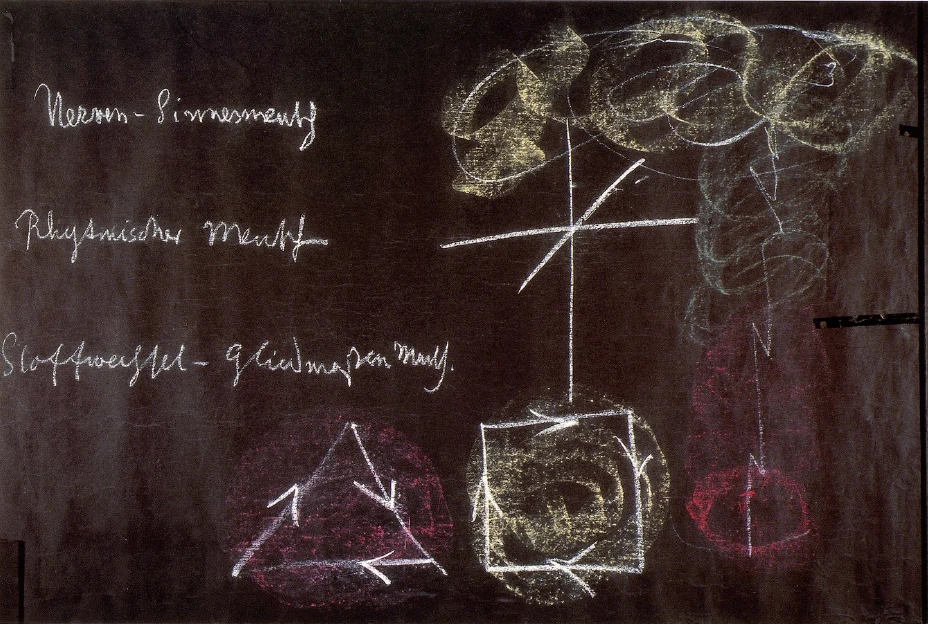
[ 14 ] Das erste Erlebnis, das Bewegungserlebnis, von dem würden Sie sagen, Sie erleben es gemeinsam mit dem äußeren Raume, denn Sie gehen fortwährend aus Ihrem Orte heraus. Das zweite Erlebnis, das ich durch Farben gekennzeichnet habe, ist ein Zeiterlebnis, ist eine Aufeinanderfolge von inneren intensiven Erlebnissen.
[ 14 ] The first experience—the experience of movement—is one that you would say you experience together with the external space, because you are constantly moving out of your place. The second experience, which I have characterized by colors, is an experience of time—a succession of intense inner experiences.
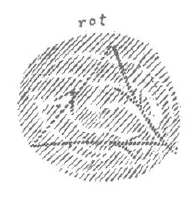
[ 15 ] Sie können in der Tat auch, wenn Sie nun die Kunst ausführen, im Dreieck zu laufen, ein innerliches Erlebnis haben als Blutserlebnis:
[ 15 ] In fact, even when you perform the art of walking in a triangle, you can have an inner experience that feels like a blood experience:
[ 16 ] Wenn Sie im Viereck laufen, können Sie ein anderes Blutserlebnis haben. Dasjenige, was äußerlich quantitativ, was äußerlich geometrisch ist, ist innerlich im Blutserlebnis intensiv qualitativ:
[ 16 ] When you walk in a square, you can have a different experience of blood. What is quantitatively external and geometrically external is, internally, intensely qualitative in the experience of blood:
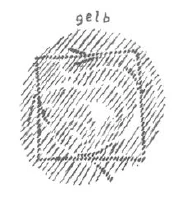
[ 17 ] Das ist das Überraschende, das ungeheuer Überraschende, wenn man darauf kommt, daß eine ältere Mathematik ganz anders redet vom Dreieck und Viereck. Wenn darinnen gesehen wird allerlei Geheimnisvolles, so ist das nicht ein Geheimnisvolles, wie es die heutigen nebulosen Mystiker beschreiben, sondern es ist dasjenige, was einer etwa beim Dreieck erlebt hätte innerlich im Blute, wenn er das Dreieck abgelaufen wäre, was einer innerlich erlebt hätte im Blute, wenn er das Viereck abgelaufen wäre. Und gar jenes Blutserlebnis, das für das Pentagramm gilt! Sie sehen, im Blute wird die ganze Geometrie qualitativ inneres Erlebnis. Wir kommen in die Zeit zurück, die wahrhaftig sagen durfte: Blut ist ein ganz besonderer Saft. Denn wird er innerlich erlebt, dieser Saft, so saugt er alle geometrischen Gebilde auf, macht sie zu intensiven inneren Erlebnissen. Aber der Mensch lernt sich ja dadurch auch selber kennen. Er lernt kennen, was es heißt, ein Dreieck erleben, was es heißt, ein Viereck erleben, was es heißt, ein Pentagramm erleben, und er lernt die Projektion der Geometrie auf das Blut und seine Erlebnisse kennen. Das war einmal Mystik. Die Mathematik, die Mathesis, stand nicht nur nahe der Mystik, sondern sie war überhaupt die Bewegungsaußenseite, die Gliedmaßenseite für das Innenerlebnis, für das Blutserlebnis. Die ganze Mathematik verwandelte sich aus einer Summe von Raumesgebilden für den Mystiker einstiger Zeiten in dasjenige, was im Blute erlebt wird, in rhythmisches Innenerlebnis, aber intensives mystisches, rhythmisches Innenerlebnis.
[ 17 ] That is what is surprising—truly astonishing—when one realizes that older mathematics speaks of triangles and quadrilaterals in an entirely different way. If one perceives all manner of mystery in this, it is not a mystery as described by today’s nebulous mystics, but rather what one might have experienced inwardly in one’s blood while walking the perimeter of a triangle, or what one might have experienced inwardly in one’s blood while walking the perimeter of a quadrilateral. And especially that experience in the blood that applies to the pentagram! You see, in the blood, the entire geometry becomes a qualitative inner experience. We are returning to a time when it was truly permissible to say: Blood is a very special fluid. For when this fluid is experienced inwardly, it absorbs all geometric forms, transforming them into intense inner experiences. But through this, a person also comes to know themselves. They come to understand what it means to experience a triangle, what it means to experience a square, what it means to experience a pentagram, and they come to understand the projection of geometry onto the blood and their experiences. That was once mysticism. Mathematics, the Mathesis, was not only closely related to mysticism; it was, in fact, the outer aspect of movement, the physical aspect of the inner experience, of the experience within the blood. For the mystics of bygone times, the whole of mathematics transformed from a sum of spatial constructs into that which is experienced in the blood—into a rhythmic inner experience, yet an intense, mystical, rhythmic inner experience.
[ 18 ] Man kann sagen: Der Mensch hatte einmal eine Erkenntnis, die er erlebte, bei der war er ganz dabei, und er verlor gerade in dem Zeitpunkte, den ich Ihnen charakterisiert habe, dieses Dabeisein seiner eigenen Wesenheit mit der Welt, dieses Dabeisein bei den Weltgeheimnissen. Er riß sich die Mathematik aus seinem Inneren heraus. Er hatte nicht mehr das Bewegungserlebnis, konstruierte sich aber mathematisch die Zusammenhänge der Bewegungen draußen. Er hatte nicht mehr das Blutserlebnis. Dadurch wurde ihm überhaupt das Blut in seinem Rhythmus etwas ganz Fremdes, er wurde sich selber fremd dabei in seinem Blutserlebnis. Denken Sie sich, der Mensch reißt die Mathematik von seinem Körper los, sie wird ein Abstraktes. Er verliert das Verständnis für das Blutserlebnis. Die Mathematik geht nicht mehr nach dem Inneren. Und denken Sie sich das einmal als eine Stimmung der Seele, die einmal auftrat. Denken Sie sich, daß die Seele früher anders gestimmt war, als sie später gestimmt wurde, daß sie früher so gestimmt war, daß sie eben den Zusammenhang zwischen Blutserlebnis und Bewegungserlebnis suchte, und nachher von diesem das eine ganz abgesondert hatte, das mathematische und geometrische Erlebnis ganz abgesondert hatte, nicht mehr auf die eigene Bewegung bezog, das Blutserlebnis verlor. Denken Sie sich das wirklich als Historie, als ein in den Stimmungen der Menschheitsentwickelung Auftretendes. Ja, ein Mensch, der früher gelebt hat, als Mathesis noch Mystik war, der setzte seinen ganzen Menschen in die Welt hinein, der mußte mit seinem eigenen Bewegungswesen den Kosmos abmessen. Er als Mensch maß den Kosmos ab. Er lebte in der Astronomie darinnen. Der neuere Mensch stellt ein Koordinatenachsen-System in den Kosmos hinein und nimmt sich selbst heraus. Der ältere Mensch empfand bei jeder geometrischen Figur ein Blutserlebnis. Der neuere Mensch empfindet kein Blutserlebnis, verliert den Zusammenhang zu seinem eigenen Herzen, in dem die Blutserlebnisse zentriert sind. Kann sich irgend jemand denken, daß etwa im 7., 8. Jahrhundert des Mittelalters, als die Stimmung mit dem Bewegungserlebnis als mathematischem Erlebnis und mit dem Blutserlebnis als mystischem Erlebnis noch vorhanden war, daß da jemand eine Kopernikanische Astronomie begründet hätte, mit einem Koordinatenachsen-System einfach hineingestellt in die Welt, abgesondert von dem Menschen? Nein, das wurde erst möglich, als in der Menschheitsentwickelung diese besondere Seelenverfassung auftrat. Und bald darnach wurde etwas anderes möglich. Das innere Blutserlebnis ist verlorengegangen. Die Zeit war reif, nun die Blutbewegungen am physischen Menschenkörper äußerlich physiologisch-anatomisch zu ergründen. Und Sie haben so jenen Umschwung in der Menschheitsentwickelung, auf der einen Seite die Kopernikanische Astronomie und auf der anderen Seite die Entdeckung des Blutkreislaufes durch Harvey, den Zeitgenossen des Bacon, des Hobbes, denn jenes In-die-Welt-Schauen mit abstrakter Mathematik kann nicht mehr die alte Ptolemäische Theorie ergeben. Die ist im wesentlichen an den Menschen und seine erlebte Mathematik gebunden. Jetzt erlebt man das Abgesonderte, mit einem beliebigen Nullpunkt auftretende Koordinatenachsen-System. Jetzt hat man nicht mehr innerlich das Blutserlebnis, jetzt entdeckt man physisch die Blutzirkulation mit dem Herzen in der Mitte.
[ 18 ] One could say: Human beings once had a realization that they experienced fully, in which they were completely present; and it was precisely at the moment I have described to you that they lost this sense of their own being’s connection to the world, this sense of being part of the world’s mysteries. They tore mathematics out of their inner being. They no longer had the experience of movement, yet they constructed the relationships between external movements mathematically. They no longer had the experience of their own blood. As a result, the very rhythm of their blood became something completely foreign to them; they became alienated from themselves in their experience of their own blood. Imagine this: a person tears mathematics away from his body; it becomes an abstraction. He loses his understanding of the experience of blood. Mathematics no longer follows the inner self. And imagine this as a mood of the soul that once arose. Imagine that the soul was once in a different state of mind than it was later; that it was once such that it sought the connection between the experience of blood and the experience of movement, and later separated the mathematical and geometric experience entirely from this, no longer relating it to its own movement, and thus lost the experience of blood. Imagine this truly as history, as something that emerged within the moods of human development. Yes, a person who lived in an earlier time, when mathematics was still mysticism, placed his entire being into the world; he had to measure the cosmos with his own sense of movement. He, as a human being, measured the cosmos. He lived within astronomy. Modern man places a coordinate system into the cosmos and removes himself from it. The older human being felt a blood-experience with every geometric figure. Modern man feels no blood-experience; he loses the connection to his own heart, in which these blood-experiences are centered. Can anyone imagine that, say, in the 7th or 8th century of the Middle Ages—when the atmosphere in which the experience of movement was still a mathematical experience and the experience of blood was still a mystical experience still prevailed—that someone would have founded Copernican astronomy by simply placing a coordinate system into the world, separate from the human being? No, that only became possible when this particular state of the soul emerged in human development. And soon afterward, something else became possible. The inner experience of blood was lost. The time was ripe to now investigate the movements of blood in the physical human body externally, from a physiological and anatomical perspective. And so you have that turning point in human development: on the one hand, Copernican astronomy, and on the other, the discovery of blood circulation by Harvey, a contemporary of Bacon and Hobbes; for that way of looking into the world through abstract mathematics can no longer yield the old Ptolemaic theory. That theory is essentially bound to the human being and the mathematics he has experienced. Now one experiences the abstract, a coordinate system arising with an arbitrary origin. Now one no longer has the inner experience of blood; now one physically discovers blood circulation with the heart at its center.
[ 19 ] So stellte sich die Geburt der Naturwissenschaft in die ganze Menschheitsentwickelung hinein, in ihre bewußten und unterbewußten Prozesse, und nur so versteht man aus dem wirklichen Menschlichen heraus, was sich eigentlich zugetragen hat und was da sein mußte in der neueren Zeit, damit die uns heute so selbstverständliche Naturwissenschaft überhaupt hat entstehen können, damit jemandem erst einfallen konnte, solche Untersuchungen zu machen, wie sie etwa zu der Harveyschen Entdeckung des Blutkreislaufes führten. Dies, meine sehr verehrten Anwesenden, werde ich dann morgen fortsetzen.
[ 19 ] Thus, the birth of the natural sciences took its place within the entire course of human development, within its conscious and subconscious processes, and only in this way can one understand, from the perspective of what is truly human, what actually took place and what had to happen in recent times so that natural science—which we now take for granted—could come into being at all, so that it could even occur to someone to conduct the kinds of investigations that led, for example, to Harvey’s discovery of blood circulation. This, my esteemed audience, I will continue tomorrow.