

The Emergence of Natural Science
in World History
and its Subsequent Development
GA 326
26 December 1922, Dornach
Translated by Steiner Online Library
Third Lecture
[ 1 ] In my last two reflections, I have attempted to indicate the point in time during the recent development of humanity when the scientific worldview and scientific thinking, as we understand them today, emerged, and yesterday I was able to point out that the entire character of this scientific thinking—as it first emerged most clearly in Copernicus’s conception of astronomy—depends on the way in which, over the course of human development, mathematics and mathematical thinking were gradually brought into relation with the reality of the external world. In fact, an extraordinarily large part of modern scientific development depends on the fact that, even with regard to mathematical thinking itself, a shift—one might almost say a revolution—in human perception has taken place. Nowadays, people are so inclined to present the way they themselves think—in the present—as something absolutely valid, so to speak, and to pay no attention at all to how things have changed. Today, people hold a certain view of mathematics and, in turn, a certain conception of the relationship between the mathematical and the reality of the world. And they think that this is simply the given, the correct relationship. Certainly, people discuss it, but within certain limits they regard it as the correct relationship and do not consider how, in a past that is actually not all that distant from us, humanity perceived mathematics itself quite differently. One need only recall with sufficient clarity how, not long after that moment—which I have described as the most significant in recent intellectual life—shortly after that moment when Nicholas of Cusa presented his momentous arguments to the world, how soon after that moment not only did Copernicus seek to explain the movements of the solar system with a mathematically oriented way of thinking, with a mode of thinking already as mathematically oriented as we are accustomed to today, but how philosophers—Descartes, Spinoza—also saw it as their very ideal to apply the way of thinking used in mathematics to the most comprehensive description of the entire physical and spiritual structure of the world.
[ 2 ] Spinoza, the philosopher, placed particular emphasis on presenting his philosophical principles and propositions—even in a book such as his *Ethics*—in such a way that, although mathematical formulas and calculations do not play a special role in this book, the method of reasoning—the way of deriving later propositions from earlier ones—follows the pattern of mathematics. Gradually, it had come to seem self-evident to his contemporaries that mathematics provided a model for attaining inner certainty within oneself, and that, if one succeeds in expressing the course of the world through thoughts in such a way that these thoughts are linked together in a meticulously precise architectural structure—like the thoughts of a mathematical or geometric system—one thereby achieves something that must correspond to reality. But the particular way in which one approaches mathematics and the relationship of mathematics to reality—this must be fully understood if one wishes to grasp the nature of scientific thinking correctly. Mathematics had gradually become, in that era, what one might call—in relation to something earlier, which I will characterize shortly—a self-sufficient, inner capacity for thought. What do I mean by this?
[ 3 ] One could certainly say that mathematics in the time of Descartes, or Cartesius, and in the time of Copernicus can be characterized in much the same way as it can be today. Take, for example, a mathematician today who deals with geometry and who, within the conceptual framework of geometry, seeks analytical formulas to understand this or that physical process. As a geometer—initially within the framework of Euclidean geometry—this mathematician takes as his starting point three-dimensional space, or more generally, dimensional space, if one were to take non-Euclidean geometry into account as well; and within three-dimensional space, he distinguishes three directions that are perpendicular to one another but otherwise identical. Space is, I would say, a self-sufficient entity that is simply presented to consciousness just as I have now described it, without much inquiry: Where does this entity come from, where does the entire concept of geometry come from at all? — Given the external focus that psychological thought has gradually adopted in recent times, it was also natural that human beings could not descend into those depths of the soul—let alone into those inner depths—from which the foundations of, for example, geometric thought arise. People simply accept their ordinary consciousness and fill this ordinary consciousness with mathematics that is conceived but not experienced. Let us take, as a specific example, the conceived—but not experienced—three mutually perpendicular dimensions of Euclidean space. But human beings would never have arrived at this conception of the three mutually perpendicular dimensions of Euclidean space if they had not experienced within themselves a threefold orientation.
[ 4 ] The one orientation that a person experiences within themselves is from front to back. We need only consider how, in today’s external anatomical and physiological view of the human being—I am speaking here only of humans, not of animals, as that is not necessary in this context—how, for humans, let us say, for example, the intake of food, excretion, and other processes of the organism take place in the direction from front to back, and how this orientation of very specific processes within the human being differs from, say, when I perform an action with my right arm and, symmetrically, perform a corresponding action with my left arm. In that case, the processes are oriented to the right and left. And finally, we need only recall how, with regard to another orientation, human beings actually grow into it only during their earthly existence: At first they crawl, and only gradually do they straighten up in such a way that an orientation flows within them from top to bottom or from bottom to top.
[ 5 ] As things stand today, these three orientations of the human being are accepted in a rather superficial way, since one does not experience them inwardly but rather observes from the outside the processes within the human organism—those that essentially proceed from front to back, those that proceed from right to left or from left to right, and those that proceed from top to bottom. If one could look back into earlier ages with a true psychology, observing the soul, one would know that for an older human sensibility, an older human experience, these three orientations were inner experiences. Just as we today still recognize, to some extent, having thoughts and having feelings as inner experiences—so, too, did people of earlier times have a genuine inner experience, for example, of the “front-to-back” direction. For them, the sensation of taste—which developed intensely at the front of the oral cavity and gradually diminished toward the back—had not yet been lost. The qualitative aspect—the fact that one felt the taste intensely at the front of the tongue and then perceived it growing weaker and weaker as it receded in the direction from front to back, until it was finally lost entirely—this experience was once something quite real and concrete in human inner life. People used such qualitative experiences to follow the path from front to back. Human beings are simply no longer as inwardly attuned as they once were. That is why they no longer have experiences such as the ones I have just described. Nor do people today have a vivid sense of the alignment of the eye axes in order to fix their gaze on any given point by crossing the right eye axis over the left. Nor do people today have a fully concrete sense of what it means to them as human beings when, in orienting themselves from right to left, they align, say, the right arm and right hand with the left arm and left hand. And certainly not a sensation such as the one where one can say to oneself: “The thought shines through my head; it strikes me as it moves from top to bottom into my heart”—such a sensation, such an experience, has simply been lost to human beings along with the inner nature of their experience of the world. But such an experience did exist. Human beings initially experienced within themselves the three spatial orientations that are perpendicular to one another. And these three spatial orientations—right and left, front and back, up and down—form the basis of the three-dimensional spatial schema. The three-dimensional spatial schema is merely an abstraction of this immediate experience I have just described to you. How, then, can we speak—for example, when we look back to earlier times at geometry, at this branch of mathematics? We can speak in such a way that we say: People of earlier times were clearly aware that they could say to themselves: Through my humanity, the mathematical and the geometric reveal themselves to me in my own life, and by extending my up-down, my right-left, and my front-back, I encompass the world from within myself.
[ 6 ] One need only realize for a moment what an enormous difference there is between this mathematical intuition, which is bound to human experience, and the barren, desolate mathematical spatial schema of analytical geometry, which places a point somewhere in an abstract space, draws three mutually perpendicular coordinate axes, and has separated this imagined spatial schema from all experience. But humans first tore this imagined spatial framework away from their own inner life. So that, if one wishes to understand correctly the emergence of the later mathematical perspective—which then took hold of the natural sciences in its self-sufficient presentation of its constructs—one must derive it from the lived mathematics of an earlier time. The mathematics of an earlier time was, in fact, something entirely different. And that which once existed in, I might say, a dreamlike experience of inner three-dimensionality—and which then became abstracted—is today entirely present in the unconscious. In fact, even today, human beings still derive mathematics from their own inner three-dimensionality. But this drawing of the spatial schema from what a person experiences as inner orientation takes place in a completely unconscious manner. Nothing of this rises into consciousness. What does rise into consciousness, for example, is the finished spatial schema—just as, in general, all finished mathematical constructs that have been severed from their roots. I have chosen the example of the spatial schema. I could just as easily cite any other mathematical category, including mathematical categories from algebra, calculus, or arithmetic. They are nothing other than schemata drawn from immediate human experience into the abstract.
[ 7 ] You see, if you go back even further in the way people thought about mathematics—going back a few centuries before the 15th, 16th, or 17th centuries—then you’ll find that people still had at least a vestige of intuition when it came to numbers. After all, in the era when numbers had not yet become the abstract entities they are today, they would not have been able to come up with names for them. The names for numbers are often extraordinarily characteristic. Just think of the word “two,” which clearly still expresses a concrete process: to divide into two—indeed, it is even connected to the word “to doubt.” But when the number two is described as “splitting in two,” it is not a reproduction of something external; rather, it is in fact an inner experience that has been turned into a schema—something drawn from within, just as the abstract three-dimensional spatial schema is drawn from within.
[ 8 ] And this brings us back to a time that, in all its intellectual vitality, still existed, for example, during the early Christian centuries, and whose intellectual distinctiveness can already be seen in the fact that mathematics (mathesis) was regarded almost as one and the same with mysticism. Mysticism, *mathesis*, and mathematics are one and the same, albeit only in a certain sense. For a mystic in the early Christian centuries, true mysticism is that which is experienced more inwardly and spiritually, while mathematics is that form of mysticism experienced more outwardly through the body—for example, geometry, with the body’s orientation forward-backward, right-left, up-down. One might say that true mysticism is precisely spiritual mysticism, and that mathematics, or “mathesis,” is physical mysticism. One experiences true mysticism inwardly in what is very often called mysticism, and one experiences “mathesis”—the other form of mysticism—by having an inner experience of the physical, by not having yet lost this inner experience.
[ 9 ] In fact, the way Descartes and Spinoza still perceive mathematics—or even the mathematical method—is of an entirely different nature. One need only delve into these thinkers—not superficially, as is done today, when people always seek to find the current concepts hammered into our heads even in the ancient thinkers, but rather by selflessly stepping outside oneself to engage with them—and one will find that even Spinoza retains something of a mystical sensibility in his devotion to the mathematical method. Ultimately, Spinoza’s philosophy differs from mysticism in no other way than that a mystic of the sort of Meister Eckhart or Johannes Tauler attempts to experience the mysteries of the world more on the basis of feeling, whereas Spinoza—though just as inwardly—constructs his understanding along mathematical-methodological lines, which are not strictly geometric lines but are inwardly experienced according to mathematical method. With regard to the state of mind and mood in the experience of Master Eckhart’s mystical method and Spinoza’s mathematical method, there is actually no difference. And anyone who draws a distinction simply does not understand how Spinoza, for example, truly experienced his *Ethics* in a mathematical-mystical way. There is still an echo in this philosopher of that era in which mathematics, *mathesis*, and mysticism were perceived as one and the same experience of the soul.
[ 10 ] Now, perhaps you, my esteemed audience and dear friends, will recall how, in my book *The Riddles of the Soul*, I attempted to redefine the human organization in a way consistent with modern thought. I must refer to the relevant passage in this book, *The Riddles of the Soul*. There I divided the human organism—by which I mean, first and foremost, the physical organism—into the nervous-sensory system, the rhythmic system, and the metabolic-limb system. I need not point out here that this does not mean, as has been caricatured by academic circles, a division of the human being in which the individual parts are placed side by side in space. It will be clear to you from the description I provided in my book *On the Mysteries of the Soul* that these systems are interlinked; that the nervous-sensory system—when referred to as the “head system”—is, strictly speaking, only primarily located in the head, in the head, but that it extends throughout the entire human being; that these three systems merge into one another; and that, naturally, the respiratory and circulatory rhythms also extend upward from the middle human—the chest human—into the head’s organization, and so on. The division is therefore a functional one, not a spatial one. But one does learn to understand the human being when one has an inner understanding of this division.
[ 11 ] Now let us consider this structure today with a specific goal in mind. Let us first turn our attention to the third member of the human organization: the metabolic-limb human. We can begin by focusing on what particularly catches our eye in this member of the human being. We can focus on the fact that human beings, insofar as they are sensory beings, carry out their outer life on Earth by connecting what lives in their limbs to the inner experiences I have described—namely, the inner experience of orientation toward the three directions of space. The human limb system, in a sense, integrates its external movements—its orientation toward the world—into what constitutes inner orientation in the three directions mentioned. We integrate ourselves, in a certain way, into the experience of up and down as we walk. In many of the actions we perform with our hands or arms, we align ourselves with the right-left orientation. Indeed, even in our speech—insofar as speech is a movement of the airy element within the human being—we align ourselves with the front-to-back and back-to-front directions. As we move through the world, we project our inner orientation into the external world.
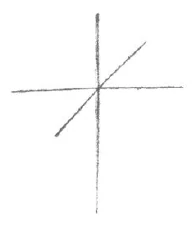
[ 12 ] Let us now consider the true process as opposed to the merely illusory in a specific mathematical case. It is something illusory—something that takes place purely within the framework of thought—when I find a spatial process somewhere in the universe, and then, as an analytical mathematician, I approach this spatial process by plotting—or even merely imagining—the three coordinates of the standard coordinate-axis system, and then fitting some external process belonging to space into this purely constructed spatial schema of Descartes. That is, after all, merely what takes place—I would say—up there through the human nervous-sensory system in the realm of conceptual schemas. One would not arrive at a relationship between a human being and such a process in space if it were not based on what one does with one’s limbs—and, for that matter, with one’s entire being—namely, that one positions oneself within the whole world according to the internal orientation of up-down, right-left, and front-back. I know that when I walk forward, I orient myself in terms of up and down on one side in order to remain upright. But I also know that I orient myself in terms of back and front in accordance with the direction of my gait, and when I swim and use my arms, for example, I orient myself in the world using left and right. I don’t grasp the very foundation of the matter at all when I take the Cartesian spatial framework—that abstract coordinate-axis system. I grasp what actually gives a person the impression of reality when they interact with spatial phenomena, only then, when I tell myself that up there in the nervous system, the illusory image of something actually unfolds—something that takes place deep in the subconscious, namely where human beings cannot reach with their ordinary consciousness—what unfolds between their system of limbs and the world. And all of mathematics, all of geometry, is derived from our system of movement. We would have no geometry if we did not position ourselves in the world according to an inner orientation. In truth, we engage in geometry by elevating what takes place in the unconscious into the illusory realm of the thought schema. Through this, it appears to us as something so abstractly independent. But that is precisely what has come about in more recent times. In the era when mathesis—the mathematics of mysticism—was still felt to be close to us, the mathematical approach to things was still something human. After all, what is there that is human in it when I take a point zero—which I place even only mentally somewhere in space—and have three mutually perpendicular directions intersect it, and then make this spatial schema coincide with a process that I perceive in real space? It is, after all, completely detached from the human being; it is something entirely inhuman. This inhuman aspect, which has emerged in recent times within mathematical thought, was once human. But when was it human?
[ 13 ] Well, I have actually described the external aspect of time to you, but its inner nature still needs to be characterized. When was it a human experience? It was a human experience back then, when human beings not only experienced inwardly—behind their movements, behind their classification, and their inner orientation in space— You walk from back to front and move in such a way that you experience your balance from top to bottom, and you may also establish a different balance with left and right—but also when the human being still felt that, indeed, in every such act of walking, in every such geometry, the blood is at work internally. There is always a flow of blood at work when I walk forward. And what a flow of blood was at work when, as a child, I raised myself from a horizontal to a vertical position! Behind human movements, behind the experience of the world through movement—which can indeed be an inner experience and once was—lies the experience of the blood. For in the smallest and the largest movements I experience—by performing them myself—lies the experience of the blood that is linked to them. Yet today we view blood simply as that which presents itself to us when we pierce the skin and the red fluid flows out, or when we similarly convince ourselves externally of the existence of blood. But in the time when mathematics, the Mathesis, was still connected to mysticism—when the experience of movement was inwardly, albeit dreamlike, linked to the experience of blood—in that time, blood was experienced inwardly. That is to say, a person became something different when observing how blood flowed through their pulmonary veins than when observing how it flowed through their cerebral veins. And they observed the flow of blood as they lifted their knee, as they lifted their foot, and they sensed themselves, lived themselves inwardly within their blood. The blood has a different nuance when I lift my foot high than when I have set it on the ground. The blood has a different hue when I sit there idly and sleep lazily than when I let thoughts race through my head. In this way, the whole person can take shape inwardly, take shape in various nuances, when the experience of the blood underlies the experience of movement. Imagine vividly what I mean here. Imagine you are walking slowly, step by step; you begin to walk faster; you begin to run; you begin to turn, to dance in all sorts of ways—and imagine that, rather than with today’s abstracting consciousness, you would first, through inner experience, have that very slow way of positioning yourself in space in all three orientations; you would experience the acceleration, you would experience running, spinning, and dancing, but you would always have the corresponding sensation in your blood. First, that inner nuance—which, of course, you can only ever experience through sensation—while walking slowly. While running, turning, or dancing, it would be different in each case, so that if you wanted to sketch your experience of movement accurately from within, you might have to sketch the following (drawing, white line). But now you would sketch an inner sensation of blood flow (red, blue, yellow) for every position you were in during this experience of movement.
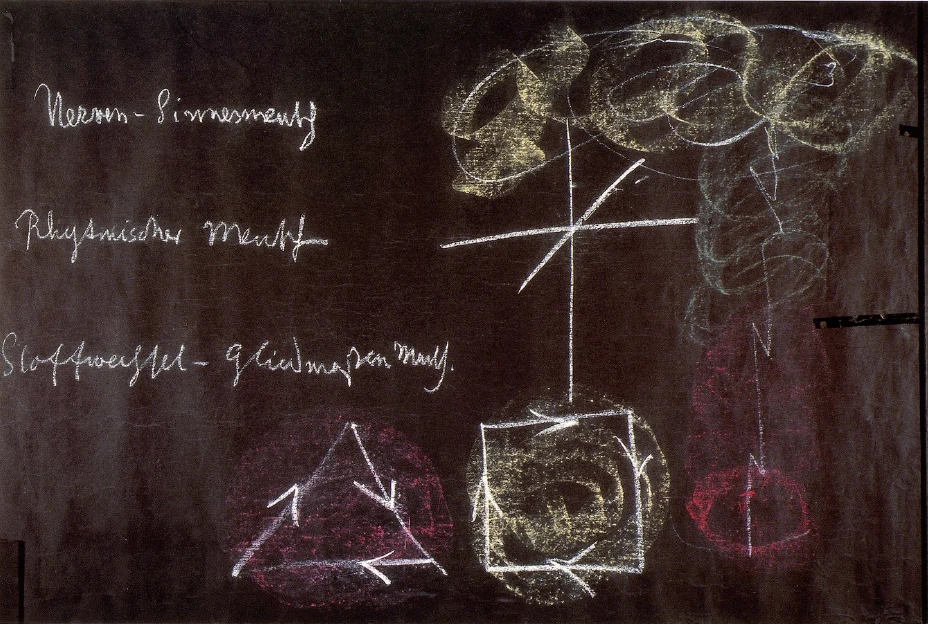
[ 14 ] The first experience—the experience of movement—is one that you would say you experience together with the external space, because you are constantly moving out of your place. The second experience, which I have characterized by colors, is an experience of time—a succession of intense inner experiences.
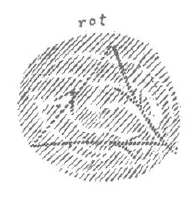
[ 15 ] In fact, even when you perform the art of walking in a triangle, you can have an inner experience that feels like a blood experience:
[ 16 ] When you walk in a square, you can have a different experience of blood. What is quantitatively external and geometrically external is, internally, intensely qualitative in the experience of blood:
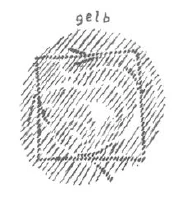
[ 17 ] That is what is surprising—truly astonishing—when one realizes that older mathematics speaks of triangles and quadrilaterals in an entirely different way. If one perceives all manner of mystery in this, it is not a mystery as described by today’s nebulous mystics, but rather what one might have experienced inwardly in one’s blood while walking the perimeter of a triangle, or what one might have experienced inwardly in one’s blood while walking the perimeter of a quadrilateral. And especially that experience in the blood that applies to the pentagram! You see, in the blood, the entire geometry becomes a qualitative inner experience. We are returning to a time when it was truly permissible to say: Blood is a very special fluid. For when this fluid is experienced inwardly, it absorbs all geometric forms, transforming them into intense inner experiences. But through this, a person also comes to know themselves. They come to understand what it means to experience a triangle, what it means to experience a square, what it means to experience a pentagram, and they come to understand the projection of geometry onto the blood and their experiences. That was once mysticism. Mathematics, the Mathesis, was not only closely related to mysticism; it was, in fact, the outer aspect of movement, the physical aspect of the inner experience, of the experience within the blood. For the mystics of bygone times, the whole of mathematics transformed from a sum of spatial constructs into that which is experienced in the blood—into a rhythmic inner experience, yet an intense, mystical, rhythmic inner experience.
[ 18 ] One could say: Human beings once had a realization that they experienced fully, in which they were completely present; and it was precisely at the moment I have described to you that they lost this sense of their own being’s connection to the world, this sense of being part of the world’s mysteries. They tore mathematics out of their inner being. They no longer had the experience of movement, yet they constructed the relationships between external movements mathematically. They no longer had the experience of their own blood. As a result, the very rhythm of their blood became something completely foreign to them; they became alienated from themselves in their experience of their own blood. Imagine this: a person tears mathematics away from his body; it becomes an abstraction. He loses his understanding of the experience of blood. Mathematics no longer follows the inner self. And imagine this as a mood of the soul that once arose. Imagine that the soul was once in a different state of mind than it was later; that it was once such that it sought the connection between the experience of blood and the experience of movement, and later separated the mathematical and geometric experience entirely from this, no longer relating it to its own movement, and thus lost the experience of blood. Imagine this truly as history, as something that emerged within the moods of human development. Yes, a person who lived in an earlier time, when mathematics was still mysticism, placed his entire being into the world; he had to measure the cosmos with his own sense of movement. He, as a human being, measured the cosmos. He lived within astronomy. Modern man places a coordinate system into the cosmos and removes himself from it. The older human being felt a blood-experience with every geometric figure. Modern man feels no blood-experience; he loses the connection to his own heart, in which these blood-experiences are centered. Can anyone imagine that, say, in the 7th or 8th century of the Middle Ages—when the atmosphere in which the experience of movement was still a mathematical experience and the experience of blood was still a mystical experience still prevailed—that someone would have founded Copernican astronomy by simply placing a coordinate system into the world, separate from the human being? No, that only became possible when this particular state of the soul emerged in human development. And soon afterward, something else became possible. The inner experience of blood was lost. The time was ripe to now investigate the movements of blood in the physical human body externally, from a physiological and anatomical perspective. And so you have that turning point in human development: on the one hand, Copernican astronomy, and on the other, the discovery of blood circulation by Harvey, a contemporary of Bacon and Hobbes; for that way of looking into the world through abstract mathematics can no longer yield the old Ptolemaic theory. That theory is essentially bound to the human being and the mathematics he has experienced. Now one experiences the abstract, a coordinate system arising with an arbitrary origin. Now one no longer has the inner experience of blood; now one physically discovers blood circulation with the heart at its center.
[ 19 ] Thus, the birth of the natural sciences took its place within the entire course of human development, within its conscious and subconscious processes, and only in this way can one understand, from the perspective of what is truly human, what actually took place and what had to happen in recent times so that natural science—which we now take for granted—could come into being at all, so that it could even occur to someone to conduct the kinds of investigations that led, for example, to Harvey’s discovery of blood circulation. This, my esteemed audience, I will continue tomorrow.