The Emergence of Natural Science
in World History
and its Subsequent Development
GA 326
6 January 1923, Dornach
Translated by Steiner Online Library
Ninth Lecture
[ 1 ] It is, of course, in the nature of things that the subject matter of a lecture series such as this one is, in fact, inexhaustible, and that the topics can be expanded upon and, above all, explored in greater depth. But since, unfortunately, a conclusion must eventually be drawn, one must be content with providing guidelines and hints. Therefore, today, too, I will naturally be able to supplement only the sparse guidelines and hints already given in such a way that the picture offers at least a certain sense of closure.
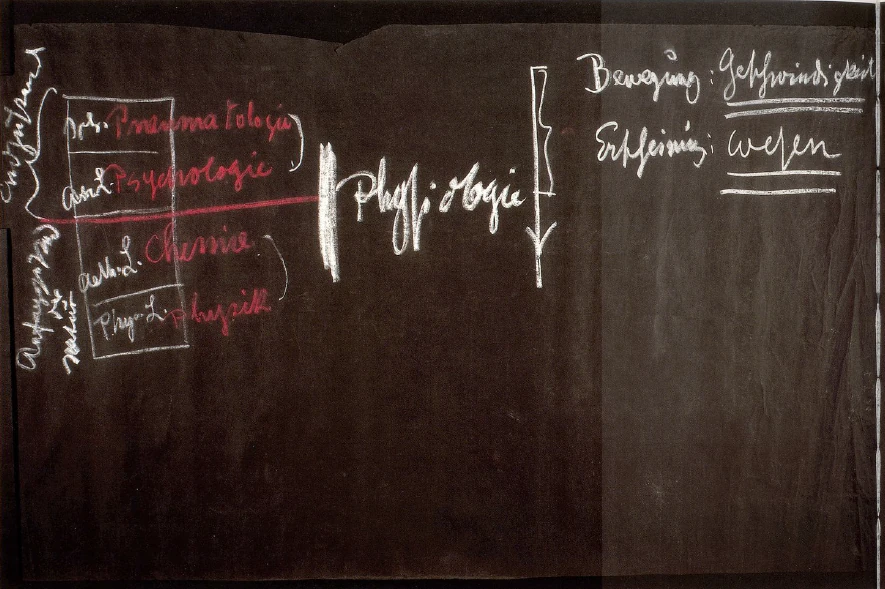
[ 2 ] If we once again take as our starting point the nature of the human being, as it can be revealed to us through the research of spiritual science, then we must say: We divide the human being into his physical body, his etheric or formative body, his astral body—which essentially represents the inner soul—and his ego organization. Let us be clear that the physical body, in the strict sense, lives only in that lesser part of the human organism which can be described as solid and sharply contoured; whereas everything that is sap, sap-like, or liquid in the human organism is already so permeated by the etheric body—or body of formative forces—that it is in a state of constant mixing, separation, chemical combination, and chemical dissolution—in a continuous flow, but in flows that are themselves brought about precisely by mixing, separation, dissolution, and combination. Let us then be clear that within this human organization there are gaseous, air-like elements, such as those found in the activity of, for example, oxygen and other substances that are gaseous in nature. Within this, however, the astral organization is at work. And finally, the I-organization is at work in everything within the human being that is warmth-bearing. However, this is not to say that one should take what I have just said schematically; rather, one must be clear that because, for example, everything sap-like and liquid is pulsed through by the formative force body, it also carries along what is solid—that everything is in intimate interaction and interplay within the human organization. One must always be aware of this. But let us now be further clear that this human organization has been experienced in various ways in the course of human development. We have, after all, highlighted this as a central point throughout these lectures.
[ 3 ] What we today refer to, for example, as the subject matter of external physics or mechanics was originally attained through an inner experience of the physical body, so that we can say: Our modern physics contains statements that arose because there was originally an inner, experienced physics of the physical body, and because this, as I have often said, was cast out of the human being and now continues to exist only as a physics that observes external nature. The same was true in the past—even during the decadent period of medieval alchemy—with regard to that which lives inwardly within the human being through the etheric body. Where the etheric body in the human being begins its “activity,” there takes place that process of humors, that process of fluids, which was once experienced and now only shimmers through all manner of fantastical alchemical descriptions that people today find in older writings—writings that were originally a spiritually elaborated science, but one experienced inwardly within the etheric organization of the human being. This is only now beginning to be cast aside, for we do not yet actually have a fully developed chemistry. But we have many chemical processes in the world that we seek to understand—or that our science seeks to understand—albeit in a physical-mechanical way.
[ 4 ] But with this, we have exhausted what human beings initially experienced internally through their own organization and then projected outward. It is in this process of projection outward that everything has developed, from astronomy to the meager beginnings of today’s chemical knowledge. In contrast, in earlier times, what we today call the content of abstract psychology—which is really just something that is no longer real for people: thinking, feeling, and willing—was once experienced in such a way that it was not actually experienced within the human being at all; rather, when a person experienced the soul, they felt themselves to be outside themselves, in the world outside. Thus, it was precisely the physical that was once experienced within; the soul was experienced by stepping outside oneself and living in the world outside. So psychology was once a science of that which in the world acts upon the human being in such a way that he appears to himself as a soul being. Because this experience of the external world was brought into the human being, while physics and chemistry were cast aside, psychology—and the next subject I am about to discuss, pneumatology—were crammed into the human being and lost their reality, becoming mere subjective perceptions and so on, from which one could no longer escape. So what a person experiences with the world through their astral body—which, after all, can leave them even during sleep—is now the subject of psychology. What a person once experienced as a spirit, and indeed to the full extent of the world, was once pneumatology. Today, as I have already said, this has shrunk to the mere concept of the “I”—or, more accurately, the mere sensation of the “I.” So that today, on the one hand, we have as the science of external nature what was once an inner experience, and we have as the science of the inner life of the human being what was once an external experience. Thus, what is today external science was once inner experience—albeit a physical one, felt in the body, felt in one’s own movement, for example—whereas today movement is described only externally. In contrast, what is today regarded merely as inner—sensations, thoughts, perceptions—was once experienced externally in relation to the world. That is precisely psychology, pneumatology.
[ 5 ] Now we must consider what is actually necessary—on the one hand, in physics and chemistry, and on the other, in psychology and pneumatology—if these disciplines are to be carried forward in a conscious manner—for humanity is now in the age of the development of the consciousness soul. Let us take physics, for example—which, for the most part, has actually become abstract and mechanical in recent times—let us take physics. Well, as you have seen from my presentation, the approach in the new age of natural science has increasingly felt compelled to make the pure, observed mechanics of space its content in physics—the observed mechanics of space. Just recall what I said in the last lecture: Movement was once experienced inwardly, and people judged movement based on what they experienced inwardly as movement; they looked at a falling stone and experienced its inner impulse of movement within their own human being, namely in the physical body. This has evolved into measuring the distance fallen in the first second when the stone is thrown. This is what underlies all our conceptions of nature today: that what is observed is simply meant to bring to mind what truly is.
[ 6 ] And what can be observed in the external world? What can be observed is motion, the change in position. We usually let speed disappear into a differential quotient, where we can make it disappear quite neatly. But what we can observe is motion, and we express speed in terms of motion per second—that is, in terms of spatiality. But with that, our experience takes us completely outside the natural body. We are not connected to anything within it if we merely observe its motion—that is, its change of position in space. We can only re-enter it if we find ways and means, by continuing the very method through which we left it, to grasp the spatial body—the physical body—internally once again. Then, instead of mere motion—the change of position in space—we must consider the speed within the bodies as that which is so inherent to them that we can know what the body is like internally, because we also find that speed within ourselves when we look back at ourselves.
[ 7 ] So what is necessary is that the direction of development in the natural sciences regarding the external physical world be continued in such a way that we move from the consideration of motion—the change of position in space—to the characterization of the velocity possessed by the individual body. So we must ascend from motion to velocity. In this way, we enter into the real, into reality. When we see a body changing its location in space, we do not enter into the real, into reality; but when we know that the body possesses an internal impulse toward velocity, this is something that lies in the very nature of this body or part of the body, and so on. We say nothing at all about a body when we describe its change in position, but we do say something about the body when we say: It possesses within itself the impulse toward its own velocity. That is then a property of it; it is something that belongs to its essence. You can illustrate this in a simple way. When I see a person moving, I know nothing about him. But if I know that he possesses a strong impulse to move quickly, then I know something about him. Likewise, I know something about him if I know that he possesses an impulse to move slowly. So, I must have the ability to incorporate into my concepts something that has meaning within a body. It is less a matter of whether, for example, modern physics speaks of atoms or not, but rather, if it does speak of atoms, it must view them as impulses of velocity. That is the essential point.
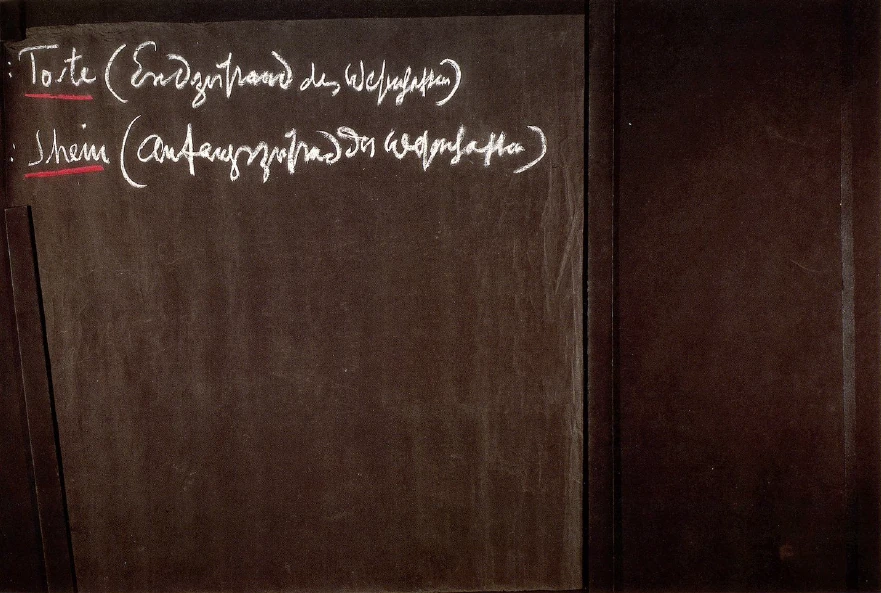
[ 8 ] But the question arises: How does one arrive at such a perspective? This can best be discussed in the context of physics; chemistry is still far too underdeveloped for that today. How does one arrive at such a view? Well, you see, one must now become clear about what one is actually doing when thinking in the direction of projecting the mechanics and physics experienced internally out into outer space. One does this by telling oneself: It doesn’t matter what is out there in space in terms of its essence. I don’t concern myself with that. I always look only at what is measurable and can be expressed in mechanical formulas; that is, I disregard everything else that is not mechanical. — What does this lead to? It leads to carrying out, in one’s understanding, the very same process that a human being undergoes when he dies—I am referring here to the physical human being. When a person dies, life leaves them; the dead organism remains. When I begin to think mechanically, life leaves my understanding. Then I have a science of the dead. And one must be radically and clearly aware of this: one constructs for oneself a science of nothing but the dead by making the mechanical-physical alone the object of one’s view of the world or of nature. One must carry this awareness within oneself: I am approaching the dead. Indeed, one must even be able to say to oneself: This is the greatness of modern natural science—that it has unconsciously resolved not to see, as the old alchemists did, a remnant of life in external nature, but to say straight out: “Whatever is in minerals, plants, animals, and so on, I regard in them only that which is dead, for I apply only ideas and concepts that apply to the dead.” Therefore, the nature of our physics is the dead.
[ 9 ] Be aware that natural science will not rest on a solid foundation until it has fully realized that, with this way of thinking, it is grasping the inanimate. The situation is similar in chemistry. I cannot elaborate on this today due to time constraints. But by viewing motion in this way—first losing sight of its speed and then building a physics upon it—we are observing the dead, that is, the final state of the essential being to which we extend our observation. For death comes at the end. So when we observe nature with the help of modern mechanics and physics, we must be absolutely clear that we are observing a corpse.
[ 10 ] Nature was not always this way. It was once different. It is foolish to believe, when I look at a corpse, that it has always been this way. The very fact that I recognize it as a corpse proves to me that it was once a living organism. The moment you realize that, with the help of modern mechanics and physics, you are viewing nature as it is—for it fits and will fit ever more closely—the more clearly you will be able to see: Present-day nature is a corpse insofar as it is confined within the concepts and ideas of modern physics. Thus, it is a corpse that is being observed.
[ 11 ] And where, then, is the possibility of returning to the initial state of the essential? The corpse is the final state of the essential. Where is the possibility of returning to the initial state? Yes, my esteemed audience and dear friends, there is no way to rediscover speed by observing motion. No matter how long you stare at the differential quotients, you will not find it there; rather, you must return to the human being and now, whereas you previously experienced the human from within, observe the human from the outside according to his physical organism—and come to realize that in the human being, and especially in the lower human, you have the initial state of the essential in nature. That is to say, you must seek the primordial state of nature here in the physical and etheric body, in the physical and etheric organization.
[ 12 ] Physics and chemistry cannot be brought to a conclusion in any other way than through true anthropology. But I would like to expressly point out that you will not achieve a true understanding of human nature by applying current physical and chemical methods to human beings. By doing so, you are once again bringing the dead back into human beings, and you are once again rendering the human physical body—that is, its lower organization—dead. You are then merely observing what is dead in human beings. You must be clear that it is necessary to observe what is alive in the human being—that is, not to apply physical and chemical methods retroactively to human nature. Rather, this requires precisely those methods that can be discovered through spiritual scientific research. In other words, spiritual scientific research fulfills the historical demand of natural science.
[ 13 ] The historical task of natural science can be summed up as follows: Natural science has come to view the corpse-like aspect of nature. Anthroposophical spiritual science must find its way back to this “corpse-like” aspect—to the primordial states that are preserved only within the human being himself and that were once, in earlier epochs of world development and the Earth’s evolution, also externally real. Once upon a time, entirely different processes were natural processes—processes that also had their beginning within themselves. Today we walk around among the remains of what was in the beginning. But in the lower human being, these primordial states are preserved for us. There one can find, all the way back to the Saturn state, what once was. You see, it simply follows that a historical perspective leads us beyond the current state of natural science. Why? That is quite clear. We are, after all, right in the midst of an epoch of development. If, as so many do, we simply regard the present form as the highest and do not realize how the actual course of events demands something entirely different, then we are also taking a historically incorrect view; for one cannot, for example, regard a person who has lived to the age of twenty-five merely by looking at the twenty-five years they have lived, but must also see within them what offers them the possibility of continuing to live. That is one thing.

[ 14 ] The other point is that our psychology has become very thin, and pneumatology has become so thin as to be nearly nonexistent. Here, too, one must understand what purpose they have come to serve in the present era. Now, when someone today speaks of blue, red, C-sharp, G, or qualities of warmth, they are saying: “These are subjective sensations.” That is, after all, already part of popular consciousness today. But what is a mere subjective sensation? It is a phenomenon, an appearance in a certain sense; so let us call it a phenomenon. Just as we observe only movement in the external natural world, so too do we observe only the phenomenon in psychology and pneumatology. And just as we lack the concept of speed when observing movement in the external world, so too do we lack the essential—the essence—in our current observation of inner spiritual life. But because we observe mere appearance and no longer experience the essence, when we experience our inner life, we no longer experience being, but rather illusion. And just as thinking, feeling, and willing are experienced today, so they are illusion. And our contemporary epistemologists are gnawing away at this illusion in a truly appalling manner. They really do seem like the famous hero who wants to pull himself up by his own hair, or like a person standing inside a railroad car, constantly pushing from the inside, completely unaware that he cannot move forward by pushing from within. That is how today’s epistemologists strike one. They speak, but there is no power in their words, because they move only within the realm of illusion.
[ 15 ] You see, I have tried twice to put an end to this line of reasoning; the first time in my *Philosophy of Freedom*, where I showed how this appearance, which lies in pure thought, is—when grasped inwardly by the human being in thought—precisely the impulse toward freedom. For if there were anything other than appearance in what one experiences subjectively, one could never be free. But when appearance becomes pure thought, then one can be free, because that which is not a being does not determine us, whereas every being would have to determine us. That was the first time. The second time was when I analyzed the matter psychologically at the philosophical congress in Bologna. There I attempted to show that, in fact, people’s sensations and thoughts are not experienced internally but externally, and that this insight can also be derived from a perspective now emerging from the spirit of the present.
[ 16 ] These attempts will simply have to be understood. Then one will know that it is a matter of finding being within appearance, just as one finds speed within motion. And then one will come to understand what this inwardly experienced appearance is. This inwardly experienced appearance will reveal itself as the primordial state of the essential. For human beings experience this appearance, live themselves as appearance within the appearance, and thereby make it the seed of future worlds. From our ethics and morality—born out of the physical world of appearance, as I have often said—future physical worlds will arise, just as the plant arises today from the plant seed. Thus, what we are dealing with here is the initial state of the essential. And only by realizing that psychology and pneumatology—if we are to have a proper natural science—must strive to regard what they gain through observation as an initial state will they actually shed, from the other side, the light that belongs to natural science. But what, then, is this initial state?
[ 17 ] It is this initial state on the outside—not on the inside, as my entire line of thought makes clear—it is the initial state on the outside; that is, when I look out and see the green carpet of vegetation, the colorful world—the red, green, and blue—and when the sounds are out there. What, then, are these fleeting formations that modern physics, physiology, and psychology insist on viewing merely as something subjective? They are the very substance from which the worlds of the future are created out there. And red is not something produced by matter in the eye or the brain; rather, red is the very first, still illusory seed of future worlds.
[ 18 ] But once you come to understand this, you will also want to take a brief look at what will one day correspond to these future worlds out there as a corpse. It will not be the corpse we have previously encountered through our physics and chemistry, but rather it will be a future corpse. One will recognize it by discovering today, in the higher human being—in whom the astral body and the “I” are primarily active—what will one day emerge out there as a future corpse. By experiencing the final state in relation to this initial state, one finally gains a proper understanding of the nervous system and the brain insofar as they are dead, not insofar as they are alive. In a certain sense, they can even be deader than a corpse, in that they still overcome the dead person’s zero point—especially with regard to the nervous system—and become deader than dead. Through this, however, they become very precisely the bearers of what is called the spiritual: that the dead lives within them; that the final state lives within them—a state that external nature has not even yet attained; and that they go even beyond this final state. Thus, in order to find psychology and pneumatology in the outside world, one will have to discover how the dead dwells within the human organism—specifically in the organization of the head and in the semi-rhythmic organization, particularly the respiratory system. We must look into our head and say to ourselves: It is constantly dying. For if it were alive, the sprouting and budding life matter would not be able to think. But because it is living out its life, because it is constantly becoming dead, the thoughts that are of a soul-spiritual nature have the possibility within it to spread out over the dead as the new living radiance.
[ 19 ] You see, these are the major challenges that arise simply from the historical perspective inherent in the natural sciences themselves. If we fail to grasp them, we will wander like ghosts through the current development of the natural sciences, rather than with the awareness of a person who knows that an epoch that has begun must also continue. You can imagine that much of the unconscious already lives within what has been discovered by the natural sciences today, for the literature provides clues everywhere. But people are not yet able to distinguish between them. That is why certain people today prefer above all else that which is as chaotic and vacillating as possible. A strict focus on physics and chemistry on the one hand, and psychology and pneumatology on the other—that does not appeal to people, for then they would have to take the inner and the outer seriously once again. People don’t like that. That is why they prefer to flounder in the murky waters between psychology and chemistry. And this gives rise to a hybrid science that has become the darling of natural science today—and even the darling of philosophers—namely, physiology. As soon as one comes to terms with reality, physiology will disintegrate, on the one hand, into psychology—that is, psychology, which is also knowledge of the world—and, on the other hand, into chemistry—that is, chemistry, which is also knowledge of human beings.
[ 20 ] Once we have these two structures, that intermediate structure—which is physiology—will disappear. Because there is a veritable quagmire today, you can find anything in it, and because everyone has the opportunity—depending on whether they lean to the left or the right—to mean a little something psychological or a little something physical, they get off scot-free. This is precisely what, above all else, must disappear as the last remnant of the obscuring of older concepts: physiology in the modern sense. For the reason physiological concepts are so unclear is that they always contain both a psychological and a physical element, which are not distinguished from one another. And it’s precisely this—that one doesn’t need to make the distinction—that appeals to people, because then one can fudge things with words and even with facts. And the essential point is, as I said, that for anyone who wants to see clearly and think clearly, physiology amounts to fudging things with words and facts. And until one dares to admit this to oneself, one does not take the history of the natural sciences seriously. For it does not merely extend from indeterminate times to the present, but it continues from the present onward, and one understands history only if one also understands the future course of events—not in a superstitious or prophetic sense, but in such a way that one can begin, starting now, to do what is right. And there is an infinite amount of the right thing to do, especially in the field of natural science. For natural science has grown up. It is, I would say, a good boy who is perhaps going through a bit of a rebellious phase right now, but who must continue to be nurtured so that he may mature. And it will continue to grow when such unclear constructs as physiology disappear, and physics and pneumatology reemerge in the manner indicated—which will already come to pass when one seriously applies the anthroposophical way of thinking to these sciences; when people once again come to believe that they are learning something when someone speaks to them of true physics, true chemistry, true psychology, and true pneumatology; when they no longer feel the urge to understand everything about the world and humanity through such hybrid disciplines and chaotic sciences as physiology. Then we will once again stand on solid ground in the development of human knowledge.
[ 21 ] In particular, of course, therapy suffers immensely from current physiology. That’s not hard to imagine, since it deals with all sorts of things that are completely beyond one’s grasp when thinking clearly. A few anthroposophical platitudes are certainly not enough to address the great challenges of our time today. Nor is it enough to tinker a little with physiology on the border between psychology and chemistry; rather, it requires a serious commitment to applying the methods derived from anthroposophy—the spiritual science—to physics and chemistry as well. If one is a slacker—please forgive the harsh expression; perhaps it is not meant quite so radically in this case—then one says: One can only judge these matters properly if one is clairvoyant. So, until I am clairvoyant, I’ll take my time; I won’t get involved in criticizing physics and chemistry—or even physiology—in any way.
[ 22 ] My dear friends, distinguished guests, one truly does not need knowledge that goes beyond the purely observable when looking at a corpse to know that it is dead and that it must have come from life. Nor does one need to be clairvoyant to properly analyze the actual facts of modern physics and chemistry and trace them back to the living principle that underlies them, once one is made aware that: You will find the living; you need only observe the lower human being; you need only observe modern humans properly, without the confusion of modern physiology—then you will have the necessary missing link for physics and chemistry. Try, for once, to truly study the mechanism of movement in humans, instead of constantly drawing coordinate axes and constructing movements within them, apart from the human being. Instead of constantly multiplying differential quotients and integrals, try studying the mechanics of movement in the human being from the outside—as it was once experienced from the inside—and then you will have what you need for your external observation of nature in physics and chemistry.
[ 23 ] In the external natural world, those who advocate atomism are still right in your view; they can even go so far as to make the very spiritual claim: If one speaks of matter in the sense of today’s physicists, then for them, matter is certainly not something material. Physicists already say this today; our opponents say this. In this case, they are correct. If we respond to this correctness merely by remaining where half-truths prevail—namely, merely the final states of what is essential—then we will never be a match for what comes from our opponents, which is necessary in the present.
[ 24 ] This is where the specialists come in. This is where those with the necessary training in one scientific field or another come in. But then we will not be establishing a “physicized” anthroposophy or a “chemized” anthroposophy; rather, we will truly establish an anthroposophical chemistry and an anthroposophical physics. Then we will not be establishing a newer form of medicine that is merely slightly modified in the spirit of traditional medicine; rather, we will establish an anthroposophical medicine. The tasks are certainly there, and they are outlined everywhere. The point is that, just as the simple soul can take in the remarks scattered throughout the lectures and lecture cycles—remarks that can sustain the human being—so, too, can the individual hints be grasped everywhere, hints that must lead to the necessary progress in the individual sciences.
[ 25 ] But the future cannot unfold unless humanity and nature become one again; unless what is investigated in nature as the ultimate state of the essential—through physics and chemistry—is complemented by an essential aspect belonging to physics and chemistry within the lower human being, within the human being who is dependent on the physical body and the etheric body. What matters is that this be sought, not that one emphasize valence systems in chemistry, structural formulas, or the periodic table as particularly essential, for that, after all, is merely a schema. It is not that alone that matters—these things are quite useful as units of measurement or as entire methods of calculation—but what matters is that one says to oneself: If I study chemical processes from the outside, the chemical laws are not to be found there, for they lie in the emergence of the chemical processes themselves; I find them solely when I set out, through serious work, to investigate the processes within the human being—those that take place in the circulation of the humors and in the activity of the humors through the activity of the etheric body. The explanation of the chemical processes in nature lies in the processes of the etheric body. And these, in turn, are reflected in the interplay of humors in the human organism, which is accessible to close study.
[ 26 ] Anthroposophy, my dear friends and esteemed guests, is certainly a task in this direction—and a serious one at that—and that is why we have established research institutes where we must begin to work intensively so that the methods arising from anthroposophy are truly cultivated. This is also the essence of our therapy: that the old, confused physiology finally disappear from it, and be replaced by a real chemistry and a real psychology. But without this real chemistry and without this real psychology—into which physiology must be broken down—we will never be able to say anything about the processes of disease and healing in human nature, because every disease process is simply an abnormal psychological process and every healing process is an abnormal chemical process. And only when we are able to see to what extent the chemical process of healing can be influenced, and to what extent the psychological process of becoming ill can be understood through true psychology, will we also have a pathology and a therapy. This follows from the spirit of the anthroposophical approach.
[ 27 ] And if one doesn’t want to see that within oneself, then one just wants something—well, something that’s a little different from other things—but one doesn’t really want to get down to work. For everything I have outlined here is really just a description of how one should work, because a true psychology in that sense, a true chemistry in that sense, comes about through work. And fundamentally, the conditions for this work are already in place, because there are a great many facts in the literature that people have stumbled upon—like a blind chicken finding a grain of corn—but do not understand. If those who work in our anthroposophical sense were to take up these facts and contribute to ensuring that they are truly understood—so that, for example, what I emphasized yesterday in a smaller circle is understood: that the essential aspect of the spleen is that it is actually an excretory organ, that it itself is an excretion of what matters, namely the functioning in the etheric body—and there are countless facts in the medical literature that simply need to be processed, but indeed should be processed—then things will certainly come together, and what is meant to emerge will emerge.
[ 28 ] A single individual in a single physical lifetime might be able to do that, perhaps, if that physical life lasted six hundred years. But by then, other tasks would already be waiting, and what one had accomplished would long since be outdated. What is to be accomplished for humanity must also be accomplished through human cooperation and collaboration. Therefore, cooperation and collaboration must emerge. This is the second task. And I believe that these tasks of the Anthroposophical Society emerge most clearly and radically from a genuine, realistic examination of the history of natural science in modern times.
[ 29 ] This history of modern science shows us on every page that something magnificent has emerged, for it was never before possible to truly contemplate what is truly dead, and therefore it was never possible to create anything from the dead. One could never before truly contemplate inner appearance; therefore, one could never bring inner appearance to life through human power, and thus could not attain freedom either. Today we stand before a magnificent world that has become possible solely because natural science contemplates what is dead—this is the world of technology, which reveals itself in its own special way simply by the fact that the word is taken from Greek, where it still means “art,” thus revealing art wherever technology still contains spirit. Today, technology is the processing of the spirit solely in the sense of abstract, spiritless thought, and we stand before technology today in such a way that we must say to ourselves: We have been able to achieve it only by gaining a true understanding of the dead. It was necessary for human development to look properly at the realm of the dead. Through this, it has entered the realm of technology. But now humanity stands within this realm of technology that surrounds it on all sides; now it stands there, gazing into this realm of technology: this is, at last, a domain where there is certainly no spirit in the true sense. What matters is that, in technology—with regard to the spiritual aspect of technology in every field—one has that inner feeling which almost corresponds to the sense of grief experienced at the death of a human being. For even if one can develop feeling and emotion through knowledge, one will still have a feeling—albeit of a different kind—similar to what one feels at the passing of a human being, when a living organism becomes a corpse, or when one looks upon a corpse. One will experience such a feeling—alongside abstract, indifferent, cold knowledge—when one truly recognizes that technology is the processing of the dead. Then this feeling will be the strongest impetus to seek the spirit through new paths.
[ 30 ] And actually, I could imagine that a vision of the future is this: that humanity stands above all the smokestacks, above all the factories, above all the telephones, above all that which technology has miraculously brought forth in recent times—as if above a vast, purely mechanical earth—that he stands above this grave of all that is spiritual and lets his yearning cry resound into the universe—his longing would be fulfilled. For just as the living fire bursts forth from dead stone—which is certainly dead—through the right treatment, so must the living spirit emerge from dead technology when people who truly understand technology are present.
[ 31 ] And on the other hand: One need only be clear about what pure thinking is—that is, that illusion from which the strongest moral impulses, the individual moral impulses, as I have described them in *The Philosophy of Freedom*, can be drawn—and then one will stand before that feeling in a new way, the same feeling before which Nicholas of Cusa and Meister Eckhart once stood. They said: When I rise above everything I am initially accustomed to observing, I arrive at the “Not” with everything I have learned. But in that “Nothing,” the “I-not,” the “I,” arises for me. — If a person only advances quite correctly to pure thought, then in this pure thought he finds the “Nothing” that becomes the “I-not,” becomes the “I,” from which, however, the entire fullness of ethical actions emerges—actions that are newly world-creating. And I could imagine a person who, at first, by allowing all the knowledge of the present—as it has just been inaugurated by the natural sciences—to take effect upon him, and now in more recent times, centuries after Meister Eckhart and Nicholas of Cusa, turns his gaze inward and, using today’s mode of thinking, arrives at this “nothingness” of the inner self—and how, in this “nothingness,” he discovers how the Spirit now speaks to him more than ever. And I could imagine that these two things might unite—that, on the one hand, a person might go to the place where technology, in a desolate way, abandons all spirit, and that there he might direct a cry out into the far reaches of the universe for the Spirit; and if he were then to reflect and thus look into his inner self, as I have just described, he would then receive from within the divine answer to his call sent out into the far reaches of the universe. If we learn, through a new, anthroposophically oriented natural science, to let the calls resound out into the world from within us in infinite longing for the spiritual, then that will be the right starting point for us to also find, through an anthroposophically oriented inner knowledge, the answer to this call for the spiritual that has been cried out longingly into the far reaches of the universe.
[ 32 ] I did not merely wish to present to you the development of the natural sciences in modern times in a documentary manner; rather, I wanted to show you the perspective of a person who understands this scientific development and, at this critical juncture in human history, knows how to speak out for the right path forward for humanity.