The Emergence of Natural Science
in World History
and its Subsequent Development
GA 326
3 January 1923, Dornach
Translated by Steiner Online Library
Eighth Lecture
[ 1 ] Ladies and gentlemen, dear friends, messages of solidarity and sympathy continue to arrive. I will take the liberty of sharing those messages here tomorrow or the day after tomorrow.
[ 2 ] I have attempted to show how individual areas of scientific thought have emerged in modern times. I would like to insert a discussion intended to shed some light on what has taken place in the formation of scientific views, because one can better understand what is actually at stake in the overall course of human development when one sheds light on these matters from a certain perspective. One must be absolutely clear that what appears in the outer culture and civilization of humanity is, inwardly, I might say, is permeated by, or coursed through, a kind of pulse—a pulse that springs from deeper insights which do not necessarily always manifest as such, as insights that are taught, but which in fact underlie development in another way—a way that I will also hint at in the coming days. For now, I would simply like to say that one can better understand what is at stake in this regard by drawing on what, at certain times, was known as the science of initiation—the science of the deeper foundations of life and world events.
[ 3 ] We know that the further back we go in human evolution, the more we encounter an instinctive spiritual-scientific understanding, an instinctive clairvoyant perception of what is happening, so to speak, behind the scenes of existence. And we also know that it is possible in the present to attain a deeper understanding because—to put it in layman’s terms— since the last third of the 19th century—following the flood of materialistic views and feelings that swept through the 19th century—the very relationship between the spiritual world and the physical world has made it possible to draw spiritual insights directly from the supersensible world once again. Since the last third of the 19th century, it has been possible to deepen human knowledge to such an extent that one can spiritually contemplate, at its very foundations, what takes place in the external natural world.
[ 4 ] So that one might say, for example: An older, instinctive science of initiation gives way to an exoteric human civilization—a civilization in which there is little trace of direct spiritual knowledge in the world. And then, in turn, a new dawn of spiritual knowledge breaks—this time fully conscious, no longer instinctive spiritual knowledge.
[ 5 ] We are at the beginning of this development of a new spiritual knowledge. However, it will continue to unfold into the future. If one now gains insight into what human beings regarded as their knowledge during the time of the ancient, instinctive science of initiation, then, against the backdrop of these insights, it becomes clear that up until the beginning of the 14th century, views existed in the civilized world that cannot be directly compared to our present-day understanding of nature—because they were of an entirely different nature—and which, on the other hand, are even less comparable to what modern science calls the study of the soul or psychology. Here, too, one must say that it was of a different nature. Both the spiritual-psychic aspects of the human being and the physical-natural aspects were, in a certain way, conceptualized in terms that are no longer understood at all today by people who do not explicitly engage with the science of initiation. It was an entirely different way of thinking and feeling.
[ 6 ] If we now compare what was once the science of initiation with the insights of earlier times—some of which are at least partially known to us through history—we find, despite the fragmentary nature of the tradition, that there were profound insights and deep conceptions regarding human beings, their relationship to the world, and so on. People today are reluctant to acknowledge the value of, for example, the 9th-century work by Johannes Scotus Erigena on the classification of nature. They are reluctant to do so because they do not regard such a work as a historical monument from a time when people thought very differently from today—a time when people thought in ways that are no longer comprehensible when reading such a work today. And when ordinary philosophers present such things in their historical writings, one is really dealing only with words. A genuine engagement with the actual spirit of such a work—such as Johannes Scotus Erigena’s treatise on the classification of nature, in which “nature” means something entirely different from the word “nature” in later natural science—such an engagement with this spirit is, in fact, no longer present. If, however, one were to delve into this through the humanities, one would, strangely enough, have to admit the following: Scotus Erigena developed ideas that give the impression of delving extraordinarily deeply into the essence of the world, but he undoubtedly presented these ideas in his work in an inadequate, non-penetrating form. If one were not to run the risk of speaking disrespectfully of a work that is, after all, a towering achievement in human development, one would essentially have to say that even Johannes Scotus Erigena himself no longer fully understood what he was writing. This is evident from his exposition. For him, even if not to the same degree as is the case for today’s historians of philosophy, the words he drew from tradition were, to a greater or lesser extent, merely words whose deeper meaning he himself no longer grasped. In fact, when reading these works, one feels increasingly compelled to go back in history. And from Scotus Erigena—as is readily apparent from his writings—one is led directly to the writings of the so-called Pseudo-Dionysius the Areopagite. I do not wish to go into this issue of historical development now—when he lived and so on. And from this Dionysius the Areopagite, one is in turn led even further back. At that point, one really must continue researching, equipped with spiritual science, and finally—when one goes back to the 2nd or 3rd millennium B.C.—one arrives at profound insights that have been lost to humanity, insights that exist only as a faint echo in writings such as those of Johannes Scotus Erigena.
[ 7 ] But even if we are able to delve deeply into the works of the Scholastics themselves, we will find that behind the incredibly pedantic, academic presentation lie profound ideas about the way in which human beings perceive the external world that confronts them; how, in this perception, the supersensible lives on the one hand, the sensible on the other, and so on. And if one considers the continuous tradition that is in turn grounded in Aristotle—who himself, in a logical and pedantic manner, summarized ancient knowledge that had been handed down to him—one encounters the same thing: Profound insights that were once well understood in ancient times, extending into the Middle Ages, are repeated in successive historical epochs yet are understood less and less. That is the defining characteristic. And in the 13th and 14th centuries, this understanding then disappears almost entirely, and a completely new spirit emerges—namely, the Copernican-Galilean spirit, the essence of which I have attempted to characterize for you in my recent lectures.
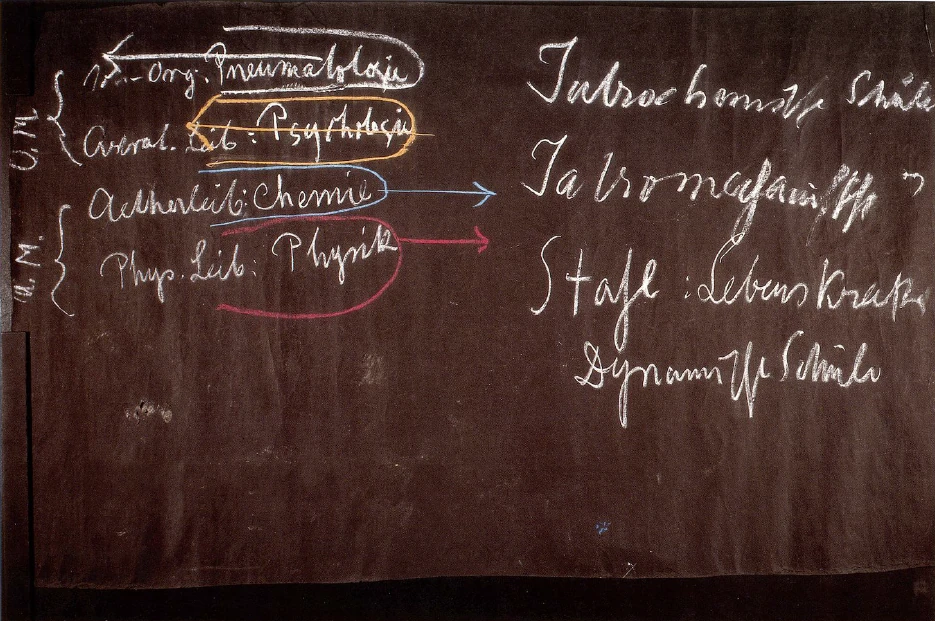
[ 8 ] Wherever one undertakes such research—the spirit of which I have just outlined—one finds that this ancient knowledge, which was passed down from epoch to epoch, becoming less and less understood as it reached the 14th century, essentially consisted of an inner experience of what takes place within the human being, that is, in the experience—and this will be very understandable in light of the discussions of the past few days—of the mathematical-mechanical aspect of human movement, in the experience of a certain chemical process, as we would say today, in the inner flow of humors within the human being, which is permeated by the etheric body. So we can indeed view the diagram I wrote on the board for you yesterday (see p. 109) from a historical perspective, so to speak. For we can view it this way: If we look again today at the nature of the human being through our initiatory science, we have the physical body, the etheric body or body of formative forces, the astral body—the inner soul—and the ego organization. As I mentioned yesterday, there was—arising from the old science of initiation—an inner experience of the physical body, an inner experience of what constitutes movement, an inner experience of the dimensionality of space, as well as an experience of other physical-mechanical processes; and we can call this inner experience the experience of the physical in the human being. At the same time, this experience of the physical in the human being is precisely the recognition of physical-mechanical laws: there was a physics of the human being oriented toward the physical body. It would never have occurred to anyone at that time to seek physics in any way other than through experience within the human being. In the Galilean-Copernican era, however, with the advent of mathematics—which is then applied to physics—that which is experienced so inwardly is cast out of the human being and grasped only in the abstract. Thus, we can say: Physics moves out of the human being, whereas previously it was contained within the human being itself.
[ 9 ] A very similar process was observed in what was experienced internally in human beings as humoral processes—processes involving the aqueous, liquid components of the human organism. Yesterday I referred to Galen in the early Christian centuries, who described the human being internally by saying: Within the human being lives “black bile,” which circulates in the humoral streams, “blood,” “phlegm,” and the ordinary bile, the “white” or “yellow bile.” Through the intermingling and mutual influence of these humoral currents, the human being develops in the physical world. But what Galen asserted was not based on methods similar to our modern physiological methods; rather, it was essentially grounded in inner experience. Galen, of course, had also inherited this knowledge through tradition. But what he had received through tradition—what he simply drew from tradition—was once experienced inwardly in the fluid part of the human organism, which is permeated by the etheric or formative body.
[ 10 ] Based on this fact, I also described the Greek philosophers at the beginning of my *Riddles of Philosophy* in a way that differs from how they are usually portrayed. If you read the standard histories of philosophy, you will find this account everywhere: Thales reflected on the origin of what exists in the sensory world, and he sought the origin, the starting point for everything, in water. Heraclitus sought the starting point in fire, others in air, others in the solid, for example, in a kind of atom, and so on. The fact that such things can be said without giving any thought to the fact that it is, in essence, inexplicable why Thales specifically declared water, and Heraclitus fire, to be the origin of things—this does not strike people as odd today. You need only read my book *The Riddles of Philosophy* and you will see how simply Thales’s view—expressed in the sentence: “Everything has sprung from water”—was based on an inner experience. He sensed the activity of what was simply called “the watery” in those days, and he felt that this inner activity was akin to that which underlies external natural processes; thus, he described the external world based on his inner experiences. The same was true of Heraclitus, who, I would say, had a different temperament. Thales was, as we would say today, a phlegmatic who lived in the inner “water” or “phlegm.” He thus described the world as a phlegmatic would: “Everything has sprung from water.” — Heraclitus was the choleric who experienced the inner “fire.” He described the world as he experienced it. And alongside them there were even more penetrating minds, no longer recorded in the external tradition today. They knew even more about these things. What they knew was then passed on and existed as tradition in the early Christian centuries, so that Galen was able to speak of his four constituents of the human internal humoral system.
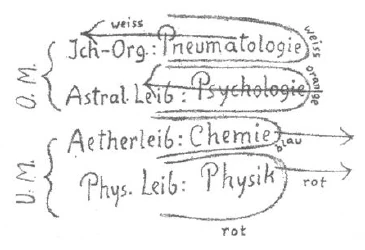
[ 11 ] What people knew back then about the inner nature of the humors—how these four types of humors: yellow bile, black bile, blood, and phlegm—interact and mix—which we today regard as child’s play, well, that’s understandable—is actually what constitutes inner human chemistry. There simply was no other chemistry back then. For what was viewed externally as phenomena that today belong to the realm of chemistry was judged according to these inner experiences, so that we can speak of an inner chemistry based on the experiences of the “humoral man”—if I may use that expression—permeated by the etheric body. And so, in earlier times, we linked this chemistry to the human being. Later, it emerged—just as mathematics and physics did—and became external chemistry (see diagram). Just think for a moment how the physics and chemistry of earlier times were experienced by people! They were experienced as something that was, in a sense, a part of themselves, not merely a description of external nature and its processes. That was the essential point. It was experienced physics, experienced chemistry. In such a time, when people felt external nature in their physical body, in their etheric body, they also experienced what is in the astral body and what is in the “I”-organization differently than they did later. Today we have psychology. But this psychology—one should admit it, though one does not—is in fact a collection of nothing but abstractions. Thinking, feeling, and willing, as well as memory, imagination, and so on, are actually listed there only as abstractions. This arose gradually from what one still regarded as the content of one’s own soul. Chemistry and physics had been cast aside; thinking, feeling, and willing—these were not cast aside; they were retained, but they gradually became so diluted that they essentially became nothing more than a collection of the most insubstantial abstractions. The easiest way to prove that these became insubstantial abstractions is as follows: Take, for example, the people who, as late as the 15th and 16th centuries, still spoke of thinking and willing. The way they spoke—please consult older writings on these subjects—all of this still has the character of something concrete. One gets the feeling that when such a person speaks of thinking, they still speak as if this thinking were truly a sum of inner processes within them, as if thoughts were colliding and carrying one another. It is still an experience of thoughts. The matter was not yet as abstract as it later became. Later, it developed to such an extent that, by the time the 19th century arrived and toward the end of the 19th century, it had become easy for philosophers to deny any reality to these abstractions altogether and to speak of them only as inner mirror images and so on—which, in a particularly witty manner, was precisely what the often-cited Richard Wahle did, who now explains the “I,” thinking, feeling, and willing as nothing more than illusions. Abstractions then become illusions—the inner contents of the soul.
[ 12 ] Precisely at the time when human beings perceived their walking as a process taking place simultaneously within themselves and in the world, when they sensed the movement of their bodily fluids—so that they knew that when they moved, say, in the hot sunshine—that is, when external influences were present—their blood and phlegm moved differently within them than they did in the cold of winter. He experienced the movements of blood and phlegm within himself, but he experienced them together with the sunshine or the absence of sunshine. Just as he experienced the physical and chemical aspects together with the world, so too did he experience thinking, feeling, and willing together with the world. He did not merely internalize them in the manner of later times, when they gradually evaporated into complete abstractions, but rather through the experience of what is taking place within the human being, and not in the movement of bodily fluids, or in physical movements and the unfolding of physical forces, but in what belongs to the human being’s astral nature—the soul—this experience encompassed what was the subject matter of psychology at that time (see Diagram $.120).
[ 13 ] It was now bound entirely to human beings. With the dawn of the age of natural science, human beings thus projected physics out into the world, chemistry out into the world; psychology, however, they projected inward into themselves. One can trace this process particularly in the works of Bacon of Verulam and John Locke. Everything that is experienced as the content of the soul in relation to the external world—sound, color, and thermal qualities—is thrust into the human being.
[ 14 ] This process plays out even more in relation to the organization of the self. The organization of the “I” gradually became a rather tenuous experience. As one looks within oneself, the “I” has gradually become something like a point. Consequently, it has in turn become very easy for philosophers to argue it away. Not “I”-consciousness, but the experience of the “I” was, in earlier times, something rich in content and fully real. And the experience of the “I” found expression in what was then a science higher than psychology—a science that might be called pneumatology. In later times, humanity also internalized this and diluted it into its truly rather tenuous sense of the “I” (see diagram, p. 120).
[ 15 ] When a person had the inner experience of his physical body, he had the physical experience; at the same time, he experienced what was taking place in the external natural world in a manner analogous to the processes occurring within his physical body. And it is similarly the case with the etheric body. In this case, not only the etheric but also the physical world of fluids—though dominated by the etheric—was experienced inwardly. What, then, is experienced inwardly when a person perceives the psychological, when they experience the processes of their astral body? What is experienced inwardly is what, if I may put it this way, constitutes the “air-human.” After all, we are not merely solid organic structures—sap-filled organic structures, that is, watery structures—but we are also constantly gaseous and airy on the inside. We inhale the air and exhale it again. In intimate union with this inner processing of air, human beings experienced the substance of psychology. That is why it was more concrete. Once the experience of air—that which can also be observed externally—was cast out of the content of thought, that content became increasingly abstract, a mere thought. Consider how the Indian philosopher strove in his exercises to become truly aware that in breathing—in the process of breathing—something akin to the thought process was taking place. He practiced a regulated breathing process in order to make progress in his thinking. He knew that thinking, feeling, and willing are not merely “airy-fairy” matters, as we view them today, but are, after all, connected to external nature and, in particular, to inner nature as it relates to breathing—that is, connected to the air. So if one can say that human beings cast the physical and the chemical out of their organization, one can also say that they drew in the psychological—but they cast out the external element, namely the experience of breathing air. He cast himself out of the physical and chemical realms and observed the external world solely as physics and chemistry; from the psychological realm, he cast out the external world—the air—and likewise, from the pneumatological realm, he cast out the warmth. This is what made the “I” so thin.
[ 16 ] So when I refer to the physical body and the etheric body as the “lower human being” (see diagram, p. 120), and to the astral body and the “I-organization” as the “upper human being,” I can say: Historical development during the transition from an earlier age to the age of natural science shows that human beings cast out the physical and the chemical from within themselves and incorporated only external nature into their physical and chemical concepts. In psychology and pneumatology, human beings developed concepts from which they cast out external nature and experienced only what remained of it within their inner concepts. In psychology, so much remained that they at least still had words for the contents of the soul. So little remained for the “I” that pneumatology—though partly prepared for by dogmatics—disappeared entirely. Everything shrank down to the point of the “I.”
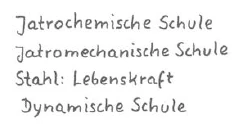
[ 17 ] This took the place of what was once experienced as purely unified, when one said: There are four elements: earth, water, air, and fire; one experiences earth within oneself when one experiences the physical body; one experiences water within oneself when one experiences the etheric body as the mover, mixer, and separator of life forces; one experiences air when one experiences the astral body in thinking, feeling, and willing, for thinking, feeling, and willing were experienced as undulating upon the inner breathing process; and warmth, or fire, as it was called at the time, was experienced in the sense of the “I.”
[ 18 ] We can therefore say: The modern scientific worldview developed out of a transformation of the entire relationship of human beings to themselves. And if one traces historical development with these insights in mind, one finds, first of all, what I told you earlier, and in every new epoch new interpretations of the old traditions—but ones that are understood less and less. And remarkable testimonies to such old traditions are the views of figures such as Paracelsus, van Helmont, and Jakob Böhme.
[ 19 ] With Jakob Böhme, anyone who is able to gain insight into such matters immediately experiences that an extraordinarily simple man is speaking—a man whose knowledge comes from sources that cannot be discussed here today, as they would lead too far afield—but who, in a manner that is truly difficult to understand precisely because it is so clumsy, Jakob Böhme incorporates deep, ancient insights into this clumsy presentation—insights that have simply been passed down in a folk tradition. What, then, was the situation of someone like Jakob Böhme? While Giordano Bruno, who belonged to the same era, was so deeply immersed in what he considered the latest phase of human development—as I described in an earlier lecture in this course—we see in the case of Jakob Böhme that he quite evidently had access to all sorts of works that have, of course, been lost today. Through an inner disposition, he perceives in works that present the most varied material in their outward form that this traces back to a primal meaning. And he, in turn—I would say, amid immense inner obstacles that make the result somewhat clumsy—presents this primordial wisdom, which he had inherited from even clumsier, inadequate traditions. Yet he was able to return to an earlier stage as a result of his inner enlightenment.
[ 20 ] And if we now turn to the 15th and 16th centuries, and especially to the 17th and 18th centuries, and if one looks beyond individual figures such as Paracelsus and Jakob Böhme—who are really only there as monuments to a bygone era—and considers what is present in the ongoing exoteric stream of human development, then, by applying the standard of initiatory science and illuminating the matter with its light, one gets the impression: No one really knows anything anymore about the deeper foundations of the nature of the world. What has already happened is that physics has been cast out of the human being, that chemistry has been cast out of the human being; mockery of alchemy is already arising. Of course, this mockery was justified, for what remained of the ancient traditions—namely, medieval alchemy—was indeed worthy of ridicule. What remained was a psychology that had been internalized within the human being and a very superficial pneumatology. So people had broken with what had previously been known about the human being, and they experienced, on the one hand, that which was separated from the human being, and on the other hand, that which had been chaotically thrown into the human being. And one might say that this very fact, just characterized, was evident everywhere in what was now being sought as knowledge of the human being.
[ 21 ] For example, in the 17th century, a view emerged that—when considered in isolation—remains quite incomprehensible, but which becomes entirely understandable when placed within the context of history: the view that the entire sum of the processes a human being undergoes internally as part of digestion is based on a kind of fermentation. Whatever a person ingests as food is mixed with saliva, permeated with digestive juices—from the pancreas, for example—and various degrees of “fermentation processes,” as they were called, take place there. If one considers these things from today’s perspective—which, of course, is itself merely a passing phase—one can naturally scoff at them. But then one is not striving for insight, but at most for a professorial exposition. If, however, one delves into the matter, one sees where such admittedly strange views about human beings come from. The old traditions—which, as far back as Galen and even earlier, were based on inner experiences and made good sense—are fading away entirely. And what is now supposed to exist externally as a crude chemistry is present only in its very most basic elements. The inner aspect is no longer present; the outer aspect has not yet developed. And so one is able to speak of the inner nutritional processes only in terms of extraordinarily weak, neo-chemical concepts, such as a vaguely conceived fermentation. And it was the stragglers of Galenic doctrine who, while still sensing to some extent that one must start with the movement of humors—that is, with the fluid within the human being—in order to understand the human being, had at the same time already begun to view the chemical aspect solely in terms of external processes, and who thus applied the externally observed processes of fermentation to the human being. Human beings had become empty sacks because they no longer experienced anything within themselves. Into these empty sacks, people now poured what had become external science. Well, back then in the 17th century, it was still limited. People had vague notions about fermentation and similar processes. These were now projected onto human beings. This was the so-called iatrochemical school of the 17th century.
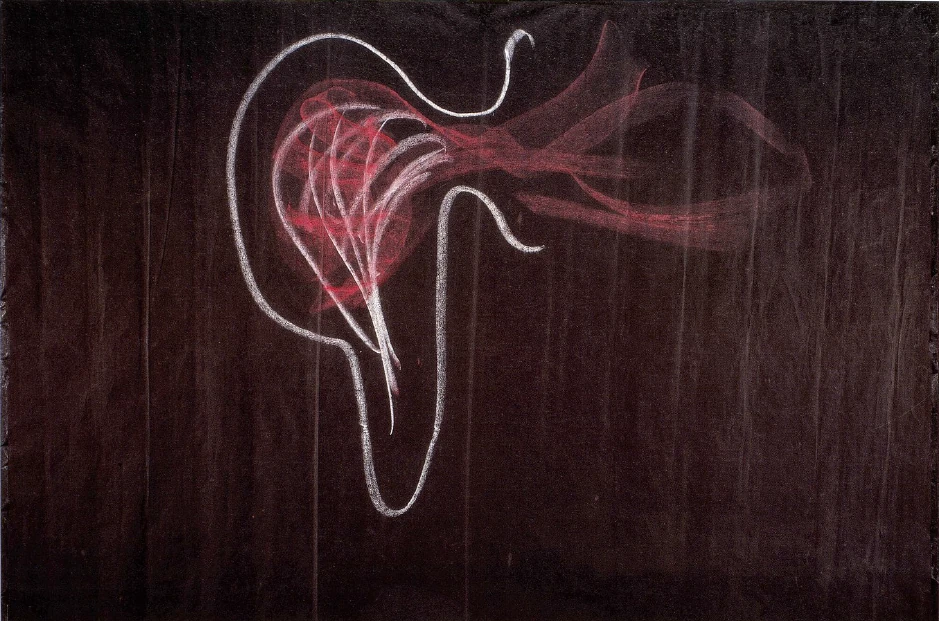
[ 22 ] When one considers the iatrochemists, one might say that their ideas still contain something like faint shadows of the ancient theory of humors, which was based on inner experience. Others, however, who were more or less contemporaries of these iatrochemists, no longer held such shadowy notions at all, and they began to view human beings as they appear, for example, when we open an anatomy textbook today. When we open an anatomy book today, the human being is depicted as follows: for the sake of argument, a skeletal system is shown, along with the stomach, the heart, and the liver, and anyone following this description inevitably gets the impression that this is the whole human being, consisting of more or less solid organs with sharp contours. These are, of course, present to a certain extent. But the solid—the earthly, to use the old term—is, at most, one-tenth of the human being. For the rest, the human being is a column of fluid. Of course, not in the actual description, but in the way it is viewed, the fact that the human being is a column of fluid has gradually been entirely forgotten—as has the fact that within this column of fluid these organs with their solid contours are formed, organs that simply float within it. Today, these are simply depicted, thereby creating the impression—especially among laypeople—that by doing so one has understood the human being. If you look at today’s illustrations in the anatomical atlas, you’ll see that this has been developed, but it presents a false image. It represents only one-tenth of the human being. To depict the rest of the human being, one would have to draw within these structures—the stomach, liver, and so on—a continuous flow of humors in the most varied ways, an interplay of humors, an interaction of humors (see drawing on p. 128). People have come to hold completely false notions about how this actually works, because, in a sense, they have focused almost exclusively on the clearly defined organs of the human body. And so it came to pass, for example, that in the 19th century people were extraordinarily struck by the fact that when a person drinks the first glass of water—I will speak of water now—it gives the impression that it passes right through the person and is processed by their organs everywhere in the way it is received. But when they drink the second or the third glass of water, it doesn’t give the impression at all that it is being processed in the same way. These things were observed at the time, but they can no longer be explained because we have developed a completely false conception—if I may put it that way—of the “fluid human,” in which the etheric body was the driving force that mixes and separates the fluids, bringing about organic chemistry within the human being.
[ 23 ] Well, in the 17th century, people really began to gradually ignore this “fluid human” entirely and to focus only on the clearly defined parts. As a result, it gradually became apparent that humans were viewed as a system of distinct parts. Within this world of clearly defined parts, everything unfolds in a mechanical order. One thing pushes against another; things move; things are pumped; things function like suction pumps or pressure pumps. Mechanically, then, the human body is viewed as a body existing solely through the interconnection of clearly defined organs. And gradually, out of the iatrochemical perspective—actually, almost simultaneously with it—emerged the iatromechanical or even iatromathematical view. Naturally, the view that the heart is essentially a pump that pumps blood through the body—in a strictly mechanical sense—flourished particularly strongly, because people no longer realized that the human body’s internal humors possess an inner life, that the humors thus move of their own accord, and that the heart is merely a sensory organ for perceiving this movement of the humors in its own way. Thus, the whole matter was turned on its head; attention was no longer directed toward the movement of the humors, toward the inner vitality of that movement, or toward the etheric body at work within—and the heart became a mechanical apparatus, which, in essence, it still is today for most so-called physiologists and physicians.
[ 24 ] So the iatrochemists still possess a faint glimmer of knowledge about the etheric body. In what Galen expounded, there was indeed a full awareness of the etheric body. In the teachings of van Helmont, for example, or Paracelsus, there is a faint awareness of the etheric body; an even fainter one among the official medical chemists who taught at the schools. The medical mechanists, however, had no awareness whatsoever of this etheric body. Every notion of the etheric body had vanished, and human beings were conceived of solely as physical bodies—but only in terms of their solid constituents, which were now treated with physics, a discipline that had already been expelled from the human being and was thus applied externally to a human being who was no longer understood. First, they had turned the human being into an empty sack—I would like to use this example again—they had established physics in an abstract way outside of the human being and had now thrown this physics back into the human being. So that what they had was not the living essence of the human being, but an empty sack filled with theories.
[ 25 ] That is still the case today. For what human physiology or anatomy tells us today is not the human being itself; it is the physics that has been extracted from the human being and has now been transformed by being crammed back into the human being. Especially when one truly contemplates this development from within, one sees how fate unfolded. The iatrochemists still had a faint awareness of the etheric body, while the iatromechanists had none at all. Then came a man named Stahl. He was, in fact—considering his era—an extraordinarily intelligent person. He had evidently looked into the work of the iatrochemists. These inner processes of fermentation seemed inadequate to him, because they merely returned the chemistry that had already been cast outward back into the human body. This was even more true of the medical-mechanists, for they merely returned the external mechanical physics back into the human body. But there was nothing left of the etheric body as the driving force behind the movement of the humors—no tradition at all. There was no way to learn about it. What did Stahl do in the 17th and 18th centuries? He invented something for himself, because there was nothing left in the tradition—he invented something for himself. He told himself: The physical and chemical processes taking place within the human being surely cannot be based on the physics and chemistry that we now find in the external world. But he had nothing else to introduce into the human being. So he invented what he called “vital force.” Through this, he founded the dynamic school. It was, therefore, a retroactive invention for something that had been lost. Stahl was, in fact, still animated by a certain instinct. He was missing something. Since he didn’t have it, he at least invented it: vital force. The 19th century, in turn, went to great lengths to rid itself of this “vital force.” In reality, it was nothing more than an invention, and so people once again went to great lengths to rid themselves of this “vital force.”
[ 26 ] So it is indeed the case that we struggle to put something back into this empty sack called “human” that somehow fits inside. And so, on the other hand, we came to say to ourselves: We have the mechanical aspect. We know how a machine moves and reacts. And so they stuffed the machine into the empty sack of “humanity”: “L’homme machine” by de La Mettrie. Man is a machine. The materialism—or rather, the mechanism—of the 18th century, as found, for example, in Holbach’s *Système de la nature*, which Goethe hated so intensely in his youth, represents the inability to grasp the essence of the human being using what was already present in external nature at that time and later became so influential. And even the 19th century was gnawed by this inability: one could not get to the core of human nature.
[ 27 ] But people still wanted to use something to explain human beings. So they settled on presenting humans as highly evolved animals. Admittedly, animals were not fully understood either, because—with the exception of pneumatology—understanding animals in the traditional sense also required physics, chemistry, and psychology. But at first, people did not realize that one also needs such things to understand animals. They simply started from a certain premise, didn’t they? And so, in the past—in the 18th century—people traced humanity back to the machine, and in the 19th century, to the animal. All of this can be well understood from a historical perspective. Throughout the entire course of human development, this has its own valid purpose, for it was under the influence of this ignorance regarding the human being that modern conceptions of humanity arose. Had the old views persisted—regarding inner physics, inner chemistry, and the psychology and pneumatology experienced by human beings as external to themselves—then, for example, the development of freedom would never have emerged in the course of human evolution. Human beings had to lose themselves as elemental beings in order to find themselves as free beings. They could do this only by, so to speak, stepping back from themselves for a while, no longer paying attention to themselves, engaging with the external world, and—when they sought theories about themselves—incorporating into themselves what now fit very well with their understanding of the external world. During this interim period, in which humanity took its time to develop something like a sense of freedom, during this interim period humanity developed the concepts of the natural sciences—those concepts which, I would say are so robust that they can grasp external nature, but are too crude for the essence of the human being, because he did not take the trouble to refine them to the point where they could also encompass the human being. Scientific concepts emerged that are well-suited to nature and celebrate its great triumphs, but which are useless for encompassing the essence of the human being.
[ 28 ] From this you can also see that I am truly not offering a critique of the natural sciences, but rather that I merely wish to provide a characterization. It is precisely through this that human beings attain their full sense of freedom—that they were no longer burdened by all that they actually had to bear when they still carried the whole thing within themselves. This experience of freedom for human beings came when they cobbled together a science that, in its robustness, was suited only to external nature, and since it is, after all, not a totality, it can naturally be subject to criticism; it is not applicable to human beings—it is actually most conveniently applicable only in physics; in chemistry it already begins to falter, and psychology actually becomes a complete abstraction. But people had to pass through an age that unfolded in this way in order to arrive at a completely different perspective—the perspective of an awareness of freedom—and at an individually nuanced moral conception of the world. One cannot understand the emergence of the natural sciences in the modern era if one views them only one-sidedly, if one does not regard them as a parallel phenomenon to the consciousness of freedom now emerging in the same era—and to everything that is morally and religiously connected with this consciousness of freedom.
[ 29 ] Therefore, we see how such people—who, like Hobbes or Bacon, lay the foundations for the ideas of natural science—find themselves unable—read Hobbes’s work on this—to connect human beings to that which constitutes the mind and soul in the universe. And what emerges from Hobbes is that, on the one hand, I would say, in the most radical way, nips the concepts of natural science in the bud; on the other hand, he expels everything spiritual from human social life, establishes the war of all against all, and thus recognizes nothing binding in social life that comes from any supernatural source—which is why, in a somewhat caricatured form, he is actually the first to discuss the consciousness of freedom theoretically.
[ 30 ] Yes, the development of humanity is certainly not linear. One must consider the parallel currents; only then can one come to understand the meaning of humanity’s historical development.