

The Emergence of Natural Science
in World History
and its Subsequent Development
GA 326
2 January 1923, Dornach
Translated by Steiner Online Library
Seventh Lecture
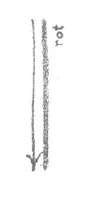
[ 1 ] Ladies and gentlemen, my dear friends, we have received expressions of sympathy and solidarity from many of our friends and supporters regarding our grief over the loss of the Goetheanum. I will take the liberty of reporting to you on these individual messages tomorrow or the day after tomorrow.
[ 2 ] Today, continuing the discussions we had yesterday about—one might say—the inability of the scientific worldview, which has emerged since the 15th century, to grasp the essence of the human being, I would like to say: What is lacking in all areas of this worldview is precisely what is already lacking in the mathematical-mechanical realm. The mathematical-mechanical has been separated from the human being. It is viewed as if the human being were no longer present in the experience of the mathematical. This trajectory of human thinking regarding mathematics has the consequence, on the one hand, of giving rise to the endeavor to separate other events taking place in the world from human beings and to no longer connect them with the human being. This, in turn, leads, on the other hand, to the inability to consciously build a genuine bridge between human beings and the world.
[ 3 ] I will discuss another consequence of this inability later on. But let us first consider—I would say—the root cause of why scientific development has taken this course. It has lost the ability to experience inwardly what is spoken of today in anthroposophy, and what in earlier times of human development was the subject of an instinctive perception or, if the word is not misunderstood, of instinctive clairvoyance. The ability to look into the human being and find him composed of various elements—this has been lost to the scientific perspective.
[ 4 ] Let us recall how, within our anthroposophical worldview, we divide the human being into parts in order to gain insight into his nature. We speak of the human physical body, the etheric body, the astral body, and the human “I” organization. Let us keep this clearly in mind today as we seek to understand the development of the scientific worldview: physical body, etheric body, astral body, and the “I”-organization. I do not need to go into greater detail about this division of the human being today, since everyone can find the necessary information on this subject, for example, in my book *Theosophy*. But let us now use this structure of the human being as our guide. Let us first ask ourselves: when we look at the human physical body and consider the possibility of inner orientation—that is, the possibility of experiencing one’s physical body from within—what do we actually experience in this physical body? It is precisely in the physical body that one experiences what I have spoken of so often—right and left, up and down, front and back. In the physical body, one experiences the perception of movement as a change in the position of one’s own physical body. But one also experiences in this physical body—at least to a certain degree, and in varying ways—for example, weight. But one experiences weight in a thoroughly modified way. When these things were still experienced in the various members of the human organism, people used to reflect on matters that, in the age of natural science, they no longer felt inclined to consider. Facts of fundamental importance to our understanding of the world were left completely unheeded. Consider the following fact: Suppose you were to carry a person who, if placed on a scale, weighs the same as you do. Suppose you are carrying this person. You walk a certain distance with this person while carrying them. You will have an experience of their weight. As you yourself walk the same distance, you are also carrying yourself. But you do not experience this in the same way. It is indeed the case that you are carrying your own weight through space, but you do not experience it. Your own weight is incorporated into your experience in a completely different way. As one grows old, one feels one’s limbs in a certain sense in such a way that one says one feels their heaviness. This is also connected, in a certain sense, with heaviness, with weight, because growing old entails a certain disintegration of the organism, whereby its individual parts are increasingly torn away from inner experience, become independent—I would say, atomized—and, in this atomization, succumb to heaviness. But of course, we could never bring this to actual reality at any moment in our lives. Perhaps we might even say that we can only use the expression “we feel the heaviness of our limbs” in a comparative sense. A more precise science, however, shows that it is not merely comparative, but that it has something significant in itself. But in any case, the experience of our own weight actually presents itself to our consciousness as a kind of obliteration of our own weight.
[ 5 ] So here we have the necessity inherent in the human being to to extinguish within the human being those effects that are undoubtedly present within this human being—to extinguish them through opposing effects, effects that are as opposite as I have explained with regard to the totality of the human being when I presented the analogy between the human being and the course of the year in the other lectures, the anthroposophical lectures. But in any case, whether we experience the more clearly perceptible processes—such as the three spatial dimensions and movement—or the less clearly perceptible processes of weight, we have processes that can be experienced in the human physical body.
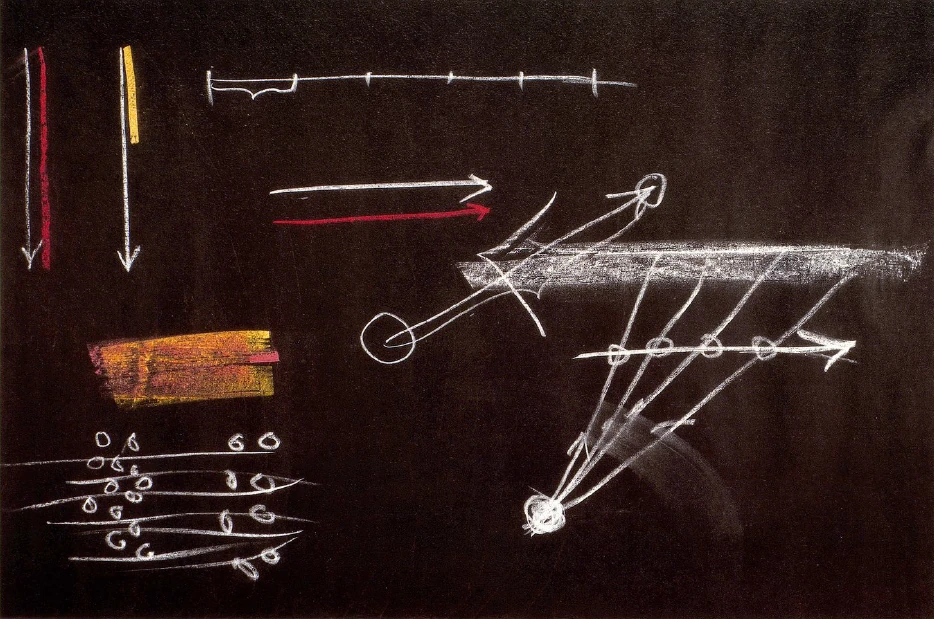
[ 6 ] What was once experienced in earlier times has since been completely separated from human beings. It has, so to speak, been set apart from them. This has become quite clear to us in the case of mathematics. With other experiences of the physical body, it becomes less vivid for this very reason, because the corresponding processes in the body—such as weight and heaviness—are completely erased from consciousness as it is today, as it has developed. But they were not always completely erased. Today, influenced by what underlies the scientific conception of the human soul’s state of mind, we simply no longer have any idea of how different the inner experience of human beings actually was. Certainly, in earlier times, human beings did not consciously carry their own weight through space. But they did have the feeling that while this weight was indeed present, a counterweight was also present. And when they learned something—as was the case, for example, with the students of the Mysteries—they came to recognize that while they carry their own heaviness within themselves and always with them, the counteracting force is also constantly at work in the light. So that, in a certain sense—it can indeed be put this way—people felt they had to be grateful to that spirituality which is in the light for counteracting within them the spirituality and soulishness that operate through heaviness. In short, one could demonstrate everywhere that a conception of something that was regarded as entirely separate from the human being did not actually exist in earlier times. Human beings experienced the processes within themselves in conjunction with what such processes are in nature. For example, when a person saw a stone falling in nature—which, in reality, was separate from himself—he experienced the essence of movement. He experienced this by comparing it to what such a movement would be like within himself. So when he saw a falling stone, he experienced something like this: If I wanted to move in the same way, I would have to give myself a certain speed, and this speed is different in the case of the falling stone than when, for example, I see a very slow, creeping entity before me. People experienced the speed of the falling stone by applying their own experience of movement to the observation of the falling stone. Thus, the phenomena of the external world that we today classify as physics were indeed viewed objectively by those people of the past; yet their cognition was carried out in such a way that they drew upon their own experience to aid this cognition, in order to see what was happening within themselves reflected in what was happening out in the world. And so, in fact, the entire physical way of viewing the world up to the beginning of the 15th century contains something about which one can say: This physical way of viewing the world brought the objects of nature themselves—in their physical processes—closer to the inner experience of human beings. Human beings experienced nature in this way as well. But with the 15th century began the separation of the perception of such processes from human beings. And with it came the separation of mathematics—a way of thinking that then became intertwined with the entire natural sciences. Only now was the inner experience within the physical body truly lost. Now what constitutes the inner physics of the human being was completely lost. External physics became just as separated from human beings as mathematics itself. The progress that resulted from this consists in what I would call the objectification of the physical. You see, one can observe something eminently physical in two ways. Let’s stick with the falling stone. One can follow this falling stone (drawing, arrow) with external observation, and one can combine this with the experience of the speed one would have to attain if one wanted to run as fast as the stone is falling. This results in an understanding that involves the whole person, not merely an understanding connected solely to visual perception.
[ 7 ] Let us now consider what became of such an older view at the beginning of the 15th century. Let us proceed from this starting point to the figure in whom this transition—which I have characterized in this way—can be seen most clearly: let us turn to Galileo. Galileo is, in a sense, the discoverer of the laws of falling bodies, as they are called. And the most important objective aspect of Galileo’s laws of falling bodies is that he determined the distance a falling body travels in the first second. Thus, an earlier conception placed, alongside the sight of the falling stone, the inner experience of the speed one must attain if one wishes to move at the same rate as the falling stone. The inner experience (drawing, red) was placed alongside the falling stone. Galileo also observes the falling stone. But he does not add the inner experience; rather, he measures the length of the path in the externalized space that the stone traverses from the moment it begins to fall until the end of the first second. Since the stone falls with increasing speed, he then also measures the subsequent distances. Thus, he does not juxtapose an inner experience, but rather something that is measured externally—a process that has nothing at all to do with the human being; it is completely separated from the human being. The physical is cast out of the human being in perception and cognition to such an extent that one no longer even becomes aware that one actually possesses it internally as well.
[ 8 ] Indeed, during this period—the early 17th century—opposition arose against Aristotle, who had been regarded throughout the Middle Ages as the great authority on science—though he had also held back the progress of that very science— opposition to Aristotle arose among all those minds that sought to move forward. If one properly considers Aristotle’s explanations—which are often misunderstood today—regarding such things as a falling stone, they essentially boil down to this: he consistently points out that whenever one observes something in the world, one should imagine what it would be like to experience it oneself. For him, then, it is not a matter of determining speed through measurement, but of conceiving of speed in such a way that the process is related to a human experience. Of course, when a person tells himself he must project himself into this speed, he feels, in a sense, behind this act of projecting himself into it, something alive and powerful within himself that propels him into this speed. In a certain sense, they feel their own inner impulse, and it is, of course, quite foreign to them to think that something is pulling them in the direction they are going. They think much more about how they propel themselves than about being pulled by something. Therefore, gravitational force—gravity—only really became something of significance to human perception in the 17th century. Human conceptions of nature are changing in a radical way. And just as I have shown with the law of falling bodies, the same applies to all physical concepts. One such concept, for example, is what is today called the law of inertia in physics. It is also referred to as the principle of persistence. But the “law of inertia” is, of course, a very general term. This law of inertia still reveals its human origin. I need not describe to you what inertia means for human beings, for surely everyone has experienced it. In any case, it is something that can be experienced inwardly. What has become of the law of inertia in physics under the influence of Galileanism? In physics, it has come to mean that a body—or, more precisely, a point—a point upon which no external influence is exerted, left to its own devices, moves through space at a constant velocity; that is, it covers the same distance in every second throughout all periods of time. Thus, if there is no external influence and the body has reached a velocity such that it moves a certain distance per second, it will also move that same distance in every subsequent second (see diagram). It is inertial. It has no tendency, in the absence of any external influence, to change in this respect. It continues to move in such a way that it covers the same distance every second. The only thing that is measured is the distance covered in one second. Indeed, a body is said to be inert when it behaves in such a way that it covers the same distance every second.

[ 9 ] People used to see things differently. People used to say: How does one experience such a moving body that covers the same distance every second? One experiences it in such a way that one remains in whatever state one happens to be in, that one never intervenes in one’s own behavior at all. Of course, as human beings, we can regard this at most as an ideal. Humans achieve this ideal of inertia only to a very limited extent. But one will notice that when one has what is commonly called inertia in everyday life, one will realize that this is, after all, an approximation of it—doing the same thing continuously, every second of one’s life.
[ 10 ] From the 15th century onward, the entire orientation of human thought was steered in a direction characterized by this: Human beings forget their inner experience. First and foremost, we are dealing here with the inner experience of the physical organism. Human beings forget it. And what Galileo devised for such things that are obvious to human beings—such as the law of falling bodies and the law of inertia—for it is indeed a devising, a devising that, admittedly, deals with what can be observed in nature—what Galileo applied to the obvious was now also applied on a broader scale.
[ 11 ] We know how Copernicus established a new world system in the physical sense by placing the Sun at the center—rather than the Earth—and by having the planets move in circles around this Sun, and then determining the position of any planetary body in the sky based on that. This was a model that Copernicus devised of our planetary system—the solar system—a model that can, of course, be depicted. Yes, this image did not yet strive quite so radically toward that mathematical mindset which completely separates the external world from human beings. Anyone who reads Copernicus’s writings certainly gains the impression that Copernicus still senses that older astronomy—which sought to comprehend the solar system, for example, through its complicated lines—did not merely summarize the successive, let us say, optical positions of the planets, but this older astronomy also had a sense of what it would be like to experience these movements of the planetary system from within. One might say: In earlier times, people had a very clear conception of the epicycles and so on, which were thought to be described by certain stars. But there was still, I would say, at least a shadow of human feeling in all of that. Just as, let’s say, when someone paints a person with a certain arm position, one understands that arm position because one can experience for oneself what it’s like to make that arm position—so there was still something alive in the re-experiencing of a planet’s orbit around its fixed star. Yes, even with Kepler—and particularly so with him—there is still something thoroughly human in the calculations of planetary orbits.
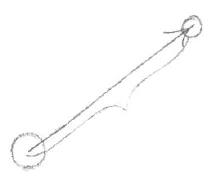
[ 12 ] Newton now applies the distinct Galilean principle to the celestial bodies by adopting something like the Copernican system in his conception, constructing ideas such as this: A central body—say, the Sun—attracts a planet in such a way that the force of this attraction decreases with the square of the distance, becoming smaller and smaller, but decreasing proportionally to the square of the distance, and increases with the mass of the bodies. Thus, if the attracting body has greater mass, the force of attraction is greater. As the distance increases, the force of attraction becomes smaller and smaller, but in such a way that, when the distance is twice as great, it becomes four times smaller; when it is three times as great, it becomes nine times smaller, and so on. Once again, a purely mathematical measurement is introduced into the picture, which is in turn conceived as entirely separate from human experience. With Copernicus and Kepler, this is not yet the case; with Newton, a so-called “objective something” is constructed, in which nothing of an experience is perceived at all, but where only construction takes place. Lines are constructed in the direction in which one looks, and forces are, so to speak, imagined into them—for what one sees is, after all, not a force; the force must be imagined into it. Of course, one says: “conceived” as long as one believes in the matter, and when one no longer believes in it, one says: “imagined.” So that one can say: Through Newton, the separate physical way of viewing things is now generalized to such an extent that it is applied to the entire universe. In short, there is an endeavor to to completely forget the experience within the human physical body, and to view as an object that which was previously thought to be closely connected with the experience of the physical body—independent of this physical body in the space outside, which one has oneself first torn away from the physical body—and to find ways and means to speak of it without even thinking of the human being at all. So that one can say: Through the separation from the physical body, through the separation of what is observed in nature from the experience within the human physical body, modern physics arises—which actually only comes into being with this separation of certain natural processes from the direct experience within the human physical body (drawing, yellow).
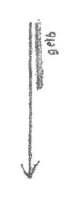
[ 13 ] On the one hand, people had forgotten the experience of the self within the physical body (see Figure 5.103, red). But by now saturating everything out there with isolated mathematical analysis and an isolated physical perspective (yellow), it was no longer possible to return to the human being with this physics. What had first been isolated could not be applied to the human being again. In short, the other side of the matter emerges: the inability to return to the human being with scientific knowledge.
[ 14 ] Well, in the physical realm, one doesn’t really notice this; but one notices it very strongly when one asks oneself: What about a person’s inner experience within the etheric body, within this finer organism? After all, a person experiences all sorts of things there as well. But this experience was separated from the human being even earlier and with greater radicalism. It’s just that this separation wasn’t as successful as it was in physics. For if we go back to a scientist of the early Christian centuries, the physician Galen, we find that Galen, in observing what exists in the external natural world, distinguished—in the spirit of his age—the four elements: earth, water, air, and fire—what we would call heat. This is what one perceives when one directs one’s gaze outward. But when one directs one’s gaze inward, focusing on the inner experience of the etheric body, and asks oneself: How does one experience these elements—the solid, earthy; the watery; the airy; the warm, fiery—within oneself?—people at that time simply said: One experiences them through the etheric body. Then one experiences it as an inwardly felt movement of the humors: earth as “black bile,” water as “phlegm,” air as “pneuma”—that which is taken in through the process of breathing—and warmth as “blood.” Thus, one experiences inwardly in the humors—in that which circulates throughout the human organism—the very same thing one observes externally. Just as one experiences the movement of a falling stone in the physical body, so does one experience the elements in the inner processes; just as in the metabolic process—where, as was once thought, bile, phlegm, and blood interact—one perceived this as the inner experience of one’s own body, but as that form of inner experience corresponding to external processes—those processes that take place between air, water, fire, and earth.
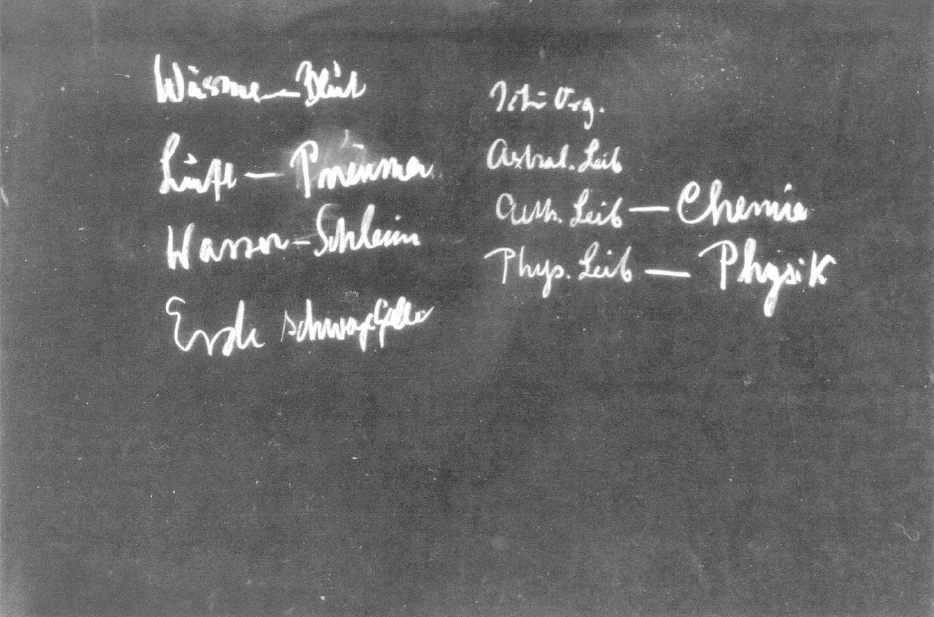
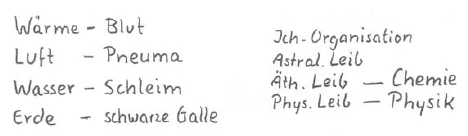
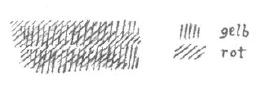
[ 15 ] Here, however, one was not quite so resolute and radical in forgetting one’s inner life, yet still managed to bring enough of it along for external observation. In the case of a fall, one could measure, for example, the distance fallen in the first second. A law of inertia was derived by assuming that there could be moving points that do not change their state of motion but rather maintain their velocity. But by attempting to expel from this inner experience—which in earlier times was perceived as something so specifically unique—the elements that constituted it, one was indeed able to forget the inner realm, yet one did not bring into the external world anything comparable to what measurement, etc., was or is. Thus, one did not succeed in objectifying what pertained to this in the same way as one did with the physical. And this is essentially how it has remained to this day. And that is why, to this day, chemistry—which could have emerged had one been able to extract from oneself into the external world for the etheric body as much as was achieved for the physical body, and which could thereby have become something that could stand alongside physics— this chemistry has not become such a discipline; rather, even today it remains the case that when it seeks to speak of its laws, it speaks of something quite indeterminate and vague. For in fact, chemistry seeks to do for the etheric body what physics has done for the physical body. Chemistry does say: When substances chemically combine—in the process of which they can completely change their properties, except for their state of aggregation—then, of course, something happens. But if one does not simply want to resort to the simplest and most convenient conception, one does not know much about this process. Water consists of hydrogen and oxygen—yes, one must somehow conceive of these two as intertwined within the water (diagram, yellow and red); but no concept that can be experienced inwardly is formed regarding how they are to be conceived as intertwined. One then explains it through something external, but quite superficially: hydrogen consists of atoms or molecules, for the sake of argument, and so does oxygen. These move about, collide with one another, and stick together, and so on. In other words, by neglecting the inner experience, one was no longer in the same position as in physics, where measurement was possible—for physics came to rely more and more on measuring, counting, and weighing—but was instead compelled to conceive of the inner process purely through thought. And in a certain sense, this has remained the case with chemistry to this day. For what is still conceived of today as the inner nature of such chemical processes is, in essence, something added to the processes through thought.
[ 16 ] We will only have a chemistry that has grown out of physics when we approach it with a full understanding of what has been presented here today—even if we no longer have the direct human experience of an earlier, instinctive clairvoyance—and nevertheless bring chemistry back into harmony with humanity. Of course, this will not succeed until we realize that, even with regard to physics—at least to complete our individual knowledge into a worldview—we must also bring our thoughts about individual phenomena back into harmony with the human being. For what happens on the one hand when one forgets inner experience and then approaches the external world, seeking to measure it externally—seeking to remain in the external, in the so-called objective—will take its toll on the other hand. For one might easily say: Inertia expresses itself in the motion of a point that travels the same distance every second. But no such point exists. This uniform motion does not occur anywhere when observed with human means. It does not occur anywhere, for a moving object is always in some kind of connection and is affected in its speed here or there. In short, what one might describe as an inertial mass, or what one might attribute to the law of inertia, does not exist. But when one speaks of motion and cannot draw upon the inner experience of motion—that is, the shared experience with nature, the grasping, let’s say, of the speed of a fall through the way one would oneself experience that speed—then one must simply say, yes, I am completely outside of that motion. I have to orient myself to the external world. So if I see a body moving here (see drawing), and if these are its successive positions, then I must somehow perceive that this body is moving. If there is a wall back here, I look in this direction, then in that direction, then in this direction, and so on. If I calmly imagine the back wall, then I say: The body is moving away in this direction. — But it would also be necessary for me to direct my perception from here (dark circle), that is, to become aware of an inner experience.
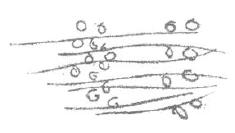
[ 17 ] If I orient myself solely based on what is out there, if I completely disregard the person and isolate him entirely, then the result is the same, whether an object here continues to move or whether it is at rest and the wall moves instead (see drawing). I simply can no longer tell whether the body is moving in one direction or the wall behind it is moving in the opposite direction. And, strictly speaking, I can calculate everything under both sets of conditions.
[ 18 ] So I lose the ability to even grasp the movement internally if I don’t experience it firsthand. And that also applies to other physical elements, if I may put it that way. By eliminating firsthand experience, one is prevented from building any bridge at all to the objective event. If I am walking myself, I will not be able to say that it makes no difference whether I am walking or whether the ground is moving in the opposite direction; but when I myself observe another person from the outside as they move across the ground, it makes no difference at all to this purely external observation whether the person is running there or whether the ground beneath them is moving in the other direction. And the present age has indeed reached the point where it is, I might say, experiencing the world spirit’s vengeance for this separation of the physical.
[ 19 ] While Newton was still entirely certain that he could assume absolute motion, we see today many people striving to demonstrate how the concept of motion—and the understanding of motion—has been lost along with the inner experience of it. This, after all, is the essence of the theory of relativity, which today seeks to upend Newtonian physics. This theory of relativity has emerged in a thoroughly historical manner. It must exist today, for one cannot go beyond it if one remains confined to those concepts that have been completely separated from human experience. For if one wishes to recognize rest or motion, one must experience them firsthand. If one does not experience them firsthand, then even rest and motion are relative to one another.
[ 20 ] Well, we'll continue discussing these matters here tomorrow at 8:00 a.m.