

The Emergence of Natural Science
in World History
and its Subsequent Development
GA 326
1 January 1923, Dornach
Translated by Steiner Online Library
Sixth Lecture
[ 1 ] In one section of my last lecture, I spoke about how the scientific worldview has one of its roots in the fact that, in the time that has passed since, I would say, the moment of the birth of this scientific worldview in the 15th century, John Locke and like-minded thinkers distinguished, within what surrounds us through our senses, the so-called primary qualities of things—the physical world—from the secondary qualities. Locke called primary qualities, for example, everything that relates to the shape of bodies, to their geometric properties, to numerical characteristics, to motion, to size, and so on. He then distinguished these from everything he called secondary qualities: color, sound, the sensation of warmth, and so on. And while he locates the primary qualities within the things themselves—so that he assumes there are spatial, physical things that have shape, geometric properties, and motion—he assumes that everything that constitutes secondary qualities—color, sound, and so on—are merely effects on human beings. Out there in the world, there are only primary qualities in bodies. Something that possesses size, shape, and motion, but is dark, silent, and cold—something exerts an effect, and this effect is expressed precisely in the fact that a person experiences a sound, a color, a quality of warmth, and so on.
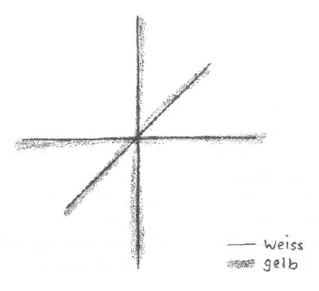
[ 2 ] In these lectures, I also pointed out how, in this age of natural science, “spatiality” has already become an abstract concept, even in terms of dimensions. People were no longer aware that within themselves the three dimensions were concretely experienced as up-down, right-left, and front-back (see drawing on p. 86). In the age of natural science, they paid no heed to this concreteness of the three dimensions. For him, they arose in complete abstraction. He no longer sought the intersection of the three dimensions where it is actually experienced—within the human being—but sought it somewhere else—and there it can be anywhere in space—and thus constructed his three dimensions for himself. Now this spatial schema of the three dimensions had an independent, but merely conceptual, abstract existence. And what was conceived was not experienced as belonging to either the external world or to the human being, whereas in an earlier time, as I said, the three spatial dimensions were experienced in such a way that the human being knew he was experiencing them within himself together with the nature of physical corporeality.
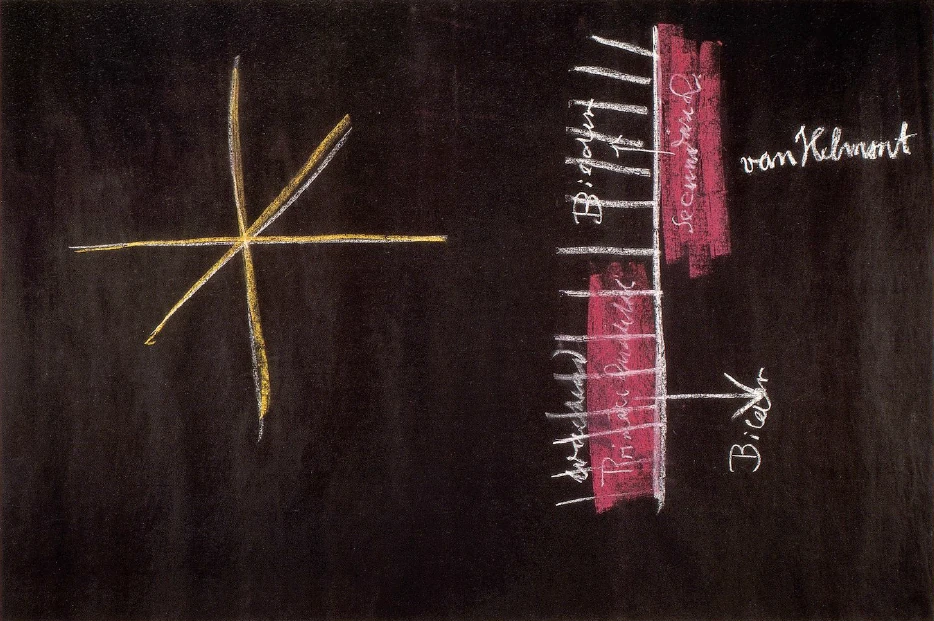
[ 3 ] In a sense, the spatial dimensions had already been separated from human beings and cast outward, thereby taking on a completely abstract, lifeless character. Human beings no longer knew that they experience the spatial dimensions—and the same can be said of everything else that is geometric, numerical, weight-related, and so on— —that he experiences all of this within himself in conjunction with the external world, but that, in order to experience it in its concreteness, in its full, living reality, he must look within himself to find it justified there. And in fact, the reason a figure like John Locke attributed primary qualities—which are of the same nature as the three spatial dimensions (for the three spatial dimensions are a kind of form)—to the external world was simply because the connection between these qualities and the human inner being was no longer understood.
[ 4 ] The other, secondary qualities—which are actually experienced qualitatively as sensory content, such as color, sound, thermal quality, smell, and taste—were now regarded solely as the effects of things on human beings, as inner experiences. But I have already pointed out how these secondary qualities can no longer be found within the physical human being, nor within the etheric human being; how, in a certain sense, they have thus become “outlaws” even within the human being. People no longer sought them in the external world; they relocated them to the human interior. It was said: If a person does not listen to the world, if a person does not look at the world, if a person does not reveal their sense of warmth to the world, then the world is silent, and so on. It has primary qualities—specifically shaped air waves—but it has no sound; it has certain processes in the ether, but it has no color; it has certain processes occurring in ponderable matter—in matter that has weight—but it lacks what constitutes the quality of warmth, and so on. In fact, in this age of natural science, what was really being said about these experienced sensory qualities was simply this: we do not really know how to account for them. People did not want to look for them in the world. They admitted to themselves that they had no power to find them in the world. One did seek them within, but only because one was—or is—thoughtless. One was—or is—thoughtless in the sense that one takes no account of the fact that, if one were to truly investigate this inner realm of the human being—to the extent that one accepts its existence— that is, if one explores it to the extent that this is naturally possible—though this happens only as an ideal, so that one cannot actually speak of the fact of a complete exploration—if, therefore, one explores this inner self, one finds these secondary qualities nowhere. One therefore does not really know where to place them in the world. Where does this come from?
[ 5 ] Well, let’s recall once more: If one wishes to properly examine anything related to form, space, geometry, or even arithmetic—if one truly wishes to examine such things correctly—one must take into account the inner activity, this vital activity through which human beings construct spatial relationships within their own organism, such as up and down, front and back, right and left. So in this case one must say: If you want to discover the essence of the geometric-spatial—though one could also say, quite appropriately: If you want to discover the essence of Locke’s primary qualities of physical things—then you must look within yourself; otherwise, you will arrive only at abstractions. Now, with regard to the secondary qualities— sound, color, thermal quality, smells, and taste, the situation is such that a person must know something about them—this knowledge may indeed be purely instinctive, but they must know something about them—because with their spiritual-soul being, they do not merely live within their physical and etheric bodies, but can also exist outside these bodies with their “I” and their astral body, namely in the state of sleep. But just as a person, in a full, intensely experienced waking state, experiences the primary qualities not outside but within themselves—such as, in the specific case, the three dimensions— so too does a person know—when they succeed, whether through instincts, instinctive self-knowledge, or training in spiritual science, in truly experiencing inwardly what lies outside the physical and etheric bodies from the moment of falling asleep until waking—that they truly experience the true nature of sound, color, smell, taste, and warmth in the external world outside their body. When a person is merely within their inner self while awake, they can experience nothing other than the images of the true realities of sound, color, quality of warmth, smell, and taste. But these images correspond to spiritual-soul realities, not physical-etheric realities. Nevertheless, just as what we experience as sound seems to be so strongly connected—and indeed it is— but in a completely different sense—to specific air waves, just as color is related to certain processes in the colorless external world; nevertheless, it must be acknowledged that sound, color, and so on are images, not of the physical, but of the spiritual and soul-spiritual that exists in the external world.
[ 6 ] So we must be able to say to ourselves: When we experience a sound, a color, or a quality of warmth, we experience them as images. But we experience them in reality when we are outside our body. And so we can, for example, schematically represent this state of affairs in the following way (see drawing): A person experiences the primary qualities while awake—fully awake—within themselves, and perceives them in the external world as images; if they are aware of them only in the external world, then they have these primary qualities only as images (arrow). These images are the mathematical, geometric, and arithmetic aspects of things.
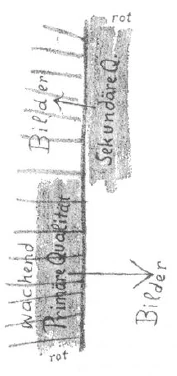
[ 7 ] It is different with the secondary qualities. A person experiences these when I denote the physical and etheric bodies with these horizontal lines and the spiritual-soul aspect, the “I,” and the astral body with the color red—a person experiences these outside of their physical and etheric bodies and projects only the images inward. Because this was no longer understood in the age of natural science, mathematical forms—and numbers as well—became, so to speak, something that people sought only abstractly in the external world. The secondary qualities, on the other hand, became something that people sought only within themselves. But because they are merely images there, they were completely lost to reality.
[ 8 ] The fact was that certain individuals, who still held on to traditions stemming from older views of the external world, struggled to form concepts that were more in line with reality than those which—I might say—gradually emerged as the “official” ones in the course of the scientific age. For example, in addition to Paracelsus, there was also van Helmont, who was fully aware that when color, sound, and so on are experienced, the human spirit is at work. But because this spiritual aspect, in the waking state, is active only with the aid of the physical body, it produces within itself merely an image of what is contained as essence in sound, color, and so on; and thus one arrives at an inaccurate description of external reality—namely, the purely mathematical-mechanical form of movement, the configuration of movement for that which is to be experienced as secondary qualities within the human being. Whereas in truth, in accordance with its reality, it can be experienced solely outside the human body. One need not say to a person: “If you want to recognize the true nature of, for example, sound, you must conduct physical experiments on what takes place internally in the air—which carries the sound to you—when you hear a sound.” Rather, one must say to the person: If you want to come to know the true nature of sound, you must form a concept of how you actually experience sound outside your physical and etheric bodies. But these are thoughts that were simply not conceived by the people of the age of natural science, because these people did not want to engage with the entirety of human nature, because they did not develop a inclination to come to know the true essence of the human being. And so they did not find mathematics or even the primary qualities in human nature, which was unknown to them; and so they did not find the secondary qualities in the external world—because they did not know that the human being also belongs to the external world.
[ 9 ] I am not saying that one must be clairvoyant to gain the proper insight into these matters, but I must emphasize that, while a clairvoyant explanation of the world can provide deeper, more intense insights—especially in this area—a healthy introspection can certainly lead to applying the mathematical, the primary qualities, the mathematical-mechanical aspects—into the inner being of the human being, and to project the secondary qualities into the outer world of the human being. People no longer understood human nature. They did not really know how the physicality of the human being is imbued with spirituality, how spirituality—by being awake within the human being—must forget itself, must surrender itself entirely to the body, in order to comprehend the mathematical. Nor did people realize the other aspect: that spirituality must withdraw entirely into itself and live independently of the body—that is, outside the body—in order to access the secondary qualities. I say that clairvoyant perception can provide deeper insights into all these things, but it is not necessary. Self-observation—true, healthy self-observation—can sense, and recognize through genuine feeling, that mathematics is also something intrinsically human, while sound, color, and so on are also external phenomena.
[ 10 ] I outlined what, while simply a healthy intuition, can nevertheless lead to genuine insights in this direction in my introductions to *Goethe’s Scientific Writings* in the 1980s. No account was taken of clairvoyant insight there, but it was shown to what extent a person can come to recognize the reality of color, tone, etc., without clairvoyant insight. This has not yet been understood. The age of natural science is still too caught up in the Lockean way of thinking. This could not be understood—nor could it have been understood—when I explained it clearly in 1911 at the Philosophical Congress in Bologna, in what I would call a philosophically condensed form. There I attempted to show how, in the waking state, the human spirit-soul is indeed present in the physical and etheric bodies, but remains inwardly independent in terms of its quality—in a sense, by filling the physical and etheric bodies. If one senses this inner independence of the human spiritual-soul aspect, then one also has a sense of what the spiritual-soul aspect has experienced during sleep in terms of the realities of green and yellow, G and C-sharp, warm and cold, sour and sweet, and so on. But the age of natural science did not initially wish to engage with a true understanding of the human being.
[ 11 ] From this characterization of the human being’s relationship to the world in terms of primary and secondary qualities, we can see very clearly how human beings lose the ability to have a correct perception of themselves and their relationship to the world. But the same thing was also inherent in other conceptions that people formed about human beings. Because people could not gain a clear understanding of how mathematics lives within the human being in its three dimensions, they were also unable to grasp the essence of the human being in terms of its spirituality. For this essence would have consisted in saying to oneself: Human beings are able to grasp the concepts of right and left through the symmetrical movement of their arms and hands, and through the other symmetrical movements they perform. By feeling, for example, the passage of food through their system, they are able to experience front and back. They experience up and down because, in the course of their lives, they first orient themselves within this framework of up and down. If one understands this, one sees how human beings internally unfold the activity that lies in the creation of the three spatial dimensions; and when speaking of human beings in relation to the animal world, one points out the characteristic fact that animals do not perceive, for example, “up” and “down” in the same way as human beings do, because their essential bodily axis lies in the horizontal plane, that is, in what human beings can perceive as front and back. The abstract spatial schema was no longer sufficient to fathom anything other than mathematical-mechanical-abstract relationships in inorganic nature. It was not sufficient, for example, to develop an understanding of the inner experience of space, on the one hand in animals and on the other in human beings.
[ 12 ] And so, at least in this age of natural science, no definitive opinion could initially emerge on the question: What is the actual relationship between humans and animals, and between animals and humans? How do they differ? Yet since people still sensed, in a certain way, that there is a difference between humans and animals—they sought to identify it in all sorts of characteristics that could not be fundamentally distinctive, neither for humans nor for animals. A very significant example of this is the observation regarding the human upper jaw, where the upper teeth are located: “In humans, this jawbone is a single unit; in animals, however, the front incisors are situated in a separate intermediate jaw, and only on either side of this intermediate jaw is the actual upper jaw.” Humans, it was claimed, do not have this intermediate jaw. Thus, having lost the ability to discern the relationship between animals and humans through inner spiritual and soul aspects, people sought it in something so external that they said: “Animals have the intermediate jaw; humans do not.”
[ 13 ] Goethe was the one who, although he could not put into words insights such as those I have expressed today regarding primary and secondary qualities, nor could he arrive at external thoughts about them with complete clarity, nevertheless possessed a sound intuition regarding all these matters. Above all, Goethe knew instinctively that one must find the distinction between humans and animals in the entirety of human development, and not in any single feature. That is why Goethe became an opponent of the idea that humans lack an intermediate jawbone. And as a young man, he wrote his significant treatise, which attributes an intermediate jaw in the upper jaw to both humans and animals. And he succeeded in finding conclusive factual evidence for this assertion by demonstrating that, even in the embryonic stage of human development, the intermaxillary bone is clearly visible; yet as humans develop—even in young children—it fuses with the upper jaw, whereas in animals it remains separate. Goethe approached all of this out of a certain sound instinct for insight, and it was through this instinct that he initially came to say: One must not seek to find the difference between humans and animals in such details; one must seek it in the overall relationship of their form, their soul, and their spirit to the world. Therefore, Goethe’s opposition to the natural scientists who deny the existence of the intermediate jaw in humans—his challenge to these natural scientists—means, on the one hand, that he brought humans close to animals in terms of outward appearances, so that, on the other hand, he could highlight their true distinction precisely in terms of their actual essence. This perspective, which Goethe—driven by an instinct for insight—opposed to the form of natural science that had prevailed up to his time and still prevails today, did not, in fact, find any followers within scientific circles. In contrast, particularly in the 19th century—as a consequence of everything that had developed in the field of natural science since the 15th century—a tendency emerged to draw humans closer to animals, not to seek their differences from animals in outward appearances, but to bring their very nature very close to that of animals. And this tendency is then embodied in what emerged as the Darwinian theory of evolution and so on. That found followers. Goethe’s view found no followers. Indeed, some have even treated Goethe as a kind of Darwinist, because all they see in Goethe is that, through something like the “intermediate jaw,” he brought humans closer to animals. But they fail to see that he did this to point out, so to speak—he did not point this out explicitly himself, but it is inherent in his worldview—that the difference between humans and animals must be found in something entirely different from these external features.
[ 14 ] Since nothing more was known about human beings, people sought their own essential characteristics in animals and told themselves: “There are the animal characteristics; they are simply more highly developed in humans.” The fact that human beings, even in purely spatial terms, must occupy an entirely different position in relation to the world in their perception—of this, people had less and less of an inkling. And fundamentally, all conceptions of the evolution of living beings in the age of natural science arose in such a way that they formed systems that excluded a true understanding of human beings. People did not know what to make of the essence of the human being. Therefore, they depicted humans merely as the culmination of the animal kingdom. They said, as it were: “Here are the animals; then the animals reach a final degree of perfection, the most perfect animal, and this most perfect animal is none other than the human being.”
[ 15 ] I wanted, my esteemed audience and dear friends, to use these discussions to draw your attention to how, with a certain inner consistency, the various fields of scientific thought have proceeded since the earliest phase of this thinking—from the 15th century to the present day—and how, in the fields of physics and physiology, human beings conceive of their relationship to the world by saying: Out there is a silent, colorless world. It acts upon you. You form the colors and the sounds within yourself as an experience of the effects of the external world. — Just as human beings told themselves this on the one hand, and on the other hand also told themselves: “There are three spatial dimensions in the external world independent of you”—just as human beings told themselves this because they had lost the ability to grasp the perfection of the human being—so, too, in their views on animal and human form, they developed conceptions that did not take into account the true nature of the human being. And so, despite these great and tremendous advances—which, from a certain point of view, can rightly be described as human progress of the very highest order—one can say: The scientific worldview has become great precisely because it has completely disregarded human beings and their nature. However, people did not really grasp just how much they were disregarding the true nature of human beings by viewing them through a scientific lens. For example, one can find descriptions by particularly enthusiastic materialist thinkers of the 19th century stating that human beings should not claim anything specifically soul-spiritual for themselves, since what appears to be soul-spiritual is, after all, merely the effect of what takes place externally in space and time. And so these enthusiastic natural philosophers described how light affects human beings—that is, the etheric, according to their view—how it continues inwardly as a vibration in their nerves, and how, in breathing, the external air continues within them, and so on. And then they would summarize by saying, for example: “Oh, human beings are, after all, dependent on every rise in temperature and every drop in temperature.” Human beings are dependent on everything that manifests, for example, as a deformation of their nervous system. Such a discussion was sometimes taken to an extreme by saying: Human beings are creatures dependent on every draft or pressure of the air and the like.
[ 16 ] Anyone who approaches such descriptions with an open mind can see that what is described there is not the true nature of the human being, but rather what causes this human being to become a neurasthenic. For example, when considering the views on humanity put forth by 19th-century materialist thinkers, one might well say: “Yes, those would not be human beings; they would be specific cases of neurasthenia if human beings were as dependent on every breath of air as these materialist thinkers depict them to be.” This neurasthenic was spoken of as a human being, while the true essence was omitted, and one was aware only of what causes this true essence—which remained unknown—to become a neurasthenic. Everywhere, little by little, due to the particular character that thinking about nature has assumed, the true essence of the human being is falling out of this thinking. We are losing sight of the true essence of the human being. This is precisely what Goethe actually rebelled against, even though he was unable to articulate in clearly formulated sentences what he had recognized as true according to his own views.
[ 17 ] One must trace what I have just presented to you within the inner transformation of the development of scientific thought since the 15th century, and one will find that it is precisely through this that one views what is essential in this development in the proper light. I would like to say: In his youth, Goethe took a keen interest in what the natural sciences had produced in their various fields. He studied them, drew inspiration from the natural sciences, but did not agree with everything that came his way, because he sensed in all of it that human beings were excluded from these views. Goethe, however, felt the fullness of the human being intensely. That is why he rebelled in the most diverse fields against the scientific worldview he saw all around him. And it is indeed important to understand this development of the natural sciences since the 15th century by viewing it against the backdrop of Goethe’s worldview. If one wishes to proceed purely historically, this is the best way to recognize that this perspective lacks the true essence of the human being—a deficiency present not only in the physical sciences but also in the biological sciences.
[ 18 ] This is not meant to be a criticism of the scientific worldview, but merely a description. For let us suppose that someone says: “Here I have water. I cannot use it as is. I separate the oxygen from the hydrogen because I need the hydrogen.” — He separates the oxygen from the hydrogen. If I then observe the result, that is not a criticism of his behavior. I do not have to tell him: “You are doing something wrong, because you must leave the water alone.” — Water is not hydrogen. Nor is it a criticism when I say: Scientific development since the 15th century took the world of living beings and, just as the chemist separates oxygen from water, stripped humanity of its true essence, cast it aside, and retained what the times required—just as the chemist needs hydrogen—and led this dehumanized natural science to the triumphs to which it indeed led. — Saying something like this is not a criticism, but rather a characterization. The modern natural scientist, in a sense, needed nature to be devoid of humanity, just as any chemist might need hydrogen to be devoid of oxygen and therefore must split water into hydrogen and oxygen. But one must understand what is at stake here, so as not to keep falling into the error of wanting to seek the essence of humanity somewhere within the natural sciences. That would be just as impossible as if, in the hydrogen that someone brings you, you were also to seek the oxygen that he has separated from the water.
[ 19 ] This is precisely how these matters must be viewed if one wishes to arrive at a correct understanding of them from a historical perspective. Tomorrow I will continue my account of the birth and development of the natural sciences in modern times.