

The Emergence of Natural Science
in World History
and its Subsequent Development
GA 326
1 January 1923, Dornach
Translate the original German text into any language:
Versions Available:
The Emergence of Natural Science, tr. SOL
Sechster Vortrag
Sixth Lecture
[ 1 ] Ich habe in einem Teile des letzten Kursvortrages davon gesprochen, wie die naturwissenschaftliche Weltanschauung eine ihrer Wurzeln darinnen hat, daß in jener Zeit, die vergangen ist, seit, ich möchte sagen, dem Geburtsmomente dieser naturwissenschaftlichen Anschauungsweise im 15. Jahrhundert, daß in dieser Zeit John Locke und ähnliche Geister unterschieden haben in dem, was uns sinnesgemäß umgibt, die sogenannten primären Qualitäten der Dinge, der Körperwelt von den sekundären Qualitäten. Primäre Qualitäten nannte Locke zum Beispiel alles dasjenige, was sich auf die Gestalt der Körper, auf deren geometrische Eigentümlichkeit, auf das Zahlenmäßige bezieht, auf die Bewegung bezieht, auf die Größe und so weiter. Davon unterschied er dann alles dasjenige, was er die sekundären Qualitäten nennt, Farbe, Ton, Wärmeempfindung und so weiter. Und während er die primären Qualitäten in die Dinge selbst hineinverlegt, so daß er annimmt, es seien räumliche, körperliche Dinge da, welche Gestalt haben, geometrische Eigentümlichkeiten haben, Bewegungen haben, nimmt er an, daß alles dasjenige, was sekundäre Qualitäten sind, Farbe, Ton usw., nur Wirkungen auf den Menschen seien. Draußen in der Welt seien nur primäre Qualitäten in den Körpern. Irgend etwas, dem Größe, Gestalt, Bewegung zukommt, das aber finster, stumm und kalt ist, irgend etwas übt eine Wirkung aus, und diese Wirkung drückt sich eben aus darinnen, daß der Mensch einen Ton, eine Farbe, eine Wärmequalität usw. erlebt.
[ 1 ] In one section of my last lecture, I spoke about how the scientific worldview has one of its roots in the fact that, in the time that has passed since, I would say, the moment of the birth of this scientific worldview in the 15th century, John Locke and like-minded thinkers distinguished, within what surrounds us through our senses, the so-called primary qualities of things—the physical world—from the secondary qualities. Locke called primary qualities, for example, everything that relates to the shape of bodies, to their geometric properties, to numerical characteristics, to motion, to size, and so on. He then distinguished these from everything he called secondary qualities: color, sound, the sensation of warmth, and so on. And while he locates the primary qualities within the things themselves—so that he assumes there are spatial, physical things that have shape, geometric properties, and motion—he assumes that everything that constitutes secondary qualities—color, sound, and so on—are merely effects on human beings. Out there in the world, there are only primary qualities in bodies. Something that possesses size, shape, and motion, but is dark, silent, and cold—something exerts an effect, and this effect is expressed precisely in the fact that a person experiences a sound, a color, a quality of warmth, and so on.
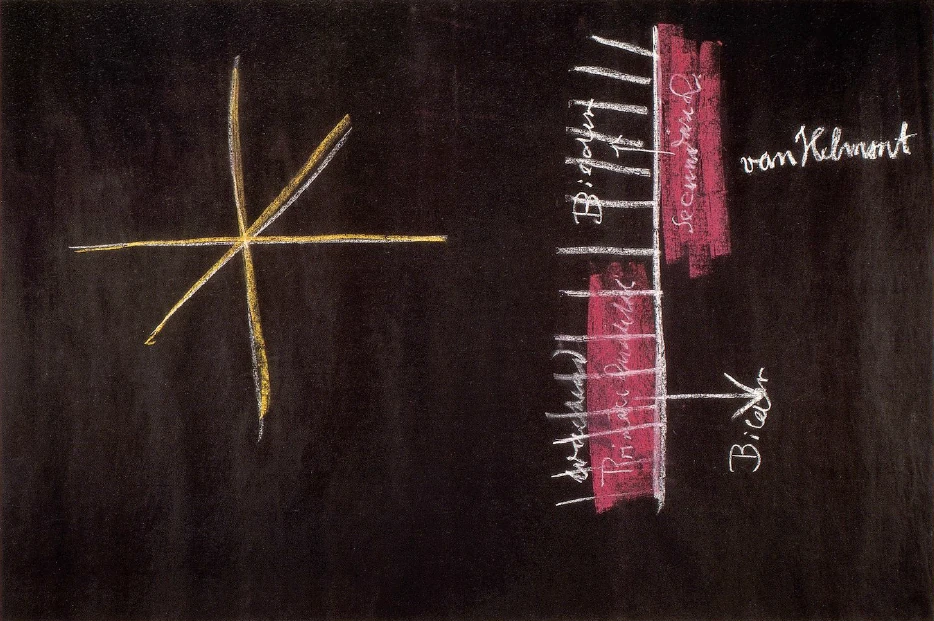
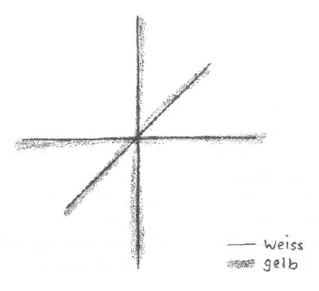
[ 2 ] Nun wies ich auch in diesen Vorträgen darauf hin, wie in diesem naturwissenschaftlichen Zeitalter das Räumliche schon in bezug auf die Dimensionen ein Abstraktes geworden ist. Der Mensch wußte nichts mehr davon, daß in ihm selbst die drei Dimensionen konkret erlebt wurden als oben-unten, rechts-links, vorne-hinten (siehe Zeichnung S. 86). Er nahm auf diese Konkretheit der drei Dimensionen im naturwissenschaftlichen Zeitalter keine Rücksicht. Für ihn entstanden sie in völliger Abstraktheit. Er suchte den Schnittpunkt der drei Dimensionen nicht mehr da, wo er real erlebt wird, im menschlichen Inneren, er suchte ihn irgendwo — und da kann er dann wo auch immer sein irgendwo im Raume — und konstruierte sich so seine drei Dimensionen. Jetzt hatte dieses Raumschema der drei Dimensionen ein selbständiges, aber nur gedachtes, abstraktes Dasein. Und das Gedachte wurde eben nicht erlebt als sowohl der Außenwelt wie dem Menschen angehörig, während eine frühere Zeit, wie ich sagte, die drei Raumdimensionen so erlebt hat, daß der Mensch wußte, er erlebt sie in sich mit der Natur der physischen Körperlichkeit zusammen.
[ 2 ] In these lectures, I also pointed out how, in this age of natural science, “spatiality” has already become an abstract concept, even in terms of dimensions. People were no longer aware that within themselves the three dimensions were concretely experienced as up-down, right-left, and front-back (see drawing on p. 86). In the age of natural science, they paid no heed to this concreteness of the three dimensions. For him, they arose in complete abstraction. He no longer sought the intersection of the three dimensions where it is actually experienced—within the human being—but sought it somewhere else—and there it can be anywhere in space—and thus constructed his three dimensions for himself. Now this spatial schema of the three dimensions had an independent, but merely conceptual, abstract existence. And what was conceived was not experienced as belonging to either the external world or to the human being, whereas in an earlier time, as I said, the three spatial dimensions were experienced in such a way that the human being knew he was experiencing them within himself together with the nature of physical corporeality.
[ 3 ] Es waren also gewissermaßen schon die Raumdimensionen von dem Menschen abgesondert und nach außen geworfen worden und hatten dadurch einen völlig abstrakten, unlebendigen Charakter angenommen. Der Mensch wußte nicht mehr, daß er die Raumdimensionen — und solches kann ja auch gesagt werden von allem anderen, das geometrisch ist, das zahlenmäßig ist, das gewichtmäßig ist usw. —, daß er alles das in seinem Inneren erlebt mit der Außenwelt zusammen, daß er aber eigentlich, um es in seiner Konkretheit, in seiner vollen, lebendigen Wirklichkeit zu erleben, in sein Inneres blicken müsse, um es da gerechtfertigt zu finden. Und eigentlich ist es so, daß eine Persönlichkeit wie John Locke nur deshalb die primären Qualitäten, die von der Art sind wie die drei Raumdimensionen — denn die drei Raumdimensionen sind eine Art Gestaltung —, in die Außenwelt verlegte, weil nicht mehr gewußt wurde der Zusammenhang dieser Qualitäten mit dem menschlichen Inneren.
[ 3 ] In a sense, the spatial dimensions had already been separated from human beings and cast outward, thereby taking on a completely abstract, lifeless character. Human beings no longer knew that they experience the spatial dimensions—and the same can be said of everything else that is geometric, numerical, weight-related, and so on— —that he experiences all of this within himself in conjunction with the external world, but that, in order to experience it in its concreteness, in its full, living reality, he must look within himself to find it justified there. And in fact, the reason a figure like John Locke attributed primary qualities—which are of the same nature as the three spatial dimensions (for the three spatial dimensions are a kind of form)—to the external world was simply because the connection between these qualities and the human inner being was no longer understood.
[ 4 ] Die anderen, die sekundären Qualitäten, die als Sinnesinhalt eigentlich qualitativ erlebt werden, wie Farbe, Ton, Wärmequalität, Geruch, Geschmack, die wurden nunmehr nur als die Wirkungen der Dinge auf den Menschen, als innere Erlebnisse angesehen. Aber ich habe ja darauf hingewiesen, wie im Inneren des physischen Menschen, auch im Inneren des ätherischen Menschen, ja diese sekundären Qualitäten nicht mehr gefunden werden können, wie sie daher in gewisser Beziehung auch für dieses Innere des Menschen vogelfrei geworden sind. Man suchte sie nicht mehr in der Außenwelt, man verlegte sie in das menschliche Innere. Man sagte: Wenn der Mensch nicht zuhört der Welt, wenn der Mensch nicht hinschaut auf die Welt, wenn der Mensch nicht seinen Wärmesinn der Welt offenbart, dann ist die Welt stumm und so weiter. Sie hat primäre Qualitäten, bestimmt gestaltete Luftwellen, aber sie hat keinen Ton; sie hat irgendwie Vorgänge im Äther, aber sie hat keine Farbe; sie hat irgendwelche Vorgänge in der ponderablen Materie, in der Materie, die ein Gewicht hat, aber sie hat nicht dasjenige, was Wärmequalität ist usw. Eigentlich war damit in diesem naturwissenschaftlichen Zeitalter für diese erlebten Sinnesqualitäten nichts anderes gesagt, als: Man weiß sie eigentlich nicht unterzubringen. In der Welt wollte man sie nicht suchen. Man gestand sich, daß man keine Macht habe, sie in der Welt zu finden. Im Inneren suchte man sie zwar, aber nur, weil man gedankenlos war oder ist. Gedankenlos war oder ist man in dem Sinne, daß man ja keine Rücksicht darauf nimmt, daß, wenn man nun dieses Innere des Menschen, soweit man es nun gelten läßt, wirklich durchforscht, das heißt, wenn man es durchforscht, soweit dies natürlich möglich ist — aber das geschieht ja nur als ein Ideal, so daß man eigentlich nicht von der Tatsache eines vollendeten Durchforschens reden kann —, wenn man also dieses Innere durchforscht, so findet man nirgends diese sekundären Qualitäten. Man weiß sie daher eigentlich in der Welt nicht unterzubringen. Woher kommt dieses?
[ 4 ] The other, secondary qualities—which are actually experienced qualitatively as sensory content, such as color, sound, thermal quality, smell, and taste—were now regarded solely as the effects of things on human beings, as inner experiences. But I have already pointed out how these secondary qualities can no longer be found within the physical human being, nor within the etheric human being; how, in a certain sense, they have thus become “outlaws” even within the human being. People no longer sought them in the external world; they relocated them to the human interior. It was said: If a person does not listen to the world, if a person does not look at the world, if a person does not reveal their sense of warmth to the world, then the world is silent, and so on. It has primary qualities—specifically shaped air waves—but it has no sound; it has certain processes in the ether, but it has no color; it has certain processes occurring in ponderable matter—in matter that has weight—but it lacks what constitutes the quality of warmth, and so on. In fact, in this age of natural science, what was really being said about these experienced sensory qualities was simply this: we do not really know how to account for them. People did not want to look for them in the world. They admitted to themselves that they had no power to find them in the world. One did seek them within, but only because one was—or is—thoughtless. One was—or is—thoughtless in the sense that one takes no account of the fact that, if one were to truly investigate this inner realm of the human being—to the extent that one accepts its existence— that is, if one explores it to the extent that this is naturally possible—though this happens only as an ideal, so that one cannot actually speak of the fact of a complete exploration—if, therefore, one explores this inner self, one finds these secondary qualities nowhere. One therefore does not really know where to place them in the world. Where does this come from?
[ 5 ] Nun, erinnern wir uns noch einmal: Will man in rechter Weise irgend etwas anschauen, das sich auf Gestaltliches, Räumliches, Geometrisches oder auch Arithmetisches bezieht, will man solches wirklich richtig anschauen, so muß man die innere Tätigkeit ins Auge fassen, diese lebensvolle Tätigkeit, wodurch der Mensch in seinem eigenen Organismus das Räumliche sich konstruiert, wie im Oben und Unten, Vorne und Hinten, Rechts und Links. Man muß also in diesem Falle sagen: Willst du finden das Wesen des Geometrisch-Räumlichen — man könnte aber auch ganz sinngemäß sagen: Willst du finden das Wesen der Lockeschen primären Qualitäten der körperlichen Dinge —, so mußt du in dich selber hineinschauen, sonst kommst du nur auf Abstraktionen. Nun ist es mit den sekundären Qualitäten, Ton, Farbe, Wärmequalität, Gerüchen, Geschmack so, daß der Mensch davon etwas wissen muß — es kann ja dieses Wissen sehr instinktiv nur sein, aber etwas wissen muß er davon —, daß er mit seinem geistig-seelischen Wesen ja nicht bloß in seinem physischen und ätherischen Leib lebt, sondern daß er auch außerhalb dieser Leiber sein kann mit seinem Ich und seinem astralischen Leibe, nämlich im Schlafzustande. Aber ebenso wie der Mensch bei einem vollen, intensiv empfundenen Wachzustande nicht außer sich, sondern in sich die primären Qualitäten erlebt, wie im speziellen Fall die drei Dimensionen, so weiß der Mensch, wenn es ihm entweder durch Instinkte oder durch eine instinktive Selbsterkenntnis oder auch durch geisteswissenschaftliche Schulung gelingt, das auch wirklich innerlich zu erleben, was außerhalb vom physischen Leib und Ätherleib vom Einschlafen bis zum Aufwachen ist, dann weiß er auch, daß er das wahre Wesen von Ton, Farbe, Geruch, Geschmack, Wärmequalität wirklich dann in der Außenwelt erlebt außerhalb seines Leibes. Wenn der Mensch im Wachzustande bloß in seinem Inneren ist, so kann er nichts anderes erleben als die Bilder der wahren Realitäten von Ton, Farbe, Wärmequalität, Geruch, Geschmack. Aber diese Bilder entsprechen geistig-seelischen Realitäten, nicht physisch-ätherischen Realitäten. Trotzdem dasjenige, was wir als Ton erleben, so stark zusammenzuhängen scheint — es tut es ja auch, aber in einer ganz anderen Hinsicht — mit bestimmt gestalteten Luftwellen, wie Farbe zusammenhängt mit gewissen Vorgängen in der farblosen Außenwelt, so muß eben dennoch anerkannt werden, daß Ton, Farbe und so weiter Bilder sind, nicht vom Körperlichen, sondern vom Geistigen, GeistigSeelischen, das in der Außenwelt ist.
[ 5 ] Well, let’s recall once more: If one wishes to properly examine anything related to form, space, geometry, or even arithmetic—if one truly wishes to examine such things correctly—one must take into account the inner activity, this vital activity through which human beings construct spatial relationships within their own organism, such as up and down, front and back, right and left. So in this case one must say: If you want to discover the essence of the geometric-spatial—though one could also say, quite appropriately: If you want to discover the essence of Locke’s primary qualities of physical things—then you must look within yourself; otherwise, you will arrive only at abstractions. Now, with regard to the secondary qualities— sound, color, thermal quality, smells, and taste, the situation is such that a person must know something about them—this knowledge may indeed be purely instinctive, but they must know something about them—because with their spiritual-soul being, they do not merely live within their physical and etheric bodies, but can also exist outside these bodies with their “I” and their astral body, namely in the state of sleep. But just as a person, in a full, intensely experienced waking state, experiences the primary qualities not outside but within themselves—such as, in the specific case, the three dimensions— so too does a person know—when they succeed, whether through instincts, instinctive self-knowledge, or training in spiritual science, in truly experiencing inwardly what lies outside the physical and etheric bodies from the moment of falling asleep until waking—that they truly experience the true nature of sound, color, smell, taste, and warmth in the external world outside their body. When a person is merely within their inner self while awake, they can experience nothing other than the images of the true realities of sound, color, quality of warmth, smell, and taste. But these images correspond to spiritual-soul realities, not physical-etheric realities. Nevertheless, just as what we experience as sound seems to be so strongly connected—and indeed it is— but in a completely different sense—to specific air waves, just as color is related to certain processes in the colorless external world; nevertheless, it must be acknowledged that sound, color, and so on are images, not of the physical, but of the spiritual and soul-spiritual that exists in the external world.
[ 6 ] Wir müssen also uns sagen können: Wenn wir einen Ton, eine Farbe, eine Wärmequalität erleben, dann erleben wir sie im Bilde. Aber wir erleben sie real, wenn wir außerhalb unseres Leibes sind. Und so können wir etwa schematisch den Tatbestand in der folgenden Weise darstellen (siehe Zeichnung): Die primären Qualitäten erlebt der Mensch wachend, voll wachend, in sich, und schaut sie in die Außenwelt hinein in Bildern; wenn er sie nur in der Außenwelt weiß, so hat er diese primären Qualitäten nur in Bildern (Pfeil). Diese Bilder sind das Mathematische, das Geometrische, das Arithmetische an den Dingen.
[ 6 ] So we must be able to say to ourselves: When we experience a sound, a color, or a quality of warmth, we experience them as images. But we experience them in reality when we are outside our body. And so we can, for example, schematically represent this state of affairs in the following way (see drawing): A person experiences the primary qualities while awake—fully awake—within themselves, and perceives them in the external world as images; if they are aware of them only in the external world, then they have these primary qualities only as images (arrow). These images are the mathematical, geometric, and arithmetic aspects of things.
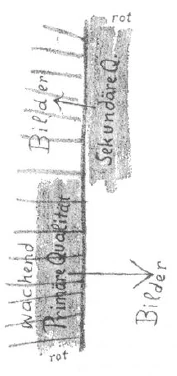
[ 7 ] Mit den sekundären Qualitäten ist es anders. Die erlebt der Mensch wenn ich den physischen und Ätherleib des Menschen mit diesen waagerechten Strichen bezeichne und das Geistig-Seelische, das Ich und das Astralische, mit dem Roten —, die erlebt der Mensch außerhalb seines physischen und Ätherleibes und er projiziert in sich herein nur die Bilder. Weil das nicht mehr durchschaut wurde im naturwissenschaftlichen Zeitalter, wurden gewissermaßen die mathematischen Formen, die Zahlen auch, zu etwas, das der Mensch nur in der Außenwelt abstrakt suchte. Die sekundären Qualitäten, sie wurden etwas, das der Mensch nur in sich suchte. Aber weil sie da bloße Bilder sind, verlor er sie eben für die Wirklichkeit vollständig.
[ 7 ] It is different with the secondary qualities. A person experiences these when I denote the physical and etheric bodies with these horizontal lines and the spiritual-soul aspect, the “I,” and the astral body with the color red—a person experiences these outside of their physical and etheric bodies and projects only the images inward. Because this was no longer understood in the age of natural science, mathematical forms—and numbers as well—became, so to speak, something that people sought only abstractly in the external world. The secondary qualities, on the other hand, became something that people sought only within themselves. But because they are merely images there, they were completely lost to reality.
[ 8 ] Es war ja so, daß einzelne Persönlichkeiten, die noch Traditionen aus älteren Anschauungen über die Außenwelt hatten, damit rangen, sich Vorstellungen zu machen, welche wirklichkeitsgemäßer waren als diejenigen, welche, ich möchte sagen, als die offiziellen im Laufe des naturwissenschaftlichen Zeitalters allmählich heraufkamen. So zum Beispiel, außer Paracelsus, auch van Helmont, der sich durchaus bewußt war, daß, wenn Farbe, Ton usw. erlebt werden, das Geistige des Menschen in Tätigkeit ist. Aber weil dieses Geistige im Wachzustande nur mit Hilfe des physischen Leibes sich betätigt, erzeugt es in sich bloß ein Bild von dem, was als Wesen in Ton, Farbe und so weiter enthalten ist, und so kommt man dann zu einer unzutreffenden Beschreibung der äußeren Wirklichkeit, nämlich zu der reinen mathematisch-mechanischen Bewegungsform, Bewegungsgestaltung für dasjenige, was als sekundäre Qualitäten im Menscheninneren erlebt werden soll. Während es in Wahrheit seiner Realität, seiner Wirklichkeit gemäß allein außerhalb des Menschenleibes erlebt werden kann. Man muß zu dem Menschen nicht sagen: Wenn du das wahre Wesen zum Beispiel des Tones erkennen willst, so mußt du physikalische Experimente machen über dasjenige, was sich, wenn du einen Ton hörst, innerlich in der Luft sich abspielt, die den Ton zu dir bringt, sondern dann mußt du dem Menschen sagen: Wenn du das wahre Wesen des Tones kennenlernen willst, so mußt du dir eine Vorstellung davon bilden, wie du eigentlich den Ton außer deinem physischen und ätherischen Leibe erlebst. Das sind aber Gedanken, welche von den Menschen des naturwissenschaftlichen Zeitalters eben nicht gedacht wurden, weil diese Menschen eben nicht auf die vollständige Menschennatur eingehen wollten, weil sie keine Neigung entwickelten, die wahre Wesenheit des Menschen kennenzulernen. Und so fanden sie eben in der ihnen unbekannten Menschennatur nicht die Mathematik oder auch die primären Qualitäten; und so fanden sie in der Außenwelt — weil sie nicht wußten, daß der Mensch ja der Außenwelt auch angehört — nicht die sekundären Qualitäten.
[ 8 ] The fact was that certain individuals, who still held on to traditions stemming from older views of the external world, struggled to form concepts that were more in line with reality than those which—I might say—gradually emerged as the “official” ones in the course of the scientific age. For example, in addition to Paracelsus, there was also van Helmont, who was fully aware that when color, sound, and so on are experienced, the human spirit is at work. But because this spiritual aspect, in the waking state, is active only with the aid of the physical body, it produces within itself merely an image of what is contained as essence in sound, color, and so on; and thus one arrives at an inaccurate description of external reality—namely, the purely mathematical-mechanical form of movement, the configuration of movement for that which is to be experienced as secondary qualities within the human being. Whereas in truth, in accordance with its reality, it can be experienced solely outside the human body. One need not say to a person: “If you want to recognize the true nature of, for example, sound, you must conduct physical experiments on what takes place internally in the air—which carries the sound to you—when you hear a sound.” Rather, one must say to the person: If you want to come to know the true nature of sound, you must form a concept of how you actually experience sound outside your physical and etheric bodies. But these are thoughts that were simply not conceived by the people of the age of natural science, because these people did not want to engage with the entirety of human nature, because they did not develop a inclination to come to know the true essence of the human being. And so they did not find mathematics or even the primary qualities in human nature, which was unknown to them; and so they did not find the secondary qualities in the external world—because they did not know that the human being also belongs to the external world.
[ 9 ] Ich sage nicht, daß man hellsichtig sein müsse, um in diesen Dingen die richtige Einsicht zu bekommen, sondern ich muß betonen, daß zwar die hellsichtige Weltenerklärung tiefere intensive Erkenntnisse gerade auch auf diesem Gebiete geben kann, daß aber eine gesunde Selbstschau durchaus dahin führt, das Mathematische, die primären Qualitäten, das Mathematisch-Mechanische auch in das Innere des Menschen zu verlegen, die sekundären Qualitäten auch in die Außenwelt des Menschen zu verlegen. Man kannte die Menschennatur nicht mehr. Man wußte nicht in Wirklichkeit, wie die Körperlichkeit des Menschen erfüllt ist von der Geistigkeit, wie die Geistigkeit, indem sie wachend im Menschen ist, sich vergessen muß, sich ganz hingeben muß dem Körper, damit sie das Mathematische begreift. Und man wußte auch nicht das andere, daß die Geistigkeit sich ganz in sich zusammenfassen muß und unabhängig vom Körper, das heißt außerhalb des Körpers, leben muß, um zu den sekundären Qualitäten zu kommen. Über alle diese Dinge, sage ich, kann die hellseherische Anschauung intensivere Einsichten geben, aber sie ist nicht nötig. Eine Selbstschau, eine wirkliche, gesunde Selbstschau kann fühlen, in richtigem Gefühl erkennen, daß Mathematik auch etwas innerlich Menschliches ist, Ton, Farbe usw. auch etwas Äußerliches sind.
[ 9 ] I am not saying that one must be clairvoyant to gain the proper insight into these matters, but I must emphasize that, while a clairvoyant explanation of the world can provide deeper, more intense insights—especially in this area—a healthy introspection can certainly lead to applying the mathematical, the primary qualities, the mathematical-mechanical aspects—into the inner being of the human being, and to project the secondary qualities into the outer world of the human being. People no longer understood human nature. They did not really know how the physicality of the human being is imbued with spirituality, how spirituality—by being awake within the human being—must forget itself, must surrender itself entirely to the body, in order to comprehend the mathematical. Nor did people realize the other aspect: that spirituality must withdraw entirely into itself and live independently of the body—that is, outside the body—in order to access the secondary qualities. I say that clairvoyant perception can provide deeper insights into all these things, but it is not necessary. Self-observation—true, healthy self-observation—can sense, and recognize through genuine feeling, that mathematics is also something intrinsically human, while sound, color, and so on are also external phenomena.
[ 10 ] Ich habe das, was einfach ein gesundes Empfinden, das aber zu wirklichen Erkenntnissen führt, nach dieser Richtung haben kann, in den achtziger Jahren in meinen Einleitungen zu «Goethes Naturwissenschaftlichen Schriften» dargestellt. Da ist auf keine hellseherische Erkenntnis Rücksicht genommen, aber es ist gezeigt, inwieweit der Mensch ohne hellseherische Erkenntnis zur Anerkennung der Realität von Farbe, Ton usw. kommen kann. Dies hat man noch nicht verstanden. Das naturwissenschaftliche Zeitalter ist in der Lockeschen Denkungsweise noch zu sehr befangen. Dies konnte man nicht verstehen, konnte es auch nicht verstehen, als ich es, ich möchte sagen, philosophisch geschürzt, 1911 deutlich ausführte am Philosophischen Kongreß in Bologna. Da versuchte ich zu zeigen, wie das GeistigSeelische des Menschen beim Wachzustande zwar im physischen und Ätherleib ist, aber seiner Qualität nach, gewissermaßen indem es den physischen und Ätherleib erfüllt, doch innerlich selbständig bleibt. Fühlt man diese innerliche Selbständigkeit des Geistig-Seelischen des Menschen, dann hat man auch eine Nachempfindung von dem, was das Geistig-Seelische im Schlafen von den Realitäten des Grünen und Gelben, des G und Cis, des Warmen und Kalten, des Sauren und Süßen usw. erlebt hat. Aber eben auf eine wirkliche Menschenerkenntnis wollte zunächst das naturwissenschaftliche Zeitalter nicht eingehen.
[ 10 ] I outlined what, while simply a healthy intuition, can nevertheless lead to genuine insights in this direction in my introductions to *Goethe’s Scientific Writings* in the 1980s. No account was taken of clairvoyant insight there, but it was shown to what extent a person can come to recognize the reality of color, tone, etc., without clairvoyant insight. This has not yet been understood. The age of natural science is still too caught up in the Lockean way of thinking. This could not be understood—nor could it have been understood—when I explained it clearly in 1911 at the Philosophical Congress in Bologna, in what I would call a philosophically condensed form. There I attempted to show how, in the waking state, the human spirit-soul is indeed present in the physical and etheric bodies, but remains inwardly independent in terms of its quality—in a sense, by filling the physical and etheric bodies. If one senses this inner independence of the human spiritual-soul aspect, then one also has a sense of what the spiritual-soul aspect has experienced during sleep in terms of the realities of green and yellow, G and C-sharp, warm and cold, sour and sweet, and so on. But the age of natural science did not initially wish to engage with a true understanding of the human being.
[ 11 ] Wir sehen an dieser Charakteristik des Verhältnisses des Menschen zur Welt nach den primären und sekundären Qualitäten ganz deutlich, wie der Mensch abkommt davon, über sich und sein Verhältnis zur Welt eine richtige Empfindung zu haben. Aber dasselbe steckte auch in anderen Vorstellungen, die man über den Menschen gewann, darinnen. Weil man keine Anschauung gewinnen konnte davon, wie das Mathematische in seinen drei Dimensionen im Inneren des Menschen lebt, konnte man auch nicht das Wesentliche des Menschen in bezug auf seine Geistigkeit durchschauen. Denn dieses Wesentliche hätte darinnen bestanden, daß man sich gesagt hätte: Der Mensch ist in der Lage, das Rechts-Links durch die symmetrische Bewegung seiner Arme und Hände, durch die anderen symmetrisch durch ihn vollbrachten Bewegungen zu erfassen. Er ist, indem er zum Beispiel den Gang seiner Nahrungsmittel fühlt, in der Lage, zu erleben das Vorne und Hinten. Er erlebt das Oben und Unten, weil er sich ja während seines Lebens erst in dieses Oben und Unten hineinordnet. Durchschaut man dieses, dann sieht man ja, wie der Mensch innerlich die Tätigkeit entfaltet, die in der Erzeugung der drei Raumdimensionen liegt, und man wird, wenn man vom Menschen spricht in seinem Verhältnisse zur Tierwelt, auf das Charakteristische hinweisen, daß ja das Tier nicht in derselben Weise wie der Mensch zum Beispiel das Oben und Unten hat, weil es seine wesentliche Körperachse in der Horizontalen hat, also in demjenigen, was der Mensch als vorne und hinten empfinden kann. Das abstrakte Raumschema genügte nicht mehr, um etwas anderes als mathematisch-mechanisch-abstrakte Verhältnisse in der unorganischen Natur zu ergründen. Es genügte zum Beispiel nicht, um über das innere Erleben des Raumes, auf der einen Seite beim Tier, auf der anderen Seite beim Menschen, eine Anschauung zu entwickeln.
[ 11 ] From this characterization of the human being’s relationship to the world in terms of primary and secondary qualities, we can see very clearly how human beings lose the ability to have a correct perception of themselves and their relationship to the world. But the same thing was also inherent in other conceptions that people formed about human beings. Because people could not gain a clear understanding of how mathematics lives within the human being in its three dimensions, they were also unable to grasp the essence of the human being in terms of its spirituality. For this essence would have consisted in saying to oneself: Human beings are able to grasp the concepts of right and left through the symmetrical movement of their arms and hands, and through the other symmetrical movements they perform. By feeling, for example, the passage of food through their system, they are able to experience front and back. They experience up and down because, in the course of their lives, they first orient themselves within this framework of up and down. If one understands this, one sees how human beings internally unfold the activity that lies in the creation of the three spatial dimensions; and when speaking of human beings in relation to the animal world, one points out the characteristic fact that animals do not perceive, for example, “up” and “down” in the same way as human beings do, because their essential bodily axis lies in the horizontal plane, that is, in what human beings can perceive as front and back. The abstract spatial schema was no longer sufficient to fathom anything other than mathematical-mechanical-abstract relationships in inorganic nature. It was not sufficient, for example, to develop an understanding of the inner experience of space, on the one hand in animals and on the other in human beings.
[ 12 ] Und so konnte zunächst in diesem naturwissenschaftlichen Zeitalter keine richtige Meinung entstehen über die Frage: Wie verhält sich eigentlich der Mensch zum Tier, das Tier zum Menschen? Wodurch unterscheiden sie sich? Da man aber doch noch fühlte in einer gewissen Weise: Es ist ein Unterschied zwischen dem Menschen und dem Tiere — so suchte man ihn in allerlei Merkmalen, die nicht durchgreifend charakteristisch sein können, weder für den Menschen noch für die Tiere. Und davon ist ein sehr bedeutsames Beispiel das, daß man mit Bezug auf die obere Kinnlade des Menschen, in der die Oberzähne sitzen, gesagt hat: Dieser Kinnladenknochen ist beim Menschen ein einziger; beim Tiere ist er so, daß die vorderen Schneidezähne in einem abgesonderten Zwischenkiefer drinnen sitzen, und erst zu beiden Seiten dieses Zwischenkiefers ist der eigentliche Oberkiefer. Der Mensch habe diesen Zwischenkiefer nicht. Nachdem man also keine Fähigkeit mehr hatte, durch innerlich Geistig-Seelisches das Verhältnis des Tieres zum Menschen zu finden, sah man es in etwas so Äußerlichem, daß man sagte: Das Tier hat den Zwischenkiefer, der Mensch hat ihn nicht.
[ 12 ] And so, at least in this age of natural science, no definitive opinion could initially emerge on the question: What is the actual relationship between humans and animals, and between animals and humans? How do they differ? Yet since people still sensed, in a certain way, that there is a difference between humans and animals—they sought to identify it in all sorts of characteristics that could not be fundamentally distinctive, neither for humans nor for animals. A very significant example of this is the observation regarding the human upper jaw, where the upper teeth are located: “In humans, this jawbone is a single unit; in animals, however, the front incisors are situated in a separate intermediate jaw, and only on either side of this intermediate jaw is the actual upper jaw.” Humans, it was claimed, do not have this intermediate jaw. Thus, having lost the ability to discern the relationship between animals and humans through inner spiritual and soul aspects, people sought it in something so external that they said: “Animals have the intermediate jaw; humans do not.”
[ 13 ] Goethe war derjenige, der zwar solche Erkenntnisse wie diese, die ich heute ausgesprochen habe über primäre und sekundäre Qualitäten, nicht in Worte fassen konnte, auch keine äußerlichen Gedanken mit völliger Klarheit sich darüber erringen konnte, aber Goethe hatte ein gesundes Gefühl von all diesen Dingen. Vor allen Dingen wußte Goethe instinktiv, man muß in der ganzen Bildung des Menschen seinen Unterschied von den Tieren finden und nicht in etwas Einzelnem. Deshalb wurde Goethe zum Bekämpfer der Idee von dem fehlenden Zwischenkieferknochen am Menschen. Und er schrieb als junger Mann seine bedeutungsvolle Abhandlung, die dem Menschen wie dem Tiere einen Zwischenkiefer in der oberen Kinnlade zuschreibt. Und es gelang ihm, den vollgültigen Tatsachenbeweis für diese Behauptung zu finden, indem er eben zeigte, wie noch im embryonalen Zustande beim Menschen der Zwischenkiefer durchaus zu sehen ist, wie er aber, indem der Mensch sich entwickelt, also schon beim kleinen Kinde, mit dem Oberkiefer verwächst, während er bei dem Tier getrennt bleibt. Goethe hat das alles aus einem gewissen richtigen Erkenntnisinstinkte heraus behandelt, und aus diesem Erkenntnisinstinkte heraus ist er zunächst dazu gekommen, zu sagen: Man darf nicht in solchen Einzelheiten den Unterschied des Menschen von den Tieren finden wollen, man muß ihn in dem ganzen Verhältnis seiner Gestaltung, seines Seelischen, seines Geistigen zur Welt suchen. Deshalb bedeutet die Bekämpfung der Naturforscher, die dem Menschen den Zwischenkiefer absprechen, die Bekämpfung dieser Naturforscher durch Goethe auf der einen Seite, daß er in bezug auf die Äußerlichkeiten den Menschen nahe herangebracht hat an die Tiere, um ihn andererseits gerade in bezug auf sein eigentliches Wesen in seinem wahren Unterschiede hinstellen zu können. Diese Anschauungsweise, die Goethe aus einem Erkenntnisinstinkt heraus der Form derjenigen Naturwissenschaft entgegengesetzt hat, die diese bis zu ihm angenommen hatte, die sie auch heute noch hat, diese Anschauungsweise Goethes fand ja eigentlich keine Nachfolge innerhalb der naturwissenschaftlichen Kreise. Dagegen trat gerade im 19. Jahrhundert immer mehr als Konsequenz alles desjenigen, was sich auf naturwissenschaftlichem Felde herausgebildet hatte seit dem 15. Jahrhundert, die Tendenz auf, den Menschen dem Tier anzunähern, nicht um seinen Unterschied von ihm in Äußerlichkeiten zu suchen, sondern um sein Wesen ganz nahe an die Tiere heranzutragen. Und diese Tendenz, sie ist dann enthalten in dem, was als darwinistischer Entwickelungsgedanke und so weiter auftrat. Das hat Nachfolge gefunden. Goethes Anschauung hat keine Nachfolge gefunden. Ja, manche haben Goethe sogar als eine Art Darwinisten behandelt, weil sie an Goethe nur gerade das sehen, daß er durch so etwas, wie es der Zwischenkiefer ist, den Menschen dem Tiere nahegebracht hat. Aber sie sehen nicht, daß er dies getan hat, um gewissermaßen darauf hinzuweisen — er hat nicht selber mit ausdrücklichen Worten darauf hingewiesen, aber es liegt in seiner Weltanschauung —, daß in etwas ganz anderem als in diesen Äußerlichkeiten der Unterschied des Menschen von den Tieren gefunden werden müßte.
[ 13 ] Goethe was the one who, although he could not put into words insights such as those I have expressed today regarding primary and secondary qualities, nor could he arrive at external thoughts about them with complete clarity, nevertheless possessed a sound intuition regarding all these matters. Above all, Goethe knew instinctively that one must find the distinction between humans and animals in the entirety of human development, and not in any single feature. That is why Goethe became an opponent of the idea that humans lack an intermediate jawbone. And as a young man, he wrote his significant treatise, which attributes an intermediate jaw in the upper jaw to both humans and animals. And he succeeded in finding conclusive factual evidence for this assertion by demonstrating that, even in the embryonic stage of human development, the intermaxillary bone is clearly visible; yet as humans develop—even in young children—it fuses with the upper jaw, whereas in animals it remains separate. Goethe approached all of this out of a certain sound instinct for insight, and it was through this instinct that he initially came to say: One must not seek to find the difference between humans and animals in such details; one must seek it in the overall relationship of their form, their soul, and their spirit to the world. Therefore, Goethe’s opposition to the natural scientists who deny the existence of the intermediate jaw in humans—his challenge to these natural scientists—means, on the one hand, that he brought humans close to animals in terms of outward appearances, so that, on the other hand, he could highlight their true distinction precisely in terms of their actual essence. This perspective, which Goethe—driven by an instinct for insight—opposed to the form of natural science that had prevailed up to his time and still prevails today, did not, in fact, find any followers within scientific circles. In contrast, particularly in the 19th century—as a consequence of everything that had developed in the field of natural science since the 15th century—a tendency emerged to draw humans closer to animals, not to seek their differences from animals in outward appearances, but to bring their very nature very close to that of animals. And this tendency is then embodied in what emerged as the Darwinian theory of evolution and so on. That found followers. Goethe’s view found no followers. Indeed, some have even treated Goethe as a kind of Darwinist, because all they see in Goethe is that, through something like the “intermediate jaw,” he brought humans closer to animals. But they fail to see that he did this to point out, so to speak—he did not point this out explicitly himself, but it is inherent in his worldview—that the difference between humans and animals must be found in something entirely different from these external features.
[ 14 ] Weil man nichts mehr vom Menschen wußte, suchte man seine eigenen wesentlichen Merkmale bei dem Tiere und sagte sich: Da sind die tierischen Merkmale, die sind nur etwas höher entwickelt beim Menschen. Daß der Mensch schon rein räumlich eine ganz andere Lage zur Welt in der Anschauung erhalten müsse, davon hatte man immer weniger und weniger eine Ahnung. Und im Grunde genommen sind alle Anschauungen über die Entwickelung des Lebendigen im naturwissenschaftlichen Zeitalter eben so entstanden, daß sie Systeme bildeten mit Ausschluß einer wirklichen Erkenntnis des Menschen. Man wußte mit der Wesenheit des Menschen nichts anzufangen. Daher stellte man ihn nur wie den Schlußpunkt der Tierreihe dar. Man sagte gewissermaßen: Da sind die Tiere; dann bringen es die Tiere noch zu einem letzten Grade der Vollkommenheit, zu einem vollkommensten Tier, und dieses vollkommenste Tier, das ist eben der Mensch.
[ 14 ] Since nothing more was known about human beings, people sought their own essential characteristics in animals and told themselves: “There are the animal characteristics; they are simply more highly developed in humans.” The fact that human beings, even in purely spatial terms, must occupy an entirely different position in relation to the world in their perception—of this, people had less and less of an inkling. And fundamentally, all conceptions of the evolution of living beings in the age of natural science arose in such a way that they formed systems that excluded a true understanding of human beings. People did not know what to make of the essence of the human being. Therefore, they depicted humans merely as the culmination of the animal kingdom. They said, as it were: “Here are the animals; then the animals reach a final degree of perfection, the most perfect animal, and this most perfect animal is none other than the human being.”
[ 15 ] Ich wollte, meine sehr verehrten Anwesenden und lieben Freunde, Sie mit diesen Auseinandersetzungen darauf aufmerksam machen, wie sogar mit einer gewissen innerlichen Konsequenz in den verschiedenen Gebieten des naturwissenschaftlichen Denkens seit der ersten Phase dieses Denkens, vom 15. Jahrhundert an bis heute, vorgegangen worden ist, wie der Mensch sich auf dem Gebiete der Physik, der Physiologie sein Verhältnis zur Welt ausmalt, indem er sagt: Da draußen ist eine stumme, eine farblose Welt. Die wirkt auf dich. Du bildest die Farbe aus, du bildest die Töne aus in dir als Erlebnis der Wirkungen der Außenwelt. — Wie der Mensch sich dieses sagte auf der einen Seite und auf der anderen sich auch sagte: Es gibt in der Außenwelt ohne dich die drei Raumdimensionen —, wie sich der Mensch das sagte, weil er die Fähigkeit verloren hatte, auf das Vollkommene des Menschen einzugehen, so bildete er sich auch in seinen Anschauungen über die tierische und menschliche Gestaltung solche Vorstellungen aus, welche nicht eingingen auf das wirkliche Wesen des Menschen. Und so kann man eigentlich, trotz dieser großen, gewaltigen Fortschritte, die von einem gewissen Gesichtspunkte aus mit Recht als menschliche Fortschritte allerersten Ranges geschildert werden, man kann sagen: Die naturwissenschaftliche Weltanschauung ist gerade dadurch groß geworden, daß sie vom Menschen und seinem Wesen völlig abgesehen hat. Allerdings bekam man eigentlich keine rechte Ahnung davon, wie sehr man von dem wirklichen Menschen absieht, indem man ihn naturwissenschaftlich betrachtete. Man kann zum Beispiel bei besonders enthusiastischen materialistischen Denkern des 19. Jahrhunderts geschildert finden, wie der Mensch gar nichts besonders Seelisch-Geistiges für sich in Anspruch nehmen dürfe, denn dasjenige, was als Seelisch-Geistiges erscheint, das sei ja nur die Wirkung desjenigen, was äußerlich räumlich-zeitlich sich vollzieht. Und da beschrieben solche enthusiastischen Naturdenker, wie das Licht auf den Menschen wirkt, also das Ätherische nach ihrer Anschauungsweise, wie das sich in seinen Nerven nach innen vibrierend fortsetzt, wie aber auch in der Atmung sich die äußere Luft in ihm fortsetzt usw. Und dann sagten sie etwa zusammenfassend: Oh, der Mensch ist ja von jeder 'Temperaturerhöhung, von jeder Temperaturerniedrigung abhängig. Der Mensch ist abhängig von alledem, was zum Beispiel auftritt als Deformation seines Nervensystems. Man spitzte etwa eine solche Auseinandersetzung zu, indem man sagte: Der Mensch ist ein Geschöpf, abhängig von jedem Zug oder Druck der Luft und dergleichen.
[ 15 ] I wanted, my esteemed audience and dear friends, to use these discussions to draw your attention to how, with a certain inner consistency, the various fields of scientific thought have proceeded since the earliest phase of this thinking—from the 15th century to the present day—and how, in the fields of physics and physiology, human beings conceive of their relationship to the world by saying: Out there is a silent, colorless world. It acts upon you. You form the colors and the sounds within yourself as an experience of the effects of the external world. — Just as human beings told themselves this on the one hand, and on the other hand also told themselves: “There are three spatial dimensions in the external world independent of you”—just as human beings told themselves this because they had lost the ability to grasp the perfection of the human being—so, too, in their views on animal and human form, they developed conceptions that did not take into account the true nature of the human being. And so, despite these great and tremendous advances—which, from a certain point of view, can rightly be described as human progress of the very highest order—one can say: The scientific worldview has become great precisely because it has completely disregarded human beings and their nature. However, people did not really grasp just how much they were disregarding the true nature of human beings by viewing them through a scientific lens. For example, one can find descriptions by particularly enthusiastic materialist thinkers of the 19th century stating that human beings should not claim anything specifically soul-spiritual for themselves, since what appears to be soul-spiritual is, after all, merely the effect of what takes place externally in space and time. And so these enthusiastic natural philosophers described how light affects human beings—that is, the etheric, according to their view—how it continues inwardly as a vibration in their nerves, and how, in breathing, the external air continues within them, and so on. And then they would summarize by saying, for example: “Oh, human beings are, after all, dependent on every rise in temperature and every drop in temperature.” Human beings are dependent on everything that manifests, for example, as a deformation of their nervous system. Such a discussion was sometimes taken to an extreme by saying: Human beings are creatures dependent on every draft or pressure of the air and the like.
[ 16 ] Derjenige, der unbefangen solche Beschreibungen nimmt, der kann merken, daß da nicht das eigentliche Wesen des Menschen beschrieben ist, sondern das beschrieben ist, wodurch dieses Menschenwesen ein Neurastheniker wird. Denn zum Beispiel kann man durchaus, wenn man die Betrachtungen, welche materialistische Denker des 19. Jahrhunderts vom Menschen gaben, sagen: Ja, das wären nicht Menschen, das wären spezifische Neurastheniker, wenn der Mensch so von jedem Luftzug abhängig wäre, wie da diese materialistischen Denker ihn schildern. Von diesem Neurastheniker sprach man als vom Menschen, ließ dasjenige, was das eigentliche Wesen ist, aus, und wußte nur noch dasjenige, wodurch dieses wahre Wesen, das unbekannt blieb, ein Neurastheniker wird. Überall fällt nach und nach durch den besonderen Charakter, den das Denken über die Natur angenommen hat, aus diesem Denken das wahre Wesen des Menschen heraus. Man verliert für die Anschauung das wahre Wesen des Menschen. Das ist dasjenige, wogegen eigentlich Goethe revoltiert hat, trotzdem er nicht imstande war, durch klar formulierte Sätze dasjenige auszusprechen, was er seinen Anschauungen nach als richtig erkannt hatte.
[ 16 ] Anyone who approaches such descriptions with an open mind can see that what is described there is not the true nature of the human being, but rather what causes this human being to become a neurasthenic. For example, when considering the views on humanity put forth by 19th-century materialist thinkers, one might well say: “Yes, those would not be human beings; they would be specific cases of neurasthenia if human beings were as dependent on every breath of air as these materialist thinkers depict them to be.” This neurasthenic was spoken of as a human being, while the true essence was omitted, and one was aware only of what causes this true essence—which remained unknown—to become a neurasthenic. Everywhere, little by little, due to the particular character that thinking about nature has assumed, the true essence of the human being is falling out of this thinking. We are losing sight of the true essence of the human being. This is precisely what Goethe actually rebelled against, even though he was unable to articulate in clearly formulated sentences what he had recognized as true according to his own views.
[ 17 ] Man muß solches, was ich Ihnen jetzt vorgeführt habe, verfolgen in dem inneren Umschwung der Entwickelung des naturwissenschaftlichen Denkens seit dem 15. Jahrhundert, und man wird finden, daß man gerade dadurch das, worauf es ankommt in dieser Entwickelung, im richtigen Lichte ansieht. Ich möchte sagen: Goethe interessierte sich in seiner Jugend intensiv für dasjenige, was die Naturwissenschaft auf ihren verschiedenen Gebieten hervorgebracht hatte. Er studierte es, ließ sich von der Naturwissenschaft anregen, war aber nicht mit allem einverstanden, was da an ihn herantrat, weil er in allem fühlte, daß der Mensch aus diesen Anschauungen herausgeworfen war. Goethe aber fühlte intensiv den vollen Menschen. Daher revoltierte er auf den mannigfaltigsten Gebieten gegen die naturwissenschaftliche Anschauung, die er um sich herum sah. Und es kommt schon darauf an, daß man diese naturwissenschaftliche Entwickelung seit dem 15. Jahrhundert auch dadurch begreift, daß man sie auf dem Hintergrunde des Goetheschen Weltanschauungssystems anschaut. Da kommt man am besten darauf, wenn man rein historisch vorgehen will, wie dieser Betrachtung das eigentliche Wesen des Menschen fehlt, fehlt schon in den physikalischen Wissenschaften, fehlt auch in den biologischen Wissenschaften.
[ 17 ] One must trace what I have just presented to you within the inner transformation of the development of scientific thought since the 15th century, and one will find that it is precisely through this that one views what is essential in this development in the proper light. I would like to say: In his youth, Goethe took a keen interest in what the natural sciences had produced in their various fields. He studied them, drew inspiration from the natural sciences, but did not agree with everything that came his way, because he sensed in all of it that human beings were excluded from these views. Goethe, however, felt the fullness of the human being intensely. That is why he rebelled in the most diverse fields against the scientific worldview he saw all around him. And it is indeed important to understand this development of the natural sciences since the 15th century by viewing it against the backdrop of Goethe’s worldview. If one wishes to proceed purely historically, this is the best way to recognize that this perspective lacks the true essence of the human being—a deficiency present not only in the physical sciences but also in the biological sciences.
[ 18 ] Das soll keine Kritik sein der naturwissenschaftlichen Weltanschauung, sondern nur eine Charakteristik. Denn nehmen wir einmal an, daß jemand sagt: Hier habe ich Wasser. Das kann ich so nicht brauchen. Ich sondere den Sauerstoff vom Wasserstoff ab, weil ich den Wasserstoff brauche. — Er sondert den Sauerstoff vom Wasserstoff ab. Wenn ich das Ergebnis dann feststelle, so ist das keine Kritik seines Verhaltens. Ich habe ihm nicht zu sagen: Du machst etwas Unrichtiges, denn du mußt das Wasser sein lassen. — Das Wasser ist kein Wasserstoff. Ebensowenig ist es eine Kritik, wenn ich sage: Die naturwissenschaftliche Entwickelung seit dem 15. Jahrhundert nahm die Welt der Lebewesen und sonderte, wie der Chemiker vom Wasser den Sauerstoff absondert, den Menschen in seinem eigentlichen Wesen ab, warf ihn weg und behielt das zurück, was die damalige Zeit brauchte, so wie der andere den Wasserstoff braucht, und führte die menschlose Naturwissenschaft zu den Triumphen, zu denen sie eben führte. — Es handelt sich nicht um eine Kritik, wenn man so etwas ausspricht, sondern um eine Charakteristik. Der neuere Naturforscher brauchte gewissermaßen die Natur menschlos, so wie irgendein Chemiker brauchen kann den Wasserstoff sauerstofflos und daher nötig hat zu teilen das Wasser in Wasserstoff und Sauerstoff. Aber man muß verstehen, um was es sich handelt, so daß man nicht immerfort wieder in den Fehler verfällt, doch irgendwo durch die Naturwissenschaften das Wesen des Menschen suchen zu wollen. Das wäre geradeso unmöglich, wie wenn man in dem Wasserstoff, den einem jemand daherbringt, auch den Sauerstoff suchen würde, den er aus dem Wasser ausgeschieden hat.
[ 18 ] This is not meant to be a criticism of the scientific worldview, but merely a description. For let us suppose that someone says: “Here I have water. I cannot use it as is. I separate the oxygen from the hydrogen because I need the hydrogen.” — He separates the oxygen from the hydrogen. If I then observe the result, that is not a criticism of his behavior. I do not have to tell him: “You are doing something wrong, because you must leave the water alone.” — Water is not hydrogen. Nor is it a criticism when I say: Scientific development since the 15th century took the world of living beings and, just as the chemist separates oxygen from water, stripped humanity of its true essence, cast it aside, and retained what the times required—just as the chemist needs hydrogen—and led this dehumanized natural science to the triumphs to which it indeed led. — Saying something like this is not a criticism, but rather a characterization. The modern natural scientist, in a sense, needed nature to be devoid of humanity, just as any chemist might need hydrogen to be devoid of oxygen and therefore must split water into hydrogen and oxygen. But one must understand what is at stake here, so as not to keep falling into the error of wanting to seek the essence of humanity somewhere within the natural sciences. That would be just as impossible as if, in the hydrogen that someone brings you, you were also to seek the oxygen that he has separated from the water.
[ 19 ] So müssen diese Dinge betrachtet werden gerade dann, wenn man in richtiger Weise über sie diese historischen Anschauungen gewinnen will. Morgen werde ich weiter fortfahren in der Schilderung der Geburt und Entwickelung der Naturwissenschaft in der neueren Zeit.
[ 19 ] This is precisely how these matters must be viewed if one wishes to arrive at a correct understanding of them from a historical perspective. Tomorrow I will continue my account of the birth and development of the natural sciences in modern times.