

The Agricultural Course
Spiritual Science Foundations
for the Prosperity of Agriculture
GA 327
14 June 1924, Koberwitz
Translated by Steiner Online Library
Sixth Lecture
My dear friends!
[ 1 ] As we continue our reflections, we will now have to draw on some of the insights into plant growth—and also into animal formations—that we have heard in the preceding days. Our task will be to briefly touch upon—at least in aphoristic form—some of the spiritual-scientific concepts related to plants, to plant and animal pests in agriculture, and to what are called plant diseases. Now, these things can really only be considered in very concrete terms. And that is why, even where one can generally say little—because the subject matter must be specialized—I will first cite examples which, if taken as the starting point for experiments, can indeed lead to further insights. To begin with, I would like to start with weeds—or whatever they are called—and consider these plant pests.
[ 2 ] You see, it’s not so much a matter of coming up with a definition of a weed, but rather of gaining insights into how to remove from a particular field those plants that you don’t want there. Isn’t it true that we sometimes still have those strange impulses that we’ve carried over from our student days? And so I tried—albeit not with much enthusiasm—to follow through on one such impulse and look up in some writings what the definition of a weed is. Now, I found that most authors who attempt to define what a weed is say: “A weed is anything that grows in a place where you don’t want it.” As you can see, it’s a definition that doesn’t really get to the heart of the matter. And one won’t have much success either if one tries to get to the essence of the weed, for the simple reason that, in the court of nature, the weed has just as much right to grow as that which is considered useful. One will have to realize that things must be viewed from a somewhat different perspective—namely, the perspective of how, in a given field, one removes precisely that which is not intended to be there but grows there as part of the general fabric of nature. This question cannot be answered in any other way than by taking into account precisely those things we have mentioned in the past few days.
[ 3 ] We have already pointed out that a strict distinction must be made between the forces at work in plant growth and those that, while originating in the cosmos, are first absorbed by the Earth and then act upon plant growth from the Earth. These forces, which essentially stem from cosmic influences—as I have said, from Mercury, Venus, and the Moon—but which do not act directly from these planets, rather acting indirectly through the Earth, must be taken into account when it comes to tracing what causes a daughter plant to emerge from a mother plant, and so on. In contrast, with regard to everything the plant absorbs from the surroundings of the supersensible realm, one must consider what the more distant planets impart to the air in terms of potential effects, and what is absorbed in this way. In a broader sense, however, one can also say that all the forces from the nearby planets acting upon the Earth are greatly influenced by the Earth’s calcareous forces, whereas what acts from the surrounding sphere is influenced by the siliceous forces. And so it is that even though the siliceous forces also emanate from the Earth itself, they nevertheless convey what emanates from Jupiter, Mars, and Saturn—not actually what emanates from the Moon, Mercury, and Venus.
[ 4 ] Nowadays, people are quite unaccustomed to really taking these things into account. But one must also atone for it. And in one instance, in numerous regions of the civilized world, there is a lack of understanding of the cosmic influence—both insofar as it acts through the air via a detour through what lies above ground level, and [of the cosmic influence] insofar as it acts from below through the Earth’s mediation [up]—and for this lack of insight, we must pay the price, in that everything that was once achieved through the older, instinctive science regarding such matters has been completely exhausted; you may all be indifferent to this, but many people are not indifferent. The soil was exhausted, the traditions were also exhausted—even if the farmers sometimes gave it a helping hand—and so the phylloxera spread across vast vineyards. People were quite helpless in the face of the phylloxera. I still have much to tell about the editorial staff of an agricultural newspaper published in Vienna in the 1880s, which was pressured from all sides to find a remedy for the phylloxera and became completely at a loss when the phylloxera plague became truly acute at that time. — These issues simply cannot be thoroughly addressed with the science available today; they can only be addressed if one is truly able to engage with what can be known through the approaches we have outlined.
[ 5 ] Now imagine this—I’ll sketch it out schematically: Let this be the earth’s level; here is everything that comes in from the cosmos in the form of influences from Venus, Mercury, and the Moon, and which in turn radiates back, so that it acts from the bottom up. And what becomes active in the Earth in this way—I’ll draw this schematically as well—brings the plants into activity in such a way that they first produce what grows in a year, then form the seed. From the seed, in turn, comes the new plant, the third plant, and so on. Everything that comes about in this way flows into the power of reproduction, into the succession of generations.
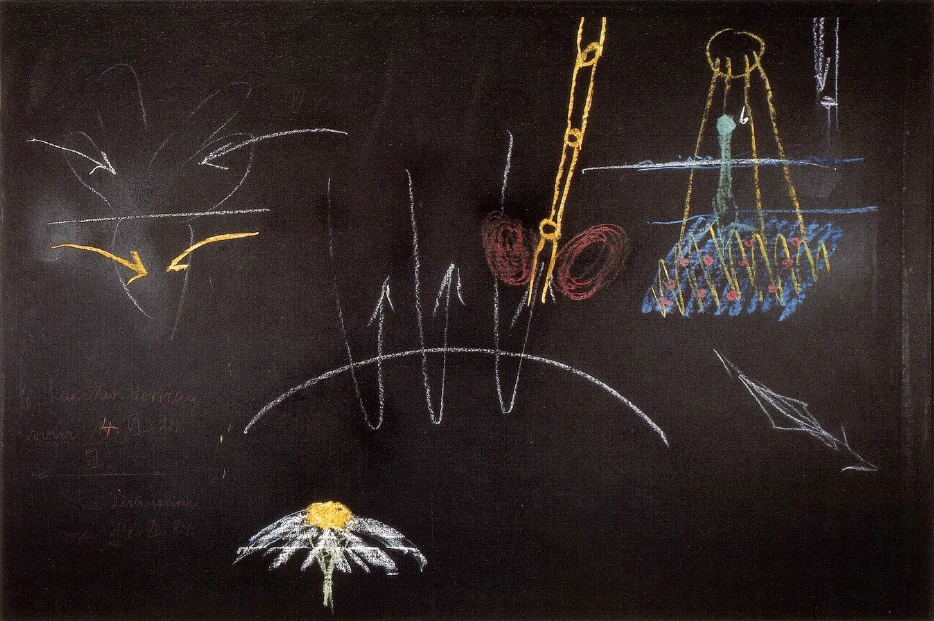
[ 6 ] In contrast, everything that comes by a different path—the one that lies above the level of the earth—comes from the other forces, from the distant planetary forces. This can be schematically illustrated as follows: This is what is now transformed within the plant as it spreads out in all directions, making it thick and plump—what we consume as food, because it constantly forms a continuous stream anew.
[ 7 ] What we extract, for example, from an apple or a peach—what we then eat as fruit pulp—all of that stems from these planetary influences that are far removed from Earth. But it is precisely from these insights that we can determine how one must act if one wishes to influence plant growth in any way. There is no other way to gain insight into how to influence plant growth than by taking these various forces into account.
[ 8 ] First of all, a large number of plants—and these are primarily the plants that we commonly regard as weeds, which are sometimes extraordinarily potent medicinal plants—it is precisely among the weeds that we find the most potent medicinal plants—these plants are most strongly influenced by what might be called the effects of the moon.
[ 9 ] In everyday life, we know that the Moon absorbs the sun’s rays on its surface and reflects them toward the Earth. We see—because we catch them with our eyes, and the Earth also catches these lunar rays—the reflected rays of the sun. It is thus the rays of the sun that are reflected in this way, but they are permeated by the Moon’s forces; they therefore reach the Earth specifically as lunar forces, ever since the Moon separated from the Earth. In the cosmos, it is precisely this lunar force that has a strengthening effect on everything earthly. — When the Moon was still united with the Earth, earthly life was much more vibrant and fruitful. A mineral nature as strong as we have today did not actually exist in that time when the Moon was still united with the Earth. But after the Moon separated from the Earth, it has acted in such a way that the ordinary condition of this Earth—which is just sufficient to bring about growth in living beings—is thereby strengthened, so that growth can intensify to the point of reproduction.
[ 10 ] When a being grows, it becomes large. The same force is at work here as in reproduction. However, growth does not go so far as to produce a being of the same kind. It merely produces cell after cell; it is a weaker form of reproduction, one that remains within the being itself; and this reproduction is a stronger form of growth. The Earth itself can mediate precisely this weak form of reproduction—growth—but without the Moon, it is powerless to bring about the intensified growth. For this, it simply needs those cosmic forces that shine down upon the Earth through the Moon—and, in the case of certain plants, also through Mercury and Venus. I mentioned earlier that people imagine the Moon merely absorbs the Sun’s rays and casts them down upon the Earth. Thus, when considering the Moon’s influence, one actually focuses only on the sunlight. But that is not the only thing that reaches the Earth. Along with the moonbeams, the entire reflected cosmos also reaches the Earth. Everything that acts upon the Moon is reflected back. Thus, the entire starry sky—even though this cannot be demonstrated to modern people using today’s physical methods—is, in a certain sense, reflected back to Earth by the Moon. It is indeed a powerful and highly organizing cosmic force that is radiated down from the Moon into the plants, so that the plant may be supported—especially in relation to its seed-bearing capacity—and so that its growth force may be enhanced into a reproductive force.
[ 11 ] Well, all of this is true for a region of the Earth only when that region is experiencing a full moon. When that region is experiencing a new moon, it does not benefit from the moon’s influence. During the new moon, plants retain only what they absorbed during the full moon. One could certainly achieve significant results simply by studying how far one could go if, for example, one were to use the moon when sowing—specifically for the very first germination activity in the earth—as the ancient Indians did well into the nineteenth century, when they sowed according to the phases of the moon. But nature is not so cruel as to punish people for the slight inattention and discourtesy they show toward the moon when sowing or harvesting. After all, we have twelve full moons a year; that is enough to ensure that the full-moon effects—that is, the [full-moon] forces that promote [fertilization]—are sufficiently present. And if, on occasion, something that contributes to fertilization is done during a new moon instead of a full moon, it simply waits in the earth until the next full moon, overlooking human errors and conforming to nature. That is certainly sufficient for humans to make use of the moon without having the slightest inkling of it. But one cannot go any further with that either.
[ 12 ] For you see, when treated this way, the weeds assert their right just as much as the herbs, and everything gets mixed up because one is not at all attuned to the forces that govern growth. One must attune oneself to these forces that govern growth. Then one can know: With the fully developed power of the Moon, the forces work toward reproduction—toward the propagation of all plant life. Thus, they work for that which surges upward from the root all the way to seed formation. Now, we will indeed get the best weeds if we allow the beneficial moon to act upon our weeds, without hindering its effect at all. For since there are also wet years when the lunar forces act more effectively than in dry ones, these weeds will reproduce and thereby multiply.
[ 13 ] But if one takes these cosmic forces into account, one will say the following: If one prevents the full effect of the moon on the weeds, allowing only external influences—which are not lunar effects but act directly—to affect them, one sets a limit on their reproduction. They will then be unable to reproduce. The point is, since we cannot turn off the moon, to treat the soil in such a way that the earth becomes reluctant to absorb the lunar influences; and not only can the earth be made reluctant to absorb these influences, but the plants—these weeds—can also develop a certain aversion to growing in soil that has been treated in a specific way. If we achieve this, we will have what we want. We’ll see the weeds come up in a year. At that point, we’ll just have to accept it—not be alarmed, but tell ourselves that now is the time to intervene. But first, let’s collect a number of seeds from these weeds—that is, the ones in which the power I’ve spoken of has finally been concentrated. We now light a flame—a simple wood fire is best—and burn these seeds, carefully collecting all that remains as ash. We obtain relatively little of these ashes in this way. But we now have, quite literally, in the plants we have treated in this manner—by passing the seeds through fire and transforming them into ashes—the opposing force to that developed by the attraction of the lunar forces concentrated within the ashes. If we now scatter—we need not proceed with particular care, since these things have a broad-ranging effect—this small preparation, which we have obtained in this way from a wide variety of weeds, over our field, then as early as the second year we will see how much less of the weed species we have treated in this way remains. It no longer grows as vigorously, and since a four-year cycle exists in nature for many things, we will see that after the fourth year, the weed in question—which we have treated annually by scattering this pepper—will cease to exist in this field.
[ 14 ] You see, this actually harnesses the effects of the tiniest entities—effects that have now been scientifically proven by the Biological Institute. One could actually achieve an extraordinary amount in this way, and you now have an extraordinary amount of control—provided you factor these things into your approach, that is, if you actually take into account the effects that are currently being completely overlooked. You can now actually plant the dandelions you need—in the way I explained yesterday—anywhere you like, but you can also use these dandelions in terms of their seeds by conducting this burning experiment with them, preparing the little pepper, and scattering it over your field. Then you’ll achieve the result that you can plant the dandelions wherever you want, but the field you treat with the dandelions burned in this way will remain free of them.
[ 15 ] These are precisely the kinds of things—hard to believe today—that were once mastered through an instinctive agricultural wisdom. Back then, people were able to plant whatever they wanted together in limited areas because they used to do such things instinctively. I can provide details on all these matters that will show you they can serve as a starting point for applying these principles in real-world practice—applying them correctly in practice. And since there’s already a prevailing view today—I don’t want to call it a prejudice—that everything must be verified afterward, well then, let’s try to verify these things. You’ll see that if you conduct the experiments correctly, they will prove themselves true. However, if I were running a business myself, I wouldn’t wait for them to be proven true; I would get started right away. For I am quite certain that this approach works. Because for me, the matter is this: spiritual scientific truths are true in and of themselves. They do not need to be verified by other circumstances or by external methods. All our scientists have made this mistake: they looked to external methods and sought to verify these truths through external methods. They did this even within the Anthroposophical Society. But people there should have known that things can be true in and of themselves. However, to achieve anything today, one must verify this externally—one must make a compromise; that compromise is necessary. In principle, it is not necessary. For how does one know these things inwardly? One knows them in such a way that they are established inwardly by their very nature—just as firmly as, for example, when I have something manufactured by fifty people, and I tell myself, “I now want to produce three times as much, so I’ll use one hundred and fifty people.” Now, a smart aleck might come along and say: “I don’t believe that 150 people will produce three times as much; you have to try it first.” It may happen, under certain circumstances, that experience proves you wrong if you actually conduct the experiment. Let’s say you have something in question worked on first by one person, then by two, then by three. Now you determine, statistically, what the three workers have produced. Well, if the three are just chatting among themselves, they’ll get less done than one person. The assumption you made is wrong. The experiment may prove the opposite. But nothing is settled yet if an experiment proves the opposite. If you proceed with complete precision, you must also examine the counterexample very closely. Then what is true internally will also be confirmed externally.
[ 16 ] So, we could speak more generally about the plant pests in our fields. We won’t be able to speak in such general terms when it comes to animal pests. In that regard, I’d like to start by selecting an example that is particularly characteristic, in order to conduct experiments and see how such approaches hold up.
[ 17 ] Let’s take, for example, a particularly good friend of the farmer: the field mouse. This field mouse—what wouldn’t one do, what measures wouldn’t one take, to combat the field mouse! You can read in agricultural publications that, first of all, all kinds of phosphorus-based preparations are used effectively, and that other substances, such as the strychnine-saccharin mixture, are employed. A somewhat radical control method has even emerged: infecting the field mouse with typhus—which can be done by adding certain bacteria, harmful only to rodents, to mashed potatoes, which are then distributed in an appropriate manner. These methods have also been tried—or at least are recommended. So in all sorts of ways, people are trying to get rid of these actually quite innocent-looking little creatures using methods that seem far from humane, once they’ve taken hold. Well, I believe even the government gets involved, because when you’re fighting mice this way, it doesn’t help unless the neighboring farmer does the same. Then they come over from the other field, and so the government must be called in to ensure that everyone is forced to drive the mice away in a specific way. The state, after all, won’t entertain modifications; it lays down its own regulations when it deems a method to be correct—regardless of whether it actually is—so that everyone must follow it. Everyone must do it the prescribed way: everything must be standardized—standardization, after all, is the ideal of the state.
[ 18 ] Well, you see, all of this is just trial and error and tinkering from the outside. And you always get the feeling that those trying it out aren’t really getting anywhere, because the mice keep coming back. They don’t feel entirely at ease—the mice keep coming back. Now, this is something that can’t exactly be applied solely to a single estate, but it can actually help in a certain way even on a single estate. It won’t be entirely feasible; even there, one will have to use persuasion to get the neighbors to act, but I maintain that in the future we’ll have to rely much more on persuasion than on police measures. That will indeed be a real step forward in our social life.
[ 19 ] Just imagine: if you catch a fairly young mouse, you can skin it and take the skin from that fairly young mouse. Now the point is that you obtain this skin—there are always plenty of mice around, though they must be field mice if you want to conduct the experiment—that you acquire this field mouse’s hide during the time when Venus is in the sign of Scorpio. You see, those old guys with their instinctive science weren’t so stupid after all. Right where we transition from plants to animals, we also come to the zodiac. For this zodiac is not called the zodiac without reason. If you want to achieve anything in the plant world, you can stick to the planetary system. With animals, that no longer works. There, you need concepts that take into account the surrounding fixed stars—namely, those fixed stars found in the zodiac.
[ 20 ] Well, when it comes to plant growth, the influence of the Moon is almost entirely sufficient to bring about reproduction. In the animal kingdom, the influence of the Moon must be supported by the influence of Venus. The influence of the Moon does not even need to be considered all that strongly in the animal kingdom, because the animal kingdom conserves the lunar forces, retains them within itself, and emancipates itself from the Moon. In this animal kingdom, therefore, the lunar force is also active even when it is not a full moon. The animal carries the full moon’s power within itself, emancipating itself in accordance with the timing. However, this is not the case with regard to what we must discuss here, nor is it the case with regard to the other planetary forces.
[ 21 ] For the point is that we perform a very specific ritual with the mouse’s skin. We obtain this mouse skin while Venus is in the sign of Scorpio and burn it there; we then carefully collect what develops as a result of the burning [ ash—in short, any components that fall out—there won’t be much, but if you have a number of mice, it is sufficient; what you obtain is enough. And you obtain the burned mouse bladder at the time when Venus is in Scorpio. And in what is destroyed by the fire, what remains is the negative force in opposition to the reproductive force of the field mouse. If you now scatter the pepper obtained in this way—things do get tricky in certain areas, so you can make the process even more homeopathic; we don’t need a whole soup plate full of pepper—over your fields, provided it has been properly passed through the fire during the superior conjunction of Venus and Scorpio, you will have a remedy that will cause the mice to avoid that field. Now, they’re cheeky little creatures; they’ll come back if the pepper is scattered in such a way that some areas nearby remain pepper-free. That’s where they’ll settle in again. In other words, the effect radiates far and wide, but it could still happen that the process isn’t carried out completely. But it’s certainly a radical effect if the same thing is done throughout the entire neighborhood. I believe one could even take great pleasure in such things. Through such measures, one might come to appreciate farming in the same way that a certain dish tastes better when it’s been lightly peppered.
[ 22 ] And you see, the point is that in this way one really does come to take the effects of the stars into account without being in the least bit superstitious. It’s just that much of what was originally knowledge later turns into mere superstition. Of course, one cannot simply revive superstition. One must start again from a foundation of knowledge; but this knowledge must be acquired in a spiritual way, and not merely in a physical or sensory way. Well, this is how the earth is treated when one wishes to take up the fight against all those field pests that can, in some sense, be classified as higher animals. Mice are rodents that are classified as higher animals. On the other hand, one will not be able to effectively deal with insects in this way; for insects are subject to entirely different cosmic influences, and all lower forms of life are subject to different cosmic influences than higher animals.
[ 23 ] Now I’d like to venture onto thin ice for a moment and, in connection with the matter we’ve been discussing, cite the beet nematode as an example, so that we can have something more familiar to work with. [I don’t mean the nematode, but the beet.] There, one discovers the so-called origin in the familiar swellings of the fibrous roots, and also that the leaves remain limp in the morning. That is the outward sign. Now one must be clear about the fact that this middle part—the leaves, which thus undergo a change here—absorbs the cosmic influences from the air, whereas the roots absorb the forces that return to the plant through the earth from the cosmos.
[ 24 ] What happens, then, when the nematode appears? When it appears, the process of absorption by the cosmic forces—which would otherwise take place in the region of the leaves—is pushed down into the region where it then reaches the roots.
[ 25 ] To put it schematically: If we have the earth’s level here, and we have the plant here, then the cosmic forces that are supposed to act above end up acting on the nematode-infested plant down here. That is the actual phenomenon we are dealing with here. Certain cosmic forces are slipping too far down. This also gives rise to the plant’s entire external appearance. But it also gives the animal the opportunity, within the earth where it must live, to have access to the cosmic forces on which it depends for life. Otherwise, it would have to live up above in the leaves—the nematode is a thread-like worm—but it cannot live there because, again, the earth is its natural environment.
[ 26 ] Certain living beings—indeed, all living beings—share the characteristic that they can only live within certain limits of existence. Try, for example, to live in air that is seventy degrees Celsius warm, or in air that is seventy degrees Celsius cold. You are entirely dependent on living within a certain “temperature.” Above or below this level, you can no longer live. The nematode cannot do so either. It cannot live unless the earth is present, and at the same time [unless] cosmic forces are also present. Otherwise, it would have to die out. There are always very specific conditions required for a living being. The entire human race, too, would have to die out if certain conditions were not present. Now, precisely for those beings that develop in this way, it is important that cosmic forces enter the Earth—those cosmic forces that would otherwise only make themselves felt in the vicinity of the Earth. These effects actually last four years. Now, in the case of the nematode, we have something quite anomalous that one can also investigate—if one is concerned with understanding—since they are exactly the same forces—when one considers the grubs that appear every four years. These are exactly the same forces that seek to give the Earth the ability to bring potato seeds to development. The Earth acquires exactly the same forces to produce the grubs that appear every four years along with the potatoes. This results in a four-year cycle when this occurs—not in the nematode itself, but in what we must do to counteract the nematode.
[ 27 ] You must not just take any part of the insect, as you would with a mouse, but you must take the entire insect. For in reality, such an insect—which settles in the root and causes damage—is, as a whole, the result of cosmic influences. It merely needs the earth as its foundation. You must burn the entire insect; burning it is the best course of action. It is the quickest way to deal with the problem. You could also let it decompose, but it is difficult to collect the decomposition products—you might achieve a more thorough result that way; but you will certainly achieve what you want by burning the entire insect. The point is to bring about this combustion. Of course, where possible, you can preserve the insect and then burn it once it has been dried. This burning must be carried out when the sun is in the sign of Taurus, directly opposite the constellations where Venus must be [in Scorpio] when making mouse-bladder pepper. For the insect world is entirely connected to the forces that develop as the Sun passes through Aquarius, Pisces, Aries, [Taurus], Gemini, and on to Cancer; there it appears very weak, and it becomes weak again in Aquarius. As the Sun passes through this region, it radiates the forces associated with the insect world.
[ 28 ] We really have no idea what kind of unique entity the Sun is. The Sun is actually not the same, whether it shines on Earth from the sign of Taurus in the course of the year or the day, or whether it shines from Cancer and so on. It is always something different. And it is actually quite nonsensical—though forgivable—to speak of the Sun in general terms. One should really say: Aries Sun, Taurus Sun, Cancer Sun, Leo Sun, and so on. It is always a completely different entity, and this depends both on—it results in a combined effect—the daily cycle and on the annual cycle, [which] is determined by the Sun’s position at the vernal equinox. You see, if you do that and obtain the insect pepper in this way, you can spread it over a beet field, and the nematodes will gradually be overcome by a sense of powerlessness. By the fourth year, you will certainly find this effect to be very effective. They can no longer live; they shy away from life if they are to live in soil that has been treated with pepper in this way.
[ 29 ] You see: What used to be called astronomy is emerging before us in a very peculiar way. The astronomy we have today serves only as a means of mathematical orientation. It can’t really be used for anything else anymore. But astronomy wasn’t always like that; people used to see in the stars something by which they could guide their earthly lives, activities, and work. That science has now been lost entirely.
[ 30 ] Now you see, in this way we also have a means of keeping animal life away from harmful influences, and it is indeed important to establish such a relationship with the earth that one recognizes, on the one hand, that it is right for the earth to acquire the ability—namely through the influences of the moon and water—to bring forth plant life from within itself. But what is within the plant—what is within every being—also carries within itself the seed of its own destruction. Just as water, on the one hand, is absolutely essential for fertility, so fire is a destroyer of fertility. It consumes fertility. Therefore, if you allow fire to act in a certain way on that which would otherwise have been treated by water to promote fertility—namely, the plant life—you are creating destruction within the balance of nature. That is what one must take into account here. A seed develops fertility largely through moon-imbued water. A seed develops destructive power largely through sun-imbued fire and, more generally, through fire imbued with cosmic energy, as we saw in the last example.
[ 31 ] You see, it is not so terribly strange to assume that there are great forces of dispersal at work here, while at the same time pointing out very precisely that time is also a factor. For [seed dispersal] does, after all, operate over [time]. It therefore also exerts a far-reaching destructive force.
[ 32 ] [There’s actually a story about a man who was a real egg connoisseur—he’d eat an egg and imagine he was eating the hen along with it, the one that might have hatched from that egg. Well, a hen. But now he goes on to imagine how that chicken—that hen—could have laid more eggs. He ate all those eggs, too. But he also ate all the chickens that hatched from that egg. That would certainly be quite a (illegible)]
[ 33 ] So you see, what lies within the seed has the power to spread. It is inherent in it—in the seed—to have this ability to spread. Thus, what we make into pepper in this way certainly has the power to spread. I call it pepper only because of its appearance. These things usually look like pepper.
[ 34 ] It now remains to consider what are known as plant diseases. You see, this brings us to a topic where one must admit that, strictly speaking, one cannot really speak of plant diseases. The processes of a more abnormal nature that occur as plant diseases are not diseases in the same sense as those found in animals. When we discuss the animal kingdom, we will understand the difference even more clearly. Above all, these are not processes like those found in a sick human being. For a true disease is not possible without the presence of an astral body. In animals and humans, the astral body is connected to the physical body through the etheric body. And there is a certain normality here. It is a very specific kind of connection—precisely the normal one. When the astral body is connected more intensely to the physical body or to any organ of the physical body than it should normally be—that is, when the etheric body does not provide sufficient cushioning, but the astral body pushes more strongly into the physical body—that is when most diseases arise. Now, the plant does not possess an actual astral body. Therefore, this specific form of illness that occurs in animals and humans does not occur in plants. One must be fully aware of this.
[ 35 ] The point now is to gain insight into what can actually cause plant disease. You will have seen from my entire presentation that the soil surrounding the plant has a certain life, and with this life, all manner of growth forces—as well as subtly indicated reproductive forces—are actually present in the soil, albeit not with the intensity required for the plant form to emerge, but still with a certain intensity—all kinds of growth forces, subtly suggested reproductive forces, and everything else that acts in this way specifically within the soil under the influence of the full moon forces, which are mediated by water.
[ 36 ] You see, there are a great many significant connections here: you have the Earth, and the Earth is filled with water. You have the Moon. By allowing its rays to flow into the Earth, the Moon, to a certain degree, brings life to it, awakening waves and vibrations within it in the etheric realm. It can do this more easily when the Earth is permeated by water. It can do so with greater difficulty when the Earth is dry. Therefore, water is really only the mediator. That which must be brought to life is the Earth itself—the solid, mineral substance. Water, after all, is also a mineral substance. Of course, there is no sharp boundary between them. Thus, we must also have the Moon’s effects present within the soil.
[ 37 ] Now, the moon’s influence can become too strong deep within the earth. This can even happen in a very simple way. Just think of a very wet winter followed by a very wet spring. In that case, the moon’s force will penetrate too deeply into the earth; the earth will be overly animated. So we have an excessive animation of the earth. I’ll illustrate this by drawing little red dots whenever the earth is overly animated by the moon. Then we see that if the red dots were not there—that is, if the earth were not overly animated by the moon—plants would grow on it that develop normally all the way to the seed; for example, grain developing all the way to the seed, when the earth receives just the right amount of vitality from the moon. Then this vitality works upward, bringing about the formation of precisely this seed.
[ 38 ] But let us suppose that the moon’s influence is too strong, that the earth is too vigorously animated; then the influence from below is too strong, and what should occur only during seed formation occurs earlier. It is just enough—when it becomes strong—not to reach upward, but rather, due to its intensity, it acts more strongly downward. The lunar influence then causes the seed formation to lack sufficient strength. The seed will take on within itself something of dying life, and through this dying life, a second level forms, so to speak, above the first layer of soil, above the first level. Although there is no soil there, the same effects are present, lying above it. The result is that the seed of the plant—the upper part of the plant—becomes a kind of substrate for other organisms. Parasites and fungal growths appear. All manner of fungal growths appear. And we see plant blight and similar diseases develop in this way. Here, precisely what is supposed to act upward from the earth is prevented from reaching the necessary height by an excessively strong lunar influence. Fertility power depends entirely on the lunar influence being normal—not too strong. It is strange, but it is true that this is not caused by a weakening of the lunar forces, but rather by a strengthening of them. If one were to reflect on this or speculate about it—rather than observe it—one might perhaps arrive at opposite conclusions. But that is precisely wrong. Observation reveals the matter exactly as I have described it here.
[ 39 ] What is this all about? It is about relieving the Earth of the excess lunar force that is within it. It is possible to relieve the Earth of this burden. One simply has to discover what acts within the Earth in such a way that it deprives the water of its mediating power and gives the Earth more earthiness, so that it does not absorb the greater lunar influence through the water present. And this is achieved—while everything remains the same on the outside—by making Equisetum arvense into a kind of tea, a fairly concentrated tea, which is then diluted and used as liquid manure on those fields where it is needed to combat blight and similar plant diseases. Here, too, very small amounts are sufficient; a kind of homeopathic dilution is all that is needed.
[ 40 ] But you see, this is also the area where one can clearly see how the various spheres of life are meant to interact. Anyone who understands what a remarkable influence Equisetum arvense has on the human organism—indirectly through kidney function—will find a guiding principle in this. Of course, one cannot speculate or simply make it up, but one does have a guiding principle for testing how Equisetum now acts when it is transformed into what I have just called a kind of liquid manure, which is then sprayed—no special equipment is needed—and which then has an effect over vast areas, even if only a very small amount is sprayed. This leads one to the conclusion that it is a very good remedy. It is not a true remedy, because plants cannot actually become ill. It is not a true healing process; it is the opposite process of the one I described earlier. Thus, by looking into what constitutes natural processes in the most diverse fields—namely, growth, and, as we shall see later, animal growth as well—we can actually gain a grasp of animal normalities and abnormalities. And that, in fact, is true science. For simply trying things out, as is done today, is not science; it is merely a recording of individual things, of individual facts—it is not science. True science arises only when one gains control over the active forces.
[ 41 ] But in fact, the plants and animals that live there—as well as all the parasites in the plants—cannot be understood in and of themselves. And what I told you in the very first lessons was indeed correct, when I said, [of course, anyone who wants to observe the magnetic needle—because it always points north—and sees a will of its own in the magnetic needle is talking nonsense].
[ 42 ] You don't do that; you take the entire Earth, assign it a magnetic north pole and a magnetic south pole, and you have to rely on the entire Earth to explain it. [If one sets aside the very ordinary, everyday—not even all everyday, but all ordinary—natural phenomena and moves on to the somewhat higher natural phenomena, one already enters a broader realm.] Just as, in the case of the magnetic needle, one must draw upon the entire Earth to explain the properties of the magnetic needle, so too, when it comes to plants, one must not merely look at the plant, animal, and human realms, but must draw upon the entire universe. For all life springs from the entire universe, not merely from what the Earth provides us.
[ 43 ] Nature is a whole; forces act upon it from all directions. Anyone who is open to the obvious workings of these forces understands nature. But what does science do today? It makes a small dish, places a specimen on it, carefully isolates everything [in a test tube], and then looks into it. One shuts out from all sides whatever might be influencing what is inside. One then calls it a microscope. It is, after all, the opposite of what one should actually do to gain such an understanding of the vastness of the universe. One is no longer content to shut oneself in a room; one shuts oneself off from the entire magnificent world within this tube. Nothing else is allowed to remain except what enters the objective lens. This is how we have gradually come to turn, more or less, to the microscope. But when we find the path to the macrocosm, then we will once again understand something of nature and many other things.
Third Question and Answer Session
Can the method described for the nematode also be applied to other insects? I’m thinking of pests of all kinds. Is it permissible to use these methods to destroy animal and plant life over such large areas without further ado? It could lead to a great deal of mischief. A limit would have to be set so that one person cannot spread destruction across the entire world.
[ 44 ] Rudolf Steiner: The question of what is permitted, you see, is this: Let’s assume for a moment—and I don’t want to address the ethical question, the occult-ethical question, right off the bat—that such things would not be permitted. Then what I have repeatedly hinted at would have to come to pass: Our agriculture in civilized regions would have to become worse and worse, and there would not merely be a partial famine and inflation here and there, but these would then become widespread. This is a situation that will arise in the not-too-distant future, so that we actually have no choice but to either let civilization on Earth collapse, or to strive to shape things in such a way that they can bring about a new fertility. Given the necessity of the situation, we really have no choice today but to discuss whether these things are permitted or not.
[ 45 ] But this question can still be raised from a different perspective. The point is that we really should be thinking about creating, in these matters, a mechanism that serves as a kind of safeguard against abuse. After all, when things become commonplace, they can naturally be misused. That’s quite clear. And one need only point out that there have, after all, been eras of civilization on Earth in which such things were known, were applied on the very broadest scale, and in which it was possible to keep these matters within the bounds of serious humanity to such an extent that no abuse took place. Indeed, greater abuse was committed with such things during periods when conditions allowed for even more widespread abuse, because these forces were generally active. This was the case in certain late periods of Atlantean development, when greater abuse occurred, leading to major catastrophes. In general, one can only say this: It is certainly a justified practice to keep knowledge of these matters within a limited circle and not to make it public. But in our time, this is almost impossible. In our time, knowledge cannot be confined to a small circle. These small circles immediately strive to ensure that, in one way or another, the knowledge does indeed find its way out of those small circles. As long as there was no printing press, it was easier. When most people could not write, it was even easier. Today, at almost every lecture given in even the smallest of circles, the question arises of where to find a stenographer. I never like having a stenographer around. One has to put up with him. It would be better if he weren’t there. I mean the stenographer again, not the person.
[ 46 ] But you see, doesn’t one then also have to reckon with another necessity on the other side—the necessity of a moral improvement of human life as a whole? That, however, will be the panacea against this nonsense: the moral improvement of human life as a whole. Admittedly, when one considers certain phenomena in the present, one is tempted to be somewhat pessimistic. With regard to this moral improvement of life, however, everything should never [...] lead merely to observation, but always to thoughts imbued with impulses of the will, and one should indeed be mindful of doing something to bring about a moral improvement in the human condition as a whole. This, too, could stem from anthroposophy, for it would have no objection if such a circle were to form—one that could serve as a kind of remedy against the mischief that might be wrought. After all, it is certainly true in nature that what is good can become harmful. Just think: if we did not have the lunar forces down here, we could not have them up there either; but they must be there, they must be at work, and whatever is absolutely essential and necessary in one realm is a pest in another. What is moral on one level is thoroughly immoral on another. That which is Ahrimanic in the earthly sphere is harmful only because it is in the earthly sphere. If it occurs in a sphere that is just a little higher, it has a thoroughly beneficial effect.
[ 47 ] As for the other question, it is true that what was stated regarding nematodes certainly applies to the insect world in general. This applies to all lower forms of animal life, which are essentially characterized by having a ventral nerve cord rather than a spinal cord. Where there is a spinal cord, the skin must be removed. Where there is a ventral nerve cord, the entire animal must be burned. [...]
Is this wild chamomile?
[ 48 ] This chamomile, with its leaves pointing downward. [This is what it looks like.] It doesn't have upward-pointing petals, but rather downward-pointing ones. Chamomilla officinalis, which grows wild along the waysides.
Do you also pick the flowers off the stinging nettle?
[ 49 ] With stinging nettles, you can also add the leaves; the whole plant when it's in bloom, but without the root.
Can you use the dog chamomile that grows in the field?
[ 50 ] [This species is more closely related to the real one than the one shown here as “garden chamomile.” You can't use that one. But the one used to make chamomile tea is much more closely related than the one shown here. You can definitely use that one.]
The chamomile growing here by the train tracks—surely that's the right kind?
[ 51 ] That's the right one.
Does what was said about weed control also apply to aquatic weeds, such as waterweed?
[ 52 ] This also applies to those things that come from the swamp, as well as to those that come from the water, including aquatic weeds. Of course, you then have to sprinkle pepper along the banks.
Can underground parasites, such as clubroot, be controlled using the same methods as above-ground ones?
[ 53 ] Absolutely.
Can this plant disease treatment also be used on grapevines?
[ 54 ] However, even though this has not yet been verified—not even by me—and even though not much has been done in this regard, even from an occult perspective, I must express my conviction that the grapevine could have been protected, as I have already suggested, if one had proceeded in the manner I indicated.
What about leaf drop disease?
[ 55 ] It should be fought in the same way as any other fire.
As anthroposophists, are we allowed to revive viticulture?
[ 56 ] You see, in many respects today, anthroposophy can only serve to describe what is. The question of what ought to be remains quite difficult in a wide variety of fields today. I knew a good anthroposophical friend who owned large vineyards. But then he used not an overly large portion of it—though still a significant portion—of what he earned each year from his vineyard to send postcards all over the world and promote abstinence. On the other hand, I had a friend who was a strict teetotaler, yet who always kept an open mind toward anthroposophy throughout his life. But he was one of those people who advertised everywhere—on streetcar posters, for example—with the words: “[Steinberger] Kabinett”! That’s where the practical question starts to get peculiar. You can’t enforce everything today. That’s why I said: The cow horns are certainly the ones we take from the cows and bury underground. But the bull horns, which we would put on to fight against everything like bulls, could, under certain circumstances, cause great harm to anthroposophy.
Couldn't the game bladder be replaced with something else?
[ 57 ] Yes, it’s true that it might be difficult to obtain game bladders. But there are so many things in this world that people make unnecessarily difficult! Of course, one could try to see if something else could be used as a substitute for the game bladder. I can’t say for sure today—it’s certainly possible that there’s an animal species somewhere that might originate from isolated territories in Australia. That could very well be the case. But among the animals native to Europe, I can’t think of anything else. Anything other than an animal bladder is simply out of the question. It’s not advisable to resort to substitutes right away.
Does the position of the stars have to be the same when fighting insects?
[ 58 ] That's something that needs to be tested. I said that the entire range is worth considering, from Aquarius up to Cancer. And there is, in fact, a variation within the constellation that is significant for the various lower animals. That needs to be tested.
Is the field mouse control program related to the astronomical Venus?
[ 59 ] Yes, what we call the Evening Star.
Venus's alignment with Scorpio?
[ 60 ] The constellation of Venus with Scorpio should be understood to mean that any constellation involving Venus is applicable, provided that Venus is visible in the sky with the constellation of Scorpio behind it. Venus must be behind the Sun.
Does burning the potato vines affect the growth of the potatoes?
[ 61 ] The effect is so slight that it is practically negligible. There is indeed an effect—in fact, there is always a certain effect whenever you apply any organic residue to anything, not just to individual plants but even to the entire field—but it is so slight that it is practically negligible.
What is beef tripe?
[ 62 ] This refers to the peritoneum. As far as I know, the term “Gekröse” refers to the peritoneum.
Is this the same thing as “Kuttelflecke”?
[ 63 ] That's not the same thing. It's the peritoneum.
How should the ashes be scattered in the field?
[ 64 ] I wanted to suggest that you can really do this just like you would sprinkle pepper on something. It has such a wide range of effect that it’s actually enough to just walk through the field and sprinkle it.
Do these products have the same effect on fruit trees?
[ 65 ] As a general rule, everything that has already been said also applies to fruit. A few additional points to consider will be shared tomorrow.
In agriculture, it is common practice to apply manure to root crops. Is this prepared fertilizer also suitable for grains, or do they require special treatment?
[ 66 ] We can certainly keep these existing practices for now. It’s simply a matter of adding what I’ve mentioned. As for the other practices I haven’t addressed, the point is this: there’s no need to immediately dismiss everything as bad and reform everything. I believe that we can certainly continue with the practices that have proven effective and simply add the elements that have been mentioned. I would just like to note that the effectiveness of what I have mentioned will change significantly if one uses fertilizers made from sheep manure and pig manure. In that case, the effect would not be as striking as it would be if one avoided using excessive amounts of sheep manure and pig manure.
[Immanuel Voegele:] What about when you use inorganic fertilizer?
[ 67 ] Then it will simply turn out that mineral fertilizer is the one thing that must eventually be phased out entirely. For every mineral fertilizer causes the crops grown in the fields fertilized with it to lose their nutritional value after a certain time. This is a very general law. Now, if what I have described is followed, it will not be necessary to fertilize more often than once every three years. Perhaps it will only be necessary to fertilize every four to six years. We will be able to do without synthetic fertilizer entirely. We will omit it primarily because using such products will simply be a matter of fairness. Artificial fertilizer is precisely what will no longer be needed—it will disappear again. Today, people judge everything based on overly short time frames. During a discussion about beekeeping, a modern beekeeper went out of his way to advocate for industrial queen rearing, where queens are sold in all directions rather than being raised on the beekeeper’s own apiary. I had to say: Yes, certainly, you’re right! But—perhaps not after thirty to forty years, though certainly after forty to fifty years—it will become very clear that the entire beekeeping industry has been ruined as a result. These things must therefore be taken into account. Today, everything is being mechanized and mineralized, but it is absolutely true that the mineral should act only in the way it can act in nature itself. Without incorporating it into anything, one should not actually intermingle the living earth with something completely lifeless—the mineral. It won’t work tomorrow, but the day after tomorrow it will surely happen on its own.
How should one catch the insects? Could they be used in their larval stage?
[ 68 ] With insects, one will be able to use both the larvae and the winged insects. It may turn out that the constellation shifts slightly. There will be a slight shift from Aquarius toward Cancer when moving from the winged insect to the larva. The insect’s constellation will be slightly more toward Aquarius.