

The Agricultural Course
Spiritual Science Foundations
for the Prosperity of Agriculture
GA 327
13 June 1924, Koberwitz
Translated by Steiner Online Library
Fifth Lecture
My dear friends!
[ 1 ] What was suggested yesterday regarding the improvement of our manure [through treatment] in cow horns is, of course, intended as an improvement to the fertilization process. Fertilization, of course, remains a fact, and today we will discuss how to approach this fertilization, given that we must hold to the view that the living must also be preserved within the living.
[ 2 ] We have seen, after all, how the ethereal-living essence should never actually leave that which is in the realm, in the sphere of growth. That is why we have placed such great emphasis on recognizing how the soil from which the plant grows—the soil that surrounds its roots—is a kind of continuation of growth within the earth; the plant-life within the earth itself is, in other words, something living. And yesterday I even pointed out how one can already conceive of the transition from a mounded heap of earth—with its inner vitality arising from, let’s say, the inclusion of humus—to that which then surrounds the tree as bark, indeed even as the outer bark, and encloses it outwardly. It has come about quite naturally that in recent times, when people have lost—and indeed had to lose—all insight into the great interconnections of nature, this insight has also been completely lost: the understanding of how this life, common to both earth and plant growth, then continues into the byproducts of life that we find in fertilizer, and how the forces of this all-encompassing life work. This insight, too, was bound to be lost more and more.
[ 3 ] Now, as I already said yesterday in the discussion, spiritual science should not intervene—as something turbulent and revolutionary—out of a certain fanaticism in what has been brought forth in recent times in the most diverse areas of life; rather, it should be a matter of fully acknowledging what has been achieved. And only those things—if one can call them that—should be challenged that are based on entirely false premises and are connected to the materialistic worldview of the present; and this should be supplemented by what can flow precisely from a living view of the world in the most diverse areas of life. I therefore do not wish to place particular emphasis on describing how fertilizer is prepared from barnyard manure, liquid manure, or compost. In this regard, a wide variety of approaches have indeed been taken concerning the processing of manure and liquid manure. And perhaps some points along these lines can be raised in this afternoon’s discussion. I will simply assume that the correct view prevails: that our farms must, in fact, be over-exploited. This over-exploitation must take place simply because everything we send out into the world from agriculture we are indeed taking forces away from the earth—and even from the air—forces that must be replaced; so that, in fact, the fertilizer content—whose value is linked to what is needed to properly revitalize the now-impoverished soil—must be managed accordingly. Recently, however, a wide variety of erroneous judgments have arisen precisely out of a materialistic worldview.
[ 4 ] First: Today, people are carefully studying how bacteria—the smallest living organisms—function; in fact, they attribute to these tiny organisms the very ability to produce fertilizer with the proper composition. They are focusing specifically on what the bacteria do in the fertilizer and counting on them. In this regard, people have indeed conducted ingenious, extraordinarily logical—but in most cases short-lived and of little practical benefit—experiments involving soil inoculation. All of this stems from a line of reasoning that can be likened to the following: If you find an extraordinary number of flies in a room, you assume that because there are so many flies, the room must be dirty. The room isn’t dirty at all because there are so many flies; rather, the flies are there because the room is dirty. And you won’t make the room any cleaner by devising all sorts of methods to increase the number of flies—thinking that they’ll then be more likely to eat the dirt—or by trying to reduce their numbers and the like. You won’t achieve much with such methods, but you’ll certainly achieve more if you tackle the dirt directly.
[ 5 ] Thus, when animal excreta are used in fertilizer, it is a matter of viewing the tiny organisms as something that arises from the processes taking place here and there within the fertilizer substance—which can therefore be an extraordinarily useful indicator of certain conditions of the fertilizer substance, [but which certainly cannot be of great significance in planting, cultivation, or pest control]. The key is always to maintain a broad perspective on the living organisms that are important to agriculture and to apply as little of an atomistic approach as possible to these small creatures.
[ 6 ] Of course, one shouldn’t make such a claim at all unless one also points out, at the same time, the ways and means of how things should be done. Certainly, what I have said so far is emphasized by various sources; but it is important not merely to know what is right. For often, one cannot do anything with what is right unless one has measures in place to counter it with the positive when the “right” thing is negative. The point is simply that, if positive suggestions cannot be made, one should actually refrain from emphasizing the negative, because that only causes annoyance.
[ 7 ] A second point is that, once again—challenged by a materialistic perspective—people in recent times have placed emphasis on treating fertilizer in all sorts of ways with all sorts of inorganic compounds or elements. Experience has shown that this, too, has no lasting value. One must be clear about the fact—[as I already hinted at yesterday]—that if one seeks to refine or improve fertilizer through mineralization, one thereby acts only to vitalize the liquid, the water, whereas for sound plant cultivation it is necessary not only to [organize] the water but also to vitalize it. For the water that seeps through the soil in this way does not provide any further vitalization.
[ 8 ] One must revitalize the soil directly, and this cannot be achieved through mineralization; it can only be done by using organic matter, which must be placed in the appropriate position so that it can have an organizing, revitalizing effect on the solid, earthy substance itself. All of this—giving this stimulation specifically to the manure or liquid manure—to any substance used in this way—can be achieved by remaining within the realm of the living—that is the task of spiritual-scientific stimulation that can be applied to agriculture. Spiritual science seeks to look into the great effects of the living everywhere and refrains—because it is not of the greatest significance—from observing the small and from drawing conclusions based on the small—which the microscope observes—from the microscopic. The observation of the macrocosmic—the broad circles of nature’s workings—is the task of spiritual science. To this end, it is of course necessary to look into these natural processes.
[ 9 ] But you see, there is a statement that you will find today in all agricultural literature in a wide variety of forms—it is, after all, based on what people believe to be their experience—which goes something like this: Nitrogen, phosphoric acid, lime, potash, chlorine, and so on—even iron—are all of great value to the soil in which plants are to thrive. But silicic acid, lead, arsenic, mercury—even sodium carbonate is cited in this context—have, at most, a stimulating effect on the actual growth of plants, as they say. They can be used to stimulate the plants.
[ 10 ] By uttering this sentence, one admits that one is actually groping in the dark, and it’s just as well that—certainly out of old traditions—one doesn’t treat plants as badly as one would if one were to actually follow this sentence. After all, it’s impossible to follow it. For what is the situation here?
[ 11 ] You see, the truth of the matter is simply this: Mother Nature does not abandon you quite so mercilessly if you fail to take her silicic acid, her lead, her mercury, and her arsenic into account, as she does when you fail to properly account for potash, lime, or phosphoric acid. For silica, lead, mercury, and arsenic are given by heaven, and heaven bestows them freely [like] rain. In order to have phosphoric acid, potash, and lime in the soil in the right way, one must work the soil; one must fertilize it properly. Heaven does not bestow these freely. Nevertheless, one can certainly deplete the soil through continuous farming. One is, after all, constantly depleting it. That is why one must fertilize it. And, as is the case with many farms, the compensation provided by the fertilizer may gradually become too weak. Then one is overexploiting the land. Then one allows the soil to become permanently depleted.
[ 12 ] We must ensure that the natural process itself can unfold properly. What are referred to as “stimulating effects” are, in fact, the most important effects. It is precisely those substances that are considered unnecessary—present in the finest doses and acting all around the Earth—that plants need just as much as what they receive from the soil. They simply absorb them from the cosmic cycle: mercury, arsenic, silicic acid—they absorb them from the soil after these substances themselves have been radiated into the soil.
[ 13 ] We humans are quite capable of preventing the soil from properly absorbing, from the cosmos, the very elements that plants need. By continuing to fertilize haphazardly, we could gradually prevent the soil from absorbing the silica, lead, mercury, [arsenic]—in the finest homeopathic dosages—which, if I may say so, comes from the cosmos and must be absorbed into plant growth, so that the plant, which actually builds its body through the formation of carbon with the help of what comes in the finest dosages from the cosmos, always truly has what it needs through the soil.
[ 14 ] That is why we must not only prepare our fertilizer properly as I explained yesterday, but also take additional steps. And it is not enough simply to add substances to the soil that we believe it needs in order to transport them to the plants; rather, it is essential that we infuse it with living forces. For the plant, living forces are far more important than mere material forces—than mere substances. Even if we were to gradually develop soil that is rich in this or that substance, it would be of no use to plant growth unless, through fertilization, we taught the plant the ability to absorb into its own body the effects contained in the soil. That is what this is all about.
[ 15 ] Today, we simply do not know how even minute quantities can have an extraordinarily powerful effect, especially when it comes to living organisms. However, I believe that since Dr. Kolisko’s research on the effects of the smallest entities—which has so brilliantly placed everything that was previously mere trial and error in homeopathy on such a thorough scientific foundation— I believe that, since that time, it can certainly be regarded as a scientific fact that in minute entities—in small quantities—the very radiant forces required in the organic world are released through the appropriate use of the tiniest amounts.
[ 16 ] Well, when it comes to fertilizing, it’s not at all difficult for us to apply even the smallest amounts. And we’ve seen how, when we prepare it ready to use—either before or after fertilizing—using what we have prepared in the cow horns, we thereby enhance the fertilizer’s effects, adding what forces are needed so that the fertilizer—when used separately from this homeopathic fertilization—is properly applied and its effects are supported. But in the most varied ways, we must first try to truly give the fertilizer the right vitality, the right consistency, so that it retains on its own as much nitrogen and as much of the other substances as it needs, and give it the tendency toward vitality that then enables it to impart the corresponding vitality to the soil. And today I would like to offer some guidance in this direction—specifically, to add to the fertilizer itself, in small doses, alongside what we add from the cow horns, something that enlivens it so that it can in turn transfer its vitality to the soil from which plant growth springs forth.
[ 17 ] I will mention various items here, but I want to emphasize that if any of them happen to be difficult to obtain in one region or another, they can still be replaced with many other alternatives. There is only one case in which a substitute cannot be found, because that particular plant is so distinctive that it is unlikely to be found in the same way in any other plant species.
[ 18 ] First of all, based on what I have stated, we must ensure that the elements that are most important in the organic world—carbon, oxygen, nitrogen, hydrogen, and sulfur—are combined in the proper way with other substances in the organic realm, that is, specifically with potassium salts. If we look solely at the amount of potassium salts the plant needs for growth—certainly, we know a fair amount about this; we know that potassium salts, or potassium in general, direct plant growth more toward those areas of the plant organism that in many cases become the framework, giving rise to the firm, sturdy structure, and that growth in the sturdy parts is held back by the potassium content. But the point is to process this potassium content within the processes occurring between the soil and the plant in such a way that it interacts appropriately in the organic process with what constitutes the plant’s actual body—its proteinaceous substance. And one achieves something in this regard by doing the following:
[ 19 ] You take yarrow, a plant that’s usually easy to come by. If it isn’t available in a particular area, you can certainly use it as a remedy in the same way. This yarrow—actually, every plant is—is a marvel, but when you look at another flower, it really strikes you just how much of a marvel this yarrow is; it is a very special marvel. It contains within it that which I’ve told you about—the very substance with which the spirit always wets its fingers when it wants to transport the various elements—carbon, oxygen, and so on—to their respective organic locations. In nature, this yarrow appears as if some kind of plant creator had used it as a model to bring sulfur into the correct proportion with the other plant substances. One might say: In no other plant do the nature spirits achieve such perfection in the use of sulfur as they do in the yarrow. And when one is familiar with the effect of yarrow on the animal and human organism—when one knows how this yarrow, when properly introduced into the biological system, can truly remedy everything stemming from a weakness of the astral body—one can continue to observe its characteristic nature throughout the entire natural process of plant growth. It is already extraordinarily beneficial when it grows wild in an area along the edges of fields or paths where grain, potatoes, or any other crops are cultivated. One should by no means eradicate yarrow. Of course, one should prevent yarrow from establishing itself in places where it is a nuisance—it is not actually harmful anywhere, but it can become a nuisance— but just as some likable people in society have a positive effect simply through their presence—not through what they say—so too does yarrow, in an area where it grows abundantly, have an extraordinarily beneficial effect simply through its presence.
[ 20 ] Now, here’s what you can do specifically with yarrow: You use exactly the same part that’s used medicinally—the flower heads at the top, those umbrella-like inflorescences. If you have fresh yarrow, it’s best to pick them while they’re still fresh and then let them dry only briefly. You don’t actually need to let them dry very much at all. If you cannot obtain fresh yarrow—and can only use it as a dried herb—then, before using it, try to squeeze the juice from the yarrow leaves—juice that you can still extract from the dry leaves by decoction—and sprinkle a little of this juice over the inflorescence. Then—see how everything here remains alive—after squeezing one or two handfuls of this yarrow rather firmly, take a bladder from a game animal and try to enclose this yarrow substance within the game animal’s bladder; tie it closed again, and you now have a fairly consistent mass of yarrow inside the game animal’s bladder. Now hang this yarrow mass in a spot that gets as much sunlight as possible during the summer. When autumn comes, take it down and bury it not too deeply in the ground for the winter. Thus, for the course of a year, the yarrow blossoms enclosed in the game animal’s bladder—which may already contain the fruit—are exposed, partly above ground and partly below ground, to the influences to which they can be subjected. You will find that during the winter it takes on a very peculiar consistency,
[ 21 ] If one then—well, one can set it aside like this for as long as one likes—adds this substance, which has been extracted from the bladder, to a manure pile as large as a house and distributes it throughout—it doesn’t even require much effort—simply spreading it causes the radiation to take effect. There is such an extraordinarily radiant force in it—and the materialist will certainly believe in radiant forces, since he speaks of radium—that even if you merely introduce it, even if you do [not] spread it very far, it acts upon the manure and slurry and upon the compost.
[ 22 ] This substance, derived from yarrow, is indeed so invigorating and refreshing that, if one continues to use this prepared fertilizer in the same way that fertilizers are used today, it helps to restore much of what would otherwise be depleted through overexploitation. It restores the fertilizer’s ability to revitalize the soil in such a way that the additional cosmic substances—those that reach the earth in the finest homeopathic dosages as silicic acid, lead, and so on—are absorbed. Well, the members of the Agricultural Ring would have to conduct their own experiments on this; they will see that it will succeed.
[ 23 ] You see, the question now is this—because one should work with insight and not with obstinacy: We have become acquainted with yarrow; its very homeopathic sulfur content, which is truly combined with potassium in an exemplary manner, has such a magnificent effect originating from the yarrow itself, and this enables yarrow to radiate its effects even further over larger masses. But why specifically in the bladder of a game animal?
[ 24 ] This is connected to an understanding of the entire process that takes place in relation to the bladder. Noble game is an animal that stands in a particularly intimate relationship not so much with the Earth as with the Earth’s surroundings—with that which is cosmic in the Earth’s surroundings; which is why game animals have antlers that serve the purpose we discussed yesterday. Now, however, it is precisely what is contained in yarrow that is preserved in a very special way in the human and animal organism through the process taking place between the kidney and the bladder, and this process, in turn, depends on the substantial nature of the bladder. Consequently, even though the bladder of the deer is very thin in substance, it nevertheless contains forces that are not connected to the internal organs—as is the case with cattle, where the forces are entirely different—but rather to the forces of the cosmos; the deer’s bladder is almost a reflection of the cosmos. Then we give yarrow the opportunity to significantly increase the forces it already possesses for combining sulfur with the other substances. Therefore, in this preparation of yarrow that I have described, we have something quite fundamental for improving the fertilizer, and we remain within the realm of the living; we do not step outside of it, nor do we venture into inorganic chemistry. That is what is important.
[ 25 ] Let’s take another example. The point is that if we want to give the fertilizer the ability to absorb enough life so that it can transfer this life to the earth from which the plant grows, we must also enable the fertilizer to bind together even more of the substances necessary for plant growth—not only potash but also calcium and calcium compounds. With yarrow, we are primarily dealing with the effects of potassium. If we also want to capture the effects of calcium, we need another plant—one that, while not as inspiring as yarrow, nevertheless contains sulfur when administered in a homeopathic dose—to draw in the other substances necessary for the plant from the sulfur and incorporate them into an organic process. That plant is chamomile, Chamomilla officinalis.
[ 26 ] One must not simply say that chamomile is characterized by its high levels of potassium and calcium; rather, the situation is this: Yarrow primarily develops its sulfuric power during the potassium-forming process. Therefore, it contains sulfur in exactly the amount necessary to process potassium. Chamomile, however, processes calcium in addition to this—and thus that which can essentially help to eliminate those harmful effects of fruiting from the plant and keep the plant healthy. Now, it is remarkable that chamomile also contains some sulfur, but in a different quantity, because it must process calcium as well. Now, one must study this further. You see, what emanates from spiritual science always pertains to the larger spheres—as they say—the macrocosmic, rather than the microcosmic, relationships.
[ 27 ] One must now trace the process that ingested chamomile undergoes in the human and animal organism. For everything that ingested chamomile undergoes in the human or animal organism, the bladder is of little significance; on the other hand, the substance of the intestinal walls is of greater importance—the substance of the intestinal walls is important. Therefore, if one wishes to use chamomile in the same way as yarrow, one must pick the chamomile in its beautiful, delicate white-yellow flower heads, treat these flower heads in the same way as the yarrow umbels, but place them not in a bladder, but in bovine intestines.
[ 28 ] Again, you see, you can make something wonderful there; you don’t need much, but it’s a wonderful thing. Instead of using everything we have in this area the way it’s used today—instead of making sausages—we could make sausages from beef casings, filled with a mixture prepared in this way from chamomile. And in doing so, we’ve once again created something that, only when prepared correctly—you see, even here we must always remain within the living realm and be open to the effects of nature. But now, since the aim is to allow living forces as closely related to the earth as possible to work there, one must take these precious—they really are precious —sausages exposed throughout the entire winter at a shallow depth in soil as rich in humus as possible, and also choose spots for the soil where the snow remains for a long time, and where the sun shines well on the lingering snow, so that the cosmic-astral influences can act as much as possible in the places where you have placed these precious sausages.
[ 29 ] Then, in the spring, you remove them, store them in the same way, and add them to the manure in the same way as the yarrow, and you will see that this produces a fertilizer that, first of all, is more nitrogen-stable than other fertilizers, but which also has the unique property of revitalizing the soil in such a way that it can have an extraordinarily stimulating effect on plant growth. And above all, one will produce healthier plants—truly healthier plants—when fertilizing in this way than when one refrains from such fertilization.
[ 30 ] Isn’t it true that all of this seems crazy today—I know that—but just think for a moment about all the things that have seemed crazy to people around the world up until now, and yet were introduced just a few years later. You should have read the Swiss newspapers when someone suggested building mountain railroads—just look at all the criticism that was heaped on him. But before long, the mountain railroads were there, and today people don’t even think of the person who came up with the idea as a fool. So, when it comes to these matters, the key is to dispel prejudices. As I said, if for some reason these two plants were difficult to obtain here or there, one could replace them with something else; that wouldn’t be as good, though, but the plant can certainly be used as a medicine.
[ 31 ] On the other hand, a plant that is often disliked—in the sense that people tend to stroke things they like—is hard to replace when it comes to having a positive effect on our compost. This plant is not one you’d want to stroke: [Urtica dioica], the stinging nettle. It is, in fact, the greatest benefactor of plant growth, and it can hardly be replaced by any other plant. If you absolutely must not have it somewhere, you’ll have to replace it with a chemical substitute. But the stinging nettle is truly a jack-of-all-trades; it can do an incredible amount. The stinging nettle also carries within itself that which organizes and processes the spiritual everywhere—sulfur, which has the significance I’ve explained. But in addition to the fact that the stinging nettle carries potassium and calcium in its radiations and currents, it also possesses a kind of iron radiation that is almost as beneficial to the course of nature as our own iron radiation in the blood. Given its goodness, the stinging nettle really does not deserve to grow out there in nature, often so despised. It should actually grow around people’s hearts, for in nature—with its magnificent inner effect and internal organization—it is truly similar to what the heart is in the human organism. Now the point is that, first of all, the stinging nettle itself is already a great blessing, and since — forgive me, Count, if I am being too parochial at this moment — one might even say that, when it comes to removing iron from the soil—should that be necessary—planting stinging nettles in uncontaminated areas actually helps, as they, in a special way, rid the topsoil of the effects of iron, because they are so fond of it and draw it to themselves. Even if not the iron itself, the effect of iron on plant growth is undermined. Planting stinging nettles would therefore be of particular importance in these regions. But I mention this only in passing. I wish to point out that the mere presence of the stinging nettle can already be significant for the entire surrounding area in terms of plant growth.
[ 32 ] And now, to improve the fertilizer, take any stinging nettles you can get your hands on, then let them wilt slightly, squeeze them together a bit, and then use it without deer bladders or beef casings; simply bury it in the ground, covering it with a light layer of peat—if you will—so that it is somewhat separated from the immediate soil. Bury it directly into the ground, but mark the spot well so that you do not simply dig up the soil when you excavate it. Then let it overwinter and over-summer again—it must remain buried for one year—and then you will have a substance of tremendous potency.
[ 33 ] If you now mix it into the fertilizer in the same way as the other substance I mentioned, then you essentially cause this fertilizer to become internally sensitive—truly sensitive—so that, as if it had now become rational, it will not tolerate anything decomposing in an improper way or anything releasing nitrogen in an improper way, and the like. It is precisely through this addition that the fertilizer is made “rational” and, in particular, enabled to make the soil into which it is now worked “rational” as well, so that it individualizes itself in relation to the plants one wishes to grow in this way. It is truly something like a “rationalization” of the soil, which can be achieved through this addition of Urtica dioica.
[ 34 ] You see, today’s methods of improving fertilizers—even if they sometimes surprise us with their outward effects—ultimately amount to gradually turning all these excellent agricultural products into, so to speak, mere stomach-fillers for humans. They will no longer possess any real nutritional value. The point, after all, is not to deceive oneself by having something grand and grandiose, but to consistently possess something with real nutritional value.
[ 35 ] Now, it may be a matter of observing plant diseases somewhere in the agricultural sector. I want to speak in general terms here. These days, people tend to specialize in everything and talk about this or that disease. That’s perfectly fine, as long as you’re doing science—you have to know what one thing or another looks like. But just as it’s usually not very helpful for a doctor to be able to describe a disease, it’s much more important that he can cure it. When it comes to curing, however, entirely different considerations come into play than those we apply today to the description of diseases. One can be highly proficient in describing diseases, knowing exactly what is happening within the organism according to the principles of modern physiology or physiological chemistry, but one cannot cure anything. Healing must not be based on histological or microscopic findings; to heal, one must understand the broader context. The same applies to the nature of plants. And since plant nature is, in this respect, simpler than animal and human nature
[ 36 ] Nature—and healing, too—is, I would say, something that can generally take place in a more universal way, so that with plants one can apply a kind of universal remedy. If this were not possible, we would indeed be in a rather dire situation with regard to the plant world—a situation we often already find ourselves in, as we will discuss later—unlike in the treatment of animals or humans. Humans can express what is causing them pain. Animals and plants cannot. But it is indeed the case that healing proceeds in a more general way in this context. Well, not all, but a large number of plant diseases, in particular, can be effectively remedied—as soon as they are noticed—through a rational approach to fertilization, and specifically in the following way.
[ 37 ] Calcium must then be supplied to the soil through fertilization. But it will not help at all if the calcium is supplied to the soil while bypassing the living; rather, if the calcium is to have a healing effect, it must remain within the realm of the living. It must not fall out of the living system. Ordinary lime or similar substances will not help.
[ 38 ] Now we have a plant that contains abundant calcium—seventy-seven percent of its ash content—but in a refined [form]; this is the oak. And in particular, it is the bark of the oak that already represents a kind of intermediate product between the plant realm and the living earth realm, entirely in the manner I have explained to you regarding the relationship between the living earth realm and the bark. With regard to what then manifests as calcium, the calcium structure present in the oak bark is the most ideal of all. Now, when calcium is still in its animate state—not in its dead state (though it also acts in the dead state)—it possesses the qualities I have described. It creates order when the etheric body is acting too strongly, so that the astral cannot approach any organic substance. It kills—it dampens—the etheric body, thereby freeing up the effects of the astral body; this is the case with all calcium. But if we want a proliferating etheric substance to contract in a very beautiful way—and to contract in such a way that this contraction is truly quite regular and does not cause shocks in the organic body—then we must use calcium precisely in the structure in which we find it in oak bark.
[ 39 ] Now let’s gather some oak bark—whatever we can get our hands on. We don’t need much at all—just what’s easily within reach. Let’s gather it and chop it up a bit so that we have a crumbly consistency, a crumbly texture. Then we take—it hardly matters which of our pets—a skull, the top of a skull, put this chopped-up oak bark inside, cover it again as much as possible with bone matter, and then we’ll bury it in the ground. After burying it not too deeply, we’ll add peat moss on top and try to channel as much rainwater as possible to the site by digging a trench. One could even do it this way: one could place such plant material—which strongly promotes the constant presence of plant sludge—into a vat into which rainwater could continuously flow in and out. In this plant sludge, so to speak, lies the bone vessel enclosing the crumbled oak bark. This must then overwinter—snowmelt is just as good as rainwater—and must ideally last through fall and winter.
[ 40 ] From this mixture, we now add to our fertilizers the very substance that truly gives them the power to prevent and halt harmful plant diseases. We have now added four ingredients. All of this does require some work, but if you think it through, you’ll find that it actually involves less work than all the little gadgets produced in agricultural chemical laboratories—which, incidentally, have to be paid for as well. You’ll see that, from an economic standpoint, what we’ve outlined here is more cost-effective.
[ 41 ] But now we still need something that draws silica from the entire cosmic environment in the right way. For we must have this silica present within the plant. And it is precisely with regard to the uptake of silica that the Earth loses its power over time. It loses this power slowly, so one doesn’t really notice it, but you see, those people who focus only on the microcosmic—and not on the macrocosmic—don’t care about the loss of silicic acid, because they believe it has no significance for plant growth. But it is of the utmost importance for plant growth. For these matters, one must know certain things. Today, it is certainly no longer seen as a sign of such profound confusion among scholars as it was considered to be some time ago, for today people speak of the transformation of the elements without any hesitation. The observation of all manner of elements has, in this regard, tamed the materialistic lions.
[ 42 ] But there are certain things that are actually happening all around us all the time—things we’re completely unaware of. If we were aware of them, it would be easier to believe in the kinds of things I’ve just explained. I know very well that anyone steeped in today’s way of thinking will say: “But you aren’t telling us anything at all about how to improve the nitrogen content of the fertilizer.” I have been speaking about this all along, specifically when I mentioned yarrow, chamomile, and stinging nettle, because there is a secret alchemy at work in the organic process that, for example, truly transforms potash into nitrogen—provided it works in the right way—and even transforms lime into nitrogen, if it functions correctly. As you know, in plant growth, all four elements I’ve spoken of are present alongside sulfur. So hydrogen is also there. I’ve explained to you the significance of hydrogen. Now, there is a reciprocal qualitative relationship between lime and hydrogen that is similar to the qualitative relationship between oxygen and nitrogen in the air. And this alone could reveal, in a purely external way—as in quantitative chemical analysis—that there is a relationship between the connection of oxygen and nitrogen in the air and the connection of lime and hydrogen in organic processes. Under the influence of hydrogen, lime and potash are continuously converted into nitrogen-like substances and ultimately into actual nitrogen. And this nitrogen, which can be produced in this way, is immensely beneficial for plant growth; however, it must be generated using the methods I have described.
[ 43 ] Silicic acid, of course, contains silicon. Silicon, in turn, is transformed within the organism into a substance of extraordinary importance—one that is currently not even listed among the chemical elements—and we need silicic acid precisely to draw in the cosmic. And now a proper interaction simply must arise within the plant between silicic acid and potassium—not calcium. We must now revitalize the soil to establish this proper balance through fertilization. We must search for a plant that, through its own ratio of potassium to silicic acid—again added to the manure in a kind of homeopathic dose—is capable of imparting the corresponding power to that manure. We can indeed find such a plant. And again, this plant, provided it grows within our agricultural regions, is already beneficial in this regard. It is Taraxacum, the dandelion. The innocent, yellow dandelion—wherever it grows in an area—is an extraordinary blessing. For it acts as a mediator between the silicic acid—finely distributed throughout the cosmos in a homeopathic manner—and that which is actually needed as silicic acid throughout the entire region. This dandelion is truly a kind of heavenly messenger; but if one wishes to make it effective in the manure—when there is a need for it—one must use it in the proper way. Of course, one must expose it to the influence of the earth—the influence of the earth during the winter months. But the point is to harness the surrounding forces by treating it in the same way as the other substances.
[ 44 ] Gather the yellow dandelion heads, let them wilt slightly, press them together, sew them into beef tripe, and bury them in the ground throughout the winter. When you then take the balls out in the spring—you can save them until you need them—they are indeed completely imbued with cosmic energy. The substance extracted from them can then be added to the manure in a similar manner, and it will give the soil the ability to draw just as much silicic acid from the atmosphere and the cosmos as the plants need, so that these plants become truly sensitive to everything acting upon their surroundings, [and themselves attract what they need].
[ 45 ] After all, in order for plants to truly grow, they must possess some kind of sensation. [Just as everything can pass a dull-witted person by without him noticing it], so too can everything in the soil and above ground pass a dull-witted plant by; it does not perceive it, nor can it put it to use for its growth. But if the plant is permeated and transformed in this way—in the most subtle manner—by silicic acid, then it becomes sensitive to everything and draws everything toward itself. However, it is very easy to cause the plant to use only a very small area of soil around itself to draw in what it needs. That, of course, is not good. If the soil is prepared as I have just described, the plant becomes ready to draw in nutrients from a wide area. The plant can benefit not only from what is in the field but also from what is in the soil of the neighboring meadow, if it needs it. The plant can benefit from what is in the nearby forest soil if it is made internally receptive in this way. And so we can bring about an interaction within nature by giving the plants the forces that are intended to reach them in this way through the dandelion.
[ 46 ] And so I might think that one should try to produce fertilizer by actually incorporating these five ingredients—or substitutes for them—into the fertilizer in the manner suggested. In the future, instead of being treated with chemical gimmicks, fertilizer must be treated
[ 47 ] with yarrow, chamomile, stinging nettle, oak bark, and dandelion. Such a fertilizer will indeed contain much of what you actually need.
[ 48 ] If one then goes a step further and, before using the manure prepared in this way, presses the flowers of Valeriana officinalis, or valerian, and dilutes the extracted liquid very heavily—one can do this at any time and then set it aside, specifically by using warm water for dilution— then, by very gently incorporating this diluted valerian flower juice into the manure, one can, in particular, elicit in it the quality that stimulates it to interact properly with what is called phosphorus. Then, using these six ingredients, one will be able to produce an excellent fertilizer from liquid manure, stable manure, or compost.
Second Question and Answer Session
[Carl von Keyserlingk:] Is the bladder of the game animal that of a male red deer, a stag?
[ 49 ] Rudolf Steiner: I was referring to male red deer.
[Carl von Keyserlingk:] Are you referring to the annual or the perennial stinging nettle?
[ 50 ] Rudolf Steiner: Urtica dioica.
Is it a good idea to cover the manure pit in areas where it rains a lot?
[ 51 ] The fertilizer should generally be able to tolerate normal amounts of rain. And just as it doesn't benefit the fertilizer if it receives no rainwater at all, it also harms it if it is completely leached out by rainwater. These matters cannot be decided in such general terms. Generally speaking, rainwater is good for the fertilizer.
[Carl von Keyserlingk:] Shouldn't we have covered manure pits so that the manure isn't wasted?
[ 52 ] In a sense, rainwater is actually necessary for the manure. It is questionable whether it would be a good idea to keep the rain out by spreading peat moss over the manure. Completely shielding the manure from the rain by covering it with a roof is something that probably serves no real purpose. It will certainly make the manure worse.
[Ludwig von Polzer-Hoditz]: If plant growth is promoted in this way by the specified type of fertilization, does this benefit both the cultivated plants and the so-called weeds equally, or must special methods be used to eradicate the weeds[, or do the cultivated plants become so robust that they grow more vigorously than the weeds?]
[ 53 ] Of course, this question is entirely justified at first glance. I would now like to discuss so-called weed control over the next few days. First of all, what I have said is generally beneficial to plant growth, and it would not result in the eradication of weeds. However, the plant becomes much more resistant to parasitic pests that attack it. But the fact is this: we already have the means to combat what appears as parasitic pests in the plant kingdom. Weed control is not something related to the principles we have discussed so far. Weeds do, after all, participate in general plant growth. We will discuss this further. Things are interconnected in such a way that it is not good to remove anything. [Let’s talk about what has happened.]
What should we make of Captain Krantz’s method, according to which manure can also be rendered odorless by piling it up in loose, layered stacks and allowing it to generate heat on its own?
[ 54 ] I deliberately did not speak about the things that are already being applied in a rational manner today. I wanted to highlight what spiritual science can offer as inspiration for improving each of these methods. The method you mentioned is certainly one that has many advantages. But I believe the method is generally new—it is not a very old one—and it is reasonable to assume that it belongs to the category of methods that are initially all show and that, over time, do not prove to be as practical as one might initially assume. In the beginning, when the field still has its traditions, everything actually revitalizes it in a certain way. But when you use the method for a longer period, it’s like with medicines when they first enter the body. Even the most incredible medicines help the first time; then the healing effect stops. With these things, too, it always takes a long time before you realize that it’s not quite what you originally believed. What is of particular importance here is the generation of endogenous heat, and the activity that must be carried out to generate this endogenous heat is certainly extremely beneficial to the fertilizer, so that something beneficial must result from this activity.
[Fertilizer: Apply pressure at 56 degrees; the odor disappears]
[ 55 ] The potential problems with this are that the fertilizer is loose and that I'm not sure if it's entirely accurate to say that the fertilizer is completely odorless.
[Presumed interjection by the questioner:] [It was odorless and remained odorless.]
[ 56 ] Well, if it turns out to be odorless, that would be a sign that it's a good, beneficial thing. It's a method that hasn't been tried for very many years yet.
[Konradin Haußer:] Isn't it better to build the manure pile above ground than to bury it in the ground?
[ 57 ] In principle, it is indeed correct to build the manure pile as high as possible. However, care must be taken to ensure that the manure pile itself is not too high, so that it remains in proper alignment with the forces beneath the earth. It cannot be built on a hill, but it can be built at ground level, and that will be the most favorable elevation.
[Ernst Jacoby]: Can the same method be applied to the grapevine, which suffers a great deal, when using compost?
[ 58 ] It can be applied with a few modifications. When I discuss fruit growing and viticulture, there will be some modifications; but in general, what I have said today applies to the improvement of any type of manure. Today I have outlined the factors that improve manure in general. We will now discuss how to apply this specifically to meadows and pastures, to seed, and to fruit and wine growing.
Is it true that the dung heap is paved?
[ 59 ] Based on what we know about the Earth’s overall structure and its relationship to manure, it’s certainly nonsense for the manure pit to be paved. I also cannot understand why it is paved. One must leave space for the actual manure pile itself, leaving an open area all around it to allow the manure and soil to interact. Why would one want to degrade the manure [further] by separating it from the soil? [Then most manure piles are set up incorrectly.]
[Walter Ritter:] Does the subsoil—whether sandy or clayey—have any effect? Sometimes the innermost layer of the manure pile is covered with clay to make it impermeable.
[ 60 ] It is certainly true that certain types of soil have a specific effect. This, of course, stems from the unique characteristics of these soil types themselves. If there is sandy soil beneath the manure pile, it will be necessary to mix some clay into this sandy soil—since it always absorbs water and is permeable—before spreading the manure on top. However, if the soil is distinctly clayey, it should actually be loosened and mixed with sand. To achieve a balanced effect, one should always alternate a layer of sand with a layer of clay. That way, you have both. You then have the right soil consistency and the proper water management. Otherwise, the water will seep away. A mixture of the two soil types will be particularly beneficial. For this reason, you should avoid—at least if possible—choosing loess soil for the manure pile. Loess and similar soils will not be particularly effective. It would be better to gradually create an artificial soil for the manure pile.
[Carl von Keyserlingk:] As for the cultivation of the plants mentioned to us—yarrow, chamomile, and stinging nettle—is it possible to simply introduce these plants into an area where they do not grow by sowing seeds? In grassland management, we have taken the position that yarrow is dangerous for cattle, as is dandelion. In the Grassland Society, we have sought to exclude these plants as much as possible, as well as thistles. We are currently in the process of implementing this. Now, should we resow them on the field margins, but not on the meadows and pastures?
[ 61 ] Yes, but in what way are they supposed to be harmful to animal nutrition?
[Carl von Keyserlingk]: It is said that yarrow contains toxic substances. It is said that dandelions are not suitable for cattle feed.
[ 62 ] You have to be careful about that. In an open field, the animal won't eat that.
[Otto von] Lerchenfeld: Here, we do it the other way around; dandelions are considered direct milk feed.
[ 63 ] Sometimes these things exist only as assumptions. We don't know if they've been tested. It is, after all, possible—we'd have to test it—that it isn't harmful in the hay. I believe that if it were harmful, the animal itself would leave the hay alone; an animal won't eat anything that's harmful to it.
[Carl von Keyserlingk:] Hasn't yarrow been particularly displaced by the heavy liming, since yarrow does, after all, require moist and acidic soil?
[ 64 ] When yarrow is used in the wild—this was a specific homeopathic preparation—even a very small amount of yarrow scattered across a very large estate is truly sufficient in this case. Having yarrow here in the garden would be enough for the entire estate.
I have observed in my pastures that young dandelions, as long as they are still about to bloom, are eagerly eaten by all cattle [and this is certainly a time when they are prized as a salad]; however, later on, once the dandelions have begun to bloom, the cattle no longer eat them.
[ 65 ] You need to keep the following in mind: This, of course, is the general rule. An animal won’t eat dandelions if they’re harmful to it; animals have an exceptionally keen instinct for what to eat. But there’s another point you need to consider. After all, when we want to promote something based on a process, we almost always apply something that we don’t use in its specific form. For example, no one would eat baker’s yeast for daily consumption, yet it is used to bake bread. The fact is this: something that may be toxic under certain circumstances if consumed in large doses will, under different conditions, have the most beneficial effect. Remedies are, after all, usually toxic. Well, the point is that the method is what really matters, not the substance. And so I believe we can quite safely set aside the concern that dandelions might be harmful to animals. There are so many strange opinions out there; it is rather curious that, on the one hand, Count Keyserlingk emphasizes the harmfulness of dandelions, while on the other hand, Count Lerchenfeld claims that they are, in fact, the very best milk feed. The effect cannot differ in regions so close to one another; one of these two views must be incorrect.
[Carl von Keyserlingk:] Could the soil be the deciding factor? Furthermore, my claim is based on veterinary opinions. Should yarrow and dandelions be planted specifically in pastures and meadows?
[ 66 ] Even a very small area is enough.
[Bartsch:] [Question: Is there any connection between what is observed microscopically as a disruption of the chromosomal structure and what spiritual science says, namely, the onset of a chaotic state in the seminal protein?
[ 67 ] There are various factors to consider. For most people today, what is known as the theory of relativity is actually more relevant than one might think—not so much Einstein’s theory of relativity, which is irrefutable in certain areas but inapplicable in others. But there is a certain theory of relativity that, for example, is based on the idea that one can magnify something small in any way and see it as magnified, and then infer its true nature from that magnification. Underlying this is the view that the size of a thing doesn’t really matter. I perceive a thing completely wrongly if it occurs in the smallest space. I see it artificially enlarged within that space; I see it completely wrongly. And so we must by no means believe that the line of thought is the same as the one that is suggested when we speak today of the breakdown of protein, which, after all, does not yet lie within the line of thought regarding sperm formation. When it comes to sperm formation, we do not speak of the breakdown of protein. One imagines that the protein in the sperm is structured in the most complex way. So one certainly does not speak of breakdown. All sorts of things happen. Perhaps people speak of it today—that would already be a precursor. But the breakdown of protein in the organism is not a precursor, because the line of thought follows a different path. One imagines that with the decomposition that is initiated there, one arrives at a point where the protein as such is broken down, whereas the approach to chaos actually consists in the fact that the protein is not broken down, but rather is guided toward its formation from the cosmos. But it would be interesting if anyone knew anything about this—whether, perhaps, there has ever been mention in biology of a breakdown of protein alone during sperm formation.
[Alfred Usteri:] The difficulty lies in determining the relationship between the animal egg and the plant egg. One cannot equate the animal seed with the plant seed. I don’t know where this chaos is supposed to occur in the seed?
[ 68 ] Between the formation of the seed in the old plant and the formation of the new plant embryo lies chaos with regard to the seed. Unless the seed undergoes chaos—that is, the absolute disintegration of its structure—reconstitution is not possible.
[Alfred Usteri:] So where would this chaotic state lie between the egg state and the sperm state, where the ovum is?
[ 69 ] That's not it. When it comes to plants, we always talk about seeds; we don't talk about an egg stage.
[Alfred Usteri:] It's called the ovule. It is fertilized, and the seed develops within it. I don't see where the chaos is. It's all a continuous process, at least under the microscope.
[ 70 ] Of course, if one is to discuss these matters from a scientific perspective, one must speak differently than when discussing agricultural operations. If one were to speak scientifically, one should address the radical difference between the animal germ and the plant seed, which is extraordinarily important. What does the plant seed pass on from the mother plant to the daughter plant? Merely the form—that is, what is newly formed—is the beginning of the form, the new form in the plant. In the case of the animal germ, however, it is not merely the form that is passed on, but the life essence itself; thus, we have two entirely different things in the plant and in the animal. Today, people speak as imprecisely as possible about these matters. Exact science is characterized by the fact that it speaks as imprecisely as possible. When it comes to such things—where it offers only an approximate description, such as the germ in animals and plants—exact science proceeds in such a way that the distinctions are always blurred. The same applies to the concept of death. Death is something entirely different in plants, in animals, and yet something entirely different in humans. Today, one can even speak of the death of machines and minerals. Death cannot be treated uniformly in this way. These matters must be specialized. In plants, it is the form that passes away; in animals, it is both the form and life. This creates a tremendous difference.)
Does it matter how long the preparations need to be stored with the manure after they are removed from the ground?
[ 71 ] If they are mixed into the fertilizer, it doesn't matter how long they stay in there. But if you spread the manure on the field, that should actually be taken care of beforehand.
Should you mix all the prepared fertilizers together or add each one separately to the soil?
[ 72 ] This is actually of some importance in that it is good that, while this interaction is taking place, one preparation does not interfere with the other; therefore, they should be buried at least a certain distance apart. If I had to do this on a small estate, I would always look for the most distant points on the outskirts and dig the pits as far apart as possible so that one does not interfere with the other. On a large estate, one can arrange the distances however one wishes.
Could the soil covering the buried specimens be overgrown?
[ 73 ] The earth can do whatever it wants. Even in cases like these, it’s actually quite good when the earth is covered with vegetation. It can also be covered with crops.
How should the preparations in the manure pile be handled?
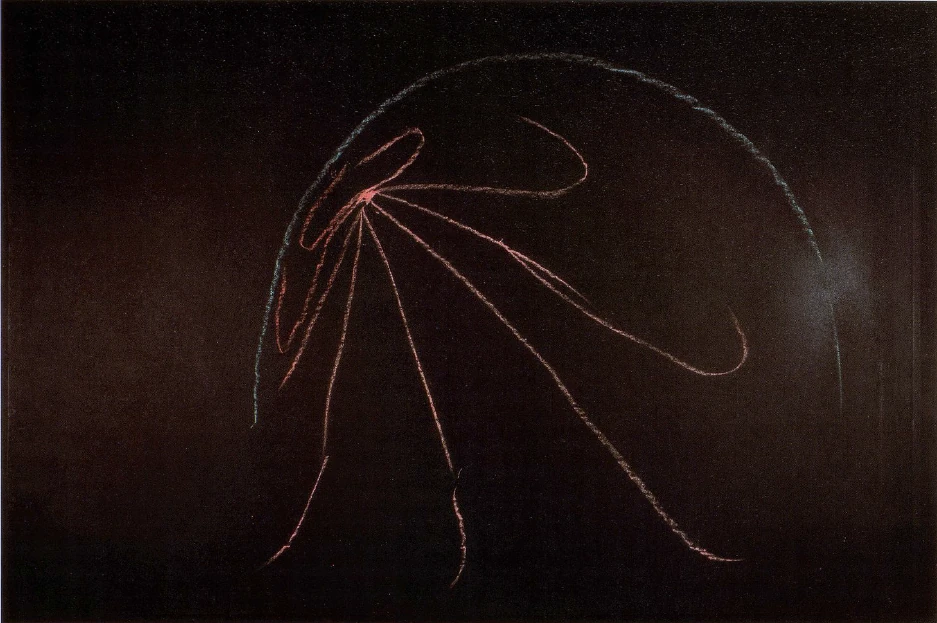
[ 74 ] I would recommend subjecting them to this procedure: dig a quarter of a meter or slightly deeper into a large manure pile so that the manure closes in around the item. You don’t need a depth of a meter, but the manure should close in around the specimens. Here’s why: If this is the manure pile, and you have a small particle lying here—the whole thing depends on the radiation—the rays all go like this; and if it’s too close to the surface, that’s not good. At the surface itself, the radiation is refracted; it follows a very specific curve; it does not escape if the manure is closed around it. A depth of half a meter is sufficient. If it is too close to the surface, a large portion of the radiation’s energy is lost.
Is it enough to just make a few holes, or should you spread them out as much as possible?
[ 75 ] It's better to spread them out rather than just drilling the holes in one spot. Otherwise, the radiation fields interfere with each other.
Should all the preparations be added to the manure pile at the same time?
[ 76 ] When you add the preparations to the manure pile, you can place them side by side. They do not affect each other; they only affect the manure itself.
Can you put all the preparations into one hole?
[ 77 ] Theoretically, one could even assume that if all the specimens were placed in a single hole, they would not interfere with one another. But I wouldn't want to claim that from the outset. They can be placed next to one another, but it could still be the case that they would interfere with one another if they were all placed together in a single hole.
[Carl von Keyserlingk:] Which oak are you referring to? [Rudolf Steiner:] Quercus robur. [Alfred Usteri:] [Could one use old corks in places where that oak doesn't grow?
[ 78 ] What does “old corks” mean?
[Alfred Usteri]: Not used.
[ 79 ] I don't know if that ends up being more expensive than getting plain oak bark some other way.
[Alfred Usteri]: And used?
[ 80 ] You definitely shouldn't use used corks that have been soaked in all sorts of things—like beer or wine—you certainly can't use those. I think it's better to use the bark directly.]
Does the bark have to come from a living tree or a felled tree?
[ 81 ] In this case, if possible, from a living tree—even one where you can assume that the oak resin is still quite effective.
Is the entire bark taken into account?
[ 82 ] Actually, just the surface. The outermost layer of bark, which crumbles when you peel it off.
Is it absolutely necessary to bury the manure preparations only as deep as the topsoil, or can the cow horns be buried deeper?
[ 83 ] It is indeed better to leave them within cultural history. In fact, it must be assumed that, buried beneath the surface of cultural history, they do not provide such fertile material after all. Of course, one would still have to consider that a deeper cultural stratum would be by far the more favorable option. If one were to select the stratum that represents the most powerful cultural layer, that would indeed be the best place. But beneath the cultural stratum, one will achieve no practical benefit.
In cultural history, objects would always be exposed to frost. Doesn't that cause damage?
[ 84 ] When they are exposed to frost, they are entering precisely the time when the Earth, due to this frost, is most vulnerable to cosmic influences.
How do you crush quartz and pebbles? In a small mill or in a mortar and pestle?
[ 85 ] In this case, it is best to start by doing this in a mortar—you’ll need an iron pestle—and grind it in the mortar until it reaches a very fine, powdery consistency. Even with quartz, it will be necessary to grind it in this manner as much as possible first and then continue grinding it on a glass surface. This is because it must be very fine powder, and that is very difficult to achieve with quartz.
Agricultural experience shows that a well-fed animal also puts on fat. So there must be a relationship between food and the absorption of nutrients from the atmosphere, right?
[ 86 ] Just keep in mind what I said. I said: When it comes to nutrition, what matters most is the vital forces that are developed within the body. Whether the animal develops sufficient vital forces to acquire the ability to absorb and process substances from the atmosphere depends on proper nutrition. It can be compared to this: If you need to pull a tight glove over your hand, you cannot do so by stuffing it; rather, you must first stretch it out with a wooden stick. In the same way, this is a process of softening the forces that must be present to receive from the atmosphere that which is not provided by food. Food expands the organism and thereby enables it to absorb more from the atmosphere. This can even lead to hypertrophy if one consumes too much. One then pays for this with a shorter lifespan. There is a point that lies in the middle between the maximum and the minimum.