

The Agricultural Course
Spiritual Science Foundations
for the Prosperity of Agriculture
GA 327
14 June 1924, Koberwitz
Translate the original German text into any language:
Versions Available:
The Agricultural Course, tr. SOL
Sechster Vortrag
Sixth Lecture
Meine lieben Freunde!
My dear friends!
[ 1 ] Wir werden jetzt im weiteren Fortgange unserer Betrachtungen uns auf manches zu stützen haben, was wir in den vorangehenden Tagen an Einsichten in das Pflanzenwachstum, auch in die tierischen Bildungen gehört haben. Es wird sich darum handeln, dass wir nun wenigstens aphoristisch auch einige von den geisteswissenschaftlichen Vorstellungen vor uns vorüberziehen lassen, die zusammenhängen mit den Pflanzen, mit den pflanzlichen, mit den tierischen Schädlingen der Landwirtschaft und mit demjenigen, was man nennt Pflanzenkrankheiten. Nun lassen sich diese Dinge eigentlich nur betrachten ganz im Konkreten. Und deshalb werde ich auch da, wo man im Allgemeinen wenig sagen kann, weil die Dinge spezialisiert werden müssen, zunächst Beispiele anführen, die dann, wenn sie zum Ausgangspunkt von Versuchen genommen werden, ja auch zu Weiterem führen können. Zunächst möchte ich ausgehen von dem Unkrautwesen oder wie man das so nennt, ich möchte diese Pflanzenschädlinge einmal betrachten.
[ 1 ] As we continue our reflections, we will now have to draw on some of the insights into plant growth—and also into animal formations—that we have heard in the preceding days. Our task will be to briefly touch upon—at least in aphoristic form—some of the spiritual-scientific concepts related to plants, to plant and animal pests in agriculture, and to what are called plant diseases. Now, these things can really only be considered in very concrete terms. And that is why, even where one can generally say little—because the subject matter must be specialized—I will first cite examples which, if taken as the starting point for experiments, can indeed lead to further insights. To begin with, I would like to start with weeds—or whatever they are called—and consider these plant pests.
[ 2 ] Sehen Sie, da handelt es sich ja darum, weniger eine Definition des Unkrautes zu bekommen, sondern es handelt sich darum, Einsichten zu bekommen darüber, wie man aus einem gewissen Feldgebiete diejenigen Pflanzen wegbringen kann, welche man dort nicht haben will. Nicht wahr, man hat ja schon manchmal noch solche merkwürdigen Anwandlungen, die man behalten hat aus der Studienzeit. Und da habe ich versucht, wenn auch nicht gerade mit viel Lust, einer solchen Anwandlung nachzugehen und in einigen Schriften aufzusuchen, was man als Definition des Unkrautes hat. Nun habe ich da gefunden, dass die meisten Autoren, die definieren wollen, was das Unkraut ist, sagen: «Unkraut ist alles dasjenige, was an dem Orte, wo man es nicht haben will, wächst.» Sie sehen, es ist eine Definition, die nicht gerade stark in das Wesen der Sache hineinkommt. Und man wird auch nicht gerade viel Glück haben, wenn man auf das Wesen des Unkrautes eingehen will, aus dem einfachen Grunde, weil ja vor dem Forum der Natur das Unkraut gerade so viel Recht hat zu wachsen, wie dasjenige, was man nützlich findet. Man wird sich schon klar werden müssen, dass die Dinge von einem etwas anderen Gesichtspunkte aus gesehen werden müssen, von demjenigen Gesichtspunkte, wie man von einem gewissen Feldgebiete wegkriegt gerade dasjenige, was dort nicht beabsichtigt ist, aber durch den allgemeinen Naturzusammenhang dort wächst. Diese Frage kann man sich gar nicht beantworten anders, als dass man gerade auf diejenigen Dinge Rücksicht nimmt, die wir in den verflossenen Tagen angeführt haben.
[ 2 ] You see, it’s not so much a matter of coming up with a definition of a weed, but rather of gaining insights into how to remove from a particular field those plants that you don’t want there. Isn’t it true that we sometimes still have those strange impulses that we’ve carried over from our student days? And so I tried—albeit not with much enthusiasm—to follow through on one such impulse and look up in some writings what the definition of a weed is. Now, I found that most authors who attempt to define what a weed is say: “A weed is anything that grows in a place where you don’t want it.” As you can see, it’s a definition that doesn’t really get to the heart of the matter. And one won’t have much success either if one tries to get to the essence of the weed, for the simple reason that, in the court of nature, the weed has just as much right to grow as that which is considered useful. One will have to realize that things must be viewed from a somewhat different perspective—namely, the perspective of how, in a given field, one removes precisely that which is not intended to be there but grows there as part of the general fabric of nature. This question cannot be answered in any other way than by taking into account precisely those things we have mentioned in the past few days.
[ 3 ] Wir haben ja angeführt, wie man streng unterscheiden müsse zwischen denjenigen Kräften, die im Pflanzenwachstum sind, und die aus dem Kosmos zwar stammen, aber vom Kosmos zuerst in die Erde aufgenommen werden und von der Erde aus auf das Pflanzenwachstum wirken. Diese Kräfte, die also im Wesentlichen herstammen aus den kosmischen Einflüssen, wie ich gesagt habe, von Merkur, Venus und dem Monde, aber die nicht direkt von diesen Planeten wirken, sondern auf dem Umwege durch die Erde wirken, diese Kräfte hat man zu berücksichtigen, wenn es sich darum handelt, zu verfolgen dasjenige, was nach einer Mutterpflanze wieder eine Tochterpflanze hervorruft und so weiter. Dagegen wird man in alledem, was die Pflanze aus dem Umkreis von dem Überirdischen hernimmt, zu sehen haben auf das, was die ferneren Planeten übertragen der Luft an Wirkungsmöglichkeiten, und was eben aufgenommen wird auf diese Weise. Im weiteren Sinne aber kann man auch sagen, dass alles das, was von den nahen Planeten an Kräften auf die Erde einwirkt, viel beeinflusst wird von den Kalkwirkungen der Erde, während beeinflusst wird das, was aus dem Umkreis wirkt, von den Kieselwirkungen. Und da ist es dann so, dass wenn die Kieselwirkungen auch von der Erde selbst ausgehen, sie dennoch das vermitteln, was von Jupiter, Mars, Saturn ausgeht, nicht eigentlich dasjenige, was von Mond, Merkur und Venus ausgeht.
[ 3 ] We have already pointed out that a strict distinction must be made between the forces at work in plant growth and those that, while originating in the cosmos, are first absorbed by the Earth and then act upon plant growth from the Earth. These forces, which essentially stem from cosmic influences—as I have said, from Mercury, Venus, and the Moon—but which do not act directly from these planets, rather acting indirectly through the Earth, must be taken into account when it comes to tracing what causes a daughter plant to emerge from a mother plant, and so on. In contrast, with regard to everything the plant absorbs from the surroundings of the supersensible realm, one must consider what the more distant planets impart to the air in terms of potential effects, and what is absorbed in this way. In a broader sense, however, one can also say that all the forces from the nearby planets acting upon the Earth are greatly influenced by the Earth’s calcareous forces, whereas what acts from the surrounding sphere is influenced by the siliceous forces. And so it is that even though the siliceous forces also emanate from the Earth itself, they nevertheless convey what emanates from Jupiter, Mars, and Saturn—not actually what emanates from the Moon, Mercury, and Venus.
[ 4 ] Nun ist man ja heute ganz ungewohnt, diese Dinge wirklich zu berücksichtigen. Aber man muss es auch büßen. Und in einem Falle hat man ja in zahlreichen Gegenden der zivilisierten Welt die Unkenntnis des kosmischen Einflusses, sowohl insofern er durch die Luft auf dem Umwege durch das über dem Bodenniveau Liegende wirkt, wie auch [des kosmischen Einflusses] insofern er durch Vermittlung der Erde von unten [hinauf]wirkt, durch diese Einsichtslosigkeit büßen müssen, indem alles ganz erschöpft war, was einmal durch die ältere instinktive Wissenschaft gemacht wurde in Bezug auf solche Dinge; Ihnen allen kann das gleichgültig sein, aber vielen Menschen ist es nicht gleichgültig. Es war der Erdboden erschöpft, die Traditionen waren auch erschöpft — wenn auch die Bauern manchmal nachgeholfen haben —, und so ist über weit ausgebreitete Weinanpflanzungen die Reblaus gekommen. Der Reblaus stand man ziemlich hilflos gegenüber. Ich weiß noch vieles zu erzählen von einer Redaktion einer in den Achtzigerjahren in Wien erschienenen landwirtschaftlichen Zeitung, die von allen Seiten angegangen wurde, sie solle ein Mittel gegen die Reblaus finden, und die ganz ratlos wurde, als dazumal die Reblausplage wirklich akut geworden ist. — Diese Dinge lassen sich eben nicht mit derjenigen Wissenschaft durchgreifend behandeln, die man heute hat; sie lassen sich nur behandeln, wenn man wirklich eingehen kann auf dasjenige, was man wissen kann auf den Wegen, die wir angedeutet haben.
[ 4 ] Nowadays, people are quite unaccustomed to really taking these things into account. But one must also atone for it. And in one instance, in numerous regions of the civilized world, there is a lack of understanding of the cosmic influence—both insofar as it acts through the air via a detour through what lies above ground level, and [of the cosmic influence] insofar as it acts from below through the Earth’s mediation [up]—and for this lack of insight, we must pay the price, in that everything that was once achieved through the older, instinctive science regarding such matters has been completely exhausted; you may all be indifferent to this, but many people are not indifferent. The soil was exhausted, the traditions were also exhausted—even if the farmers sometimes gave it a helping hand—and so the phylloxera spread across vast vineyards. People were quite helpless in the face of the phylloxera. I still have much to tell about the editorial staff of an agricultural newspaper published in Vienna in the 1880s, which was pressured from all sides to find a remedy for the phylloxera and became completely at a loss when the phylloxera plague became truly acute at that time. — These issues simply cannot be thoroughly addressed with the science available today; they can only be addressed if one is truly able to engage with what can be known through the approaches we have outlined.
[ 5 ] Nun stellen Sie sich einmal vor — schematisch will ich das zeichnen: Das sei das Erdniveau, hier alles das, was aus dem Kosmos herein an Wirkungen von Venus, Merkur und Mond kommt und wiederum zurückstrahlt, sodass es von unten nach oben wirkt. Und dieses, was auf diese Weise in der Erde zur Wirksamkeit kommt — ich will es wiederum schematisch zeichnen —, das bringt die Pflanzen so zur Wirksamkeit, dass sie zunächst das bilden, was in einem Jahre wächst, dann den Samen bilden. Aus dem Samen kommt dann wiederum die neue Pflanze, die dritte Pflanze und so weiter. Es geht das alles in die Reproduktionskraft, in die Generationenfolge hinein, was auf diesem Wege kommt.
[ 5 ] Now imagine this—I’ll sketch it out schematically: Let this be the earth’s level; here is everything that comes in from the cosmos in the form of influences from Venus, Mercury, and the Moon, and which in turn radiates back, so that it acts from the bottom up. And what becomes active in the Earth in this way—I’ll draw this schematically as well—brings the plants into activity in such a way that they first produce what grows in a year, then form the seed. From the seed, in turn, comes the new plant, the third plant, and so on. Everything that comes about in this way flows into the power of reproduction, into the succession of generations.
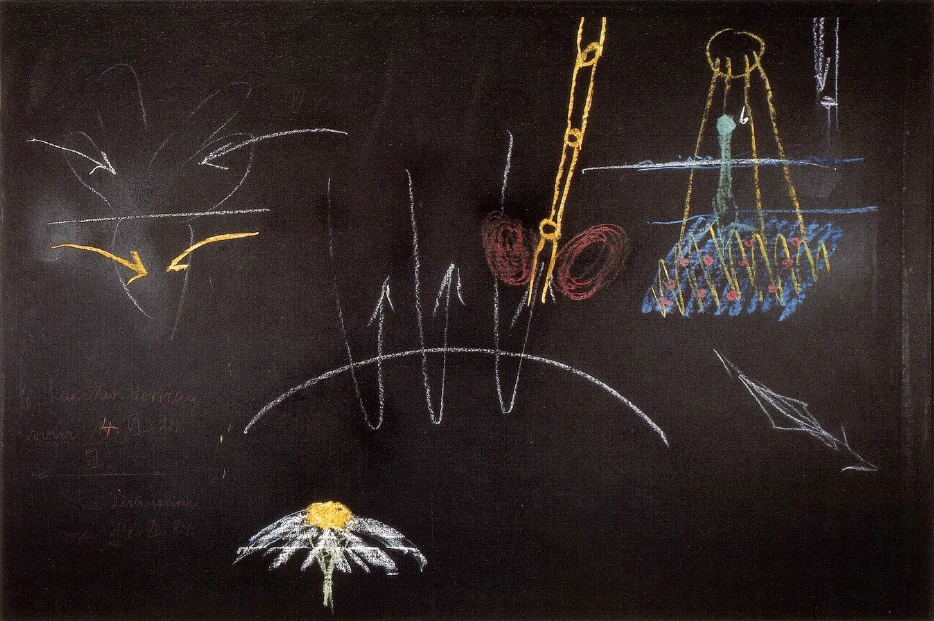
[ 6 ] Dagegen alles dasjenige, was auf einem anderen Wege kommt, der da liegt über dem Niveau der Erde, kommt von den anderen Kräften, von den fernen Planetenkräften. Das kann man schematisch so zeichnen, dass ich sage: Das ist hier, was sich nun in der Pflanze umsetzt dadurch, dass sie sich im Umkreis ausbreitet, was sie dick und fett ausschend macht, was wir als Nahrungsmittel wegnehmen, weil es ein kontinuierlicher Strom immer von Neuem bildet.
[ 6 ] In contrast, everything that comes by a different path—the one that lies above the level of the earth—comes from the other forces, from the distant planetary forces. This can be schematically illustrated as follows: This is what is now transformed within the plant as it spreads out in all directions, making it thick and plump—what we consume as food, because it constantly forms a continuous stream anew.
[ 7 ] Was wir ablösen zum Beispiel vom Apfel, vom Pfirsich, was wir dann essen als Fruchtfleisch, all das rührt her von diesen erdfernen Planetenwirkungen. Nun aber geht gerade aus diesen Einsichten hervor, wie man sich verhalten muss, wenn man in irgendeiner Weise das Pflanzenwachstum beeinflussen will. Nicht auf eine andere Art lässt sich eine Einsicht darüber gewinnen, wie man das Pflanzenwachstum beeinflussen will, als dadurch, dass man eben Rücksicht nimmt auf diese verschiedenen Kräfte.
[ 7 ] What we extract, for example, from an apple or a peach—what we then eat as fruit pulp—all of that stems from these planetary influences that are far removed from Earth. But it is precisely from these insights that we can determine how one must act if one wishes to influence plant growth in any way. There is no other way to gain insight into how to influence plant growth than by taking these various forces into account.
[ 8 ] Nun hat zunächst auf eine große Anzahl von Pflanzen, und das sind vor allen Dingen diejenigen Pflanzen, die man so im gewöhnlichen Leben zu den Unkräutern rechnet, die manchmal außerordentlich starke Heilpflanzen sind — gerade unter den Unkräutern suchen wir die stärksten Heilpflanzen —, auf diese Pflanzen hat nun den größten Einfluss dasjenige, was man die Mondenwirkungen nennen kann.
[ 8 ] First of all, a large number of plants—and these are primarily the plants that we commonly regard as weeds, which are sometimes extraordinarily potent medicinal plants—it is precisely among the weeds that we find the most potent medicinal plants—these plants are most strongly influenced by what might be called the effects of the moon.
[ 9 ] Von dem Monde weiß man im gewöhnlichen Leben, dass er die Sonnenstrahlen in seiner Oberfläche aufnimmt und sie auf die Erde hinwirft. Wir sehen ja dadurch, dass wir es auffangen mit unseren Augen — und die Erde fängt ja auch diese Mondenstrahlen auf — die zurückgeworfenen Sonnenstrahlen. Es sind also die Sonnenstrahlen, die auf diese Weise zurückgeworfen werden, die aber vom Mond mit seinen Kräften durchströmt werden, die also gerade als Mondenkräfte auf die Erde kommen, seit der Mond sich von der Erde getrennt hat. Im Kosmos wirkt gerade diese Mondenkraft verstärkend auf alles Irdische. — Als der Mond noch mit der Erde vereint war, war ja das Irdische viel mehr ein Lebendiges, viel mehr ein Fruchtendes. Ein so stark Mineralisches, wie wir es heute haben, gab es eigentlich in jener Zeit nicht, als der Mond noch mit der Erde vereint war. Aber nachdem der Mond sich von der Erde getrennt, wirkt er so, dass der gewöhnliche Zustand dieser Erde, der gerade hinreicht, um Wachstum bei den Lebewesen zu bewirken, dadurch verstärkt wird, sodass das Wachstum sich steigern kann zur Reproduktion.
[ 9 ] In everyday life, we know that the Moon absorbs the sun’s rays on its surface and reflects them toward the Earth. We see—because we catch them with our eyes, and the Earth also catches these lunar rays—the reflected rays of the sun. It is thus the rays of the sun that are reflected in this way, but they are permeated by the Moon’s forces; they therefore reach the Earth specifically as lunar forces, ever since the Moon separated from the Earth. In the cosmos, it is precisely this lunar force that has a strengthening effect on everything earthly. — When the Moon was still united with the Earth, earthly life was much more vibrant and fruitful. A mineral nature as strong as we have today did not actually exist in that time when the Moon was still united with the Earth. But after the Moon separated from the Earth, it has acted in such a way that the ordinary condition of this Earth—which is just sufficient to bring about growth in living beings—is thereby strengthened, so that growth can intensify to the point of reproduction.
[ 10 ] Wenn ein Wesen wächst, wird es groß. Da ist dieselbe Kraft täuig, die auch bei der Fortpflanzung tätig ist. Nur kommt es nicht so weit beim Wachsen, dass ein Wesen gleicher Art entsteht. Es entsteht Zelle auf Zelle nur, es ist ein schwächeres Fortpflanzen, ein Fortpflanzen, das innerhalb des Wesens stehen bleibt; und das Fortpflanzen ist ein stärkeres Wachsen. Die Erde selbst kann nun gerade das schwache Fortpflanzen, das Wachstum vermitteln, aber ohne den Mond vermag sie nichts über das verstärkte Wachstum. Da braucht sie eben einfach dasjenige, was an kosmischen Kräften durch den Mond und bei besonderen Pflanzen auch durch Merkur und Venus auf die Erde hereinscheint. Ich sagte vorhin, man stellt sich vor, der Mond nimmt nur die Sonnenstrahlen auf und wirft sie herein über die Erde. Man sieht also eigentlich bei der Mondenwirkung nur auf das Sonnenlicht hin. Aber das ist nicht das Einzige, was auf die Erde kommt. Mit den Mondenstrahlen kommt nun auch der ganze reflektierte Kosmos auf die Erde. Alles, was auf den Mond hinwirkt, wird wieder zurückgestrahlt. So wird auch der ganze Sternenhimmel, ohne dass man auch dieses mit den heutigen physikalischen Methoden dem heutigen Menschen nachweisen kann, in einer gewissen Weise vom Mond auf die Erde zurückgestrahlt. Es ist schon eine starke und sehr organisierende kosmische Kraft, die da vom Mond heruntergestrahlt wird in die Pflanzen, damit der Pflanze auch mit Bezug auf das Samenhafte gedient werden kann, damit sich die Wachstumskraft erhöht zur Fortpflanzungskraft.
[ 10 ] When a being grows, it becomes large. The same force is at work here as in reproduction. However, growth does not go so far as to produce a being of the same kind. It merely produces cell after cell; it is a weaker form of reproduction, one that remains within the being itself; and this reproduction is a stronger form of growth. The Earth itself can mediate precisely this weak form of reproduction—growth—but without the Moon, it is powerless to bring about the intensified growth. For this, it simply needs those cosmic forces that shine down upon the Earth through the Moon—and, in the case of certain plants, also through Mercury and Venus. I mentioned earlier that people imagine the Moon merely absorbs the Sun’s rays and casts them down upon the Earth. Thus, when considering the Moon’s influence, one actually focuses only on the sunlight. But that is not the only thing that reaches the Earth. Along with the moonbeams, the entire reflected cosmos also reaches the Earth. Everything that acts upon the Moon is reflected back. Thus, the entire starry sky—even though this cannot be demonstrated to modern people using today’s physical methods—is, in a certain sense, reflected back to Earth by the Moon. It is indeed a powerful and highly organizing cosmic force that is radiated down from the Moon into the plants, so that the plant may be supported—especially in relation to its seed-bearing capacity—and so that its growth force may be enhanced into a reproductive force.
[ 11 ] Nun, das alles ist für eine Gegend der Erde aber nur dann da, wenn diese Gegend Vollmond hat. Wenn diese Gegend Neumond hat, so genießt sie die Wohltat des Mondeneinflusses nicht. Es hält nur an in den Pflanzen während des Neumondes, was sie aufgenommen haben zur Zeit des Vollmondes. Man würde schon auch dadurch Bedeutsames erreichen können, wenn man überhaupt studierte, wie weit man kommt, wenn man schon, sagen wir, bei der Aussaat für die allererste Keimestätigkeit in der Erde den Mond benützen würde, wie es die alten Inder getan haben bis ins neunzehnte Jahrhundert hinein, die nach den Mondphasen gesät haben. Aber so grausam ist ja die Natur nicht, dass sie den Menschen schon straft für die geringe Unaufmerksamkeit und Unhöflichkeit, die er dem Mond zuteil werden lässt beim Säen, beim Ernten. Also Vollmond haben wir ja zwölfmal im Jahre; das reicht aus, dass die Vollmondwirkungen, das heißt die die [Befruchtung] befördernden [Vollmond-]Kräfte, genügend da sind. Und wenn halt einmal irgendetwas, was zur Befruchtung beiträgt, statt bei Vollmond, bei Neumond vorgenommen wird, so wartet es eben in der Erde bis zum nächsten Vollmond, setzt sich da über die menschlichen Irrtümer hinweg und richtet sich nach der Natur. Das reicht durchaus aus für die Benutzung des Mondes durch die Menschen, ohne dass sie eine Ahnung davon haben. Aber weiter kommt man auch damit nicht.
[ 11 ] Well, all of this is true for a region of the Earth only when that region is experiencing a full moon. When that region is experiencing a new moon, it does not benefit from the moon’s influence. During the new moon, plants retain only what they absorbed during the full moon. One could certainly achieve significant results simply by studying how far one could go if, for example, one were to use the moon when sowing—specifically for the very first germination activity in the earth—as the ancient Indians did well into the nineteenth century, when they sowed according to the phases of the moon. But nature is not so cruel as to punish people for the slight inattention and discourtesy they show toward the moon when sowing or harvesting. After all, we have twelve full moons a year; that is enough to ensure that the full-moon effects—that is, the [full-moon] forces that promote [fertilization]—are sufficiently present. And if, on occasion, something that contributes to fertilization is done during a new moon instead of a full moon, it simply waits in the earth until the next full moon, overlooking human errors and conforming to nature. That is certainly sufficient for humans to make use of the moon without having the slightest inkling of it. But one cannot go any further with that either.
[ 12 ] Denn sehen Sie, so behandelt, fordern die Unkräuter ebenso ihr Recht wie die Kräuter, und man kriegt alles durcheinander, weil man gar nicht in den Kräften drinnen steht, die das Wachstum regeln. Man muss sich hineinstellen in diese Kräfte, die das Wachstum regeln. Da kann man wissen: Mit der voll entwickelten Mondeskraft wird gewirkt für die Reproduktion, für die Fortpflanzung alles PflanzlichLebendigen. Für das also, was von der Wurzel bis hoch hinauf in die Samenbildung heraufstößt, wird gewirkt. Nun werden wir ja die besten Unkräuter bekommen, wenn wir den wohltätigen Mond auf unsere Unkräuter wirken lassen, ihn in seiner Wirkung gar nicht aufhalten. Denn die Unkräuter werden sich dadurch, dass es ja auch nasse Jahre gibt, wo die Mondenkräfte besser wirken als in trockenen, diese Unkräuter werden sich fortpflanzen und dadurch vermehren.
[ 12 ] For you see, when treated this way, the weeds assert their right just as much as the herbs, and everything gets mixed up because one is not at all attuned to the forces that govern growth. One must attune oneself to these forces that govern growth. Then one can know: With the fully developed power of the Moon, the forces work toward reproduction—toward the propagation of all plant life. Thus, they work for that which surges upward from the root all the way to seed formation. Now, we will indeed get the best weeds if we allow the beneficial moon to act upon our weeds, without hindering its effect at all. For since there are also wet years when the lunar forces act more effectively than in dry ones, these weeds will reproduce and thereby multiply.
[ 13 ] Rechnet man aber mit diesen kosmischen Kräften, so wird man sich ja Folgendes sagen: Unterbindet man die volle Mondenwirkung bei den Unkräutern, lässt man auf die Unkräuter nur das wirken, was von außen hereinwirkt, daher nicht Mondenwirkung ist, was direkt wirkt, so setzt man ihrer Fortpflanzung eine Grenze. Sie können sich dann nicht fortpflanzen. Nun handelt es sich darum, dass man den Erdboden so behandelt — da man ja den Mond nicht abstellen kann —, dass die Erde ungeneigt wird, die Mondenwirkungen aufzunehmen; und nicht nur die Erde kann ungeneigt werden, die Mondenwirkungen aufzunehmen, sondern es können auch die Pflanzen, diese Unkräuter, eine gewisse Scheu dafür bekommen, in einer in einem gewissen Sinne behandelten Erde zu wachsen. Wenn wir das erreichen, so haben wir das, was wir wollen. Wir sehen, wie das Unkraut kommt in einem Jahre. Da müssen wir halt die Sache mal hinnehmen, nicht erschrecken, sondern uns sagen, nun heißt es eingreifen. Jetzt aber sammeln wir von diesem Unkraut eine Anzahl von Samen, dasjenige also, worin sich die Kraft, von der ich gesprochen, zuletzt abgeschlossen hat. Wir zünden uns nun eine Flamme an — eine einfache Holzflamme ist am besten — und verbrennen diese Samen und sammeln sorgfältig alles, was sich als Asche ergibt. Wir verschaffen uns verhältnismäßig wenig auf diesem Wege von dieser Asche. Aber wir haben ja jetzt buchstäblich bei denjenigen Pflanzen, die wir so behandelt haben, indem wir den Samen haben durchs Feuer gehen lassen, in Asche verwandelt haben, in der Asche konzentriert die entgegengesetzte Kraft von dem, was entwickelt wird in der Anziehung der Mondenkräfte. Streuen wir nun — wir brauchen gar nicht besonders sorgfältig vorzugehen, da die Dinge im großen Umkreise wirken — dieses kleine Präparat, was wir auf diese Weise aus den verschiedensten Unkräutern uns verschafft haben, auf unseren Acker, dann werden wir schon im zweiten Jahre sehen, wie weit weniger von der Unkrautart da ist, die wir so behandelt haben. Es wächst nicht mehr so stark, und da ein Zyklus von vier Jahren in der Natur für sehr viele Dinge vorhanden ist, so werden wir sehen, dass nach dem vierten Jahre das betreffende Unkraut, das wir jährlich so behandeln, indem wir diesen Pfeffer ausstreuen, auf diesem Acker aufhört zu sein.
[ 13 ] But if one takes these cosmic forces into account, one will say the following: If one prevents the full effect of the moon on the weeds, allowing only external influences—which are not lunar effects but act directly—to affect them, one sets a limit on their reproduction. They will then be unable to reproduce. The point is, since we cannot turn off the moon, to treat the soil in such a way that the earth becomes reluctant to absorb the lunar influences; and not only can the earth be made reluctant to absorb these influences, but the plants—these weeds—can also develop a certain aversion to growing in soil that has been treated in a specific way. If we achieve this, we will have what we want. We’ll see the weeds come up in a year. At that point, we’ll just have to accept it—not be alarmed, but tell ourselves that now is the time to intervene. But first, let’s collect a number of seeds from these weeds—that is, the ones in which the power I’ve spoken of has finally been concentrated. We now light a flame—a simple wood fire is best—and burn these seeds, carefully collecting all that remains as ash. We obtain relatively little of these ashes in this way. But we now have, quite literally, in the plants we have treated in this manner—by passing the seeds through fire and transforming them into ashes—the opposing force to that developed by the attraction of the lunar forces concentrated within the ashes. If we now scatter—we need not proceed with particular care, since these things have a broad-ranging effect—this small preparation, which we have obtained in this way from a wide variety of weeds, over our field, then as early as the second year we will see how much less of the weed species we have treated in this way remains. It no longer grows as vigorously, and since a four-year cycle exists in nature for many things, we will see that after the fourth year, the weed in question—which we have treated annually by scattering this pepper—will cease to exist in this field.
[ 14 ] Sehen Sie, da hat man dann tatsächlich die Wirkung kleinster Entitäten, die ja nun durch das Biologische Institut wissenschaftlich nachgewiesen ist, fruchtbar gemacht. Man könnte auf diese Weise tatsächlich außerordentlich viel erreichen, und Sie können jetzt überhaupt, wenn Sie mit diesen Dingen rechnen bei Ihrem Vorgehen, wenn Sie also tatsächlich die Wirkungen, die heute ganz unberücksichtigt bleiben, in Rechnung ziehen, außerordentlich viel in der Hand haben. Sie können jetzt wirklich dasjenige, was Sie an Löwenzahn brauchen in der Richtung, wie ich das gestern auseinandergesetzt habe, irgendwo anpflanzen, können aber auch noch diesen Löwenzahn so verwenden in Bezug auf seinen Samen, dass Sie dieses Brennexperiment mit ihm machen, sich den kleinen Pfeffer bereiten und ihn über ihren Acker ausstreuen. Dann werden Sie das erreichen, dass Sie den Löwenzahn hinsetzen können, wohin Sie wollen, aber dass derjenige Acker, den Sie mit dem so verbrannten Löwenzahn behandeln Ihnen ungeschoren bleibt von diesem Löwenzahn.
[ 14 ] You see, this actually harnesses the effects of the tiniest entities—effects that have now been scientifically proven by the Biological Institute. One could actually achieve an extraordinary amount in this way, and you now have an extraordinary amount of control—provided you factor these things into your approach, that is, if you actually take into account the effects that are currently being completely overlooked. You can now actually plant the dandelions you need—in the way I explained yesterday—anywhere you like, but you can also use these dandelions in terms of their seeds by conducting this burning experiment with them, preparing the little pepper, and scattering it over your field. Then you’ll achieve the result that you can plant the dandelions wherever you want, but the field you treat with the dandelions burned in this way will remain free of them.
[ 15 ] Das sind eben Dinge — man glaubt es heute nicht —, die früher einmal aus einer instinktiven Agrikulturweisheit beherrscht worden sind. Da hat man können in begrenzten Gebieten zusammenpflanzen dasjenige, was man gewollt hat, weil man solche Dinge instinkthaft ehemals gemacht hat. Ich kann in all diesen Dingen Angaben geben, aus denen Sie sehen können, sie können der Ausgangspunkt sein, diese Dinge in wirklicher Praxis anzuwenden, richtig in Praxis anzuwenden. Und da heute schon einmal das Urteil — ich will es nicht Vorurteil nennen — besteht, alles muss nachträglich verifiziert werden, nun gut, dann versuche man es, diese Dinge zu verifizieren. Man wird schon sehen, wenn man die Experimente richtig macht, sie werden sich schon bewahrheiten. Nur, würde ich selber eine Wirtschaft haben, so würde ich nicht warten auf das Bewahrheiten, sondern ich würde die Sache gleich anfangen. Denn ich bin ganz sicher, dass die Sache geht. Denn für mich liegt die Sache so: Geisteswissenschaftliche Wahrheiten sind durch sich selbst wahr. Man braucht nicht ihre Bewahrheitung durch andere Umstände, durch äußerliche Methoden. Diese Fehler haben alle unsere Wissenschafter gemacht, dass sie hinschauten auf äußere Methoden, durch äußere Methoden diese Wahrheiten verifizieren wollten. Sie haben das auch gemacht innerhalb der Anthroposophischen Gesellschaft. Da hätten die Leute aber wissen sollen, dass die Dinge durch sich wahr sein können. Aber um heute etwas zu erreichen, muss man nach außen schon dieses verifizieren, einen Kompromiss vornehmen, da ist der Kompromiss notwendig. Im Prinzip ist es nicht notwendig. Denn wie weiß man denn die Dinge innerlich? Man weiß sie so, dass sie eben innerlich durch ihre Qualität feststehen, so feststehen, wie ungefähr feststeht, wenn ich irgendetwas durch fünfzig Leute fabrizieren lasse, und ich sage mir, ich will jetzt dreimal so viel produzieren, ich nehme hundertfünfzig Leute. Da kann nun ein Vorwitziger kommen und sagen: Das glaube ich nicht, dass hundertfünfzig dreimal so viel machen, das muss man erst ausprobieren. Es kann nun unter Umständen geschehen, dass man durch die Erfahrung desavouiert wird, wenn man jetzt wirklich experimentiert. Sagen wir, man würde irgendetwas, was da in Betracht komm, erst durch einen, dann durch zwei, dann durch drei arbeiten lassen. Jetzt stellt man fest, statistisch, was die drei gearbeiter haben. Nun, wenn die drei immer für sich gerade schwätzen, so arbeiten sie weniger als einer. Die Voraussetzung, die man gemacht hat, ist falsch. Das Experiment kann das Gegenteil erweisen. Aber es ist noch nichts ausgemacht, wenn ein Experiment das Gegenteil erweist. Man muss dann schon, wenn man ganz exakt vorgeht, auch die Gegeninstanz ganz genau ins Auge fassen. Dann wird sich das, was innerlich wahr ist, auch äußerlich bestätigen.
[ 15 ] These are precisely the kinds of things—hard to believe today—that were once mastered through an instinctive agricultural wisdom. Back then, people were able to plant whatever they wanted together in limited areas because they used to do such things instinctively. I can provide details on all these matters that will show you they can serve as a starting point for applying these principles in real-world practice—applying them correctly in practice. And since there’s already a prevailing view today—I don’t want to call it a prejudice—that everything must be verified afterward, well then, let’s try to verify these things. You’ll see that if you conduct the experiments correctly, they will prove themselves true. However, if I were running a business myself, I wouldn’t wait for them to be proven true; I would get started right away. For I am quite certain that this approach works. Because for me, the matter is this: spiritual scientific truths are true in and of themselves. They do not need to be verified by other circumstances or by external methods. All our scientists have made this mistake: they looked to external methods and sought to verify these truths through external methods. They did this even within the Anthroposophical Society. But people there should have known that things can be true in and of themselves. However, to achieve anything today, one must verify this externally—one must make a compromise; that compromise is necessary. In principle, it is not necessary. For how does one know these things inwardly? One knows them in such a way that they are established inwardly by their very nature—just as firmly as, for example, when I have something manufactured by fifty people, and I tell myself, “I now want to produce three times as much, so I’ll use one hundred and fifty people.” Now, a smart aleck might come along and say: “I don’t believe that 150 people will produce three times as much; you have to try it first.” It may happen, under certain circumstances, that experience proves you wrong if you actually conduct the experiment. Let’s say you have something in question worked on first by one person, then by two, then by three. Now you determine, statistically, what the three workers have produced. Well, if the three are just chatting among themselves, they’ll get less done than one person. The assumption you made is wrong. The experiment may prove the opposite. But nothing is settled yet if an experiment proves the opposite. If you proceed with complete precision, you must also examine the counterexample very closely. Then what is true internally will also be confirmed externally.
[ 16 ] Man könnte also mehr im Allgemeinen sprechen bei den Pflanzenschädlingen unserer Felder. Man wird nicht so stark im Allgemeinen sprechen können, wenn man zu den tierischen Schädlingen kommt. Da möchte ich zunächst einmal ein Beispiel auswählen, das besonders charakteristisch sein kann, um Versuche zu machen, zu sehen, wie sich solche Dinge auch bewähren.
[ 16 ] So, we could speak more generally about the plant pests in our fields. We won’t be able to speak in such general terms when it comes to animal pests. In that regard, I’d like to start by selecting an example that is particularly characteristic, in order to conduct experiments and see how such approaches hold up.
[ 17 ] Nehmen wir da einmal einen besonders guten Freund des Landmannes, die Feldmaus. Diese Feldmaus, was will man nicht alles machen, was macht man nicht alles, um die Feldmaus zu bekämpfen! Man kann es in landwirtschaftlichen Werken lesen, dass man ja zunächst einmal allerlei Phosphorpräparate gut anwendet, dass man andere Dinge, das Strychnin-Sacharin-Präparat anwendet. Es ist sogar aufgetaucht die etwas radikale Bekämpfung, der Feldmaus den Typhus anzuzüchten, was man kann, wenn man gewisse Bazillen, die nur für Nagetiere schädlich sind, hineingibt in Kartoffelbrei, den man in entsprechender Weise verteilt. Auch diese Dinge sind gemacht worden, oder wenigstens werden sie empfohlen. Also auf allen möglichen Gebieten sucht man diesen doch eigentlich sehr treuherzig ausschauenden Tierchen durch eigentlich sehr wenig menschlich ausschauende Maßnahmen beizukommen, wenn sie einmal da sind. Nun ja, ich glaube, sogar der Staat wird in Bewegung gesetzt, weil nämlich es, wenn man so die Mäuse bekämpft, nichts hilft, wenn nicht der Nachbarbauer das auch tut. Da kommen sie dann von dem anderen Acker herüber, und so muss der Staat dann zu Hilfe gerufen werden, damit alle gezwungen werden, in einer bestimmten Weise die Mäuse zu vertreiben. Der Staat lässt sich ja nicht auf Modifikationen ein; der macht seinerseits seine Vorschriften, wenn er irgendeine Methode richtig findet, ganz gleichgültig, ob es richtig ist oder nicht, sodass sie jeder machen muss. Er muss es auf bekannte Weise tun: Es muss alles uniformiert werden — die Uniform ist ja das Ideal des Staates.
[ 17 ] Let’s take, for example, a particularly good friend of the farmer: the field mouse. This field mouse—what wouldn’t one do, what measures wouldn’t one take, to combat the field mouse! You can read in agricultural publications that, first of all, all kinds of phosphorus-based preparations are used effectively, and that other substances, such as the strychnine-saccharin mixture, are employed. A somewhat radical control method has even emerged: infecting the field mouse with typhus—which can be done by adding certain bacteria, harmful only to rodents, to mashed potatoes, which are then distributed in an appropriate manner. These methods have also been tried—or at least are recommended. So in all sorts of ways, people are trying to get rid of these actually quite innocent-looking little creatures using methods that seem far from humane, once they’ve taken hold. Well, I believe even the government gets involved, because when you’re fighting mice this way, it doesn’t help unless the neighboring farmer does the same. Then they come over from the other field, and so the government must be called in to ensure that everyone is forced to drive the mice away in a specific way. The state, after all, won’t entertain modifications; it lays down its own regulations when it deems a method to be correct—regardless of whether it actually is—so that everyone must follow it. Everyone must do it the prescribed way: everything must be standardized—standardization, after all, is the ideal of the state.
[ 18 ] Nun ja, also, das alles, sehen Sie, ist ja ein Von-außen-Herumprobieren und -Herumregieren. Und man hat immer so das Gefühl, recht wohl wird es den Probierern doch nicht bei der Sache, weil die Mäuse immer wieder kommen. Es wird ihnen nicht ganz wohl, die Mäuse kommen immer wieder zurück. Nun handelt es sich allerdings da um etwas, was man schon auch nicht gerade einzig und allein auf einem Gute anwenden kann, was aber sogar schon in einer gewissen Weise auf einem Gute helfen kann. Es wird nicht ganz durchführbar sein, man wird auch da durch Einsicht so wirken müssen, dass es die Nachbarn machen, aber ich behaupte, in der Zukunft wird man überhaupt viel mehr auf Einsichten sehen müssen als auf Polizeimaßnahmen. Das wird ein wirklicher Fortschritt in unserem sozialen Leben schon sein.
[ 18 ] Well, you see, all of this is just trial and error and tinkering from the outside. And you always get the feeling that those trying it out aren’t really getting anywhere, because the mice keep coming back. They don’t feel entirely at ease—the mice keep coming back. Now, this is something that can’t exactly be applied solely to a single estate, but it can actually help in a certain way even on a single estate. It won’t be entirely feasible; even there, one will have to use persuasion to get the neighbors to act, but I maintain that in the future we’ll have to rely much more on persuasion than on police measures. That will indeed be a real step forward in our social life.
[ 19 ] Denken Sie sich einmal, wenn man eine ziemlich junge Maus abfängt, da kann man sie häuten und kann die Haut von der ziemlich jungen Maus nehmen. Nun handelt es sich darum, dass man diese Haut — so viel Mäuse sind immer da, es müssen allerdings Feldmäuse sein, wenn man das Experiment machen will —, dass man diesen Balg der Feldmaus sich verschafft in der Zeit, wo die Venus im Zeichen des Skorpions steht. Sehen Sie, diese alten Kerle mit der instinktiven Wissenschaft waren gar nicht so dumm. Da, wo wir übergehen von der Pflanze zu den Tieren, kommen wir gerade auch auf den Tierkreis. Denn dieser Tierkreis ist nicht in unsinniger Weise der Tierkreis genannt. Will man in der Pflanzenwelt irgendetwas erreichen, so kann man stehen bleiben beim Planetensystem. Beim Tier geht das nicht mehr. Da braucht man schon Vorstellungen, die Rücksicht nehmen auf die umliegenden Fixsterne, namentlich diejenigen Fixsterne, die im Tierkreis vorhanden sind.
[ 19 ] Just imagine: if you catch a fairly young mouse, you can skin it and take the skin from that fairly young mouse. Now the point is that you obtain this skin—there are always plenty of mice around, though they must be field mice if you want to conduct the experiment—that you acquire this field mouse’s hide during the time when Venus is in the sign of Scorpio. You see, those old guys with their instinctive science weren’t so stupid after all. Right where we transition from plants to animals, we also come to the zodiac. For this zodiac is not called the zodiac without reason. If you want to achieve anything in the plant world, you can stick to the planetary system. With animals, that no longer works. There, you need concepts that take into account the surrounding fixed stars—namely, those fixed stars found in the zodiac.
[ 20 ] Nun, beim Pflanzenwachstum reicht die Mondenwirkung fast ganz aus, um die Reproduktion hervorzubringen. Beim Tierreich muss die Mondenwirkung unterstützt werden von der Venuswirkung. Die Mondenwirkung braucht nicht einmal gar so stark beim Tierreich ins Auge gefasst zu werden, weil das Tierreich die Mondenkräfte konserviert, in sich behält und sich emanzipiert vom Mond. In diesem Tierreich ist also auch die Mondeskraft dann entwickelt, wenn nicht gerade Vollmond ist. Das Tier trägt die Vollmondkraft in sich, emanzipiert sich der Zeitbestimmung nach. Das ist aber nicht der Fall mit Bezug auf dasjenige, was wir hier ausführen müssen, nicht der Fall mit Bezug auf die übrigen planetarischen Kräfte.
[ 20 ] Well, when it comes to plant growth, the influence of the Moon is almost entirely sufficient to bring about reproduction. In the animal kingdom, the influence of the Moon must be supported by the influence of Venus. The influence of the Moon does not even need to be considered all that strongly in the animal kingdom, because the animal kingdom conserves the lunar forces, retains them within itself, and emancipates itself from the Moon. In this animal kingdom, therefore, the lunar force is also active even when it is not a full moon. The animal carries the full moon’s power within itself, emancipating itself in accordance with the timing. However, this is not the case with regard to what we must discuss here, nor is it the case with regard to the other planetary forces.
[ 21 ] Denn es handelt sich darum, dass wir mit dem Balg der Maus etwas ganz Bestimmtes ausführen, Wir verschaffen uns zur Zeit des Stehens der Venus im Zeichen des Skorpions diesen Mäusebalg und verbrennen da diesen Mäusebalg, nehmen sorgfältig dasjenige, was sich da jetzt entwickelt durch das Verbrennen [an] Asche, überhaupt an Bestandteilen, die herausfallen — es wird nicht viel sein, aber wenn man eben eine Anzahl von Mäusen hat, so ist es genügend, so ist es genug, was man da bekommt; und man bekommt jetzt den verbrannten Mäusebalg zur Zeit, als die Venus im Skorpion steht. Und in dem, was da durch das Feuer vernichtet wird, bleibt jetzt übrig die negative Kraft gegenüber der Reproduktionskraft der Feldmaus. Wenn Sie nun den auf diese Weise gewonnenen Pfeffer — die Dinge werden ja auf gewissen Gebieten schwierig, da können Sie sich die Sache noch mehr homöopathisch machen, wir brauchen nicht einen ganzen Suppenteller voll Pfeffer — ausstreuen auf Ihre Felder, wenn er richtig bei der Hochkonjunktion von Venus und Skorpion durch das Feuer hindurchgeleitet worden ist, so werden Sie darin ein Mittel haben, dass die Mäuse dieses Feld meiden. Nun sind sie freche Tiere, sie kommen wieder hervor, wenn der Pfeffer so ausgestreut ist, dass in der Nähe etwas pfefferlos geblieben ist. Da nisten sie sich wieder ein. Das heißt, die Wirkung strahlt weit aus, aber es könnte ja doch geschehen, dass die Dinge nicht ganz durchgeführt werden. Aber es ist ganz gewiss eine radikale Wirkung, wenn in der ganzen Nachbarschaft dasselbe gemacht wird. Ich glaube, an solchen Dingen könnte man sogar viel Freude haben. Es würde einem können durch solche Dinge die Landwirtschaft so schmecken, wie eine gewisse Speise schmeckt, wenn man sie ein wenig gepfeffert hat.
[ 21 ] For the point is that we perform a very specific ritual with the mouse’s skin. We obtain this mouse skin while Venus is in the sign of Scorpio and burn it there; we then carefully collect what develops as a result of the burning [ ash—in short, any components that fall out—there won’t be much, but if you have a number of mice, it is sufficient; what you obtain is enough. And you obtain the burned mouse bladder at the time when Venus is in Scorpio. And in what is destroyed by the fire, what remains is the negative force in opposition to the reproductive force of the field mouse. If you now scatter the pepper obtained in this way—things do get tricky in certain areas, so you can make the process even more homeopathic; we don’t need a whole soup plate full of pepper—over your fields, provided it has been properly passed through the fire during the superior conjunction of Venus and Scorpio, you will have a remedy that will cause the mice to avoid that field. Now, they’re cheeky little creatures; they’ll come back if the pepper is scattered in such a way that some areas nearby remain pepper-free. That’s where they’ll settle in again. In other words, the effect radiates far and wide, but it could still happen that the process isn’t carried out completely. But it’s certainly a radical effect if the same thing is done throughout the entire neighborhood. I believe one could even take great pleasure in such things. Through such measures, one might come to appreciate farming in the same way that a certain dish tastes better when it’s been lightly peppered.
[ 22 ] Und sehen Sie, es handelt sich darum, dass man ja auf diese Weise wirklich dahin kommt, ohne irgendwie im Geringsten abergläubisch zu sein, mit den Sternenwirkungen zu rechnen. Es ist nur eben so, dass vieles sich später in bloßen Aberglauben verwandelt, was ursprünglich ein Wissen war. Natürlich kann man nicht den Aberglauben aufwärmen. Man muss wiederum von einem Wissen ausgehen; aber dieses Wissen, das muss nun durchaus erworben werden auf eine geistige Art, und nicht bloß auf eine physisch-sinnliche Art. Nun, so behandelt wird die Erde, wenn man den Kampf aufnehmen will gegen alles dasjenige Ungeziefer des Feldes, was in irgendeinem Sinne zu den höheren Tieren gerechnet werden kann. Mäuse sind Nagetiere, die zu den höheren Tieren gerechnet werden. Dagegen wird man auf diesem Wege nicht gut den Insekten beikommen können; denn die Insekten stehen unter ganz anderen kosmischen Einflüssen, und alles das, was niederes Getier ist, steht unter anderen kosmischen Einflüssen als die höheren Tiere.
[ 22 ] And you see, the point is that in this way one really does come to take the effects of the stars into account without being in the least bit superstitious. It’s just that much of what was originally knowledge later turns into mere superstition. Of course, one cannot simply revive superstition. One must start again from a foundation of knowledge; but this knowledge must be acquired in a spiritual way, and not merely in a physical or sensory way. Well, this is how the earth is treated when one wishes to take up the fight against all those field pests that can, in some sense, be classified as higher animals. Mice are rodents that are classified as higher animals. On the other hand, one will not be able to effectively deal with insects in this way; for insects are subject to entirely different cosmic influences, and all lower forms of life are subject to different cosmic influences than higher animals.
[ 23 ] Nun möchte ich einmal auf dünnes Eis treten und möchte im Zusammenhang mit der Sache, die wir auseinandergesetzt haben, als Beispiel anführen die Rübennematode, damit man etwas Naheliegendes auch haben kann. [Ich will nicht sagen der Nematode, aber der Rübe.] Da entdeckt man den sogenannten Ursprung in den bekannten Anschwellungen der Faserwurzel, und auch, dass die Blätter schlaff bleiben am Morgen. Das ist das äußere Zeichen. Nun muss man sich klar darüber sein, dass dieses Mittlere — die Blätter, die also hier eine Veränderung erfahren — aus der Luft die kosmischen Wirkungen aufnimmt, dass aber die Wurzeln die Kräfte aufnehmen, die durch die Erde aus dem Kosmos in die Pflanze zurückkommen.
[ 23 ] Now I’d like to venture onto thin ice for a moment and, in connection with the matter we’ve been discussing, cite the beet nematode as an example, so that we can have something more familiar to work with. [I don’t mean the nematode, but the beet.] There, one discovers the so-called origin in the familiar swellings of the fibrous roots, and also that the leaves remain limp in the morning. That is the outward sign. Now one must be clear about the fact that this middle part—the leaves, which thus undergo a change here—absorbs the cosmic influences from the air, whereas the roots absorb the forces that return to the plant through the earth from the cosmos.
[ 24 ] Was geschieht nun, wenn die Nematode auftritt? Wenn sie auftritt, dann geschieht das, dass der Aufnahmeprozess von den kosmischen Kräften, der eigentlich sonst in der Region der Blätter sein sollte, heruntergedrückt wird in die Region, wo er dann an die Wurzeln herankommt.
[ 24 ] What happens, then, when the nematode appears? When it appears, the process of absorption by the cosmic forces—which would otherwise take place in the region of the leaves—is pushed down into the region where it then reaches the roots.
[ 25 ] Schematisch gezeichnet: Wenn wir hier das Erdniveau haben, und wir hier haben die Pflanze, so wirken diejenigen kosmischen Kräfte, die oben wirken sollen, bei der nematodenbesetzten Pflanze hier unten. Das ist die eigentliche Erscheinung, um die es sich hier handelt. Es rutschen gewisse kosmische Kräfte zu tief herunter. Dadurch wird auch die ganze äußere Erscheinung der Pflanze hervorgerufen. Dadurch wird aber dem Tier die Möglichkeit gegeben, innerhalb der Erde, wo es leben muss, die kosmischen Kräfte zu haben, von denen es leben muss. Sonst müsste es oben leben in den Blättern — die Nematode ist ein drahtartiger Wurm —, da kann sie aber nicht leben, weil wieder die Erde ihr Milieu ist.
[ 25 ] To put it schematically: If we have the earth’s level here, and we have the plant here, then the cosmic forces that are supposed to act above end up acting on the nematode-infested plant down here. That is the actual phenomenon we are dealing with here. Certain cosmic forces are slipping too far down. This also gives rise to the plant’s entire external appearance. But it also gives the animal the opportunity, within the earth where it must live, to have access to the cosmic forces on which it depends for life. Otherwise, it would have to live up above in the leaves—the nematode is a thread-like worm—but it cannot live there because, again, the earth is its natural environment.
[ 26 ] Gewisse Lebewesen, ja alle Lebewesen, haben schon einmal die Eigentümlichkeit, dass sie nur innerhalb gewisser Grenzen des Seins leben können. Versuchen Sie es einmal, zu leben in einer Luft, die siebzig Grad Celsius warm ist, in einer Luft, die siebzig Grad Celsius kalt ist. Sie sind ganz darauf angewiesen, in einer bestimmten "Temperatur zu leben. Über diesem und unter diesem Niveau können Sie nicht mehr leben. Das kann die Nematode auch nicht. Sie kann nicht leben, wenn nicht die Erde da ist, zu gleicher Zeit [nicht auch] kosmische Kräfte da sind. Denn sonst müsste sie aussterben. Es sind immer ganz bestimmte Bedingungen für ein Lebewesen da. Auch das ganze Menschengeschlecht müsste aussterben, wenn nicht gewisse Bedingungen da sind. Nun, gerade bei denjenigen Wesen, die sich auf diese Art entwickeln, ist es wichtig, dass Kosmisches hineinkommt in die Erde, dasjenige Kosmische, das sich sonst bloß im Umkreis der Erde geltend machen sollte. Diese Wirkungen sind eigentlich vierjährig. Nun haben wir bei der Nematode etwas stark Abnormes, was man, wenn es einem auf die Erkenntnis ankommt, auch untersuchen kann — es sind ganz dieselben Kräfte —, wenn man die Engerlingslarven ins Auge fasst, die alle vier Jahre kommen. Es sind ganz dieselben Kräfte, die der Erde die Fähigkeit geben wollen, die Keime der Kartoffel zur Entwicklung zu bringen. Ganz dieselben Kräfte erlangt die Erde zur Bildung der Engerlinge, die alle vier Jahre zusammen mit den Kartoffeln auftreten. Das gibt einen vierjährigen Zyklus, wenn das gerade auftritt, nicht bei der Nematode, aber in dem, was wir machen müssen, um der Nematode entgegenzuarbeiten.
[ 26 ] Certain living beings—indeed, all living beings—share the characteristic that they can only live within certain limits of existence. Try, for example, to live in air that is seventy degrees Celsius warm, or in air that is seventy degrees Celsius cold. You are entirely dependent on living within a certain “temperature.” Above or below this level, you can no longer live. The nematode cannot do so either. It cannot live unless the earth is present, and at the same time [unless] cosmic forces are also present. Otherwise, it would have to die out. There are always very specific conditions required for a living being. The entire human race, too, would have to die out if certain conditions were not present. Now, precisely for those beings that develop in this way, it is important that cosmic forces enter the Earth—those cosmic forces that would otherwise only make themselves felt in the vicinity of the Earth. These effects actually last four years. Now, in the case of the nematode, we have something quite anomalous that one can also investigate—if one is concerned with understanding—since they are exactly the same forces—when one considers the grubs that appear every four years. These are exactly the same forces that seek to give the Earth the ability to bring potato seeds to development. The Earth acquires exactly the same forces to produce the grubs that appear every four years along with the potatoes. This results in a four-year cycle when this occurs—not in the nematode itself, but in what we must do to counteract the nematode.
[ 27 ] Da müssen Sie nun nicht nehmen irgendeinen Teil des Insekts wie bei der Maus, sondern Sie müssen das ganze Insekt nehmen. Denn eigentlich ist solch ein Insekt, das in der Wurzel sich schädlich ansetzt, als Ganzes ein Ergebnis kosmischer Einwirkungen. Es braucht nur zu seiner Unterlage die Erde. Da müssen Sie das ganze Insekt verbrennen, Es ist das beste, es zu verbrennen. Man kommt am schnellsten zu Rande. Man könnte es auch verwesen lassen, aber es ist schwer, die Verwesungsprodukte zu sammeln — man würde vielleicht Gründlicheres erreichen; aber man erreicht ganz sicher auch dasjenige, was man will, durch das Verbrennen des ganzen Insektes. Es handelt sich darum, diese Verbrennung herbeizuführen. Man kann ja, wo es möglich ist, das Insekt aufbewahren, das Aufbewahrte als Getrocknetes dann verbrennen. Diese Verbrennung muss herbeigeführt werden, wenn die Sonne im Zeichen des Stieres steht, gerade entgegengesetzt den Konstellationen, wo die Venus stehen muss [im Skorpion], wenn man den Mäusebalgpfeffer herstellt. Denn die Insektenwelt hängt ganz zusammen mit den Kräften, die sich entwickeln, wenn die Sonne durchgeht durch Wassermann, Fische, Widder, [Stier], Zwillinge bis zum Krebs hin; da erscheint es ganz schwach, wiederum schwach wird es beim Wassermann. Indem die Sonne durch diese Region durchgeht, strahlt sie diejenigen Kräfte, die mit der Insektenwelt zusammenhängen.
[ 27 ] You must not just take any part of the insect, as you would with a mouse, but you must take the entire insect. For in reality, such an insect—which settles in the root and causes damage—is, as a whole, the result of cosmic influences. It merely needs the earth as its foundation. You must burn the entire insect; burning it is the best course of action. It is the quickest way to deal with the problem. You could also let it decompose, but it is difficult to collect the decomposition products—you might achieve a more thorough result that way; but you will certainly achieve what you want by burning the entire insect. The point is to bring about this combustion. Of course, where possible, you can preserve the insect and then burn it once it has been dried. This burning must be carried out when the sun is in the sign of Taurus, directly opposite the constellations where Venus must be [in Scorpio] when making mouse-bladder pepper. For the insect world is entirely connected to the forces that develop as the Sun passes through Aquarius, Pisces, Aries, [Taurus], Gemini, and on to Cancer; there it appears very weak, and it becomes weak again in Aquarius. As the Sun passes through this region, it radiates the forces associated with the insect world.
[ 28 ] Man weiß ja gar nicht, was die Sonne für ein spezialisiertes Geschöpf ist. Die Sonne ist eigentlich nicht dasselbe, ob sie vom Stier her auf die Erde scheint im Jahres- oder Tageslaufe, oder ob sie scheint vom Krebs aus und so weiter. Sie ist immer etwas anderes. Und es ist sogar ein ziemlicher Unsinn, den man aber verzeihen kann, von der Sonne im Allgemeinen zu sprechen. Man sollte eigentlich sagen: Widdersonne, Stiersonne, Krebssonne, Löwensonne und so weiter. Das ist immer ein ganz anderes Wesen, und das richtet sich sowohl nach — es kommt eine kombinierte Wirkung heraus — dem täglichen Lauf, wie nach dem Jahreslaufe, [der] bestimmt [wird] durch das Stehen der Sonne im Frühlingspunkte. Sehen Sie, wenn Sie das machen und sich auf diese Weise wieder den Insektenpfeffer verschaffen, dann können Sie den über ein Rübenfeld ausbreiten, und die Nematoden wird nach und nach eine Ohnmacht überkommen. Nach dem vierten Jahre wird man ganz sicher diese Ohnmacht sehr wirksam finden. Sie können nicht mehr leben, sie scheuen das Leben, wenn sie leben sollen in einer Erde, die in dieser Weise durchpfeffert ist.
[ 28 ] We really have no idea what kind of unique entity the Sun is. The Sun is actually not the same, whether it shines on Earth from the sign of Taurus in the course of the year or the day, or whether it shines from Cancer and so on. It is always something different. And it is actually quite nonsensical—though forgivable—to speak of the Sun in general terms. One should really say: Aries Sun, Taurus Sun, Cancer Sun, Leo Sun, and so on. It is always a completely different entity, and this depends both on—it results in a combined effect—the daily cycle and on the annual cycle, [which] is determined by the Sun’s position at the vernal equinox. You see, if you do that and obtain the insect pepper in this way, you can spread it over a beet field, and the nematodes will gradually be overcome by a sense of powerlessness. By the fourth year, you will certainly find this effect to be very effective. They can no longer live; they shy away from life if they are to live in soil that has been treated with pepper in this way.
[ 29 ] Sehen Sie: Da taucht ja auf vor uns in einer ganz merkwürdigen Weise dasjenige, was man früher als Sternkunde bezeichnete. Die Sternkunde, die man heute hat, dient ja nur noch als mathematische Orientierung. Zu sonst anderem kann sie ja eigentlich nicht mehr gebraucht werden. Aber das war nicht die Sternkunde zu allen Zeiten, sondern man hat schon gesehen in den Sternen etwas, wonach man sich für das irdische Leben und Treiben und Arbeiten richten konnte. Diese Wissenschaft ist nun ganz und gar verloren gegangen.
[ 29 ] You see: What used to be called astronomy is emerging before us in a very peculiar way. The astronomy we have today serves only as a means of mathematical orientation. It can’t really be used for anything else anymore. But astronomy wasn’t always like that; people used to see in the stars something by which they could guide their earthly lives, activities, and work. That science has now been lost entirely.
[ 30 ] Nun sehen Sie, auf diese Weise haben wir also auch nun eine Möglichkeit, Tierisches an Schädlichkeiten fernzuhalten, und es kommt schon darauf an, dass man mit der Erde in ein solches Verhältnis kommt, dass man weiß, dass es auf der einen Seite richtig ist, dass die Erde die Fähigkeit bekommt, namentlich durch die Mond- und Wasserwirkungen Pflanzliches aus sich heraus hervorzubringen. Aber dasjenige, was in der Pflanze ist, was in jedem Wesen ist, trägt auch den Keim zu seiner eigenen Vernichtung in sich. So, wie das Wasser auf der einen Seite ist ganz und gar ein Erfordernis des Fruchtbaren, so ist das Feuer ein Zerstörer der Fruchtbarkeit. Es zehrt die Fruchtbarkeit auf. Wenn Sie daher dasjenige vom Feuer in entsprechender Weise behandeln lassen, was sonst durch das Wasser behandelt wurde zur Fruchtbarkeit — das Pflanzliche —, so schaffen Sie innerhalb des Haushalts der Natur eben Vernichtung. Das ist das, was man da berücksichtigen muss. Ein Same entwickelt Fruchtbarkeit weithin durch das monddurchtränkte Wasser. Ein Same entwickelt weithin Zerstörungskraft durch das sonnendurchtränkte Feuer und überhaupt kosmisch durchtränktes Feuer, wie wir das nach dem letzten Beispiel gesehen haben.
[ 30 ] Now you see, in this way we also have a means of keeping animal life away from harmful influences, and it is indeed important to establish such a relationship with the earth that one recognizes, on the one hand, that it is right for the earth to acquire the ability—namely through the influences of the moon and water—to bring forth plant life from within itself. But what is within the plant—what is within every being—also carries within itself the seed of its own destruction. Just as water, on the one hand, is absolutely essential for fertility, so fire is a destroyer of fertility. It consumes fertility. Therefore, if you allow fire to act in a certain way on that which would otherwise have been treated by water to promote fertility—namely, the plant life—you are creating destruction within the balance of nature. That is what one must take into account here. A seed develops fertility largely through moon-imbued water. A seed develops destructive power largely through sun-imbued fire and, more generally, through fire imbued with cosmic energy, as we saw in the last example.
[ 31 ] Sehen Sie, so furchtbar absonderlich erscheint die Sache nicht, dass man da rechnet mit großen Ausbreitungskräften, wobei man in ganz exakter Weise darauf aufmerksam macht, dass da noch die Zeit wirkt. Denn die [Samenausbreitung] wirkt ja nach der [Zeit] hin. Sie wirkt daher auch in der Vernichtungskraft weithin.
[ 31 ] You see, it is not so terribly strange to assume that there are great forces of dispersal at work here, while at the same time pointing out very precisely that time is also a factor. For [seed dispersal] does, after all, operate over [time]. It therefore also exerts a far-reaching destructive force.
[ 32 ] [Es gibt ja schon eine solche Erzählung, dass einer, der ein besonderer Eier-Gourmand war, dass der ein Ei isst und sich vorstellt, er isst die Henne mit. Die hätte aus diesem Ei kommen können. Nun ja, eine Henne. Aber jetzt stellt er sich weiter vor, wie dieses Huhn, diese Henne hätte wieder Eier legen können. All diese Eier hat er mitgegessen. Aber auch all die Hühner, die aus diesem Ei kommen, hat er mitgegessen. Das würde schon eine ganz (unleserlich)]
[ 32 ] [There’s actually a story about a man who was a real egg connoisseur—he’d eat an egg and imagine he was eating the hen along with it, the one that might have hatched from that egg. Well, a hen. But now he goes on to imagine how that chicken—that hen—could have laid more eggs. He ate all those eggs, too. But he also ate all the chickens that hatched from that egg. That would certainly be quite a (illegible)]
[ 33 ] Sie sehen also, dasjenige, was im Samen liegt, hat ausbreitende Kraft. Es ist ihm eigen, ist ihr eigen, ausbreitende Fähigkeit zu haben. So hat dasjenige, was wir auf diese Weise als Pfeffer machen, durchaus ausbreitende Kraft. Ich nenne es Pfeffer nur wegen des Aussehens. Die Dinge sehen meist so wie Pfeffer aus.
[ 33 ] So you see, what lies within the seed has the power to spread. It is inherent in it—in the seed—to have this ability to spread. Thus, what we make into pepper in this way certainly has the power to spread. I call it pepper only because of its appearance. These things usually look like pepper.
[ 34 ] Es bleibt nun noch übrig, die sogenannten Pflanzenkrankheiten zu betrachten. Sehen Sie, da kommt man in ein Kapitel, das ja so ist, dass man sagen muss, so im rechten Sinne kann man eigentlich nicht von Pflanzenkrankheiten sprechen. Die Vorgänge mehr abnormer Natur, die als Pflanzenkrankheiten vorkommen, sind nicht in demselben Sinne Krankheiten wie die bei den Tieren. Wenn wir das Tierreich besprechen werden, werden wir den Unterschied noch genauer begreifen. Es sind vor allen Dingen nicht solche Vorgänge wie die im kranken Menschen. Denn eine eigentliche Krankheit ist ohne das Vorhandensein eines astralischen Leibes nicht möglich. Der astralische Leib hängt im tierischen oder menschlichen Wesen durch den Ätherleib mit dem physischen Leib zusammen. Und da gibt es eine gewisse Normalität. Es ist eine ganz bestimmte Art Zusammenhang, eben die normale. Wenn nun der astralische Leib intensiver mit dem physischen Leib oder mit irgendeinem Organ des physischen Leibes zusammenhängt, als er normalerweise zusammenhängen sollte, wenn also der Ätherleib nicht eine genügende Auspolsterung ist, sondern der astralische Leib sich stärker in den physischen Leib hineindrängt, da entstehen die meisten Krankheiten. Nun, die Pflanze hat nicht einen eigentlichen Astralleib in sich. Daher tritt diese spezifische Weise des Kranken, das im Tierischen und im Menschen auftritt, bei der Pflanze nicht auf. Dessen muss man sich durchaus bewusst sein.
[ 34 ] It now remains to consider what are known as plant diseases. You see, this brings us to a topic where one must admit that, strictly speaking, one cannot really speak of plant diseases. The processes of a more abnormal nature that occur as plant diseases are not diseases in the same sense as those found in animals. When we discuss the animal kingdom, we will understand the difference even more clearly. Above all, these are not processes like those found in a sick human being. For a true disease is not possible without the presence of an astral body. In animals and humans, the astral body is connected to the physical body through the etheric body. And there is a certain normality here. It is a very specific kind of connection—precisely the normal one. When the astral body is connected more intensely to the physical body or to any organ of the physical body than it should normally be—that is, when the etheric body does not provide sufficient cushioning, but the astral body pushes more strongly into the physical body—that is when most diseases arise. Now, the plant does not possess an actual astral body. Therefore, this specific form of illness that occurs in animals and humans does not occur in plants. One must be fully aware of this.
[ 35 ] Nun handelt es sich darum, Einsicht zu gewinnen, was eigentlich die Erkrankung der Pflanzen bewirken kann. Nun werden Sie aus meiner ganzen Darstellung gesehen haben: Die in der Umgebung des Pflanzlichen befindliche Erde hat ein bestimmtes Leben, und mit diesem Leben sind eigentlich auch in der Erde, wenn auch nicht bis zu der Intensität, dass die Pflanzenform zum Vorschein kommt, aber doch mit einer gewissen Intensität in der Pflanzenumgebung vorhanden alle möglichen Wachstumskräfte, leise angedeutete Fortpflanzungskräfte, und auch alles das, was auf diese Weise gerade in der Erde wirkt unter dem Einfluss der Vollmondkräfte, die durch das Wasser vermittelt werden.
[ 35 ] The point now is to gain insight into what can actually cause plant disease. You will have seen from my entire presentation that the soil surrounding the plant has a certain life, and with this life, all manner of growth forces—as well as subtly indicated reproductive forces—are actually present in the soil, albeit not with the intensity required for the plant form to emerge, but still with a certain intensity—all kinds of growth forces, subtly suggested reproductive forces, and everything else that acts in this way specifically within the soil under the influence of the full moon forces, which are mediated by water.
[ 36 ] Sehen Sie, da haben Sie eine ganze Menge bedeutsamer Zusammenhänge: Sie haben die Erde, Sie haben ausgefüllt die Erde vom Wasser. Sie haben den Mond. Der Mond macht die Erde dadurch, dass er seine Strahlungen in sie hineinströmen lässt, bis zu einem gewissen Grade in sich lebendig, erweckt Wellen und Weben in ihr im Ätherischen. Er kann das leichter machen, wenn die Erde vom Wasser durchsetzt ist. Er kann es schwerer machen, wenn sie trocken ist. Daher ist das Wasser auch eigentlich nur der Vermittler. Dasjenige, was lebendig gemacht werden muss, ist schon die Erde selber, das Feste, Mineralische. Das Wasser ist ja auch etwas Mineralisches. Eine scharfe Grenze ist natürlich nicht da. So müssen wir also in dem Boden drinnen auch die Mondenwirkungen haben.
[ 36 ] You see, there are a great many significant connections here: you have the Earth, and the Earth is filled with water. You have the Moon. By allowing its rays to flow into the Earth, the Moon, to a certain degree, brings life to it, awakening waves and vibrations within it in the etheric realm. It can do this more easily when the Earth is permeated by water. It can do so with greater difficulty when the Earth is dry. Therefore, water is really only the mediator. That which must be brought to life is the Earth itself—the solid, mineral substance. Water, after all, is also a mineral substance. Of course, there is no sharp boundary between them. Thus, we must also have the Moon’s effects present within the soil.
[ 37 ] Nun können in dem Erdboden drinnen die Mondenwirkungen zu stark werden. Das kann sogar auf eine schr einfache Weise geschehen. Denken Sie einmal an einen recht nassen Winter, dem auch ein recht nasser Frühling folgt. Da wird zu stark die Mondenkraft in das Erdige hineingehen; die Erde wird zu stark belebt. Da haben wir also eine zu starke Belebung der Erde. Ich will das andeuten dadurch, dass ich rote Pünktchen mache, wenn eine zu stark vom Monde belebte Erde da ist. Alsdann sehen wir, wenn die roten Pünktchen nicht da wären, wenn also diese Erde nicht zu stark vom Mond belebt wäre, so würde darauf wachsen Pflanzliches, das sich normal entwickelt bis zum Samen hin, also, sagen wir, Korn bis zum Samen hin, wenn gerade die richtige Lebendigkeit der Erde durch den Mond erteilt wird. Dann wirkt hinauf diese Lebendigkeit, dass gerade dieser Same zustande kommt.
[ 37 ] Now, the moon’s influence can become too strong deep within the earth. This can even happen in a very simple way. Just think of a very wet winter followed by a very wet spring. In that case, the moon’s force will penetrate too deeply into the earth; the earth will be overly animated. So we have an excessive animation of the earth. I’ll illustrate this by drawing little red dots whenever the earth is overly animated by the moon. Then we see that if the red dots were not there—that is, if the earth were not overly animated by the moon—plants would grow on it that develop normally all the way to the seed; for example, grain developing all the way to the seed, when the earth receives just the right amount of vitality from the moon. Then this vitality works upward, bringing about the formation of precisely this seed.
[ 38 ] Nehmen wir aber an, die Mondenwirkung sei zu stark, die Erde sei zu stark belebt, dann wirkt es von unten herauf zu stark, und dasjenige, was eintreten sollte erst in der Samenbildung, das tritt schon früher ein. Es reicht gerade, wenn es stark wird, nicht aus, um nach oben zu kommen, sondern es wirkt durch seine Intensität mehr unten. Die Mondenwirkung bewirkt dann, dass die Samenbildung nicht Kraft genug hat. Der Same wird etwas von absterbendem Leben in sich bekommen, und durch dieses absterbende Leben bildet sich gewissermaßen über dem ersten Erdboden, über dem ersten Niveau ein zweites Niveau. Da ist zwar nicht Erde, aber dieselben Wirkungen sind da, sind drüber. Die Folge davon ist, dass der Same der Pflanze, das Obere der Pflanze, wird eine Art Boden für andere Organismen. Parasiten, Pilzbildungen treten auf. Allerlei Pilzbildungen treten auf. Und wir sehen die Brandkrankheiten der Pflanzen und dergleichen auf diesem Wege sich bilden. Da wird durch eine zu starke Mondenwirkung von der nötigen Höhe abgehalten eben dasjenige, was von der Erde hinaufwirken soll. Es hängt durchaus die Fruchtbarkeitskraft davon ab, dass die Mondenwirkung normal, nicht zu stark ist. Es ist merkwürdig, aber es ist so, dass nicht durch eine Abschwächung der Mondenkräfte das bewirkt wird, sondern durch eine Verstärkung bewirkt wird. Beim Nachdenken, beim Ausspekulieren, nicht beim Anschauen, würde man vielleicht zu entgegengesetzten Resultaten kommen. Aber das ist eben falsch. Das Anschauen ergibt die Sache so, wie ich sie hier dargestellt habe.
[ 38 ] But let us suppose that the moon’s influence is too strong, that the earth is too vigorously animated; then the influence from below is too strong, and what should occur only during seed formation occurs earlier. It is just enough—when it becomes strong—not to reach upward, but rather, due to its intensity, it acts more strongly downward. The lunar influence then causes the seed formation to lack sufficient strength. The seed will take on within itself something of dying life, and through this dying life, a second level forms, so to speak, above the first layer of soil, above the first level. Although there is no soil there, the same effects are present, lying above it. The result is that the seed of the plant—the upper part of the plant—becomes a kind of substrate for other organisms. Parasites and fungal growths appear. All manner of fungal growths appear. And we see plant blight and similar diseases develop in this way. Here, precisely what is supposed to act upward from the earth is prevented from reaching the necessary height by an excessively strong lunar influence. Fertility power depends entirely on the lunar influence being normal—not too strong. It is strange, but it is true that this is not caused by a weakening of the lunar forces, but rather by a strengthening of them. If one were to reflect on this or speculate about it—rather than observe it—one might perhaps arrive at opposite conclusions. But that is precisely wrong. Observation reveals the matter exactly as I have described it here.
[ 39 ] Um was handelt es sich jetzt? Es handelt sich darum, dass man die Erde entlastet von der überschüssigen Mondenkraft, die in ihr ist. Man kann die Erde entlasten. Nur muss man darauf kommen, was in der Erde so wirkt, dass es dem Wasser seine vermittelnde Kraft entzieht und der Erde mehr Erdenhaftigkeit gibt, damit sie die größere Mondenwirkung nicht aufnimmt durch das anwesende Wasser. Und man erreicht dieses — äußerlich bleibt alles so, wie es ist — dadurch, dass man Equisetum arvense zu einer Art von Tee macht, ziemlich konzentriertem Tee, den man dann verdünnt und dann als Jauche für diejenigen Felder benutzt, bei denen man ihn braucht, den Brand und ähnliche Pflanzenkrankheiten bekämpfen will. Da genügen wiederum ganz geringe Mengen, genügt wiederum eine Art Homöopathisierung.
[ 39 ] What is this all about? It is about relieving the Earth of the excess lunar force that is within it. It is possible to relieve the Earth of this burden. One simply has to discover what acts within the Earth in such a way that it deprives the water of its mediating power and gives the Earth more earthiness, so that it does not absorb the greater lunar influence through the water present. And this is achieved—while everything remains the same on the outside—by making Equisetum arvense into a kind of tea, a fairly concentrated tea, which is then diluted and used as liquid manure on those fields where it is needed to combat blight and similar plant diseases. Here, too, very small amounts are sufficient; a kind of homeopathic dilution is all that is needed.
[ 40 ] Aber sehen Sie, hier ist auch das Gebiet, wo man deutlich sieht, wie die einzelnen Lebensfelder ineinanderwirken sollen. Derjenige, der begreift, was das Equisetum arvense für einen merkwürdigen Einfluss auf den menschlichen Organismus hat auf dem Umwege durch die Nierenfunktion, der hat darin eine Richtschnur. Natürlich kann man nicht spekulieren und es ausdenken, aber eine Richtschnur hat man, um das prüfen zu können, wie nun Equisetum wirkt, wenn man es umwandelt in dasjenige, was ich jetzt eine Art Jauche genannt habe, die man dann ausspritzt — da braucht man keine Apparate —, die dann wirkt in die Weiten hin, wenn auch nur ganz wenig ausgespritzt wird. Da kommt man dahin, dass das ein sehr gutes Heilmittel ist. Es ist nicht ein wirkliches Heilmittel, weil die Pflanzen ja eigentlich nicht krank werden können. Es ist nicht ein wirklicher Heilprozess, es ist der entgegengesetzte Prozess von dem, den ich vorhin beschrieben habe. So kann man, wenn man hineinschaut in dasjenige, was auf den verschiedensten Gebieten Naturwirkungen sind, tatsächlich das Wachstum, und wir werden später sehen, auch das tierische Wachstum, die tierischen Normalitäten und Anormalitäten, in seine Hand bekommen. Und das ist eigentlich erst wirkliche Wissenschaft. Denn ausprobieren die Dinge, so wie man es heute macht, ist ja keine Wissenschaft, ist ja nur eine Notierung von einzelnen Dingen, von einzelnen Fakten, ist keine Wissenschaft. Wirkliche Wissenschaft entsteht erst dann, wenn man die Wirkungskräfte in die Hand bekommt.
[ 40 ] But you see, this is also the area where one can clearly see how the various spheres of life are meant to interact. Anyone who understands what a remarkable influence Equisetum arvense has on the human organism—indirectly through kidney function—will find a guiding principle in this. Of course, one cannot speculate or simply make it up, but one does have a guiding principle for testing how Equisetum now acts when it is transformed into what I have just called a kind of liquid manure, which is then sprayed—no special equipment is needed—and which then has an effect over vast areas, even if only a very small amount is sprayed. This leads one to the conclusion that it is a very good remedy. It is not a true remedy, because plants cannot actually become ill. It is not a true healing process; it is the opposite process of the one I described earlier. Thus, by looking into what constitutes natural processes in the most diverse fields—namely, growth, and, as we shall see later, animal growth as well—we can actually gain a grasp of animal normalities and abnormalities. And that, in fact, is true science. For simply trying things out, as is done today, is not science; it is merely a recording of individual things, of individual facts—it is not science. True science arises only when one gains control over the active forces.
[ 41 ] Nun sind aber tatsächlich die Pflanzen, die Tiere, die da leben, auch alle Parasiten in den Pflanzen, sie sind durch sich selber nicht zu begreifen. Und es war schon richtig, was ich in den ersten Stunden bereits zu Ihnen gesagt habe, als ich sagte, [derjenige redet natürlich einen Unsinn, der die Magnetnadel betrachten will — weil sie immer nach Norden sich stellen will —, der in der Magnetnadel einen Eigensinn sieht].
[ 41 ] But in fact, the plants and animals that live there—as well as all the parasites in the plants—cannot be understood in and of themselves. And what I told you in the very first lessons was indeed correct, when I said, [of course, anyone who wants to observe the magnetic needle—because it always points north—and sees a will of its own in the magnetic needle is talking nonsense].
[ 42 ] Das tut man nicht, man nimmt die ganze Erde, gibt der Erde einen magnetischen Nordpol, einen magnetischen Südpol, und man muss zur Erklärung die ganze Erde zu Hilfe nehmen. [Wenn man von den ganz gewöhnlichen alltäglichen, nicht mal allen alltäglichen, allen gewöhnlichen Naturwirkungen absieht und zu den etwas höheren Naturwirkungen ausgeht, kommt man schon in größeres Gebiet hinaus.] Geradeso, wie man bei der Magnetnadel die ganze Erde, um die Eigenschaften der Magnetnadel zu erklären, heranziehen muss, so muss man eben, wenn man an die Pflanzen kommt, nicht bloß auf das Pflanzliche, Tierische, Menschliche sehen, sondern man muss das ganze Universum zurate ziehen. Denn aus dem ganzen Universum ist all das Leben heraus, nicht bloß aus demjenigen, was die Erde uns überlässt.
[ 42 ] You don't do that; you take the entire Earth, assign it a magnetic north pole and a magnetic south pole, and you have to rely on the entire Earth to explain it. [If one sets aside the very ordinary, everyday—not even all everyday, but all ordinary—natural phenomena and moves on to the somewhat higher natural phenomena, one already enters a broader realm.] Just as, in the case of the magnetic needle, one must draw upon the entire Earth to explain the properties of the magnetic needle, so too, when it comes to plants, one must not merely look at the plant, animal, and human realms, but must draw upon the entire universe. For all life springs from the entire universe, not merely from what the Earth provides us.
[ 43 ] Die Natur ist ein Ganzes, von überall her wirken die Kräfte. Wer einen offenen Sinn hat für das offensichtliche Kräftewirken, der begreift die Natur. Was tut aber die Wissenschaft heute? Sie macht ein kleines Tellerchen, legt darauf ein Präparat, sondert sorgfältig [in einer Röhre] alles ab und guckt da nun hinein. Man schließt von allen Seiten, was da hineinwirken könnte, ab. Man nennt es dann Mikroskop. Es ist ja das Gegenteil desjenigen, was man eigentlich tun soll, um solches Verständnis zu gewinnen für die Weiten. Man ist nicht mehr zufrieden, dass man sich im Zimmer abschließt; man schließt sich ab in dieser Röhre von der ganzen herrlichen Welt. Da darf nichts anderes bleiben, als dasjenige ist, was in das Objektiv hineinkommt. Dazu ist man nach und nach gekommen, mehr oder weniger überzugehen zum Mikroskop. Wenn wir aber den Weg finden werden zum Makrokosmos, dann wird man wieder von der Natur und mancherlei anderen Dingen etwas verstehen.
[ 43 ] Nature is a whole; forces act upon it from all directions. Anyone who is open to the obvious workings of these forces understands nature. But what does science do today? It makes a small dish, places a specimen on it, carefully isolates everything [in a test tube], and then looks into it. One shuts out from all sides whatever might be influencing what is inside. One then calls it a microscope. It is, after all, the opposite of what one should actually do to gain such an understanding of the vastness of the universe. One is no longer content to shut oneself in a room; one shuts oneself off from the entire magnificent world within this tube. Nothing else is allowed to remain except what enters the objective lens. This is how we have gradually come to turn, more or less, to the microscope. But when we find the path to the macrocosm, then we will once again understand something of nature and many other things.
Dritte Fragenbeantwortung
Third Question and Answer Session
Kann man die für die Nematode angeführte Methode auch anwenden für andere Insekten? Ich denke dabei an Ungeziefer jeder Art. Ist es erlaubt, durch diese Methoden über weite Flächen hin das tierische und pflanzliche Leben so ohne Weiteres zu vernichten? Es könnte ein großer Unfug herauskommen. Es müsste eine Grenze gesetzt werden, dass ein Mensch nicht Zerstörung über die ganze Welt verbreiten kann.
Can the method described for the nematode also be applied to other insects? I’m thinking of pests of all kinds. Is it permissible to use these methods to destroy animal and plant life over such large areas without further ado? It could lead to a great deal of mischief. A limit would have to be set so that one person cannot spread destruction across the entire world.
[ 44 ] Rudolf Steiner: Die Frage des Erlaubtseins, sehen Sie, liegt ja so: Nehmen wir einmal an, wir bleiben dabei stehen — ich will jetzt gar nicht von vornherein die ethische Frage, die okkult-ethische Frage ins Auge fassen —, dass solche Dinge nicht erlaubt sein würden. Dann würde das eintreten müssen, was ich schon wiederholt angedeutet habe: Unsere Landwirtschaft innerhalb der zivilisierten Gegenden müsste immer schlechter und schlechter werden, und es würde nicht nur bloß eine partielle Hungersnot und Teuerung da oder dort eintreten, sondern diese würden dann ganz allgemein werden. Das ist eine Sache, die in gar nicht so ferner Zukunft da sein wird, sodass man eigentlich keine andere Wahl hat, als dass man die Zivilisation zugrunde gehen lässt auf der Erde, oder aber, dass man sich darum bemüht, die Dinge so zu gestalten, wie sie eben eine neue Fruchtbarkeit hervorbringen können. In Bezug auf die Notwendigkeit hat man eigentlich heute keine Wahl, zu diskutieren darüber, ob die Dinge erlaubt sind oder nicht.
[ 44 ] Rudolf Steiner: The question of what is permitted, you see, is this: Let’s assume for a moment—and I don’t want to address the ethical question, the occult-ethical question, right off the bat—that such things would not be permitted. Then what I have repeatedly hinted at would have to come to pass: Our agriculture in civilized regions would have to become worse and worse, and there would not merely be a partial famine and inflation here and there, but these would then become widespread. This is a situation that will arise in the not-too-distant future, so that we actually have no choice but to either let civilization on Earth collapse, or to strive to shape things in such a way that they can bring about a new fertility. Given the necessity of the situation, we really have no choice today but to discuss whether these things are permitted or not.
[ 45 ] Aber von einem anderen Gesichtspunkte aus kann diese Frage dennoch gestellt werden. Da handelt es sich darum, dass ja tatsächlich daran gedacht werden müsste, in diesen Dingen wiederum etwas zu schaffen, was eine Art Ventil ist gegen den Missbrauch. Nicht wahr, wenn die Dinge allgemein werden, so kann selbstverständlich Missbrauch damit getrieben werden. Das ist ja ganz klar. Und man darf nur hinweisen darauf, dass es immerhin Zivilisationsepochen auf der Erde gegeben hat, in denen solche Dinge gewusst worden sind, angewendet worden sind im allerweitesten Umfange und dass es möglich war, die Dinge so weit innerhalb der ernsten Menschheit zu halten, dass Missbrauch nicht getrieben worden ist. Es ist ja größerer Missbrauch getrieben worden mit solchen Dingen in der Zeit, in der die Dinge so lagen, dass man noch viel stärker Missbrauch treiben konnte, weil diese Kräfte allgemein wirksam waren. Das war in gewissen Spätperioden der atlantischen Entwicklung der Fall, wo größerer Missbrauch getrieben worden ist, was zu großen Katastrophen geführt hat. Im Allgemeinen kann man nur dieses sagen: Es ist gewiss ein berechtigter Usus, das Wissen von diesen Dingen im engeren Kreise zu halten, es nicht allgemein sein zu lassen. Aber in unserer Zeit geht das fast schon gar nicht mehr. In unserer Zeit lässt sich das Wissen nicht in kleinem Kreise halten. Die kleinen Kreise streben sogleich danach, dass auf irgendeine Weise das Wissen doch hinauskommt aus den kleinen Kreisen. Solange keine Buchdruckerkunst war, war das leichter. Als die meisten Menschen nicht schreiben konnten, war es noch leichter. Heute wird fast bei jedem Vortrag, den man in einem noch so kleinen Kreise hält, die Frage aufgeworfen, wo man einen Stenografen hernimmt. Ich sehe ja den Stenografen niemals gern. Man muss ihn sich gefallen lassen. Es wäre besser, er wäre nicht da. Ich meine wieder den Stenografen, nicht die Person.
[ 45 ] But this question can still be raised from a different perspective. The point is that we really should be thinking about creating, in these matters, a mechanism that serves as a kind of safeguard against abuse. After all, when things become commonplace, they can naturally be misused. That’s quite clear. And one need only point out that there have, after all, been eras of civilization on Earth in which such things were known, were applied on the very broadest scale, and in which it was possible to keep these matters within the bounds of serious humanity to such an extent that no abuse took place. Indeed, greater abuse was committed with such things during periods when conditions allowed for even more widespread abuse, because these forces were generally active. This was the case in certain late periods of Atlantean development, when greater abuse occurred, leading to major catastrophes. In general, one can only say this: It is certainly a justified practice to keep knowledge of these matters within a limited circle and not to make it public. But in our time, this is almost impossible. In our time, knowledge cannot be confined to a small circle. These small circles immediately strive to ensure that, in one way or another, the knowledge does indeed find its way out of those small circles. As long as there was no printing press, it was easier. When most people could not write, it was even easier. Today, at almost every lecture given in even the smallest of circles, the question arises of where to find a stenographer. I never like having a stenographer around. One has to put up with him. It would be better if he weren’t there. I mean the stenographer again, not the person.
[ 46 ] Aber sehen Sie, muss man dann nicht auch doch auf der anderen Seite rechnen mit einer anderen Notwendigkeit, mit der Notwendigkeit einer moralischen Aufbesserung des ganzen menschlichen Lebens? Das wird aber die Panazee sein gegen den Unfug, die moralische Aufbesserung des ganzen menschlichen Lebens. Allerdings, wenn man gewisse Erscheinungen in der Gegenwart betrachtet, dann möchte man etwas pessimistisch sein. Mit Bezug auf diese moralische Aufbesserung des Lebens aber sollte eigentlich alles niemals [...] zu einer bloßen Betrachtung führen, sondern immer zu Gedanken, die von Willensimpulsen durchzogen sind, und man sollte eigentlich doch auch darauf bedacht sein, irgendwas zu tun zur moralischen Aufbesserung des allgemeinen Menschenwesens. Auch das könnte ja von der Anthroposophie ausgehen, denn die wird nichts dawider haben, wenn auch ein solcher Ring sich bildete, der eine Art Heilmittel gegen den Unfug sein kann, der angerichtet werden könnte. Es ist ja auch in der Natur durchaus so, dass das Gute zum Schädlichen werden kann. Denn denken Sie nur einmal, wenn wir die Mondenkräfte nicht für da unten hätten, so könnten wir sie auch nicht für da oben haben, aber sie müssen eben doch da sein, sie müssen wirken, und irgendetwas, was auf einem Gebiete im höchsten Grade erforderlich und notwendig ist, das ist ein Schädling auf einem anderen Gebiete. Was auf einem Niveau ein Sittliches ist, ist auf einem anderen Niveau ein durchaus Unsittliches. Das, was ahrimanisch in der Erdensphäre ist, ist nur deshalb schädlich, weil es in der Erdensphäre ist. Geschieht es in der Sphäre, die nur um ein Stückchen höher ist, so hat es eine durchaus gute Wirkung.
[ 46 ] But you see, doesn’t one then also have to reckon with another necessity on the other side—the necessity of a moral improvement of human life as a whole? That, however, will be the panacea against this nonsense: the moral improvement of human life as a whole. Admittedly, when one considers certain phenomena in the present, one is tempted to be somewhat pessimistic. With regard to this moral improvement of life, however, everything should never [...] lead merely to observation, but always to thoughts imbued with impulses of the will, and one should indeed be mindful of doing something to bring about a moral improvement in the human condition as a whole. This, too, could stem from anthroposophy, for it would have no objection if such a circle were to form—one that could serve as a kind of remedy against the mischief that might be wrought. After all, it is certainly true in nature that what is good can become harmful. Just think: if we did not have the lunar forces down here, we could not have them up there either; but they must be there, they must be at work, and whatever is absolutely essential and necessary in one realm is a pest in another. What is moral on one level is thoroughly immoral on another. That which is Ahrimanic in the earthly sphere is harmful only because it is in the earthly sphere. If it occurs in a sphere that is just a little higher, it has a thoroughly beneficial effect.
[ 47 ] Was die andere Frage betrifft, so ist es richtig, dass das, was für die Nematode angeführt wurde, durchaus für die Insektenwelt im Allgemeinen gilt. Für alle niedere Tierwelt gilt es, die im Wesentlichen dadurch charakteristisch ist, dass sie ein Bauchmark hat und nicht ein Rückenmark. Wo man Rückenmark hat, muss man die Haut abziehen. Wo man Bauchmark hat, muss man das ganze Tier verbrennen. [...]
[ 47 ] As for the other question, it is true that what was stated regarding nematodes certainly applies to the insect world in general. This applies to all lower forms of animal life, which are essentially characterized by having a ventral nerve cord rather than a spinal cord. Where there is a spinal cord, the skin must be removed. Where there is a ventral nerve cord, the entire animal must be burned. [...]
Handelt es sich um die wilde Kamille?
Is this wild chamomile?
[ 48 ] Diese Kamille, die so die Blätter abwärtsstehen hat. [So sieht sie aus.] Die hat nicht die hinaufgehenden, sondern die nach unten gerichteten Blütenbläuer. Die an den Wegrändern wild wachsende Chamomilla offeinalis.
[ 48 ] This chamomile, with its leaves pointing downward. [This is what it looks like.] It doesn't have upward-pointing petals, but rather downward-pointing ones. Chamomilla officinalis, which grows wild along the waysides.
Nimmt man auch von der Brennnessel die Blüte?
Do you also pick the flowers off the stinging nettle?
[ 49 ] Bei der Brennnessel kann man auch die Blätter dazunehmen; das ganze Kraut, wenn sie blüht, aber ohne Wurzel.
[ 49 ] With stinging nettles, you can also add the leaves; the whole plant when it's in bloom, but without the root.
Kann man die auf dem Felde vorkommende Hundskamille nehmen?
Can you use the dog chamomile that grows in the field?
[ 50 ] [Diese Art ist der richtigen verwandter als diejenige, die hier herumgezeigt wird als die Gartenkamille. Die kann man nicht brauchen. Aber die, die man auch zu Kamillentee braucht, die ist viel verwandter, als die hier ist. Die kann man schon verwenden.]
[ 50 ] [This species is more closely related to the real one than the one shown here as “garden chamomile.” You can't use that one. But the one used to make chamomile tea is much more closely related than the one shown here. You can definitely use that one.]
Die Kamille, die man hier an den Bahngeleisen findet, wäre doch wohl die richtige?
The chamomile growing here by the train tracks—surely that's the right kind?
[ 51 ] Das ist schon die richtige.
[ 51 ] That's the right one.
Gilt das in Bezug auf die Vernichtung des Unkrauts Gesagte auch für die Wasserunkräuter, zum Beispiel für die Wasserpest?
Does what was said about weed control also apply to aquatic weeds, such as waterweed?
[ 52 ] Das gilt auch für diese Dinge, die aus dem Sumpfe her, und auch für diejenigen, die aus dem Wasser herkommen, auch für das Wasserunkraut. Man muss dann natürlich die Ufer mit dem Pfeffer besäen.
[ 52 ] This also applies to those things that come from the swamp, as well as to those that come from the water, including aquatic weeds. Of course, you then have to sprinkle pepper along the banks.
Können die unterirdischen Parasiten, zum Beispiel die Kohlhernie, mit den gleichen Mitteln bekämpft werden wie die oberirdischen?
Can underground parasites, such as clubroot, be controlled using the same methods as above-ground ones?
[ 53 ] Ganz gewiss.
[ 53 ] Absolutely.
Kann man das Mittel gegen Pflanzenkrankheiten auch bei der Weinrebe verwenden?
Can this plant disease treatment also be used on grapevines?
[ 54 ] Ich muss allerdings, obwohl das gerade nicht ausgeprüft ist — auch nicht von mir —, auch okkult nicht sonderlich viel dafür getan worden ist, meine Überzeugung dahin aussprechen, dass die Weinrebe hätte geschützt werden können, wie ich schon angedeutet habe, wenn man in der angedeuteren Weise vorgegangen wäre.
[ 54 ] However, even though this has not yet been verified—not even by me—and even though not much has been done in this regard, even from an occult perspective, I must express my conviction that the grapevine could have been protected, as I have already suggested, if one had proceeded in the manner I indicated.
Wie ist es bei der Blattfallkrankheit?
What about leaf drop disease?
[ 55 ] Die ist in derselben Weise wie irgendein Brand zu bekämpfen.
[ 55 ] It should be fought in the same way as any other fire.
Dürfen wir das als Anthroposophen — den Weinbau wieder heben?
As anthroposophists, are we allowed to revive viticulture?
[ 56 ] Sehen Sie, Anthroposophie kann in vielen Dingen heute nur dazu da sein, zu sagen, was ist. Die Frage, was sein soll, wird für die verschiedensten Gebiete heute noch recht schwierig. Ich habe einen guten anthroposophischen Freund gekannt, der hatte große Weinberge. Dann aber hat er einen nicht allzu großen Teil dessen, aber einen großen Teil, was er im Jahre profitiert hat durch seinen Weinberg, verwendet, um Postkarten in alle Welt hinauszuschicken und für die Abstinenz zu werben. Auf der anderen Seite hatte ich einen Freund, der ein strenger Abstinenzler war, der für die Anthroposophie, so lange er lebte, immer eine offene Hand sogar hatte. Aber er gehörte zu denjenigen Leuten, die überall angekündigt haben bei der Straßenbahn auf Plakaten, worauf stand: «[Steinberger] Kabinett»! Da beginnt die praktische Frage eigentümlich zu werden. Man kann nicht heute alles durchsetzen. Deshalb sagte ich: Die Kuhhörner sind ja gewiss die, die wir von den Kühen nehmen und unter die Erde versenken. Aber die Stierhörner, die wir uns aufsetzen würden, um stiermäßig gegen alles zu kämpfen, könnten uns unter Umständen großen Schaden bringen für die Anthroposophie.
[ 56 ] You see, in many respects today, anthroposophy can only serve to describe what is. The question of what ought to be remains quite difficult in a wide variety of fields today. I knew a good anthroposophical friend who owned large vineyards. But then he used not an overly large portion of it—though still a significant portion—of what he earned each year from his vineyard to send postcards all over the world and promote abstinence. On the other hand, I had a friend who was a strict teetotaler, yet who always kept an open mind toward anthroposophy throughout his life. But he was one of those people who advertised everywhere—on streetcar posters, for example—with the words: “[Steinberger] Kabinett”! That’s where the practical question starts to get peculiar. You can’t enforce everything today. That’s why I said: The cow horns are certainly the ones we take from the cows and bury underground. But the bull horns, which we would put on to fight against everything like bulls, could, under certain circumstances, cause great harm to anthroposophy.
Könnte man die Edelwildblase nicht durch etwas anderes ersetzen?
Couldn't the game bladder be replaced with something else?
[ 57 ] Ja, es ist richtig, dass es vielleicht schwer ist, Edelwildblasen zu bekommen. Aber was wird nicht alles schwer in der Welt gemacht! Man könnte natürlich probieren, ob man durch etwas anderes die Edelwildblase ersetzen könnte. Ich kann es heute nicht sagen wäre ja durchaus möglich, dass es irgendwo eine Tiergattung gäbe, die vielleicht von eingeschränkten Territorien in Australien stammt. Das könnte ja sein. Aber unter den in Europa einheimischen Tieren könnte ich mir nichts anderes denken. An etwas anderes als an eine Tierblase könnte überhaupt nicht gedacht werden. Es wird sich nicht empfehlen, gleich zu Surrogaten zu greifen.
[ 57 ] Yes, it’s true that it might be difficult to obtain game bladders. But there are so many things in this world that people make unnecessarily difficult! Of course, one could try to see if something else could be used as a substitute for the game bladder. I can’t say for sure today—it’s certainly possible that there’s an animal species somewhere that might originate from isolated territories in Australia. That could very well be the case. But among the animals native to Europe, I can’t think of anything else. Anything other than an animal bladder is simply out of the question. It’s not advisable to resort to substitutes right away.
Ob bei der Bekämpfung der Insekten die Gestirnstellung die gleiche sein muss?
Does the position of the stars have to be the same when fighting insects?
[ 58 ] Das ist etwas, was ausprobiert sein muss. Ich sagte, dass die ganze Reihe in Betracht kommt, vom Wassermann herauf bis zum Krebs hin. Und da ist allerdings eine Variierung innerhalb der Konstellation für die verschiedenen niederen Tiere von Bedeutung. Das muss man ausprobieren.
[ 58 ] That's something that needs to be tested. I said that the entire range is worth considering, from Aquarius up to Cancer. And there is, in fact, a variation within the constellation that is significant for the various lower animals. That needs to be tested.
Handelt es sich bei der Feldmausbekämpfung um die astronomische Venus?
Is the field mouse control program related to the astronomical Venus?
[ 59 ] Ja, das, was wir den Abendstern nennen.
[ 59 ] Yes, what we call the Evening Star.
Konstellation der Venus mit dem Skorpion?
Venus's alignment with Scorpio?
[ 60 ] Die Konstellation der Venus mit dem Skorpion ist so zu verstehen, dass jede Konstellation mit der Venus in Betracht kommt, wo die Venus am Himmel zu sehen ist und hinter ihr das Sternbild des Skorpions. Die Venus muss hinter der Sonne stehen.
[ 60 ] The constellation of Venus with Scorpio should be understood to mean that any constellation involving Venus is applicable, provided that Venus is visible in the sky with the constellation of Scorpio behind it. Venus must be behind the Sun.
Hat das Verbrennen des Kartoffelkrautes einen Einfluss auf das Gedeihen der Kartoffeln?
Does burning the potato vines affect the growth of the potatoes?
[ 61 ] Der Einfluss ist ein so geringer, dass er eigentlich nicht in Betracht kommt. Es ist schon ein Einfluss da, es ist sogar immer ein gewisser Einfluss da, wenn man mit einem Rest von irgendetwas Organischem irgendetwas vornimmt, nicht bloß auf die einzelnen Pflanzen, sondern sogar auf den ganzen Acker; aber es ist ein so geringer, dass er praktisch nicht in Betracht kommt.
[ 61 ] The effect is so slight that it is practically negligible. There is indeed an effect—in fact, there is always a certain effect whenever you apply any organic residue to anything, not just to individual plants but even to the entire field—but it is so slight that it is practically negligible.
Was wird unter Rindergekröse verstanden?
What is beef tripe?
[ 62 ] Es ist das Bauchfell gemeint. Unter Gekröse wird meines Wissens das Bauchfell verstanden.
[ 62 ] This refers to the peritoneum. As far as I know, the term “Gekröse” refers to the peritoneum.
Ist das dasselbe wie die «Kuttelflecke»?
Is this the same thing as “Kuttelflecke”?
[ 63 ] Das ist nicht dasselbe. Es ist das Bauchfell.
[ 63 ] That's not the same thing. It's the peritoneum.
Wie ist die Asche auf dem Felde zu verteilen?
How should the ashes be scattered in the field?
[ 64 ] Ich wollte andeuten, dass man das wirklich so machen kann, wie man Pfeffer in irgendetwas hineinstreut. Es hat einen so großen Wirkungsradius, dass es eigentlich wirklich genügt, wenn man so durch das Feld geht und streut.
[ 64 ] I wanted to suggest that you can really do this just like you would sprinkle pepper on something. It has such a wide range of effect that it’s actually enough to just walk through the field and sprinkle it.
Wirken die Präparate auch in derselben Weise auf die Obstbäume?
Do these products have the same effect on fruit trees?
[ 65 ] Da gilt im Allgemeinen, dass alles das schon Gesagte auch für das Obst anwendbar ist. Einige Dinge, die noch zu berücksichtigen sind, sollen morgen mitgeteilt werden.
[ 65 ] As a general rule, everything that has already been said also applies to fruit. A few additional points to consider will be shared tomorrow.
Es ist in der Landwirtschaft üblich, den Stallmist zu den Hackfrüchten zu geben. Ist es bei dem präparierten Dünger so, dass er auch für Getreide infrage kommt, oder muss dieses extra behandelt werden?
In agriculture, it is common practice to apply manure to root crops. Is this prepared fertilizer also suitable for grains, or do they require special treatment?
[ 66 ] Diese Usancen, die da sind, kann man ja zunächst beibehalten. Es handelt sich nur darum, dass man das dazufügt, was ich gesagt habe. Die sonstigen Usancen, die ich nicht berührt habe, von denen gilt eben: Man braucht nicht gleich alles als schlecht hinzustellen und alles zu reformieren. Ich glaube nun, dass man mit den Dingen, die sich bewähren, durchaus fortfahren kann und nur die Dinge dazuzufügen hat, die angeführt worden sind. Ich möchte nur bemerken, dass sich modifizieren wird ganz stark die Wirkungsweise dessen, was ich angeführt habe, wenn man schafsmist- und schweinemistreiche Dünger nimmt. Da würde die Wirkung nicht so eklatant hervortreten, als wenn man vermeiden würde, im Übermaß Schafsmist und Schweinemist zu verwenden.
[ 66 ] We can certainly keep these existing practices for now. It’s simply a matter of adding what I’ve mentioned. As for the other practices I haven’t addressed, the point is this: there’s no need to immediately dismiss everything as bad and reform everything. I believe that we can certainly continue with the practices that have proven effective and simply add the elements that have been mentioned. I would just like to note that the effectiveness of what I have mentioned will change significantly if one uses fertilizers made from sheep manure and pig manure. In that case, the effect would not be as striking as it would be if one avoided using excessive amounts of sheep manure and pig manure.
[Immanuel Voegele:] Wenn man nun unorganischen Dünger verwendet, wie ist es da?
[Immanuel Voegele:] What about when you use inorganic fertilizer?
[ 67 ] Dann wird sich nur herausstellen: Der mineralische Dünger ist dasjenige, was mit der Zeit ganz aufhören muss. Denn jeder mineralische Dünger bewirkt, dass nach einiger Zeit dasjenige, was auf den Feldern erzeugt wird, die mit ihm gedüngt werden, an Nährwert verliert. Das ist ein ganz allgemeines Gesetz. Nun wird gerade das, was ich angegeben habe, wenn es dann befolgt wird, es nicht nötig machen, dass man öfter düngt als alle drei Jahre. Vielleicht wird man alle vier bis sechs Jahre nur zu düngen brauchen. Den Kunstdünger wird man ganz entbehren können. Den wird man vor allem weglassen, weil es schon eine Billigkeitsfrage sein wird, wenn die Sachen angewendet werden. Der Kunstdünger ist dasjenige, was man dann nicht mehr braucht, was wieder verschwinden wird. Man beurteilt heute alles nach allzu kurzen Zeiträumen. Gelegentlich einer Auseinandersetzung über die Bienenzucht legte sich ein heutiger Bienenvater besonders ins Zeug dafür, dass die industrielle Weiselzucht betrieben werde, wo die Weisel nach allen Seiten hin verkauft werden, nicht in der einzelnen Bienenzucht selbst fortgewirtschaftet wird. Ich musste sagen: Ja, gewiss, Ihr habt recht! Aber, vielleicht nicht nach dreißig bis vierzig, wohl aber nach vierzig bis fünfzig Jahren, wird man sehr genau sehen, dass die ganze Bienenzucht dadurch zugrunde gerichtet worden ist. Diese Dinge muss man daher berücksichtigen. Es wird heute alles mechanisiert und mineralisiert, aber es gilt durchaus das, dass wirken sollte das Mineralische nur auf diejenige Weise, wie es selber in der Natur wirken kann. Ohne dass man es in irgendetwas einbezieht, das Mineralische, soll man nicht eigentlich die lebendige Erde mit etwas ganz Leblosem, mit dem Mineralischen, durchsetzen. Morgen wird es noch nicht gehen, aber übermorgen wird es dann sicher von selbst gehen.
[ 67 ] Then it will simply turn out that mineral fertilizer is the one thing that must eventually be phased out entirely. For every mineral fertilizer causes the crops grown in the fields fertilized with it to lose their nutritional value after a certain time. This is a very general law. Now, if what I have described is followed, it will not be necessary to fertilize more often than once every three years. Perhaps it will only be necessary to fertilize every four to six years. We will be able to do without synthetic fertilizer entirely. We will omit it primarily because using such products will simply be a matter of fairness. Artificial fertilizer is precisely what will no longer be needed—it will disappear again. Today, people judge everything based on overly short time frames. During a discussion about beekeeping, a modern beekeeper went out of his way to advocate for industrial queen rearing, where queens are sold in all directions rather than being raised on the beekeeper’s own apiary. I had to say: Yes, certainly, you’re right! But—perhaps not after thirty to forty years, though certainly after forty to fifty years—it will become very clear that the entire beekeeping industry has been ruined as a result. These things must therefore be taken into account. Today, everything is being mechanized and mineralized, but it is absolutely true that the mineral should act only in the way it can act in nature itself. Without incorporating it into anything, one should not actually intermingle the living earth with something completely lifeless—the mineral. It won’t work tomorrow, but the day after tomorrow it will surely happen on its own.
Wie soll man die Insekten einfangen? Könnte man sie im Larvenzustande verwenden?
How should one catch the insects? Could they be used in their larval stage?
[ 68 ] Man wird bei den Insekten sowohl die Larven wie das beflügelte Insekt verwenden können. Es kann sich ergeben, dass sich etwas die Konstellation ändert. Es wird sich in der Richtung vom Wassermann zum Krebs hin etwas verschieben, wenn man vom geflügelten Insekt zur Larve geht. Das Insekt wird etwas mehr gegen den Wassermann hin die Konstellation haben.
[ 68 ] With insects, one will be able to use both the larvae and the winged insects. It may turn out that the constellation shifts slightly. There will be a slight shift from Aquarius toward Cancer when moving from the winged insect to the larva. The insect’s constellation will be slightly more toward Aquarius.