

Understanding Human Beings
in Terms of Body, Soul, and Spirit.
Early Conditions on Earth
GA 347
27 September 1922, Dornach
Translate the original German text into any language:
Versions Available:
Understanding Human Beings in Terms of Body, Soul, and Spirit, tr. SOL
9. Früheste Erdenzeit
9. The Earliest Period of Earth's History
[ 1 ] Ich habe Ihnen das letzte Mal geredet von dem Herausfliegen des Mondes aus der Erde und wie das mit dem Leben auf der Erde überhaupt zusammenhängt. Ich kann mir schon denken, daß Sie viele Fragen haben werden. Wir können sie dann am nächsten Samstag behandeln. Überlegen Sie sich bis dahin einiges. Aber heute muß ich noch einiges auseinandersetzen. Da können sich auch vielleicht einige Fragen ergeben.
[ 1 ] Last time, I talked to you about the moon breaking away from the Earth and how that relates to life on Earth in the first place. I can imagine that you’ll have a lot of questions. We can address them next Saturday. Think about it a bit until then. But today I still have a few things to go over. That might raise some questions as well.
[ 2 ] Wir haben gesagt: Solange der Mond innerhalb der Erde war, solange war es mit dem, was man Fortpflanzungskraft der tierischen Wesen nennen kann, etwas ganz anderes als später, nachdem der Mond hinausgeflogen war. Ich habe Ihnen gesagt, daß in der Zeit, in der der Mond noch in der Erde war, der Mond diejenigen Kräfte für die Erde hergegeben hat, die gewissermaßen die mütterlichen Kräfte sind, die weiblichen Kräfte. So daß wir uns vorstellen können: Es hat eine Zeit gegeben, da war der Mond noch in der Erde drinnen. Ich will Ihnen das nur ganz schematisch aufzeichnen, wie das war.
[ 2 ] We have said: As long as the Moon was within the Earth, the so-called reproductive power of animal beings was something entirely different from what it became later, after the Moon had flown out. I have told you that during the time when the Moon was still inside the Earth, the Moon imparted to the Earth those forces that are, so to speak, the maternal forces, the feminine forces. So we can imagine: There was a time when the Moon was still inside the Earth. I just want to sketch out for you, in very general terms, how that was.
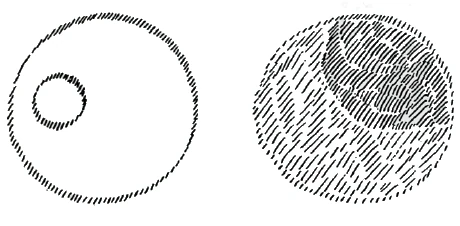
[ 3 ] Als der Mond noch in der Erde drinnen war, da war er nicht in der Mitte drinnen, sondern etwas nach außen gelegen (siehe Zeichnung, links). Wenn Sie heute die Erde anschauen, dann werden Sie ja auch bemerken, daß auf der einen Seite, mehr dahin, wo Australien liegt, viel Wasser auf der Erde ist, währenddem auf der Seite, wo Europa liegt und Asien, viel Land ist. So daß die Erde eigentlich nicht Land und Wasser gleich verteilt hat, sondern die Erde ist so, daß sie auf der einen Seite eigentlich das meiste Land hat undauf der anderen Seite das meiste Wasser. Also gleich verteilt ist der Stoff auf der Erde nicht (siehe Zeichnung $.149, rechts). Das war auch nicht gleich verteilt, als der Mond noch in der Erde drinnen war. Der Mond war eben nach der Seite gelegen, wo die Erde überhaupt die Neigung hat, schwer zu sein. Natürlich, wenn da ein fester Stoff liegt, ist sie dort schwer. So daß ich also die Sache so zeichnen muß, wie ich es dort mit weißer Kreide bezeichnet habe.
[ 3 ] When the Moon was still inside the Earth, it was not located at the center, but slightly toward the outside (see drawing, left). If you look at the Earth today, you’ll notice that on one side—more toward where Australia is located—there is a lot of water on the Earth, whereas on the side where Europe and Asia are located, there is a lot of land. So the Earth doesn’t actually have land and water distributed evenly; rather, the Earth is such that it has most of the land on one side and most of the water on the other. So the matter on Earth is not evenly distributed (see drawing $.149, right). Nor was it evenly distributed when the Moon was still inside the Earth. The Moon was simply located on the side where the Earth naturally tends to be heavier. Of course, if there is a solid substance there, it is heavy there. So I have to draw it the way I’ve indicated there with white chalk.
[ 4 ] Nun müssen Sie sich aber vorstellen, daß damals die Befruchtung so vor sich gegangen ist, daß der Mond, der in der Erde war, diesen Riesenviechern die Kräfte gegeben hat, durch die sie gewissermaßen Fortpflanzungsstoff lieferten. Man kann nicht sagen, daß dazumal schon etwa die Tiere richtige Eier gelegt hätten. Diese Riesenaustern sind ja selber eigentlich nur eine schleimige Masse gewesen und sie haben eben ein Stückchen von sich abgesondert. So daß solch eine riesige Auster, wie ich es Ihnen das letzte Mal beschrieben habe, die ursprünglich so groß gewesen sein könnte wie ganz Frankreich, da eine mächtige Schale gehabt hat, auf der man hätte herumspazieren können, und gegen das Innere der Erde zu eine Schleimmasse. Auf diese Schleimmasse haben die Mondenkräfte gewirkt, und da hat sich ein Stückchen Schleimmasse abgesondert. Das ist dann weitergeschwommen in der Erde. Und wenn wiederum die Sonne daraufgeschienen hat — ich habe Ihnen das an dem Beispiel vom Hund anschaulich erklärt —, hat sich eben eine Eischale gebildet, und dadurch, daß sich diese Eischale gebildet hat, wurde die schleimige Masse der Auster wiederum geneigt, ein Stückchen von sich abzusondern, und dann konnte ein neues Tier entstehen. So daß also die weiblichen Kräfte vom Mond kamen, der in der Erde war, und die männlichen Kräfte von der Sonne, die von außen auf die Erde draufschien. Nun, meine Herren, da schildere ich Ihnen eine ganz bestimmte Zeit, die Zeit eben, wo der Mond noch in der Erde drinnen war.
[ 4 ] Now you must imagine that back then, fertilization took place in such a way that the moon, which was inside the Earth, gave these giant creatures the powers through which they, so to speak, provided reproductive material. One cannot say that the animals had already laid proper eggs back then. These giant oysters were, in fact, nothing more than a slimy mass themselves, and they simply secreted a small piece of themselves. So that such a giant oyster, as I described to you last time—which could originally have been as large as all of France, since it had a massive shell on which one could have walked around—consisted of a slimy mass toward the Earth’s interior. The forces of the moon acted upon this slimy mass, and a small piece of it separated off. That piece then drifted further into the earth. And when the sun shone on it again—I explained this to you clearly using the example of the dog—an eggshell formed, and because this eggshell formed, the slimy mass of the oyster was once again prompted to separate a small piece from itself, and then a new animal could come into being. So the feminine forces came from the Moon, which was inside the Earth, and the masculine forces from the Sun, which shone down on the Earth from outside. Well, gentlemen, I am describing to you a very specific time—the time when the Moon was still inside the Earth.
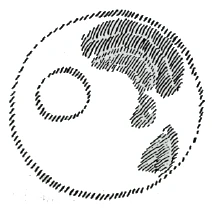
[ 5 ] Nun müßten Sie sich folgendes vorstellen. Heute, wo der Mond draußen ist, außerhalb der Erde, da wirkt er ganz anders. Sie wissen ja auch, wenn die Kohlensäure im Menschen drinnen ist — ich habe es Ihnen das letzte Mal gesagt —, wirkt sie ganz anders, als wenn sie draußen ist, wo sie ein Gift ist. Wenn Sie sich an die Fortpflanzung der Tiere heute erinnern, so müssen Sie sagen: Die Tiere müssen Eier hervorbringen, und diese Eier müssen dann erst in irgendeiner Weise befruchtet werden. Dasjenige also, was früher der Mond gegeben hat, als er drinnen war in der Erde, das haben jetzt die Tiere in sich. Die Tiere haben diese Mondenkräfte in sich.
[ 5 ] Now you need to imagine the following. Today, when the Moon is out there, outside the Earth, it has a completely different effect. As you know—I told you this last time—when carbon dioxide is inside the human body, it has a completely different effect than when it is outside, where it is a poison. If you think about animal reproduction today, you have to say: Animals must lay eggs, and these eggs must then be fertilized in some way. So what the Moon used to provide when it was inside the Earth, animals now have within themselves. Animals possess these lunar forces within them.
[ 6 ] Und von außen gibt ja der Mond auch noch Kräfte. Ich habe Ihnen das letzte Mal gesagt: Sogar die Dichter wissen das, daß der Mond der Erde Kräfte gibt. Aber das sind Kräfte, durch die die Phantasie angeregt wird, durch die man innerlich lebendiger wird. Das sind Kräfte, die nicht mehr auf die Fortpflanzung wirken, sondern die von außen hereinstrahlen, die gar nicht mehr die Fortpflanzung bewirken können.
[ 6 ] And from the outside, the moon also exerts forces. I told you last time: Even poets know that the moon imparts forces to the Earth. But these are forces that stimulate the imagination, that make one feel more alive inwardly. These are forces that no longer affect reproduction, but rather shine in from the outside—forces that can no longer bring about reproduction at all.
[ 7 ] So müssen Sie sich vorstellen: Dasjenige, was der Mond der Erde geben konnte, als er noch drinnen war, diese Fortpflanzungskräfte, die haben sich die Tiere angeeignet, als Erbschaft bekommen, und die pflanzen sie jetzt fort von einem Tier aufs andere. Also wenn Sie die Eier der Tiere anschauen, so müssen Sie sich sagen: Da drinnen sind die Mondenkräfte. Aber diejenigen Mondenkräfte sind da noch drinnen, welche gewirkt haben, als der Mond noch in der Erde war. Heute kann der Mond nicht mehr viel anderes bewirken, als daß er den Kopf anregt. Also der Mond wirkt heute auf den Kopf. Dazumal hat er aber gerade auf die Fortpflanzung gewirkt. Sehen Sie, das ist ein beträchtlicher Unterschied. Es ist ein großer Unterschied, ob irgend etwas in der Erde drinnen ist, oder ob es außerhalb der Erde ist.
[ 7 ] You have to imagine it this way: What the Moon was able to give the Earth when it was still inside it—those reproductive forces—the animals have appropriated them, received them as an inheritance, and are now passing them on from one animal to another. So when you look at the eggs of animals, you must tell yourself: The lunar forces are in there. But the lunar forces that are still present are the ones that were active when the Moon was still inside the Earth. Today, the Moon can no longer bring about much else besides stimulating the head. So today, the Moon acts on the head. Back then, however, it acted specifically on reproduction. You see, that is a significant difference. It makes a huge difference whether something is inside the Earth or outside of it.
[ 8 ] Mit der Fortpflanzung ist es ja eben doch eine recht merkwürdige Sache. Aber wiederum müssen wir sagen: Alles Verständnis der Natur überhaupt hängt zusammen damit, daß man die Fortpflanzung versteht. Denn dadurch entstehen heute noch die einzelnen Tiere und die einzelnen Pflanzen. Wenn die Fortpflanzung nicht wäre, wäre alles längst tot geworden. Man muß schon, wenn man irgend etwas über die Natur verstehen will, die Fortpflanzung verstehen. Aber mit der Fortpflanzung ist es etwas Eigentümliches auf der Erde.
[ 8 ] Reproduction is, after all, a rather strange phenomenon. But then again, we must say: Any understanding of nature at all depends on understanding reproduction. For it is through reproduction that individual animals and plants continue to come into being even today. If it weren’t for reproduction, everything would have died out long ago. If one wants to understand anything about nature, one must understand reproduction. But reproduction is something peculiar on Earth.
[ 9 ] Denken Sie sich einmal: Der Elefant hat die Eigentümlichkeit, daß er erst mit etwa fünfzehn, sechzehn Jahren imstande ist, ein einziges Junges hervorzubringen. Nehmen Sie dagegen eine Auster; das ist so ein kleines, schleimiges Tier. Wenn Sie sich dieses riesig groß denken, so haben Sie ungefähr diejenigen Viecher, die ich Ihnen für die damalige Zeit gezeigt habe. Also, an der Auster kann man schon etwas lernen. Aber die Auster ist nicht wie der Elefant, der so viele Jahre warten muß, um ein Junges hervorzubringen. Eine einzige Auster kann in einem Jahr eine Million Austern hervorbringen. Also eine Auster steht in einem anderen Verhältnis zu der Fortpflanzungsfähigkeit als der Elefant.
[ 9 ] Just think about it: Elephants have the peculiarity that they are not able to give birth to a single calf until they are about fifteen or sixteen years old. Take an oyster, on the other hand—it’s such a small, slimy creature. If you imagine it on a gigantic scale, you’ll have roughly the kind of creatures I showed you back then. So, there’s something to be learned from the oyster. But the oyster isn’t like the elephant, which has to wait so many years to produce a single offspring. A single oyster can produce a million oysters in a year. So an oyster has a different relationship to reproductive capacity than an elephant.
[ 10 ] Nun, meine Herren, ein anderes interessantes Tier ist die Blattlaus. Sie wissen, sie kommt auf den Blättern der Bäume vor, findet sich überhaupt als eine recht schädliche Bevölkerung der Pflanzenwelt. Man leidet sehr unter ihr. Eine Blattlaus ist ja, wie Sie wissen, viel kleiner als ein Elefant, aber sie kann in wenigen Wochen — eine einzige Blattlaus! — mehrere tausend Millionen Nachkommen erzeugen. Also ein Elefant braucht etwa fünfzehn, sechzehn Jahre, bis er imstande ist, einen einzigen Nachkommen hervorzubringen, und die Blattlaus, die kann eben in wenigen Wochen sich so vermehren, daß von einer einzigen mehrere Millionen kommen.
[ 10 ] Well, gentlemen, another interesting animal is the aphid. As you know, it lives on the leaves of trees and is generally considered a rather harmful pest to the plant world. People suffer greatly from it. Aphids, as you know, are much smaller than an elephant, but in just a few weeks—a single aphid!—can produce several thousand million offspring. An elephant, on the other hand, takes about fifteen or sixteen years to be able to produce a single offspring, whereas the aphid can multiply so rapidly in just a few weeks that a single one can give rise to several million.
[ 11 ] Und dann gibt es noch kleinwinzige Tiere, die nennt man Vorticellen. Wenn man sie durch ein Mikroskop anschaut, dann sind sie überhaupt nur so ein ganz kleines Schleimklümpchen, und sie haben einen Faden, an dem sie sich fortschlängeln. Es sind ganz interessante Tiere, aber sie bestehen nur aus einem ganz kleinen Schleimklümpchen, wie wenn man einen Faden aus einer Auster herausnehmen würde, und sie schwimmen so herum. Diese kleinen Vorticellen, die sind nun ganz so, daß sie in vier Tagen hundertvierzig Billionen Nachkommen — eine einzige! — erzeugen können. Also man kann es auf die Tafel gar nicht aufschreiben, so viele Nullen muß man aufschreiben. Das einzige, was damit konkurrieren kann, ist jetzt die russische Valuta!
[ 11 ] And then there are tiny little animals called vorticelles. When you look at them through a microscope, they’re really just a tiny little lump of slime, and they have a thread that they use to wriggle along. They’re quite interesting creatures, but they consist of nothing more than a tiny lump of slime—like a thread you’d pull out of an oyster—and they just float around like that. These little vorticelles are such that a single one can produce one hundred forty trillion offspring in just four days. So you can’t even write it on the board—there are just too many zeros. The only thing that can compete with that right now is the Russian currency!
[ 12 ] Also Sie sehen, es ist ein beträchtlicher Unterschied in der Fortpflanzungsfähigkeit zwischen einem Elefanten, der fünfzehn, sechzehn Jahre warten muß, um ein einziges Junges hervorzubringen, und solch einer kleinen Vorticelle, die in vier Tagen sich so vermehrt, daß hundertvierzig Billionen Nachkommen wachsen.
[ 12 ] So you see, there is a considerable difference in reproductive capacity between an elephant, which must wait fifteen or sixteen years to produce a single calf, and such a tiny Vorticella, which multiplies in four days to the point where one hundred forty trillion offspring are produced.
[ 13 ] Also sehen Sie, da liegen wirklich ganz bedeutende Naturgeheimnisse vor. Und es gibt eine ganz interessante französische Erzählung, die äußerlich mit dem nicht viel zu tun hat, aber innerlich doch. Da war ein bedeutender französischer Dichter — der hieß Racine. Und dieser Racine, der brauchte, um solch eine Dichtung, wie zum Beispiel die «Athalie» zu schreiben, sieben Jahre. Also er hat in sieben Jahren ein solches Theaterstück wie die «Athalie» geschrieben. Und da gab es zu seiner Zeit einen anderen Dichter, der war furchtbar stolz gegen den Racine und sagte: Der Racine braucht sieben Jahre, um ein Stück zu schreiben; ich schreibe in einem Jahr sieben Stücke! — Und da entstand eine Fabel, so eine Erzählung, und diese Erzählung, diese Fabel lautet: Es haben einmal gestritten dasSchwein und der Löwe; und dasSchwein, das stolz war, sagte zum Löwen: Ich kriege jedes Jahr sieben Junge, aber du, Löwe, du bringst nur ein einziges in einem Jahr zustande. — Da sagte der Löwe: Jawohl, aber das einzige, das ist eben auch ein Löwe, und deine sieben sind Schweine. — Und damit, nicht wahr, hat Racine den Dichter abfertigen wollen. Er hat ihm nicht gerade sagen wollen, seine Theaterstücke seien Schweine, aber er verglich das, denn er sagte: Nun ja, du machst alle Jahr sieben solche Stücke, aber ich mache in sieben Jahren eine «Athalie» — die heute weltberühmt ist.
[ 13 ] So you see, there really are some very significant mysteries of nature at work here. And there’s a very interesting French story that, on the surface, doesn’t have much to do with this, but in essence, it does. There was a prominent French poet—his name was Racine. And this Racine—it took him seven years to write a play like Athalie, for example. So he wrote a play like Athalie in seven years. And there was another poet in his day who was terribly proud in comparison to Racine and said: “Racine needs seven years to write one play; I write seven plays in a year!” — And so a fable came into being—a story—and this story, this fable, goes like this: Once upon a time, the pig and the lion were arguing; and the pig, who was proud, said to the lion: “I have seven young every year, but you, lion, you only manage to produce a single one in a year.” — Then the lion said: “Yes, but that one is also a lion, and your seven are pigs.” — And with that, didn’t Racine mean to dismiss the poet? He didn’t want to tell him outright that his plays were pigs, but he drew the comparison, for he said: “Well, you produce seven such plays every year, but I produce one Athalie in seven years”—which is world-famous today.
[ 14 ] Sehen Sie, so kann man sagen: Selbst in einer solchen Fabel, in einer solchen Erzählung liegt so etwas drinnen, daß es wertvoller ist, nach Elefantenart fünfzehn, sechzehn Jahre zu brauchen, um dann ein Junges zu kriegen, als eine Vorticelle zu sein, die in vier Tagen sich so vermehrt, daß sie hundertvierzig Billionen Junge kriegt. Man redet schon viel, daß die Kaninchen so viel Junge kriegen; wenn man nun gar von der Vorticelle reden würde — eine solche Vermehrungsfähigkeit ist ja gar nicht auszudenken!
[ 14 ] You see, one could say: Even in a fable like this, in a story like this, there’s something to be found that makes it more valuable to take fifteen or sixteen years—like an elephant—to have a single young one, than to be a Vorticella, which multiplies so rapidly in four days that it produces one hundred forty trillion offspring. People already talk a lot about how many young rabbits have; if one were to talk about the Vorticella—such a capacity for reproduction is simply unimaginable!
[ 15 ] Nun muß man doch herausbekommen, woran das liegt, daß solche kleinwinzigen Tiere so viele Junge kriegen, während der Elefant so lange dazu braucht.
[ 15 ] Now we really have to figure out why such tiny animals have so many young, while the elephant takes so long to do so.
[ 16 ] Nun habe ich Ihnen gesagt: Die Sonne, die ist dasjenige, was eigentlich der Befruchtung zugrunde liegt. Die Sonne braucht man also heute auch noch bei der Befruchtung. Und ich habe Ihnen auch gesagt: Wenn ein Himmelskörper draußen ist wie der Mond, so wirkt er höchstens noch auf den Kopf, aber nicht mehr wirkt er auf die Unterleibsorgane, also nicht mehr direkt auf die Fortpflanzungskräfte. Die Fortpflanzungskräfte müssen heute vererbt werden von einem Wesen aufs andere. Aber, meine Herren, in einem gewissen Sinne ist dennoch dasjenige, was da geschieht in der heutigen Fortpflanzung noch, doch noch vom Monde abhängig. Und das will ich Ihnen auf die folgende Weise erklären, indem ich auch wiederum auf die Sonne zurückgehe.
[ 16 ] Now I have told you: The sun is what actually underlies fertilization. So the sun is still needed today for fertilization. And I have also told you: When a celestial body like the moon is out there, it affects at most the head, but it no longer affects the abdominal organs—that is, it no longer acts directly on the reproductive forces. Today, the reproductive forces must be inherited from one being to another. But, gentlemen, in a certain sense, what still happens in modern reproduction is nevertheless still dependent on the Moon. And I will explain this to you in the following way, by returning once again to the Sun.
[ 17 ] Sehen Sie, wir müssen uns fragen: Warum braucht der Elefant fünfzehn, sechzehn Jahre, um seine Fortpflanzungsfähigkeit so weit zu bringen, daß er ein Junges kriegt? Nun wissen Sie alle, daß der Elefant ein Dickhäuter ist, und weil er ein Dickhäuter ist, braucht er so lange. Eine dicke Haut läßt nämlich die Sonnenkräfte weniger stark durch sich durch, als wenn man eine Blattlaus ist und ganz weich ist und überall die Sonnenkräfte hereinkönnen. So daß tatsächlich die geringe Fortpflanzungsfähigkeit des Elefanten eben mit seiner Dickhäutigkeit zusammenhängt.
[ 17 ] You see, we have to ask ourselves: Why does it take an elephant fifteen or sixteen years to reach the point where it can reproduce and have a calf? Now, you all know that the elephant is a pachyderm, and because it is a pachyderm, it takes that long. Thick skin, you see, allows the sun’s rays to penetrate less easily than if you were an aphid—which is very soft and lets the sun’s rays in from all sides. So the elephant’s limited reproductive capacity is, in fact, directly related to its thick skin.
[ 18 ] Das können Sie ja auch daran schen: Denken Sie wiederum zurück an diese riesigen schwimmenden Austern. Ja, es würde niemals eine zweite Auster entstehen, wenn es auf die Sonne nur ankäme, die da draufstrahlt auf diesen Schuppenpanzer, auf die dicke Haut! Sondern diese Auster, die gibt ein bißchen Schleim ab, habe ich Ihnen gesagt; der Schleim, der hat noch keine Austernschale, da kann dieSonne draufkommen. Und indem sie anfängt, den Schleim abzutrocknen und eine neue Auster dadurch entstehen kann, wirkt sie auf diese Auster befruchtend. — Ja, wenn die Sonnenstrahlen von außen kommen, meine Herren, dann können sie eben nur Schalen erzeugen. Wie kommt es denn, daß die Sonnenkräfte dennoch befruchtend wirken können?
[ 18 ] You can tell that from this, too: Just think back to those huge floating oysters. Yes, a second oyster would never form if it depended solely on the sun shining down on that scaly shell, on that thick skin! But this oyster secretes a little mucus, as I’ve told you; that mucus doesn’t yet have an oyster shell, so the sun can shine on it. And as it begins to dry out the mucus—allowing a new oyster to form—it has a fertilizing effect on this oyster. — Yes, when the sun’s rays come from the outside, gentlemen, they can only produce shells. How is it, then, that the sun’s forces can nevertheless have a fertilizing effect?
[ 19 ] Sehen Sie, da müssen wir wiederum etwas anderes anschauen, damit Sie einsehen können, wie die Geschichte eigentlich zusammenhängt. Sie wissen vielleicht, daß die Bauern, wenn sie die Kartoffeln geerntet haben, ziemlich tiefe Gruben machen, und in diese Gruben hinein legen sie die Kartoffeln. Dann graben sie die Gruben wieder zu. Und sie graben dann später, wenn der Winter vorüber ist, aus diesen Gruben die Kartoffeln wiederum aus, weil sie da drinnen gut geblieben sind. Wenn sie die Kartoffeln einfach in dem Keller aufgehoben hätten, wären sie zugrunde gegangen. Da drinnen bleiben sie ganz gut.
[ 19 ] You see, we need to look at something else here so that you can understand how the story actually fits together. You may know that when farmers have harvested their potatoes, they dig fairly deep pits and place the potatoes in them. Then they fill the pits back in. And later, once winter is over, they dig the potatoes out of these pits again, because they’ve kept well in there. If they had simply stored the potatoes in the cellar, they would have gone bad. They keep quite well in there.
[ 20 ] Woher kommt das eigentlich? Es ist eine sehr interessante Sache. Die Bauern wissen nicht viel Auskunft darüber zu geben. Aber, meine Herren, wenn Sie selber eine Kartoffel wären und würden da hineingegraben in diese Grube, so würden Sie sich da drinnen, wenn Sie nicht gerade etwas zu essen brauchten, eigentlich außerordentlich gut fühlen. Denn sehen Sie, da drinnen bleibt nämlich die Sonnenwärme vom Sommer drinnen, und dasjenige, was im Sommer von der Sonne auf die Erde draufscheint, das zieht sich immer mehr und mehr eben nach unten hin. Und wenn man im Januar in die Erde hineingräbt, so ist da noch die Sonnenwärme und alle anderen Sonnenkräfte vom Sommer, die sind da eineinhalb Meter tief noch drinnen.
[ 20 ] Where does that actually come from? It’s a very interesting phenomenon. The farmers don’t have much information to offer on the subject. But, gentlemen, if you yourselves were a potato and were buried in that pit, you’d actually feel exceptionally good in there—unless, of course, you were in need of something to eat. You see, the sun’s heat from the summer stays trapped down there, and the energy that the sun shines down on the earth in the summer gradually seeps deeper and deeper into the ground. And when you dig into the earth in January, the sun’s heat and all the other solar energies from the summer are still there, still trapped one and a half meters deep.
[ 21 ] Das ist das Merkwürdige. Im Sommer, da ist die Sonne draußen, da erwärmt sie von draußen, und im Winter, da zieht sich die Sonnenkraft nach unten und ist weiter unten zu finden. Aber sie kann nicht sehr tief nach unten gehen; sie strömt wiederum zurück. Wenn man eine Kartoffel wäre und da unten läge, so würde es einem ganz gut gehen; einheizen brauchte man nicht, denn erstens ist da noch die Wärme vom Sommer drinnen, und zweitens kommt es ganz warm herauf von unten, weil die Sonnenkräfte wiederum zurückstrahlen. Und diesen Kartoffeln ist es eigentlich furchtbar wohl. Da genießen sie eigentlich erst die Sonne. Im Sommer haben sie nicht viel von der Sonne, da ist es ihnen sogar unangenehm. Wenn sie Köpfe hätten, kriegten sie Kopfweh, wenn die Sonne so draufscheint; da ist es eigentlich unangenehm für die Kartoffeln. Aber im Winter, wenn ihnen die Wohltat geschieht, in die Erde hineingegraben zu werden, da können sie die Sonne erst so recht genießen.
[ 21 ] That’s the strange thing. In the summer, the sun is out there, warming us from the outside, and in the winter, the sun’s energy draws downward and can be found further down. But it can’t go very deep down; it flows back up again. If you were a potato lying down there, you’d be quite comfortable; you wouldn’t need to heat the place, because, first of all, the summer’s warmth is still inside, and second, it gets quite warm coming up from below because the sun’s energy reflects back up. And these potatoes are actually incredibly comfortable. That’s when they really get to enjoy the sun. In the summer, they don’t get much of the sun; in fact, it’s even unpleasant for them. If they had heads, they’d get headaches when the sun shines down on them like that; it’s actually unpleasant for the potatoes. But in the winter, when they’re blessed with the good fortune of being buried in the ground, that’s when they can truly enjoy the sun.
[ 22 ] Daraus sehen Sie, daß die Sonne ja nicht nur wirkt, wenn sie auf etwas draufscheint, sondern sie wirkt weiter, wenn ihre Kräfte von etwas aufgefangen, aufgehalten werden.
[ 22 ] From this you can see that the sun does not merely exert its influence when it shines on something, but that its influence continues even when its forces are absorbed or held back by something.
[ 23 ] Ja, meine Herren, jetzt tritt eine Eigentümlichkeit ein. Ich habe Ihnen gesagt: Wenn ein Körper draußen ist aus der Erde, dann wirkt er abtötend, entweder — wie die Kohlensäure — wie ein Gift, oder aber wie die Sonne hier, die Schuppen erzeugt, wenn sie draufscheint; die verhärtet das Lebewesen, auf das sie draufscheint. Aber im Winter, da ist es ja gar nicht wahr, daß die Sonne von außen wirkt; da wirkt sie vom Inneren der Erde. Da läßt sie ihre Kraft zurück, wirkt im Inneren der Erde. Und da frischt sie im Inneren der Erde auch wiederum die Fortpflanzungskräfte auf.So daß die Fortpflanzungskräfte heute, in unserer Gegenwart, auch von der Sonne kommen, aber nicht etwa von der direkten Sonnenbestrahlung, sondern sie kommen von dem, was in der Erde drinnen zurückbleibt und im Winter dann wiederum zurückstrahlt,
[ 23 ] Yes, gentlemen, now something peculiar occurs. I have told you: When a body is outside the Earth, it has a destructive effect—either, like carbon dioxide, as a poison, or like the sun here, which causes flaking when it shines on something; this hardens the living being upon which it shines. But in winter, it is not at all true that the sun acts from the outside; then it acts from within the Earth. There it leaves its power behind, acting within the Earth. And there, within the Earth, it also revitalizes the reproductive forces. So that the reproductive forces today, in our present time, also come from the sun—but not from direct sunlight, rather they come from what remains inside the Earth and then radiates back again in winter,
[ 24 ] Es ist eine sehr interessante Sache. Es ist gerade so, wie wenn wir die Kohlensäure einatmen: da ist sie ein Gift. Wenn aber die Kohlensäure in unserem Körper drinnen ist und durch das Blut geht, da brauchen wir sie. Denn hätten wir keinen Kohlenstoff, so hätten wir überhaupt nichts in uns. Da brauchen wir ihn im Inneren, da ist er wohltätig; von außen ist er Gift. Sonnenstrahlen von außen erzeugen Schalen bei den Tieren, Sonnenstrahlen, von innen aufgefangen und wiederum zurückgestrahlt, erzeugen Leben, machen die Tiere fortpflanzungsfähig.
[ 24 ] It’s a very interesting thing. It’s just like when we inhale carbon dioxide: there, it’s a poison. But once the carbon dioxide is inside our body and travels through the blood, we need it. For if we had no carbon, we would have nothing at all within us. We need it inside us; there it is beneficial; from the outside, it is poison. Sunlight from the outside creates shells in animals; sunlight absorbed from the inside and then reflected back creates life and enables animals to reproduce.
[ 25 ] Aber, meine Herren, denken Sie sich jetzt, Sie wären nicht eine Kartoffel, sondern ein Elefant. Da hätten Sie eine furchtbar dicke Haut, und da ließen Sie nur wenig von dieser Wärme in sich herein, die die Erde da von der Sonne hat. Daher brauchten Sie furchtbar lang, wenn Sie ein Elefant wären, um ein Elefantenkind hervorzubringen. Aber denken Sie sich, Sie wären eine Blattlaus oder eine Auster; da wären Sie ja — bei dieser Auster — gerade gegen die Erde zu nur eine Schleimmasse. Solch eine Schleimmasse ist der Elefant nicht. Der Elefant ist nach allen Seiten durch seine Haut abgeschlossen, läßt also diese Wärme, die von unten kommt, furchtbar langsam nur in sich hinein.
[ 25 ] But, gentlemen, imagine for a moment that you were not a potato, but an elephant. You would have incredibly thick skin, and you would let very little of the heat that the Earth receives from the sun penetrate inside you. That’s why, if you were an elephant, it would take you an incredibly long time to give birth to a baby elephant. But imagine you were an aphid or an oyster; in the case of the oyster, you’d be nothing more than a mass of slime right up against the earth. The elephant is not such a mass of slime. The elephant is enclosed on all sides by its skin, so it allows this heat, which comes from below, to enter it only very slowly.
[ 26 ] Nun, sehen Sie, das ist so: Solche Tiere wie Blattläuse, die halten sich auch so in der Nähe der Erde schon auf und außerdem an Pflanzen und haben gar keine dicken Häute; die können furchtbar leicht das, was da von der Erde zurückdunstet, mit dem Frühling aufnehmen, bekommen also ihre Fortpflanzungskräfte immer rasch aufgefrischt. Und die Vorticellen erst recht, denn die leben im Wasser und das Wasser bewahrt die Sonnenwärme noch viel intensiver, so daß die aufgesparte Sonnenwärme in den Vorticellen die hundertvierzig Billionen zur richtigen Jahreszeit hervorbringt; das heißt, wenn sie genügend aufgenommen haben von dem, was die Sonnenwärme im Wasser ist, können sie sich furchtbar rasch fortpflanzen. So können wir sagen: Heute ist es bei der Erde so, daß sie die Fortpflanzungsfähigkeit ihren Wesen dadurch gibt, daß sie die Sonnenkräfte in sich während des Winters bewahrt.
[ 26 ] Well, you see, here’s the thing: Animals like aphids already live close to the ground and on plants, and they don’t have thick skins at all; they can absorb what evaporates from the earth in the spring with remarkable ease, thus constantly and rapidly replenishing their reproductive powers. And this is even more true of the vorticelles, for they live in water, and water retains the sun’s heat much more intensely, so that the stored solar heat within the vorticelles produces the one hundred forty trillion of them at the right time of year; that is, once they have absorbed enough of the sun’s heat stored in the water, they can reproduce incredibly quickly. Thus, we can say: Today, the Earth endows its beings with the ability to reproduce by preserving the sun’s energies within itself during the winter.
[ 27 ] Nun gehen wir von da aus auf die Pflanzen über. Sehen Sie, bei den Pflanzen, da ist es so: Sie wissen, es gibt bei den Pflanzen auch eine Fortpflanzung durch sogenannte Stecklinge. Wenn also die Pflanze aus der Erde herauswächst, so kann man irgendwo einen Steckling abschneiden. Man muß ihn ordentlich herausschneiden, kann ihn dann wiederum einsetzen, und das wächst sich dann zur Pflanze aus. Solch eine Fortpflanzung gibt es bei gewissen Pflanzen. Woher kommt denn das? Diese Kraft, die da die Pflanzen haben, sogar noch durch ein Stückchen von ihnen sich fortzupflanzen, haben die Pflanzen aus dem Grunde, weil sie ja den Samen im Winter in der Erde drinnen haben. Das ist nämlich eine ganz besonders wichtige Sache bei den Pflanzen. Will man irgendwie Pflanzen zum richtigen Wachstum bringen, so ist es ja so, nicht wahr, daß sie eigentlich im Winter in der Erde drinnen sein müssen. Sie müssen überhaupt aus der Erde herauswachsen. Es gibt ja Sommerfrüchte, da könnten wir ja später einmal darüber reden. Aber in der Hauptsache müssen die Pflanzen in der Erde drinnen ihren Samen entwickeln, und dann können sie wachsen. Man kann manchmal zwiebelartige Gewächse auch im Wasser zum Wachsen bringen, aber da muß man besondere Maßregeln ergreifen, nicht wahr. In der Hauptsache ist es so in der Natur, daß die Pflanzen in die Erde hineingesetzt werden müssen und von da aus ihre Kraft zum Wachsen haben müssen.
[ 27 ] Now let’s move on from there to plants. You see, with plants, it works like this: As you know, plants also reproduce through what are called cuttings. So when the plant grows out of the ground, you can cut off a cutting from somewhere. You have to cut it off neatly, then you can plant it again, and it will grow into a plant. This method of propagation exists for certain plants. Where does this come from? The ability plants have to reproduce even from a small piece of themselves stems from the fact that they have seeds inside the soil during the winter. That is, in fact, a particularly important aspect of plants. If you want to encourage plants to grow properly, it’s true, isn’t it, that they actually need to be in the ground during the winter. They have to grow out of the ground in the first place. There are summer crops, of course—we could talk about those later. But essentially, plants must develop their seeds while in the ground, and only then can they grow. Sometimes you can also grow bulb-like plants in water, but you have to take special precautions, don’t you think? Essentially, the way nature works is that plants must be planted in the ground and draw their strength to grow from there.
[ 28 ] Was geschieht nun da, meine Herren, wenn ein Samenkorn in die Erde hineingelegt wird? Da ist dieses Samenkorn erst recht in die Wohltat versetzt, diese von der Sonne der Erde übergebenen Kräfte in sich aufzunehmen. Gerade das Pflanzensamenkorn, das nimmt diese Kräfte, die da von der Sonne in die Erde hineinkommen, erst recht auf.
[ 28 ] What happens, gentlemen, when a seed is placed in the earth? There, the seed is especially well-positioned to absorb the forces bestowed upon the earth by the sun. It is precisely the plant seed that absorbs these forces—which enter the earth from the sun—to the greatest extent.
[ 29 ] Beim Tier, da geht das viel schwerer. Diejenigen Tiere, die in der Erde selber drinnen sind wie die Regenwürmer und dergleichen, die nehmen diese Kraft auch leicht auf. Deshalb pflanzen sich diese auch alle sehr stark fort, alle die Tiere, die entweder ganz nahe der Erde oder in der Erde sind. Würmer sind ja auch so, daß sie furchtbar viel Nachkommen haben, und zum Beispiel gerade solche Würmer, die auch leider in die menschlichen Gedärme kommen können, erzeugen furchtbar viele Nachkommen, und der Mensch muß fortwährend seine eigenen Kräfte anstrengen, damit diese Würmer nicht schrecklich viele Nachkommen erzeugen. So daß man da eben, wenn man Würmer in sich hat, fast alle Lebenskräfte anwenden muß, um diese Schreckenskerle, die man in sich hat, zu töten.
[ 29 ] With animals, it’s much more difficult. Those animals that live inside the earth itself, like earthworms and the like, absorb this energy quite easily. That is why they all reproduce very vigorously—all the animals that are either very close to the ground or in the ground. Worms, after all, have an enormous number of offspring, and, for example, precisely those worms that can unfortunately end up in the human intestines produce an enormous number of offspring, and humans must constantly exert their own strength to prevent these worms from producing such a terrible number of offspring. So if you have worms inside you, you have to use almost all your life forces to kill these dreadful creatures that are inside you.
[ 30 ] Ja, aber Pflanzen, die sind in der Lage, daß sie aus dem Boden herauswachsen (siehe Zeichnung); da unten ist die Wurzel, dann wachsen sie aus dem Boden heraus, und dann haben sie die Blätter, dann entwickeln sie die Blüten und neue Samen. Aber, meine Herren, Sie wissen ganz genau: Wenn die Blüte anfängt sich zu entwickeln, da wächst die Pflanze nicht mehr nach oben. Das ist schr interessant. Der Same der Pflanze, der Keim, der wird in den Boden gegeben; da wächst der Stengel heraus, es werden Blätter, grüne Blätter, und nachher kommt die Blüte. Da wird das Wachstum aufgehalten, und die Pflanze macht jetzt geschwind, erzeugt geschwind den Samen. Denn würde sie nicht geschwind den Samen erzeugen, so würde die Sonne alle Kraft auf diese Blütenblätter verwenden, die unfruchtbar wären. Die Pflanze würde oben eine riesige schöne Blüte kriegen, vielfarben, aber der Same würde sich nicht entwickeln können. Die Pflanze nimmt zuletzt noch alle Kraft zusammen, um geschwind den Samen zu erzeugen.
[ 30 ] Yes, but plants are able to grow out of the ground (see drawing); down below is the root, then they grow out of the ground, and then they have leaves, and then they develop flowers and new seeds. But, gentlemen, you know very well: Once the flower begins to develop, the plant no longer grows upward. That’s quite interesting. The plant’s seed, the embryo, is placed in the soil; the stem grows out of it, leaves form—green leaves—and then the flower appears. At that point, growth is halted, and the plant now works quickly to produce the seed. For if it did not produce the seed quickly, the sun would direct all its energy toward these petals, which would be fruitless. The plant would develop a huge, beautiful flower at the top, multicolored, but the seed would not be able to develop. Finally, the plant gathers all its remaining strength to produce the seed quickly.
[ 31 ] Sehen Sie, die Sonne, die von außen kommt, die hat die Eigentümlichkeit, die Pflanzen schön zu machen. Wenn wir schöne Pflanzen auf der Wiese finden, so ist es die äußere Sonne mit ihren Strahlen, die diese schönen Farben hervorbringt. Aber sie würde die Pflanzen damit ersterben machen, geradeso wie sie mit der Austernschale die Auster ersterben macht, vertrocknet.
[ 31 ] You see, the sun, which comes from outside, has the unique quality of making plants beautiful. When we find beautiful plants in a meadow, it is the external sun, with its rays, that brings out these beautiful colors. But it would cause the plants to wither and die, just as the oyster shell causes the oyster to wither and die.
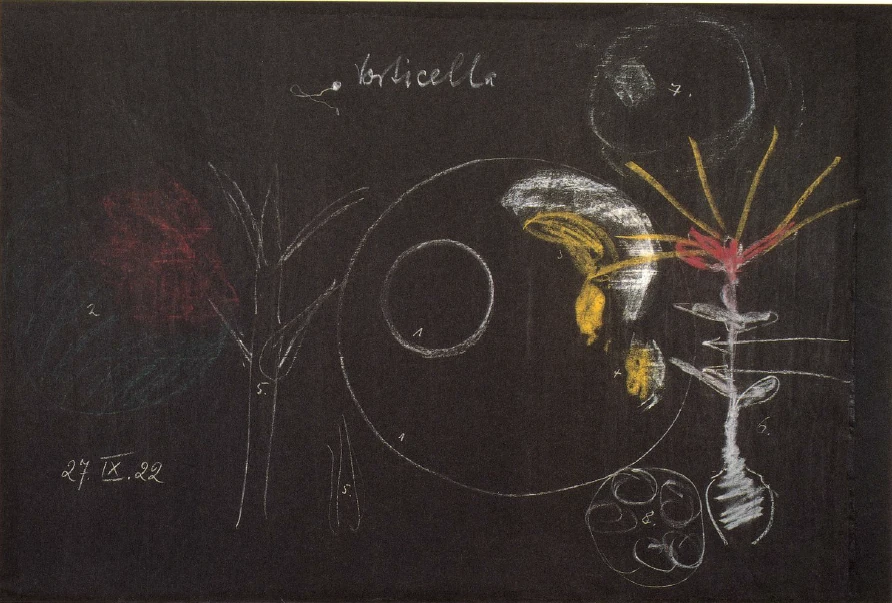
[ 32 ] Daher können Sie das auch auf der ganzen Erde sehen. Dieses Wirken der Sonne können Sie besonders schön sehen, wenn Sie in heiße Gegenden kommen, in Äquatorialgegenden; da schwirren alle Vögel in den wunderbarsten Farben durcheinander. Das ist die Wirkung der äußeren Sonne. Diese Federn sind alle wunderschön gefärbt, enthalten aber keine Lebenskraft mehr in sich. In den Federn ist die Lebenskraft am meisten abgestorben.
[ 32 ] That is why you can see this all over the world. You can see this effect of the sun particularly beautifully when you visit hot regions, such as those near the equator; there, birds of the most wonderful colors flit about in a jumble. This is the effect of the outer sun. These feathers are all beautifully colored, but they no longer contain any life force. The life force has died away most completely in the feathers.
[ 33 ] Und so ist es bei der Pflanze. Wenn sie aus dem Erdboden herauswächst, da hat sie strotzende Lebenskraft. Dann verliert sie diese immer mehr und muß zuletzt noch alle Kraft zusammennehmen; das ganz kleine bißchen Lebenskraft bringt sie noch in den Samen hinein. Und die Sonne macht schöne Blätter, farbige Blüten, aber sie tötet diePflanze dabei ab. In den farbigen Blumenblättern lebt nichts von Fortpflanzungsfähigkeit.
[ 33 ] And so it is with the plant. When it grows out of the ground, it is brimming with vitality. Then it loses more and more of this vitality and must finally muster all its remaining strength; it channels that very small bit of vitality into the seed. And the sun creates beautiful leaves and colorful flowers, but in doing so, it kills the plant. There is no reproductive capacity in the colorful petals.
[ 34 ] Aber was tut denn die Pflanze, wenn man ihren Samen in die Erde hereingibt? Da läßt sie sich nicht nur darauf ein, in die Erde hineingelegt zu werden, sondern sie bringt Wachstum in den Blättern herauf; das trägt sie herauf. Wenn ich da etwas Grünes zeichne, entwickeln das die Sonnenkräfte, also Wärme, Licht und so weiter. So gehen die Sonnenkräfte herauf in der Pflanze. Die nimmt sich die Pflanze im Samenkorn mit, währenddem die Sonnenkräfte, die von außen kommen, die Pflanze ertöten, so daß da eine sehr schöne Blüte entsteht. Aber da mitten drin ist noch der Same, der noch von der mitten im Winter aufgespeicherten Sonnenwärme kommt. Von der heurigen Sonne kommt der Same nicht. Das ist bloß eine falsche Vorstellung. Von der heurigen Sonne kommt die schöne Blüte; der Same aber kommt von der Sonnenwärme des vorigen Jahres, der hat noch die Kraft, die die Sonne erst der Erde hingegeben hat. Die trägt die Pflanze durch ihren ganzen Körper durch.
[ 34 ] But what does the plant do when its seed is placed in the earth? It not only allows itself to be placed in the earth, but it also brings forth growth in its leaves; that is what it brings forth. When I draw something green there, the forces of the sun—that is, warmth, light, and so on—develop it. This is how the forces of the sun rise up within the plant. The plant carries these forces with it in the seed, whereas the forces of the sun that come from outside kill the plant, so that a very beautiful flower emerges. But right in the middle of it is still the seed, which comes from the sun’s warmth stored in the middle of winter. The seed does not come from this year’s sun. That is merely a misconception. The beautiful flower comes from this year’s sun; the seed, however, comes from the sun’s warmth of the previous year, which still possesses the energy that the sun first imparted to the earth. The plant carries this energy throughout its entire body.
[ 35 ] Beim Tier ginge das nicht so leicht. Das Tier ist darauf angewiesen, daß diese Sonnenwärme mehr von außen, mehr von der Erde kommt und nur aufgefrischt wird. Denn das Tier nimmt nicht die Sonnenkräfte so direkt auf wie die Pflanze. Die Pflanze aber trägt durch ihren eigenen Leib bis zum Samen in der Blüte herauf die vorjährige Sonnenwärme, die also in die Erde hinein sich aufgespeichert hat.
[ 35 ] This wouldn’t be so easy for an animal. Animals depend on this solar heat coming primarily from the outside—from the earth—and being merely replenished. This is because animals do not absorb the sun’s energy as directly as plants do. Plants, however, carry the previous year’s solar heat—which has thus been stored in the earth—through their own bodies all the way up to the seed in the flower.
[ 36 ] Wenn man diese Geschichte richtig betrachtet — es ist außerordentlich interessant, es ist wunderbar interessant —, dann sagt man sich: Pflanzen und Tiere pflanzen sich fort. Sie könnten sich nicht fortpflanzen, wenn nicht die Sonne wirkte. Wäre keine Sonne da, könnten sie sich nicht fortpflanzen. Aber die Sonne, die draußen ist am Himmelsraume, außer der Erde, die tötet gerade die Fortpflanzungsfähigkeit. Es ist eine solche Sache wie mit der Kohlensäure: Wenn wir die Kohlensäure einatmen, so tötet sie uns; wenn wir sie in uns haben, so belebt sie uns. Wenn die Erde die Sonnenstrahlen von außen bekommt, so werden ihre Tiere und Pflanzen getötet; wenn die Erde den Tieren und Pflanzen von ihrem Inneren aus das, was in der Sonne ist, geben kann, so werden sie gerade recht belebt und zur Fortpflanzung angeregt. Das sieht man an den Pflanzen; die entwickeln fortpflanzungsfähige Samen nur aus der Kraft der Sonne, die sie von früher mitnehmen, vom vorigen Sommer. Was die Pflanze dieses Jahr schön werden läßt, das kommt von der heurigen Sonne. Das ist überhaupt so: Das Innere, das wächst von der Vergangenheit, und schön — schön wird man durch die Gegenwart,
[ 36 ] If you look at this story properly—it’s extraordinarily interesting, it’s wonderfully interesting—then you realize: Plants and animals reproduce. They couldn’t reproduce if the sun weren’t at work. If there were no sun, they couldn’t reproduce. But the sun, which is out there in the heavens, outside the Earth, actually destroys the ability to reproduce. It’s similar to carbon dioxide: when we inhale carbon dioxide, it kills us; when we have it within us, it gives us life. When the Earth receives the sun’s rays from the outside, its animals and plants are killed; when the Earth can provide the animals and plants with what is in the sun from within itself, they are just the right amount of enlivened and stimulated to reproduce. You can see this in plants; they develop seeds capable of reproduction only through the power of the sun that they carry with them from the past, from the previous summer. What makes the plant beautiful this year comes from this year’s sun. This is true in general: the inner self grows from the past, and beauty—one becomes beautiful through the present,
[ 37 ] Nun, meine Herren, dem Elefanten mit seiner dicken Haut, dem würde aber das bißchen Wärme von der Erde her und das bißchen Sonne drinnen, das er von der Erde her bekommt, furchtbar wenig nützen, denn der ist eben ein Dickhäuter. Da gehen diese Kräfte nicht so leicht durch. Der muß sehr viel in seinem eigenen Samen aufgespeichert haben von früher her. Mondenkräfte hat er aufgespeichert. Die braucht er ja natürlich zur mütterlichen, zur weiblichen Fortpflanzung. Die hat er aufgespeichert. Der Mond ist heraus aus der Erde, und die Tiere, die sich fortpflanzen, die haben eben jetzt die Mondenkräfte in sich.
[ 37 ] Well, gentlemen, for the elephant with its thick skin, that little bit of warmth from the earth and that little bit of sunlight it receives from the earth would be of very little use, because it is, after all, a pachyderm. Those forces don’t penetrate it very easily. He must have stored a great deal in his own seed from earlier times. He has stored lunar forces. He needs these, of course, for maternal, for female reproduction. He has stored them. The Moon has emerged from the Earth, and the animals that reproduce now have these lunar forces within them.
[ 38 ] Sehen Sie, da kommt etwas, was man überhaupt recht berücksichtigen muß. Es könnte natürlich einer kommen und sagen: Da ist solch ein dummer Kerl, der von den ehemaligen, von den früheren Mondenkräften sagt, da leben in den Eiern, in den Fortpflanzungskräften noch solche alten Kräfte drinnen. Dieser dumme Kerl behauptet, die gegenwärtigen Fortpflanzungskräfte, die seien von früher her. — Ich würde diesem Menschen einfach sagen: Hast du denn noch nie gesehen, daß etwas, was jetzt lebt, etwas in sich hat, was von früher her ist? — Ich würde ihm einen Buben zeigen, der seinem Vater so ähnlich ist, daß er ihm, wie man sagt, wie aus dem Gesicht geschnitten ist. Ja, wenn man dann zurückgeht — der Vater könnte ja sogar schon gestorben sein; einer könnte den Vater gekannt haben, als der Vater selber ein so kleiner Bub war, wie der Junge jetzt ist, und der Betreffende könnte sagen: Ja, der Bub ist seinem Vater wie aus dem Gesicht geschnitten. — Aber er schaut ihm gerade ähnlich, so wie der Vater war, als er selber so ein kleiner Bub war. Was Sie da vor vielleicht dreißig oder vierzig Jahren gesehen haben — bei dem kleinen Bub ist es jetzt noch drinnen! Immer sind die Kräfte der Vergangenheit in dem, was in der Gegenwart lebt, noch drinnen. Und so ist es auch mit den Fortpflanzungskräften. Das, was in der Gegenwart ist, das stammt aus der Vergangenheit.
[ 38 ] You see, here’s something that really needs to be taken into account. Of course, someone might come along and say: There’s this silly fellow who claims that the forces of the former, earlier moons still live on inside the eggs, within the reproductive forces. This foolish fellow claims that the present reproductive forces date back to earlier times. — I would simply say to this person: Haven’t you ever seen that something that lives now contains within itself something that dates back to earlier times? — I would show him a boy who resembles his father so closely that he is, as they say, the spitting image of him. Yes, if you go back in time—the father might even have already passed away; someone might have known the father when the father himself was as small a boy as the boy is now, and that person might say: “Yes, the boy is the spitting image of his father.”—But he looks just like him, just as the father was when he himself was such a small boy. What you saw there perhaps thirty or forty years ago—it’s still there within that little boy! The forces of the past are always still present within what lives in the present. And so it is with the forces of procreation. What exists in the present originates from the past.
[ 39 ] Sie wissen ja, man hat es als einen besonders starken Aberglauben angeschaut, daß der Mond aufs Wetter wirken soll. Nun, darinnen steckt auch sehr viel Aberglaube. Aber einmal hat es doch zwei Gelehrte gegeben in Deutschland, an der Universität in Leipzig, von denen hat der eine sich gesagt — Fechner hat er geheißen —: Vielleicht steckt in diesem Aberglauben, daß der Mond aufs Wetter wirke, wirklich ein bißchen Wahrheit. — Und da hat er sich notiert, wie das Wetter war beim Vollmond, und wie das Wetter war beim Neumond, und hat gefunden: Es ist ein Unterschied; es regnet mehr bei Vollmond als bei Neumond. — Das hat er herausgekriegt. Daran muß man ja noch nicht glauben. Solche Notizen sind nicht sehr überzeugend. Bei der wirklichen Wissenschaft muß man viel, viel genauer arbeiten. Aber er hat doch gesagt, man müsse eben solche Untersuchungen fortsetzen und sehen, ob nicht doch dabei herauskommt, daß der Mond auf das Wetter wirkt.
[ 39 ] As you know, the belief that the moon influences the weather has been regarded as a particularly strong superstition. Well, there is certainly a great deal of superstition involved in that. But there were once two scholars in Germany, at the University of Leipzig, one of whom—his name was Fechner—said to himself: “Perhaps there really is a little truth to this superstition that the moon affects the weather.” — And so he kept track of what the weather was like during a full moon and what it was like during a new moon, and he found: There is a difference; it rains more during a full moon than during a new moon. — That’s what he discovered. Of course, that doesn’t mean you have to believe it. Such notes aren’t very convincing. In real science, you have to work much, much more precisely. But he did say that we should continue such investigations and see if it turns out, after all, that the moon does affect the weather.
[ 40 ] Nun war an derselben Universität Leipzig ein anderer, einer, der sich für viel gescheiter gehalten hat — Schleiden hat er geheißen —, der hat gesagt: Nun fangen sogar schon meine Kollegen an, davon zu reden, daß der Mond auf das Wetter wirkt. Donnerwetter, die Geschichte geht nicht, da muß man mit aller Kraft dagegen anstürmen! — Da hat der Fechner gesagt: Nun schön, zwischen uns Männern wird der Streit schon bestehen bleiben, aber wir haben ja auch Frauen. — Sehen Sie, das war noch in früheren Zeiten. Als die zwei Universitätsprofessoren in Leipzig gelebt haben, da haben die Universitätsprofessoren-Frauen noch einen alten Brauch gehabt in der Stadt. Sie haben nämlich ihre Tröge, ihre Bottiche in den Regen gestellt, um da Waschwasser zu bekommen. Sie haben das gesammelt, weil das Wasser nicht so leicht zu kriegen war im alten Leipzig. Es hat dazumal noch keine Wasserleitungen gegeben. — Da hat der Professor Fechner gesagt: Ja, diesen Streit sollen einmal unsere Frauen ausmachen. Die Frau Professor Schleiden und die Frau Professor Fechner, die sollen das so machen: Damit sie immer gleich viel Regenwasser bekommen, kann Frau Professor Schleiden beim Neumond ihre Tröge herausstellen, und meine Frau, die stellt die Tröge heraus beim Vollmond! — Da hat er sich gesagt: Nach meiner Rechnung kriegt sie dann das meiste Regenwasser.
[ 40 ] Now there was another man at the same university in Leipzig—one who considered himself much smarter—his name was Schleiden—who said: “Now even my colleagues are starting to talk about the moon influencing the weather. Good grief, that’s nonsense; we must fight against it with all our might!” — Then Fechner said: “All right, the dispute will certainly continue among us men, but we do have wives, after all.” — You see, that was back in the old days. When those two university professors lived in Leipzig, the professors’ wives still observed an old custom in the city. They used to put their troughs and tubs out in the rain to collect water for washing. They collected it because water wasn’t easy to come by in old Leipzig. There were no water pipes back then. — So Professor Fechner said: “Yes, let our wives settle this dispute.” Professor Schleiden’s wife and Professor Fechner’s wife should do it this way: To ensure they always get the same amount of rainwater, Professor Schleiden’s wife can put her troughs out during the new moon, and my wife will put hers out during the full moon!” — Then he thought to himself: “According to my calculations, she’ll end up with the most rainwater.”
[ 41 ] Nun, sehen Sie, die Frauen sind nicht darauf eingegangen. Die wollten nicht auf die Wissenschaft ihrer Männer eingehen. Die haben sich gar nicht überzeugen lassen. So kam einmal auf eine merkwürdige Weise die Geschichte heraus, daß ein Mensch, selbst wenn die Wissenschaft in Form vom Mann dasteht, nicht daran glaubt, wie die Frau Schleiden, und sich nicht sagt: Ich kriege geradesoviel Wasser beim Neumond wie beim Vollmond, sondern ihre Regentröge auch beim Vollmond herausstellen wollte, trotzdem ihr Mann fürchterlich gewettert hat auf den Fechner.
[ 41 ] Well, you see, the women didn’t go along with it. They didn’t want to accept their husbands’ science. They simply wouldn’t be persuaded. So, in a strange way, the story emerged that a person—even when science is presented in the form of a man—does not believe it, like Mrs. Schleiden, and does not say to herself, “I get just as much water during the new moon as during the full moon,” but instead wanted to put her rain barrels out during the full moon as well, even though her husband raged terribly at Fechner.
[ 42 ] Das ist etwas, was ja noch nichts beweist. Aber sehen Sie, etwas Merkwürdiges ist doch, daß heute noch Ebbe und Flut mit Sonne und Mond zusammenhängen. So daß man schon sagen kann: Fluten treten bei einem Mondesviertel ganz anders auf als bei irgendeinem anderen Mondesviertel. Das hängt zusammen. Aber, meine Herren, davon kommt es nicht, daß der Mond irgendwo aufs Meer scheint und dadurch eben Flut entsteht, sondern das ist eine alte Geschichte.
[ 42 ] That doesn’t really prove anything, of course. But look, it is strange that even today the tides are still linked to the sun and the moon. So much so that one can say: Tides occur quite differently during one phase of the moon than during any other phase. There’s a connection. But, gentlemen, it’s not because the moon shines on the ocean somewhere and thereby causes the tide—that’s an old story.
[ 43 ] Als der Mond noch in der Erde drinnen war, da hat er seine Kräfte entwickelt und die Fluten bewirkt. Und die Erde hat noch immer diese Reste von den Kräften selbst, durch die die Flut entsteht. Kein Wunder, die Erde macht das schon selbständig. Heute ist es ein Aberglaube, wenn man glaubt, der Mond wirke auf die Erde. Aber er hat einmal auf die Erde gewirkt, als er noch drinnen war, als alles noch auf die Erde gewirkt hat; und die Erde ist noch immer in diesem Zusammenhang drinnen. Sie macht deshalb Ebbe und Flut vom Monde abhängig. Aber das ist nur scheinbar. Geradeso wie wenn ich auf meine Uhr schaue, ich auch nicht sage: Sie wirft mich um zehn Uhr zum Saal heraus. — So treffen heute die Mondphasen mit Ebbe und Flut zusammen, weil das einmal voneinander abhing.
[ 43 ] When the Moon was still inside the Earth, it developed its powers and caused the tides. And the Earth still possesses these remnants of those very powers that give rise to the tides. No wonder—the Earth does this all on its own. Today, it’s considered superstition to believe that the Moon influences the Earth. But it once did influence the Earth, when it was still inside it, when everything was still influencing the Earth; and the Earth is still part of that system. That is why it makes the tides dependent on the Moon. But that is only apparent. Just as when I look at my watch, I don’t say: “It’s going to throw me out into the hall at ten o’clock.” — In the same way, the phases of the moon coincide with the tides today because they were once interdependent.
[ 44 ] Und so ist es mit den Fortpflanzungskräften, soweit sie vom Mond abhängen, soweit sie also weiblich sind. Und so ist es mit den Fortpflanzungskräften, soweit sie von der Sonne abhängig sind, also von derjenigen Sonnenkraft kommen, die im Inneren der Erde ist.
[ 44 ] And so it is with the reproductive forces, insofar as they depend on the Moon—that is, insofar as they are feminine. And so it is with the reproductive forces, insofar as they depend on the Sun—that is, insofar as they originate from the solar force that is within the Earth.
[ 45 ] Aber alle die Tiere, die sich so stark fortpflanzen, bis in die Billionen hinein, die also diese von der Sonne durch die Erde aufgespeicherten Sonnenkräfte benützen können, das sind niedere Tiere. Die höheren Tiere und dieMenschen, die haben diese Fortpflanzungskräfte geschützt im Inneren. Da kommt zwar etwas noch von der Sonnenkraft heran und frischt diese Kräfte immerfort auf. Ohne Auffrischung würden sie auch nicht da sein. Aber aus dem, was heute in der Erde von der Sonnenkraft drinnen ist, würden sie nicht so richtig ihre Fortpflanzungskräfte haben können.
[ 45 ] But all the animals that reproduce so prolifically—numbering in the trillions—and are thus able to utilize the solar energy stored by the Earth from the Sun, are lower animals. Higher animals and humans, on the other hand, have these reproductive powers protected within themselves. Some solar energy does still reach them and constantly replenishes these forces. Without this replenishment, they would not exist. But from what solar energy is currently stored within the Earth, they would not be able to derive their reproductive forces properly.
[ 46 ] Die Pflanze kann sie haben, weil sie das, was in der Erde drinnen lebt, vom Winter in den Sommer hinein durch ihren eigenen Körper hinaufträgt, Die Pflanze, die hat die Fortpflanzungskraft vom vorigen Jahr.
[ 46 ] The plant is able to do this because it carries what lives inside the earth from winter into summer through its own body. The plant possesses the reproductive power from the previous year.
[ 47 ] Aber der Elefant kann sie nicht haben vom vorigen Jahr. Der hat sie von einer Zeit vor Jahrmillionen, und hat sie eben in seinem Fortpflanzungssamen, den er wiederum vererbt vom Elefantenvater auf den Elefantensohn. Da hat er sie drinnen. Aber aus welcher Zeit hat er sie drinnen! Nun, geradeso wie die Pflanze in sich die Fortpflanzungskraft vom vorigen Jahr hat, so hat der Elefant die Fortpflanzungskraft von Jahrmillionen in sich. Deshalb kann sich die Pflanze — und die niedrigen Tiere — daraus fortpflanzen, weil sie heute noch die von der Erde aufgespeicherte Kraft benützen können. Das sind ungeheuer starke Fortpflanzungskräfte. Diejenigen Tiere, die darauf angewiesen sind, sehr weit zurückliegende Kräfte in sich noch aufzubewahren, die können sich nur schwach fortpflanzen.
[ 47 ] But the elephant cannot have acquired it from last year. It has had it since a time millions of years ago, and it is contained in its reproductive cells, which it in turn passes down from the elephant father to the elephant son. That is where it is stored. But from what era does it originate! Well, just as the plant possesses within itself the reproductive power from the previous year, so does the elephant possess within itself the reproductive power from millions of years ago. That is why the plant—and the lower animals—can reproduce from it, because they can still draw upon the power stored by the Earth today. These are immensely powerful reproductive forces. Those animals that are dependent on still retaining within themselves forces from a very distant past can reproduce only weakly.
[ 48 ] Aber gehen wir jetzt zurück zu der Zeit, wo da solche Riesenaustern waren: Kaum hat eine solche Auster das erreicht, daß sie von der Sonne beschienen worden ist, da verlor sie schon die innere Kraft, konnte nur diejenige benützen, die aus der Erde heraufkam. Aber sie konnte sie doch noch benützen, weil die Auster nach unten offen war. Wenn diese Auster auch so groß war wie heute Frankreich, nach unten war sie offen, konnte die Erdenkräfte, die von der Sonne kamen, in sich aufnehmen. Als diese Tiere sich dann umgestaltet hatten zu Megatherien, zu Ichthyosauriern, als sie von der Sonne so beschienen wurden, daß sie von allen Seiten kam, sie also nicht mehr von unten her offen waren, da waren sie auf die Fortpflanzungskraft angewiesen, die sie in sich selber hatten, die höchstens aufgefrischt wurde durch die Sonne.
[ 48 ] But let’s now go back to the time when such giant oysters existed: As soon as one of these oysters was exposed to the sun’s rays, it immediately lost its inner energy and could only draw upon the energy rising from the earth. But it could still make use of that energy because the oyster was open at the bottom. Even if this oyster were as large as France is today, since it was open at the bottom, it could absorb the earth’s forces that came from the sun. When these animals had then transformed into megatheres and ichthyosaurs, and were illuminated by the sun in such a way that the light came from all sides—meaning they were no longer open from below—they were dependent on the reproductive power they possessed within themselves, which was at most replenished by the sun.
[ 49 ] Ja, meine Herren, was muß es denn da einmal für eine Zeit gegeben haben, wenn Tiere Fortpflanzungskräfte gekriegt haben, die sie nicht bekommen können, wenn die Sonne von außen scheint? Es muß einmal eine Zeit gegeben haben, wo die Sonne in der Erde drinnen war, wo also nicht bloß das bißchen Sonnenkräfte in die Erde hereingekommen ist, das im Winter zum Beispiel dableibt für die Kartoffeln; sondern es hat einmal eine Zeit gegeben, wo die ganze Sonne in der Erde drinnen war.
[ 49 ] Yes, gentlemen, what kind of time must there have been when animals acquired reproductive powers that they cannot obtain when the sun shines from outside? There must have been a time when the sun was inside the earth—a time when not just the small amount of solar energy that remains in the earth during winter, for example, for the potatoes, entered the earth; rather, there was a time when the entire sun was inside the earth.
[ 50 ] Nun werden Sie sagen: Die Physiker sagen aber, daß die Sonne so furchtbar heiß ist, und wenn die Sonne in der Erde drinnen war, so hätte sie ja alles verbrannt. — Ja, meine Herren, das wissen Sie ja nur von den Physikern. Aber die Physiker würden nämlich höchst erstaunt sein, wenn sie sehen könnten, wie die Sonne wirklich ausschaut. Wenn sie einmal einen Luftballon bauen und da hinauffahren könnten, so würden sie gar nicht finden, daß die Sonne so heiß ist, sondern die Sonne ist gerade in sich drinnen voller Lebenskräfte, und die Hitze entwickelt sie, indem die Sonnenstrahlen durch Luft und alles mögliche durchgehen. Da entwickelt sie erst die Hitze. Also als die Sonne einmal in der Erde drinnen war, da war sie voller Lebenskräfte. Da hat sie nicht nur das bißchen Lebenskräfte geben können, das sie heute geben kann, sondern als die Sonne einmal in der Erde drinnen war, da konnten diese lebendigen Wesen, Tiere und Pflanzen, die damals da waren, genügend kriegen von dem, was ihnen die Sonne gab, denn die Sonne war ja in der Erde selber drinnen. Da entwickelten diese Austern aber auch keine Schalen, sondern da waren sie überhaupt bloßer Schleim.
[ 50 ] Now you will say: But physicists say that the sun is so incredibly hot, and if the sun were inside the Earth, it would have burned everything up. — Yes, gentlemen, but you only know that from the physicists. But physicists would actually be extremely surprised if they could see what the sun really looks like. If they could build a hot-air balloon and fly up there, they wouldn’t find the sun to be that hot at all; rather, the sun is full of life forces right at its core, and it generates heat as the sun’s rays pass through the air and all sorts of other things. That’s when it actually generates heat. So when the sun was once inside the Earth, it was full of life forces. It wasn’t just able to provide the small amount of life forces it can provide today; rather, when the sun was once inside the Earth, the living beings—animals and plants—that were there at the time could get enough of what the sun gave them, because the sun was, after all, inside the Earth itself. Back then, however, these oysters didn’t develop shells either; instead, they were nothing but slime.
[ 51 ] Und nun denken Sie sich: Da war also die Erde, der Mond in ihr, die Sonne war in der Erde drinnen, Austern entwickelten sich, die keine Schalen hatten, sondern die Schleim waren. Es entstand Schleim; der schmierte sich ab, trennte sich ab, wiederum entstand eine Auster, wiederum entstand eine Auster und so weiter fort. Die waren aber so riesengroß, daß man sie gar nicht voneinander unterscheiden konnte. Sie grenzten aneinander an. Wie muß denn dazumal die Erde ausgesehen haben? So ähnlich wie unser Gehirn nämlich, wo auch die Zellen nebeneinander liegen. Da liegt auch eine Zelle neben der anderen; nur sterben die ab, während dazumal, als die Sonne in der Erde drinnen war, Austernzellen, riesige Zellen, eine neben der anderen, waren, und die Sonne ihre Kräfte entwickelte, die sie ja fortwährend entwickelte, weil sie in der Erde drinnen war. Ja, meine Herren, bedenken Sie jetzt das: Da war also die Erde da (siehe Zeichnung), hier eine Riesenauster, da wieder eine Riesenauster, wieder eine, lauter solche Riesenschleimbatzen nebeneinander, und die pflanzten sich immer fort. Und die heutigen Austern pflanzen sich noch so rasch fort, daß sie in einer kurzen Zeit eine Million Nachkommen haben können; da pflanzten sich die damaligen Austern erst recht rasch fort. Donnerwetter, kaum war die alte Auster da, waren schon die Jungen wieder da, und die hatten wieder Junge und so weiter. Die Alten mußten sich wieder auflösen. Wenn das einer von außen angeschaut hätte, wie da dieser riesige Erdklumpen wie ein großes Gehirn dagewesen wäre, natürlich viel weicher, viel schleimiger als ein heutiges Gehirn, wie da eine Riesenauster sich so schnell fortpflanzte — aber jede andere hätte wieder eine Million Nachkommen haben können —, der hätte gesehen: Da mußte jeder sich gegen die anderen verteidigen, weil sie aneinander anstießen. Und wenn da einer gekommen wäre, ein besonders Neugieriger, und hätte von einem fremden Stern zugeschaut, da hätte er gesehen: Da unten schwimmt im Weltenraum ein Riesenkörper, aber der ist ganz Leben, bringt fortwährend Leben hervor, besteht nicht nur aus Millionen von ineinandergeschobenen Austern, sondern die vermehren sich fortwährend. Und was hätte er gesehen? Ganz dasselbe — nur riesengroß —, was man heute sieht, wenn man ein kleines Ei, aus dem ein Mensch entsteht, in der ersten Zeit anschaut! Da geht es nur ganz kleinwinzig vor sich. Da sind auch diese kleinen Zellenschleimbläschen, die sich rasch vermehren,
[ 51 ] And now imagine: There was the Earth, with the Moon inside it; the Sun was inside the Earth; oysters developed that had no shells, but were made of slime. Slime formed; it spread out, separated, and another oyster formed, and then another, and so on. But they were so enormous that you couldn’t tell them apart at all. They were right up against one another. What must the Earth have looked like back then? Much like our brain, in fact, where the cells also lie side by side. There, too, one cell lies next to another; only these die off, whereas back then, when the sun was inside the Earth, there were oyster cells—giant cells—one next to the other, and the sun was developing its powers, which it was, after all, developing continuously because it was inside the Earth. Yes, gentlemen, just think about this: So there was the Earth (see drawing), here a giant oyster, there another giant oyster, and yet another—nothing but these giant slimy blobs side by side, and they were constantly reproducing. And today’s oysters still reproduce so rapidly that they can have a million offspring in a short time; back then, the oysters reproduced even more rapidly. Good grief, no sooner had the old oyster appeared than the young ones were already there again, and they had young ones of their own, and so on. The old ones had to dissolve again. If someone had looked at it from the outside—seeing that huge lump of earth lying there like a giant brain, though of course much softer and much slimy than a brain today, and seeing how a giant oyster reproduced so quickly—but any other one could have had a million offspring as well—that observer would have seen: Each one had to defend itself against the others because they were bumping into one another. And if someone had come along—someone particularly curious—and watched from a distant star, they would have seen: Down there, floating in outer space, is a gigantic body, but it is pure life, constantly producing life; it consists not only of millions of oysters pressed together, but they are constantly multiplying. And what would he have seen? Exactly the same thing—only on a gigantic scale—as what we see today when we observe a tiny egg, from which a human being develops, in its earliest stages! There, it all happens on a very tiny scale. There, too, are those tiny mucous vesicles of cells that multiply rapidly,
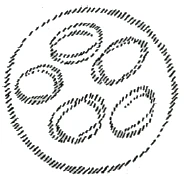
[ 52 ] 166 denn sonst würde der Mensch in den ersten Wochen, in denen er getragen wird, seine Größe nicht erreichen können. Die Zellen sind eben so klein, daß sie sehr rasch sich vermehren müssen. Hätte man dazumal die Erde angeschaut, man hätte das Bild von der Erde bekommen: Ein Riesentier, und darinnen die Kräfte der Sonne und des Mondes, in der ganzen Erde inwendig.
[ 52 ] 166 Otherwise, a human being would not be able to reach its full size during the first few weeks of gestation. The cells are so small that they must multiply very rapidly. If one had looked at the Earth back then, one would have seen it as a giant creature, with the forces of the sun and the moon contained within the entire Earth.
[ 53 ] Sehen Sie, jetzt habe ich Ihnen gezeigt, wie man zurückkommen kann zu der Zeit der Erdenentwickelung, wo Erde, Sonne und Mond noch ein Körper waren. Aber, meine Herren, ich möchte sagen: Im «Faust», wenn Sie den einmal lesen oder gelesen haben, da sagt einmal das sechzehnjährige Gretchen, als ihm der Faust seine Religion entwickelt: So ungefähr sagt es der Pfarrer auch; aber doch ein bißchen anders. — So könnten Sie auch sagen: Ja, so ungefähr sagen es einem die Professoren auch, aber doch ein bißchen anders. Sie sagen: Einmal war die Sonne mit Erde und Mond ein Körper. — Das sagen sie schon; denn sie sagen, nicht wahr: Diese Sonne, die war ein Riesenkörper; dann hat sie sich gedreht, und dann hat sich die Erde abgespalten, als sie sich gedreht hat. Dann hat sich die Erde weiter gedreht, und da hat sich wieder der Mond abgespalten. — Also im Grunde genommen sagt man auch da, es waren alle drei einmal ein Körper.
[ 53 ] You see, I have now shown you how to go back to the time in Earth’s evolution when the Earth, Sun, and Moon were still a single body. But, gentlemen, I would like to say: In Faust—if you ever read it or have read it—the sixteen-year-old Gretchen says at one point, when Faust explains his religion to her: “That’s more or less what the pastor says, too; but still a little differently.” — So you could also say: “Yes, that’s more or less what the professors tell us, too, but still a little differently.” You say: “Once upon a time, the Sun, Earth, and Moon were a single body.” — That’s what they say; for they say, don’t they: “This sun was a giant body; then it spun, and as it spun, the Earth broke off from it. Then the Earth continued to spin, and the Moon broke off from it as well.” — So, basically, they’re saying there, too, that all three were once a single body.
[ 54 ] Da kommen dann die Leute und sagen: Das kann man ja beweisen; den Schulkindern wird das schon bewiesen. Man kann das furchtbar nett vormachen. Man nimmt ein kleines Öltröpfchen — das schwimmt nämlich auf dem Wasser — und dann nimmt man ein Kartenblatt und schneidet einen kleinen Kreis heraus, schiebt oben eine Stecknadel durch; nachher gibt man das ins Wasser und dreht da am Kopf der Stecknadel. Die kleinen Oltröpfelchen spalten sich ab und gehen so herum. Da habt ihr es ja, sagt man, da seht ihr es: Das ist einmal in der Welt geschehen! Da war in der Welt ein riesiger Gasball, bloß Gas; aber gedreht hat sich die Geschichte, und beweglich war es. Und dann sind halt die äußeren Dinge geradeso abgespalten worden, unsere Erde von der Sonne, wie da diese Oltröpfchen abgespalten wurden. — Das können sie schon in der Schule beweisen. Und die Kinder, die ja an die Autorität glauben, die sagen: Das ist ganz natürlich zugegangen; da war einmal ein riesiger Gasball, der hat sich gedreht, und da sind die Planeten abgespalten worden. Wir haben es selber gesehen, wie die Oltröpfelchen abgespalten worden sind.
[ 54 ] Then people come along and say: “That can be proven; it’s already been proven to schoolchildren.” You can demonstrate this in a really nice way. You take a tiny drop of oil—which floats on water—and then you take a sheet of paper and cut out a small circle, push a pin through the top; then you put it in the water and twist the head of the pin. The tiny oil droplets split off and float around like that. “There you have it,” one says, “there you see it: that’s exactly what happened in the world! There was a huge ball of gas in the world—nothing but gas—but it spun, and it was in motion. And then the outer parts simply broke away—our Earth from the Sun—just as those little oil droplets broke away.” — They can already prove that in school. And the children, who believe in authority, say: That happened quite naturally; there was once a huge ball of gas that spun, and that’s how the planets broke away. We saw it ourselves, how the little droplets broke away.
[ 55 ] Nun müssen Sie aber auch die Kinder fragen: Habt ihr denn auch gesehen, wie da oben der Schulmeister an dem Stecknadelkopf gedreht hat? Also müßt ihr euch einen riesigen Schulmeister dazu denken, der dazumal den Gasball gedreht hat, sonst hätten sich ja die Planeten nicht abspalten können! — Der Riesenschulmeister — im Mittelalter hat man ihn gezeichnet: das war der Herrgott mit dem langen Bart. Das war der Riesenschulmeister, und den vergessen diese Leute.
[ 55 ] But now you must also ask the children: Did you see how the schoolmaster up there was turning that pinhead? So you have to imagine a giant schoolmaster who turned the gas sphere back then—otherwise the planets wouldn’t have been able to break away! — The Giant Schoolmaster — that’s how they depicted him in the Middle Ages: he was God with a long beard. That was the Giant Schoolmaster, and these people have forgotten him.
[ 56 ] Aber es ist keine Erklärung, wenn man da einen Riesengasball annimmt, der sich dreht, und der sich erst drehen könnte, wenn einmal ein riesiger Weltenschulmeister dagewesen wäre. Das ist keine Erklärung. Aber, meine Herren, das ist eine Erklärung, wenn man darauf kommt, daß Sonne und Mond mit der Erde verbunden waren, und das sich selber bewegt hat. Das konnte sich bewegen. Ein Gasball, der kann sich nicht allein bewegen. Aber das, was ich Ihnen hier erklärt habe, das konnte sich bewegen. Dazumal brauchte es nicht einen Weltenschulmeister, sondern das war in sich selbst lebendig. Die Erde war eben einmal ein lebendiges Wesen, und zwar ein solches, wie heute ein Samenkorn es ist, und hat Sonne und Mond in sich gehabt. Sonne und Mond sind herausgegangen aus der Erde und haben ihre Erbschaft zurückgelassen, so daß heute die Keimkraft, die geschützt ist im mütterlichen und väterlichen Leibe des Menschen, diese Kräfte, die einstmals direkt von der Sonne kommen konnten, sich noch fortpflanzen und heute die Tiere, die Samen und Eier in sich entwickeln, die uralte Sonnenkraft in ihrer Eier- und Samenflüssigkeit in sich tragen, aus uralten Zeiten als Erbschaft in sich tragen von den Zeiten, wo die Erde selber noch Sonne und Mond in sich gehabt hat.
[ 56 ] But it’s not an explanation to assume a giant ball of gas that’s spinning—and that could only have started spinning if a giant cosmic teacher had once existed. That’s not an explanation. But, gentlemen, it is an explanation if one concludes that the sun and moon were connected to the Earth, and that the Earth itself moved. It was capable of moving. A ball of gas cannot move on its own. But what I have explained to you here was capable of moving. Back then, it did not need a “world teacher”; rather, it was alive in and of itself. The Earth was once a living being—just as a seed is today—and contained the Sun and the Moon within itself. The Sun and the Moon emerged from the Earth and left their legacy behind, so that today the germinative power, which is protected within the maternal and paternal bodies of human beings, these forces—which once could come directly from the sun—can still propagate, and today the animals, seeds, and eggs that develop within carry the ancient solar power in their egg and seed fluids, carrying it within them as an inheritance from ancient times, from the days when the Earth itself still contained the sun and moon.
[ 57 ] Sehen Sie, das ist eine wirkliche Erklärung, und nur wenn man es so versteht, kommt man zu einem wirklichen Verständnis. Dann begreift man, daß es einmal eine Zeit gegeben hat, wo der Mond herausgeflogen ist, und die Erde mit dem Mond aus der Sonne herausgeflogen ist. Wir werden uns über diese Sache noch weiter verständigen zunächst am Samstag um neun Uhr. Es wird noch etwas schwer sein, trotzdem aber glaube ich, daß die Geschichte so ausschaut, daß man es begreifen kann.
[ 57 ] You see, that’s a real explanation, and only by understanding it that way can you arrive at a true understanding. Then you realize that there was once a time when the Moon flew out, and the Earth, along with the Moon, flew out of the Sun. We’ll discuss this matter further, starting this Saturday at nine o’clock. It will still be a bit difficult, but I believe the story is such that it can be understood.