

Understanding Human Beings
in Terms of Body, Soul, and Spirit.
Early Conditions on Earth
GA 347
27 September 1924, Dornach
Translated by Steiner Online Library
9. The Earliest Period of Earth's History
[ 1 ] Last time, I talked to you about the moon breaking away from the Earth and how that relates to life on Earth in the first place. I can imagine that you’ll have a lot of questions. We can address them next Saturday. Think about it a bit until then. But today I still have a few things to go over. That might raise some questions as well.
[ 2 ] We have said: As long as the Moon was within the Earth, the so-called reproductive power of animal beings was something entirely different from what it became later, after the Moon had flown out. I have told you that during the time when the Moon was still inside the Earth, the Moon imparted to the Earth those forces that are, so to speak, the maternal forces, the feminine forces. So we can imagine: There was a time when the Moon was still inside the Earth. I just want to sketch out for you, in very general terms, how that was.
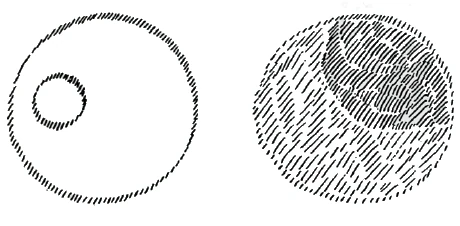
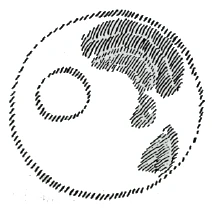
[ 3 ] When the Moon was still inside the Earth, it was not located at the center, but slightly toward the outside (see drawing, left). If you look at the Earth today, you’ll notice that on one side—more toward where Australia is located—there is a lot of water on the Earth, whereas on the side where Europe and Asia are located, there is a lot of land. So the Earth doesn’t actually have land and water distributed evenly; rather, the Earth is such that it has most of the land on one side and most of the water on the other. So the matter on Earth is not evenly distributed (see drawing $.149, right). Nor was it evenly distributed when the Moon was still inside the Earth. The Moon was simply located on the side where the Earth naturally tends to be heavier. Of course, if there is a solid substance there, it is heavy there. So I have to draw it the way I’ve indicated there with white chalk.
[ 4 ] Now you must imagine that back then, fertilization took place in such a way that the moon, which was inside the Earth, gave these giant creatures the powers through which they, so to speak, provided reproductive material. One cannot say that the animals had already laid proper eggs back then. These giant oysters were, in fact, nothing more than a slimy mass themselves, and they simply secreted a small piece of themselves. So that such a giant oyster, as I described to you last time—which could originally have been as large as all of France, since it had a massive shell on which one could have walked around—consisted of a slimy mass toward the Earth’s interior. The forces of the moon acted upon this slimy mass, and a small piece of it separated off. That piece then drifted further into the earth. And when the sun shone on it again—I explained this to you clearly using the example of the dog—an eggshell formed, and because this eggshell formed, the slimy mass of the oyster was once again prompted to separate a small piece from itself, and then a new animal could come into being. So the feminine forces came from the Moon, which was inside the Earth, and the masculine forces from the Sun, which shone down on the Earth from outside. Well, gentlemen, I am describing to you a very specific time—the time when the Moon was still inside the Earth.
[ 5 ] Now you need to imagine the following. Today, when the Moon is out there, outside the Earth, it has a completely different effect. As you know—I told you this last time—when carbon dioxide is inside the human body, it has a completely different effect than when it is outside, where it is a poison. If you think about animal reproduction today, you have to say: Animals must lay eggs, and these eggs must then be fertilized in some way. So what the Moon used to provide when it was inside the Earth, animals now have within themselves. Animals possess these lunar forces within them.
[ 6 ] And from the outside, the moon also exerts forces. I told you last time: Even poets know that the moon imparts forces to the Earth. But these are forces that stimulate the imagination, that make one feel more alive inwardly. These are forces that no longer affect reproduction, but rather shine in from the outside—forces that can no longer bring about reproduction at all.
[ 7 ] You have to imagine it this way: What the Moon was able to give the Earth when it was still inside it—those reproductive forces—the animals have appropriated them, received them as an inheritance, and are now passing them on from one animal to another. So when you look at the eggs of animals, you must tell yourself: The lunar forces are in there. But the lunar forces that are still present are the ones that were active when the Moon was still inside the Earth. Today, the Moon can no longer bring about much else besides stimulating the head. So today, the Moon acts on the head. Back then, however, it acted specifically on reproduction. You see, that is a significant difference. It makes a huge difference whether something is inside the Earth or outside of it.
[ 8 ] Reproduction is, after all, a rather strange phenomenon. But then again, we must say: Any understanding of nature at all depends on understanding reproduction. For it is through reproduction that individual animals and plants continue to come into being even today. If it weren’t for reproduction, everything would have died out long ago. If one wants to understand anything about nature, one must understand reproduction. But reproduction is something peculiar on Earth.
[ 9 ] Just think about it: Elephants have the peculiarity that they are not able to give birth to a single calf until they are about fifteen or sixteen years old. Take an oyster, on the other hand—it’s such a small, slimy creature. If you imagine it on a gigantic scale, you’ll have roughly the kind of creatures I showed you back then. So, there’s something to be learned from the oyster. But the oyster isn’t like the elephant, which has to wait so many years to produce a single offspring. A single oyster can produce a million oysters in a year. So an oyster has a different relationship to reproductive capacity than an elephant.
[ 10 ] Well, gentlemen, another interesting animal is the aphid. As you know, it lives on the leaves of trees and is generally considered a rather harmful pest to the plant world. People suffer greatly from it. Aphids, as you know, are much smaller than an elephant, but in just a few weeks—a single aphid!—can produce several thousand million offspring. An elephant, on the other hand, takes about fifteen or sixteen years to be able to produce a single offspring, whereas the aphid can multiply so rapidly in just a few weeks that a single one can give rise to several million.
[ 11 ] And then there are tiny little animals called vorticelles. When you look at them through a microscope, they’re really just a tiny little lump of slime, and they have a thread that they use to wriggle along. They’re quite interesting creatures, but they consist of nothing more than a tiny lump of slime—like a thread you’d pull out of an oyster—and they just float around like that. These little vorticelles are such that a single one can produce one hundred forty trillion offspring in just four days. So you can’t even write it on the board—there are just too many zeros. The only thing that can compete with that right now is the Russian currency!
[ 12 ] So you see, there is a considerable difference in reproductive capacity between an elephant, which must wait fifteen or sixteen years to produce a single calf, and such a tiny Vorticella, which multiplies in four days to the point where one hundred forty trillion offspring are produced.
[ 13 ] So you see, there really are some very significant mysteries of nature at work here. And there’s a very interesting French story that, on the surface, doesn’t have much to do with this, but in essence, it does. There was a prominent French poet—his name was Racine. And this Racine—it took him seven years to write a play like Athalie, for example. So he wrote a play like Athalie in seven years. And there was another poet in his day who was terribly proud in comparison to Racine and said: “Racine needs seven years to write one play; I write seven plays in a year!” — And so a fable came into being—a story—and this story, this fable, goes like this: Once upon a time, the pig and the lion were arguing; and the pig, who was proud, said to the lion: “I have seven young every year, but you, lion, you only manage to produce a single one in a year.” — Then the lion said: “Yes, but that one is also a lion, and your seven are pigs.” — And with that, didn’t Racine mean to dismiss the poet? He didn’t want to tell him outright that his plays were pigs, but he drew the comparison, for he said: “Well, you produce seven such plays every year, but I produce one Athalie in seven years”—which is world-famous today.
[ 14 ] You see, one could say: Even in a fable like this, in a story like this, there’s something to be found that makes it more valuable to take fifteen or sixteen years—like an elephant—to have a single young one, than to be a Vorticella, which multiplies so rapidly in four days that it produces one hundred forty trillion offspring. People already talk a lot about how many young rabbits have; if one were to talk about the Vorticella—such a capacity for reproduction is simply unimaginable!
[ 15 ] Now we really have to figure out why such tiny animals have so many young, while the elephant takes so long to do so.
[ 16 ] Now I have told you: The sun is what actually underlies fertilization. So the sun is still needed today for fertilization. And I have also told you: When a celestial body like the moon is out there, it affects at most the head, but it no longer affects the abdominal organs—that is, it no longer acts directly on the reproductive forces. Today, the reproductive forces must be inherited from one being to another. But, gentlemen, in a certain sense, what still happens in modern reproduction is nevertheless still dependent on the Moon. And I will explain this to you in the following way, by returning once again to the Sun.
[ 17 ] You see, we have to ask ourselves: Why does it take an elephant fifteen or sixteen years to reach the point where it can reproduce and have a calf? Now, you all know that the elephant is a pachyderm, and because it is a pachyderm, it takes that long. Thick skin, you see, allows the sun’s rays to penetrate less easily than if you were an aphid—which is very soft and lets the sun’s rays in from all sides. So the elephant’s limited reproductive capacity is, in fact, directly related to its thick skin.
[ 18 ] You can tell that from this, too: Just think back to those huge floating oysters. Yes, a second oyster would never form if it depended solely on the sun shining down on that scaly shell, on that thick skin! But this oyster secretes a little mucus, as I’ve told you; that mucus doesn’t yet have an oyster shell, so the sun can shine on it. And as it begins to dry out the mucus—allowing a new oyster to form—it has a fertilizing effect on this oyster. — Yes, when the sun’s rays come from the outside, gentlemen, they can only produce shells. How is it, then, that the sun’s forces can nevertheless have a fertilizing effect?
[ 19 ] You see, we need to look at something else here so that you can understand how the story actually fits together. You may know that when farmers have harvested their potatoes, they dig fairly deep pits and place the potatoes in them. Then they fill the pits back in. And later, once winter is over, they dig the potatoes out of these pits again, because they’ve kept well in there. If they had simply stored the potatoes in the cellar, they would have gone bad. They keep quite well in there.
[ 20 ] Where does that actually come from? It’s a very interesting phenomenon. The farmers don’t have much information to offer on the subject. But, gentlemen, if you yourselves were a potato and were buried in that pit, you’d actually feel exceptionally good in there—unless, of course, you were in need of something to eat. You see, the sun’s heat from the summer stays trapped down there, and the energy that the sun shines down on the earth in the summer gradually seeps deeper and deeper into the ground. And when you dig into the earth in January, the sun’s heat and all the other solar energies from the summer are still there, still trapped one and a half meters deep.
[ 21 ] That’s the strange thing. In the summer, the sun is out there, warming us from the outside, and in the winter, the sun’s energy draws downward and can be found further down. But it can’t go very deep down; it flows back up again. If you were a potato lying down there, you’d be quite comfortable; you wouldn’t need to heat the place, because, first of all, the summer’s warmth is still inside, and second, it gets quite warm coming up from below because the sun’s energy reflects back up. And these potatoes are actually incredibly comfortable. That’s when they really get to enjoy the sun. In the summer, they don’t get much of the sun; in fact, it’s even unpleasant for them. If they had heads, they’d get headaches when the sun shines down on them like that; it’s actually unpleasant for the potatoes. But in the winter, when they’re blessed with the good fortune of being buried in the ground, that’s when they can truly enjoy the sun.
[ 22 ] From this you can see that the sun does not merely exert its influence when it shines on something, but that its influence continues even when its forces are absorbed or held back by something.
[ 23 ] Yes, gentlemen, now something peculiar occurs. I have told you: When a body is outside the Earth, it has a destructive effect—either, like carbon dioxide, as a poison, or like the sun here, which causes flaking when it shines on something; this hardens the living being upon which it shines. But in winter, it is not at all true that the sun acts from the outside; then it acts from within the Earth. There it leaves its power behind, acting within the Earth. And there, within the Earth, it also revitalizes the reproductive forces. So that the reproductive forces today, in our present time, also come from the sun—but not from direct sunlight, rather they come from what remains inside the Earth and then radiates back again in winter,
[ 24 ] It’s a very interesting thing. It’s just like when we inhale carbon dioxide: there, it’s a poison. But once the carbon dioxide is inside our body and travels through the blood, we need it. For if we had no carbon, we would have nothing at all within us. We need it inside us; there it is beneficial; from the outside, it is poison. Sunlight from the outside creates shells in animals; sunlight absorbed from the inside and then reflected back creates life and enables animals to reproduce.
[ 25 ] But, gentlemen, imagine for a moment that you were not a potato, but an elephant. You would have incredibly thick skin, and you would let very little of the heat that the Earth receives from the sun penetrate inside you. That’s why, if you were an elephant, it would take you an incredibly long time to give birth to a baby elephant. But imagine you were an aphid or an oyster; in the case of the oyster, you’d be nothing more than a mass of slime right up against the earth. The elephant is not such a mass of slime. The elephant is enclosed on all sides by its skin, so it allows this heat, which comes from below, to enter it only very slowly.
[ 26 ] Well, you see, here’s the thing: Animals like aphids already live close to the ground and on plants, and they don’t have thick skins at all; they can absorb what evaporates from the earth in the spring with remarkable ease, thus constantly and rapidly replenishing their reproductive powers. And this is even more true of the vorticelles, for they live in water, and water retains the sun’s heat much more intensely, so that the stored solar heat within the vorticelles produces the one hundred forty trillion of them at the right time of year; that is, once they have absorbed enough of the sun’s heat stored in the water, they can reproduce incredibly quickly. Thus, we can say: Today, the Earth endows its beings with the ability to reproduce by preserving the sun’s energies within itself during the winter.
[ 27 ] Now let’s move on from there to plants. You see, with plants, it works like this: As you know, plants also reproduce through what are called cuttings. So when the plant grows out of the ground, you can cut off a cutting from somewhere. You have to cut it off neatly, then you can plant it again, and it will grow into a plant. This method of propagation exists for certain plants. Where does this come from? The ability plants have to reproduce even from a small piece of themselves stems from the fact that they have seeds inside the soil during the winter. That is, in fact, a particularly important aspect of plants. If you want to encourage plants to grow properly, it’s true, isn’t it, that they actually need to be in the ground during the winter. They have to grow out of the ground in the first place. There are summer crops, of course—we could talk about those later. But essentially, plants must develop their seeds while in the ground, and only then can they grow. Sometimes you can also grow bulb-like plants in water, but you have to take special precautions, don’t you think? Essentially, the way nature works is that plants must be planted in the ground and draw their strength to grow from there.
[ 28 ] What happens, gentlemen, when a seed is placed in the earth? There, the seed is especially well-positioned to absorb the forces bestowed upon the earth by the sun. It is precisely the plant seed that absorbs these forces—which enter the earth from the sun—to the greatest extent.
[ 29 ] With animals, it’s much more difficult. Those animals that live inside the earth itself, like earthworms and the like, absorb this energy quite easily. That is why they all reproduce very vigorously—all the animals that are either very close to the ground or in the ground. Worms, after all, have an enormous number of offspring, and, for example, precisely those worms that can unfortunately end up in the human intestines produce an enormous number of offspring, and humans must constantly exert their own strength to prevent these worms from producing such a terrible number of offspring. So if you have worms inside you, you have to use almost all your life forces to kill these dreadful creatures that are inside you.
[ 30 ] Yes, but plants are able to grow out of the ground (see drawing); down below is the root, then they grow out of the ground, and then they have leaves, and then they develop flowers and new seeds. But, gentlemen, you know very well: Once the flower begins to develop, the plant no longer grows upward. That’s quite interesting. The plant’s seed, the embryo, is placed in the soil; the stem grows out of it, leaves form—green leaves—and then the flower appears. At that point, growth is halted, and the plant now works quickly to produce the seed. For if it did not produce the seed quickly, the sun would direct all its energy toward these petals, which would be fruitless. The plant would develop a huge, beautiful flower at the top, multicolored, but the seed would not be able to develop. Finally, the plant gathers all its remaining strength to produce the seed quickly.
[ 31 ] You see, the sun, which comes from outside, has the unique quality of making plants beautiful. When we find beautiful plants in a meadow, it is the external sun, with its rays, that brings out these beautiful colors. But it would cause the plants to wither and die, just as the oyster shell causes the oyster to wither and die.
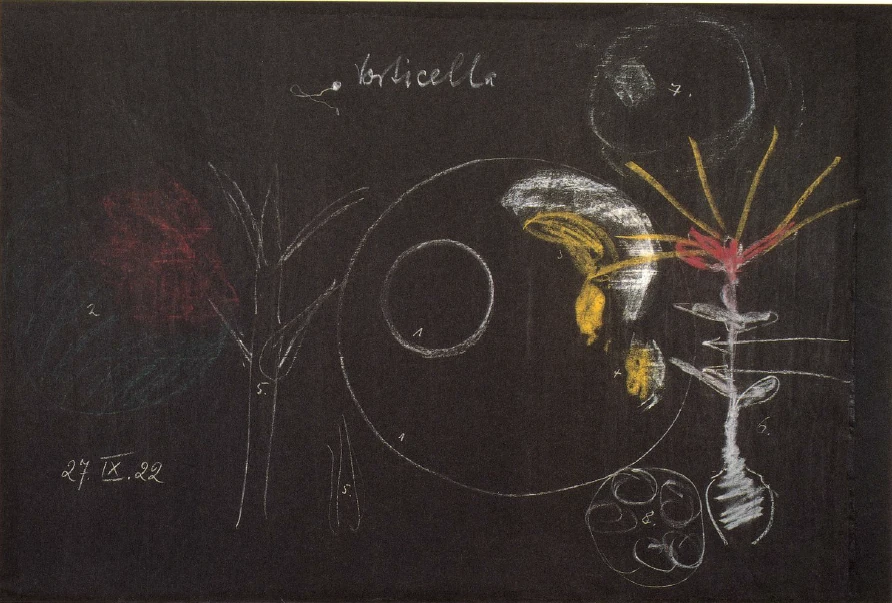
[ 32 ] That is why you can see this all over the world. You can see this effect of the sun particularly beautifully when you visit hot regions, such as those near the equator; there, birds of the most wonderful colors flit about in a jumble. This is the effect of the outer sun. These feathers are all beautifully colored, but they no longer contain any life force. The life force has died away most completely in the feathers.
[ 33 ] And so it is with the plant. When it grows out of the ground, it is brimming with vitality. Then it loses more and more of this vitality and must finally muster all its remaining strength; it channels that very small bit of vitality into the seed. And the sun creates beautiful leaves and colorful flowers, but in doing so, it kills the plant. There is no reproductive capacity in the colorful petals.
[ 34 ] But what does the plant do when its seed is placed in the earth? It not only allows itself to be placed in the earth, but it also brings forth growth in its leaves; that is what it brings forth. When I draw something green there, the forces of the sun—that is, warmth, light, and so on—develop it. This is how the forces of the sun rise up within the plant. The plant carries these forces with it in the seed, whereas the forces of the sun that come from outside kill the plant, so that a very beautiful flower emerges. But right in the middle of it is still the seed, which comes from the sun’s warmth stored in the middle of winter. The seed does not come from this year’s sun. That is merely a misconception. The beautiful flower comes from this year’s sun; the seed, however, comes from the sun’s warmth of the previous year, which still possesses the energy that the sun first imparted to the earth. The plant carries this energy throughout its entire body.
[ 35 ] This wouldn’t be so easy for an animal. Animals depend on this solar heat coming primarily from the outside—from the earth—and being merely replenished. This is because animals do not absorb the sun’s energy as directly as plants do. Plants, however, carry the previous year’s solar heat—which has thus been stored in the earth—through their own bodies all the way up to the seed in the flower.
[ 36 ] If you look at this story properly—it’s extraordinarily interesting, it’s wonderfully interesting—then you realize: Plants and animals reproduce. They couldn’t reproduce if the sun weren’t at work. If there were no sun, they couldn’t reproduce. But the sun, which is out there in the heavens, outside the Earth, actually destroys the ability to reproduce. It’s similar to carbon dioxide: when we inhale carbon dioxide, it kills us; when we have it within us, it gives us life. When the Earth receives the sun’s rays from the outside, its animals and plants are killed; when the Earth can provide the animals and plants with what is in the sun from within itself, they are just the right amount of enlivened and stimulated to reproduce. You can see this in plants; they develop seeds capable of reproduction only through the power of the sun that they carry with them from the past, from the previous summer. What makes the plant beautiful this year comes from this year’s sun. This is true in general: the inner self grows from the past, and beauty—one becomes beautiful through the present,
[ 37 ] Well, gentlemen, for the elephant with its thick skin, that little bit of warmth from the earth and that little bit of sunlight it receives from the earth would be of very little use, because it is, after all, a pachyderm. Those forces don’t penetrate it very easily. He must have stored a great deal in his own seed from earlier times. He has stored lunar forces. He needs these, of course, for maternal, for female reproduction. He has stored them. The Moon has emerged from the Earth, and the animals that reproduce now have these lunar forces within them.
[ 38 ] You see, here’s something that really needs to be taken into account. Of course, someone might come along and say: There’s this silly fellow who claims that the forces of the former, earlier moons still live on inside the eggs, within the reproductive forces. This foolish fellow claims that the present reproductive forces date back to earlier times. — I would simply say to this person: Haven’t you ever seen that something that lives now contains within itself something that dates back to earlier times? — I would show him a boy who resembles his father so closely that he is, as they say, the spitting image of him. Yes, if you go back in time—the father might even have already passed away; someone might have known the father when the father himself was as small a boy as the boy is now, and that person might say: “Yes, the boy is the spitting image of his father.”—But he looks just like him, just as the father was when he himself was such a small boy. What you saw there perhaps thirty or forty years ago—it’s still there within that little boy! The forces of the past are always still present within what lives in the present. And so it is with the forces of procreation. What exists in the present originates from the past.
[ 39 ] As you know, the belief that the moon influences the weather has been regarded as a particularly strong superstition. Well, there is certainly a great deal of superstition involved in that. But there were once two scholars in Germany, at the University of Leipzig, one of whom—his name was Fechner—said to himself: “Perhaps there really is a little truth to this superstition that the moon affects the weather.” — And so he kept track of what the weather was like during a full moon and what it was like during a new moon, and he found: There is a difference; it rains more during a full moon than during a new moon. — That’s what he discovered. Of course, that doesn’t mean you have to believe it. Such notes aren’t very convincing. In real science, you have to work much, much more precisely. But he did say that we should continue such investigations and see if it turns out, after all, that the moon does affect the weather.
[ 40 ] Now there was another man at the same university in Leipzig—one who considered himself much smarter—his name was Schleiden—who said: “Now even my colleagues are starting to talk about the moon influencing the weather. Good grief, that’s nonsense; we must fight against it with all our might!” — Then Fechner said: “All right, the dispute will certainly continue among us men, but we do have wives, after all.” — You see, that was back in the old days. When those two university professors lived in Leipzig, the professors’ wives still observed an old custom in the city. They used to put their troughs and tubs out in the rain to collect water for washing. They collected it because water wasn’t easy to come by in old Leipzig. There were no water pipes back then. — So Professor Fechner said: “Yes, let our wives settle this dispute.” Professor Schleiden’s wife and Professor Fechner’s wife should do it this way: To ensure they always get the same amount of rainwater, Professor Schleiden’s wife can put her troughs out during the new moon, and my wife will put hers out during the full moon!” — Then he thought to himself: “According to my calculations, she’ll end up with the most rainwater.”
[ 41 ] Well, you see, the women didn’t go along with it. They didn’t want to accept their husbands’ science. They simply wouldn’t be persuaded. So, in a strange way, the story emerged that a person—even when science is presented in the form of a man—does not believe it, like Mrs. Schleiden, and does not say to herself, “I get just as much water during the new moon as during the full moon,” but instead wanted to put her rain barrels out during the full moon as well, even though her husband raged terribly at Fechner.
[ 42 ] That doesn’t really prove anything, of course. But look, it is strange that even today the tides are still linked to the sun and the moon. So much so that one can say: Tides occur quite differently during one phase of the moon than during any other phase. There’s a connection. But, gentlemen, it’s not because the moon shines on the ocean somewhere and thereby causes the tide—that’s an old story.
[ 43 ] When the Moon was still inside the Earth, it developed its powers and caused the tides. And the Earth still possesses these remnants of those very powers that give rise to the tides. No wonder—the Earth does this all on its own. Today, it’s considered superstition to believe that the Moon influences the Earth. But it once did influence the Earth, when it was still inside it, when everything was still influencing the Earth; and the Earth is still part of that system. That is why it makes the tides dependent on the Moon. But that is only apparent. Just as when I look at my watch, I don’t say: “It’s going to throw me out into the hall at ten o’clock.” — In the same way, the phases of the moon coincide with the tides today because they were once interdependent.
[ 44 ] And so it is with the reproductive forces, insofar as they depend on the Moon—that is, insofar as they are feminine. And so it is with the reproductive forces, insofar as they depend on the Sun—that is, insofar as they originate from the solar force that is within the Earth.
[ 45 ] But all the animals that reproduce so prolifically—numbering in the trillions—and are thus able to utilize the solar energy stored by the Earth from the Sun, are lower animals. Higher animals and humans, on the other hand, have these reproductive powers protected within themselves. Some solar energy does still reach them and constantly replenishes these forces. Without this replenishment, they would not exist. But from what solar energy is currently stored within the Earth, they would not be able to derive their reproductive forces properly.
[ 46 ] The plant is able to do this because it carries what lives inside the earth from winter into summer through its own body. The plant possesses the reproductive power from the previous year.
[ 47 ] But the elephant cannot have acquired it from last year. It has had it since a time millions of years ago, and it is contained in its reproductive cells, which it in turn passes down from the elephant father to the elephant son. That is where it is stored. But from what era does it originate! Well, just as the plant possesses within itself the reproductive power from the previous year, so does the elephant possess within itself the reproductive power from millions of years ago. That is why the plant—and the lower animals—can reproduce from it, because they can still draw upon the power stored by the Earth today. These are immensely powerful reproductive forces. Those animals that are dependent on still retaining within themselves forces from a very distant past can reproduce only weakly.
[ 48 ] But let’s now go back to the time when such giant oysters existed: As soon as one of these oysters was exposed to the sun’s rays, it immediately lost its inner energy and could only draw upon the energy rising from the earth. But it could still make use of that energy because the oyster was open at the bottom. Even if this oyster were as large as France is today, since it was open at the bottom, it could absorb the earth’s forces that came from the sun. When these animals had then transformed into megatheres and ichthyosaurs, and were illuminated by the sun in such a way that the light came from all sides—meaning they were no longer open from below—they were dependent on the reproductive power they possessed within themselves, which was at most replenished by the sun.
[ 49 ] Yes, gentlemen, what kind of time must there have been when animals acquired reproductive powers that they cannot obtain when the sun shines from outside? There must have been a time when the sun was inside the earth—a time when not just the small amount of solar energy that remains in the earth during winter, for example, for the potatoes, entered the earth; rather, there was a time when the entire sun was inside the earth.
[ 50 ] Now you will say: But physicists say that the sun is so incredibly hot, and if the sun were inside the Earth, it would have burned everything up. — Yes, gentlemen, but you only know that from the physicists. But physicists would actually be extremely surprised if they could see what the sun really looks like. If they could build a hot-air balloon and fly up there, they wouldn’t find the sun to be that hot at all; rather, the sun is full of life forces right at its core, and it generates heat as the sun’s rays pass through the air and all sorts of other things. That’s when it actually generates heat. So when the sun was once inside the Earth, it was full of life forces. It wasn’t just able to provide the small amount of life forces it can provide today; rather, when the sun was once inside the Earth, the living beings—animals and plants—that were there at the time could get enough of what the sun gave them, because the sun was, after all, inside the Earth itself. Back then, however, these oysters didn’t develop shells either; instead, they were nothing but slime.
[ 51 ] And now imagine: There was the Earth, with the Moon inside it; the Sun was inside the Earth; oysters developed that had no shells, but were made of slime. Slime formed; it spread out, separated, and another oyster formed, and then another, and so on. But they were so enormous that you couldn’t tell them apart at all. They were right up against one another. What must the Earth have looked like back then? Much like our brain, in fact, where the cells also lie side by side. There, too, one cell lies next to another; only these die off, whereas back then, when the sun was inside the Earth, there were oyster cells—giant cells—one next to the other, and the sun was developing its powers, which it was, after all, developing continuously because it was inside the Earth. Yes, gentlemen, just think about this: So there was the Earth (see drawing), here a giant oyster, there another giant oyster, and yet another—nothing but these giant slimy blobs side by side, and they were constantly reproducing. And today’s oysters still reproduce so rapidly that they can have a million offspring in a short time; back then, the oysters reproduced even more rapidly. Good grief, no sooner had the old oyster appeared than the young ones were already there again, and they had young ones of their own, and so on. The old ones had to dissolve again. If someone had looked at it from the outside—seeing that huge lump of earth lying there like a giant brain, though of course much softer and much slimy than a brain today, and seeing how a giant oyster reproduced so quickly—but any other one could have had a million offspring as well—that observer would have seen: Each one had to defend itself against the others because they were bumping into one another. And if someone had come along—someone particularly curious—and watched from a distant star, they would have seen: Down there, floating in outer space, is a gigantic body, but it is pure life, constantly producing life; it consists not only of millions of oysters pressed together, but they are constantly multiplying. And what would he have seen? Exactly the same thing—only on a gigantic scale—as what we see today when we observe a tiny egg, from which a human being develops, in its earliest stages! There, it all happens on a very tiny scale. There, too, are those tiny mucous vesicles of cells that multiply rapidly,
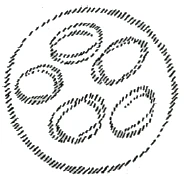
[ 52 ] 166 Otherwise, a human being would not be able to reach its full size during the first few weeks of gestation. The cells are so small that they must multiply very rapidly. If one had looked at the Earth back then, one would have seen it as a giant creature, with the forces of the sun and the moon contained within the entire Earth.
[ 53 ] You see, I have now shown you how to go back to the time in Earth’s evolution when the Earth, Sun, and Moon were still a single body. But, gentlemen, I would like to say: In Faust—if you ever read it or have read it—the sixteen-year-old Gretchen says at one point, when Faust explains his religion to her: “That’s more or less what the pastor says, too; but still a little differently.” — So you could also say: “Yes, that’s more or less what the professors tell us, too, but still a little differently.” You say: “Once upon a time, the Sun, Earth, and Moon were a single body.” — That’s what they say; for they say, don’t they: “This sun was a giant body; then it spun, and as it spun, the Earth broke off from it. Then the Earth continued to spin, and the Moon broke off from it as well.” — So, basically, they’re saying there, too, that all three were once a single body.
[ 54 ] Then people come along and say: “That can be proven; it’s already been proven to schoolchildren.” You can demonstrate this in a really nice way. You take a tiny drop of oil—which floats on water—and then you take a sheet of paper and cut out a small circle, push a pin through the top; then you put it in the water and twist the head of the pin. The tiny oil droplets split off and float around like that. “There you have it,” one says, “there you see it: that’s exactly what happened in the world! There was a huge ball of gas in the world—nothing but gas—but it spun, and it was in motion. And then the outer parts simply broke away—our Earth from the Sun—just as those little oil droplets broke away.” — They can already prove that in school. And the children, who believe in authority, say: That happened quite naturally; there was once a huge ball of gas that spun, and that’s how the planets broke away. We saw it ourselves, how the little droplets broke away.
[ 55 ] But now you must also ask the children: Did you see how the schoolmaster up there was turning that pinhead? So you have to imagine a giant schoolmaster who turned the gas sphere back then—otherwise the planets wouldn’t have been able to break away! — The Giant Schoolmaster — that’s how they depicted him in the Middle Ages: he was God with a long beard. That was the Giant Schoolmaster, and these people have forgotten him.
[ 56 ] But it’s not an explanation to assume a giant ball of gas that’s spinning—and that could only have started spinning if a giant cosmic teacher had once existed. That’s not an explanation. But, gentlemen, it is an explanation if one concludes that the sun and moon were connected to the Earth, and that the Earth itself moved. It was capable of moving. A ball of gas cannot move on its own. But what I have explained to you here was capable of moving. Back then, it did not need a “world teacher”; rather, it was alive in and of itself. The Earth was once a living being—just as a seed is today—and contained the Sun and the Moon within itself. The Sun and the Moon emerged from the Earth and left their legacy behind, so that today the germinative power, which is protected within the maternal and paternal bodies of human beings, these forces—which once could come directly from the sun—can still propagate, and today the animals, seeds, and eggs that develop within carry the ancient solar power in their egg and seed fluids, carrying it within them as an inheritance from ancient times, from the days when the Earth itself still contained the sun and moon.
[ 57 ] You see, that’s a real explanation, and only by understanding it that way can you arrive at a true understanding. Then you realize that there was once a time when the Moon flew out, and the Earth, along with the Moon, flew out of the Sun. We’ll discuss this matter further, starting this Saturday at nine o’clock. It will still be a bit difficult, but I believe the story is such that it can be understood.