

Understanding Human Beings
in Terms of Body, Soul, and Spirit.
Early Conditions on Earth
GA 347
23 September 1924, Dornach
Translated by Steiner Online Library
8. On Early Earth Conditions II
[ 1 ] Gentlemen, it will be necessary to examine the matter we have discussed in even greater detail. Last time, I was able to show you what strange creatures once populated the Earth, and how these truly remarkable creatures behaved. I was also able to point out to you that the entire Earth itself was once a living being.
[ 2 ] You see, when we look at all these animals that once lived on Earth—last time I spoke to you about the ichthyosaurs, the plesiosaurs, the megatheres, and the sea cows— if we look at all these animals, whose remains are still on display in various museums, we find that they share a distinctive feature: namely, that they are usually covered on the outside by a scale-like armor and have powerful, thick forelimbs and paws. So, of course, not only could one have ridden on such an animal—they were large enough for that—but one could also have struck it with a mighty hammer, and the animal would not have been greatly bothered by any of this, precisely because the entire animal was surrounded on all sides by such a scaly armor. In a small form, however—as very tiny dwarfs—only turtles and crocodiles remain today of these ancient animals. Turtles and crocodiles are, I would say, the small-scale versions of what these animals once were in their gigantic forms. So you must imagine that these ancient animals had a kind of horn-like coat consisting of individual horn plates.
[ 3 ] Now we need to try to imagine where these animals actually got this horn-like coat. To do that, we have to study history from the very beginning—not from a human perspective, but in terms of how history itself developed from the very beginning. Just imagine a dog getting a wound somewhere. Animals have remarkable healing instincts. You’ve probably seen what a dog does when it gets a wound somewhere. When a dog has a wound, it first licks it; it coats it with saliva. And then, once it’s coated it with saliva, it prefers to lie in the sun, letting the sun shine on it. And what happens then? A kind of scab forms over the wound. So you could say: If this here is the dog’s wound (see drawing), then it coats it with saliva so that the entire surface of the wound is covered with saliva. Then he lets the sun shine on it, and the sun, together with the saliva, turns what’s brewing there into a hard crust, and underneath it, the wound heals. So the dog has a very remarkable healing instinct. He does the right thing based on his instinct.
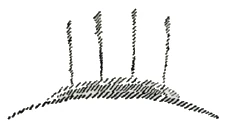
[ 4 ] Now we can expand a little on what we’ve been looking at. We can examine another curious phenomenon that will help us begin to understand something like the healing of this wound. As you know, we breathe in air. When we inhale, oxygen enters our bodies. The oxygen spreads throughout our bodies. And when the oxygen spreads throughout our bodies, that’s what allows us to live. We would suffocate immediately if we couldn’t get oxygen. But what do we do in return? We aren’t exactly very grateful for the air that provides us with oxygen. We’re actually quite ungrateful creatures toward the air, because we combine this oxygen within ourselves with carbon, turning it into carbon dioxide, which we then exhale. That’s actually quite ungrateful toward our environment, because we’re constantly polluting the air with it. If someone were to stand in carbon dioxide, they too would suffocate. What is produced inside us from the beautiful, pure air we breathe—that is what we use to pollute our environment. We constantly spread carbon dioxide-laden air around us, in which no creature—not a human, nor any animal—could live. So you see, animal life essentially consists of constantly drawing into itself from the environment what it needs to live, while returning the substance of death to the environment. That is what animal life consists of.
[ 5 ] However, life on Earth as we know it today would soon be in a very bad state if all creatures behaved as indecently as humans and animals do. Humans and animals pollute the air. And if all creatures behaved as badly as humans and animals do, our Earth would have long since reached a point where nothing could live anymore; our Earth would have long since become one big graveyard. But the good news is that plants don’t behave that badly. In fact, they do the opposite. For just as we inhale oxygen and pollute the air around us, plants absorb carbon dioxide, retain the carbon, and release oxygen back into the atmosphere. So, in fact, it is solely because there are plants—and especially forests—on Earth that life on Earth can survive. If there were no forests on Earth, or if large corporations—as they are already doing to some extent—were to cut down the forests, life on Earth would become much less healthy. That is precisely why we need forests on Earth. If we focus only on the wood, then of course we’ll gradually make life on Earth impossible by cutting down the forests. So we can say: The Earth is set up in such a way that humans and animals actually behave quite badly, because they pollute everything, while the plants and forests, in turn, keep everything in order.
[ 6 ] Yes, you see, gentlemen, that’s how it is on Earth now, but it wasn’t always that way on Earth. We simply have to be very clear about the fact that the Earth has changed, that it was quite different back in the time I told you about last Wednesday; you’ve already realized that. For when you go for a walk now, you don’t encounter an ichthyosaur up there on the Gempen, as might have happened back then. That is no longer the case. But the Earth is constantly changing and will look quite different in the future than it does today. But what can we conclude from all that we have learned here? We can say: What is inside a human being—what he produces on his own—cannot sustain him. He must obtain something else; on the present-day Earth, he must obtain what the plants provide him so that he can live. We cannot live on what we have within us alone; that destroys us.
[ 7 ] So that you can visualize this very clearly: What is beneficial inside a person destroys us when it comes from the outside. Inside, we would be in quite a bad way if we had too much oxygen. But oxygen must constantly come in from the outside.
[ 8 ] So whatever is harmful on the inside—when it comes from the outside, it is beneficial. Whatever is beneficial on the inside—when it comes from the outside, it is harmful. You see, gentlemen, it is so important to realize that what is useful on the inside is harmful when it comes from the outside, and what is harmful on the inside is useful when it comes from the outside. This is so important that if you do not realize this, you understand nothing at all.
[ 9 ] Now we can say: We know this from our present-day lives—that something entirely different must come to us from the outside than what we have within ourselves. Something entirely different must come from the outside.
[ 10 ] Now that we’ve familiarized ourselves with a few concepts from the present, let’s go back to ancient times. Let’s go back again and use our imagination to transport ourselves to the time when ichthyosaurs were roaming the Earth—half walking, half swimming—and when plesiosaurs were hopping around on land. Let’s imagine ourselves in that era. Yes, but that was also a time that followed another. So, what was it like on Earth in those ancient times, before there were ichthyosaurs and plesiosaurs?
[ 11 ] Yes, gentlemen, judging by these remains that we have preserved from that ancient, very ancient time, the animals that existed back then were even more clumsy than those that came later. You know, a plesiosaur—you can see this if you look at one in any museum—with its enormous size, its heavy scaly armor, as heavy as a knight’s armor in the Middle Ages, which must have made it a bit awkward to move around in, and its clumsy legs—those were terribly clumsy creatures. So, you know, they weren’t exactly agile creatures. But these clumsy creatures at least still had something like feet that were fin-like, with which they could swim, and with which they could even hold onto something. So, at least, I’d say that was already a kind of modern era. But the animals that existed earlier, before these clumsy ichthyosaurs, plesiosaurs, megatheres—the animals that existed before them—were even far more clumsy, because they really didn’t have much else besides a soft body that contained all sorts of things: up front, something a bit like a head; at the back, a pretty long tail; and covering it all, a huge, huge scale-armor.
[ 12 ] For example, if you’ve ever seen an oyster, you can imagine that an oyster is like a tiny little creature. Inside, it’s just a slimy body surrounded by a shell. Well, if you imagine the shell a little differently—with scales like a turtle’s and a soft oyster-like body inside—then you’ll get a rough idea of the animals that once lived on Earth before the ichthyosaurs and megatheres appeared.
[ 13 ] Back then, the Earth was very thick, even thicker than milk. Everything that is now mountains out there had dissolved. So it was a very thick substance. And there, floating in that thick sauce—the entire Earth was a terribly thick sauce in outer space—was a giant oyster. Compared to it, our entire carpentry shop here would have been a dwarf. These giant oysters were so enormous that, if you were to trace the outline of, say, modern-day France on their backs, it would have fit comfortably. The oldest of these creatures were such giants because the Earth itself was still enormous. So there were once giant creatures that actually consisted only of a slimy mass and could move only like oysters—except that oysters must live in much thinner water. And these slimy creatures, which had a giant turtle shell, swam inside this thick earth.
[ 14 ] So you see, the Earth was really something like—imagine a huge bowl of thick soup today, with dumplings in it. But you have to imagine these dumplings as being very thick on one side—so thick that you’d break your teeth if you bit into that side—and very soft on the other. You could then peel off one side of these dumplings; that would leave you with something like a hat. And the other part would be completely soft—you could eat that. It was much softer in these animals than the thick, earthy substance in which they swam. That’s why these animals were like certain very small creatures that have survived to this day. You’ve probably seen snails crawling around. When snails crawl, you can follow the trail they leave behind; it’s full of that slime—you’ve surely seen it—which the snail leaves behind. Today, that slime dries up in the sun. Today, it doesn’t mean much. But just imagine: in ancient times, when the earth wasn’t so solid, these animals left this slime behind in the thick earthen soup, and it mixed with that thick earthen soup. So these animals were constantly very useful in that thick earthen soup.
[ 15 ] Today, you can still detect such things, if at all, only in very faint traces when you walk along the path and it has rained quite a bit. You can notice this especially here at the Goetheanum: that’s when the earthworms come out. You’ve probably seen it before—during heavy rains, earthworms crawl out everywhere. Where are the earthworms the rest of the time? They’re usually inside the soil, burrowing through it and making holes as they go. You see, if these earthworms didn’t exist, our fields would be much less fertile. Because what these earthworms leave behind in the soil is what makes the farmland fertile. One mustn’t imagine that anything in nature is unnecessary.
[ 16 ] And that is how it was with these giant oysters in ancient times. They constantly secreted what they produced as mucus into the primordial soup, thereby constantly, constantly refreshing it.
[ 17 ] But here’s the thing: In today’s soil—yes, no matter how much snails and earthworms mix in what they excrete—in today’s soil, it still breaks down. The manure that earthworms provide for farmland is very useful; in a certain sense, even the manure that snails provide is very useful for farmland—and not only on farmland, but in meadows as well, what is present on the ground—as the snail slime sinks into it—is a very, very good fertilizer. But you see, what enters the soil through today’s animals does not come to life.
[ 18 ] But during the period I am now referring to, when these giant oysters deposited their products into the primordial soup, something truly remarkable occurred—and such things still happen today. Isn’t it true that fertilization in certain lower animals—and even in some fairly higher animals—does not occur the same way as it does in higher animals and in humans? Rather, fertilization occurs, let’s say, in certain fish-like, amphibian-like, or toad-like animals in such a way that the eggs are laid laid somewhere, so that there’s a clump of eggs lying somewhere that the female has laid; and the male simply lets his semen fall onto them, outside the female, and that’s where the eggs are fertilized—outside the female. This still happens today. So one can say: The female lays her eggs somewhere and walks away. The male finds these eggs, fertilizes them, and then walks away as well. Fertilization therefore takes place externally. However, it cannot take place—nothing will come of it—unless the sun shines on these fertilized eggs. If the sun doesn’t shine on them, nothing will come of it; they’ll die. But if the sun shines on these fertilized eggs, new animals will develop from them. This still happens today.
[ 19 ] Back when these giant oysters were swimming around in the primordial soup, this slime—when it seeped into the earth—caused such giant animals to develop again and again from the earth itself. The old ones died off, but new animals emerged from the earth itself. The Earth itself continually gave birth to such—admittedly highly clumsy, but gigantic—animals. Thus, the Earth was such that it was fertilized by what these animals secreted. So you can imagine: Once upon a time, there was life on Earth; the Earth was entirely a living being. But that life had to be sustained by the slime secreted by these animals up above. If this thick earthen soup had been the only thing there, these massive creatures here would have died out soon enough. They secreted mucus, and through this, the Earth’s life was continually sustained, so that the Earth continually gave birth to such creatures from within itself. These, in turn, fertilized the Earth itself, and it was now able to grow such creatures again from within itself.
[ 20 ] But those animals over there wouldn’t have been able to secrete that mucus if something else hadn’t been there. You see, the Earth was a terribly thick soup; but I’ve told you: the animals’ mucus was much thinner than that Earth soup, much thinner. So where did that come from—that the animals could have such thin mucus? It would have been completely impossible for the animals to have mucus thinner than the earth itself. The earth was also a paste, a slime, but a very thick one; yet these thinner clumps of mucus kept forming. How did they come about?
[ 21 ] You see, gentlemen, if you have just a glass of water and a liquid—water with salt dissolved in it—it can happen that the salt settles to the bottom. The salt accumulates as a sediment at the bottom; but then the water is less concentrated. Only when the salt was dissolved was the water thick. Now the water has become thinner because the salt is out. So later you’ll have thinner water on top and much thicker salt water at the bottom. And if I could turn this glass upside down—right, if I were to do that, of course all the salt water would simply flow out, and the whole thing wouldn’t happen. But with these ancient animals, the process was reversed. With these ancient creatures, it was like this: there was the thick earth; something then formed from it. At the top was the scaly shell, and further down was slime. What was the scaly shell? It was nothing other than what had separated out from the thick earthen mass. Just as salt settles to the bottom of water, so this thick, very dense mass—which then formed a scaly shell like that of a turtle—separated from the thick part of the earth’s mass, but rose upward, leaving the thinner part below. And so this inverted glass—or the head—was able to rise out of the water. Only the salt rose to the top.
[ 22 ] And what happened to that salt? Well, gentlemen, let’s go back to what a dog does when it has a wound. When a dog has a wound, it licks it. Then it lets the sun shine on it; then it thickens, and then it kills whatever is inside the wound. Otherwise, bacteria would come and the wound would get bigger, and the whole dog would be ruined. You see, a scab forms—a scab made of what’s inside. The mucus that the dog secretes onto the wound comes from within; when the sun shines on it, the heat causes the mucus to thicken.
[ 23 ] That’s exactly how it was with these animals in those ancient times. The sun shone down on this thick earthen soup, and because the sun shone on it, thickened areas formed in certain places, just like the scabs that form on a dog’s wound. Those were the shells. And underneath them, because a thickening had formed, was a thinner slimy mass. And that is how these giant oysters came into being. But, you see, these giant oysters could never have formed if the sun hadn’t shone. It would have been impossible. So now we have this curious situation: we have the Earth—I’ll draw it very small here—; during the day, the sun shines on the Earth, and the sun draws these giant oysters out of the Earth. So we can say: There was a time when the Earth was a thick soup, and because it was illuminated from the outside by the sun, such creatures formed.
[ 24 ] But none of that would have helped back then, since the Earth could have become a fertilizer again if these animals had left behind their thin mucus as they swam through the soup. That would have been of no use. Yes, so there must have been something else inside the Earth after all. It must have been something like an egg. Only in that way could it have been fertilized. Isn’t that obvious? The Earth must once have been, so to speak, like an egg. Only in that way could it have been fertilized.
[ 25 ] We really need to study how such an egg actually works so that it can become a fertilizer, because we’re looking at a state of the Earth where there was a thick, soup-like mass. The beings capable of fertilization—that is, the male beings—we have found them there in ancient times; but if the Earth was supposed to have been a generally female being—we haven’t found that yet, so we must search for it now as well. We must figure out how the Earth could once have been such a gigantic egg.
[ 26 ] You see, gentlemen, if you want to come up with something like that, you really have to take a closer look at the world. And so, oddly enough, I’ll first have to draw your attention to a completely different area—to something that still exists today, but, I would say, in such a diluted state that many people aren’t really aware of it. But it’s really not just out of a certain sense of mystery that poets, when they want to depict lovers or the development of love, have the lovers walk out into the moonlight. There is something about moonlight that has an extraordinary effect on the human imagination.
[ 27 ] You might think this doesn’t really belong here, but it does. Moonlight stirs the human imagination. And you see, it’s quite a curious thing that moonlight stirs the human imagination. When people who are currently scholars sometimes have a sudden burst of cleverness, they sometimes come up with quite charming things, lovely things. For example, some time ago in Paris there was a scholar who said to himself: With all the medicines we now have in medicine, we can accomplish so terribly little for people, and—really, it’s quite remarkable that a Parisian scholar finally came to this conclusion!—if we wanted to make people healthier, we could do something else. And mark my words, gentlemen: The scholar in Paris advised people to read Goethe’s Faust quite a lot—it will make them healthier than if they were to absorb all that stuff that merely stimulates the intellect—because Goethe’s Faust stimulates the imagination, and the imagination is healthy. — So even a materialist scholar has found reading Goethe’s Faust—because it stimulates the imagination—so beneficial that he said: People today are so clever; they strain only their intellect; but the intellect actually makes one sick. But if people were to read Faust and immerse themselves in all the images contained within it, they would be much healthier.
[ 28 ] So the scholar wanted people to let themselves be imbued a little with healthy growth energy. People should let themselves be imbued a little with healthy growth energy! Yes, you see, that was once a moment of clarity, the kind that modern science has so few of. That was a wholesome moment that modern science once had. It is wholesome because it stimulates one to digest better. It is truly true: A person digests better when studying Goethe’s Faust than when studying all scholarly works. Those other works upset one’s stomach. With Goethe’s Faust, the stomach becomes healthier and healthier—and so do the other organs. And where does that come from? Well, because Goethe’s Faust springs from the imagination, not from the intellect.
[ 29 ] Just imagine: when a person is inspired by the moon, their imagination is stimulated. In other words, the moon actually stimulates the forces of growth within a person. But today, this happens only to a very limited extent. Isn’t it true that a person feels a little warmed up inside—that is, they feel their growth forces stimulated from within—when they take a moonlit walk? That is certainly true. But it doesn’t amount to much.
[ 30 ] But the Moon is, after all, connected to everything that constitutes life for human beings. I can share a small fact with you that illustrates exceptionally clearly how the Moon is connected to life. You see, today, when people draw attention, for example, to certain things that people once knew—remember, for instance, what I told you here about the Roman Janus with his two faces—you can imagine that people in the past knew more than they do today; even if they weren’t “smarter,” they certainly knew more. Isn’t that right? Today, when everything people once knew has been buried by human “cleverness,” people say: “Well, a human child is carried for nine months.” — But medicine, which has sometimes preserved old ideas just as it has preserved the Latin language—today’s doctors don’t want to know anything about them anymore, but these old ideas are still around sometimes—says: The child is carried for ten months. Where does that come from, gentlemen? Well, if you do the math: A lunar month has about 28 days; ten times 28 equals 280 days. A month, as we know it today, is calculated as 30 days; if you multiply that by nine, you get roughly the same result—270 days. This means that the nine months we have today are ten lunar months. It’s the same amount of time. In the past, people often calculated in lunar months when discussing the gestation period of a child in the womb.
[ 31 ] Where did this come from, gentlemen? Because people used to know that the development of the child in the womb is connected to the moon. It is connected to the moon. It was once known—and can be confirmed again today through anthroposophical studies—that it is the moon that enables the child to develop as a living being within the human being.
[ 32 ] But this moon only affects the female beings in the human and animal kingdoms, because they are predisposed to it. The moon no longer affects the Earth today. It no longer produces eggs here. And yet, if one studies the matter thoroughly, one comes to realize that it is not only in a subtle sense that the imagination is stimulated—and thereby our growth forces and we ourselves are set in motion—when we take a moonlit walk. The moon has a vitalizing effect within us, but it has such a powerful vitalizing effect on the female human and animal bodies that it actually endows the child or the animal with growth forces.
[ 33 ] Yes, you see, the moon shining down from the sky—it doesn’t enable the Earth itself to grow, because the Earth is already far too barren today. So this Earth, which was once capable of being fertilized, must have been more alive.
[ 34 ] And now remember that I told you that whatever is inside a person—if it comes from outside—is harmful. So the moon, which shines down on Earth today, can no longer bring forth life. Why? Because its light comes from the outside, just as the air we ourselves have exhaled comes from the outside. Then it can no longer enliven us from within. So today, the moon up there can no longer have any effect on the Earth itself. Today, the moon can only have an effect on the animal and human bodies, because they are protected.
[ 35 ] But where must the moon have been in order to make the Earth itself a living being? It cannot make the Earth a living being from outside the Earth. It must have been inside the Earth! Just as carbon dioxide, when it is outside, can no longer make us alive—but must be inside, must develop into a living substance from within—so, too, the moonlight must not have been outside at one time, but inside the Earth.
[ 36 ] So imagine, gentlemen: Back when those beings existed, the moon was not outside the Earth at all, but was inside it, dissolved in the thick soup. It was not yet defined as a separate entity, but was an even thicker sphere within it. There, it could turn the entire Earth into an egg. One comes to realize that the Moon—which today appeals only to the imagination and to the female, fertilized body—that the Moon, which is up there in the sky today, was once inside the Earth.
[ 37 ] But that means it must have left at some point. And you see, gentlemen, this brings us to an immensely important moment in the Earth’s evolution: The Moon, which is always outside today, was once inside the Earth. The Earth expelled it. Today, it orbits the Earth from the outside.
[ 38 ] When we study the entire Earth, something remarkable emerges. Isn’t it true that when we study the Earth, we actually find that it consists of water, and that the continents—the landmasses—float within this water, just as those giant creatures once swam within it? Europe, Asia, and Africa float in the water, just as those giant creatures once floated in the Earth’s soup, in the thick Earth’s soup. And when we study what that looks like—you know, it doesn’t look the same everywhere—we can still see today, from the Earth’s hollowed-out areas and the shifting of the continents, that the Moon once flew out from where the Pacific Ocean is today. The Moon was once inside the Earth; it flew out. It only hardened once it was on the outside.
[ 39 ] We are now looking back on an ancient state of the Earth. At that time, the Earth still had its moon within its body. The moon made the Earth a mother through its substance, and the fatherly substance was brought about by the Sun, because the Sun continuously produced such clumps of slime, which it surrounded on the outside with a thick horny mantle. This was brought about by the sun’s rays. And these floating clumps of slime continuously fertilized what lay at the bottom of the primordial soup and what had been sustained by the Moon. Thus, the Earth was a gigantic egg and was continuously fertilized by what the Sun brought about.
[ 40 ] Yes, gentlemen, if history had continued in that way, a rather unpleasant situation would have arisen on Earth. The Moon would have been flung out. The Earth would have become barren, and eventually everything would have perished. So what actually happened? While the Moon’s ejection did indeed cause the Earth to perish, some of the old life-giving force was preserved within the maternal bodies of animals and humans. Before that, there was no such thing as birth in the way it exists today, was there? Just as when you make a new loaf of bread, you take some of the old yeast and add it to the dough, so too has something of the old substance—taken from the Moon—remained in the female bodies, so that it can be fertilized. What is fertilized there inside—that which internally becomes an egg—is merely a replica of the ancient Earth egg. So it is no wonder that, when the child is conceived—with the lunar history still haunting it from within—even the time during which the child is carried is governed by the moon. Isn’t it true that the baron’s son must also live within the limits of the inheritance his father leaves him? So must the fertilized egg, which actually descends from the ancient lunar soup. It must still be governed by the moon today, for that is what it has inherited.
[ 41 ] In general, you see, people knew much more about these things in earlier times. I’ll explain the reasons why once again. In earlier times, people knew much more about these things, and they used to say: Sol, the sun, is masculine. After all, it is the source of masculinity. This is still the case in Latin. Sol, the sun, is masculine. Luna, the moon, is feminine; in Latin, it is a feminine noun. Sol, the solar principle, fertilizes Luna, the feminine principle. In the German language, the situation is completely reversed; there, people say “die Sonne” and “der Mond,” even though in reality the sun represents the masculine and the moon the feminine. That is how confused the situation has become. If we wanted to speak correctly, we would actually have to say in German: “der Sonn” and “die Mond.”
[ 42 ] But even the ancient Latin scholar made a joke about this and said—this is just a joke with which I want to conclude today’s reflection; I just wanted to give you something here that will become even much clearer to us next time—namely, the ancient Latin scholar said: First we have a moon like this (see drawing); then the moon gradually waxes, becomes like this, and then it becomes full; then it wanes again, becoming like this. — And you see, if we take these words in the Romance languages, for example in French, we can turn this here (see drawing, waning crescent) into a C, and this here (waxing moon, first quarter) into a D; but then we end up with the word croître = to grow. But that’s precisely when the moon is waning—it isn’t growing when it forms a C! In contrast, décroître means “to wane” — and that’s when it is growing. So when we look up at the sky, the moon tells us, “I am growing,” when it is actually waning, and vice versa. This gave rise to the proverb: “The moon is a liar. It lies to you.”
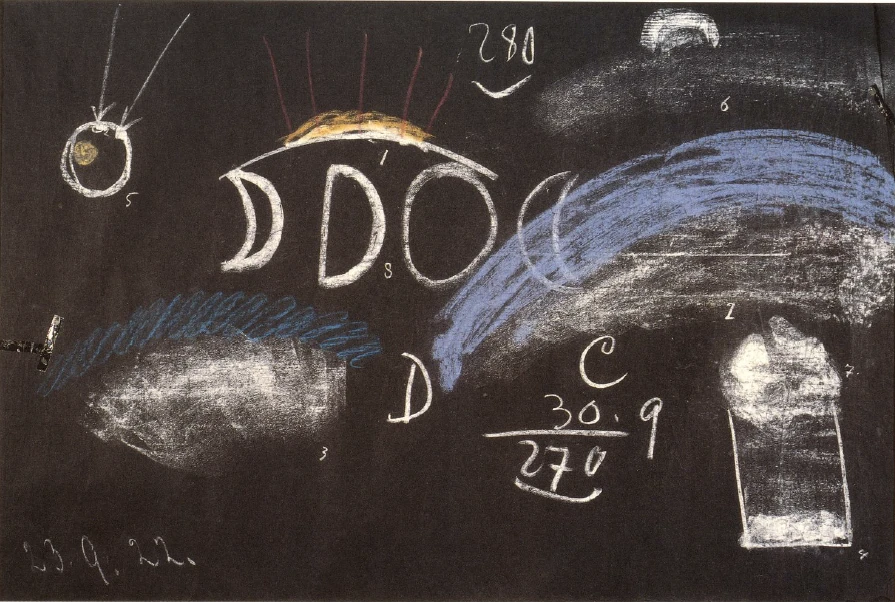
[ 43 ] But this actually has a deeper meaning. People gradually became embarrassed to talk about the lunar, because the lunar is connected to the origin of humankind. It gradually became something that was not spoken of. And people lost the ability to speak of the lunar in the proper way at all. That is why the moon also became a liar. When people looked at it, it no longer conveyed to them that which they are connected to. Doctors gradually stopped talking about the fact that a child remains in the womb for ten lunar months and began speaking of the nine solar months, which are, after all, roughly the same length of time. But in reality, it is ten lunar months, not nine solar months. This is precisely connected to the moon and stems from the fact that the Earth once carried the moon within her womb, gave birth to the moon herself, and cast it out into outer space.
[ 44 ] Now think about it, gentlemen: Yes, when it comes down to it, I’m telling you nothing other than what someone tells you today when they speak of an ancient primordial mist—a kind of vapor from which the Earth was formed, and from which the Moon emerged. — But that’s all mechanical thinking! It’s all materialistic! No matter how much might flow out of it, nothing living could ever come from a vapor. But what I’ve told you about isn’t an ancient vapor. You can generate as much vapor as you like in a boiler and have something separate off from it—but what I’m telling you leads you back to a reality. And that is reality, not that vapor from which Jupiter and the Earth are said to have separated; and when the Earth was still like Jupiter, it cast out the Moon. The real Moon is connected to the entire process of growth and even to human procreation, as I said, and the Earth once possessed its own power of procreation within itself; it was the Mother Earth, and was fertilized by the animals that were up there with their shells, and by the sunlight. The Moon’s power within the Earth was fertilized by the sunlight. Yes, there you see how we gradually emerge from the Earth into outer space.
[ 45 ] Of course, I’m asking quite a bit of your attention, but as you can see, you actually learn something from it!