

Understanding Human Beings
in Terms of Body, Soul, and Spirit.
Early Conditions on Earth
GA 347
20 September 1924, Dornach
Translated by Steiner Online Library
7. On Early Earth Conditions (Lemuria)
[ 1 ] Well, gentlemen, in order to understand human beings even better than we already do, let us also consider the Earth. When the people of Earth come together, human life—as a physical, human existence—cannot really be considered in isolation; rather, we must also consider the Earth.
[ 2 ] When you visit one natural history museum or another, you sometimes find the remains of animals and plants that lived on Earth a long time ago. You can, of course, imagine that all sorts of things happen deep within the Earth until these ancient animals and plants are, in a certain sense, destroyed. You can also consider, for example, that of certain animals in the earth, at most only the bones are preserved, whereas the muscles, soft tissues, heart, and other vessels are lost—they are destroyed very quickly—and that, therefore, one can only find the fossilized bones—that is, the bones that, after the animals’ death, become filled with other material— —that is, when mud enters them—and that, consequently, one can find and excavate only these hardened remains, these fossils, and that, in a sense, one must form an idea of what the Earth once looked like based on what is available—which, for the most part, consists only of bone remains. After all, you can imagine that the conditions on Earth today could not have existed during the time when entirely different animals and plants lived here; otherwise, today’s species would not have emerged. The Earth must therefore have looked very different at one time. You will be able to see this precisely from what I am going to tell you today.
[ 3 ] You see, it was said of a naturalist named Cuvier, who lived in the first half of the 19th century, around 1810, that when he was given a bone, he could form a mental image of what the entire animal must have looked like. If you really study the shape of the bones—if, for example, you have just a single forearm bone—you can form an idea of what the whole animal must have looked like, because the shape of every single bone changes immediately when the entire body changes. So even from individual bones, you can determine what the whole body looked like. Apart from the fact that we sometimes have entire skeletons of animals that once lived on Earth, we have these individual bones, and from them one can form an idea of what life on Earth must once have been like.
[ 4 ] I will now begin to describe to you a state of the Earth that once existed in very ancient times, many thousands of years ago. I would like to describe this state to you in narrative form. We will learn the details more precisely later, but for now I simply want to describe what it once looked like on Earth, the Earth we walk upon today. You are all familiar with its current state.
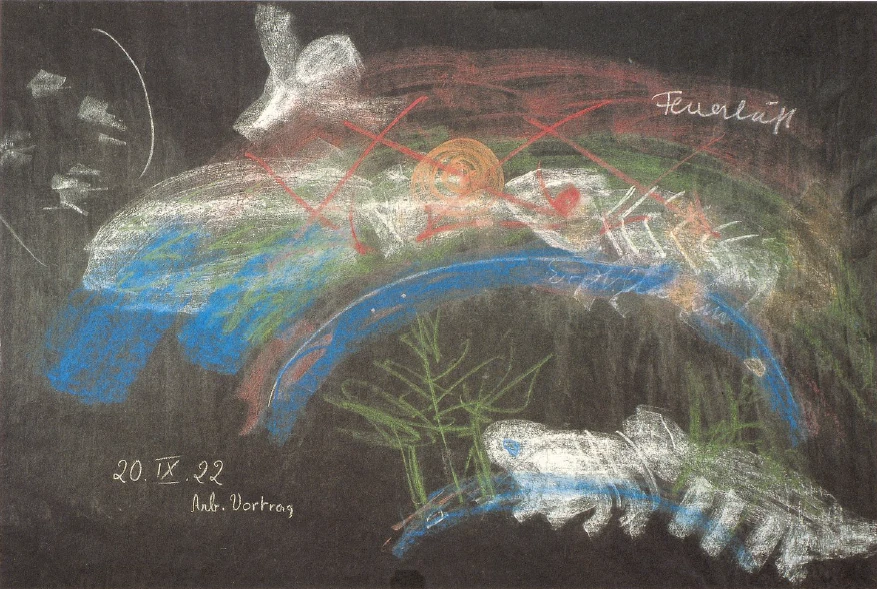
[ 5 ] That’s how it was. Imagine the Earth—I’ll draw a small part of it here (see drawing); but this Earth didn’t yet have such solid mountains as it does today—instead, it was actually like the Earth’s outermost surface is today after it has rained for weeks on end—yes, even much muddier. So the Earth’s surface wasn’t as solid as it is today; rather, it was much muddier. If humans of today’s kind had existed back then, they would either have had to swim—but then they would have been constantly covered in mud, that is, terribly dirty—or they would have had to sink constantly. So there were no humans in their present form back then. It was a muddy, very muddy Earth, and all sorts of things were in that muddy Earth.
[ 6 ] If you go out there today and pick up a rock—a rock like the one Mr. Erbsmehl once brought—or if you go even deeper into Switzerland and pick up even harder rocks, you have to imagine: back then, they were all dissolved in the muddy soil, just as if you were dissolving salt in water. For in that muddy earth there were all kinds of acids that dissolved all sorts of things. In short, it was a very peculiar mud that made up this soil. And above this soil, there wasn’t yet an atmosphere like the one we have today—not an atmosphere containing only oxygen and nitrogen—but one in which all kinds of acids existed in a gaseous state. There was even sulfuric acid in it—sulfuric acid vapors and nitric acid vapors; all of that was present in this atmosphere. From this you can already deduce that humans, in their present form, could not have lived there. Of course, these vapors were weak, but they were present in that air. And this air also had the peculiarity of being roughly like what you would experience today if you were to slip into an old oven just as the heat for baking bread was being prepared—the heat you would feel all around you. So it would have been somewhat uncomfortable for modern humans to be inside that atmosphere, which also smelled of sulfuric acid and was quite warm.
[ 7 ] Well, above that, however, there was another layer of air. It was even slightly warmer than the layer below it, and it formed clouds. These clouds that had formed—because they contained all sorts of substances, such as sulfuric acid, nitric acid, and various other compounds—constantly produced lightning and tremendous thunder. So there was a constant flash of massive lightning bolts inside. That was roughly the Earth’s environment at one time.
[ 8 ] So that we have names for these things, I’d like to call what was up there—because it was terribly hot air—“fire air.” It wasn’t exactly glowing—that’s just a misconception of modern science—it wasn’t glowing; it wasn’t any warmer than an oven like that. That was the temperature of the fire up there; it got a little cooler the further down you went. So I’d like to call that air up there “fire air,” and what was down there, “earth mud.”
[ 9 ] That gives you some idea of what it was like on Earth back then. At the bottom was a greenish-brownish mud that sometimes became as thick as a horse’s hoof, but then it would dissolve again. What is winter today was, back then, the time when the mud became just that thick—almost like a horse’s hoof—and it solidified. And in the summer, when the sun shone down from above, it would dissolve again and turn into liquid mud. And above was this warm air, which contained all sorts of things that later fell out. It was only later that the air cleared.
[ 10 ] Well, that state gave rise to another one in which some very strange animals lived. So you see, up there in the fiery air, all sorts of animals lived. They looked like this: they had a very scaly tail, but it was flat, so that the tail served them well for flying in the fiery air. And then they had wings like a bat’s, and a head like a bat’s, too. And there they flew, up there in the air, once the fiery air no longer contained such harmful fumes. These very creatures were remarkably well-suited to this—of course, when the storms grew particularly fierce, when there was terrible thunder and lightning, it became uncomfortable for them as well; but when things calmed down, when there was just a little crackling up there and a faint flash of lightning, they were happy to live within that flash of lightning, within that faint glow. There they flew about, and they were even capable of radiating something like an electrical current around themselves and sending it down to the earth. So that, had a human been down there, he would even have sensed from these electrical emissions: there’s another flock of birds up there. They were little dragon-birds that radiated electrical energy around themselves and actually existed within that fiery air.
[ 11 ] You see, those birds—those dragon-birds that were there—were truly exceptionally well-organized. They had exceptionally keen senses. The eagles and vultures that later evolved from them—after these creatures transformed—retained only their keen eyesight from what those ancient creatures possessed. But those creatures could sense everything, especially with their bat-like wings, which were incredibly sensitive—almost as sensitive as our eyes. With these wings they could perceive; they sensed everything that was going on. So, for example, when the moon shone, they felt such a sense of well-being in their wings that they moved them; just as a dog wags its tail when it’s happy, so these creatures moved their wings. They felt at ease in the moonlight. They would flit about like that, and they particularly enjoyed creating little clouds of light around themselves—a trait that today has been preserved only by the fireflies in the grass. When the moon shone, they were like glowing clouds up there. And if there had been people back then, they would have seen such swarms of glowing spheres and little glowing clouds up there.
[ 12 ] And when the sun was shining—yes, back then, that’s when they lost the desire to spread their luminous bodies! Then they would contract more into themselves, and that’s when they actually processed what they had absorbed from the air—all the substances they had absorbed were still dissolved in the air. They nourished themselves by absorption. They then digested that in the sun. They were truly remarkable creatures. And they once really existed in the Earth’s fiery atmosphere.
[ 13 ] If one goes even further down, to where the earth and its mud first began, one finds animals that are characterized by their gigantic size—they were gigantic... (gap in the text), when one considers these animals that once lived right there on Earth, leading a life that was half swimming and half wading in the mud. Remains of these animals already exist and can be seen in natural history museums. These giant creatures that once existed are called ichthyosaurs, or fish-lizards. These ichthyosaurs were animals of which we can say that they actually lived on Earth. These ichthyosaurs looked particularly strange. They had a head (drawing shown) like a dolphin’s, but the snout wasn’t as hard—so, a dolphin-like head. Then they had a body like a gigantic but rather slender lizard, with incredibly thick scales. And inside their heads, they had huge teeth like a crocodile’s. They had crocodile teeth—in fact, all these strange creatures had those strange triangular crocodile teeth. Then they had something like whale fins—since they moved by half-swimming—; these were very soft, and they could use them to waddle or wade along even in the mud.
[ 14 ] So they had something like whale fins, a gigantic body, and then a head like a dolphin’s, with a pointed snout facing forward and crocodile teeth. And the strangest thing was that they had huge eyes that were glowing. You could have seen electric dots there in the clouds. The glowing birds flew especially on moonlit nights. And when twilight fell, if one had been able to see it, one might have had an encounter—which would be highly unpleasant for people today—with a giant light coming toward you, with a body larger than today’s whales, with fins that swam through this muddy water and sometimes even stood upright when the mud was harder. Sometimes this muddy water became as hard as horses’ hooves. One could stand on it. They moved on like this: they shaped their fins into hands; they were so flexible at the joints. They waded through these horn-like layers, which were like deserts, and swam over the softer spots again. Then they would wade across it again, and afterward, when they came to softer ground, they would move on by swimming. And if back then any human had been traveling in a boat—he couldn’t have walked; that wouldn’t have been possible—he might have encountered such a giant creature that he could have climbed up onto with a ladder. It was like climbing a mountain today. A whole mountain of cattle could have come your way! It was simply something completely different back then.
[ 15 ] All of this can be discerned; just as Cuvier was able to identify an entire animal from a single bone, so today we can understand how these ichthyosaurs—whose remains still exist—actually lived back then, and what they were capable of doing with their giant fins back then, that they had such a huge eye, which shone like a giant lantern even from a distance, so that one could have gotten out of the way. So they moved like that on and over the muddy ground, above it and within it.
[ 16 ] And a little deeper still, so that they waded and bathed in the mud with genuine delight and always looked terribly dirty—that greenish-brownish kind of dirty—were other animals. These other animals would sometimes just stick their giant heads out into the softer muddy soil, but otherwise they waddled around inside, relying in particular on the fact that the mud had become a bit harder; there they lay like lazy pigs most of the time. Only sometimes did they come to the surface, sticking their heads out. And there was something quite remarkable about that.
[ 17 ] These other animals—the ones with the giant eyes—are now referred to as ichthyosaurs based on their fossils. But then there were those that were a bit more land-bound: the plesiosaurs. The plesiosaurs also had a sort of belly-like, whale-like body and heads like lizards—so a kind of whale-like body and lizard-like heads; but their eyes were positioned more toward the sides, whereas the ichthyosaurs had their eyes—which shone brightly—right at the front. The plesiosaurs had a whale-like body, but one that was also completely covered in scales. And the strange thing was, because they were already lazier—they tended to settle down on what looked like somewhat sturdier giant boats floating in the muddy earth—they had developed four legs, four clumsy legs, with which they could even walk quite comfortably. They no longer had fins like the ichthyosaurs, on which they supported themselves. The ichthyosaurs supported themselves on their fins when they encountered such a hard surface, and where they braced themselves, the fins spread out; in other words, they turned them into feet themselves. But these plesiosaurs had hand-like feet. And from the remains, you can see that they must have had incredibly strong ribs.
[ 18 ] That was more or less what it used to look like on Earth—how the plesiosaurs led a lazy life down there, how the ichthyosaurs swam and flew around on Earth—for the animals with fins could also fly very low—and above them, those glowing clouds that always shone in the twilight and in the moonlight, which were actually dragon-bird stars. That, then, is what it looked like.
[ 19 ] Well, the plesiosaurs were lazy creatures. But you know, there was a reason for that. Back then, the Earth itself was lazier than it is today. Today, the Earth rotates around its axis in twenty-four hours. Back then, it took much longer; the Earth itself was lazier. It rotated more slowly on its axis, and that’s what led to everything else. Because the fact that the air is so clean today depends entirely on the Earth rotating on its axis in twenty-four hours—in other words, on it having become more diligent over time.
[ 20 ] From today’s perspective—judging by modern standards—it must actually have been most unpleasant for these dragon-birds back then, because they were suffering. They didn’t perceive this as a bad situation; rather, they had an immense joy and longing for what you, if you heard it described today, might interpret as these pterosaurs having had a very hard time. That was indeed the case. Imagine the ichthyosaur with its giant eye crawling, flying, swimming—doing all sorts of things—through the very warm air; but that eye shone very brightly. That glowing eye drew those birds up there just as a lamp attracts a mosquito. You see the same phenomenon on a small scale. If you turn on a lamp and there’s a mosquito in the room, it flies right over and burns itself immediately. Well, those birds up there were completely hypnotized by the ichthyosaur’s giant eye, and they plunged down, and the ichthyosaur was able to eat them. So the ichthyosaurs lived off what was flitting about in the air above them,
[ 21 ] If a person had been able to walk around on this curious Earth back then, he would have said: “Those are giant beasts, and they eat fire.” — Because that’s what it looked like—that’s exactly what it looked like—as if giant beasts were whizzing and flying around, devouring fire that was flying toward them from the air.
[ 22 ] And these plesiosaurs—I told you, they’d stick their heads out like that; their eyes would glow, too, and if a bird was swooping down, they’d get a piece of it, too.
[ 23 ] So it all adds up when you look at reality. A dog like that, which you feed quite poorly, will also show you its prominent ribs. The ichthyosaurs had already eaten all the fire away from the plesiosaurs; the plesiosaurs were left with only the worst firebirds and therefore had such prominently protruding ribs. You can still see today that these plesiosaurs were malnourished in ancient times.
[ 24 ] But I said, you’ll think: The birds up there, those beautiful, glowing birds—for they were beautiful—those beautiful, glowing birds had a rough time of it. But they actually liked it that way, and they felt a sense of well-being when they could plunge into the jaws of an ichthyosaur. They regarded that as their bliss. Just as the Turks wanted to go to paradise, so these birds regarded it as their bliss to plunge into the jaws of an ichthyosaur.
[ 25 ] But really, gentlemen, I would say it almost became more uncomfortable for the fire-eater himself—he had to eat them because he needed them for food—but it almost became more uncomfortable for the fire-eater himself than for the others who ended up in his belly. The firebirds plunged in as if into their bliss; but for the ichthyosaur, it became quite uncomfortable in there inside his belly, because all sorts of electricity was building up inside. And under the influence of this fire-devouring and the electricity developing in the giant stomach—which filled almost the entire ichthyosaur; he had almost nothing else on the surface—he was mainly filled with a giant stomach—the ichthyosaurs gradually grew weak. It took quite a long time—fish nature can endure a great deal; I recently said of human nature that it can endure a great deal, but fish nature, especially an ichthyosaur, can of course endure even more—but little by little, the ichthyosaurs grew weaker and weaker. They began to experience all sorts of states of weakness. Their eyes no longer shone as brightly. They were no longer as strongly attracted to the birds. And eating caused them more and more pain. These ichthyosaurs suffered from increasingly severe stomachaches. What did that mean? In the world, everything means something.
[ 26 ] You see, as these ichthyosaurs evolved on Earth and consumed this fire, and as this fire was digested inside their stomachs, their stomachs underwent a transformation; eventually, they were no longer true stomachs. And in the end, all these ichthyosaurs themselves took on a different form. They transformed.
[ 27 ] Modern science tells you only this: There were once other animals, and they evolved. That is no better than telling people: Once upon a time, God came down, took a piece of earth, and formed Adam from it. — One can understand one just as well as the other.
[ 28 ] But what I am about to explain to you, you can easily understand. For because the ichthyosaurs and the plesiosaurs ate the dragon birds, their entire internal structure was transformed, and they became different animals. This was also due to the fact that the Earth was spinning faster and faster—not as fast as today, but faster than before, when it was quite sluggish—and that, in addition, the air increasingly released substances harmful to later beings, which were then incorporated into the Earth. In particular, all sulfurous substances were incorporated into the Earth. The air became purer and purer—not as pure as today’s, but already considerably purer. Only in its later state did it become a kind of watery air, constantly permeated by dense water vapor and mist. In the beginning, the air was actually much purer because it was warmer. Later, it cooled down and became terribly foggy. There was actually a fog over the Earth that never really dissipated, not even under the influence of the sun; it was a foggy layer over the Earth. The mud also gradually became somewhat thicker, and the rocks that would later form began to crystallize. The mud became thicker, but it was still there. At the bottom there was still this thick stuff, and in between there was always thinner stuff—brownish-greenish, muddy stuff—and above that was a misty atmosphere.
[ 29 ] In this misty air, gigantic plants appeared—truly enormous plants. If you go into the forest today and look at the ferns, they are tiny now. But many, many thousands of years ago, there were giant plants similar to these ferns—plants with shallow roots in the spongy, muddy soil, plants that towered high and formed a kind of forest where the mud had already become somewhat thicker. So that later, the Earth reached a state where the soil was already somewhat thicker. There were already all kinds of rocks—they had hardened, not very strong, somewhat coarse, like wax—and in between there was mud everywhere, and out of it grew these giant fern trees, these giant trees. Where there was quite a lot of rock below, such giant forests with giant trees emerged. Then it was open again—then it was different again. With these giant forests of enormous trees that had arisen naturally on Earth, the ichthyosaur and the plesiosaur would no longer have been able to do much. It was already too hard down there for the plesiosaur, and although it was still soft enough, it was too hard for the ichthyosaur, and the plesiosaur would have become even more covered in mud: a crust would have formed around their scales. They would no longer have been able to survive. But all these animals had already corrupted themselves by eating fire. If you had come to this later Earth—but “later” always means thousands and thousands of years—well, things looked quite different by then. There were animals in the mud (as shown in the drawing) that have also been preserved as fossils, so that we can get an idea of what these creatures looked like. These creatures, first and foremost, had a huge belly and a huge stomach, but they had a head that looked something like this—though much more clumsy—like the head of a modern seal. Their eyes had already turned blackish, whereas the eyes of earlier animals were bright. They already had four feet—quite stubby feet. But on top of that, these creatures were completely covered in very fine hair, and their feet were actually like stubby hands.
[ 30 ] And these creatures led a strange life on this earth. At certain times they were on solid ground, but deep down in the mud, and they moved around in that mud. And it was mainly their breasts that moved. For they had giant breasts that were half lungs and half breasts. It was as if their lungs were still completely on the outside. At certain times, they would come waddling and swimming up to these forests and eat these fern trees. So these animals had transitioned from being fire-eaters to herbivores. There were these animals here (it’s being drawn) that were completely covered as if in women’s hair, that had giant heads—heads like clumsy seal heads. If you’d gone for a walk back then, you could have seen these animals, just as they always lived down there, breathing underwater, always coming up, sitting on the shores, and going into the forests. There, with their giant mouths, they ate quite a lot of what today we wouldn’t exactly be able to eat in a single meal; they mainly devoured large portions of these giant forests. These are the animals that, as I said, are still very much alive today and are now called manatees... (gap in the text).
[ 31 ] And how did these animals actually come into being? Well, you see, it was because the earlier animals ate the flying animals. And through electrical forces, their bodies were transformed. Manatees did not evolve directly from the ichthyosaurs I have described, but from similar animals. What they used to eat has become their external form. What they absorbed internally has become their external form. Through eating, these animals have transformed themselves.
[ 32 ] That is precisely what must be said about modern science. You see, in the past, everything on Earth was much softer than it is today; these animals took on the forms that developed within them as a result of what they ate from the air animals.
[ 33 ] And these dragon-birds, for their part, had to change their form as well, because the substances in the air were no longer the same as they had been in the past. They descended closer to the earth, and that is where the birds of later times gradually emerged.
[ 34 ] But down below, eating always resulted in a different form emerging. For example, from an animal like this plesiosaur, an animal emerged that had four legs, like four huge pillars (it’s drawn here), but on top of that it also had a giant belly, a head that looked a bit like a seal’s—plump—and a tail. It was also a giant animal. It was truly very large. If you step on a tiny wren with your feet, it’s naturally right underneath you. This animal could easily have stepped on an ostrich—it was that big—and could have simply trampled it to death. The largest animals of today would have been to those animals back then what mice are to larger animals today. There are also remains of this animal. This animal is called Megatherium.
[ 35 ] These animals moved slowly, in keeping with their build—just as one might move on four pillars—and they fed on whatever happened to fly into their mouths at that moment, now that conditions in the air had changed: into their enormous mouths, which still contained crocodile-like teeth, albeit somewhat weaker ones. Some animals had survived, so there were still dinosaur-like creatures crawling around, like crocodiles. But these megatheres simply trampled them to death whenever they came along. Yes, that’s how it happened back then!
[ 36 ] And only now, after all this had happened, did the air gradually rid itself of these water vapors—for everything had been living within these water vapors—and the time came when the sun could truly begin to exert its influence on the Earth, for the sun’s rays had previously been blocked because the air was like a sea, albeit a thin one, but it was like a sea; the sun’s rays were blocked there. So it was not until later that the sun’s rays actually reached the Earth.
[ 37 ] Yes, gentlemen, you really need to take a closer look at this story from within! Those animals down there—ichthyosaurs, plesiosaurs—and later, manatees and megatheres—well, they were pretty dumb animals. The ichthyosaur was still the smartest of them, but the others were actually really, really dumb. But you can’t say that about those dragon birds that were up there. I’ve already told you: they had an incredibly keen sense of perception. You might say: “We humans are smart; we wouldn’t fly right into the jaws of the ichthyosaurs like those dragon birds did.”—But I don’t actually believe that. If you had lived back then as dragon birds, you would have flown right in there too. But these birds were intelligent. And these birds, first and foremost, had a very keen sensitivity to the moon and the sun, just like our eyes, and these pterosaurs perceived this with their entire bodies, especially with their wings, which—albeit on a smaller scale—are imitated today in the wings of bats, which are also extraordinarily sensitive.
[ 38 ] Well, these animals sensed the sun and the moon; as for the moon, as I have already explained, they created something like an electromagnetic shell around themselves that glowed. And when the moon shone down on this fiery air, they, too, began to glow, shimmer, and flicker in the air with their own light, just like fireflies. But they sensed all of this. And one doesn’t need to use one’s imagination at all; instead, one can proceed entirely scientifically and thus also know that these creatures perceived the starry sky as something different than if there had been no stars. They felt, in the presence of the starry sky, that their wings were very comfortable when the stars shone upon them, and as a result, these wings became speckled.
[ 39 ] Today, one can even verify this story to a certain extent, if one pays very close attention. Of course, very little has survived of these birds, which had very soft bodies, and they are almost impossible to find in the fossils; but wing impressions can be found. Anyone who is truly able to study fossils—particularly limestone fossils and softer fossils—will indeed find such wing impressions. But of course, you have to keep an open mind, not be as rigid as a professor. So if it’s the imprint of a pterosaur wing—there’s naturally nothing left of the wing itself, but the imprint in the limestone—if you look more closely, you’ll see all sorts of stars that were imprinted along with it. These are simply the traces of the impression the stars made on these bat wings at night. They could sense whether it was day or night.
[ 40 ] Now I don’t need to describe much more to you; you’ll say to yourselves: Yes, this whole story here looks remarkably similar to what I described to you the other day about the liver and the kidneys! — Even today, human beings still carry within their bellies a kind of replica of what took place across the entire Earth. And these dragon-birds were like the eyes that the Earth itself once had. That is to say—and I can only tell you this today as a conclusion—the entire Earth was a fish, an animal, and all these giant creatures lived within the Earth and moved about and waddled around, just like the white blood cells within us. We are still such an Earth. The white blood cells—which, incidentally, though small, are not entirely dissimilar in shape to those creatures—sometimes look, in their smallness, almost as these animals must have looked back then. So the entire Earth was a giant fish, a giant animal, and these dragon-birds were the moving eyes with which the Earth gazed out into the space of the stars, into the space of the sun, into the space of the universe, and perceived it.
[ 41 ] The idea that the Earth is dead today is something that only emerged later. Originally, the Earth was alive, just as we are alive. And what I’ve described to you—megatheres, manatees, plesiosaurs, ichthyosaurs, and so on—well, those looked remarkably similar, only on a gigantic scale, to what circulates in our bodies today as white blood cells. And what I’ve described as dragon birds looks remarkably similar to what goes on in our eyes, only it’s motionless.
[ 42 ] And so one might say: The Earth was once a giant creature that, given its size, was quite sluggish, rotating only slowly on its axis in outer space, but which peered out into outer space through these dragon-birds—which were nothing but moving eyes—and observed it all, And what I have described to you—this fire-eating and so on—actually bears a devilish resemblance to what still takes place in the stomach and intestines. And the dragon-birds, in turn, bear a devilish resemblance to the counterpart of the white blood cells—the brain cells, as I have described them—which extend into the eyes.
[ 43 ] In short, you can understand the Earth if you think of it as a dead animal. The Earth is a dead animal. And only after the Earth had lost its own life were other beings—including, as I will describe to you, human beings—able to inhabit the Earth.
[ 44 ] It is just as if we, as human beings, were to die and our white blood cells were to transform into independent entities. This is what once happened to this giant creature, the Earth. And today we stand before this giant corpse. You need not be at all surprised that today’s geologists, who can study only what is dead, study nothing but the corpse. Today’s geologists study only the Earth’s corpse. Science does this everywhere: it studies only what is dead. It lays the corpse on the dissection table. But if one wants to understand something, one must truly go back to what is alive. The Earth was once alive, flying through outer space—albeit moving very sluggishly—like a giant creature, and could look out through the eyes it had everywhere, which were the small, agile dragon-birds. With them, it gazed out into outer space.
[ 45 ] We'll take a closer look at that next time. It's actually quite an interesting topic.