Understanding Human Beings
in Terms of Body, Soul, and Spirit.
Early Conditions on Earth
GA 347
16 September 1924, Dornach
Translated by Steiner Online Library
6. The Process of Nutrition: A Physical, Material, and Spiritual-Emotional Perspective
[ 1 ] So that you, gentlemen, may gain a more complete picture, I would like to examine in greater detail what actually takes place in the human body every day during certain processes. For one can only understand higher processes if one truly recognizes certain lower processes. I would therefore like to examine the entire process of nutrition once again today, both from the physical, material perspective and from the psychological perspective.
[ 2 ] We eat; when we eat, we first put food into our mouths. We consume solid and liquid foods, while we take in gaseous foods through breathing, via the lungs. So we consume solid and liquid foods. But our bodies can only utilize liquids. Therefore, solid food must be broken down into a liquid state in the mouth. This process begins in the mouth. It is made possible in the mouth—specifically on the palate—by the presence of small organs, known as glands, throughout the palate and the entire oral cavity; these glands continuously secrete saliva.
[ 3 ] So you have to imagine that, for example, there are these small glands on the side of the tongue. These are small structures arranged in such a way that, when viewed closely under a microscope, they look like little clusters of grapes; they’re composed of cells arranged in that way. These glands secrete saliva. The saliva breaks down and penetrates the food. Food must be mixed with saliva in the mouth; otherwise, it is of no use to the human body.
[ 4 ] Well, an action is taking place here—this is indeed an action, this salivation, this permeation of the food with saliva—and we perceive this action; we experience it through taste. We taste the food through our sense of taste as we salivate. Just as we perceive colors through our eyes, we perceive the taste of food through our sense of taste.
[ 5 ] So we can say: Food is mixed with saliva in the mouth, and it is tasted. Through taste, we become aware of the food. And through the action of saliva, it is prepared in such a way that it can then be absorbed by the rest of the body. But there must be a certain substance in the saliva of the mouth; otherwise, the food could not be prepared in such a way that it is then usable by the stomach. There must be a certain substance in it. This substance is indeed present, and it is called ptyalin. So, in the mouth, ptyalin is secreted from the salivary glands. And this ptyalin is the substance that first processes the food so that it becomes usable for the stomach.
[ 6 ] Then the food, which has been mixed with saliva and broken down by ptyalin, passes through the esophagus and into the stomach. In the stomach, it must be further broken down. For this to happen, there must be a substance present in the stomach. This substance is secreted by the stomach. Just as saliva containing ptyalin is produced in the mouth, a kind of saliva is also produced in the stomach. However, this gastric saliva contains a slightly different substance. It further breaks down the food in the stomach. So we can say: In the stomach, pepsin is present instead of ptyalin.
[ 7 ] Well, you see, in adults—and even in seven-year-old children—the sense of taste no longer develops in the stomach. But an infant still tastes food in the stomach just as an adult tastes food in the mouth. So one must take the infant’s psychological state into account if one wants to understand a person. An adult, at most, gets a sense of this taste in the stomach when the stomach is already somewhat impaired and the contents travel upward instead of downward. Then the person begins to realize that there is a taste in the stomach. I assume that at least some of you have already experienced this—that something which was already in the stomach comes back up into the mouth—and you will know that it really does taste worse than everything, or at least most of what, one eats. And anything that tasted like what comes back up from the stomach would certainly not be considered particularly palatable. After all, you don’t eat things that would taste like what comes back up from the stomach. But the taste present in the chyme that comes back up must have formed somehow. It forms in the stomach. Isn’t that right? In the mouth, food is merely ptyalinized; in the stomach, it is pepsinized. And the result of that is that it simply tastes different. Taste is a strange thing in general.
[ 8 ] Suppose you have a very sensitive palate and you drink water; generally speaking, unless the water is spoiled, it won’t taste bad. But if—and of course you have to be somewhat sensitive to it—you let a lot of sugar melt on your tongue and your tongue has become accustomed to it, you may find that the water tastes sour. Taste is a matter of its own. But as adults experience it, it does not develop in the mouth but in the stomach. A child feels, but of course does not yet think; therefore, it does not perceive taste the way an adult perceives the taste in its mouth. A child must therefore be given foods that do not taste too bad once they are in the stomach. And that is precisely what breast milk—or milk in general—is, for the reason that it does not taste too bad in the stomach, because the child is kindred to milk. After all, the child is born from a body capable of producing milk. So the child feels a kinship with milk. That is why milk does not taste bad to the child. However, if the child were given other foods too early, it would find them disgusting. Adults no longer react this way because their sense of taste has become coarsened. But the child would find them repulsive because it has no affinity for them—they are external foods.
[ 9 ] Well, you see, after food has been mixed with saliva and pepsin in the stomach, it passes into the intestines—the small intestine, large intestine, and so on—and the chyme spreads throughout the intestines.
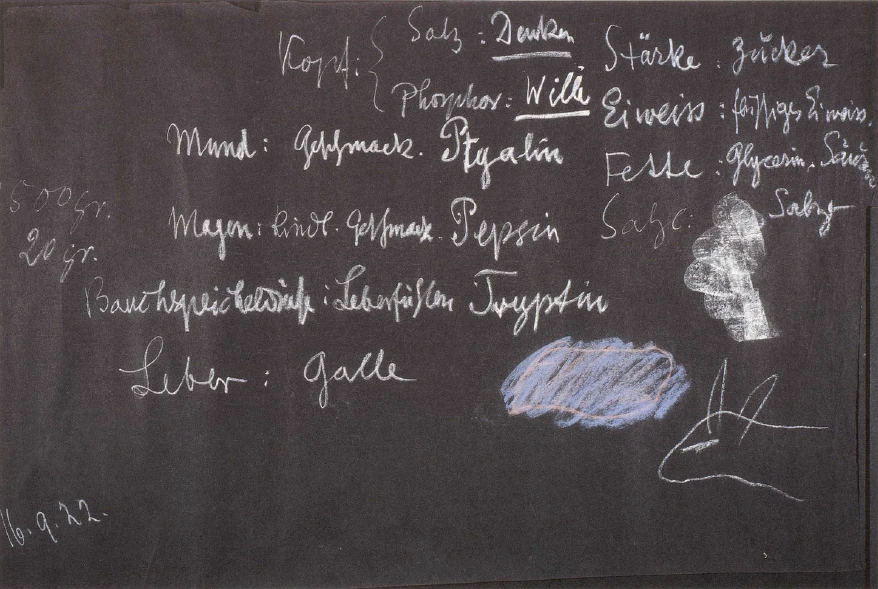
[ 10 ] I can write here, speaking from the heart: a childlike taste.
[ 11 ] If the chyme were to simply remain there without anything happening to it, it would turn into a hard, stony mass in the intestines and cause the person’s death. So something else is done with this chyme.
[ 12 ] What takes place there is, once again, initially carried out by a gland. We have glands in the mouth, glands in the stomach, and now there is a large gland behind the stomach. So when the stomach is there, behind the stomach—if you look at a person from the front—is a fairly large gland, and in front of this gland is the stomach. This gland is therefore behind the stomach. And this gland, which is called the pancreas, secretes a kind of saliva, and this saliva flows through fine ducts into the intestines. Thus, the food is salivated a third time in the intestines. And the substance secreted by the pancreas actually undergoes a transformation within the human body. First, the pancreas secretes it. At that point, it is almost like the pepsin in the stomach. But then, on its way into the intestines, it changes. It becomes more potent. After all, the food now needs to be broken down more thoroughly than before. And this more potent type of digestive enzyme secreted by the pancreas is called trypsin. So, thirdly, we have the pancreas. It secretes trypsin—or at least it secretes something that turns into the potent trypsin juice in the intestines. This means the chyme is subjected to salivation a third time. So something new happens to it once again.
[ 13 ] As I told you last time, this can no longer be perceived by the human consciousness in the head; rather, what arises from the chyme is now perceived, tasted, or felt by the liver and thought by the kidneys. So everything that takes place in the intestines is thought by the kidneys and perceived by the liver. There is, therefore, a spiritual element within the kidneys and liver, and it perceives in the same way that a person perceives through the head. Only, the person is unaware of it. At most, as I told you last time, when he dreams; then the process comes to consciousness in a pictorial form. Just as the chyme winds its way like a snake through the intestines and constantly mixes with trypsin, this exerts a stimulus, and the person then perceives this as snakes in a dream. So what the person perceives there is a transformation into an indistinct, unclear psychological experience.
[ 14 ] Well, the liver—it’s the one that handles the whole business with ptyalin, pepsin, and trypsin—I have to say it that way because science has, unfortunately, given these things such awful names, and if you’re already met with such hostility by the scientific community when you try to clarify these matters, science would be turned completely upside down if you were to give them new names; one could do that, but so as not to turn the scientific world upside down unnecessarily, one doesn’t; instead, one continues to use the old names ptyalin, pepsin, and trypsin. So it is that these substances are now being mixed with saliva for the third time. And underlying this is a sensation in the liver (see diagram on page 104).
[ 15 ] To understand what this “feeling the liver” is all about, gentlemen, just think back to what it’s like—if you’ve ever done it—when you hold a really pungent onion up to your nose. Doesn’t it make your eyes water? Even when you hold horseradish up to your nose, tears come to your eyes. Where does that come from? It comes from the fact that the horseradish or the onion stimulates the lacrimal glands, and the lacrimal glands then secrete bitter tears. Yes, you see, gentlemen, the chyme passing through the intestines is much like an onion or horseradish, and the liver secretes bile just as the eyes secrete tears. The onion must be perceived if it is to cause tears; one must feel it. In the same way, the liver perceives this chyme and secretes the bile that is added to it. That is the fourth.
[ 16 ] Now, in the intestines—after the mouth has acted through ptyalin, the stomach through pepsin, and the pancreas through trypsin—bile from the liver is added to the chyme. And only then does the kidneys take over.
[ 17 ] Once the chyme has been prepared in this way and mixed with saliva four times, it first passes through the intestinal walls into the lymphatic vessels and from there into the blood. So we can say: There is an extraordinarily complex life process at work in the human body. From the mouth until the chyme enters the bloodstream, it is constantly being transformed so that it can be properly digested not only by the stomach but by the entire human body.
[ 18 ] But this, in turn, is achieved in a different way. Isn’t that right? Just imagine, gentlemen—if you yourselves were in a chemistry lab, even if you were the most brilliant professor, and had to do all of this—you wouldn’t be able to do it if you first had to chew the food with saliva from your mouth, then with gastric juice, then with intestinal juice, and finally with bile! All of this happens inside you; you do it continuously every day. But if you had to do it in a laboratory, you wouldn’t be able to. Humans do have a mind, but what takes place intelligently in their stomachs happens far more intelligently than any human on Earth could ever manage. And that is a very wise, very intelligent process that is taking place there. It cannot be easily replicated.
[ 19 ] But you’ll have even more respect for this process once I explain the details to you. What does a person eat? A person eats plant matter, animal matter, and minerals, and as a result, a wide variety of substances enter their mouth, stomach, and intestines, which must be converted and transformed through the action of saliva.
[ 20 ] Imagine you’re eating potatoes. What are potatoes made of? Potatoes consist mainly of what you find in starch. As you know, starch is made from potatoes. So when you eat potatoes, you’re actually eating starch. That’s one of the first things you eat; we eat starch. There are many starch-like substances. The potato consists almost entirely of starch, interspersed only with small amounts of liquid, namely water. And that is why the potato looks the way it does—because it is also alive, not dead. The potato is actually living starch. But that is why, as I have told you, it must be killed. So there it is: pure starch. Starch is found everywhere in plants; whatever you eat from the plant kingdom—it contains starch everywhere.
[ 21 ] What else do you eat? Whether you get it from the plant kingdom or the animal kingdom, you’re eating protein. You eat protein in a regular egg; there you have it just as it is, just slightly inactivated. But you also eat protein that is mixed in with muscle meat or plants. You’re actually eating protein all the time. So the second category is protein and protein-like substances.
[ 22 ] And the third thing you eat—which is different from starch and protein—is fat. Fats are substances distinct from starch and protein. Plants contain less fat than animals. There are what are known as plant fats. Humans need fats from either the plant kingdom or the animal kingdom in order to maintain a proper diet. Thus, fats are the third component of what humans consume as food.
[ 23 ] And fourth, there are the salts. People must always either eat foods that naturally contain sufficient salts or at least contain some salts, or—as you know—people place a salt shaker on the table, and depending on the situation, they take the salt from the shaker with their fingers, a small horn spoon, or the tip of a knife and add it to the soup or other foods. That is what is eaten. We need that. That is the fourth thing that is eaten; I must write “salts” because there are, in fact, different kinds of salts.
[ 24 ] All of that ends up in the gut, and it’s all transformed there.
[ 25 ] Well, gentlemen, what comes of all this? Because the food has been well prepared by saliva from the mouth and the stomach, it can be salivated a third time in the intestines, and it does not harden, but rather it transforms; it becomes something else.
[ 26 ] What happens to starch? Starch turns into sugar. So when you eat starch, it turns into sugar in your stomach. If we want to have sugar in our bodies, we don’t even need to eat it, for the simple reason that—if we produced enough of it—we make it ourselves. But it’s a fact of human nature that we can’t produce everything, even though the human body is capable of a great deal. And so it simply doesn’t produce enough sugar—in some people, far too little. That’s why extra sugar has to be added to meals, or it’s added so that what the intestines would normally produce on their own is already prepared when it enters the digestive tract. And the intestines convert starch into sugar. That is a great art.
[ 27 ] One more thing: As you know, people with sensitive stomachs are better off eating soft-boiled eggs than hard-boiled ones. What’s more, if the eggs have already started to smell a bit off, they’ll make you feel even worse. Egg whites are indeed a good food, but if we introduce them into our intestines while they’re still in an active state, those egg whites would also become foul-smelling and unusable inside us. We cannot utilize egg white in our intestines in the form it exists outside the body. This egg white must also be converted, and above all, it must be dissolved. If you put it in water, it does not dissolve. Something else entirely must be present for it to dissolve. And trypsin dissolves egg white particularly effectively. Thus, egg white is transformed into liquid egg white.
[ 28 ] And while liquid protein is being produced, something else is forming in the human body; under the influence of this pancreatic “intestinal saliva,” something else is formed. As funny as it may sound, what is actually formed is alcohol. The human being produces alcohol within himself. You don’t need to drink any alcohol at all; you have a source of alcohol within yourself. Alcohol is produced in the intestines. And when people become alcoholics, it is only because their liver becomes too greedy. It is not satisfied with the alcohol that is produced in small amounts in the intestines; it demands more alcohol, and that is how people become alcoholics.
[ 29 ] Look, people who knew this even cited it as a reason for drinking wine and beer. They said: There are these so-called teetotalers; but a person can’t really be a teetotaler, because the body produces alcohol in the intestines on its own. — Well, but of course that doesn’t mean you have to become a drunkard and drink too much alcohol. Because if you drink too much alcohol—that is, if you give in to the liver’s craving for alcohol—then it becomes diseased; it degenerates and becomes overgrown as a result of all that. The liver has to be active, after all. The liver enlarges, and the small glands become swollen. And when the liver then has to work to produce bile, it does not produce proper bile. The chyme is not properly mixed with bile in the intestines. It enters the lymphatic vessels and blood vessels as improper chyme. This reaches the heart and also attacks the heart. That is why people who drink too much beer have a diseased liver that looks completely different from those who drink little or who are content with the small amount of alcohol produced in the human intestines themselves—which is actually sufficient for the most part. The degenerated liver and heart are a consequence of excessive alcohol consumption. Hence the “beer heart,” which affects a large portion of Munich’s population. But the liver is always degenerated as well. You see, one can understand degeneration and the various diseases by examining in this way the different pathways of the chyme through the organism.
[ 30 ] Now I have told you what happens when the protein is liquefied. Alcohol penetrates the protein and prevents it from becoming foul-smelling. As you know, when you want to preserve living matter, you also preserve it in alcohol, because alcohol, as they say, preserves it. It can be preserved. The protein can also be preserved within the organism by being placed in alcohol by the organism itself. That is extraordinarily clever.
[ 31 ] But the processes taking place there are so delicate that a human being could not possibly replicate them. If, say, a person wants to preserve a human limb or a small organism—a tiny living creature—he places it in alcohol and displays it in his natural history cabinet. But in the human intestine, trypsin accomplishes this in a much more subtle and ingenious way; it releases alcohol and converts the protein into alcohol.
[ 32 ] And what happens to the fats? Yes, gentlemen, the fats enter the intestine and are in turn broken down by substances secreted by the pancreas, in combination with bile. And from the fat, two types of substances are produced. One substance is glycerin. You are familiar with glycerin from external sources, but you produce glycerin within your own body every day. The other substance is acid. So, glycerin and acids—all kinds of fatty acids—are produced from the fats.
[ 33 ] And only the salts remain essentially the same; they undergo very little change. At most, they are dissolved so that they become more easily digestible. But they essentially remain as they are when ingested. Thus, the salts remain salts (see diagram on page 106).
[ 34 ] So, by eating the appropriate foods, we consume starchy substances, protein-like substances, fatty substances, and salts. And after digestion, instead of these starches, proteins, and fats, we have within us: sugar, dissolved liquid protein, glycerin, acids, and salts.
[ 35 ] And what is happening now with what we have inside us? We have something completely different inside us than what we ate. We have truly transformed the story.
[ 36 ] You see, a few centuries ago here in Switzerland—though he traveled far and wide—there was a doctor whom science today holds in rather low regard, but who still had some inkling of all these processes. That was Paracelsus. He was a professor in Basel. But those guys kicked him out because he knew more than they did. He’s still generally reviled today. Even though he was a very intelligent man, he happened to fall off a cliff and smashed his head open. He spent the last years of his life in Salzburg. He was a doctor. If he had been, as they say today, an honorable citizen or a city councilman in Salzburg, he would have been remembered in the best possible light. But he was a man who knew more than the others. And so they said: He was a drunkard, he was drunk, and he fell off the cliff. — Well, that’s just the way of the world. So he did know something about the world and always pointed out forcefully how there is a transformative power within the human being. But that has been forgotten for centuries since that time.
[ 37 ] And what happens now to everything that’s inside there? Here, science is once again succumbing to a great illusion. For you see, science says: Everything that is now being produced—sugar, liquid protein, alcohol, glycerin, fatty acids, and salts—all of that enters the blood vessels and from there goes to the heart, and from the heart, through the blood vessels, it is then carried out to the rest of the organism. — Certainly, I would say, with the thickest substance that remains—everything is liquid, but even among liquids there are thicker ones—but with the thickest substance that remains, it may be so, and indeed it is so: it passes into the veins and from there supplies the body. But, gentlemen, haven’t you ever noticed that when there was a glass of water and you put sugar into the glass and then drank it, it wasn’t just sweet at the bottom, where the sugar had settled? The whole glass of water is sweet, isn’t it! When sugar is dissolved in liquid, it dissolves throughout the entire water. And the same goes for salt. In that glass of water right there, there aren’t just veins to allow the sugar or salt to reach all parts—rather, it’s absorbed.
[ 38 ] Well, I told you some time ago that the human body is actually 90 percent water—or at least fluid. It’s living water, but it’s water. Well, do all the substances present there first need the veins to be distributed throughout the entire body? When sugar is produced in the intestines, does it first need the veins so that it can be distributed throughout the entire body? The human body consists of water so that the sugar can spread throughout it.
[ 39 ] Yes, people used to say: When a person becomes an alcoholic, all the alcohol that person consumes travels through the intestines to the heart and from there throughout the entire body. — I can assure you, gentlemen, that if all the alcohol a drunkard like that consumes were to pass through the heart first, he wouldn’t die from alcoholism after years, but after days. For it can be proven that whatever is ingested in liquid form in this way does not first pass through the veins into the entire body, but rather enters the body just as sugar dissolves into a glass of water. If someone with a fairly healthy body drinks a glass of water—and drinks it because they’re thirsty—that first glass of water is actually processed by the intestines, added to the chyme, and from there does indeed enter the veins and pass through the heart into the body. But once the veins and the heart have had enough, you can drink as much water as you want: it no longer passes through the veins, because the body doesn’t need it. If you drink one or one and a half glasses of water—just as much as you need to quench your thirst—it leaves your body unscathed; but if you drink too much water—as early as the third or fourth glass—the water is quickly excreted through the urine. It doesn’t even take the time to pass through the heart; it simply leaves through the urine because the human body is essentially a column of water, and there would be too much water otherwise. Just think for a moment about what happens when people are sitting together at a regulars’ table and they get to their third or fourth glass of beer—you can see how one after another starts to urinate! This beer didn’t even take the time to enter the heart in the first place; it leaves again via a much shorter route, because the human body is, after all, a fluid body.
[ 40 ] So we can say: The chyme, which now consists of sugar, liquid protein, glycerin, acids, and salts, is distributed throughout the entire body; only the thickest part is distributed throughout the body via the veins. And this is why salts are deposited in the head and in all the other organs—salts that do not pass through the blood at all, but enter these organs directly.
[ 41 ] Well, you see, if it were the case that a person constantly felt all the salt that accumulates in their head, then they would have a constant headache. Too much salt in the head causes headaches. You may have already heard something about migraines. I’ve also spoken about them here before. You can explain things differently at different levels. What exactly is a migraine? A migraine occurs when this entire distribution is out of balance and too many salts—specifically uric acid salts—are deposited in the head. Instead of being excreted in the urine, the uric acid salts remain in the head during a migraine because the other foods are not properly prepared and retain the salts. A migraine is actually not such a “noble” illness, even though it is most often suffered by people of high social standing. Migraine is a rather unsavory illness. What should be excreted in the urine remains on the right side of the head because it already spoils in the stomach. Thus, what acts on the left side of the body acts on the right side of the head. I will explain why this is so in the near future.
[ 42 ] And that is why the waste that should actually be excreted through urine ends up being deposited on the right side of the head.
[ 43 ] How much salt can a person actually tolerate? Well, remember what I’ve told you before. Remember that I said: The head contains cerebrospinal fluid. Simply because that fluid is inside, the brain becomes so light that it can exist within the human body at all. Because a body that’s simply in the air has a certain heaviness, a certain weight. But when we submerge it in water, it becomes lighter. If that weren’t the case, we wouldn’t be able to swim. And you see, the brain—if it weren’t in water—would weigh about 1,500 grams. I’ve told you this before: Because the brain floats in water, it weighs only 20 grams. That’s how much lighter it becomes—it weighs only 20 grams! But the more salts that are deposited in the brain, the heavier it becomes, because the salts increase the brain’s weight. It then simply becomes too heavy due to the salts.
[ 44 ] So we can say: In humans, when salts are deposited in the brain, the salt is made lighter—the entire brain is made lighter (due to buoyancy). But now consider how this differs in humans from animals. You must realize that humans have placed their head on top of their entire organism. There, the head has a proper support surface. It’s different with animals. Their heads don’t have this support surface; instead, the head is directed purely forward. What follows from this? Well, in humans, the pressure exerted by the head—even though it is very light—is absorbed by the body. In animals, it is not absorbed by the body. You see, this is the main difference between humans and animals.
[ 45 ] Naturalists are always pondering how humans evolved from animals. It’s certainly fine to think that way, but you can’t view humans in that light. You can’t say: “This animal has so many bones, and humans have just as many.” “Monkeys have so many bones, and humans have just as many.” So it doesn’t matter. — You can’t say that. In apes, the head still protrudes forward, no matter how upright they walk—even if they are orangutans or gorillas. Humans, however, are built in such a way that the head sits on top of the body, so that the entire weight is supported by the body. What is happening here?
[ 46 ] Now, something very peculiar happens here. We have sugar, liquid protein, glycerin, acids, and salts within us. The salts, which travel up from the abdomen to the head and are deposited there, must return; they then travel back through the body when there are too many of them. But with regard to the other substances, something else must happen in the body. And as the substances rise, a new transformation takes place. This happens simply because the body counteracts gravity. The substances become lighter and lighter—a certain portion of them; another portion settles as a thick substance. Just as when you dissolve something, a sediment settles out, so too, in a sense, sediment forms everywhere along the path from the abdomen to the head; the finest particles rise and are transformed by this lightened gravity. And what is produced there when the lightest particles of food, which travel all the way to the head, are transformed? A kind of phosphorus is produced from the food. And it is indeed the case that a kind of phosphorus is produced from the food, so that the food does not simply rise up into the head. Much rises up—sugar, glycerin, and so on; all sorts of things rise up—but a portion of it is transformed into phosphorus before it reaches the head.
[ 47 ] You see, gentlemen, we have salts in our heads that have been absorbed from the outside world almost unchanged and have made their way up here, and we have phosphorus spread out in a state finely dispersed like air—actually much finer than the air itself. And these are the principal substances found in the human head: salts and phosphorus. The others are there only so that the human being can sustain itself as a living organism. But the most important ones are salts and phosphorus. So we can say: In the human head, the most important substances are salt and phosphorus.
[ 48 ] Now, in a way that I will show you shortly, it can be demonstrated that if a person does not have the right amount of salt in their head, they cannot think properly. You have to have the right amount of salt in your head to be able to think properly. Salt in the head—that is what you need to use for thinking. This is in addition to what I’ve already told you about thinking. Things inside a person are just complicated.
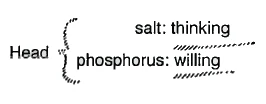
[ 49 ] And if we simply have too much phosphorus in our bodies—that is, if we eat foods that are too fiery—then we become a terrible fidgeter who wants to attack everything, who always wants more. It is because we have phosphorus that the will is present. And when we have too much phosphorus, that will begins to fidget. And if the organism is such that, due to its entire composition, it sends too much phosphorus up to the head, then the person not only begins to fidget—and, as they say, to act nervously—which has nothing to do with the nerves but with the phosphorus—but also begins to rage and becomes a madman, becomes raving mad. We need a little bit of phosphorus within us so that we can have any will at all. But if we produce too much phosphorus within ourselves, then we go mad.
[ 50 ] Well, gentlemen, just think about it for a moment: when someone gives you salt, how do you make it “think”? I’d advise you to take a salt shaker and try to make it “think”! You do it all the time; inside your head, you’re constantly using salt to “think.” And then—don’t you think—please scrape a little phosphorus off a match, grind it down a bit so it becomes very fine, then light the end and try to burn it. Let’s see if it will! It burns—that is, it vaporizes—but it doesn’t “will” to do so! Yet that is exactly what you do constantly within yourselves. Don’t you tell yourself now that there is something within you that is truly smarter than our foolish head, which can do very little, which cannot turn salt into a thinking being or phosphorus into a willing being? And that is the very thing within us that can be called the soul-spiritual. That is the living, weaving force that can be called the soul-spiritual. It lies within us, making use of the salt in the head for thinking, and making use of the phosphorus, which rises up like smoke, very finely, for willing.
[ 51 ] This is how one moves from the physical to the soul and the spiritual, if one looks at it correctly. But what does modern science do? It stops at the stomach. At most, it knows that sugar and so on are produced in the stomach; but then it loses track of things as they spread out from there, and knows nothing about what happens next. That is why science cannot say anything about the soul and the spirit. This science must be supplemented and expanded. One must not limit oneself to the stomach and think of the head as merely an appendage. But one cannot see how salts and phosphorus have risen up there. People believe that things in the head work the same way as in the stomach. The whole matter hinges on the fact that modern science knows only something about the abdomen—and even then, only that something arises there—but does not know that the liver perceives and the kidneys think. It certainly does not know that. It does not know this fundamentally because it knows nothing about the head either. Naturally, it does not even look for it there, considering what lies on the dissection table from the liver to be complete. But that is not the whole picture, for the soul has been lost when the body was in the state in which it was simply cut out of the body. As long as the soul is inside, you cannot cut it out of the body. So you see that a serious science must continue working where modern science must stop. That is what matters. That is why we built the Goetheanum here—so that science does not merely know something incomplete about the abdomen, but can explain something about the entire body. Then it will truly be a science.