

Understanding Human Beings
in Terms of Body, Soul, and Spirit.
Early Conditions on Earth
GA 347
13 September 1924, Dornach
Translated by Steiner Online Library
5. Perception and Thought of the Internal Organs
[ 1 ] Gentlemen! The points we have discussed in our recent reflections are so important for understanding what I have yet to say that I would like to briefly review these key points once more.
[ 2 ] Isn't it true that we have seen that, essentially, the human brain consists of small, star-shaped structures? But the rays of these stars extend very far. The extensions of these small entities intertwine and interweave with one another, so that the brain is, in fact, a kind of tissue, formed in the way I have described to you.
[ 3 ] Such tiny beings, like those found in the brain, are also present in the blood, with the sole difference that brain cells—as these tiny structures are called—cannot live; they can only live to some extent at night, while sleeping. They cannot fully exercise this life. They cannot move because they are crammed together and clumped up, as if in a barrel of herring. But the blood cells—the white blood cells in the red blood inside—can move. They swim around in the blood, moving their extensions, and only lose some of this vitality—dwindle somewhat—when a person sleeps. Thus, sleep and wakefulness are connected to this activity—or inactivity—of the brain cells, indeed of the nerve cells in general, and of the cells that swim around in the blood as white blood cells, moving about within it.
[ 4 ] Now, I have also told you that it is precisely in an organ such as the liver that one can observe how the human body changes over the course of its life. I told you last time that if, for example, an infant’s liver does not function properly—it is, after all, a kind of sensory activity; the liver perceives and regulates digestion—if, therefore, the liver’s sensory function is disrupted so that it actually perceives digestion incorrectly during infancy, this often does not become apparent until very late in life, as I told you, in people aged forty-five or fifty. The human organism is simply capable of withstanding a great deal. So even if the liver is already impaired during infancy, it can still endure this until the age of forty-five or fifty. Then it becomes internally hardened, and liver diseases develop—diseases that sometimes appear so late in life and are the result of what was impaired during infancy.
[ 5 ] It is therefore best for an infant to be fed its own mother’s milk. After all, the child comes forth from the mother’s body. One can therefore understand that the child is related to the mother in its entire organism, in its entire body. It must therefore thrive best if, immediately upon birth, it receives nothing other than that which also comes from the mother’s body—to which it is thus related.
[ 6 ] However, there are cases where breast milk is unsuitable due to its composition. For example, some breast milk tastes bitter, and some is too salty. In such cases, a different diet—ideally provided by another caregiver—must be introduced.
[ 7 ] Now the question may arise: Can’t the child be fed cow’s milk right from the start? — Well, it must be said that in the very earliest stages of infancy, feeding cow’s milk is not very good. But one need not think that feeding a child cow’s milk—which has been diluted appropriately and so on—constitutes a terrible sin against the human organism. For while milk naturally varies among different species, the differences are not so great that cow’s milk cannot be introduced as a substitute for human milk.
[ 8 ] But when this feeding takes place, it happens in such a way that, as long as the child drinks only milk, nothing needs to be chewed. As a result, certain organs in the body are much more active than they will be later, when solid food must be prepared. Milk is essentially such that—I would almost say—it is still alive when the child receives it. It is almost liquid life that the child takes into itself.
[ 9 ] Now, as you know, something very important for the human organism takes place in the intestines—something extraordinarily important. This extraordinarily important process is this: everything that enters the intestines through the stomach must first be killed, and when it then passes through the intestinal walls into the lymph vessels and the blood, it must be revived. That is, first and foremost, the most important thing one must understand: that a person must first kill the food they consume and then revive it again. The external life, taken in directly by a person, is not usable within the human body. Human beings must kill everything they take in through their own activity and then revive it again. That is all one needs to know. Conventional science does not know this, and therefore it does not know that human beings possess the power of life within themselves. Just as they have muscles, bones, and nerves within themselves, so too do they have a vitalizing power, a life-body within themselves.
[ 10 ] During this entire digestive process—in which matter is broken down and then revitalized, and in which the broken-down matter rises inwardly into new life and enters the blood—the liver observes, just as the eye observes external things. And just as the eye can be afflicted by cataracts in later life—that is, what was once transparent becomes opaque, and hardens—so too can the liver harden. And liver hardening is essentially the same thing in the liver as cataracts are in the eye. Cataracts can also form in the liver. Then, toward the end of life, liver disease develops. At the age of forty-five, fifty, or even later, liver disease develops. This means that the liver no longer observes the inner workings of the human being. It is truly the case that: with the eye, you observe the external world; with the ear, you hear the sounds of the external world; and with the liver, you first observe your own digestion and what follows from it. The liver is an internal sensory organ. And only those who recognize the liver as an internal sensory organ can understand what is going on within a person. So one can compare the liver to the eye. In a sense, a person has a head inside their abdomen. Only this head does not look outward; rather, it looks inward. And that is why a person works internally through an activity of which they are not consciously aware.
[ 11 ] But the child senses this activity. It is quite different for the child. The child pays little attention to the outside world, and when it does look at the outside world, it does not understand it. But all the more, it looks inward through its feelings. The child senses very precisely when there is something in the milk that does not belong there, something that must be expelled into the intestines so that it can be eliminated. And if something in the milk is not right, the liver absorbs the predisposition to illness for the rest of the child’s life.
[ 12 ] Well, you see, you can imagine that when the eye looks outward, there’s a brain involved. Merely looking at the outside world wouldn’t be of any use to us as human beings. We would just stare at the outside world, staring all around us, but we wouldn’t be able to think anything about it. It would be just like a panorama, and we’d be sitting there with an empty mind. We think with our brain, and we think about what’s out there in the world using our brain.
[ 13 ] Yes, but, gentlemen, if the liver is a kind of internal eye that monitors all intestinal activity, then the liver must also have a kind of brain, just as the eye relies on the brain. You see, the liver can observe everything that is happening in the stomach—how the entire chyme is mixed with pepsin. The liver can then, when the chyme enters the intestine through the so-called pylorus, see how the chyme moves further along in the intestine, how the useful components are increasingly absorbed from this chyme through the intestinal walls, and how these useful components then pass into the lymphatic vessels and from there enter the bloodstream. But from that point on, the liver can do nothing more. Just as the eye cannot think, so too can the liver not carry out any further activity. Another organ must come into play for the liver, just as the brain must come into play for the eye.
[ 14 ] And just as you have a liver within you that constantly monitors your digestive activity, so too do you have a thought process within you of which you are completely unaware in everyday life. This thinking activity—that is to say, you are simply unaware of the thinking activity itself, though you are familiar with the organ—this thinking activity, which is just as closely linked to the liver’s perceptual and cognitive functions as thinking is linked to the eye’s perceptual activity through the brain, is, strange as it may seem to you, carried out by the kidney, the renal system.
[ 15 ] The renal system, which to ordinary consciousness merely excretes urine, is not at all as base an organ as it is usually regarded; rather, the kidney—which otherwise merely excretes water—is that which belongs to the liver and which exercises an inner activity, an inner thinking. The kidney is also closely connected to the other form of thinking in the brain, so that if brain activity is not functioning properly, the activity of the kidney is also not functioning properly. Let’s suppose we start, even with a child, by preventing the brain from functioning properly. It does not function properly if, for example, we cause the child to study too much—as I already hinted at last time—or to rely too heavily on mere memory, or if we make the child memorize too much. They do need to memorize some things so that the brain becomes flexible; but if we make them memorize too much, then the brain has to exert itself so much that it engages in excessive activity, which causes hardening in the brain. This leads to hardening of the brain if we make the child memorize too much. But if stiffness develops in the brain, it may be the case throughout the child’s entire life that the brain does not function properly. It is simply too rigid.
[ 16 ] But the brain is connected to the kidneys. And because the brain is connected to the kidneys, the kidneys no longer function properly. The human body can endure a great deal; it only becomes apparent later: The entire body no longer functions properly, nor do the kidneys, and you find sugar in the urine that should actually be processed. But the body has become too weak to utilize the sugar because the brain is not functioning properly. It allows the sugar to remain in the urine. The body is not functioning properly; the person suffers from diabetes.
[ 17 ] You see, I’d like to make this particularly clear to you: a person’s future development depends to some extent on their mental activities—for example, on memorizing too much. Haven’t you heard that diabetes is particularly common among wealthy people? They can provide exceptionally well for their children, materially and physically; but they don’t realize that they should also ensure their child has a proper schoolteacher who doesn’t make the child memorize so much. They think: Well, the state takes care of that; everything’s fine there, so there’s no need to worry about it. — The child memorizes too much and will later develop diabetes! You simply can’t make a person healthy through material upbringing alone—through what you teach them via food. One must take into account what constitutes the soul. And you see, that’s when one gradually begins to feel that the soul is something important, that the body isn’t the only thing that matters in a person, because the body can be ruined by the soul. For no matter how well we eat as children, and no matter how closely we follow the nutritional research that chemists conduct in laboratories—if the soul is not in order, if the soul is not taken into account, the human organism will still break down. Through a true science—not today’s purely material science—one gradually learns to delve into what is already present in a human being before conception and remains present after death, because one comes to know precisely what the soul is. This must be taken into special consideration, particularly in such matters.
[ 18 ] But now think about it: where does this actually come from—the fact that people today don’t want to know anything about what I’ve just told you? Well, if you approach people today who are so-called “educated,” it’s considered “uneducated” to talk about the liver, or even the kidney. It’s something uneducated. Why is it considered “uneducated”?
[ 19 ] You see, the ancient Jews in Hebrew antiquity—and after all, our Old Testament comes from the Jews—the ancient Jews did not yet regard talk of the kidney as something so terribly uncultured. For example, the Jews did not say—as one can read in the Old Testament; today’s Jews are already so educated that they do not repeat what is written in the Old Testament when they are in decent company, but it is written there—they did not say, when a person had bad dreams at night: “My soul is tormented.” — Yes, gentlemen, that is easy to say when one has no concept of the soul; then “soul” is merely a word—it means nothing. But the Old Testament said, as is correct, out of a wisdom that humanity once possessed, that when a person had bad dreams at night: “The kidney torments him.” — What was already known in the Old Testament is being rediscovered through modern anthroposophy and recent research: Kidney function is not right when one has bad dreams.
[ 20 ] Then came the Middle Ages, and during the Middle Ages, what is still true today gradually took shape. For in the Middle Ages, there was a tendency to praise only that which one cannot perceive—that which is, in a sense, outside the world. One leaves the head uncovered; the rest is covered. One is only allowed to speak of what is actually exposed. Admittedly, some women—especially in the educated world—go about today leaving so much uncovered that one is still far from being allowed to speak of what is left uncovered. But in any case, that which is then within the human being became, for a certain kind of Christianity in the Middle Ages—later called Puritanism in England—something one must not speak of. One must not speak of it from the perspective of purely material sensory science. It is not something spiritual; one must not speak of it. And in this way, one has gradually lost the spirit altogether. Of course, if one speaks only of the spirit where the head is located, one cannot grasp it so easily. But if one grasps it where it resides in the entire human body, then one can certainly do so.
[ 21 ] And you see, the kidneys are what contribute to the liver’s perceptual activity. The liver observes, the kidneys think; and they can then process the heart’s activity and, in fact, process everything that the liver has not observed. The liver can still observe the entire digestive process and how the digestive juices enter the blood. But once they begin to circulate in the blood, that requires thought. And that is what the kidneys do. So, in a sense, a person actually has something like a second person within themselves.
[ 22 ] But now, gentlemen, surely you cannot possibly believe that those kidneys which you cut out of a dead body and then place on the dissection table—or, if it is a beef kidney, which you even eat; which you can, of course, examine quite comfortably before you eat or cook them—but surely you don’t believe that this piece of meat, with all the characteristics the anatomist describes, that this piece of meat thinks! It doesn’t think, of course; rather, it is the spiritual element within the kidney that thinks. That is why it is just as I told you last time: The physical substance, for example, in the kidney—let’s say during childhood—is completely replaced after seven or eight years. There is a different substance inside. Just as your fingernails are no longer the same after seven or eight years—because you’ve always cut off the tips—so too has everything that was in the kidney and liver been replaced by new material from you.
[ 23 ] Yes, you have to ask: If the substance that was present in the liver and kidneys seven years ago is no longer there at all, and yet the liver can still become diseased decades later due to what was neglected in its development as an infant, then there is simply an activity at work that cannot be seen, because the substance does not propagate itself. Life continues from infancy into the forty-fifth year. The substance itself cannot become diseased—it is excreted—but the invisible activity that is present within and continues throughout a person’s entire life does persist. There you see how the human body is actually a complex, an immensely complex being.
[ 24 ] Now I’d like to tell you something else. I told you: The ancient Jews still knew something about how kidney activity is involved in the kind of dull, dark thinking that dreams are at night. But at night, our conscious thoughts are gone; that is when we perceive what the kidneys are thinking. During the day, our heads are full of thoughts that come from the outside. Just as when there is a bright light and a dim candlelight, one sees the bright light, and the dim candlelight disappears beside it. So it is with a person when they are awake: their mind is full of the images that come from the outside world, and whatever activity is taking place down below in the kidneys is like that little light; they do not perceive it. When the mind stops thinking, they still perceive what the kidneys think and what the liver observes internally as dreams. That is why dreams look the way you sometimes see them.
[ 25 ] Just imagine: something isn’t right in the intestines; the liver picks up on that. During the day, you don’t notice it because your mind is occupied with other, more dominant thoughts. But at night, as you fall asleep or wake up, you become aware of how the liver perceives that something is wrong with the intestines. But the liver isn’t as smart—and neither is the kidney—as the human mind is. Because they aren’t that smart, they can’t immediately say, “Those are the intestines I see there.”—They form an image out of it, and the person dreams instead of seeing reality. If the liver were to see reality, it would see the intestines burning. But it doesn’t see reality; it creates an image out of it. So it sees snakes flicking their tongues. When a person dreams of snakes flicking their tongues—which they do very often—the liver looks at the intestines, and that’s why they appear to it as snakes. Sometimes the mind behaves just like the liver and the kidneys. If a person sees something nearby—for example, a curved piece of wood—and, moreover, in an area where snakes might be, even the head can mistake this curved piece of wood for a snake if it is five steps ahead. In the same way, the inner perception and thinking of the liver and the kidneys mistake the coiled intestines for snakes.
[ 26 ] Sometimes you dream of a stove that’s burning hot. You wake up with your heart pounding. What happened there? Yes, the kidney interprets the stronger heart palpitations, but it imagines them as if they were a hot stove, and you dream of a blazing stove. That is how the kidney interprets your heart’s activity.
[ 27 ] So there, inside the human abdomen—even though it is once again “inappropriate” to speak of it in these terms—resides a spiritual being. The soul is a little mouse that slips into the human body somewhere and crouches there. Isn’t that right? That’s how people used to think about it. They would ask themselves: Where is the seat of the soul? — But you don’t really know anything about the soul at all when you ask where its seat is. It is just as much in the “ear lobe” as it is in the big toe; it’s just that the soul needs organs through which it thinks, imagines, and creates images. And in an activity like this—which you know very well—it does so through the head; and in the way I’ve described to you, where the inner world is observed, it does so through the liver and the kidneys. You can see everywhere how the soul is at work in the human body. And that is what you must see.
[ 28 ] This, however, requires a science that does not simply cut open dead bodies, place them on the dissection table, remove organs, and examine them physically; it requires that one truly engage one’s entire inner spiritual life in thought and in everything to a greater extent than those who merely observe would like. Of course, it’s easier to cut open human bodies, remove the liver, and then write down what you find there. You don’t have to strain your inner faculties very much to do that. You have your eyes for that, and you only need a little thought when you cut the liver in all directions, make small pieces, place them under the microscope, and so on. That is an easy science. But almost all science today is an easy science. One simply has to engage one’s inner thinking much more, and above all, one must not believe that one can come to know a human being from the moment one places them on the dissection table, cuts out their organs, and describes them. For when one cuts out the liver of a fifty-year-old woman or a fifty-year-old man, one does not know—when looking at it—what has already taken place in an infant. One simply needs a whole science. That is precisely what a true science must strive for. That is the aim of anthroposophy: to have a true science. And this true science leads not only to the physical, but, as I have shown you, to the soul and to the spirit.
[ 29 ] I told you last time: In the liver, the blue blood vessels—that is, the vessels in which the blood does not flow as red blood but as blue blood, meaning it contains carbon dioxide—such special blood vessels enter the liver. This is not the case with any other organs. In this respect, the liver is a truly remarkable organ. It receives blue blood vessels and causes the blue blood to virtually disappear within itself (see Figure $. 70).
[ 30 ] This is something extraordinarily significant and important. So when we think of the liver, the usual red veins naturally also enter the liver. The blue veins lead out of the liver. But in addition, there is a special blue vein, the portal vein—carrying blood rich in carbon dioxide—that enters the liver (see diagram on Plate 4). Now, the liver absorbs this and does not let it out again; the carbon dioxide that enters the liver through this special blue blood is retained.
[ 31 ] Yes, isn't it true that conventional science, once it has removed the liver, observes this so-called portal vein and then doesn't give it any further thought? But someone who has been able to arrive at true science does make the comparison.
[ 32 ] Now there are other organs in the human body that have something very similar, and those are the eyes. In the case of the eyes, it is something very small, only faintly hinted at, but nevertheless, it is also true of the eye that not all the blood—all the blue blood—that enters the eye flows back out again. Veins enter the eye—red veins go in, blue veins come out. But not all the blue blood that enters the eye flows back out again; rather, it is distributed just as it is in the liver. The difference is that in the liver this process is strong, whereas in the eye it is very weak.
[ 33 ] Isn't that proof that I am justified in comparing the liver to the eye? Of course, one can draw parallels to everything that exists in the human organism. That is precisely how one comes to the conclusion that the liver is an inner eye.
[ 34 ] But the eye is directed outward. It looks outward and uses the blue blood it receives to look outward. The liver uses it inwardly. That is why it makes the blue blood disappear inside and uses it for something else. Only sometimes, you see, does the eye also develop a tendency to use its blue veins just a little bit. That happens when a person becomes sad, when they cry; then the bitter-tasting tear fluid wells up from the eyes, from the lacrimal glands. This comes from the small amount of blue blood that remains in the eye. When that is particularly stimulated by sadness, the tears are secreted.
[ 35 ] But this story is constantly playing out inside the liver! The liver is constantly sad because, just as the human organism is in this earthly life, one can become sad when looking at it from the inside—for it is predisposed to the highest, yet it doesn’t look all that good. The liver is simply always sad. That is why it constantly secretes a bitter substance: bile. What the eye does with tears, the liver does for the entire organism through the secretion of bile. However—tears flow outward, and as soon as they leave the eye, they are blown away; but the bile within the entire human organism is not blown away, because the liver looks inward rather than outward. There, the act of looking recedes, and the secretion—which can be compared to the secretion of tears—comes to the fore.
[ 36 ] Yes, but, gentlemen, if what I am telling you is truly true, then that must certainly be evident in another area as well. It must become evident that those earthly beings who live more in their inner world, who live more in their inner thought processes—that is, that animals do not think any less than humans, but rather that animals think more—though less so in their heads than humans, since they have an imperfect brain. But then they must pay more attention to the life of the liver and the life of the kidneys, must look inward more with the liver and think inward more with the kidneys. This is also the case with animals. There is external evidence for this. Our human eyes are structured in such a way that the amount of blue blood entering them is actually very small—so small that modern science does not even mention it. In the past, it did discuss this. But in animals, which live more within their inner being, the eyes do not merely look; rather, the eyes think as well.
[ 37 ] If one could say, so to speak, that the eyes are a kind of liver, then one could say: In animals, the eye is much more like a liver than in humans. In humans, the eye has become more perfect and less like a liver. This is evident in the eye. For in animals, it can be clearly demonstrated that inside there is not merely what is found in humans—a vitreous, watery body, then the lens, which is again a vitreous, watery body—but in certain animals, the blood vessels enter the eye and form a structure within it (see drawing). The blood vessels extend all the way into this vitreous body, forming a structure inside it called the fan, the ocular fan. In these animals, this fan is... (gap in the postscript.) Why? Because in these animals, the eye is even more like the liver. And just as the portal vein enters the liver, so this fan enters the eye. That is why it is like this in animals: When the animal looks at something, the eye itself is already thinking; in humans, the eye merely looks, and the person thinks with the brain. In animals, the brain is small and imperfect. It does not think so much with the brain; it thinks already within the eye, and it is able to think within the eye because it has this crescent-shaped process—that is, because it utilizes the spent blood, the carbon dioxide-rich blood, within the eye.
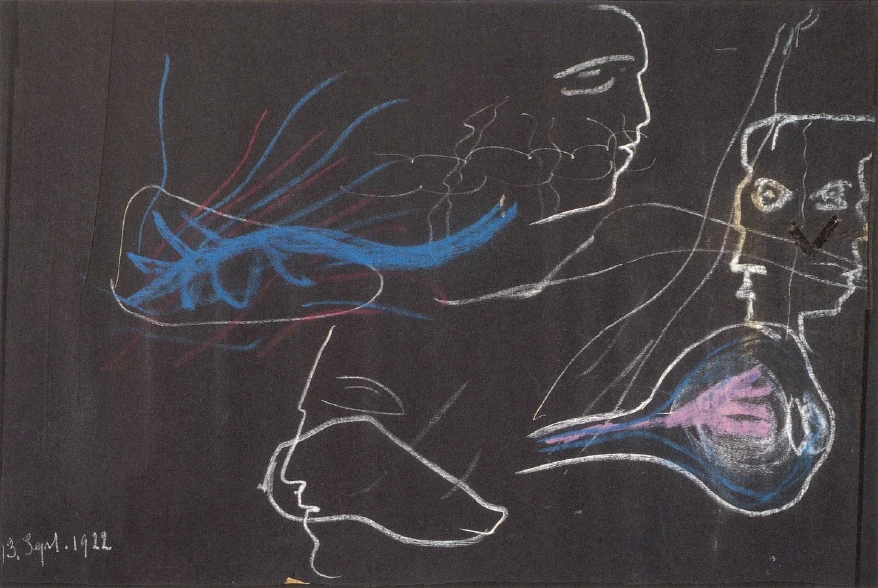
[ 38 ] I can tell you something that really won’t surprise you. You wouldn’t expect the vulture, high up in the sky with its damn tiny brain, to be able to make the very clever decision to drop down right where the lamb is sitting! If it were up to the vulture’s brain, it might starve to death. But the vulture has a way of thinking right there in its eye—which is simply an extension of its instinctive thinking—and through that it makes its decision, dives down, and snatches the lamb. The vulture doesn’t go about it by saying to itself: “There’s a lamb down there; now I have to get into position; now I’ll drop straight down along that line, and I’ll land right on the lamb.” — That’s the kind of reasoning a brain would do. If a human were up there, he would make that calculation; only he wouldn’t be able to carry it out. But with the vulture, the eye itself thinks. The soul is already inside the eye. He isn’t really conscious of it, but he does think.
[ 39 ] You see, I told you: the old Jew who understood his Old Testament knew what it meant when it said, “God tormented you through your kidneys in the night.” — By this he meant to express the reality of what appears to the soul as mere dreams. “God has tormented you through your kidneys at night”—that’s what he said, because he knew: There is not only a person who looks out into the outer world through his eyes, but there is also a person who thinks inward through his kidneys and looks inward through his liver.
[ 40 ] And the ancient Romans knew that, too. They knew that there are actually two people: the one who looks out through his eyes, and the other who has his liver in his belly and looks into his own inner self. Now, however, the fact is that when it comes to the liver—as can be seen from the distribution of all the blue veins—one must say, if one wants to use the expression: It actually looks backward. That is why human beings perceive so little of their inner selves; just as you do not perceive what is behind you, the liver does not consciously perceive what it is actually looking at. The ancient Romans knew this. But they expressed it in such a way that one does not immediately grasp it. They imagined: Here, a person has a head in front, and in the lower body he has another head; but this is only a vague head that looks backward. — And then they combined the two heads and created something like this (see drawing): a head with two faces, one looking backward and the other looking forward. Such statues can still be found today when one visits Italy. They are called Janus heads.
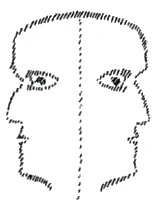
[ 41 ] You see, travelers who can afford it wander through Italy with their Baedeker guide, take a look at these Janus heads, and flip through the Baedeker—but there’s nothing sensible in there. Because, don’t you think, one has to ask oneself: How did those ancient Romans come to create such a head? They weren’t actually so stupid as to believe that if you sail across the sea somewhere, there are people with two heads on Earth. But that’s roughly what the traveler must think—since his eyes don’t enlighten him—when he sees that the Romans sculpted a head with two faces, one facing backward, one facing forward.
[ 42 ] Yes, well, the Romans knew something through a certain kind of natural thinking that all of later humanity did not know, and which we are now discovering on our own. So now we can see once again that the Romans weren’t stupid—they were smart! Janus is the name for January. Why did they place him precisely at the beginning of the year? That, too, is a special mystery.
[ 43 ] Yes, gentlemen, once one has come to realize that the soul is at work not only in the head but also in the liver and kidneys, one can also observe how this varies throughout the year. For in summer, the warm season, the liver is active to an exceptionally small degree. During this time, the liver and kidneys enter a sort of spiritual slumber, performing only their external physical functions, because the human being is more attuned to the warmth of the outside world. Things begin to come to a standstill within. The entire digestive system is quieter in midsummer than in winter; but in winter, this digestive system begins to take on a very spiritual and psychological character. And when the Christmas season arrives, the New Year’s season, when January begins, that is when psychological activity is at its strongest within the liver and the kidneys.
[ 44 ] The Romans knew that, too. That is why they called the man with two faces the “January Man.” Once you come to realize on your own just how profound this concept actually is, you no longer need to stare at things in bewilderment, but can understand them again. People just stare at them today because modern science is nothing anymore. You see, anthroposophy is really not impractical at all. It can explain not only everything that is human, but even what is historical; for example, it can explain why the Romans created these Janus heads! Actually—and I’m really not saying this out of vanity—actually, to help people understand the world, we’d have to put an anthroposophist right in the Baedeker guidebook; otherwise, people just wander through the world in a daze, merely staring at everything, unable to think for themselves.
[ 45 ] Yes, gentlemen, from this you will see that it is truly meant seriously when one says that one must start with the physical in order to reach the spiritual. Well, I will continue speaking to you about this spiritual aspect next Saturday. Then you can also think about what questions you would like to ask. But you will have seen that it is truly no trivial matter to learn how to recognize the spiritual through the physical; rather, it is a very serious science.