

Understanding Human Beings
in Terms of Body, Soul, and Spirit.
Early Conditions on Earth
GA 347
9 September 1924, Dornach
Translated by Steiner Online Library
4. Understanding Human Nature in Terms of Body, Soul, or Spirit; Brain and Thought — The Liver as a Sensory Organ
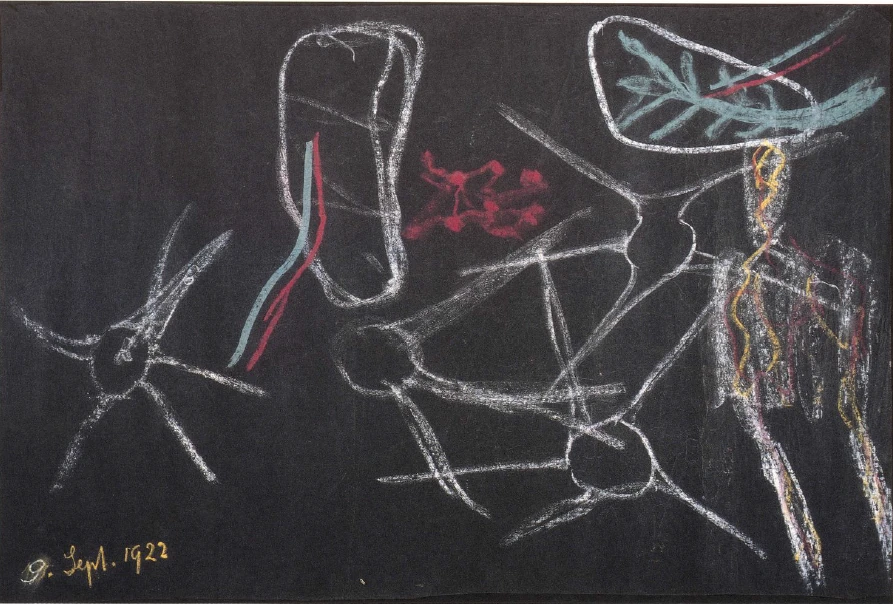
[ 1 ] Well, gentlemen, since there has been quite a long interval between our lectures, I would like to pick up where we left off last time. As I recall, I mainly tried to explain to you then how sleep and wakefulness fit into life. I told you that we have certain small structures in the brain—they’re called cells—and I also sketched their shape for you. These cells have a protein body here (see drawing) and then extensions; they’re star-shaped. But these extensions are not all the same. One is long, the other is short. Then there is another such cell nearby that has its own extensions, followed by a third that also has its own extensions, and these extensions—these filaments—that extend from the round cells become intertwined with one another, forming a network. So the brain is actually—you can’t see it with the naked eye, but only under high magnification—a network, forming a web, and within this web, the small spheres are embedded.
[ 2 ] You see, these brain cells are basically half-dead. That’s what’s most striking about them. Because tiny organisms like brain cells—when they’re alive, they move around. And I’ve already explained the other cells to you—the white blood cells that swim around like little animals. They’re little animals, too; they look just like that. But they swim around and eat. If there’s anything in the blood they can absorb, they take it in, extend their feelers, and suck it into their own bodies. And so they swim and flow through our bodies like streams. That’s how we have half-dead and half-alive cells swimming around in our blood.
[ 3 ] The fact is that when we’re awake, these brain cells are actually almost completely dead. And it’s only because the brain cells are dead that we can think. If the brain cells were more alive, we wouldn’t be able to think. And you can actually see that, too. Because when we’re asleep, these brain cells start to come to life a little; it’s precisely when we’re not thinking—when we’re asleep—that the brain cells start to come to life. And the only reason they don’t move is because they’re so close together—they can’t get out of each other’s way. Otherwise, if they started moving, we wouldn’t wake up at all.
[ 4 ] When someone becomes mentally deficient—that is, can no longer think—and then dies, and their brain cells are examined, one also finds that these brain cells in a person who has become mentally deficient have begun to “live,” to proliferate. They are softer than they are in a normal person. That is why people also speak of “brain softening” in people who have become mentally disabled, and the term “brain softening” isn’t entirely inaccurate.
[ 5 ] If one truly gets to know a living human being without prejudice, one says to oneself: The life that is within him—this physical life—cannot be the source of his thinking, for it must, after all, cease to function in the brain precisely when the human being is to think. That is precisely the point. If science today were to proceed correctly—if it were to work correctly—then it could not be materialistic, because one would then see from the very nature of the human body that a spiritual element is most vividly active within a person precisely when the physical aspect dies off, as in the brain. One can therefore prove the existence of the soul and the spirit strictly scientifically.
[ 6 ] At night, when we sleep, our brain cells are a little more active. That’s why we can’t think. And our white blood cells start to become active when we’re awake. That’s the difference between sleeping and being awake. So we are awake when our brain cells are paralyzed, almost dead; that is when we can think. We sleep and cannot think when our white blood cells are somewhat dead, and our brain cells begin to show a little life. A person must therefore actually have something of death within them—in terms of their body—if they are to think, that is, if they are to live spiritually.
[ 7 ] You see, gentlemen, it is not at all surprising that modern science does not come to such conclusions, for modern science has, after all, developed in a very particular way. If one has the opportunity to observe something like this—as I did, for example, recently in Oxford—I was able to give a series of lectures there, and Oxford is, after all, one of the foremost universities in England—one may notice that this Oxford university is organized quite differently from our universities here in Switzerland, Germany, or Austria. This Oxford university still has something very medieval about it—absolutely medieval. It has such a strong medieval character that those who earn their doctorate there—that is, who complete their doctoral studies—are given a gown and a cap. Each such university has its own distinctive style for the gown and cap. You can tell an Oxford bachelor’s graduate or doctorate holder apart from a Cambridge one because the style of their gown and cap is different. However, people must wear this gown and cap on certain ceremonial occasions so that everyone knows: this person attended that university and belongs to it. This is precisely because in England many such traditions from the Middle Ages have been preserved, as is the case, for example, with the judges there; when they are on duty, they must still wear a wig—it’s part of the tradition. Now you see, there the medieval traditions have been preserved in their entirety. That is no longer the case on the continent—in Switzerland, Austria, or Germany. There, you don’t receive a gown, and even judges no longer wear wigs. I believe that is no longer the case in Switzerland either, as far as I know.
[ 8 ] From the outside, this is quite amusing to watch for someone from continental Europe. They just think to themselves: Well, they’re still stuck in the Dark Ages there. The bachelors and doctors walk around on the streets in gowns and caps and so on. But it actually means something completely different. You see, scholarship is still practiced there just as it was in the Middle Ages. That is to say, what goes on there is extraordinarily appealing; compared to a modern university, which has done away with all that—I don’t want the academic gown to be reintroduced, don’t get me wrong—but compared to some of what goes on at other universities today, it’s actually something extraordinarily appealing, because it has a sense of wholeness. It has truly preserved the Middle Ages in all its forms. It really does have a sense of wholeness. For in the Middle Ages, one could explore all sorts of things, but one was not allowed to explore anything about the world that religion had claimed as its monopoly. That is also something you can still sense at Oxford. As soon as anyone were to venture forth and attempt to say something about the supernatural world, they would be met with extraordinary reserve there.
[ 9 ] Well, medieval science enjoyed complete freedom as long as people did not comment on religious life. That has been lost in our society. In our society today, you have to be a materialist at the universities. If you’re not a materialist, you’re treated like a heretic—isn’t that right? If, let’s say, it were acceptable to burn people at the stake, they’d still be burning them today, even at the universities. You can see this firsthand: how people are treated when it comes to introducing anything new into the fields of knowledge. The outward wigs have indeed disappeared, but the inner wigs—those certainly haven’t disappeared from the continent yet!
[ 10 ] The fact is that, while a science has indeed developed on the continent, this science still retains the old habits, and it becomes materialistic precisely because it has never gotten into the habit of engaging with the spiritual. In the Middle Ages, people were not allowed to engage with the spiritual realm because that was left to religion. People continue to do the same today. They concern themselves only with the body, and for that reason they learn nothing at all about what is actually spiritual in human beings. So it is really just a case of science neglecting to truly study the things that are there.
[ 11 ] I would like to illustrate this to you today with an example, so that you can see: Anyone who practices true science today can certainly speak scientifically about the fact that a soul or spirit enters the body as a human being develops its physical form in the womb, and that at death, the spirit leaves the body once again. This can be scientifically proven today, but one must truly understand science to do so. One must be able to engage with science properly. What does science do in a specific case today? Let’s say, for example, that a fifty-year-old person develops liver disease and dies from it. Very well! They place him on the dissection table, cut open his abdomen, and examine the liver. They find that the liver may be somewhat hardened internally, and they ponder where this might have come from. At most, they might also consider what the person might have eaten, thinking that the liver could have hardened due to an improper diet. But human nature is not so easy to understand that we can simply take a person, examine their liver, and know exactly what is going on with it; it’s not that simple. Even if one considers only the person’s final years, it is impossible to determine from the liver alone why it is the way it is.
[ 12 ] If you remove the liver of a fifty-year-old person and find that it is hardened, then in most cases—not all, but in most cases—the cause is that the person was fed the wrong kind of milk as a very young child, as an infant. What often does not manifest as a disease until the age of fifty has its roots in very early childhood. Why is that? You see, anyone who can truly examine the liver and understands its significance in the human body can draw the following conclusion. They know that in a very young child, the liver is still fresh; it is even still developing. Now, the liver is a human organ that is quite different from all other human organs. The liver is something very special. You can see this even from the outside. You see, if you take any human organ—the heart, the lungs, or whatever you like—you can say: This organ is simply part of the entire human body. Take any organ—let’s say, for example, the right lobe of the lung—and you can say: Red blood vessels enter this right lobe of the lung—you know what that means—and blue blood vessels, in turn, exit it. The red blood vessels that flow in carry oxygen—you can see it entering the body—and the blue blood vessels carry the waste products; they contain carbon dioxide that must be removed and exhaled (see drawing).
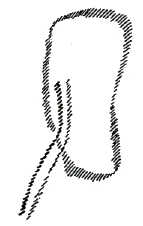
[ 13 ] Well, you see, every organ—the stomach, the heart—is designed so that red blood flows into these organs and blue blood flows out. With the liver, it’s different. At first glance, it essentially looks the same with the liver, too. If you look at the liver—which lies beneath the diaphragm on the right side of the human body—you’ll see that, at first glance, red blood vessels enter it and blue blood vessels leave it. If that were the case, the liver would simply be an organ like the other human organs. But in addition, there is a large vein containing blue blood—which contains carbon dioxide—that enters the liver specifically, which is not the case with any other organ. So a blue vein, the so-called portal vein, enters the liver—a powerful blue vein. It branches out throughout the liver and supplies it with blue blood—that is, blood that has become unusable for all other organ processes and is otherwise purified by exhaling carbon dioxide. We are constantly sending carbon dioxide into the liver. The liver needs precisely what the other organs have to expel.
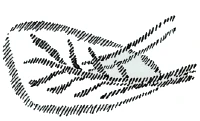
[ 14 ] Where does this come from? It comes from the fact that the liver is a kind of inner eye. The liver really is a kind of inner eye. The liver senses—especially when it is young, as in a child—not only the taste but also the quality of the milk that the child suckles from its mother’s breast. And even much later, the liver perceives everything that occurs within the human body in relation to food. The liver is a sensory organ—an eye, one might say; I could also call it a tactile organ, an organ of feeling. The liver perceives all of this.
[ 15 ] Another organ in the human body that perceives is the eye. But the eye perceives the outside world so intensely precisely because it is situated almost separately inside the head. It is completely enclosed within this bony cavity, yet it is almost a separate organ. You can remove it, and it lies there quite separately, isolated from the body inside this bony cavity. The other senses do not lead us into the outside world in the same way as the eye does. When you hear, you still experience it internally. Music is therefore more internal than seeing. The eye is designed in such a way that it does not so much belong to the human body as it does to the outside world.
[ 16 ] However, because blue blood enters the liver—blood that would otherwise expel carbon dioxide into the outside world and be turned red again—the liver is almost as separate from the rest of the human body as the eye. The liver is therefore a sensory organ. The eye perceives colors. The liver perceives whether the sauerkraut I eat is beneficial or harmful to the body, whether the milk I drink is beneficial or harmful to the body. The liver perceives this with great sensitivity, and the liver secretes bile, and bile is secreted—this is truly the case—just as the eye secretes tears. When a person becomes sad, they begin to cry. Tears do not flow from the eye for no reason. Becoming sad is connected to the act of perceiving and noticing things. And in the same way, the secretion of bile is connected to the liver’s perception of whether something is harmful or beneficial to the body. It secretes more or less bile, depending on how harmful what a person ingests is. So we have a sensory organ in the liver.
[ 17 ] Now just imagine: If a child is given unhealthy milk, the liver is constantly under strain. And even if the person is healthy enough not to immediately develop jaundice due to excessive bile secretion, there is still a constant urge for bile secretion in the child. And then the liver becomes diseased even in childhood. A person can endure a great deal. He can carry around this diseased liver—which he acquired as an infant—for forty or forty-five years; but eventually, at the age of fifty, it comes to a head: the liver has become cirrhotic.
[ 18 ] It really isn’t the case that you simply lay a fifty-year-old person on the dissection table, cut open their abdomen, remove their organs, look at them, and say something about them. You simply can’t say anything in that situation. A person is not merely a creature of the moment; rather, a person is a being who develops over a certain number of decades. And what sometimes lies fifty years in the past becomes apparent fifty years later. But to understand this, one must know the person completely.
[ 19 ] Now, let’s assume for a moment that you are materialists. But if you are materialists, then consider the following. I have told you that the liver is an organ whose disease can be caused in infancy and may manifest itself at the age of fifty. Yes, gentlemen, but what about human beings? Let’s assume, for the sake of simplicity, that a human being is a creature consisting of flesh, blood, muscles, and so on. He has blood vessels within him, he has arteries, nerves—all of these are substances, of course, real substances. But do you believe that the substances found, for example, in the liver of a small breastfed child are still present at the age of fifty? No, that is not the case. After all, just take the simplest example: you cut your fingernails. If you don’t cut your nails, they keep growing like a hawk’s talons. So you’re constantly cutting off a little bit of matter from yourself! And when you cut your hair, you’re also cutting off a little bit of matter from yourself. But you’ve probably noticed that this loss of tissue doesn’t just happen when you cut your hair or fingernails; when you scratch yourself—especially if you haven’t washed your hair in a while—you also scratch off dandruff. Those are little pieces of skin. And if you didn’t wash yourself thoroughly—if sweat didn’t wash away the small flakes from your body—you could end up with a body completely covered in flakes. In other words, on the outside of the body, material is constantly being shed.
[ 20 ] Now just imagine cutting off a piece of your fingernail. It grows back. It comes from the inside. Yes, that’s exactly how it is with the entire human body. Whatever is at the very core will reach the outer surface in about seven years, and we can shed it like scales. Otherwise, nature takes care of it, and we don’t even notice how we constantly shed those fine scales. For the substance—the matter of the human body—always moves from the inside out and sheds on the outside. What you have deep inside today will be on the outside in seven years and will have shed completely, and what you’ll have inside you then will be newly formed—completely new. Every seven years, the soft parts of the human body are regenerated. When one is a small child, this even applies to certain external bony structures. That is why we have baby teeth only until about the age of seven; then they are shed, and new teeth form from within. They remain only because we no longer have the strength to shed them; just as we cannot shed our fingernails, we simply cannot shed them. But in modern humans, they actually do not tend to last very long! Well, humans can endure a great deal. The teeth do last, but for how long? Especially in Switzerland, they become terribly damaged after some time. This damage to the teeth is related to the water, particularly in this region.
[ 21 ] But from this you can see that the substance you possess within yourself today will no longer be within you seven years from now. You will have cast it out and formed it anew. If it were a matter of substance, then, for example, Mr. Dollinger sitting there today would not be the same person; for the substance he possessed back then is gone—it has vanished. In terms of substance, he has become a completely new person since that time. Yet even back then, people addressed him by the same name. He is still the same person today; yes, but it is not the substance—it is not the substance at all. That which continually holds the substance together as a force—that which, when the substance departs from one place here, carries a new one there—that substance can be seen when one lays a person on the dissection table, but what is spread out within the person as a force cannot be seen—that is what is called the supersensible.
[ 22 ] Yes, gentlemen, if the liver is damaged in infancy and a liver disease manifests itself at the age of fifty, then the part of the liver that is still there has been completely replaced. The substance is long gone. It is not the physical substance that causes us to develop liver disease, but rather the forces that are invisible. These forces have become accustomed, during infancy, to preventing the liver from functioning properly. It is the activity—not the physical substance—that has become disordered. So if we are clear about the fact that this is how it is with the liver, we must say: It is quite obviously clear that human beings, since they are constantly renewing their physical substance, carry within themselves something that is not physical substance.
[ 23 ] If one simply grasps this idea properly, one inevitably concludes that, for scientific reasons, it is impossible to be a materialist. Only those people who believe that a fifty-year-old human being is made of the same matter as he was as a child are materialists. This, then, is what makes it necessary—for purely scientific reasons—to conceive of a spiritual element as underlying the human being, that is, that the human being carries a spiritual element within himself.
[ 24 ] But, gentlemen, surely you do not believe that these liver particles—which are long gone by the age of fifty—build up the liver, or that they can do anything to help the liver be built up. They simply disappear; they simply leave the liver. In fact, nothing remains there for these particles except space. What the liver continually regenerates is power; it is something supernatural. That is what continually regenerates the liver.
[ 25 ] The whole human being must be formed anew in this way if he is to be born at all. The forces present in the liver must already be there when the human being is first formed in the mother’s womb.
[ 26 ] Well, you might say: The female egg cell and the male sperm cell come together in the mother’s body, and from this, a human being is formed. Yes, gentlemen, a human being can no more arise from this mixture of matter than liver disease can arise at the age of fifty from matter that was corrupted in the first year of life. That matter must be present. Anyone who claims that a human being is formed in the mother’s womb from matter should also claim that if I pile up some wood and sit there for a few years, after a few years a very beautiful statue will emerge from it. Of course, the matter must be made available to the spirit. That happens in the mother’s womb. But the human being is not formed in the mother’s womb; rather, this substance—like the material used by a sculptor—is shaped by the spirit, and through this process, that which continually renews the human being is formed, even as physical matter is cast off. We would actually need to eat far less than we do if this substance were of greater significance. Of course, when we are small children, we would have to eat so that we can grow larger. But if we were fully grown by the age of twenty and the physical substance remained the same, we would no longer need to eat anything at all. It would be a wonderful situation for employers, since children are not allowed to be employed today, and the workers would no longer need to eat. So it would indeed be a wonderful situation! But the fact that we must continue to eat even after we have reached full growth proves that what remains—what is still present in a human being throughout life—is not the physical substance, but rather the spiritual and soul elements. And this must be present before human conception even takes place; it is already there, and it shapes the physical substance from the very beginning, just as it continues to shape it thereafter.
[ 27 ] When a human being is born, one can see how, in the very earliest stages of infancy, the infant sleeps almost constantly. The infant sleeps constantly. It is actually healthy for a human being only if, during the very earliest infancy, they are awake for no more than one or two hours; otherwise, the infant should sleep constantly and also has the need to sleep almost all the time.
[ 28 ] But what does that mean: the infant has a need to sleep constantly, and he should sleep? It means that his brain should still be somewhat active. The white blood cells shouldn’t be rushing too vigorously through the body just yet; they need to calm down a bit, these white blood cells, and the brain shouldn’t be dead yet. That’s why the infant must sleep. But he also can’t think yet. As soon as he starts to think, the brain cells also begin to die off more and more. As long as we are growing, the force that makes us bigger constantly drives those processes toward the brain that can keep it supple. But when we stop growing—when growth comes to a halt—it becomes increasingly difficult for what is meant to reach the brain to actually make its way there, even during sleep. And the result of this is that, although we learn to think better and better as we get older, our brain becomes much more prone to death, and once we have fully grown, we are actually dying off continuously within our brains.
[ 29 ] Well, humans can endure a great deal. They keep their brains in such a state for a very long time that they become soft enough at night. But there does come a time when the forces that rise up to the head can no longer properly nourish the brain, and then old age approaches.
[ 30 ] What actually causes a person to die? Of course, when an organ fails, the mind can no longer function—just as a machine that is not working properly can no longer be operated. But aside from that, the brain becomes increasingly rigid, and the person can no longer properly maintain it. During the day, the brain is constantly being ruined, because it is not the body that restores the brain, but rather the spiritual-soul aspect. But this is, if one may put it that way, like a poison; the spiritual-soul aspect ruins the brain while we are awake. That is why we must sleep, so that the brain can be restored. If the brain were incapable of thinking, then it would not be destroyed, but would grow ever stronger. For the arm, which does not think but simply works, grows ever stronger and stronger. But the brain grows ever weaker and weaker through thinking. The brain is not an organ that thinks through its life; rather, it thinks by dying off, and this is why the body eventually becomes useless to the human being. The spirit is there, but the body eventually becomes useless.
[ 31 ] This also becomes clear if you recall what I said earlier: The liver is like a sensory organ, like a kind of eye inside the body. Yes, gentlemen, it is a liver disease when, in a fifty-year-old person, the liver is as stiff and hardened as I assumed earlier. But the liver is always somewhat hardened in later life. In a small child, it is fresh and soft. There are these reddish-brown islands of tissue—the liver, after all, consists of such islands of tissue—connected by a network. That is the liver tissue.
[ 32 ] Well, the liver is quite soft and elastic in childhood. But it becomes stiffer and harder as one gets older. Consider that the same thing happens with the eye. As you get older, the inside of the eye becomes stiffer and stiffer. If it stiffens pathologically, cataracts develop. If the liver stiffens pathologically, cirrhosis sets in, along with liver abscesses and so on.
[ 33 ] “But even when healthy, the liver is just as worn out as a sensory organ as the eye is. And the liver becomes less and less able to discern whether the food entering it is beneficial or harmful, because it has become worn out. So when a person grows old, the liver no longer serves him as well in assessing whether the things that enter the stomach are beneficial or harmful. It no longer filters them out as effectively. When the liver is healthy, it ensures that beneficial substances are distributed throughout the body and harmful ones are filtered out. But when the liver has become impaired, harmful substances also enter the intestinal glands and the lymph, circulate throughout the body, and cause all kinds of diseases. And this is why a person who has grown old can no longer perceive their body internally as well as they once could through the liver. They have, I would say, become internally blind to their own body. If one is physically blind, another person can guide them and help them. But when one becomes inwardly blind, bodily processes no longer function properly; very soon, colon cancer, stomach cancer, or pancreatic cancer—or some other condition where the liver is not functioning properly—will develop. Then the body is no longer of any use. Furthermore, the new substances that must be continuously expelled can no longer be properly integrated into the body. The soul can no longer function in harmony with the human body, and the time has come when the body must be cast aside entirely.
[ 34 ] Yes, gentlemen, you can see how the body is shed year after year, for when you remove dandruff from your head or cut your nails, you discard what has become useless. But the forces that lie within remain. But when the whole body becomes useless, then what is at work within can no longer replace anything. Then, just as the body normally sheds its nails, scales, and other parts, the entire body is now shed, and what remains of the human being is precisely the spiritual. So that you can say: When I understand a human being, I understand them in body and spirit, and it is not true that a human being is merely something physical.
[ 35 ] Yes, you see, one could say that this is just a religious matter. But it is not merely a religious matter. Here in this Goetheanum science, it becomes clear that this is not merely a religious matter. Religion is meant to reassure people that they do not die when their bodies die. These are, fundamentally speaking, selfish feelings, and the preachers count on that as well. They tell people things like that—that they do not die. This is not a religious matter, but a truly practical one.
[ 36 ] Anyone who merely places a person on the dissection table, cuts open their abdomen, and examines the liver will never consider how much effort is needed to ensure that a child is properly nourished as an infant. But anyone who understands how this process works will realize how a child should be raised so that it can grow into a healthy person. Building health in childhood is far more important than curing illness later in life. But of course, one knows nothing of this if one views a person merely as a lump of flesh.
[ 37 ] Well, this example makes it easy to see what I meant. But let’s take another example. Suppose I have a child in school, and I constantly feed him all sorts of things, causing his memory to become overloaded and preventing him from really finding his bearings. Yes, gentlemen, that really does strain the mind. But it is not true that one merely strains the mind, for the mind is constantly working on the body. And if I teach and raise the child incorrectly—even if, let’s say, only in terms of memory—then I cause certain organs in the child to stiffen, because what is used in the brain is lost to the other organs. And if you place too heavy a burden on the child’s brain, its kidneys will become diseased. This means that you can make a child sick not only through physical influences, but also—through the way you teach and raise the child—make the child healthy or sick.
[ 38 ] You see, that’s where history becomes practical. If you truly understand human nature, you’ll have a sound educational approach in school. If you know human beings the way modern science knows them, then you can lecture people at universities, as we’ve seen: “The liver looks like this; we have reddish-brown liver lobules,” and so on. — And what I’ve outlined for you here can, of course, be described at the university. But afterward, you fall silent.
[ 39 ] Such a science is not practical because it cannot be incorporated into schools. Teachers cannot make use of such a science. The teacher can only make use of it once he knows: If the liver looks like this at age thirty, then—in order for it to develop properly—I must do something in the eighth or ninth year of life to ensure its proper development; I must not demand that the child engage in visual learning, but rather, in the eighth or ninth year, teach the child something that guides his organs in the right way. So, for example, I must tell the child something and have them retell it to me, and I must not overload their memory but let it work on its own. This is achieved when one knows the human being in body, soul, and spirit. Only then can one educate properly.
[ 40 ] Now I ask you: Isn’t the most important thing to ensure that people aren’t merely reassured through pulpit sermons with a story about the supernatural—that they won’t die when their bodies die? That is certainly not the case—as I have already proven to you—but by doing so, one merely appeals to people’s selfishness, since they simply wish to live on, and one accommodates these wishes. Science has nothing to do with wishes, but with facts, and these facts, once known, make the whole matter practical. That is what one must bring into the classroom if one truly understands people.
[ 41 ] And this is what distinguishes this Goetheanum science from other sciences. Here, the aim is to gradually bring about a state of affairs that is applicable not only to a few people who happen to belong to the scientific community, but one in which science is universally human, benefits humanity, and contributes to the development of humanity.
[ 42 ] Today’s science is applied only in technology; sometimes it is also applied in one field or another, such as medicine, but even there not to a great extent. Yes, gentlemen, theology or history, for example, are taught—but ask yourselves whether these are applied anywhere in real life. Not even from the pulpit can the theologian apply his scholarship; he must speak the way people want to hear it. Or ask the lawyer, the attorney, the judge! They learn their material so they can cram it into their heads and know it for the exam. But afterward, they forget it as quickly as possible, because out in the real world they operate according to entirely different laws. Nothing is applied to real, living people. In short, we have a science that is no longer practical for life at all. And that is the problem.
[ 43 ] From this you can also see that classes of people really do form. In life, whatever exists must also be put to use. So if there is a science that cannot be applied—a useless science—then the people who pursue that science are also, in a certain sense, useless, and this gives rise to a useless class of people. That is where class differences arise.
[ 44 ] I have tried to illustrate this in my “Key Points”—that class differences are, in fact, connected to spiritual life. But when one points to the truth, one is labeled a fantasist from all sides. But here you can see for yourself that this is not a matter of fantasy, but of genuine, factual insight and the practical application of science that can truly intervene in life. Then people will also find peace regarding death.
[ 45 ] Of course, some things are difficult for you, precisely because school education isn’t what it should be. But you’ll gradually come to understand these things. And you can be sure that the others don’t really understand it either. When you approach all these medieval conditions with today’s science, you see what kind of science it really is. When I lecture on the science of the Goetheanum in Oxford, it differs quite considerably from what is otherwise lectured on in Oxford. It is simply a completely different approach and will only gradually be understood.
[ 46 ] And so I want you to understand how difficult it is to make this idea take hold. It is difficult, but it will happen and must happen, because otherwise humanity will simply perish.