

Understanding Human Beings
in Terms of Body, Soul, and Spirit.
Early Conditions on Earth
GA 347
9 August 1924, Dornach
Translated by Steiner Online Library
3. Humanity in Its Relationship to the World — Creation and Dissolution
[ 1 ] Question: A listener brings back some stones from vacation. The question is asked whether stones also have life or once had life, and how they came to be.
[ 2 ] Dr. Steiner: I may be able to return to these stones another time; but perhaps I can also incorporate them into our discussion today.
[ 3 ] You see, gentlemen, this is what I want to say: We have seen, then, that a kind of “killing off” of life actually takes place within us, within human beings. We have seen that we have these tiny creatures crawling around in our blood—the white blood cells—which crawl through the veins all the way to our skin. I have told you: It is a special delicacy for these little creatures when they come to the surface, whereas otherwise they are only found inside the entire human body. For them, this is, so to speak, the spice of life. So these are the living cells that are crawling around there. In contrast, I’ve told you: The cells in the nervous system—namely those in the brain—are actually cells that are constantly being killed off, constantly entering a state of death. The cells in the brain are such that they actually only begin to be a little more alive when you sleep. That’s when they start to be a little more alive. They cannot move away from their place then, because they are very cramped in among the others; they cannot move like white blood cells, but they begin to live a little at night, while you sleep. And therein lies the reason why, when these cells receive a little more vitality and willpower from the body, the white blood cells must remain somewhat more at rest. And through this, as I have told you, thinking actually takes place throughout the entire body.
[ 4 ] Now let’s consider the question: Where do thoughts actually come from? — Don’t you think that people who simply want to think materialistically—that is, who want to take the easy way out—say: Well, thoughts just arise in the human brain or nervous system. Thoughts grow there like cabbages in a field. — But if people would just think this through for a moment — “like cabbages in a field”! Cabbages don’t grow in a field unless you plant them first. So, to speak, these things have to be “planted” first. For all I care, anyone can see the human brain as a kind of field for thoughts. But just imagine for a moment: If you had a beautiful field of cabbages, and the person who had always cultivated it had moved away and no one could be found to continue cultivating it, then cabbages would never grow in that field.
[ 5 ] So it must be said: Just when one thinks that thoughts come from the brain, one must first ask: Where do they come from? Well, just as cabbage comes from the field! — So the question must first be properly understood. And here we must tell ourselves the following: What you see there actually originated out there in nature. I’d like to explain to you what arises out there in nature. I’ve told you: We find everything within the human being when we understand everything in the human being’s surroundings. When we looked at the plants and so on, we came to understand many things about the human being. Now we have this stone here. Let’s take a good, close look at this rock. You see, there’s a very soft rock underneath, behind, and on top of it. You can scrape that off with a knife. The outer layer surrounding it is simply like somewhat denser soil. So it’s like this—I’ll just draw the lower part here—: There’s this soft rock at the bottom, and just as if they were growing out of it, there are all kinds of crystals on top of this soft rock—crystals that seem to be growing out. I’d have to draw many of them, wouldn’t I, but this is enough. So there are these little crystals; they’re down there, as if they’d grown out of the rock, but they’re incredibly hard. You can’t scrape them off with a knife—the knife doesn’t cut through them; at most, if you can get close to one, you can cut it off in one piece, but you can’t scratch into it. So these are hard crystals that are embedded there.

[ 6 ] Now let’s ask ourselves: How do such crystals form in softer soil that is only slightly compacted? Such crystals are, therefore, objects that are beautifully shaped; here they have a longitudinal shape, and at the top they have a little roof. There would also be a little roof at the bottom if it didn’t protrude into the earth. If the soil were soft enough, every crystal would be like this; but it breaks down when it enters the soil.
[ 7 ] Where do these crystals come from? After all, when plants grow, there has to be carbon dioxide outside the plants. Otherwise, plants cannot grow. The same substance that we exhale must reach the plants. And then, when the carbon dioxide reaches the plants, the plants absorb it, retain the carbon contained within the carbon dioxide, and exhale the oxygen. That is, after all, the difference between humans and plants. Humans inhale oxygen and exhale carbon dioxide; we retain the oxygen while releasing the carbon dioxide. The plant is connected to the earth. When the plant dies, this carbon returns to the soil and becomes the black coal that we excavate from the earth centuries later.
[ 8 ] However, there are also other substances. For example, there is a substance that is quite similar to coal in certain respects, yet different in others. That is gravel. Suppose you have soil that is rich in silica, containing a lot of silica. Then, because oxygen is always present, the oxygen takes effect. There is now oxygen above it. At first, this oxygen does not act on the silica. But after some time, in the course of the Earth’s development, you suddenly find that the oxygen has combined with the silica. And just as carbon dioxide is produced when we exhale, when the silica from the earth truly combines with oxygen, quartz—silicic acid—is formed; that is, such crystals are formed. All it takes is for the silica from the earth to combine with oxygen, and then crystals like those found there are formed.
[ 9 ] But oxygen does not have the power on its own to combine with silica. You could have a lot of silica and oxygen on top of it, but none of this would form. Why do these beautiful shapes form? Well, they form precisely because forces from all directions in the universe act upon the Earth, and the Earth is constantly connected to the entire universe. Forces are constantly acting upon it, and these forces bring oxygen into the silica, thereby creating such crystals. So all these crystals come into being because the Earth is influenced by all the other celestial bodies. We can therefore say: These crystals are actually formed from the universe itself.
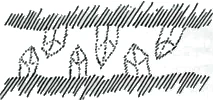
[ 10 ] But now you might say: What are you telling us? The rock that Erbsmehl gave us proves the opposite! — The rock is actually like this: There is loose soil down below (see drawing), loose soil above it, and loose soil behind it. It is completely surrounded by loose soil, and these crystal formations here—they don’t just grow upward from the bottom, as I’ve just described, but such formations are already growing upward, you might say, if only these were present from below. But these are the ones that are growing upward from above. Now you might say: But that cannot be explained by forces coming in from the universe, for then one would have to assume that the same forces are emerging from the Earth’s interior—forces that would have to come in from the universe if one were to explain them solely as growing from the bottom up.
[ 11 ] Yes, you see, that's an apparent contradiction. There must be something behind it. Now I'll tell you what's behind it.
[ 12 ] Such rocks don’t form on open ground; they form in the mountains. And even when they are on open ground, there are still layers of earth above and below them, just as there are in the mountains. But let’s suppose we extract them from the mountains. Imagine we have a mountain like this, and I’ll draw the slope of the mountain. Now, if you walk up there (see drawing), you walk up like this, and of course you have to pass by there—the path has to go that way; the earth or the rock might overhang a bit. You’ll find overhanging earth everywhere when you go into the mountains. Now imagine that a very, very long time ago, what I’ve drawn here in brown would have been there, would have been deposited there, and that would have been deposited there (see drawing). According to my explanation, crystals would now have formed here through the forces of the universe, as I have explained, and such crystals would also have formed over here. Crystals would have, so to speak, grown out from down there through the forces of the universe, and up there as well.
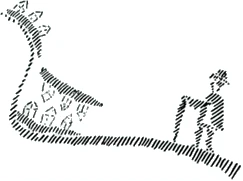
[ 13 ] Then, later on, what was up there came crashing down and covered it. So you see: When the upper layer crashes down, it falls in such a way that it ends up on top (see drawing), and the crystals that had originally risen to the top—due to the crash—fell over it and were held back by those that had been at the bottom, causing them to layer on top of one another. The ones that tumbled down settled on top of the lower ones, so that the top layer ended up at the very bottom.
[ 14 ] That is, in fact, how it has always been in the mountains. Anyone who studies the subject will find that landslides of this kind have been occurring continuously in the mountains, where the upper layers have settled on top of the lower ones. That is precisely what makes the study of mountains so interesting. When you walk on the plains, you get the impression—because this has only happened in the last few millennia—that one layer is always deposited on top of another. We could never say that about the Alps. The Alps were, of course, formed in this way a long time ago; but then the higher parts plunged down over the lower parts, and the Alps consist of completely jumbled layers of earth.
[ 15 ] That is why it is so difficult to study the Alps—because you have to constantly consider whether what is on top actually formed that way. Often, it did not form that way, but rather there was a layer down below, another layer up above, and then, due to an impact, what was on top was knocked down; it covered over what was below. And so these folds, as they are called, in the mountains formed over the course of millennia upon millennia and brought about such features. So one must first clarify these things by recognizing that the mountain ranges, in turn, have been thrust upon one another. One would therefore have to say: The lower layer formed on a slope like this (see drawing), the upper layer on a slope like this, and behind them, of course, was the mountain range, so that what was above fell down; it settled on top of it. Thus, such a phenomenon—where crystals from below and above face each other—can only be explained once one understands that, over the course of millennia, everything on Earth has gradually been thrown into disarray.
[ 16 ] So throughout the entire inanimate realm, there are always forces acting upon us from the cosmos, and these forces also act within us in such a way that we must actually do something within ourselves to prevent these forces from disturbing us.
[ 17 ] For you see, gentlemen, that pebble which is so common in the earth—we actually have it within us as well. It’s not very much, to be sure, but we do have within us the kind of material from which such terribly hard stones can form. But if such hard rocks were to form inside us—like the one Mr. Erbsmehl has brought here—then we’d be in big trouble! If, for example, a child who already has pebbles inside them had no other way to cope, and such crystals—even if they were very small, indeed minuscule—were to form everywhere, that would be a very serious matter! They do sometimes form during an illness.
[ 18 ] Sugar, too—as you know—can form crystals. If you look at rock candy, you’ll see that it’s made up of crystals layered on top of one another. Well, we have a great deal of sugar in our bodies. Not everyone on Earth eats exactly the same amount of sugar. So it varies. For example, in Russia people eat very little sugar, while in England they eat a great deal—on average, of course. But there are also differences among individuals. The Russian character is different from the English character. Russians are quite different people from the English. This stems in large part from the fact that Russians consume little sugar in their diet. The English eat foods that contain a great deal of sugar—foods high in sugar.
[ 19 ] This is related to what I’ve already said. The forces of the universe influence all kinds of things. So, human beings have a lot of sugar within them. That sugar always wants to turn into crystals. What can we do to prevent it from becoming crystals?
[ 20 ] You see, I’ve told you that there’s a lot of water inside us—living water—and that dissolves the sugar. That would be a nice story if the water weren’t constantly dissolving the sugar! Little crystals, like rock candy crystals, would form, and we’d have those little, stiff crystals inside us if the sugar weren’t constantly being dissolved. We humans need sugar as part of our diet, but we can only use it if we’re constantly dissolving it. We have to have it. Why do we have to have it? Because we have to carry out the process of dissolving it! We don’t live on it alone, but dissolving sugar is part of our life. So we have to get it into our bodies.
[ 21 ] But if we don’t have enough energy to break down this sugar, then these tiny little crystals form, and they’re excreted in the urine. And that’s when diabetes sets in. And that explains why people develop diabetes: They lack the energy to break down the sugar they consume. They need to consume sugar, but if they lack the energy to break it down, diabetes sets in. The sugar must not be allowed to reach the point where it is excreted in tiny crystals; rather, it must be broken down. A person must have the energy to break down the sugar. That is the essence of life.
[ 22 ] When you think about something like this, you can see that we must not only have the power to dissolve sugar, but we must also have the power to continually dissolve these tiny crystals—which always try to form within us as quartz crystals (there are only a few, but they do try to form)—. They must not be allowed to form within us. If they were to form even in a child, the child would come and say: “It’s awful—it’s pricking me everywhere! It’s pricking me everywhere!”
[ 23 ] What’s going on here, if the child feels pricks all over? Well, you see, there are these tiny silica crystals that formed in the nerves and haven’t been dissolved. They’ve just been left there. You don’t have to imagine that they’re huge masses. There are very few of them—tiny ones that aren’t even easy to find with a microscope; much smaller than one ten-thousandth of a millimeter. When many very tiny crystals have accumulated in the nervous system, a person experiences tiny, prickling sensations all over their body that they can’t explain. It stings all over. Furthermore, this process triggers small inflammations—very minor inflammations are caused. And then the person develops rheumatism or gout. Gout is nothing more than the deposition of these tiny crystals. The pain the person experiences stems from this. And the fact that a person with gout develops gouty nodules is due to these inflammations. If you dig a nail into your skin, inflammation occurs. These tiny little spikes, which come from inside, push their way to the surface. This causes small internal inflammations, and these inflammations then lead to the formation of these gouty nodules.
[ 24 ] So these are all processes that can take effect within a person. But from this you can see that we must actually always have forces within us that, let’s say, counteract gout; otherwise, as human beings, we would constantly suffer from gout. But we must not suffer from it constantly. So there must always be something underlying that enables us to counteract it.
[ 25 ] So what does that mean? Well, you see, it means: Forces are at work here from the universe. These forces actually do not want to form large crystals within us, but rather microscopically tiny ones. When these forces enter and form these crystals here, they also act within us, so that we are constantly permeated by these forces, and we must develop within ourselves the forces that continually reduce this process to nothing. We must constantly counteract these forces. So we must have forces within us that counteract them. These forces from the universe also enter us; but we counteract them—especially strongly in the nerves. Entirely mineral substances would constantly form in the nerves if we did not counteract them.
[ 26 ] Mineral substances must be produced, because, you see, there are children who remain mentally deficient and die young. When such mentally deficient children are autopsied, one often finds that they lack what is called “brain sand.” Everyone must have a little brain sand inside them. That brain sand must be formed, and it must be dissolved again and again.
[ 27 ] However, too much can also remain undigested if we lack the strength to break it down. But, gentlemen, what you are constantly doing in your brain is allowing sand to continuously settle there whenever you absorb food into your bloodstream. This causes it to be deposited continuously. And the brain sand that’s in there (it’s being drawn) is just as exposed to the forces of the universe as what’s out there in nature, so that tiny crystals are constantly trying to form inside. But they must not be allowed to form. If we had no “brain sand,” we’d go stupid. If the crystals were to form, we’d constantly faint because we’d, so to speak, develop brain rheumatism or brain gout. For in the rest of the body, it merely causes pain; but when the brain contains these tiny crystals, you can no longer function and faint. So we need brain sand, but we must constantly dissolve it. It is a continuous process: brain sand is deposited, dissolved, deposited, dissolved.
[ 28 ] If too much builds up, it can sometimes damage the walls of the blood vessels in the brain. Then the blood leaks out. That’s when the stroke happens—not just fainting, but a stroke, a cerebral stroke.
[ 29 ] So it is precisely when we study the processes of disease that we come to understand what human beings actually possess within themselves. For in illness, everything that is within us—just as it is in a healthy person—is simply too intense. Being sick means nothing other than that we are developing something to an excessive degree.
[ 30 ] That happens in real life, too, gentlemen. You’ve surely seen that when a small child is there and you touch its cheek with your hand—gently, lightly—then it’s a caress; you’re stroking it. And of course, you can also make that same touch with your hand too forceful; then it’s no longer a caress—it’s a slap.
[ 31 ] Well, you see, that’s just how the world works. Things that can be a caress on the one hand can be a slap in the face on the other. And so, in life, even that which must be present in the brain—this gentle work in the brain’s sand—becomes a slap in the face of life if it becomes too strong, that is, if the strength within us is too weak to dissolve this mineral substance we have within us. Then we would constantly lose consciousness; or if it becomes too strong—if these little crystals keep piercing our blood vessels—we would suffer a stroke. So we must constantly dissolve these little crystals within ourselves. What I have just told you is constantly taking place within you.
[ 32 ] I’d like to tell you something else now. Let’s make things very clear. Suppose you have a person here—I’ll draw it very schematically—here is his brain, here is his eye, and here I’ll draw something that you’re looking at in some way; let’s say, for the sake of argument, there’s a plant in front of your eye.
[ 33 ] Now turn your attention to this plant. You see, when you turn your attention to this plant—which, of course, you can only do when it is daytime—and the plant is bathed in sunlight, it appears bright, and the effect of the light enters your eye. But through the optic nerve, which runs backward from the eye, this light stimulus enters your brain. So when you look at a plant, your gaze is directed at the plant through your eye, and from the plant, the light stimulus then travels through your eye and into your brain.
[ 34 ] Gentlemen, when you look at a plant this way—a flower, for example—your attention is focused on the flower. But that means a great deal: one’s attention is focused on a flower. When one’s attention is focused on the flower, one actually forgets oneself. As you know, one can be so attentive that one completely forgets oneself. The moment one forgets—even just a tiny bit—that one is looking at the flower, a force arises somewhere in the brain that secretes a bit of “brain sand.” So looking means secreting “brain sand” from within.
[ 35 ] You must think of this secretion as a thoroughly human process. You’ve probably already noticed that you don’t just sweat when you exert yourself greatly, but also—for example, when you’re terribly afraid of something—you secrete not exactly “brain sand,” but other salts, and with them water, through your skin. That is secretion. But to look at something means to continuously secrete “brain sand.” When someone looks very intently at something, “brain sand” is continuously secreted. And this is where the need arises to dissolve this “brain sand.” For if we did not dissolve this “brain sand” again, a tiny little flower would spring up inside us from the “brain sand” in the brain! Looking at the flower actually means that a very small, tiny flower forms within us from the “brain sand,” which is then directed only from top to bottom, just as the little image in the eye is also directed from top to bottom. That is the difference, gentlemen.
[ 36 ] Here’s the thing: When we look at a chair—it doesn’t even have to be a flower—a little bit of “brain sand” forms inside us through the act of looking, and if we were to simply let ourselves be carried away by this act of looking, we would end up with a very small—much smaller than anything visible under a microscope—a tiny little image made of silica sand of this chair inside us. And if I were standing in such a room, and I had developed a certain power of observation as a human being, the entire room would be inverted within me—with the floor at the top—and composed of a picture made up of tiny, tiny pebbles. It is truly colossal how things are constantly being constructed within us. But we are the kind of people who don’t let that come to fruition. Without even realizing it, we dissolve the whole thing again. In this respect, we are quite peculiarly constituted as human beings. We look at the world. The world constantly seeks to form within us such structures that are just like the world, only inverted. And if we weren’t there—if we weren’t looking at all—then, especially at night when we sleep, if we didn’t develop the inner strength to dissolve them, such structures would constantly form through what exists in the universe. These forms also arise primarily when the Earth is not illuminated by the Sun or by light, but rather by forces coming from much farther away; it is through these that they form. But we are always subject to these forces. So we can say: When we sleep, all manner of mineral, lifeless forms constantly seek to form within us through the universe, and when we look at things, forms likewise seek to form within us that are just like our surroundings. When we sleep, we recreate the universe. In the universe, everything is arranged in a crystalline pattern. What we see there (in the crystals) is the way it is because the forces in the universe are arranged exactly like the crystals. Some forces move this way, others that way, so that the crystals are formed from the entire universe. But this is what seeks to happen within us. And when we perceive, when we look at our immediate surroundings, what is in our immediate surroundings seeks to take shape. We must constantly prevent this from solidifying; we must constantly dissolve it.
[ 37 ] Well, gentlemen, a peculiar process is taking place here. Just imagine: the flower wants to form a lifeless, pebble-like image of itself inside there. That must not be allowed to happen; otherwise, we would know nothing of the flower, but would instead develop a headache. So that must first be dissolved.
[ 38 ] I want to illustrate this process, which is constantly taking place, by saying the following. Suppose you have a pot of lukewarm water here, and someone blindfolds you; after blindfolding you, they bring an object that is soluble in this lukewarm water. You are to simply reach your hand into this lukewarm water. You cannot see the object because you are blindfolded. But the other person might now ask you: “Look, you’re reaching your hand into the water; do you feel anything in there?” — “Yes, the lukewarm water.” — “Do you feel anything else in there?” — “Yes, it’s getting cold around my fingers.”
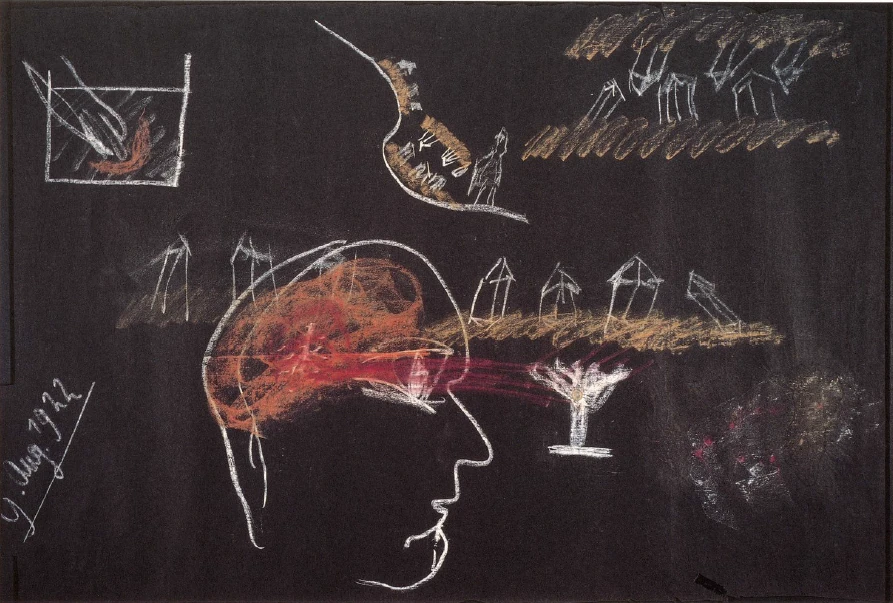
[ 39 ] Where could this be coming from? The other person has put an object into the water that is dissolving! And this dissolving causes the lukewarm water around his fingers to get colder. He feels this dissolving around his fingers, and he can say: Something is dissolving in there.
[ 40 ] But this is always the case when we have formed the object here inside and must dissolve it again. We sense the dissolution and then say—because we sense the dissolution—“Yes, the object is out there, for it has formed an image for us, and we have dissolved that image.” Because we have dissolved it, we know what the object looks like. This is how the thought of the object comes to us, because we must first dissolve the image of the object. That is how the thought arises. If we had only the image, we would faint. But if we are strong enough to dissolve the image, then we know about it. So that is the difference between fainting when we see something and having knowledge of it.
[ 41 ] So consider someone who is, let’s say, somewhat frail, and then there’s a terrible clap of thunder—that can happen. That thunder causes “brain sand” to be deposited within them—not through the eye, but through the ear—and an image is formed. They cannot dissolve it quickly enough. They may faint or lose consciousness. If they are healthy, they do not lose consciousness—that is, they have dissolved their “brain sand” quickly enough. So, fainting means not dissolving the “brain sand” quickly enough. Not fainting means dissolving the “brain sand” quickly enough. We must always, as we observe the things around us, dissolve the “brain sand” quickly enough.
[ 42 ] This brings us, then, to the question of how human beings relate to the forces throughout the entire universe. I told you last time: If a human being relates to the forces in the universe in such a way that the brain cells in his brain are constantly on the verge of dying, then they are, of course, completely lifeless, and he must manage them. It is his soul-spiritual nature with which he manages them. Now we even find the force that is constantly dissolving the brain cells. Brain sand, after all, is constantly killing the cells. The fact that brain sand mixes in there is what constantly kills the cells. And we must work against this. And that, you see, is the reason why we are human beings: so that we can, in a certain way, work against the brain sand.
[ 43 ] This is not the case with animals in the same way. Animals cannot counteract the “brain sand” as effectively as we humans can. Therefore, animals do not have a mind like ours—at most, the higher animals do. We have a mind capable of dissolving everything that continually enters us. This dissolution of what enters us is what enables human beings to perceive themselves in such a way that they can say, “I.” — This is the most powerful dissolution of the “brain sand” when we say, “I.” — In doing so, we infuse our language with consciousness. So the “brain sand” dissolves—indeed, the entire “nervous sand.” This is not the case with animals. That is why animals resort to screaming or something similar, but not to true language. That is why no animal has the ability to perceive itself, to say “I” to itself as a human does, because humans dissolve the “brain sand” to a much greater degree.
[ 44 ] So that we can say: We are not only working within ourselves against what is on Earth, but we are also counteracting the forces of the universe. The forces of the universe would cause us to crystallize internally. We would become, inwardly, a mountain with all these layers of crystals piled one upon another. We work inwardly against this. We are constantly dissolving it. We are constantly counteracting the forces of the universe with dissolving forces.
[ 45 ] And so we don't just dissolve silicic acid—because that's what these crystals here are made of—we dissolve all sorts of things; we dissolve the components of sugar, and so on.
[ 46 ] One can actually explore these stories in detail. Suppose a person doesn’t really know anything about them—since such things happen within a person almost instinctively—but still senses something vague within themselves. Imagine that a person feels: “Oh, I can’t really think straight; I can’t quite keep my thoughts together.”
[ 47 ] A journalist who writes an article every day can fall into this mindset particularly easily. Yes, gentlemen, writing an article every day—that means churning out an awful lot of mental drivel, an awful lot of mental drivel! It’s a truly dreadful business, writing an article every day, because it means churning out an awful lot of mental drivel. And then, when you have to write the article—at least that’s how it used to be—you start nibbling on the back end of your pen. That’s something people have always said about journalists in particular—that they gnaw on the ends of their pen stems to muster up what little strength they have left. Isn’t it true that when you bite into something, you draw on the last reserves of strength from your entire body to channel them into your head, so you can conquer that mental fog? You have to clear away a lot of mental fog.
[ 48 ] All of this happens so instinctively. Of course, the journalist doesn’t say to himself: “I’ll chew on my pen to come up with ideas.” — It can go on from there. Driven by this instinct, he then goes to the coffeehouse and drinks black coffee there. Journalists don’t think anything of it because they know nothing about these processes. But once they’ve had their black coffee—wow, that’s when the story flows, and they can write again once they’ve had their black coffee.
[ 49 ] Where does this come from? It comes from the fact that, in this case, the so-called caffeine is ingested along with the black coffee. This is a toxic substance that contains a great deal of nitrogen. Nitrogen is present in the air. But we can take it back in. When we breathe, we always take in a certain amount of oxygen and nitrogen. Now, the one who has to dissolve the “brain sand” needs a force—found specifically in nitrogen—to dissolve it. We draw this force from the nitrogen to dissolve the “brain sand.”
[ 50 ] That is why, at night when we sleep, we are exposed to nitrogen to a greater extent than when we are awake, and as we have said: Because we breathe in more oxygen, we live much faster; if we breathed in more nitrogen, we would live much more slowly and would therefore exist for longer. We could dissolve more.
[ 51 ] The journalist drinking coffee is, in fact, unconsciously relying on this nitrogen he’s taking in, and through this nitrogen—which he’s getting specifically from the caffeine—he gains the ability to form more “brain sand” and then to dissolve more of it as well. Then he no longer needs to nibble on the pen shaft, but can write with the pen because his thoughts are once again flowing more smoothly.
[ 52 ] So you see how the human ego works. The human ego facilitates this because, when you consume nitrogen-rich food—such as caffeine—it transports that nitrogen into the brain, which in turn makes it easier for us to break down the “brain sand,” and this gives us the ability to connect one thought with another.
[ 53 ] Some people, on the other hand, have the peculiarity that their thoughts are too tightly intertwined, so that they cannot break free from them. They are predisposed to constantly working on the “sand in their brains.” Yes, it’s good for them to do the opposite. While one person is held captive by his thoughts because he can develop a coherent train of thought, the other must resort to caffeine—to coffee—to help himself. But those who don’t want their thoughts to be held together too tightly—who want to let them sparkle and shine—those who, as they say, want to “throw thoughts at people’s heads,” which looks very witty—they drink tea. That has the opposite effect. It drives the thoughts apart. And this promotes a different kind of dissolution of the “brain sand.”
[ 54 ] So this process that takes place within the human being is, in fact, an extraordinarily interesting and complex one. Every food acts in different ways, and we must always add the opposite of what is actually trying to arise. We must dissolve it again. This is actually our highest spiritual activity at present, through which we are continually dissolving our human nature from within.
[ 55 ] And you see, if a person eats in such a way that, for a time, they don’t get enough of what contains sufficient nitrogen, then exactly what makes them fall asleep so easily happens—which is what one of the gentlemen also asked me about.
[ 56 ] So this is due to the fact that we’re not getting enough nitrogen from our food. And that’s why, in such a case—when we become too sleepy—we need to try to consume foods that are richer in nitrogen. Of course, this can be done in a variety of ways. But it happens in particular when we try to eat, for example, cheese or protein—that is, eggs. Then our nitrogen levels are continually replenished. This is how one must work with a person so that they are able to work on this matter with what constitutes their “I.”
[ 57 ] I told you at the beginning today: The field may be there, and cabbages may grow on it; but they will not grow unless there is a person there to cultivate them. But the field must also be properly prepared. In the same way, our brain must contain the necessary substances so that our “I” can function within it. But this “I” is connected to the vast forces of the universe, which have a different purpose. These forces of the universe constantly seek to turn us into hard stones, and we must dissolve ourselves again and again. If we were unable to dissolve ourselves, we would not be able to think, nor would we attain “I”-consciousness. This process of dissolution is what we call our “I”-consciousness.
[ 58 ] You see, gentlemen, these questions must first and foremost be answered sensibly if we are to proceed scientifically toward a worldview, if we wish to understand humanity in its relationship to the world. The most important thing for a human being is to grasp something that is connected to their own dissolution. We see a person die; that is to say, he is now dissolving completely as a physical being. If we do not know that a process of dissolution is taking place within us in every waking moment, we can never comprehend what the dissolution means that is taking place when a person dissolves in death.
[ 59 ] So this is what you must first understand, gentlemen: that by being able to counteract the forces of the world within ourselves, we are actually capable of continually dissolving within ourselves. This dissolution is only continually suspended because nourishment supplies us once again with the substances through which we dissolve. But when a person has reached a state where he can no longer dissolve the substances within himself, then he dissolves himself. Then the person becomes a corpse; then he dissolves himself.
[ 60 ] When we meet again, we must ask: What, then, happens when a human being dissolves into nothingness? — Today we have at least come this far in our understanding: There is a continuous process of dissolution, and if we lack the strength—because we have too little nitrogen within us—to dissolve the things that seek to form within us from the universe, then our “I” first becomes powerless, or else it becomes drowsy. Being drowsy simply means that we cannot dissolve enough; the force of accumulation overwhelms us. And so, don’t you think, these forces intensify,
[ 61 ] But just as you are there when you fall asleep—since you can wake up again—you must not infer the spiritual from what happens externally within the body. For just as nothing can happen to a machine without a human being present, nothing could happen to a human being without the spirit being present. That is scientific, gentlemen; the other view is unscientific. This is not something I am trying to impose on you; it is something that anyone who can truly take the matter seriously from a scientific standpoint will come to understand on their own.
[ 62 ] We will continue these reflections in early September. You will see that this topic delves deeply into our understanding of human beings and, through all sorts of detours, leads to an understanding of people in everyday life. You will come to understand human beings in a completely different way as we continue our discussion, based on what we have already been discussing for some time now. Human beings are constantly being recreated; they dissolve and so on. We will continue to examine this in the coming days. Then you will see what human beings are actually like from the perspective of a true scientist.