Understanding Human Beings
in Terms of Body, Soul, and Spirit.
Early Conditions on Earth
GA 347
5 August 1924, Dornach
Translated by Steiner Online Library
2. On the Human Body — The Brain and Thought
[ 1 ] Good morning, gentlemen! Today I will have to continue with what we discussed yesterday, because this matter can only be fully understood by delving deeper and deeper into it.
[ 2 ] You see, as you have observed, what matters for human beings is that they derive their nourishment from the earth, through which they sustain themselves—and that they obtain their breath from what surrounds the earth, that is, from the air, and it is only through this that he truly lives and is able to become a feeling and sensing being—and that, as we have seen, he draws forces from the entire world; it is through this that he is a thinking being and only through this does he truly become a complete human being.
[ 3 ] So human beings must be able to nourish themselves; they must be able to breathe, thereby becoming sentient beings—and they must be able to draw strength from the universe in order to become thinking beings. Just as they cannot speak on their own, they cannot become thinking beings by themselves. A human being cannot think of himself, any more than he can eat himself.
[ 4 ] Now let’s take a closer look at how these processes actually work. Let’s start by understanding how this process actually occurs when we ingest nutrients, which are, so to speak, in a dormant, dead state within our digestive system, and are then revitalized by the lymph glands and transported via the lymph into the blood, which is renewed through respiration. The blood—or rather, the life force of the blood, the breath—then rises through the spinal cord into the brain, where it connects with what constitutes brain activity.
[ 5 ] You need only observe how a child feeds itself differently from an adult, and you will be able to glean a great deal from this for your overall understanding of human beings. As you know, a child must drink a lot of milk in the very earliest stages of life. At first, the child feeds exclusively on milk. What does it actually mean for a child to feed exclusively on milk? We can understand this if we consider what milk is actually made of.
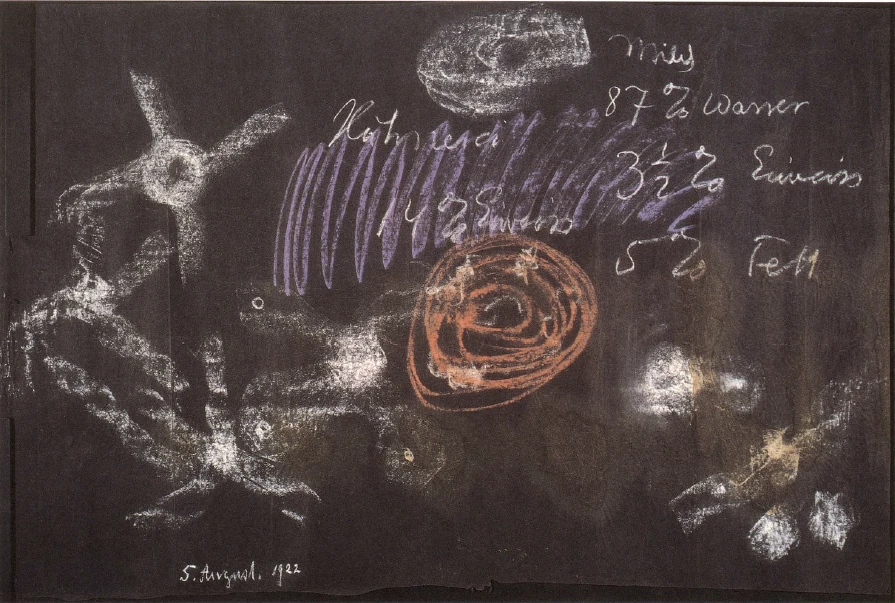
[ 6 ] Milk consists—and this is something people don’t usually consider—of 87 percent water. So when we drink milk as children, we’re actually drinking 87 percent water, and only the remaining 13 percent is something else. Of that remaining 13 percent, only 4!/a percent is protein; 4 percent is milk fat, and then there are a few other residual substances, salts, and so on. But essentially, that is what the child consumes with the milk. So, for the most part, the child is actually consuming water.
[ 7 ] Now, as I’ve told you, the human body consists mainly of fluid. A child must constantly replenish this fluid. After all, it needs to grow and therefore requires a great deal of water, which it obtains from milk.
[ 8 ] You might say: “So it would be the same if we gave the child only this 13 percent of nutrients and gave it water to drink for the rest.” — Yes, but you see, the human body isn’t designed for that. What we get from milk isn’t just 13 percent of ordinary protein and fat and so on; rather, all of that—protein and fat—is dissolved in the milk, dissolved in the water, if it’s milk. So it’s true that when the child drinks the milk, it receives the nutrients it needs in a dissolved state. And that’s different from if the body first had to perform the processes involved in dissolving them.
[ 9 ] If you recall what I’ve said so far about nutrition, you’ll say: We first have to break down the food we take in through our mouths. Nature actually only allows us to put solid food into our mouths; we then break it down using our own bodily fluids. The rest of the body—the stomach, intestines, and so on—can only utilize what has been broken down. A child must first acquire this ability to break down food; it must first be given this capacity. So the child cannot manage this on its own from the very beginning. Therefore, the food is broken down for the child beforehand. You can best see this from the fact that if a child is fed too much of any kind of artificial, processed food, it will still become stunted.
[ 10 ] Now you might say: So if I were perhaps able to produce artificial milk—if I could combine the 13 percent of protein, fat, and so on that’s in the water with the water itself in such a way that it would look and feel similar to milk—would that be milk that would be just as good for the child as the milk it usually gets? — Yes, you see, gentlemen, that is precisely not the case. The child would wither away if it were given such artificial milk. And since people can only produce according to need, we will also have to refrain from producing such milk. It would be a substance that would corrupt humanity.
[ 11 ] For who can provide, as a solution, exactly what the child needs? You see, that, in turn, can only be done by life itself. Animals could do so to a limited extent, but not even all animals. However, during that very early period when the child is dependent on it—because it cannot yet properly break down these nutrients, protein, and fat on its own—the child can truly be properly nourished only with human milk itself.
[ 12 ] And of all other types of milk, donkey’s milk is the most similar to human milk; therefore, if it is not possible for any reason to feed the child through direct breastfeeding or any other form of breastfeeding, donkey’s milk is the best alternative available. This may sound very strange, but donkey’s milk is in fact the most similar to human milk, so that if proper breastfeeding cannot be provided, feeding could—in a pinch—be accomplished by keeping a donkey stable and a female donkey and supplying the child with milk in this way. Of course, this is merely a hypothesis I am presenting to help you see how things are interconnected in nature.
[ 13 ] If, for example, you compare milk—let’s say—with a chicken egg as a food source, you’ll find that a chicken egg contains about 14 percent protein—that is, far more, actually four times as much as milk contains. So when you start giving a child food that contains more protein, the child must already have developed this ability to break things down within itself. It must already be able to break things down on its own.
[ 14 ] You can see from this how essential it is for the child to receive liquid nourishment. But what kind of liquid nourishment? A liquid nourishment that has already passed through life, and—since the child is placed directly at the mother’s breast—may even still be alive.
[ 15 ] In the case of a child, it is quite evident that when the child drinks milk and the milk passes through the mouth and esophagus into the stomach—where it is first killed off in the human body—it can then be revived in the intestines. So we can see directly in the child that life must first be killed off. And because life has not yet been significantly altered, the child needs less energy to revive it when drinking milk than when consuming something else. So you see how close human beings are to life.
[ 16 ] But you can see something else from this as well. If you really think it through properly, what conclusion do you actually reach? Start thinking about this point very carefully right now. You see, when we say to ourselves: “The child must therefore consume living food that it can kill and revive itself,” and we then say: “The human being consists largely of fluid”—can we then say that the human being consists of water, of the water we find out there in nature, in inanimate nature? — Then this water that we find in inanimate nature would have to be able to work in the child exactly as it works in the adult, who has already accumulated more life forces!
[ 17 ] But from this you can see that what we carry within us—nearly 90 percent water—is not ordinary, lifeless water, but rather living water. So what humans carry within them as water is something else: they carry vitalized water within them. And this vitalized water is, in fact, water as we find it out there in lifeless nature—permeated by that which permeates the entire world as life, yet makes itself felt just as little in lifeless water as human thought does in a dead corpse. So when you say, “Water—here I have water in the stream, and I have water in the human body,” you can understand this just as you would if you said, “Here I have a corpse, and here I have a living human being”; the water in the stream is the corpse of the water that is in the human body.
[ 18 ] That is why we say: Human beings do not only have this lifeless, physical aspect within them, but they also have a life body, a living body within them. This is what true thinking actually reveals: Human beings have this life body within them. And we can understand how this continues to work within the human being if we truly observe the human being in connection with nature. But in doing so, we must actually keep in mind that we first look out into nature, and then look inward at the human being. When we look out into nature, we find almost everywhere the elements—the parts—of which human beings are composed, except that human beings process these parts from nature in their own way.
[ 19 ] So, to understand this, let’s turn to the tiniest of animals. As I speak, you will already notice how I have spoken in a similar way about what is within human beings, just as I must now speak of the smallest and lowest forms of life out in nature. You see, there are very small animal creatures in the water, in seawater. These small animal creatures are actually just tiny lumps of slime, usually so small that they can only be seen through a powerful magnifying glass. Of course, I’m drawing them enlarged here (see drawing, left). These little clumps of slime float in the surrounding water, in the liquid.
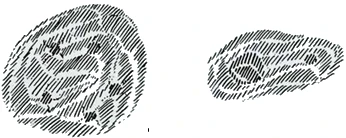
[ 20 ] If there were nothing else there but a little lump of slime surrounded by water, this lump of slime would remain at rest. But if, say, some small grain of some substance swims by—for example, one like this (see drawing, right)—then this little creature, with nothing else present, spreads its mucus far enough so that this grain is now enclosed within it. And of course, it must spread this mucus by pulling itself away. This causes the little clump to move. So, by this tiny creature—this little slime organism—enveloping a grain with its own slime, we have simultaneously set it in motion. But the other grain over there is now being dissolved inside. It dissolves, and the little creature has eaten that grain.
[ 21 ] But such a little creature can eat several of these grains. Imagine this little creature is here, a grain there, another grain there, and a grain here and there (see drawing); then the creature extends its feelers this way, that way, and that way, and wherever it has extended them the most—where the grain was largest—it pulls itself toward it and drags the others along. So this little creature moves in such a way that it feeds itself at the same time.
[ 22 ] Well, gentlemen, when I describe to you how these little slimy lumps swim around in the sea and feed at the same time, you’ll recall how I described the so-called white blood cells in humans. In humans, they are essentially the same at first. In human blood, too, such tiny creatures swim around, feeding and moving in this way. By observing these tiny creatures swimming around out there in the sea, we gain an understanding of what is actually swimming around in human blood. So we carry that within us.
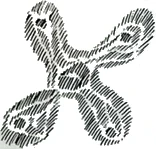
[ 23 ] And now that we have recalled how, in a certain sense, we actually have such living beings—which are widespread out in nature—swimming around in our blood, and which thus live all around us inside our bodies, let us take a moment to understand the nature of our nervous system, specifically our brain. Our brain, too, consists of the tiniest parts. If I were to draw these tiniest parts for you, they would look like a kind of lumpy, thick mucus. Rays extend from this mucus (see drawing), which are made of the same substance as the mucus itself. Look, here is one such cell—as they’re called—from the brain. It has a neighboring cell. This one extends its little feet or arms here, and they touch the others there. There’s a third such cell; it extends its little feet here and touches them there. They can grow very long. Some extend almost halfway across the body. That one, in turn, is adjacent to another cell. When we look at our brain through a microscope, it certainly appears to consist of such little dots where the mucus mass is more densely concentrated. And then thick branches extend from here; they constantly intertwine with one another. If you were to imagine a dense forest with thick tree canopies that have wide-spreading branches touching one another, you would have an idea of what the brain looks like under a microscope or a magnifying glass.
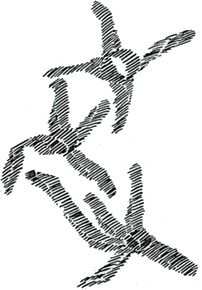
[ 24 ] But, gentlemen, you might now say: So he has described to us these white blood cells that live in the blood. And what is described as the brain is quite similar; it is populated by all sorts of such little cells, just like those found in the blood. — For if I were to remove all the white blood cells from a person—without killing him in the process—and then, after first removing his brain, were to place them neatly into the top of his skull, I would have made a brain out of his white blood cells.
[ 25 ] But the strange thing is that, before we could turn his white blood cells into a brain, those white blood cells would have to die off partially. That is the difference between white blood cells and brain cells. White blood cells are full of life. They’re always moving around each other in human blood. I’ve told you, they surge through the veins just like the blood. Then they exit there. Then, as I’ve explained, they become connoisseurs and make their way to the body’s surface. They crawl all over the body.
[ 26 ] But when you look at the brain, these cells—these little bodies—stay in place. They are at rest. They simply extend their branches and always touch the next one. So what is present in the body in the form of white blood cells and is in full motion comes to rest in the brain and is, in fact, half-dead.
[ 27 ] Just imagine this little creature crawling around in the sea—it eats one bite too many. When it eats too much, this is what happens: It stretches out its arm, its “branch,” takes a bite here and there, and has eaten too much. It can’t handle that; now it splits in two, goes its separate ways, and instead of one, we have two. It has multiplied. Our white blood cells also have this ability to multiply. Some are always dying off, and others are created through multiplication.
[ 28 ] In this way, the brain cells I’ve shown you here cannot multiply—our white blood cells are fully independent living organisms—the brain cells that merge in this way cannot multiply; one brain cell will never become two brain cells. When a person develops a larger brain—when the brain grows—cells must always migrate from the rest of the body into the brain. The cells must grow into it. It’s not that brain cells ever multiply within the brain; they merely accumulate. And as we grow, new cells must constantly flow in from the rest of the body so that, when we reach adulthood, we have a brain that is large enough.
[ 29 ] You can also see from the fact that these brain cells cannot reproduce that they are half-dead. These brain cells are always dying—always, always dying. If we really look at this closely, we see a wonderful contrast within the human being: In his blood, he carries cells full of vitality in the white blood cells, which constantly strive to live, and in his brain, he carries cells that actually constantly strive to die, that are always on the path to death. This is also true: through his brain, a human being is always on the path to death; the brain is actually always in danger of dying.
[ 30 ] Well, gentlemen, you have probably heard—or perhaps even experienced it yourselves (it’s always unpleasant when you experience it yourself)—that people can also faint. When people faint, they enter a state similar to that of falling. They lose consciousness.
[ 31 ] What actually happens inside a person when they lose consciousness in this way? You probably also know that, for example, people who are quite pale—such as girls who are anemic—are the most likely to faint. Why? Well, you see, they faint because they have too many white blood cells in relation to their red blood cells. A person must have a very precise ratio—as I have already explained to you—between white blood cells and red blood cells in order to be fully conscious. So, what does it mean when we lose consciousness? For example, when we faint, but also when we sleep, we lose consciousness. This means that the activity of the white blood cells is far too vigorous, far too strong. When the white blood cells are too active—that is, when a person has too much life within them—they lose consciousness. So it is very good that a person has cells in their brain that are constantly dying; for if those white blood cells in the brain were still alive, we would not be able to have any consciousness at all—we would always be sleeping beings. We would always be asleep.
[ 32 ] And so you might ask: Why do plants sleep all the time? — Plants sleep all the time simply because they do not possess such living beings, because they actually have no blood at all, because they lack this life that exists within us as an independent life.
[ 33 ] If we want to compare our brain to something in the natural world, we must, in turn, compare it only to plants. The brain, in essence, is constantly undermining our own life, and in doing so, it is precisely what creates consciousness. So we end up with a completely contradictory concept of the brain. It is indeed contradictory: plants do not possess consciousness, whereas humans do. This is something we must first explain through lengthy reflection, and we now want to set out on the path to being able to explain it.
[ 34 ] We lose consciousness every night when we sleep. So something must be happening inside our bodies that we now need to learn to understand. What, then, is going on inside our bodies? Well, you see, gentlemen, if everything in our bodies were exactly the same while we sleep as when we’re awake, we simply wouldn’t be sleeping. When we sleep, our brain cells begin to be a little more active than they are when we’re awake. They thus become more like those cells that have a life of their own within us. So you can imagine: When we’re awake, these brain cells are completely still; but when we sleep, although these brain cells can’t move very far from their place—because they’re already localized, because they’re held in place from the outside—they can’t move around very well, can’t swim around very well, because they’d immediately bump into something else—yet they acquire, so to speak, the will to move. The brain becomes internally restless. This is what brings us into the unconscious state—the brain becoming internally restless.
[ 35 ] Now we must ask: Where does this thinking actually come from within human beings? In other words, how is it that we are able to absorb the forces from the entire vast universe into ourselves? With our digestive organs, we can only absorb the forces of the earth along with the substances. With our respiratory organs, we can only take in air—namely, oxygen. In order for us to be able to absorb all the forces from the vast world with our head, it is necessary for it to become quite still inside—that is, for the brain to calm down completely. But when we sleep, the brain begins to become active; then we absorb fewer of these forces that exist out there in the vast universe, and we lose consciousness.
[ 36 ] But here’s the situation: Imagine that work is being done in two places; here, let’s say, five workers are doing the work, and there, two workers. These tasks are then combined, and each group continues to do a portion of the work. But let’s suppose it becomes necessary to temporarily halt work there a bit, because too many parts of one type have been produced here and too few of the other type there. What will we do then? We’ll ask one of the five workers to go over to join the two workers. Now we have three workers there, and of the five, there are four here. We shift the work from one side to the other when we don’t want to increase the workload. A person has only a very specific amount of energy. They must distribute it. So when the brain becomes more active during sleep at night—working harder—that energy must be drawn from the rest of the body; that work must be taken from there. Well, where does it come from? Yes, you see, it is taken from a portion of the white blood cells. A portion of the white blood cells begins to function less at night than during the day. The brain functions more. A portion of the white blood cells functions less. That is the balance.
[ 37 ] But now I have told you: It is precisely because the brain temporarily suspends its activity and becomes calm that a person begins to think. So if these white blood cells become calm—if they settle down at night—then a person should begin to think wherever the white blood cells become calm. That is where they should begin to think with their body.
[ 38 ] Let us now ask ourselves: Does a person perhaps think with his body at night? — That’s a tricky question, isn’t it, whether a person might think with his body at night! Well, he knows nothing about it. For the time being, he can only say that he knows nothing about it. But the fact that I know nothing about something is not proof that it does not exist; otherwise, everything that people have not yet seen would have to be nonexistent. So the fact that I do not yet know anything about something is no proof that it does not exist. The human body could in fact be thinking at night, and we simply know nothing about it and therefore believe that it is not thinking.
[ 39 ] Now we must examine whether human beings might, after all, show signs that, while they think with their heads during the day, at night they begin to think with their livers, stomachs, and other organs—perhaps even with their intestines.
[ 40 ] We have certain signs of this. Every person has signs that this is the case. Just imagine, for a moment, how it is that something is there and yet we know nothing about it. Just imagine: I’m standing here, talking to you, and I’m focusing my attention on you—which means I don’t see what’s behind me.
[ 41 ] Strange things can happen. For example, I might be in the habit of sometimes sitting down on this chair here between speaking. Now I turn my attention to you, and during that time, someone takes the chair away from me. I didn’t see any of it happen, but it did happen, and I notice the consequences when I try to sit down now!
[ 42 ] You see, the thing is that one must not merely judge based on what one usually knows, but one must judge based on what one might also know in a very indirect way. If I had just quickly looked around, I probably wouldn’t have sat down on the floor. If I had looked around, I would have prevented that.
[ 43 ] Now let’s consider human thought within the body. You see, natural scientists love to talk about the limits of human knowledge. What do they actually mean by that? When natural scientists speak of the limits of knowledge, they mean that what they haven’t yet seen—whether through a microscope, a telescope, or any other means—doesn’t exist. But people constantly dismiss such claims, because the fact that you haven’t seen something is no proof at all that it doesn’t exist. That much is certain.
[ 44 ] Well, whatever is to become conscious to me must not only be conceived by me, but I must also specifically observe what I have conceived. Thinking could be a process that always takes place, sometimes in my head, sometimes throughout my whole body. But when I’m awake, my eyes are open. My eyes don’t just look outward; they also perceive inward. Likewise, when I taste something, I do not merely taste what is external; I also perceive internally—for example, whether I am, let’s say, sick throughout my entire body—and what someone else might find pleasant to taste becomes repulsive to me. So the inner state always determines the experience. This inner perception must also be present.
[ 45 ] Now imagine this: we wake up just as we normally do. Our brain cells slowly settle down. They gradually come to rest, and the process unfolds in such a way that I gradually learn to use my senses—that is, I begin to use my senses again. The process of waking up proceeds quite naturally in accordance with the cycle of life. That could be one scenario.
[ 46 ] The other possibility, however, is that, due to some circumstance, I calm my brain cells too quickly. I calm them down far too quickly. Something else happens when I calm them down too quickly. Let’s say, for example, that someone is directing the workers’ movements—as I mentioned, if there are five here, he takes the fifth one away and places him over there—if someone is directing that, it might go very smoothly under certain circumstances. But suppose one person has to take one worker away, and the other has to put him back—then the whole situation can turn out badly, especially if the two argue over whether it’s right or wrong. Now, if the brain cells in my brain calm down too quickly, then those white blood cells that have come to rest during sleep won’t be able to get moving again so quickly. And what will happen is that, while I am already calm in my brain—that is, while I have already calmed all the activity in my brain that was present during sleep—the white blood cells down there in the blood will not yet want to get moving. They will want to remain at rest for a while longer. They do not want to get moving.
[ 47 ] It would be truly wonderful if we could simply perceive these “lazy” blood cells—I’m speaking figuratively, of course—that still want to stay in bed. They would just look at each other the way the otherwise calm brain cells look at one another, and we would perceive the most wonderful thoughts. Precisely at the moment when we wake up too quickly, we would perceive the most wonderful thoughts. This is easy to understand, gentlemen, if one understands the whole story of humanity’s connection to nature. If, with nothing else standing in the way, one were to wake up quickly, one would be able to perceive the most wonderful thoughts within one’s body. But that is not possible. Why can’t we do that? Well, you see, right there—between those sluggish, still-sleeping white blood cells, and between what we use to perceive them—which is all we can do with our heads—that’s where the entire breathing process takes place. The red blood cells are in there. Breathing takes place, and we must observe this thought process—which is going on within us—through the entire breathing process.
[ 48 ] Just imagine: I wake up; this calms my brain. Down there (it’s being drawn), somewhere in the blood are the white blood cells. I would perceive them as calm as well, and I would see the most beautiful thoughts in there. Yes, but now there’s the whole breathing process in between. It’s just like when I want to look at something, and I look at it through a cloudy glass; I see it indistinctly, everything blurs for me. This breathing process is like a cloudy glass. It blurs all my thinking that’s down there in the body. And what results from that? Dreams. Dreams arise from this: indistinct thoughts that I perceive when brain activity in my body calms down too quickly.
[ 49 ] And again, when falling asleep, if I experience an irregularity—that is, if the brain enters a state of activity too slowly as I fall asleep—then what happens is that, because the brain enters this state of activity too slowly and thus still retains the ability to perceive something, I am able to observe the thinking that is already beginning down there during sleep as I fall asleep. And so it happens that what actually remains unobserved by a person throughout the night is perceived as dreams upon waking and while falling asleep.
[ 50 ] For we actually only become aware of dreams at the moment we wake up. You can very easily bring this fact to mind by taking a close look at a dream. Suppose I am asleep and there is a chair next to my bed. Now I might dream the following: I am a student and run into another student somewhere, to whom I say something rude. The other student has to react to that—this is called a “comment”—he has to react to this rude remark, and it eventually comes to the point where he challenges me. Sometimes it can be a complete trifle; that’s just how students challenge each other.
[ 51 ] Well, everything happens in a dream now: the seconds are chosen, you go out into the forest in your dream, and suddenly you’re there; you start shooting. The first one shoots. I can still hear the shot in my dream, but I wake up and realize I’ve just knocked over the chair with my arm next to the bed. That was the shot!
[ 52 ] Yes, gentlemen, if I hadn’t knocked over the chair, then I wouldn’t have had the whole dream at all—the dream wouldn’t have existed! So the fact that the dream took on precisely this form only happened at the moment of waking up, because it was the overturned chair that woke me up in the first place. So in that single moment of waking up, the image arose, and what was going on inside me became unclear. From this you can see that what is pictorial in a dream only takes shape in the single moment when I wake up, just as, when falling asleep, what is pictorial in a dream must take shape in that single moment.
[ 53 ] But if such images form, and I can in turn perceive something through them, then there must necessarily be thoughts associated with them. What does this lead us to? It leads us to understand something about sleeping and waking. So let’s ask ourselves: What happens when we sleep? When we sleep, our brain is more active than when we’re awake; when we’re awake, our brain calms down. Yes, gentlemen, if we could say that our brain becomes more active when we’re awake, then, you see, we could be materialists, because then the physical activity of the brain would mean thinking. But if we are reasonable people, we cannot say at all that the brain is more active when we’re awake than when we’re asleep. It must, in fact, calm down precisely when we’re awake.
[ 54 ] So physical activity cannot, after all, give us thought. If physical activity were to give us thought, then this thought would have to consist of a greater degree of physical activity than non-thinking. But non-thinking consists of a greater physical activity. So you could say: I have a lung; the lung would be idle if external oxygen did not flow through it and set it in motion. But as it is, my brain becomes idle during the day; so something external must also come to the brain to set it in motion. And so we must acknowledge that in the world—just as oxygen sets the lungs in motion or sets them to work—during the day the brain is brought to think by something that is not within the body itself, that does not belong to the body itself.
[ 55 ] So we must tell ourselves: If we practice true natural science, it will lead us to accept something incorporeal, something spiritual. We can see, after all, that it is there. We see it, as it were, flying in when we wake up, for what constitutes thinking cannot come from the body. If it came from the body, we would have to think better at night. We would have to lie down and fall asleep, and then thinking would arise in our brains. But we do not do that. So, in a sense, we see what constitutes our soul and spiritual being flying in.
[ 56 ] So one can say: Natural science has indeed made great strides in recent times, but it has come to know only that which is not actually suited to life or to thinking, while it has not understood life itself, and has understood thinking even less. And so, when one practices natural science correctly, one is led—not by superstition, but precisely by this correct natural science—to say: Just as there must be oxygen for breathing, there must be something spiritual for thinking.
[ 57 ] We’ll talk about that next time, because it’s not something that can be decided so easily. Many of you will still have all sorts of objections to what I have said. But it must be said that anyone who does not speak this way simply does not understand the whole story of the human being. So this is what it’s about: not spreading some kind of superstition, but first creating complete clarity. That is what this is all about.