

On Health and Illness
GA 348
24 October 1922, Dornach
Translate the original German text into any language:
Versions Available:
On Health and Illness, tr. SOL
Zweiter Vortrag
Second Lecture
[ 1 ] Nun, meine Herren, ist gewünscht worden, daß wir etwas sprechen über die inneren menschlichen Organe, und ich habe damit das letzte Mal angefangen. Solch eine Sache kann man natürlich nur, ich möchte sagen, von weit her besprechen. Man kann sie nur so besprechen, daß man wirklich auf die Sache von Anfang an eingeht. Und ich habe Ihnen gesagt, nicht nur, daß das vorkommen kann, daß der Mensch gewissermaßen, wie ich Ihnen das an dem Beispiel von William Windom erklärt habe und noch an einem andern Beispiel, aus sich heraus redet wie dieser Windom, der während einer Rede gestorben ist und fast ganz seinen eigenen Zustand in Worten geschildert hat - ich habe Ihnen nicht nur das gesagt, sondern ich habe Ihnen gewisse Dinge gesagt über den Verlauf des menschlichen Lebens so, daß wir finden, daß in den allerersten Lebenszeiten, also während der Mensch Säugling ist, in den ersten Kinderjahren ist, die Sterblichkeit am allergrößten ist. Da sterben die Menschen am häufigsten. Und wenn das auch später mit dem dritten, vierten, fünften Jahre abnimmt, so kann man trotzdem sagen: Die größte Sterblichkeit ist bis zum Zahnwechsel, so um das siebente Jahr herum.
[ 1 ] Well, gentlemen, it has been requested that we speak a little about the internal human organs, and I began to do so last time. Of course, one can only discuss such a subject—I would say—in broad terms. One can only discuss it in such a way that one truly addresses the subject from the very beginning. And I have told you—not only that it can happen that a person, so to speak, as I explained to you using the example of William Windom and another example, speaks from within himself like this Windom, who died during a speech and described his own condition almost entirely in words —I have not only told you that, but I have also told you certain things about the course of human life, such that we find that in the very earliest stages of life—that is, while a person is an infant or in early childhood—mortality is at its highest. That is when people die most frequently. And even though this declines later on, around the third, fourth, and fifth years, one can still say: The highest mortality rate persists until the teeth begin to fall out, around the age of seven.
[ 2 ] Dann, von dem Zahnwechsel an, bis das Kind geschlechtsreif wird, ist eigentlich der Mensch am allergesündesten. Tatsächlich ist es so. Wenn wir nicht selber in der Schule die Kinder ungesund machen, wenn wir sie nicht durch allerlei falsches Sitzen und dergleichen dazu bringen, daß sie Verkrümmungen oder durch schlechte Luft irgendwelche inneren Erkrankungen zeigen, wenn wir achtgeben, so können wir in der Tat während des sogenannten schulpflichtigen Alters, während der Volksschulzeit, darauf rechnen, daß wir da die Kinder im allgemeinen am gesündesten haben. Was da vorkommt an Erkrankungsfällen, das ist meistens von außen verschuldet. Die große Gefahr, daß der Mensch wiederum durch sich selber krank wird, die beginnt eigentlich erst wiederum im fünfzehnten, sechzehnten Lebensjahre. Und dann treten ganz andere Krankheiten auf, als im Kindesalter auftreten.
[ 2 ] In fact, from the time a child’s baby teeth fall out until they reach sexual maturity, that is when a person is actually at their healthiest. That is indeed the case. If we do not ourselves make the children unhealthy in school—if we do not cause them, through all sorts of poor posture and the like, to develop deformities or internal illnesses due to poor air quality—if we are careful, then we can indeed expect that during the so-called compulsory schooling years, during elementary school, children are generally at their healthiest. The cases of illness that occur there are mostly caused by external factors. The great danger that people will once again make themselves sick actually begins anew around the ages of fifteen or sixteen. And then entirely different illnesses arise than those that occur in childhood.
[ 3 ] Sehen Sie, da ist es so: Bei ganz kleinen Kindern - ich habe es schon zum Teil gesagt — finden wir, daß sie zum Beispiel sehr leicht Vereiterungen des Blutes kriegen. Das Blut wird eiterig. Das kann so weit kommen, daß gelbsuchtartige Erscheinungen auftreten. Dann tritt sehr häufig bei den Kindern eine unregelmäßige Verdauung in Form von Durchfall auf. Dann bekommen die Kinder diese kleinen weißen Pustelchen an den verschiedenen Stellen, Schwämmchen, wie man sagt, und dergleichen; und dann bekommen die Kinder noch eine ganz andere Art von Erkrankung, die sogenannten Fraisen - Kinderkrämpfe sind das. Heute tritt ja ganz besonders stark auf als eine Kinderkrankheit die sogenannte Kinderlähmung, die auch noch im späteren Alter auftritt, die aber eine furchtbar verderbliche Krankheit ist. Die Kinder kommen in die Unmöglichkeit, zum Beispiel ihre Beine zu bewegen. Sie haben ganz gelähmte Beine und dergleichen. Diese Krankheit tritt heute immer stärker auf. Sie haben ja vielleicht gelesen, daß von Thüringen gemeldet wird, daß selbst Schulen geschlossen werden mußten, weil die Kinderlähmung epidemisch auftritt.
[ 3 ] You see, here’s the thing: With very young children—as I’ve already mentioned in part—we find that they, for example, are very prone to blood infections. The blood becomes purulent. This can progress to the point where jaundice-like symptoms appear. Then, very often, children experience irregular digestion in the form of diarrhea. Then the children develop these small white pustules in various places—little blisters, as they’re called—and the like; and then the children develop yet another type of illness, the so-called “Fraisen”—these are childhood convulsions. Today, the so-called polio is particularly prevalent as a childhood disease; it also occurs at a later age, but it is a terribly debilitating illness. Children find themselves unable, for example, to move their legs. Their legs are completely paralyzed and so on. This disease is becoming increasingly prevalent today. You may have read reports from Thuringia stating that even schools had to be closed because polio has broken out in epidemic proportions.
[ 4 ] Aus alledem und noch aus manchem anderen kann man sehen, daß die Kinderkrankheit einen ganz besonderen Charakter hat. Die Kinderkrankheiten schauen anders aus als die Krankheiten, die der Mensch später bekommt. Die Kinderkrankheiten sind ja gerade Scharlach, Masern - allerdings, Masern ist ja eine Krankheit, die der Mensch auch später bekommen kann, und wir müssen uns fragen: Warum bekommen sie die Kinder am allerhäufigsten?
[ 4 ] From all of this, and from many other factors as well, it is clear that childhood illnesses have a very special character. Childhood illnesses look different from the illnesses people contract later in life. Childhood illnesses include scarlet fever and measles—though measles is a disease that adults can also contract later in life, and we must ask ourselves: Why do children get them most frequently?
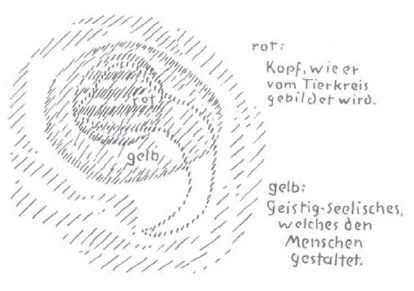
[ 5 ] Sehen Sie, man kann diese Dinge nur verstehen, wenn man weiß, wie eigentlich im menschlichen Leib die Kräfte wirken. Wenn man das Kind als Menschenkeim betrachtet, bevor es geboren wird, sagen wir sogar, betrachtet im ersten, zweiten, dritten Monat, so ist ja das Kind eigentlich im Grunde genommen etwas ganz anderes als der spätere Mensch. Das Kind ist im ersten Monat, und im zweiten auch noch, so, daß es eigentlich nur Kopf ist, und die anderen Organe sind eigentlich nur ein Anhang am Kopfe. Alles das, was später Gliedmaßen sind, Hände, Füße, sind ja kleine Stumpfe; und auch die eigentliche Brust- und Bauchgegend funktioniert ja noch nicht, ist ja noch nicht tätig. Es ist ja so, sehen Sie, daß wenn man den Kindeskeim hat, so schaut er ja eigentlich so aus: Da hier ist dann, ich möchte sagen, eine Art von Sack, in dem er drinnen ist, und in diesem Sack sind vom mütterlichen Leibe aus Blutgefäße. Diese Blutgefäße, die gehen dann in das Kind hinein und füllen es aus. Das Blut kriegt das Kind von der Mutter, und ebenso die Nahrungsstoffe. Das sind Anhangsorgane, die später abfallen. Das fällt ja alles ab. Der Kopf ist im Verhältnis zu dem Körper bei dem Kindeskeim riesengroß. Das ist der Kopf (siehe Zeichnung); das andere sind nur Anhängsel — das ist noch nicht tätig. Da entsteht später das Herz und der Verdauungsapparat. Die Blutzirkulation wird von außen, von der Blutzirkulation der Mutter besorgt. Da sind nur kleine Stumpfel als Hände und Füße; das wird später erst entwickelt. So daß man sagen muß: Das ist alles der Kopf, und alles andere sind unbedeutende Organe, denn alles, was Nahrungs- und Luftaufnahme ist, das wird beim Kind von der Mutter aus besorgt. Also das Kind ist eigentlich in den ersten Monaten von der Mutter aus ganz Kopf.
[ 5 ] You see, one can only understand these things if one knows how the forces actually work within the human body. If one considers the child as a human embryo before it is born—let’s even say, during the first, second, or third month—then the child is, in essence, something entirely different from the adult it will later become. In the first month—and even in the second—the child is such that it is essentially just a head, and the other organs are really just appendages to the head. Everything that will later become limbs—hands and feet—are just little stumps; and the actual chest and abdominal regions aren’t functioning yet, aren’t active yet. You see, when you have the embryo, it actually looks like this: here, I would say, is a kind of sac in which it is contained, and within this sac are blood vessels extending from the mother’s body. These blood vessels then enter the embryo and fill it out. The embryo receives blood from the mother, as well as nutrients. These are accessory organs that will later be shed. It all falls off. The head is enormous in proportion to the body in the embryo. That is the head (see drawing); the rest are merely appendages—they are not yet functional. The heart and the digestive system will develop there later. Blood circulation is supplied from the outside, from the mother’s blood circulation. There are only small stumps for hands and feet; these will develop later. So one must say: This is all the head, and everything else are insignificant organs, because everything related to the intake of food and air is provided to the child by the mother. So, in the first few months, the child is actually nothing but a head, provided by the mother.
[ 6 ] Sehen Sie, meine Herren, die Leute wundern sich darüber, daß Geisteskrankheiten, wie man sie nennt, durch Vererbung entstehen. Geisteskrankheiten sind aber immer körperliche Krankheiten, die sich dadurch ausdrücken, daß der Körper seine Funktionen nicht ordentlich ausführt. Der Geist wird nicht krank, die Seele auch nicht; Geisteskrankheit ist immer etwas Körperliches. Also die Leute wundern sich darüber, daß jemand, wie man also sagt, geisteskrank wird durch Vererbung. Ja, gewiß, der Mensch wird geisteskrank durch Vererbung. Wenn die Eltern, namentlich die Mutter, an Schwindsucht leiden, oder wenn sie an irgendwelchen Krankheiten, sagen wir zum Beispiel an Arterienverkalkung leiden — das kommt ja in der Jugend weniger vor, aber es kommt bei manchen Leuten vor -, wenn also die Eltern leiden an Schwindsucht, an Tuberkulose, an Arterienverkalkung, so werden die Kinder nicht durchaus wieder an Schwindsucht, an Tuberkulose, an Arterienverkalkung leiden, sondern sie können geisteskrank werden. Da wundern sich die Leute.
[ 6 ] You see, gentlemen, people are surprised that what are called mental illnesses are caused by heredity. But mental illnesses are always physical illnesses that manifest themselves when the body fails to perform its functions properly. The mind does not become ill, nor does the soul; mental illness is always a physical condition. So people are surprised that someone, as they say, becomes mentally ill through heredity. Yes, certainly, a person becomes mentally ill through heredity. If the parents—especially the mother—suffer from consumption, or if they suffer from any illnesses, let’s say, for example, arteriosclerosis—which is less common in youth, but it does occur in some people—so if the parents suffer from consumption, tuberculosis, or arteriosclerosis, the children will not necessarily suffer from consumption, tuberculosis, or arteriosclerosis again, but they may become mentally ill. That is what surprises people.
[ 7 ] Ja, meine Herren, braucht man sich darüber zu wundern? Dasjenige, was der Mensch erben kann, muß er ja zunächst über den Kopf erben. Also wenn die Mutter schwindsüchtig ist, so braucht man sich nicht zu wundern, daß das nicht übergeht auf die Lunge — die ist ja noch gar nicht tätig —, sondern auf den Kopf geht das über, so daß es im Kopf zur Ausgestaltung kommt. Also man braucht sich gar nicht darüber zu verwundern, daß dasjenige, was vererbt wird, ganz andere Krankheiten sind als diejenigen, die dieEltern hatten, die sie vererbten.
[ 7 ] Yes, gentlemen, is that really any surprise? Whatever a person can inherit, they must first inherit through the head. So if the mother suffers from consumption, it should come as no surprise that it does not affect the lungs—which are not yet fully functional—but rather affects the head, where it manifests itself. So there is really no need to be surprised that what is inherited are entirely different diseases than those the parents had and passed on.
[ 8 ] Sehen Sie, wenn die Eltern zum Beispiel irgendwie geschlechtskrank sind, so können die Kinder eine Augenkrankheit zeigen. Das ist nicht zu verwundern. Wie soll man sich denn nicht verwundern, wenn die Eltern geschlechtskrank sind, und das Kind den Kopf ausgebildet hat die Augen sind ja am meisten ausgesetzt dem, was die Eltern haben; sie sind ja in einer geschlechtskranken Umgebung! Über diese Sache braucht man sich also gar nicht zu verwundern.
[ 8 ] You see, if the parents, for example, have some kind of sexually transmitted disease, the children may develop an eye disease. That’s not surprising. How could one not be surprised when the parents have a sexually transmitted disease, and the child has developed a head—after all, the eyes are most exposed to what the parents have; they are, after all, in an environment affected by a sexually transmitted disease! So there is really no need to be surprised by this at all.
[ 9 ] Und nun wird das Kind geboren. Das weiß nun jeder von Ihnen auch:,Wenn das Kind geboren ist, dann ist der Kopf zunächst auch noch am meisten ausgebildet. Das Kind muß mit dem anderen Körper erst in der späteren Zeit am meisten wachsen. Der Kopf ist am meisten ausgebildet, wächst nicht mehr so stark wie die andern Organe, wächst viel weniger. Und daran, an alledem kann man ja sehen, wie eigentlich die inneren Organe eines Menschen arbeiten. Darüber kann sich die materialistische Wissenschaft keine richtige Vorstellung bilden. Das ist ganz unmöglich, weil sie gar nicht so richtig darauf kommt, daß beim Kinde alles Wachstum vom Kopfe ausgeht. Alles wird vom Kopfe aus geregelt. Beim Kindeskeim ist es am auffallendsten, daß vom Kopfe aus alles geregelt wird, weil es nur den Kopf hat. Später aber ist noch immer, was im menschlichen Leibe vor sich geht, vom Kopfe aus geregelt. Vom Kopfe aus wird alles geregelt im menschlichen Organismus. Der Magen, die Darmtätigkeit und der Blutumlauf, alles wird vom Kopfe aus geregelt.
[ 9 ] And now the child is born. As each of you knows, when the child is born, the head is initially the most developed part. The rest of the body will experience its greatest growth at a later stage. The head is the most developed; it no longer grows as rapidly as the other organs—it grows much more slowly. And from all of this, one can see how a human’s internal organs actually function. Materialistic science cannot form a proper mental image of this. That is entirely impossible, because it fails to realize that in a child, all growth originates from the head. Everything is regulated from the head. In the embryo, it is most striking that everything is regulated from the head, because it has only the head. Later on, however, what takes place in the human body is still regulated from the head. Everything in the human organism is regulated from the head. The stomach, intestinal activity, and blood circulation—everything is regulated from the head.
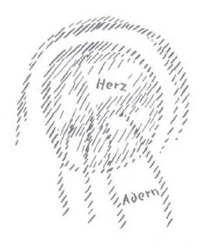
[ 10 ] Nehmen Sie jetzt einmal an, ein Kind wird geboren, und durch irgend etwas hat es einen zu langsamen Blutumlauf. Das kann also vorkommen. Es kann das vorkommen, daß das Kind durch Vererbung einen zu langsamen Blutumlauf hat; das gibt es einmal. Nun denken Sie sich einmal, das Kind - ich will jetzt Adern zeichnen — hat so die Adern und da geht das Blut zu langsam durch; da ist das Herz, da geht das Blut zu langsam durch. Aber das Herz wird vom Kopfe aus gebildet. Der Kopf kann ganz in Ordnung sein, doch der Blutumlauf ist zu langsam. So kommt es, daß das Herz zwar ordentlich ausgebildet ist, aber daß das Blut nicht ordentlich hereinfließt ins Herz. Das ist bei Kindern im allerersten Säuglingsalter sehr häufig der Fall, daß der Kopf ganz ordentlich ist, aber nicht ein ordentlicher Blutumlauf stattfindet. Das kann einfach dadurch geschehen, daß das Kind in stickiger Luft lebt; so kann es dann nicht richtig atmen, und der Blutkreislauf stockt. Oder wenn es nicht die richtige Nahrung kriegt, kann das Blut nicht richtig in den Körper übergeführt werden; der Blutkreislauf kann stocken. Der Kopf ist ganz in Ordnung, will das Herz richtig ausbilden, aber der Blutumlauf stockt. Statt daß die Sache richtig abgeführt wird vom Herz in die Nieren und herausginge, bleibt sie im Körper, bleibt sie im Blut drinnen. Sind Stoffe, die nicht im Körper sein sollten, die schon herausgeschafft sein sollten, noch im Blut drinnen, so vereitert das Blur.
[ 10 ] Now suppose a child is born, and for some reason its blood circulation is too slow. So that can happen. It can happen that the child has too slow blood circulation due to heredity; that is one possibility. Now imagine that the child—I’ll draw some veins here—has veins like this, and the blood flows through them too slowly; there’s the heart, and the blood flows through it too slowly. But the heart is formed by the head. The head may be perfectly normal, yet the blood circulation is too slow. So it happens that although the heart is properly formed, the blood does not flow properly into it. This is very common in children in the very early infant stage: the head is perfectly normal, but proper blood circulation does not take place. This can happen simply because the child lives in stuffy air; as a result, the child cannot breathe properly, and blood circulation stalls. Or if the child does not receive the right nutrition, the blood cannot be properly transported throughout the body; blood circulation can stall. The head is perfectly fine and wants the heart to develop properly, but blood circulation stalls. Instead of substances being properly carried from the heart to the kidneys and excreted, they remain in the body, remaining in the blood. If substances that should not be in the body—that should already have been excreted—are still in the blood, the blood becomes infected.
[ 11 ] Sehen Sie, diese Gefahr ist eben später, sagen wir, im achten, neunten Jahre nicht mehr so stark vorhanden, als sie vorhanden ist im allerersten Kindesalter. Warum? Nun, wenn das Kind die zweiten Zähne ordentlich gekriegt hat, so ist das schon ein Beweis dafür, daß sein Körper eigentlich stark ist. Sonst kriegt es die zweiten Zähne nicht ordentlich. Warum? Ja, sehen Sie, die zweiten Zähne, die werden ja aus dem ganzen Körper herausgetrieben. Was da in einem Zahn sitzt, das kommt aus dem ganzen Körper heraus; das ist nicht bloß etwa da im Kiefer, sondern beim zweiten Zähnekriegen ist der ganze Körper tätig. Aber nur bei den zweiten Zähnen. Bei den ersten Zähnen noch nicht. Die ersten Zähne, die das Kind kriegt, die sogenannten Milchzähne, die sind etwas ganz anderes als die zweiten Zähne. Die ersten Zähne kriegt das Kind durch Vererbung, weil seine Mutter und sein Vater auch Zähne haben. Diese werden im Lauf der ersten sieben Jahre ausgestoßen, und dann kriegt das Kind erst seine eigenen Zähne, die zweiten Zähne, die der Körper selber fabrizieren muß.
[ 11 ] You see, this danger isn't as great later on—say, in the eighth or ninth year—as it is in early childhood. Why? Well, if the child has grown its permanent teeth properly, that's already proof that its body is actually strong. Otherwise, it wouldn't grow its permanent teeth properly. Why? Well, you see, the permanent teeth are actually driven up from the entire body. What’s inside a tooth comes from the whole body; it’s not just something in the jaw—when the permanent teeth come in, the whole body is at work. But that’s only the case with the permanent teeth. Not yet with the first set of teeth. The first teeth a child gets—the so-called baby teeth—are something entirely different from the permanent teeth. A child gets its first teeth through heredity, because its mother and father also have teeth. These are shed over the course of the first seven years, and only then does the child get its own teeth—the permanent teeth—which the body must produce itself.
[ 12 ] Überhaupt, wenn Sie ein Kind angucken, das neun oder zehn Jahre alt ist, so hat es ja schon seinen zweiten Körper. Da ist der erste, den es geerbt hat, ganz weggeschmissen. Eigentlich kriegt das Kind seinen eigenen Körper erst so um das siebente Jahr herum. Und während der ganzen Zeit bis zum siebenten Jahre, da zeigt es sich, daß das Kind so stark geboren ist, daß es die Luft und die Nahrung verträgt. Hat es gezeigt, daß es die zweiten Zähne kriegen kann, dann ist die Gefahr, krank zu werden, nicht mehr so groß, weil es schon seinen Körper aufgebaut hat; dann hat es eben die Zähne schon. Und deshalb ist die Gefahr am allergrößten beim Säugling. Er muß in alles, was er sonst im Schutze des Mutterleibes getan hat, sich hineinfinden. Der Kopf ist eigentlich immer im ersten Stadium gut; er wird erst später schlecht. Wenn man einmal alt wird, ist der Kopf nicht mehr so ordentlich. Da soll er denken, sich mit der Außenwelt beschäftigen. Da muß er sich auch erst hineinfinden. Da hapert es auch häufig! Aber in den allerersten Lebensjahren braucht das Kind noch nicht Geschicklichkeit für die Arbeit, braucht noch nicht in die Schule zu gehen, noch nichts zu lernen. Der Kopf arbeitet nur am eigenen Körper. Dazu ist er meistens gut. Aber der eigene Körper, der ist im zarten Kindesalter am allerschlechtesten, denn da muß man sich erst eingewöhnen in die Welt.
[ 12 ] In fact, when you look at a child who is nine or ten years old, they already have their second body. The first one—the one they inherited—has been completely cast aside. Actually, the child doesn’t really develop its own body until around the age of seven. And during the entire period up to the age of seven, it becomes apparent that the child was born strong enough to tolerate the air and food. Once it has shown that it can grow its second set of teeth, the risk of getting sick is no longer as great, because it has already built up its body; by then, it already has its teeth. And that is why the danger is greatest of all for the infant. It must find its way in everything it previously did under the protection of the womb. The mind is actually always sound in the first stage; it only deteriorates later. Once a person grows old, the mind is no longer as sound. Then it is expected to think and engage with the outside world. It must first find its way there as well. That’s where things often go wrong! But in the very first years of life, the child doesn’t yet need dexterity for work, doesn’t yet need to go to school, and doesn’t yet need to learn anything. The mind works only on its own body. It’s usually good at that. But the child’s own body is at its worst during tender childhood, because that’s when one must first get used to the world.
[ 13 ] Nun, nicht ganz so, wie ich es erzähle, weil ich Ihnen die Tatsachen ganz genau erzähle, aber so ähnlich erzählt das ja auch die äußere Wissenschaft. Aber diese äußere Wissenschaft versteht eigentlich den ganzen Vorgang nicht. Diese ganze äußere Wissenschaft steht eigentlich wie vor einem Rätsel, wenn sie nun sieht, wie der Mensch in den allerersten Jahren den größten Krankheiten ausgesetzt ist. Aber das ist aus dem Grunde, weil diese äußere Wissenschaft glaubt, daß das, was man Seele und Geist nennt, eigentlich nichts Rechtes ist.
[ 13 ] Well, not quite the way I’m describing it—because I’m telling you the facts exactly as they are—but that’s more or less how conventional science describes it, too. But this conventional science doesn’t really understand the whole process. The entire field of conventional science is actually baffled when it sees how humans are exposed to the most serious illnesses in their very first years of life. But that is because this conventional science believes that what is called the soul and the spirit is not really anything real.
[ 14 ] In Wirklichkeit ist das so: Wenn das Kind noch im Leibe der Mutter ist und dann geboren wird, so ist ja das Seelisch-Geistige hauptsächlich mit dem Kopf verbunden. Was da drinnen arbeitet, sind ja Kräfte, ist ja dasjenige, was man nicht sieht. Diese Kräfte, diese geistig-seelischen Kräfte arbeiten an dem Kinde.
[ 14 ] In reality, it is like this: When the child is still in the mother’s womb and is then born, the soul-spiritual aspect is primarily connected to the head. What is at work there are forces—that which cannot be seen. These forces, these soul-spiritual forces, are at work within the child.
[ 15 ] Sie werden sagen: Ja, das ist eine Ansicht, die man haben kann oder nicht. Aber wenn Sie glauben, daß man diese Ansicht haben kann oder nicht, dann machen Sie sich desselben Irrtums schuldig, wie jemand, der sagt: Da ist ein Stück Eisen; ein anderer kommt und sagt: Her damit, damit will ich mein Pferd beschlagen! — Der erste sagt ihm aber: Kerl, du bist aber dumm, wenn du damit dein Pferd beschlagen willst! Das ist nämlich ein Magnet, da ist eine Kraft drinnen. Diesen Magnet, den verwendet man zu etwas ganz anderem als zum Pferdebeschlagen! - Der eine weiß, das ist einfach ein Hufeisen; der andere weiß, daß es ein Magnet ist, in dem eine unsichtbare Kraft drinnen ist. Sie können das ja nicht sehen. Und ebenso ist der, der mit der materialistischen Wissenschaft sagt: Nun ja, das ist ein Stück Fleisch, der Kopf. - Der ist geradeso wie der, der sagt: Das ist ein Hufeisen! — Der kindliche Kopf ist eben nicht bloß ein Stück Fleisch, sondern da drinnen arbeiten die unsichtbaren Kräfte, die wie ein Bildhauer den ganzen menschlichen Organismus aufbauen. Sie bauen ganz frisch auf in den ersten sieben Jahren. Der Mensch behält ja manches davon als die Form, die Gestalt, was er geerbt hat. Und die Kräfte, mit denen der Mensch da ganz frisch aufgebaut wird, das sind die seelisch-geistigen Kräfte, die vom Kopfe ausgehen, und die bringt der Mensch von ganz woanders her als von den Eltern.
[ 15 ] You might say: Yes, that’s a view one may or may not hold. But if you believe that one may or may not hold this view, then you’re guilty of the same error as someone who says: “There’s a piece of iron”; another comes along and says: “Give it to me—I want to shoe my horse with it!” — But the first one says to him: “Man, you’re really stupid if you want to shoe your horse with that! That’s actually a magnet; there’s a force inside it. This magnet is used for something completely different than shoeing horses!” — One knows it’s simply a horseshoe; the other knows it’s a magnet containing an invisible force. You can’t see that, of course. And the same goes for the person who, relying on materialistic science, says: “Well, the head is just a piece of meat.” — He’s just like the one who says: “That’s a horseshoe!” — A child’s head isn’t merely a piece of meat; rather, invisible forces are at work inside it, building up the entire human organism like a sculptor. They build it up anew during the first seven years. After all, a person retains some of this as the form and shape they have inherited. And the forces with which a person is built up anew—these are the soul-spiritual forces that emanate from the head, and a person brings these from somewhere entirely different than from their parents.
[ 16 ] Wenn er sie sich von den Eltern herbrächte - ja, meine Herren, wenn mal einer ein Genie ist, haben Sie gesehen, daß dann die Kinder auch Genies werden? Oder wenn die Kinder Genies sind, haben Sie gesehen, daß die Eltern es auch sind? Das ist ganz gewiß nicht der Fall! Nehmen Sie zum Beispiel Goethe, der ganz gewiß ein Genie war: sein Vater war ein furchtbarer Philister, seine Mutter war auch kein Genie — sie war eine liebe, nette Frau, die schöne Geschichten erzählen konnte -, und sein Sohn war dumm, der war gar kein Genie. Also dasjenige, was geistig-seelisch ist, das kann man nicht vererben, das bringt man sich aus ganz anderen Welten mit. Das vereinigt sich nur mit dem, was man vererbt. Der Mensch hat eben außer dem, daß er ein Dasein hat im Mutterleibe, ein Dasein vorher als geistig-seelischer Mensch.
[ 16 ] If he inherited it from his parents—yes, gentlemen, if someone is a genius, have you ever seen that their children become geniuses too? Or if the children are geniuses, have you ever seen that the parents are as well? That is certainly not the case! Take Goethe, for example, who was certainly a genius: his father was a terrible philistine, his mother was no genius either—she was a dear, kind woman who could tell beautiful stories—and his son was stupid; he was no genius at all. So whatever is spiritual and soulful cannot be inherited; one brings it with oneself from entirely different worlds. It merely unites with what is inherited. Human beings, apart from their existence in the womb, have a prior existence as spiritual and soulful beings.
[ 17 ] Sehen Sie, daß die Menschen das heute ableugnen, das beruht ja nur darauf, daß das ganze Mittelalter hindurch die katholische Kirche gesagt hat: Man darf dem Menschen nicht ein geistig-seelisches Dasein vor der Geburt zuschreiben — weil die katholische Kirche angenommen hat, die Seele muß geschaffen werden bei der Geburt von irgendeinem solchen Gotte, wie ihn eben die katholische Kirche angenommen hat. Und dasjenige, was die katholische Kirche das ganze Mittelalter hindurch verboten hat anzunehmen, daß man eine, wie man es dazumal nannte, Präexistenz hatte — das heißt vorexistieren, vorher existieren -, das beobachtet heute die materialistische Wissenschaft auch und fühlt sich furchtbar gescheit. Das ist es eben, daß die Leute gar nicht wissen, wie sie erst dressiert worden sind zu solcher Ansicht, und nachher glauben, gerade mit einer solchen Ansicht besonders gescheit zu sein.
[ 17 ] You see, the reason people deny this today is simply because, throughout the entire Middle Ages, the Catholic Church claimed: One must not attribute a spiritual-soul existence to a human being prior to birth—because the Catholic Church assumed that the soul must be created at birth by some kind of God, as the Catholic Church itself conceived Him. And what the Catholic Church forbade people to accept throughout the entire Middle Ages—namely, that one had, as it was called back then, “pre-existence”—that is, existing beforehand—is now also observed by materialistic science, which considers itself terribly clever. The point is that people have no idea how they were initially conditioned to hold such a view, and subsequently believe that holding precisely this view makes them particularly clever.
[ 18 ] In Wahrheit ist es so, daß tatsächlich der Mensch, geradeso wie er ein physisches Dasein in seinen Eltern, Großeltern und so weiter hat, ein geistig-seelisches Dasein hat, das er sich mitbringt. Das arbeitet in ihm. Das ist das Geistig-Seelische. Und derjenige, der nicht einsieht, daß das Geistig-Seelische vor dem Körper schon da ist, sieht auch nicht ein, daß das Geistig-Seelische nach dem Tode bleibt, sondern er kann höchstens daran glauben. Ein Wissen von der Unsterblichkeit der menschlichen Seele kann man nur dadurch bekommen, daß man auch weiß: sie ist vorher schon da. Natürlich stünde es einem göttlichen Schöpfer zu, wenn er den Menschen schaffen würde, die Seele auch wieder verschwinden zu lassen, wenn der Mensch stirbt; aber wenn diese Seele erst da sein muß, damit der Körper aufgebaut werden kann, dann bleibt sie natürlich auch vorhanden, wenn der Körper stirbt.
[ 18 ] The truth is that just as a person has a physical existence in their parents, grandparents, and so on, they also have a spiritual-soul existence that they bring with them. This is at work within him. This is the spiritual-soul aspect. And anyone who does not recognize that the spiritual-soul aspect already exists before the body also fails to recognize that the spiritual-soul aspect remains after death; at best, he can only believe in it. Knowledge of the immortality of the human soul can only be gained by also knowing that it already exists beforehand. Of course, it would be within the power of a divine Creator, if He were to create human beings, to cause the soul to vanish again when a person dies; but if this soul must first be present in order for the body to be formed, then it naturally remains in existence even after the body dies.
[ 19 ] Also Sie können sich sagen: Aus alle den Dingen, welche man richtig beobachten kann, folgt ganz ohne weiteres das Dasein der menschlichen Seele. Und wie soll sie denn sterben, wenn sie es ist, die das Sterbliche erst aufgebaut hat! Man müßte ja in ganz andere Welten gehen, um einzusehen, daß die Seele sterben könnte. Darüber wollen wir dann in späteren Vorträgen reden, daß sie dort auch nicht sterben kann. Aber durch den Körper kann sie nicht sterben, weil sie den Körper erst selber aufbaut.
[ 19 ] So you can say to yourself: From all the things that can be properly observed, the existence of the human soul follows quite naturally. And how could it possibly die, when it is the very thing that created the mortal body in the first place! One would have to go into entirely different worlds to realize that the soul could die. We will discuss in later lectures that it cannot die there either. But it cannot die through the body, because it is the soul itself that first creates the body.
[ 20 ] Jetzt haben wir solche Krankheiten kennengelernt, die dadurch entstehen, daß vom Kopfe aus das Geistig-Seelische arbeitet und der Körper nicht in Ordnung ist. Es kann aber noch anderes eintreten. Es kann das eintreten, daß der Blutkreislauf zu langsam ist und die Stockung eintritt, von der ich Ihnen gesagt habe, daß das Blut vereitert. Aber es kann noch etwas ganz anderes eintreten. Es kann das eintreten, daß das Kind Nahrung bekommt und es zu schwach ist, diese Nahrung überhaupt vom Darm aus nur ins Blut hinein zu kriegen. Es geht nicht durch die Darmzotten durch. Der Körper ist zu schwach. Was tritt dann ein? Dann kriegt das Kind zunächst einmal Durchfall. Natürlich, was nicht aufgenommen wird, muß heraus; aber es sollte eigentlich im Körper bleiben und aufgenommen werden. Statt dessen geht es im Durchfall unverarbeitet hinaus. Aber das ist noch mit etwas anderem verbunden. Gewiß, das Kind kriegt ein bißchen Durchfall, stärkeren Durchfall, kriegt vielleicht Brechdurchfall. Das ist oftmals nur das erste Stadium. Aber wenn das Kind längere Zeit die Nahrungsstoffe nicht verarbeiten kann, dann können ja die inneren Organe nicht aufgebaut werden. Der Kopf will sie fortwährend aufbauen. Die inneren Organe können nicht aufgebaut werden, weil kein Stoff durchgeht. Es ist so, wie wenn Sie, sagen wir, an irgendeiner Bildsäule arbeiten und keinen Stoff haben, aus dem Sie sie machen können, und Sie fuchteln in der Luft herum. So fuchtelt der Kopf in der Luft herum, wenn zum Beispiel das Kind keinen Stoff bekommt, aus dem es die Organe formen kann. Er will das Herz formen, den Magen formen. Er fuchtelt in der Luft herum, weil er keinen Stoff kriegt, weil der durch den Durchfall weggegangen ist.
[ 20 ] We have now learned about illnesses that arise when the spiritual-soul aspects are active in the head while the body is not functioning properly. But other things can happen as well. It can happen that the blood circulation is too slow and stagnation sets in—which, as I’ve told you, causes the blood to become putrid. But something else entirely can happen as well. It can happen that the child receives nourishment but is too weak to even get that nourishment from the intestines into the bloodstream. It doesn’t pass through the intestinal villi. The body is too weak. What happens then? First of all, the child develops diarrhea. Of course, what is not absorbed must come out; but it should actually remain in the body and be absorbed. Instead, it leaves the body unprocessed in the diarrhea. But this is also connected to something else. Certainly, the child gets a little diarrhea, more severe diarrhea, and may even experience vomiting and diarrhea. This is often only the first stage. But if the child is unable to process nutrients for an extended period, then the internal organs cannot be built up. The head is constantly striving to build them up. The internal organs cannot be built up because no material is passing through. It is as if you were, say, working on a statue and had no material with which to make it, so you were just waving your hands around in the air. That’s how the mind flails about in the air when, for example, the child doesn’t receive the material needed to form the organs. It wants to form the heart, to form the stomach. It flails about in the air because it doesn’t get any material—because it has been lost through diarrhea.
[ 21 ] Ja, wenn man nun materialistischer Gelehrter ist, kann man jetzt überhaupt nichts begreifen. Da sagt man sich halt: Ich untersuche das Kind; nun, das hat Durchfall. Geben wir ihm irgendwelche Mittel, daß es nicht weiter Durchfall hat. - Da wird nur die Folge sein, daß die Nahrungsstoffe sich im Darm ansammeln, denn aufgenommen können sie nicht werden, und das Kind kriegt einen dicken Bauch, aber weiter nichts. Man untersucht weiter und findet, daß zum Beispiel die Lunge nichts anderes als ein leerer Beutel wird. Sie will gebildet werden, aber die Stoffe sind nicht da. Man findet nichts als einen leeren Beutel anstelle der Lunge.
[ 21 ] Yes, if you’re a materialistic scholar, you can’t understand anything at all. You just say to yourself: I’m examining the child; well, it has diarrhea. Let’s give it some kind of remedy so it doesn’t have diarrhea anymore. - The only result will be that nutrients accumulate in the intestines, since they cannot be absorbed, and the child will develop a distended belly, but nothing else. You continue the examination and find, for example, that the lung has become nothing more than an empty sac. It needs to develop, but the necessary substances aren’t there. You find nothing but an empty sac in place of the lung.
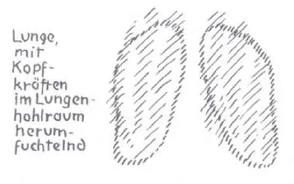
[ 22 ] Derjenige, der also die Lunge anguckt und nur einen leeren Beutel findet, der muß aber wissen, daß in diese Lunge eben gerade diejenigen Kräfte hineingehen, die vom Kopfe ausgehen. Das, was vom Kopfe ausgeht, das geht in die Lunge, durch die Lunge. Jetzt wollen die Kräfte vom Kopfe aus etwas haben, wodurch sie sich betätigen können. Die greifen etwas an, was ihnen keinen Halt gibt. Jetzt ist das so: Wenn ich den Stuhl schüttle, da habe ich Halt am Stuhl; wenn ich aber so herumfuchtle und nicht den Stuhl kriege, habe ich keinen Halt. Sie sehen dann nur, daß ich wie ein Narr herumfuchtle. Aber wenn der Kopf herumfuchtelt in der Lunge und keinen Halt kriegt, dann entstehen Krämpfe, die Fraisen.
[ 22 ] So anyone who looks at the lungs and finds only an empty sac must understand that the very forces emanating from the head flow into these lungs. What emanates from the head enters the lungs, passing through them. Now the forces from the head want something through which they can act. They grasp at something that offers them no support. Here’s how it works: When I shake the chair, I have a foothold on the chair; but when I wave my arms around like this and can’t grab the chair, I have no foothold. Then you just see me waving my arms around like a fool. But when the head waves its arms around in the lungs and can’t find a foothold, that’s when spasms—the “Fraisen”—arise.
[ 23 ] Sehen Sie, wenn einer überhaupt vernünftigerweise die Krämpfe erklären will, dann muß er wissen, daß da der Kopf herumfuchtelt und keinen Halt kriegt. Durchfälle kann man noch auf materialistische Weise erklären; Krämpfe kann man nicht mehr auf materialistische Weise erklären.
[ 23 ] You see, if anyone wants to explain the convulsions in a reasonable way, they must understand that the head is thrashing about and cannot find a foothold. Diarrhea can still be explained in a materialistic way; convulsions, however, can no longer be explained in a materialistic way.
[ 24 ] Also das zeigt einem, daß gerade beim Kind am meisten geistige Tätigkeit vorhanden ist. Die hört später auf. Denn so viel geistige Tätigkeit ist beim Kind vorhanden, daß aus alledem, was es ißt bis zu seinem sechsten, siebenten Jahre, immer nur ganz kleine, winzige Partikel, Teile, ausgesondert werden, und aus denen werden nun die zweiten Zähne gemacht. Denken Sie, meine Herren, wenn Sie das selber machen müßten! Sie müßten erstens so gescheit sein, daß Sie wissen könnten, wie in den Nahrungsmitteln da drinnen Magnesiumsalze und kohlensaure Salze sind. Das kann man zur Not noch lernen, aber man kann es auch nur dadurch, daß man die Zähne zuerst chemisch analysiert, selber erst aus den Zähnen lernt. Denn kein Mensch kann natürlich heute sagen, wie man solche Zähne macht, denn die künstlichen Zähne, die gemacht werden, sind ja natürlich keine Zähne, keine lebendigen Zähne. Also da wird aus alledem, was das Kind ißt bis zum siebenten Jahre, immer in ganz kleinen Portionen dasjenige herausgeholt, was als zweite Zähne erscheint.
[ 24 ] So this shows us that mental activity is at its peak in children. This activity ceases later on. For there is so much mental activity in a child that, from everything it eats up until the age of six or seven, only very small, tiny particles—fragments—are extracted, and these are then used to form the second set of teeth. Just think, gentlemen, if you had to do that yourselves! First of all, you’d have to be smart enough to know how magnesium salts and carbonic acid salts are present in the food. You could learn that if necessary, but you could only do so by first chemically analyzing the teeth and then learning it from the teeth themselves. For no one today can naturally say how to make such teeth, since the artificial teeth that are made are, of course, not teeth—not living teeth. So, from everything the child eats up to the age of seven, in very small portions, the substance that will become the second set of teeth is extracted.
[ 25 ] Aber man muß nicht nur wissen, was für Stoffe drinnen sind, sondern man muß wissen, was machen sie im Magen, damit der richtige Stoff ausgesondert wird, oder was machen diese kleinen Partikelchen, die Sie ausgesondert haben im zweiten, dritten Jahre? Wenn Sie das ausgesondert haben, wie halten Sie das lange genug im Blutkreislauf fest, daß es weiter mitgeht, gerade just im sechsten, siebenten, achten Jahr in die Kiefer hineingeht, so daß die Zähne daraus werden? Das alles muß ja gemacht werden und wird gemacht von dem GeistigSeelischen des Kindes, das nur unbewußt ist. Aber gemacht wird es. Ich glaube, Sie werden sich gar nicht beleidigt fühlen, wenn ich Ihnen sage: Sie sind nicht imstande, wenn ich sage, laß da irgendwo ein einziges Haar wachsen -, Sie sind nicht imstande, dieses Haar irgendwie wachsen zu lassen! Aber das Kind ist dazu imstande, indem es die nötigen Stoffe hintreibt bis zu dem Ort, wo die Haarwurzeln sich eingliedern, diese Stoffe dem Lichte entgegenzubringen - denn die Haare wachsen, werden aus Licht.
[ 25 ] But it’s not enough just to know what substances are in there; you also need to know what they do in the stomach so that the right substance is excreted, or what do those tiny particles you’ve excreted do in the second, third year? Once you’ve excreted them, how do you keep them in the bloodstream long enough so that they continue on their way, entering the jaw precisely in the sixth, seventh, and eighth years, so that they develop into teeth? All of this has to be done, and it is done by the child’s spiritual-soul aspect, which is merely unconscious. But it is done. I don’t think you’ll feel offended at all if I tell you: You are not capable—if I were to say, “Let a single hair grow somewhere”—you are not capable of making that hair grow in any way! But the child is capable of doing this by directing the necessary substances to the place where the hair roots take hold, bringing these substances toward the light—for the hair grows and comes into being from light.
[ 26 ] Also das alles geschieht in dem Kinde. Sehen Sie, das alles ist etwas, wovon die heutige Wissenschaft nicht reden will. Sie macht den Leuten diese Dinge durchaus unklar. Sie weiß nichts darüber und will nicht reden davon, daß da das Geistig-Seelische drinnen arbeitet, und daß das Geistig-Seelische nicht vererbt wird, sondern daß das GeistigSeelische eben aus einer geistigen Welt kommt.
[ 26 ] So all of this takes place within the child. You see, this is something modern science does not want to talk about. It makes these things completely unclear to people. It knows nothing about it and does not want to talk about the fact that the spiritual-soul aspect is at work within the child, and that the spiritual-soul aspect is not inherited, but rather comes from a spiritual world.
[ 27 ] Nun, ich habe Ihnen das Beispiel von den Haaren erzählt. Sehen Sie, der Mensch ist ja im allgemeinen während seines normalen Lebens nicht behaart, sondern nur an gewissen Stellen bleiben die Haare, sonst ist er unbehaart. Aber der Mensch war einmal auf der Erde auch behaart. Er hat die Haare verloren. Er war ein ganz behaarter Mensch. Einmal, in sehr alten Zeiten war der Mensch auch zottelig behaart, ganz zottelig behaart. Er hat die Haare verloren. Ja, wodurch hat der Mensch die Haare verloren? Ich will Ihnen darüber keine Theorie geben, denn die kann man sich ausdenken, aber ich will Sie auf Tatsachen verweisen. Andere Wesen zum Beispiel, welche auch, wenn sie in der Natur herumgehen, behaart sind, verlieren die Haare, wenn sie zahm gemacht werden: das sind die Schweine. Schauen Sie sie an im wilden Zustande: da haben sie Haare; und wenn sie gezähmt werden, wenn sie also in solchen Verhältnissen leben, in denen sie ursprünglich nicht gelebt haben, da verlieren sie die Haare. Der Mensch hat auch ursprünglich nicht in solchen Verhältnissen gelebt wie heute. Der Mensch ist nämlich auch wie solch ein gezähmtes Tier. Daß er aber Haare bekommen hat, unter dem Einfluß von Licht und Wärme Haare bekommen hat, das zeigt das Kind ja heute noch; denn in den ersten Monaten, wo es fast nur Kopf ist, da ist der ganze Kindeskeim behaart — im Mutterleib ist das Kind in den ersten Monaten sogar behaart! Die Haare verliert es wieder; die gehen weg. Es ist ganz behaart. Geradeso wie ich Ihnen erklärt habe, daß die Pflanzen im ersten Stadium das Licht und die Wärme noch vom vorigen Jahr haben, so hat das Kind Licht und Wärme von der Mutter, so bekommt es das Licht und verliert erst später die Haare. Also auch daraus können Sie sehen, wie das GeistigSeelische am Körper arbeitet.
[ 27 ] Well, I told you the example about hair. You see, humans generally aren’t hairy during their normal lives; hair remains only in certain places, and otherwise they’re hairless. But humans used to be hairy on Earth, too. They lost their hair. They used to be completely hairy. Once, in very ancient times, humans were also shaggy with hair—completely shaggy. They lost their hair. Yes, how did humans lose their hair? I don’t want to offer you a theory about this, because you can come up with your own, but I want to point out the facts. Other creatures, for example, which are also hairy when they roam freely in nature, lose their hair when they are domesticated: pigs are a case in point. Look at them in the wild: there they have hair; and when they are domesticated—that is, when they live in conditions in which they did not originally live—they lose their hair. Humans, too, did not originally live in conditions like those of today. For human beings are, in fact, like such a domesticated animal. But the fact that they grew hair—that they grew hair under the influence of light and warmth—is still evident in children today; for in the first few months, when they are almost entirely head, the entire embryo is covered with hair—in the womb, the child is even covered with hair during the first few months! It loses that hair again; it falls out. It is completely covered in hair. Just as I explained to you that plants in their first stage still have the light and warmth from the previous year, so the child receives light and warmth from the mother; thus it receives the light and only loses the hair later. So from this, too, you can see how the spiritual-soul aspect works in the body.
[ 28 ] Nun sagte ich Ihnen: Während des schulpflichtigen Alters, da ist der Mensch eigentlich von Natur aus am allergesündesten. Das ist so. Warum? Ja, das ist so, weil nur diejenigen Menschen übrig bleiben, die die Kräfte entwickelt haben, durch die sie die zweiten Zähne entwickeln können, denn das sind starke Kräfte. Man treibt da ganz harte Kräfte aus sich heraus. Diese Kräfte, die muß man durch eine ganz furchtbar starke Angewöhnung erst erwerben während des kindlichen Alters. In den ersten Kindesjahren ist also alles dasjenige, was der Kopf am Innern des Menschen macht, am stärksten entwickelt. Und da ist es wirklich so, daß man sagen muß - natürlich weiß der Mensch nichts davon -: Dieser Kopf, der muß sich anstrengen, der muß ein ganz großer Künstler sein. Und der Körper gibt ihm fortwährend Widerstände. Dagegen muß der Kopf fortwährend ankämpfen. Es hilft ihm nichts. In den ersten sieben Jahren kann er nichts haben, was ihm richtig hilft. Man muß solch eine furchtbare Kraft anwenden. Und unter dieser Kraftanstrengung kommen eben alle diese Krankheiten, von denen ich Ihnen erzählt habe.
[ 28 ] Now I told you: During the school-age years, a person is actually, by nature, at their healthiest. That is true. Why? Well, it is true because only those people remain who have developed the forces that enable them to grow their permanent teeth—for those are powerful forces. One draws very powerful forces from within oneself. These forces must first be acquired through an incredibly intense process of habituation during childhood. In the early years of childhood, therefore, everything that the mind does within a person is most strongly developed. And it is truly the case that one must say—though, of course, the person knows nothing of this—: This head—it has to exert itself; it has to be a truly great artist. And the body constantly offers it resistance. The head must constantly struggle against this. Nothing helps it. In the first seven years, it cannot have anything that truly helps it. One must exert such a tremendous amount of force. And it is precisely under this exertion of force that all these illnesses I have told you about arise.
[ 29 ] Nehmen Sie aber jetzt an, der Blutkreislauf ist nicht dadurch in Unordnung, daß nicht genügend abgeht, sondern daß zu viel übergeführt wird. Das kann ja auch sein. Es gibt schon einmal dieses, daß die Eltern eben nicht so weise sind, wie der menschliche Organismus eigentlich ist. Die Eltern glauben oftmals: Wenn man möglichst viel hineinstopft, so ist das das allerbeste. Nun, man kann ja daraus niemand einen Vorwurf machen, denn es ist wirklich im allgemeinen schwer zu wissen, wann das Kind genug hat. Es weiß es meistens nur durch seinen eigenen Instinkt, durch seine eigene Weisheit, die in ihm ist. Wenn es zu viel Milch kriegt, weil die Mutter zu viel erzeugt, bekommt das Kind einen unsicheren Instinkt und ißt selber zu viel. Dann wird zu viel hineingestopft, da kann der Kopf nicht nach; dann ist er zu langsam, um das Viele da hineinzukriegen. Dann muß er sich wehren, damit das ausgeworfen wird, damit das weggeht. Aber das ist ja schon von dem Darm ins Blut hineingegangen; er kann es nicht mehr auf dem natürlichen Wege des Wiederablassens oder der Verdauung wegwerfen, denn es ist schon ins Blut hineingegangen. Was tut er? Er muß es auswerfen durch die Haut. Scharlach, Masern entstehen! Scharlach und Masern sind ganz andere Krankheiten als Durchfall oder die Krämpfe. Durchfall und Krämpfe, das sind Krankheiten, die das Kind kriegt, weil es im Innern einfach herumfuchtelt und zu wenig Nahrung bekommt. Wenn aber zu viel hineinkommt, dann muß das ausgeworfen werden, und dann entstehen solche Dinge, selbst dasjenige, was dann durch die Lungen ausgeworfen wird, wenn es zu viel ist. Diphtherie, Lungenentzündung, die werden dadurch hervorgerufen, daß der Körper sich dadurch hilft, daß er noch durch die Haut wegwirft, was er sonst nicht herauskriegt. Wenn man den Menschen versteht, versteht man, wie das eigentlich vor sich geht, und es ist ganz natürlich, daß ein Kind solche Krankheiten kriegen kann.
[ 29 ] But suppose now that the blood circulation is not disrupted because not enough is flowing out, but because too much is being transported. That is certainly possible. It is certainly true that parents are simply not as wise as the human organism actually is. Parents often believe that stuffing as much as possible into a child is the very best thing. Well, you can’t really blame anyone for that, because it’s generally difficult to know when a child has had enough. The child usually knows this only through its own instinct, through its own inner wisdom. If the child gets too much milk because the mother produces too much, the child develops an unreliable instinct and ends up eating too much. Then too much is crammed in, and the brain can’t keep up; it’s too slow to process all that food. Then the child has to fight back so that it’s expelled, so that it goes away. But by then it has already entered the bloodstream from the intestines; the child can no longer eliminate it through the natural processes of excretion or digestion, because it has already entered the bloodstream. What does the child do? It must expel it through the skin. Scarlet fever and measles develop! Scarlet fever and measles are entirely different illnesses than diarrhea or cramps. Diarrhea and cramps are illnesses that a child gets simply because the child is thrashing about inside and not getting enough nourishment. But when too much enters the body, it must be expelled, and that’s when such conditions arise—even what is eventually expelled through the lungs when there’s too much. Diphtheria and pneumonia are caused by the body’s attempt to help itself by expelling through the skin what it cannot otherwise get out. When one understands the human body, one understands how this actually works, and it is perfectly natural for a child to contract such illnesses.
[ 30 ] Es kann noch andere Krankheiten kriegen. Denken Sie einmal, es ist gerade zufällig das Kind zu schwach, um die zweiten Zähne herauszutreiben. Es hat die ersten Zähne gekriegt, die hat es geerbt; da braucht es sich nicht anzustrengen. Aber es ist zu schwach, um die zweiten herauszutreiben. Jetzt gehen die Kräfte, die da nicht ankommen, in die Lunge, und das Kind zeigt eine Lungenentzündung. Das kann auch sein. Der menschliche Leib ist ein furchtbar kompliziertes Ding. Wenn also ein Kind eine Lungenentzündung kriegt, so ist nicht nur nachzuschauen, wie es mit dem Kind auf der Lunge ist, sondern wie es ist mit den Nieren, wie mit dem Magen und so weiter. Man muß also bei jeglicher Krankheit den ganzen menschlichen Körper untersuchen, nicht nur einen Teil, an dem gerade die Krankheit auftritt.
[ 30 ] It can develop other illnesses as well. Just imagine: it just so happens that the child is too weak to push through its second set of teeth. It has already gotten its first set of teeth—which it inherited—so it doesn’t have to exert itself there. But it’s too weak to push through the second set. Now the energy that isn’t going there is directed to the lungs, and the child develops pneumonia. That can happen, too. The human body is an incredibly complex thing. So when a child gets pneumonia, one must not only examine the condition of the child’s lungs, but also the condition of the kidneys, the stomach, and so on. With any illness, therefore, one must examine the entire human body, not just the part where the illness is currently manifesting.
[ 31 ] Wenn aber das Kind jetzt sieben Jahre alt ist, dann sind auch seine Atmungsorgane so weit, daß nicht mehr der ganze Körper vom Kopf aus die Atmung besorgen muß. Beim ganz kleinen Kind muß der Kopf noch fortwährend die Atmungsorgane in Ordnung bringen. So wie er die Zähne aufbauen muß, so muß er die Atmungsorgane aufbauen. Mit dem siebenten, achten Jahre ist das Kind so weit, daß sie in Ordnung sind. Jetzt kann das Kind ordentlich atmen. Das ist gerade das Allerwichtigste, daß man einsieht: Wenn das Kind die zweiten Zähne gekriegt hat, ist sein Atmungsorganismus in Ordnung gekommen; es hat seine zweiten Lungen bekommen, seine zweiten Bronchien - alles ist aufgebaut. Es atmet nicht mehr mit dem schwachen vererbten Organismus, sondern es atmet mit dem zweiten, aufgebauten Organismus. Dadurch steht es ganz anders da. Jetzt hat es eine Hilfe. Das ist eben die Geschichte. Es ist etwas ganz anderes, ob ich von einem schwachen Vater oder einer schwachen Mutter meinetwillen einen Atmungsorganismus habe, den ich vom Kopf aus dirigieren soll, der aber zu schwach ist, oder ob ich mir als Kind richtig einen zweiten Atmungsorganismus aufgebaut habe, wie ich ihn brauche. Denn der Kopf baut ihn sich ordentlich auf. Und dadurch, daß dieser zweite Atmungsorganismus bei Kindern, die überhaupt so alt werden — die andern sind vorher weggestorben —, in Ordnung ist, dadurch sind diese Kinder zwischen sieben und vierzehn Jahren am allergesündesten, denn bei den Kindern ist es vorzugsweise der Atmungsorganismus, der ganz gesund wird. Das ist das Gute in diesem zweiten Lebensalter, daß der Atmungsorganismus da am allergesündesten wird.
[ 31 ] But when the child is now seven years old, his respiratory organs have developed to the point where the entire body no longer has to take care of breathing from the head down. In very young children, the head must still constantly regulate the respiratory organs. Just as it must develop the teeth, so must it develop the respiratory organs. By the seventh or eighth year, the child has reached the stage where they are fully developed. Now the child can breathe properly. This is precisely the most important thing to realize: Once the child has gotten its permanent teeth, its respiratory system has come into proper order; it has received its “second set” of lungs, its “second set” of bronchi—everything is fully developed. It no longer breathes with the weak, inherited respiratory system, but rather with the second, fully developed respiratory system. As a result, the child is in a completely different state. Now it has a source of support. That is precisely the story. It is quite a different matter whether, because of a weak father or a weak mother, I have a respiratory system that I am supposed to control from the head but which is too weak, or whether, as a child, I have properly developed a second respiratory system just as I need it. For the head builds it up properly. And because this second respiratory organism is in good working order in children who live to that age—the others have died before then—these children between the ages of seven and fourteen are at their healthiest, for in children it is primarily the respiratory organism that becomes completely healthy. That is the benefit of this second stage of life: that the respiratory system becomes at its healthiest during this time.
[ 32 ] Wenn aber die Geschlechtsreife eingetreten ist, dann nimmt nämlich diese Geschlechtsreife etwas von den Nahrungssubstanzen für sich weg. Früher, wenn das Kind noch nicht geschlechtsreif ist, geschieht das nicht. Da nimmt die Geschlechtsreife noch nicht etwas von den Nahrungsmitteln für sich weg. Jetzt muß eine ganz andere Art von Verdauung eintreten. Das können Sie leicht einsehen, weil etwas ganz anderes nun eingetreten ist, weil die Nahrungsmittel zu etwas anderem hingeleitet werden. Diese neue Art zu atmen, die macht, daß von der Geschlechtsreife an überhaupt die Verdauungsorgane sich erst neu einrichten müssen, daß also erst vom Magen, von den Gedärmen aus der richtige Gegendruck eintreten muß, weil von dem, was früher Druck war, etwas weggenommen ist. Jetzt muß der richtige Gegendruck eintreten. Kein Wunder, daß Bleichsucht bei den Mädchen und andere Krankheiten in diesem Alter auftreten, weil sich der Organismus erst einrichten muß.
[ 32 ] But once sexual maturity has set in, this sexual maturity actually diverts some of the nutrients for itself. Previously, when the child was not yet sexually mature, this did not happen. At that stage, sexual maturity did not yet divert any of the nutrients for itself. Now a completely different kind of digestion must take place. You can easily see this, because something entirely different has now come into play—the nutrients are being directed toward a different purpose. This new way of breathing means that, from the onset of sexual maturity onward, the digestive organs must first readjust; in other words, the proper counterpressure must first be established from the stomach and intestines, because some of the pressure that was previously present has been reduced. Now the proper counterpressure must be established. It is no wonder that anemia and other illnesses occur in girls at this age, because the organism must first adjust itself.
[ 33 ] So ist das Kind in dieser Zeit vom siebenten bis vierzehnten Jahre am allermeisten geschützt. Denn in den ersten Jahren muß vom Kopfe aus so furchtbar stark hineingearbeitet werden in den Organismus. Daran muß er sich erst gewöhnen. In dieser Zeit vom siebenten bis vierzehnten Jahre, also in der Volksschulzeit, ist das Kind am allergesündesten. Dieser zweite Atmungsorganismus, der ist von nichts beeinträchtigt, und der kann ganz fein den Sauerstoff überliefern. Der wirkt auf der einen Seite günstig nach dem Kopf hinauf, auf der andern Seite günstig nach der Verdauung zu. Da müßte man, wie gesagt, schon von außen durch eigene Schulgeschichten die Sache verderben.
[ 33 ] Thus, the child is most protected during this period from the ages of seven to fourteen. For in the early years, the mind must exert such an incredibly strong influence on the organism. The child must first get used to this. During this period from the ages of seven to fourteen—that is, during elementary school—the child is at its healthiest. This second respiratory system is unimpeded by anything and can supply oxygen very efficiently. On the one hand, this has a beneficial effect on the brain; on the other hand, it supports digestion. As I said, one would have to deliberately spoil this process from the outside by imposing one’s own school curriculum.
[ 34 ] Jetzt kommen wir zur Geschlechtsreife. Sehen Sie sich den Knaben an. Bis zur Geschlechtsreife hat er seinen Organismus ausgebildet mit den gesündesten Kräften, die der Mensch hat. Er hat den Ansturm unternommen, zum erstenmal seinen Organismus neu zu machen. Nichts hat ihm das verdorben, wenn er eben übrig geblieben ist. Doch jetzt kommt die Geschlechtsreife heran. Sehen Sie sich den Knaben an: Der ganze Atmungsorganismus wird da durch die Verdauung beeinträchtigt. Nicht einmal die Stimme behält er. Die Stimme wird tiefer. Der Stimmwechsel zeigt ja, daß die Verdauung heraufwirkt bis in den Atmungsorganismus. Also das zweite Mal, wenn er seinen Organismus bilden muß, da pfuscht ihm die Verdauung hinein. Dieses Hineinpfuschen, das ist eben im Stimmwechsel zum Ausdruck kommend. Da muß er ganz andere Saiten anschlagen. Da stürmen nun wiederum die Krankheiten heran.
[ 34 ] Now we come to sexual maturity. Look at the boy. Up until sexual maturity, his organism has developed with the healthiest vital forces a human being possesses. He has undertaken the task of renewing his organism for the first time. Nothing has spoiled this process, provided he has simply been left to his own devices. But now puberty is approaching. Look at the boy: his entire respiratory system is being affected by digestion. He doesn’t even keep his original voice—it deepens. The change in voice shows, after all, that digestion is affecting the respiratory system. So the second time he has to develop his organism, digestion interferes. This interference is precisely what is expressed in the change of voice. He must strike a completely different note. And now, once again, illnesses are closing in.
[ 35 ] Und sehen Sie, erst wenn man den Menschen nun so betrachtet, dann kriegt man die Möglichkeit, überhaupt über eine solche Frage nachzudenken, wie sie einer der Herren das letzte Mal gestellt hat. Vorher kann man ja über diese Fragen überhaupt gar nicht nachdenken, denn man kriegt nichts heraus. Wenn man weiß, daß es einfach der Kopf ist, der in den ersten sieben Lebensjahren am meisten arbeiten muß, was wird man sich da sagen?
[ 35 ] And you see, only when you look at people in this way do you have the opportunity to even think about a question like the one one of the gentlemen asked last time. Before that, you can’t think about these questions at all, because you won’t get anywhere. If you know that it is simply the mind that has to work the hardest during the first seven years of life, what will you say to yourself?
[ 36 ] Ja, nicht wahr, im mütterlichen Leibe wird das gebilder (auf die Zeichnung deutend); aber der Kopf, der im mütterlichen Leibe gebildet wird, der wird ja wirklich nicht bloß gebildet durch die Befruchtung, nur durch die Substanz, sondern dieser Kopf wird gebildet aus dem ganzen Weltenall herein. Die mütterliche Substanz bilder nur die Grundlage, daß sich das bilden kann. Aber der Kopf des Menschen wird aus dem ganzen Weltenall herein gebildet. Er ist ja auch ein Abbild, er ist ein Bild des Weltenalls. Er ist deshalb oben rund, weil er nachgebildet ist dem Weltenall. Da drauf auf diesen Hirnschädel, den manchmal etwas so Dummes bedeckt beim Menschen, da drauf wirkt die ganze Sternenwelt. Da wirkt wirklich die ganze Sternenwelt. Das ist nicht eine Phantasterei. Das ist ebenso wahr, wie es das Folgende ist, ich habe es Ihnen schon einmal gesagt: Denken Sie sich, es wäre hier eine Magnetnadel; diese Magnetnadel können Sie nicht beliebig zum Stillstand bringen. Sie steht immer von Norden nach Süden. Keinem Menschen wird es einfallen, zu sagen, da sitzen Kräfte in der Magnetnadel drinnen, die diese von Norden nach Süden stellen, sondern jeder sagt: Die Erde ist selber ein Magnet und die Magnetnadel richtet sich nach der Erde. — Das sieht jeder ein. Nur in bezug auf das, was sich da im mütterlichen Leibe drinnen entwickelt, sind die Menschen so dumm, daß sie sagen: Das kommt von der Befruchtung. — Das ist ebenso gescheit, wie wenn man sagen würde: Daß sich die Magnetnadel immer von Süden nach Norden richtet, das kommt von Kräften in der Magnetnadel! - Daß sich da dieser Kopf ausbildet wie ein Abbild von der ganzen Welt, das zeigt eben, daß die ganze Welt wirkt auf den Menschenkopf. Und die Kräfte, mit denen der Kopf dann wiederum im Kinde weiter wirkt, die hat der Mensch aus dem Weltenall bekommen. Wenn also meineLunge aufgebaut wird, dann hat der Kopf dieKraft zum Aufbauen meiner Lunge bekommen aus dem Weltenall. Namentlich wenn zum Beispiel die Nieren ausgebildet werden, so hat der Mensch die Kräfte von weit im Weltenall draußen liegenden Körpern bekommen, vom Jupiter zum Beispiel. Also das sind keine Phantastereien. Das kann man ebenso untersuchen, wie man andere physikalische Sachen untersucht. So daß der Mensch, wenn er mit seinem Kopfe geboren wird, wirklich in seinem Kopf dieKräfte der ganzen Welt drinnen trägt.
[ 36 ] Yes, isn’t that right? In the mother’s womb, the form is created (pointing to the drawing); but the head that is formed in the mother’s womb—it is certainly not formed merely through fertilization, merely through the substance—but this head is formed from the entire universe. The mother’s substance merely provides the foundation upon which this formation can take place. But the human head is formed from the entire universe. It is, after all, a reflection; it is an image of the universe. It is round at the top because it is modeled after the universe. Upon this skull—which is sometimes covered by something so foolish in human beings—the entire starry world exerts its influence. The entire starry world truly exerts its influence there. This is not a figment of the imagination. It is just as true as what follows—I have told you this before: Imagine there were a magnetic needle here; you cannot bring this magnetic needle to a standstill at will. It always points from north to south. It would never occur to anyone to say that there are forces inside the magnetic needle that make it point from north to south; rather, everyone says: The Earth itself is a magnet, and the magnetic needle aligns itself with the Earth.—Everyone understands that. Only when it comes to what develops inside the mother’s womb are people so foolish as to say: That comes from fertilization. — That is just as sensible as saying: “The fact that the magnetic needle always points from south to north is due to forces within the magnetic needle!” — The fact that this head develops as a reflection of the entire world shows precisely that the entire world acts upon the human head. And the forces with which the head then continues to act within the child—these the human being has received from the universe. So when my lungs are formed, the head has received the force to form my lungs from the universe. Specifically, when, for example, the kidneys are formed, the human being has received these forces from bodies far out in the universe—from Jupiter, for example. So this is not mere fantasy. It can be investigated just as one investigates other physical phenomena. Thus, when a human being is born with a head, they truly carry within their head the forces of the entire world.
[ 37 ] Natürlich ist es ein Unsinn, wenn einer sagt, der Mond oder die Sonne oder der Jupiter wirken auf irgendein menschliches Organ. Also wenn die Leute sich hinsetzen und ein Horoskop stellen, weil sie glauben, der Mond, die Sonne, der Jupiter und so weiter wirken, das ist Blech! Aber der Kopf ist herausgebildet aus dem ganzen Weltenall. Und die Kräfte, die dem Kopf aus dem ganzen Weltenall mitgeteilt worden sind, die wirken dann in den ersten sieben Jahren auf den Menschen. Und in den zweiten sieben Jahren gewöhnt sich der Mensch mehr an den Umkreis der Erde, so daß er herauswächst aus dem Weltenall. Er wird also, während er vorher ein Sternenmensch war, mehr ein Luftmensch.
[ 37 ] Of course, it’s nonsense when someone says that the Moon, the Sun, or Jupiter have an effect on any human organ. So when people sit down and draw up a horoscope because they believe the Moon, the Sun, Jupiter, and so on have an effect, that’s utter nonsense! But the head is formed from the entire universe. And the forces imparted to the head from the entire universe then influence the human being during the first seven years. And in the second seven years, the human being becomes more accustomed to the Earth’s orbit, so that he grows out of the universe. Thus, whereas he was previously a “star-human,” he becomes more of an “air-human.”
[ 38 ] Und nachher, wenn da die Verdauungsstoffe eine so besondere Rolle spielen beim Menschen, daß sie ihm sogar die Stimme verändern, was ist denn das? Ja, das ist nichts anderes als das, was wir hereinbringen von der Erde. Was wir von der Erde hereinbringen, das müssen wir dann verarbeiten. Ich habe Ihnen gezeigt, daß das erst getötet werden muß in den Gedärmen und so weiter. Das wird erst zur Hauptsache in den Zeiten, in denen der Mensch geschlechtsreif wird. Da wird er hauptsächlich von der Erde abhängig. Wir haben als Männer zuerst die Stimme von der Luft; daß die Stimme dann dumpf wird, das kommt davon her, daß später die Erdensubstanzen und die Erdenstoffe drinnen wirken.
[ 38 ] And then, if digestive substances play such a special role in humans that they even change their voices, what is that? Yes, it is nothing other than what we take in from the earth. What we take in from the earth, we must then process. I have shown you that this must first be broken down in the intestines and so on. This becomes particularly significant during the periods when a person reaches sexual maturity. That is when he becomes primarily dependent on the earth. As men, we initially have a voice derived from the air; the fact that the voice then becomes hoarse stems from the fact that, later on, the substances and materials of the earth begin to take effect within us.
[ 39 ] Erst kommen wir zur Welt, indem wir Sternenmenschen sind, vom Kopf aus die Kräfte nachwirken lassen, die wir aus der Sternenwelt zuerst hereingebracht haben. Dann werden wir Luftmenschen. Und mit der Geschlechtsreife werden wir erst Erdenmenschen, werden erst richtig dem Erdigen zugeteilt. Später werden wir erst den Dingen zugeteilt, die uns mehr an die Erde fesseln. Und so sehen Sie, daß der Mensch erst von der Welt herein auf die Erde versetzt wird.
[ 39 ] First, we come into the world as star beings, allowing the forces we initially brought in from the starry world to continue to work through our heads. Then we become air beings. And it is only upon reaching sexual maturity that we become earth beings, truly assigned to the earthly realm. Later, we are assigned to the things that bind us more closely to the earth. And so you see that the human being is first brought down from the world onto the earth.
[ 40 ] Wenn man nicht so verstockt ist wie die Materialisten oftmals, die darüber phantasieren, daß der Mensch wächst und so weiter, dann sieht man ja, wie der Mensch in die Erde hineinwächst. Und wenn er alt genug dazu wird, wächst er nämlich im Alter wieder heraus. Was geschieht zum Beispiel im Alter? Die Kräfte, die wir im Alter haben, die haben wir auch in der Jugend; die haben unsere Knochengebilde sehr, sehr hart gemacht; aber die anderen Teile bleiben weich. Wenn aber im Alter die Kraft, die in den Knochen ist, in den andern Körper übergeht, so verhärten zuerst die Adern, und dann kommt, was man Arteriosklerose nennt. Das Gehirn kann auch verkalken. Das Gehirn muß immer ein bißchen von dem haben, durch das die Verkalkung eintritt. Sehen Sie, wenn das Kind nicht ein wenig Kalksand im Kopfe hat, der von der Zirbeldrüse ausgestreut wird, verteilt wird, wenn es nicht ein wenig Kalksand im Kopfe hat, dann bleibt es dumm, dann kann die Seele nicht eingreifen, denn die bildet in den Kalk hinein. Wenn aber später (im Alter) zu viel Kalk abgelagert wird, dann kommt eben die Verkalkung, und dann kann wiederum die Seele nicht eingreifen, weil das zu stark ist. Dann kommt die Lähmung, der Gehirnschlag, oder so etwas, oder man wird eben ergriffen von Altersschwachsinn, weil man das Gehirn nicht mehr ergreifen kann, nicht mehr verwenden kann. Aber wenn im übrigen Körper eine Verkalkung eintritt, ist es ebenso. Man wird wieder herausgenommen aus den Kräften der Erde. Man kann also sehen, wie der Mensch hineinwächst in die Kräfte der Erde bis zu seiner Geschlechtsreife, und wie er dann wieder herauswächst aus der Erde, wie die abgelagerten Schichten immer dicker und dicker werden und dadurch die Seele nicht mehr eingreifen kann.
[ 40 ] If one is not as narrow-minded as materialists often are—who fantasize that human beings grow and so on—then one can see how human beings grow into the earth. And when they become old enough, they actually grow out of it again in old age. What happens, for example, in old age? The forces we possess in old age are the same ones we had in youth; they have made our bone structures very, very hard; but the other parts remain soft. However, when in old age the force contained in the bones transfers to the rest of the body, the arteries harden first, and then what is called arteriosclerosis sets in. The brain can also calcify. The brain must always have a little of what causes calcification. You see, if a child does not have a little calcium sand in its head—which is dispersed and distributed by the pineal gland—if it does not have a little calcium sand in its head, then it remains stupid; then the soul cannot intervene, for the soul forms itself within the calcium. But if later on (in old age) too much calcium is deposited, then calcification sets in, and then again the soul cannot intervene because it is too intense. Then paralysis, a stroke, or something like that occurs, or one is simply overcome by senile dementia, because one can no longer grasp the brain, can no longer use it. But if calcification occurs in the rest of the body, it is the same. One is once again removed from the forces of the earth. So one can see how a person grows into the forces of the earth until sexual maturity, and how they then grow out of the earth again, as the deposited layers become thicker and thicker, preventing the soul from intervening.
[ 41 ] So sehen Sie tatsächlich, daß man studieren kann das, was der Mensch vom Weltenall hat. Er trägt es selber herein. Man muß nur nicht der abergläubischen Ansicht huldigen, daß auf die Lunge meinetwillen irgendeines fünfunddreißigjährigen Menschen irgendwie ein Stern wirkt! Aber die Lunge ist aufgebaut nach den Kräften, die zuerst im Kindeskopf von den Sternen hereingekommen sind.
[ 41 ] So you can actually see that one can study what a person possesses from the universe. He brings it in himself. One simply must not subscribe to the superstitious view that a star somehow influences the lungs of any 35-year-old person for my sake! But the lungs are structured according to the forces that first entered the child’s head from the stars.
[ 42 ] Also wenn man die Sache richtig wissenschaftlich anschaut, dann gibt es eben eine Geisteswissenschaft. Die gibt es einmal, und die kann man ebenso studieren, wie die andere Wissenschaft. Und es ist einmal so, man mag ja noch so stark schimpfen über frühere Zeiten — gewiß, wir können nicht wieder dieselben Zeiten heraufholen, die früher waren —, aber sie waren halt für die Menschen, die früher da waren, brauchbar, für uns nicht mehr. Aber die Zeit, in der wir leben, die ist nur brauchbar für uns. Wenn wieder Leute da sein werden, die etwas wissen von der Welt, die nicht bloß glauben, der Menschenkopf wird nur als, was weiß ich, so eine kleine Kugel im Mutterleibe erzeugt, sondern die etwas wissen von der Sache, wird es auch wieder bessere Politiker geben. Wenn man nichts weiß, kann man auch kein ordentlicher Politiker sein. Denn derjenige, der nichts weiß vom Menschen, der weiß auch nicht, was die Menschen tun sollen. Daher ist es so dringend notwendig, daß Leute entstehen, die wiederum etwas wissen von der Welt. Das ist dasjenige, was unbedingt angestrebt werden muß.
[ 42 ] So if you look at the matter from a truly scientific perspective, then Spiritual Science does indeed exist. It exists, and it can be studied just like any other science. And the fact is, no matter how much one may complain about earlier times—certainly, we cannot bring back the times that once were—they were simply useful for the people who lived then, but not for us anymore. But the time in which we live is the only one that is useful to us. When there are people again who know something about the world—who do not merely believe that the human brain is produced as, I don’t know, just a little sphere in the womb—but who know something about the matter, there will be better politicians again. If you know nothing, you cannot be a proper politician. For whoever knows nothing about human beings also does not know what people should do. That is why it is so urgently necessary for people to emerge who, in turn, know something about the world. That is what we must absolutely strive for.
[ 43 ] Die Schulen sollen den Menschen wiederum etwas lehren, was einen Wert hat. Heute hat das einen großen Wert, womit man Maschinen machen kann. Dagegen wird auch nichts gesagt von der Geisteswissenschaft, denn das hat ja seinen großen Wert; aber wodurch man unter den Menschen zurechtkommt, das wird gar nicht gelehrt, sondern es wird irgendeine abstrakte soziale Wissenschaft gelehrt, die man erfindet, weil man den Menschen nicht kennt. Den muß man erst kennenlernen, dann aber so, wie wir es hier tun. Das aber, was ich Ihnen hier sage, das wird ja leider nicht gelehrt. Erinnern Sie sich an Ihre eigene Schulzeit! Wo wird denn so etwas gelehrt? Und das ist dasjenige, was heute dem Menschen fehlt. Dasjenige, was der Mensch heute lernt, das ist geradeso in ihm, wie wenn Sie ihm Steine in den Magen hineinlegen. Das verträgt höchstens eine Gans, aber nicht der Mensch. Wenn Sie dem Menschen Steine in den Magen hineingeben, dann ruiniert er seinen Verdauungsapparat. Wenn Sie den Menschen das lehren, was heute gelehrt wird, so ruinieren Sie eigentlich seinen Kopf. Nicht wahr, wenn ich meinen Arm nicht gebrauche, wird er schwach. Wenn ich meinen Kopf nicht richtig gebrauche, wird der Kopf schwach. Aber der Kopf hat auch während des mütterlichen Keimens schon Sternenkräfte bekommen. Wenn Sie ihm nichts erzählen und er keine Gedanken haben kann von den Sternen, so bleibt er schwach, geradeso wie die Muskeln, wenn man sie nicht gebraucht. Wenn man dem Kind nichts beibringt von der Welt, so muß der Kopf schwach bleiben. Und der hauptsächlichste Schaden des heutigen Zustandes ist — Sie müssen das nicht übel nehmen -, daß die Menschen schwache Köpfe haben und nichts verstehen voneinander, sich nach Klassen trennen und gar nichts verstehen voneinander. Das ist geradeso, wie wenn ich Menschen zu Athleten machen will und ihnen ihren Bizeps ganz schwach lasse. So ist es mit Menschen, die ich ausbilde und deren Kopf ich schwach lasse, weil sie dann gerade dasjenige nicht wissen, was sie wissen sollten. Das ist schon so.
[ 43 ] Schools should once again teach people something that has value. Today, what is highly valued is the knowledge needed to build machines. The Spiritual Science has nothing to say against that, for it certainly has great value; but what enables people to get along with one another is not taught at all—instead, some abstract social science is taught, one that is invented because people do not know human nature. One must first get to know human nature, but in the way we do here. But what I am telling you here, unfortunately, is not taught. Think back to your own school days! Where is such a thing taught? And that is precisely what people lack today. What people learn today is just as harmful to them as if you were putting stones in their stomachs. A goose might be able to tolerate that, but not a human being. If you put stones in a person’s stomach, you ruin their digestive system. If you teach people what is taught today, you are actually ruining their minds. Isn’t it true that if I don’t use my arm, it grows weak? If I don’t use my mind properly, my mind grows weak. But the mind has already received stellar forces even during the time of the mother’s conception. If you tell them nothing and they cannot form thoughts about the stars, their minds remain weak, just like muscles do when they are not used. If you don’t teach a child anything about the world, their mind is bound to remain weak. And the greatest harm of the current state of affairs is—please don’t take this the wrong way—that people have weak minds and don’t understand one another; they separate themselves into classes and understand nothing of one another at all. It’s just as if I wanted to turn people into athletes but left their biceps completely weak. It’s the same with people I train whose minds I allow to remain weak, because then they don’t know precisely what they should know. That’s just how it is.
[ 44 ] Wenn die Kinder mit der unbewußten Weisheit, durch die sie ihren Körper aufbauen, fertig sind und ihre zweiten Zähne gekriegt haben, ist es von besonderer Wichtigkeit, daß man ihnen jetzt bewußt etwas beibringt von dem, was sie früher unbewußt angewendet haben. Dann werden sie auch richtige Menschen, solche Menschen, die nicht so verkehrt denken wie die heutigen, sondern Menschen, die richtig denken eine gesunde Geisteswissenschaft.
[ 44 ] Once children have completed the process of building their bodies through unconscious wisdom and have grown their permanent teeth, it is particularly important to consciously teach them some of what they previously applied unconsciously. Then they will become true human beings—people who do not think as wrongly as people do today, but rather people who think correctly, grounded in a healthy Spiritual Science.
[ 45 ] Richtet man alles soziale Denken erst zugrunde, so kriegen wir kein vernünftiges Denken über das, was man tun soll. Wenn wir eine richtige Geisteswissenschaft anwenden, so wird in dieser Beziehung vieles besser werden können.
[ 45 ] If we first undermine all social thinking, we will not be able to think rationally about what should be done. If we apply a proper Spiritual Science, much will improve in this regard.