

On Health and Illness
GA 348
29 November 1922, Dornach
Translate the original German text into any language:
Versions Available:
On Health and Illness, tr. SOL
Dritter Vortrag
Third Lecture
Es wird gefragt wegen des Motives auf der Zeitschrift «Anthroposophie, Österreichischer Bote von Menschengeist zu Menschengeist»: Adler, Löwe, Stierkopf und Menschenkopf.
There is a question about the motif on the magazine *Anthroposophy, Austrian Messenger from Human Spirit to Human Spirit*: an eagle, a lion, a bull's head, and a human head.
[ 1 ] Dr. Steiner: Ich glaube, meine Herren, ich werde das am besten so machen, daß ich Ihnen den Menschen erst noch ganz fertig erkläre, soweit es notwendig ist, und daß ich dann den Menschen als in diesen vier Symbolen sich darstellend, das nächste Mal gebe. Nicht wahr, es ist nicht möglich, immer alles ohne Voraussetzungen zu sagen. Ich werde versuchen, heute noch diese Voraussetzungen zu schaffen. Denn sehen Sie, diese vier Tiere, wovon eigentlich das eine der Mensch ist, die gehen auf eine sehr frühe in der Menschheit vorhandene Menschenerkenntnis zurück. Heute könnte man nicht mehr so, wie das zum Beispiel die alten Ägypter gemacht haben, diese vier Tiere erklären, sondern heute muß man sie etwas anders erklären. Natürlich muß man sie richtig erklären, aber man muß heute von etwas anderen Voraussetzungen ausgehen.
[ 1 ] Dr. Steiner: I believe, gentlemen, that the best way to proceed is for me to first explain the concept of the human being in its entirety, to the extent necessary, and then, next time, to present the human being as represented by these four symbols. After all, it is not possible to always explain everything without providing some background. I will try to lay this groundwork today. For you see, these four animals—one of which is actually the human being—date back to a very early understanding of humanity. Today, one could no longer explain these four animals in the same way that, for example, the ancient Egyptians did; rather, today one must explain them somewhat differently. Of course, one must explain them correctly, but today one must start from slightly different premises.
[ 2 ] Nun möchte ich Sie noch einmal aufmerksam machen, wie ich Sie immer wieder und wieder darauf hingewiesen habe, wie der Mensch ja hervorgeht aus dem Menschenkeim, der zunächst im Leibe der Mutter sich entwickelt. Ich habe Ihnen auch schon manches von diesem Menschenkeim gesagt. Nun möchte ich heute noch einmal zurückkehren zum allerersten Stadium, zu der allerersten Zeit, in der der Menschenkeim nach der Befruchtung im Leibe der Mutter sich entwickelt. Sehen Sie, da ist der Menschenkeim eben eine einzige Zelle, also eine Zelle, die im Innern Eiweißstoff hat und einen Kern (es wird gezeichnet). Das ist so klein, daß man es nur im Mikroskop erkennen kann. Und der Mensch nimmt eigentlich im physischen Leben seinen Anfang von einer einzigen solchen Eizelle, die befruchtet worden ist.
[ 2 ] Now I would like to draw your attention once again—as I have pointed out to you time and time again—to how the human being emerges from the human embryo, which initially develops in the mother’s womb. I have already told you quite a bit about this human germ. Today I would like to return once more to the very first stage, to the very earliest period in which the human germ develops in the mother’s womb after fertilization. You see, at this stage the human embryo is just a single cell—that is, a cell containing protein and a nucleus (a diagram is drawn). It is so small that it can only be seen under a microscope. And human life actually begins in the physical realm with a single such egg cell that has been fertilized.
[ 3 ] Nun müssen wir die nächsten Vorgänge ins Auge fassen. Sehen Sie, die nächsten Dinge, die sich mit diesem kleinen Ei, das im Leib der Mutter ist, abspielen, das sind diese, daß sich solch ein Ei teilt; es entstehen aus einem zwei, und aus jedem solchen wiederum zwei, die so nebeneinander sind, und so entstehen durch Teilung immer mehr und mehr solche Zellen. Unser ganzer Körper ist ja später aus solchen Zellen zusammengesetzt. Aber sie bleiben nicht so rund, sondern sie nehmen verschiedenste Formen an. Diese Zellen bekommen die verschiedensten Gestalten.
[ 3 ] Now we must consider the next processes. You see, the next things that happen with this little egg inside the mother’s body are as follows: such an egg divides; one becomes two, and from each of those, in turn, two more, which are side by side, and in this way, through division, more and more such cells are produced. Our entire body is, after all, later composed of such cells. But they do not remain round; rather, they take on a wide variety of shapes. These cells take on the most diverse forms.
[ 4 ] Nun müssen wir da etwas berücksichtigen, was ich Ihnen schon einmal gesagt habe, nämlich: Wenn diese kleine Zelle im Leibe der Mutter ist, dann wirkt eigentlich die ganze Welt auf diese Zelle ein - die ganze Welt. Heute kann man natürlich auf diese Dinge noch nicht mit dem nötigen Verständnis eingehen. Aber dennoch: Es wirkt die ganze Welt auf eine solche Zelle ein. Es ist nicht einerlei, ob, sagen wir, dieses Ei sich teilt, wenn da oben der Mond vor der Sonne steht; da ist es anders, als wenn der Mond abseits von der Sonne steht und so weiter. Also der ganze Sternenhimmel hat auf diese Zelle einen Einfluß. Und unter dem Einfluß dieses Sternenhimmels bildet sich auch das Innere der Zelle aus.
[ 4 ] Now we must take into account something I have told you before, namely: When this tiny cell is in the mother’s body, the entire world actually exerts an influence on this cell—the entire world. Of course, today we cannot yet address these matters with the necessary understanding. But still: The entire world exerts an influence on such a cell. It makes a difference whether, say, this egg divides when the Moon is in front of the Sun; it is different from when the Moon is away from the Sun, and so on. So the entire starry sky has an influence on this cell. And the interior of the cell also develops under the influence of this starry sky.
[ 5 ] Nun, sehen Sie, wenn das Kind in den ersten Monaten ist - ich habe es Ihnen schon gesagt —, da ist ja eigentlich vom Kind nur der Kopf ausgebildet (es wird gezeichnet). Der Kopf ist ausgebildet, und der übrige Körper ist eigentlich nur solch ein Anhängsel; da sind dann kleine Stummel, die Hände, und andere kleine Stummel, die Beine. Und immer mehr und mehr wird dieses kleine Wesen eben so, daß es seine Hände und Arme umbildet, und diese Stummel da zu Füßen umbildet und so weiter.
[ 5 ] Well, you see, when the child is in its first few months—as I’ve already told you—only the child’s head is actually formed (it is drawn). The head is fully formed, and the rest of the body is really just an appendage; there are little stubs—the hands—and other little stubs—the legs. And little by little, this tiny being develops to the point where it transforms its hands and arms, and transforms those stubs into feet, and so on.
[ 6 ] Woher kommt das? Das müssen wir uns fragen: Woher kommt das? Das kommt davon her, daß der Mensch, je früher er im Keimzustand ist, desto mehr noch der Sternenwelt ausgesetzt ist, und je mehr er sich entwickelt, je längere Monate er im Mutterleibe ist, desto mehr der Schwerkraft der Erde ausgesetzt wird. Solange der Sternenhimmel auf den Menschen wirkt, ordnet er alles so an, daß die Hauptsache der Kopf ist. Erst die Schwerkraft treibt das andere da heraus. Und es ist so, daß eigentlich, je weiter wir zurückgehen in den ersten, zweiten Monat der Schwangerschaft, wir da um so mehr finden, daß alle diese Zellen, die da entstehen - Millionen von solchen Zellen bilden sich nach und nach —, dem Sterneneinfluß ausgesetzt sind und dann immer mehr und mehr von der Erde abhängig werden.
[ 6 ] Where does this come from? We must ask ourselves: Where does this come from? It comes from the fact that the earlier a human being is in its embryonic state, the more it is still exposed to the world of the stars, and the more it develops—the longer it remains in the womb—the more it is exposed to Earth’s gravity. As long as the starry sky influences the human being, it arranges everything so that the head is the most important part. It is only gravity that drives the rest out. And it is true that, in fact, the further back we go into the first and second months of pregnancy, the more we find that all these cells that are forming there—millions of such cells gradually form—are subject to the influence of the stars and then become more and more dependent on the Earth.
[ 7 ] Sehen Sie, in dieser Beziehung kann man sich überzeugen, wie wunderbar eigentlich der menschliche Körper eingerichtet ist. Und das möchte ich Ihnen anschaulich machen an einem Sinnesorgan. Ich könnte es Ihnen ebensogut am Auge anschaulich machen; ich will es Ihnen heute am Ohr anschaulich machen. Denn, sehen Sie, eine von diesen Zellen, die wird das Ohr. Das Ohr ist da drinnen eingesetzt in einer Höhle der Kopfknochen. Eine solche Zelle wird also Ohr. Aber wenn Sie dieses Ohr, dieses menschliche Ohr richtig betrachten, dann ist das eigentlich ein ganz merkwürdiges Gebilde. Ich will es Ihnen einmal, damit Sie einen Begriff davon bekommen, darstellen, damit Sie auch sehen, wie eine solche Zelle allmählich sich gestaltet, teilweise noch unter dem Sterneneinfluß, teilweise unter dem irdischen Einfluß, in einer so merkwürdigen Weise, daß der Mensch dann die Sache brauchen kann.
[ 7 ] You see, in this regard, one can truly appreciate just how wonderfully the human body is designed. And I’d like to illustrate this to you using a sensory organ. I could just as easily illustrate this to you using the eye; today, however, I want to illustrate it using the ear. For, you see, one of these cells becomes the ear. The ear is situated inside a cavity in the skull. So such a cell becomes an ear. But if you really look closely at this ear—this human ear—you’ll see that it’s actually a quite remarkable structure. To give you an idea of what I mean—and so that you can see how such a cell gradually takes shape, partly under the influence of the stars and partly under earthly influences—I’ll describe it to you in such a way that you can see how this process unfolds in such a remarkable manner that the human being can then make use of it.
[ 8 ] Gehen wir zunächst einmal von außen nach innen. Da können Sie ja ein jeder sich beim Ohrwaschel anfassen; da haben wir also zunächst einmal das äußere Ohr. Das äußere Ohr, von der Seite gezeichnet, besteht aus Knorpel und ist mit einer Haut überzogen. Es ist eigentlich dazu da, daß recht viel von dem Ton, von dem Schall, der da ankommt, aufgefangen wird. Wenn wir bloß ein Loch da hätten, dann würde weniger von dem Schall aufgefangen werden können. Sie können hineingreifen ins Ohr; da geht dann ein Kanal ins Innere der sogenannten Paukenhöhle, ins Innere des Kopfknochensystems. Sehen Sie, dieser Kanal, der ist nun nach innen abgeschlossen von dem sogenannten Trommelfell. Da ist richtig an diesem Kanal angesetzt so etwas wie ein dünnes Häutchen, so daß man sagen kann: Es ist wie ein Trommelfell. Sie brauchen nur an eine Trommel zu denken, wo eine Haut oben ist, auf die man klopft; so ist das Ohr nach innen durch dieses Trommelfell abgeschlossen.
[ 8 ] Let’s start by moving from the outside in. You can all feel this for yourselves when you touch your ears; so first, we have the outer ear. The outer ear, when viewed from the side, consists of cartilage and is covered with skin. Its main purpose is to capture a significant portion of the sound waves that reach it. If we had nothing but a hole there, less of the sound would be captured. You can reach into your ear; there’s a canal leading into the so-called tympanic cavity, inside the skull. You see, this canal is sealed off inwardly by what’s called the eardrum. Attached right to this canal is something like a thin membrane, so you could say: It’s like a drumhead. Just think of a drum, where there’s a skin on top that you tap; that’s how the ear is sealed off inwardly by this eardrum.
[ 9 ] Und wenn wir da dann weitergehen, da will ich Ihnen die Höhlung zeichnen, die man am Skelett sieht. Sehen Sie, da sind überall die Kopfknochen, hier gehen die Knochen nach dem Kiefer hin; da ist eine Höhle drin, und in diese Höhle der Kopfknochen führt dieser Kanal, der durch das Trommelfell abgeschlossen ist, hinein. Hinter Ihrem Ohrwaschel haben Sie da drinnen eine Höhle; was da alles drinnen ist, will ich Ihnen nun sagen. Aber es geht nicht nur dieser äußere Kanal, in den Sie mit Ihrem kleinen Finger hineingreifen können, in diese Höhle hinein, sondern vom Mund geht auch wiederum ein solcher Kanal in diese Höhle hinein. Wenn da also der Mund ist (siehe Zeichnung), so geht auch wieder ein solcher Kanal da hinein. So daß also in diese Höhle zwei Kanäle hineingehen: einer von außen, einer vom Mund. Diesen Kanal, der vom Mund hineingeht, den nennt man die Eustachische Röhre, dieOhrtrompete. Nun, es kommt ja nicht auf dieNamen an.
[ 9 ] And if we continue from there, I’d like to draw you the cavity that can be seen in the skeleton. See, the skull bones are all around here; here, the bones extend toward the jaw; there’s a cavity inside, and this canal—which is closed off by the eardrum—leads into that cavity in the skull. Behind your earlobe, you have a cavity there; I’ll now tell you what’s inside it. But it’s not just this outer canal—the one you can reach into with your little finger—that leads into this cavity; there’s also another canal that runs from the mouth into this cavity. So if the mouth is there (see drawing), another such canal also leads into it. Thus, two canals enter this cavity: one from the outside, one from the mouth. This canal that enters from the mouth is called the Eustachian tube, or the ear trumpet. Well, the names aren’t really important.
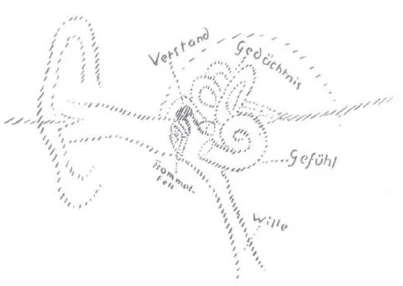
[ 10 ] Nun, sehen Sie, jetzt ist hier ein merkwürdiges Ding. Da würde man dann wiederum auf Knochen kommen. Es ist nun ein Loch, das in den Kopf hineingeht, im Knochen. Das ganze Ohr ist hier in einer Knochenhöhle drinnen. Aber hier ist ein merkwürdiges Ding, so ein richtiges Schneckenhaus (siehe Zeichnung). Und das Ganze besteht aus zwei Teilen; da hier ist eine Haut (das Spiralblatt), und da ist ein Raum (die Vorhoftreppe) und da ist der andere Raum (die Trommelhöhlentreppe). Das Ganze ist ausgefüllt mit Wasser, mit lebendigem Wasser, wie ich es Ihnen beschrieben habe. Und da drinnen ist so etwas wie ein Schneckenhaus, aber aus Haut. Und in dem Schneckenhaus drinnen, da sind lauter Fransen, lauter solche Fransen. Das ist außerordentlich interessant. Wenn Sie da das Trommelfell durchstoßen und weiter hineingehen würden, so würden Sie da drinnen ein Schneckenhaus finden, dieses weiche Schneckenhaus, und das ist innerlich mit solchen hautartigen Fransen besetzt. Was ist denn das eigentlich, dieses Schnekkenhaus da drinnen? Ja, meine Herren, wenn man mit wirklicher Wissenschaft an diese Sache herangeht, dann merkt man, was das ist. Das ist nämlich nichts anderes als ein Stückchen kleiner Darm, der sich ins Ohr verirrt hat. Geradeso wie wir im Bauch unsere Gedärme haben, so haben wir im Ohr ein Stückchen kleinen Darm. Das Ohr ist also so gestaltet, daß es, wie der Mensch selber seinen großen Darm hat, da einen kleinen Darm hat. Und der ist sowohl im Innern ausgefüllt mit solchem lebendigen Wasser, wie auch äußerlich umgeben von solchem lebendigen Wasser. Das ist außerordentlich interessant. Und dieses ganze Schneckenhaus, das ist hier abgeschlossen (siehe Zeichnung) - es ist alles mit Wasser gefüllt - durch ein Häutchen (ovales Fenster). Hier ist wiederum so ein Häutchen darauf (rundes Fenster). Ebenso wie, wenn man auf die Trommel klopft, das Trommelfell der Trommel in Bewegung kommt, so kann, wenn der Schall von beiden Seiten kommt, dieses Häutchen in Schwingung kommen.
[ 10 ] Well, you see, here’s a strange thing. That would lead us back to the bones. There’s a hole that goes into the head, in the bone. The entire ear is contained within a bony cavity here. But here’s something strange—it’s like a real snail shell (see drawing). And the whole thing consists of two parts; here there’s a membrane (the spiral lamina), and there’s a chamber (the vestibular staircase), and there’s another chamber (the tympanic staircase). The whole thing is filled with water—living water, as I’ve described to you. And inside there is something like a snail shell, but made of skin. And inside that snail shell, there are all these fringes, all these kinds of fringes. That is extraordinarily interesting. If you were to pierce the eardrum and go further in, you would find a snail shell in there—this soft snail shell—and it is lined on the inside with these skin-like fringes. What exactly is that snail shell in there? Well, gentlemen, if you approach this matter with true science, you’ll realize what it is. It is, in fact, nothing other than a small piece of small intestine that has found its way into the ear. Just as we have our intestines in our abdomen, so we have a small piece of small intestine in our ear. The ear is thus designed so that, just as a human has a large intestine, it also has a small intestine. And this small intestine is filled on the inside with living water, just as it is surrounded on the outside by living water. This is extraordinarily interesting. And this entire snail shell—which is enclosed here (see drawing)—is filled entirely with water through a small membrane (oval window). Here, in turn, is another such membrane (round window). Just as when you tap a drum, the drumhead begins to vibrate, so too, when sound comes from both sides, this membrane can begin to vibrate.
[ 11 ] Da in der Mitte, sagte ich Ihnen, ist eine Haut. Diese Haut schließt ab das, was mit dickerem lebendigen Wasser durchsetzt ist, und da ist dünneres Wasser; und da ist wiederum solch ein Häutchen zwischen den beiden Räumen. Da kommt nun etwas ganz besonders Interessantes. Da ist nämlich etwas, ich möchte sagen, ganz Wunderbares drinnen. Auf diesem Häutchen (des ovalen Fensters), da sitzt nämlich solch eine Sache darauf: Da sind zwei ganz feine, winzige Knochen; die sitzen so darauf und schauen aus wie ein Steigbügel. Daher haben die Leute das auch einen Steigbügel genannt. Das ist etwas ganz anderes; ich werde es Ihnen nachher sagen, was es ist. Wenn da dieses Häutchen ist, so sitzt da drauf dieser Steigbügel, und der hat richtig hier einen Knochenfortsatz. Und dieser Knochenfortsatz, der ist hier so wie der Oberarm und der Unterarm. Das sitzt dann hier auf diesem Ding drauf, auf diesem Häutchen. Also wenn Sie sich vorstellen würden, da wäre ein solcher Arm, der Oberarm da, der Unterarm da, so ist hier noch kurioserweise ein Knochen, der frei aufsitzt. Die sind im Gelenk miteinander verbunden, der sitzt hier frei auf. Das sind kleine, winzige Knochen. Nun, die materialistische Denkweise, die alles äußerlich betrachtet, die nennt diesen Knochen hier, der unmittelbar am Trommelfell aufsitzt und da aufschlägt, den Hammer, und das da hier, das Stückchen Knochen nennt sie den Amboß. Und das nennt sie den Steigbügel. Diese drei kleinen Knöchelchen werden also von der gewöhnlichen Wissenschaft genannt: Hammer, Amboß und Steigbügel.
[ 11 ] As I told you, there is a membrane right in the middle. This membrane encloses a space filled with thicker, living water, and there is thinner water; and there is, in turn, another thin membrane between the two spaces. Now comes something particularly interesting. There is, in fact, something—I would say—quite marvelous inside. On this thin membrane (of the oval window), there is actually something sitting on top of it: there are two very fine, tiny bones; they sit there like this and look like a stirrup. That is why people have also called it a stirrup. It is something entirely different; I will tell you later what it is. When this little membrane is there, this “stirrup” sits on top of it, and it actually has a bony process here. And this bony process is like the upper arm and the forearm. It sits right here on top of this thing, on this little membrane. So if you were to create a mental image of an arm like that—the upper arm here, the forearm there—curiously enough, there’s another bone here that sits freely. They’re connected to each other at the joint, but this one sits here freely. These are small, tiny bones. Now, the materialistic way of thinking, which views everything from an external perspective, calls this bone here—which rests directly on the eardrum and strikes it—the “hammer,” and that little piece of bone here it calls the “anvil.” And it calls this one the “stirrup.” So these three little bones are referred to by conventional science as the hammer, the anvil, and the stirrup.
[ 12 ] Aber die gewöhnliche Wissenschaft weiß eigentlich nicht, was das ist. Dasjenige, was da ist in Steigbügelform, das ist nämlich, nur ein bißchen anders gestaltet, dasselbe, was hier im Oberarm ist. Sehen Sie, wie da das Gelenk ansitzt, so sitzt auf diesem Häutchen drauf das Gelenk. Und hier ist der Ellbogen; das ist also eine Art von Hand. Und da drauf, da sitzt ein freier Knochen. Den haben wir zwar nicht an der Hand, aber da an der Kniescheibe. Wir könnten ebensogut sagen: Das ist ein Bein, ein Fuß; dann wäre das ein Oberschenkel, das wäre das Knie (Zeichnung), da säße der Fuß darauf, und da ist die Kniescheibe.
[ 12 ] But conventional science doesn't really know what that is. That stirrup-shaped structure—which is, in fact, just the same thing found here in the upper arm, albeit shaped a little differently—is exactly the same. Look at how the joint is attached there—the joint sits on top of this little membrane. And here is the elbow; so that’s a kind of hand. And on top of that sits a free bone. We don’t have one of those in the hand, but we do have one in the kneecap. We might just as well say: This is a leg, a foot; then that would be a thigh, that would be the knee (drawing), the foot would sit on top of it, and there’s the kneecap.
[ 13 ] Es ist sehr interessant, sehen Sie: Wir haben da in unserer Ohrhöhle drinnen zuerst eine Art von Eingeweide, und nachher eine richtige Hand oder Arm oder einen richtigen Fuß. Wozu ist denn das Ganze da? Nun, denken Sie sich, es kommt ein Schall. Der Schall, der schlägt da ans Trommelfell an. Das Ganze, was da ist, kommt in Erschütterung. So probiert der Mensch, ganz ohne daß er es weiß, im Innern des Ohres, was da für Erschütterungen anschlagen. Und denken Sie einmal nach, Sie werden das schon einmal gespürt haben, wenn Sie irgendwo auf der Straße stehen, und da hinten explodiert etwas - ich meine, Sie haben es schon bemerkt -: das spüren Sie in Ihren Eingeweiden! Ja, es kann sogar sein, daß man in den Eingeweiden krank wird von einer solchen Erschütterung. Die feinste Erschütterung aber, die da durch diesen Arm zieht, die verspürt das Wasser in diesem Schneckenhaus. Dieses Wasser im Schneckenhaus, das macht die Schwingungen mit, die der Mensch dadurch kennenlernt, daß er mit dieser Hand das Trommelfell angreift. Können Sie das verstehen? (Ja!)
[ 13 ] It’s very interesting, you see: Inside our ear cavity, we first have a sort of inner structure, and then a real hand or arm or a real foot. What is the whole thing for? Well, just imagine: a sound comes along. The sound strikes the eardrum. Everything in there starts to vibrate. So, without even realizing it, a person senses inside the ear what kind of vibrations are occurring. And think about it—you’ve probably felt this before when you’re standing somewhere on the street and something explodes in the distance—I mean, you’ve surely noticed it—you feel it in your guts! Yes, it’s even possible that such a vibration could make you sick in your gut. But the subtlest vibration—the one that runs through this arm—is sensed by the water inside this snail shell. This water in the snail shell resonates with the vibrations that a person experiences when they touch the eardrum with this hand. Can you understand that? (Yes!)
[ 14 ] Nun will ich Ihnen aber noch etwas sagen. Wozu ist denn diese Trompete da, die da vom Mund in das Ohr hineingeht? Ja, wenn da hier ein gewöhnlicher Schall hineingeht, da braucht man eigentlich diese Trompete nicht. Aber wenn wir einer dem andern zuhören, wenn einer redet zu dem andern und wir wollen ihn verstehen, denn wir haben ja reden gelernt - wenn wir selber nicht reden gelernt haben, können wir den andern nicht gut verstehen; dadurch, daß wir reden gelernt haben, dadurch gehen die Töne der Sprache durch die Eustachische Röhre, die Ohrtrompete so hinüber; und wenn der andere so her redet, dann geht das so her, erschüttert da; das geht über in diese Flüssigkeit. Und dadurch, daß die Luft durchgeht, durch die Eustachische Trompete ins Ohr hineingeht, und ich gewohnt worden bin, diese Luft selber zu bewegen durch meine eigene Sprache, kann ich den andern verstehen. Da drinnen in dem Ohr, da trifft sich dasjenige, was ich gewohnt bin, von meiner eigenen Sprache zu haben, und dasjenige, was von der Sprache des andern kommt. Das trifft sich hier.
[ 14 ] But now I want to tell you something else. What is the purpose of this tube that goes from the mouth into the ear? Well, if it were just ordinary sound entering here, we wouldn’t really need this tube. But when we listen to one another—when one person speaks to another and we want to understand them, since we’ve learned to speak—if we hadn’t learned to speak ourselves, we wouldn’t be able to understand others very well; it is precisely because we’ve learned to speak that the sounds of speech travel through the Eustachian tube—the auditory tube—in that way; and when the other person speaks to me, the sound comes this way, vibrating there; it passes into this fluid. And because the air passes through—entering the ear via the Eustachian tube—and I have become accustomed to moving this air myself through my own speech, I can understand the other person. Inside the ear, what I am accustomed to from my own speech meets what comes from the other person’s speech. That is where they meet.
[ 15 ] Sie wissen, wenn ich spreche: Haus — da bin ich gewohnt, daß da drinnen in meiner Eustachischen Trompete gewisse Erschütterungen vorgehen; wenn ich sage: Pulver — eine andere Erschütterung. Diese Erschütterungen kenne ich. Wenn ich sage: Haus — so kommt die Erschütterung von außen, und ich bin gewohnt, wenn ich sage: Haus — dies wahrzunehmen. Und da treffen die beiden zusammen, meine Erkenntnis und die Erschütterung von außen, und ich verstehe, was «das Haus» heißt. Nicht wahr, das ist doch zu verstehen? Meine Trompete, die vom Mund ins Ohr hineingeht, die ist da, wenn wir selber als Kind reden lernen, damit wir zugleich den andern verstehen. Die Dinge sind außerordentlich interessant.
[ 15 ] You know, when I say “house”—I’m used to feeling certain vibrations inside my Eustachian tube; when I say “gunpowder”—a different kind of vibration. I’m familiar with these vibrations. When I say “house”—the vibration comes from outside, and I’m used to perceiving it when I say “house.” And that’s where the two come together—my understanding and the vibration from outside—and I understand what “the house” means. Isn’t that easy to understand? My tube, which runs from my mouth to my ear, is already there when we ourselves learn to speak as children, so that we can understand others at the same time. These things are extraordinarily interesting.
[ 16 ] Jetzt ist die Sache aber so: Denken Sie sich, es wäre alles da im Ohr, was ich Ihnen aufgezeichnet habe, aber nichts anderes zunächst. Sie würden allenfalls, sagen wir, den anderen verstehen können, Sie würden auch ein Musikstück anhören können; aber Sie würden sich das, was Sie anhören, nicht merken können. Sie hätten kein Gedächtnis für Sprache oder Töne. Wenn das Ohr nur so wäre, so hätten Sie kein Gedächtnis für Sprache oder Töne. Damit Sie ein Gedächtnis haben, ist noch etwas anderes im Ohr. Damit Sie nun auch im Gedächtnis dasjenige, was Sie hören, behalten können, ist noch eine andere Einrichtung da. Da sind nämlich hier drei solche Bögen; die sind da oben (siehe Zeichnung). Sie müssen sich vorstellen also solche Bögen, die hohl sind. Da ist der zweite, der steht senkrecht drauf auf dem ersten; und da ist noch ein dritter, der steht wiederum senkrecht auf dem andern. Sie stehen in den drei Richtungen senkrecht aufeinander. Das ist also noch ein weiteres wunderbares Gebilde, das in diesem Ohr drinnen ist. Diese Kanäle da oben sind aber hohl — natürlich, weil es Kanäle sind. Und da drinnen ist wiederum ein feines, lebendiges Wasser. Das sitzt da drinnen.
[ 16 ] But here’s the thing: Imagine that everything I’ve recorded for you were in your ear, but nothing else at first. At best, let’s say, you’d be able to understand others, and you’d also be able to listen to a piece of music; but you wouldn’t be able to remember what you were hearing. You would have no memory for language or sounds. If the ear were only like that, you would have no memory for language or sounds. For you to have a memory, there is something else in the ear. So that you can also retain what you hear in your memory, there is another mechanism there. Namely, there are three such arches here; they are up there (see drawing). You have to create a mental image of these arches as being hollow. There’s the second one, which stands perpendicular to the first; and there’s a third one, which in turn stands perpendicular to the other. They stand perpendicular to one another in all three directions. So this is yet another marvelous structure found inside the ear. These canals up there are hollow—naturally, since they are canals. And inside them is a fine, living fluid. It resides there.
[ 17 ] Aber das Merkwürdige an diesem lebendigen Wasser ist das, daß sich fortwährend kleine Kristalle aus diesem Wasser heraus bilden, winzige kleine Kristalle. Wenn Sie zum Beispiel hören: Haus, oder ein C hören, so bilden sich da drinnen solche kleine Kristalle; wenn Sie hören: Mensch, bilden sich etwas andere Kristalle. In diesen drei winzigen Kanälen bilden sich winzige Kristalle, und diese winzigen Kristalle, die machen, daß wir nicht nur verstehen können, sondern auch das Verstandene im Gedächtnis behalten können. Denn was tut der Mensch unbewußt?
[ 17 ] But the remarkable thing about this living water is that tiny crystals are constantly forming from it—tiny, tiny crystals. For example, when you hear the word “house,” or when you hear the letter “C,” such tiny crystals form inside; when you hear the word “human,” slightly different crystals form. In these three tiny channels, tiny crystals form, and these tiny crystals enable us not only to understand but also to retain what we have understood in our memory. For what does a person do unconsciously?
[ 18 ] Sie brauchen sich nur vorzustellen, Sie hören, sagen wir: fünf Franken; Sie wollen das Gesprochene erinnern, schreiben sich das in Ihr Notizbuch. Das, was Sie da mit Blei in Ihr Notizbuch eingeschrieben haben, das hat nichts mit den fünf Franken zu tun, aber Sie erinnern sich daran durch die Notiz. Geradeso wird in diese feinen Kanäle durch die winzigen Kristalle, die eigentlich wie Buchstaben sind, eingeschrieben, was man hört. Und durch einen unbewußten Verstand wird das wiederum, wenn wir es brauchen, gelesen. So daß wir sagen können: Da drinnen (in den drei halbkreisförmigen Kanälen), da ist das Gedächtnis für die Töne und für die Laute. Da hier, bei diesem Arm oder Bein (Zeichnung, Gehörknöchelchen), da ist das Verständnis. Da drinnen in dieser Schnecke, da ist ein Stückchen Gemüt vom Menschen, ein Stückchen Gefühl. Da fühlen wir die Töne in diesem (Teil des) Labyrinth, in diesem Schneckenhauswasser drinnen. Da fühlen wir die Töne. Und wenn wir reden und selbst den Ton hervorbringen, so geht durch unsere Eustachische Trompete der Wille zum Sprechen. Da ist das ganze Seelische des Menschen drinnen im Ohr: In dieser Trompete hier, da lebt der Wille; da drinnen (in der Schnecke) lebt das Gefühl; da drinnen (bei diesem Arm oder Bein, den Gehörknöchelchen) lebt der Verstand; und da in diesem (in den drei kleinen halbkreisförmigen Kanälen) lebt das Gedächtnis. Und damit der Mensch sich das, wenn es fertig ist, zum Bewußtsein bringen kann, geht von hier aus durch diese Höhle hier (siehe Zeichnung), durch dieses Loch hier ein Nerv. Der Nerv breitet sich überall aus, kleidet alles aus, geht überall hin. Und durch diesen Nerv kommt uns das Ganze dann zum Bewußtsein hier im Gehirn.
[ 18 ] Just create a mental image of yourself hearing, say, “five francs”; you want to remember what was said, so you write it down in your notebook. What you’ve written in your notebook with a pencil has nothing to do with the five francs, but you remember it because of the note. In exactly the same way, what we hear is inscribed into these fine canals by the tiny crystals, which are actually like letters. And through an unconscious mind, this is in turn read when we need it. So that we can say: In there (in the three semicircular canals), there lies the memory for tones and sounds. Here, in this arm or leg (drawing, ossicles), lies understanding. In there, inside this cochlea, lies a little piece of the human soul, a little bit of feeling. There, in this (part of the) labyrinth, in the fluid inside the cochlea, we sense the sounds. There, we sense the sounds. And when we speak and produce the sound ourselves, the will to speak passes through our Eustachian tube. The entire human psyche is contained within the ear: in this tube here, the will lives; in there (in the cochlea), feeling lives; in there (in this arm or leg, the ossicles), the intellect lives; and in there (in the three small semicircular canals), memory lives. And so that a person can bring this to consciousness once it is complete, a nerve runs from here through this cavity (see drawing), through this opening here. The nerve spreads out everywhere, permeates everything, goes everywhere. And through this nerve, the whole process then comes to our consciousness here in the brain.
[ 19 ] Sehen Sie, meine Herren, etwas höchst Eigentümliches! Wir haben da in unserem Schädel, in unseren Schädelknochen, eine Höhle drinnen; es geht einfach eine solche Höhle hinein. In die Höhle kommt man hinein, wenn man vom äußeren Ohr durch den Gehörgang mit Durchstoßung vom Trommelfell hineingeht. In dieser Höhle ist all das drinnen, was ich Ihnen gezeigt habe. Zunächst streckt man die Hand aus, welche die Töne, die hereinkommen, berührt, so daß wir die Töne verstehen können. Dann übertragen wir das auf diese Schnecke, auf das lebendige Wasser; dadurch fühlen wir den Ton. Wir stoßen mit dem Willen hinein durch unsere Eustachische Trompete. Und durch die kleinen Kristallzeichen, die in diesen drei, wie man sie nennt, halbkreisförmigen Kanälen sind, erinnern wir uns an dasjenige, was gesprochen oder gesungen wird, oder was uns sonst als Klang kommt.
[ 19 ] Look, gentlemen, at something most peculiar! We have a cavity inside our skull, within our skull bones; there is simply such a cavity there. You enter this cavity by going from the outer ear through the ear canal and piercing the eardrum. Everything I have shown you is contained within this cavity. First, we extend our hand to touch the sounds that enter, so that we can understand them. Then we transfer this sensation to the cochlea, to the living water; in this way, we feel the sound. We penetrate it with our will through our Eustachian tube. And through the tiny crystalline structures found in these three so-called semicircular canals, we recall what is spoken or sung, or whatever else reaches us as sound.
[ 20 ] Wir können also sagen: Da drinnen tragen wir eigentlich wiederum einen kleinen Menschen, richtig einen kleinen Menschen. Denn der Mensch hat Wille, Gefühl, Verständnis, Verstand und Gedächtnis. In dieser kleinen Höhle tragen wir wieder einen kleinen Menschen drinnen. Wir bestehen halt nur aus lauter kleinen Menschen. Unser großer Mensch ist nur die Zusammenfassung von lauter kleinen Menschen. Ich werde Ihnen nächstens zeigen, daß das Auge auch ein kleiner Mensch ist. Die Nase ist auch ein kleiner Mensch. Und diese kleinen Menschen werden durch das Nervensystem zusammengehalten und geben dann den Gesamtmenschen. Und diese kleinen Menschen entstehen dadurch, daß eigentlich all dasjenige, was da drinnen sich bildet, solange der Mensch im Keimzustand im Leibe der Mutter ist, noch unter dem Gestirneinfluß steht. Denn all diese wunderbaren Gebilde da, also die Kanäle, die die Kristalle bilden, und dieser Arm, die kann die Schwerkraft der Erde und alles, was auf der Erde ist, nicht bilden. Die werden noch im Mutterleibe veranlagt durch die Kräfte, die von den Sternen hereinwirken. Und erst dasjenige, was zum Menschen gehört, also diese Partie dahier, die Schnecke und die Eustachische Trompete, das wird später ausgebildet. Die wird dazu gemacht durch dasjenige, was von der Erde ausgeht, geradeso wie wir als ganzer Mensch unsere ganze Gestalt durch die Erdenschwere kriegen, und wir uns ja erst aufrichten als Kind, das schon längst geboren ist.
[ 20 ] So we can say: Inside there, we’re actually carrying another little human being—truly a little human being. For a human being has will, feeling, understanding, intellect, and memory. In this little cavity, we’re carrying another little human being inside. We’re simply made up of nothing but little human beings. Our “big” human being is merely the sum of all these little human beings. I will show you soon that the eye is also a little human being. The nose is also a little human being. And these little human beings are held together by the nervous system and thus form the whole human being. And these little human beings come into being because everything that forms inside there—as long as the human being is in the embryonic state within the mother’s womb—is still under the influence of the stars. For all these marvelous structures there—the channels that form the crystals, and this arm—cannot be formed by the Earth’s gravity or anything on Earth. They are laid down while still in the womb by the forces acting from the stars. And only that which belongs to the human being—that is, this part here, the cochlea and the Eustachian tube—is formed later. It is shaped by what emanates from the Earth, just as we, as whole human beings, acquire our entire form through Earth’s gravity, and just as we only begin to stand upright as children who have long since been born.
[ 21 ] Sehen Sie, wenn man zunächst weiß, wie der ganze Mensch ausgeht von einer kleinen Zelle, und die eine Zelle sich zum Auge umbildet, die andere Zelle - es sind eigentlich zehn Haufen, die sich umbilden, es ist nicht nur eine Zelle, aber das macht nicht viel Unterschied, wenn man sich vorstellt, daß das nur eine ist —, also die eine sich zum Auge umbildet, die andere zum Ohr, die dritte zur Nase, dann sieht man, wie sich der Mensch nach und nach aufbaut dadurch, daß er zuerst nur aus einer einzigen Zelle besteht, die eine zweite erzeugt, und dadurch, daß sie an einen andern Ort geht, unter einen andern Einfluß kommt, sie wird jetzt anders, wird zum Ohr, eine andere wird zur Nase, eine dritte zum Auge und so weiter. Aber das ist wahrhaftig nicht alles von den Erdenkräften ausgehend. Die Erdenkräfte könnten nur dasjenige bilden, was im ausgesprochenen Sinne rund ist, geradeso wie in unserem Bauch die Erde unser Gedärm bildet. Aber alles übrige wird noch von den Sternen herein gebildet.
[ 21 ] You see, when you first understand how the entire human being originates from a single small cell—and one cell develops into the eye, another cell—there are actually ten clusters that develop; it’s not just one cell, but that doesn’t make much difference if you have a mental image of it as just one— so one transforms into the eye, another into the ear, a third into the nose—then you see how the human being gradually develops through the fact that it initially consists of a single cell, which produces a second one, and through the fact that, as it moves to another place and comes under a different influence, it now becomes something else: one becomes the ear, another the nose, a third the eye, and so on. But this is certainly not all derived from the forces of the Earth. The forces of the Earth could only form that which is round in the strict sense, just as the Earth forms our intestines within our abdomen. But everything else is still formed by the forces of the stars.
[ 22 ] Nun, nicht wahr, das alles wissen wir heute dadurch, daß wir eben Mikroskope haben, durch die wir diese Sachen beobachten können. Diese Knöchelchen sind ja ganz furchtbar klein. Nun aber, das Merkwürdige ist eben, daß man in älteren Zeiten so etwas auch gewußt hat, und daß man das aus einer ganz anderen Art von Erkenntnis heraus gewußt hat, als wir heute das wissen. Und nun haben, sagen wir zum Beispiel, die alten Ägypter vor dreitausend Jahren sich auch mit einer solchen Erkenntnis beschäftigt und haben auch schon in ihrer Art gewußt, wie wunderbar das in dem menschlichen Ohr drinnen ist. Und sie haben sich dann gesagt: Der Mensch hat an seinem Kopf Ohren, Augen und andere Organe. Wenn wir uns diese Organe erklären wollen, so können wir nur sagen: Wodurch ist das Ohr, das Auge — wie gesagt, das werde ich Ihnen nächstens einmal erklären — so geworden, ganz anders als die Organe sonst am Körper? Da haben sie gesagt: Diese Organe am Kopf, Ohr, Auge, die sind deshalb so geworden, weil vorzugsweise auf diese Organe das wirkt, was von außen zum Irdischen kommt, von oben herunter. - Dann haben sie hinaufgeschaut und haben gesagt: Da oben fliegt ein Adler zum Beispiel, der bildet sich aus hoch in den Lüften; da hinauf muß man schauen, wenn man auf die Kräfte schauen will, die im menschlichen Kopfe die Organe bilden. — Deshalb haben sie zunächst, wenn sie den Menschen aufgezeichnet haben, für den Kopf den Adler gezeichnet.
[ 22 ] Well, don’t you see, we know all this today precisely because we have microscopes that allow us to observe these things. These little bones are, after all, incredibly tiny. But the remarkable thing is that people in ancient times also knew this, and they knew it through a completely different kind of insight than we have today. And now, let’s say, for example, that the ancient Egyptians three thousand years ago also engaged with this kind of knowledge and, in their own way, already knew how marvelous the human ear is on the inside. And they then said to themselves: Human beings have ears, eyes, and other organs on their heads. If we want to explain these organs, we can only ask: How did the ear and the eye—as I said, I’ll explain this to you another time—come to be so different from the other organs on the body? They replied: These organs on the head—the ear and the eye—have become this way because what comes to the earthly realm from outside, from above, acts primarily upon these organs. - Then they looked up and said: “Up there, for example, an eagle is flying; it takes shape high in the air; one must look up there if one wants to observe the forces that form the organs in the human head.” — That is why, when they first drew a picture of a human being, they drew an eagle for the head.
[ 23 ] Wenn wir zum Beispiel Herz und Lunge anschauen, so schauen die ganz anders aus als Auge und Ohr. Wenn wir die Lunge anschauen, da können wir nicht viel zu den Sternen gehen, und beim Herz können wir auch nicht viel zu den Sternen gehen. Die Kraft der Sterne wirkt im Herzen ganz besonders, aber die Form, die Gestalt, die können wir nicht so auf die Sterne beziehen. Das wußten auch schon die alten Ägypter vor dreitausend Jahren: die können wir nicht so auf die Sterne beziehen wie die Kopforgane. Nun dachten sie nach: Wo gibt es ein Tier, welches besonders diejenigen Organe ausbildet, die ähnlich sind dem menschlichen Herzen und der menschlichen Lunge und so weiter? Der Adler bildet besonders diejenigen Organe aus, die ähnlich sind dem menschlichen Kopfe. Das Tier — haben die Alten gefunden -, das am meisten das Herz ausbildet, daher auch das mutigste Tier ist, ganz Herz ist, das ist der Löwe. Daher haben sie diese Organpartie, Lunge, Herz und so weiter, «Löwe» genannt. So haben sie also gesagt: Kopf = Adler. Dann der Löwe, der den mittleren Menschen ausmacht. Und dann haben sie gesagt: Aber noch ganz anders schauen des Menschen Gedärme aus. Sehen Sie, der Löwe hat nämlich sehr kurze Gedärme; bei dem sind die Gedärme zu kurz gekommen. Also die Gedärme schauen ganz anders aus. Im Ohr ist eigentlich nur das ganz kleine Gedärm; das ist zierlich gebildet. Unsere übrigen Gedärme sind gar nicht so zierlich gebildet. Wenn man auf die Gedärme hinschauen will, so muß man die Bildung der Gedärme vergleichen mit den Tieren, welche besonders unter dem Einfluß ihrer Gedärme stehen. Der Löwe steht unter dem Einfluß des Herzens; der Adler steht unter dem Einfluß der oberen Kräfte. Unter dem Einfluß der Gedärme — ja, wenn Sie hinschauen, wenn die Kühe gefressen haben, dann können Sie anmerken den Ochsen und Kühen: diese Tiere stehen ganz unter dem Einfluß ihrer Gedärme. Denen ist furchtbar wohl, wenn sie verdauen. Daher nannten die alten Menschen das, was beim Menschen zu den Gedärmen gehört, den Stier- oder Kuh-Menschen.
[ 23 ] If we look at the heart and lungs, for example, they look quite different from the eye and the ear. When we look at the lungs, we can’t draw many parallels to the stars, and when we look at the heart, we can’t draw many parallels to the stars either. The power of the stars has a particularly strong effect on the heart, but we cannot relate its form or shape to the stars in the same way. The ancient Egyptians already knew this three thousand years ago: we cannot relate these organs to the stars in the same way as we do the organs of the head. So they reflected: Where is there an animal that particularly embodies those organs that are similar to the human heart and the human lungs, and so on? The eagle particularly embodies those organs that are similar to the human head. The animal—as the ancients discovered—that most fully embodies the heart, and is therefore also the bravest animal, entirely heart—is the lion. That is why they called this group of organs—lungs, heart, and so on—“lion.” So they said: Head = eagle. Then the lion, which represents the middle part of the human being. And then they said: But the human intestines look quite different. You see, the lion actually has very short intestines; its intestines are underdeveloped. So the intestines look quite different. In the ear, there is actually only the very small intestine; it is delicately formed. Our other intestines are not formed quite so delicately. If one wants to examine the intestines, one must compare their structure with that of animals that are particularly under the influence of their intestines. The lion is under the influence of the heart; the eagle is under the influence of the higher powers. Under the influence of the intestines—yes, if you look closely, after the cows have eaten, you can observe the oxen and cows: these animals are entirely under the influence of their intestines. They feel incredibly comfortable when they are digesting. That is why the ancients called what belongs to the intestines in humans the “bull-man” or “cow-man.”
[ 24 ] Und jetzt haben Sie die drei Glieder der menschlichen Natur:
[ 24 ] And now you have the three parts of human nature:
[ 25 ] Adler = Kopf
Löwe = Brust
Stier = dasjenige, was zum Verdauungssystem gehört.
[ 25 ] Eagle = Head
Lion = Chest
Bull = that which belongs to the digestive system.
[ 26 ] Das wußten natürlich diese alten Menschen auch: Wenn ich nun einem Menschen begegne — der Kopf, der ist doch nicht eigentlich ein Adler, und der mittlere Mensch ist auch nicht ein Löwe, der untere ist auch nicht ein Stier oder ein Ochs. Das wußten sie schon. Daher sagten sie: Ja, wenn nichts anderes da wäre, so gingen wir alle so herum, daß wir oben einen Adlerkopf hätten, dann einen Löwen im Körper, und dann würden wir in den Stier auslaufen. So würden wir alle herumlaufen. Aber nun kommt noch etwas, was den Kopf da oben so umbildet und macht wie einen Menschenkopf, und das wiederum, was macht, daß wir nicht ein eigentlicher Löwe sind und so weiter, das ist der eigentliche Mensch. Der faßt dann alles zusammen. (Siehe Zeichnung S. 70.)
[ 26 ] Of course, these old people knew that, too: When I meet a person—the head isn’t really an eagle, and the middle part isn’t a lion, nor is the lower part a bull or an ox. They already knew that. That is why they said: Yes, if there were nothing else, we would all walk around with an eagle’s head on top, then a lion’s body, and then we would end in a bull. That is how we would all walk around. But now there is something else that transforms the head up there and makes it like a human head, and that, in turn, is what prevents us from being an actual lion and so on—that is the true human being. He then brings everything together. (See drawing on p. 70.)
[ 27 ] Und es ist wirklich eigentlich merkwürdig, wie diese alten Menschen gewisse Wahrheiten, die wir heute wieder erkennen, dadurch zum Ausdrucke gebracht haben, daß sie Bilder geformt haben. Allerdings, diese Bilder waren ihnen leichter zu formen als uns. Sehen Sie, wir heutigen Menschen, wir können ja manches lernen, aber man kann nicht sagen, daß uns diese Gedanken, die wir heute fürs gewöhnliche lernen, wenn wir sie draußen in der Schule lernen, so sehr zu Herzen gehen. Das war bei diesen alten Menschen doch ganz anders. Die wurden wirklich von Gefühl ergriffen von diesen Gedanken, und deshalb träumten sie auch davon. Und richtig träumten diese Menschen: sie sahen im Bilde den ganzen Menschen und gewissermaßen aus der Stirne heraus einen Adler blickend, aus dem Herzen einen Löwen und aus dem Bauch einen Stier. Das malten sie dann zum ganzen Menschen zusammen, ein sehr schönes Bild. So daß man sagen kann: Die Alten haben eben den Menschen zusammengesetzt aus Mensch, Stier, Adler, Löwe.
[ 27 ] And it really is quite remarkable how these ancient people expressed certain truths—which we now recognize—by creating images. Admittedly, it was easier for them to create these images than it is for us. You see, we people today can certainly learn many things, but one cannot say that these ideas—which we usually learn today when we study them in school—truly touch our hearts. It was quite different for those ancient people. They were truly moved by these ideas, and that is why they also dreamed about them. And these people truly dreamed: they saw the whole human being in the image—an eagle gazing out from the forehead, a lion from the heart, and a bull from the abdomen. They then combined these into a single image of the whole human being—a very beautiful picture. So one can say: The ancients composed the human being from the human, the bull, the eagle, and the lion.
[ 28 ] Das hat sich ja noch fortgesetzt in die Beschreibungen der Evangelien hinein. Man ist viel von diesen Dingen ausgegangen. So zum Beispiel sagte man: Nun, es gibt ein Evangelium nach Matthäus, das beschreibt eigentlich den Menschen Jesus geradeso wie einen Menschen, und deshalb wurde dieser Schreiber des Matthäus-Evangeliums der «Mensch» genannt. Aber nehmen wir den Johannes, sagten die Alten: Ja, der beschreibt den Jesus so, wie wenn er über der Erde schwebte, wie wenn er über die Erde flöge; er beschreibt eigentlich nur dasjenige, was im menschlichen Kopfe vorgeht. Das ist der «Adler». Wenn Sie das Evangelium des Markus lesen, so werden Sie sehen, da wird Jesus als der Kämpfer dargestellt, als der Streitbare, der «Löwe». Der beschreibt so wie einer, der vorzugsweise die Brustorgane darstellt. Und der Lukas, wie beschreibt denn der? Lukas ist ja sogar vorgestellt worden als ein Arzt, der vorzugsweise auf die Heilung ausgeht. Das sieht man dem Evangelium auch an. Heilen muß man, indem man nun in die Verdauungsorgane etwas hereinbringt. Daher beschreibt er den Jesus als «Stier», der vorzugsweise in die Verdauung etwas hereinbringt. Und so kann man die vier Evangelien zusammenfassen:
[ 28 ] This trend continued right into the accounts of the Gospels. People often took these things for granted. For example, they would say: Well, there is the Gospel according to Matthew, which actually describes the man Jesus just as a human being, and that is why the writer of the Gospel of Matthew was called “the Man.” But take John, the ancients said: Yes, he describes Jesus as if he were hovering above the earth, as if he were flying over the earth; he actually describes only what goes on in the human mind. That is the “eagle.” If you read the Gospel of Mark, you will see that Jesus is portrayed there as the warrior, the fighter, the “lion.” He describes him as one who primarily focuses on the chest organs. And Luke—how does he describe him? Luke has even been described as a physician who focuses primarily on healing. This is also evident in the Gospel. Healing must be achieved by introducing something into the digestive organs. Therefore, he describes Jesus as the “Bull,” who primarily introduces something into the digestive system. And so the four Gospels can be summarized as follows:
[ 29 ] Matthäus = Mensch
Markus = Löwe
Lukas = Stier
Johannes = Adler
[ 29 ] Matthew = Man
Mark = Lion
Luke = Bull
John = Eagle
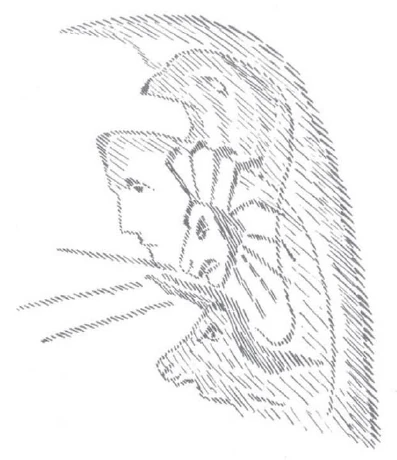
[ 30 ] Nun, bei dieser Zeitung [an deren Kopf die vier Gestalten dargestellt sind, nach denen gefragt wurde] war ich ja vor die Aufgabe gestellt, daß darin gegeben werden sollte, was von Menschengeist zu Menschengeist geht, was ein Mensch dem andern Wertvolles sagen kann. So sollte man auch den Menschen darstellen. Es ist also in dieser Figur dargestellt oben der Adler, dann der Löwe, der Stier, die Kuh, und dann der Mensch selbst, der sie zusammenfaßt. Das ist also so, damit man sehen kann, diese Zeitung soll etwas recht Menschliches sein. Sie werden ja begreifen, meine Herren, daß man das heute gern den Menschen sagen möchte, daß man ihnen etwas Menschliches sagen möchte. Denn in dem, was heute vielfach auch durch die Zeitungen gegeben wird, ist ja nicht viel Menschliches enthalten. Also das sollte zum Ausdruck gebracht werden, daß in dieser Zeitung wirklich der Mensch so recht voll alle seine Organe ausleben soll. Es soll nicht dumm sein, was er redet, also: Adler; es soll auch nicht feige sein, also: Löwe. Aber es soll auch nicht in der Luft verfliegen, sondern praktisch auf der Erde stehen, also: Stier, Kuh. Und das Ganze soll dem Menschen etwas geben, soll zum Menschen sprechen. Das möchte man ja heute, daß alles, alles wirklich vom Menschen zum Menschen gehen könnte.
[ 30 ] Well, with this newspaper [at the top of which are depicted the four figures that were asked about], I was faced with the task of conveying what passes from one human spirit to another—what one person can say to another that is of value. That is also how people should be portrayed. So the figures depicted at the top are the eagle, then the lion, the bull, the cow, and finally the human being himself, who unites them all. This is so that one can see that this newspaper is meant to be something truly human. You will understand, gentlemen, that today we would like to tell people this—that we would like to say something human to them. For in what is often presented in the newspapers today, there is not much that is human. So this is what should be expressed: that in this newspaper, the human being should truly live out all his faculties to the fullest. What he says should not be foolish—that is, the eagle; nor should it be cowardly—that is, the lion. But it should not float away into thin air either; rather, it should stand firmly on the ground—that is, the bull, the cow. And the whole thing should give something to people; it should speak to them. That is what we want today—for everything, absolutely everything, to truly flow from person to person.
[ 31 ] Nun bin ich doch noch dazu gekommen, von dem Ausgangspunkte aus mich dem zu nähern, was Sie gefragt haben, und ich hoffe, daß diese Frage verständlich werden konnte. Hat gerade die Ohrengeschichte Sie etwas interessiert? Man soll wissen, was man eigentlich in sich trägt!
[ 31 ] Well, I’ve finally gotten around to addressing your question from that starting point, and I hope this has helped clarify the issue. Were you particularly interested in the story about the ears? It’s important to know what you actually carry within yourself!
Frage betreffs der Lotosblumen, von denen manchmal gesprochen werde, ob darüber etwas noch gesagt werden könne.
Question regarding the lotus flowers that are sometimes mentioned—is there anything more that can be said about them?
[ 32 ] Dr. Steiner: Dazu werde ich dann kommen, wenn ich Ihnen die einzelnen Organe erkläre. Die nächste Vortragsstunde werden wir dann am Samstag um zehn Uhr haben.
[ 32 ] Dr. Steiner: I’ll get to that when I explain the individual organs to you. The next lecture will be on Saturday at 10:00 a.m.