

On Health and Illness
GA 348
29 November 1922, Dornach
Translated by Steiner Online Library
Third Lecture
There is a question about the motif on the magazine *Anthroposophy, Austrian Messenger from Human Spirit to Human Spirit*: an eagle, a lion, a bull's head, and a human head.
[ 1 ] Dr. Steiner: I believe, gentlemen, that the best way to proceed is for me to first explain the concept of the human being in its entirety, to the extent necessary, and then, next time, to present the human being as represented by these four symbols. After all, it is not possible to always explain everything without providing some background. I will try to lay this groundwork today. For you see, these four animals—one of which is actually the human being—date back to a very early understanding of humanity. Today, one could no longer explain these four animals in the same way that, for example, the ancient Egyptians did; rather, today one must explain them somewhat differently. Of course, one must explain them correctly, but today one must start from slightly different premises.
[ 2 ] Now I would like to draw your attention once again—as I have pointed out to you time and time again—to how the human being emerges from the human embryo, which initially develops in the mother’s womb. I have already told you quite a bit about this human germ. Today I would like to return once more to the very first stage, to the very earliest period in which the human germ develops in the mother’s womb after fertilization. You see, at this stage the human embryo is just a single cell—that is, a cell containing protein and a nucleus (a diagram is drawn). It is so small that it can only be seen under a microscope. And human life actually begins in the physical realm with a single such egg cell that has been fertilized.
[ 3 ] Now we must consider the next processes. You see, the next things that happen with this little egg inside the mother’s body are as follows: such an egg divides; one becomes two, and from each of those, in turn, two more, which are side by side, and in this way, through division, more and more such cells are produced. Our entire body is, after all, later composed of such cells. But they do not remain round; rather, they take on a wide variety of shapes. These cells take on the most diverse forms.
[ 4 ] Now we must take into account something I have told you before, namely: When this tiny cell is in the mother’s body, the entire world actually exerts an influence on this cell—the entire world. Of course, today we cannot yet address these matters with the necessary understanding. But still: The entire world exerts an influence on such a cell. It makes a difference whether, say, this egg divides when the Moon is in front of the Sun; it is different from when the Moon is away from the Sun, and so on. So the entire starry sky has an influence on this cell. And the interior of the cell also develops under the influence of this starry sky.
[ 5 ] Well, you see, when the child is in its first few months—as I’ve already told you—only the child’s head is actually formed (it is drawn). The head is fully formed, and the rest of the body is really just an appendage; there are little stubs—the hands—and other little stubs—the legs. And little by little, this tiny being develops to the point where it transforms its hands and arms, and transforms those stubs into feet, and so on.
[ 6 ] Where does this come from? We must ask ourselves: Where does this come from? It comes from the fact that the earlier a human being is in its embryonic state, the more it is still exposed to the world of the stars, and the more it develops—the longer it remains in the womb—the more it is exposed to Earth’s gravity. As long as the starry sky influences the human being, it arranges everything so that the head is the most important part. It is only gravity that drives the rest out. And it is true that, in fact, the further back we go into the first and second months of pregnancy, the more we find that all these cells that are forming there—millions of such cells gradually form—are subject to the influence of the stars and then become more and more dependent on the Earth.
[ 7 ] You see, in this regard, one can truly appreciate just how wonderfully the human body is designed. And I’d like to illustrate this to you using a sensory organ. I could just as easily illustrate this to you using the eye; today, however, I want to illustrate it using the ear. For, you see, one of these cells becomes the ear. The ear is situated inside a cavity in the skull. So such a cell becomes an ear. But if you really look closely at this ear—this human ear—you’ll see that it’s actually a quite remarkable structure. To give you an idea of what I mean—and so that you can see how such a cell gradually takes shape, partly under the influence of the stars and partly under earthly influences—I’ll describe it to you in such a way that you can see how this process unfolds in such a remarkable manner that the human being can then make use of it.
[ 8 ] Let’s start by moving from the outside in. You can all feel this for yourselves when you touch your ears; so first, we have the outer ear. The outer ear, when viewed from the side, consists of cartilage and is covered with skin. Its main purpose is to capture a significant portion of the sound waves that reach it. If we had nothing but a hole there, less of the sound would be captured. You can reach into your ear; there’s a canal leading into the so-called tympanic cavity, inside the skull. You see, this canal is sealed off inwardly by what’s called the eardrum. Attached right to this canal is something like a thin membrane, so you could say: It’s like a drumhead. Just think of a drum, where there’s a skin on top that you tap; that’s how the ear is sealed off inwardly by this eardrum.
[ 9 ] And if we continue from there, I’d like to draw you the cavity that can be seen in the skeleton. See, the skull bones are all around here; here, the bones extend toward the jaw; there’s a cavity inside, and this canal—which is closed off by the eardrum—leads into that cavity in the skull. Behind your earlobe, you have a cavity there; I’ll now tell you what’s inside it. But it’s not just this outer canal—the one you can reach into with your little finger—that leads into this cavity; there’s also another canal that runs from the mouth into this cavity. So if the mouth is there (see drawing), another such canal also leads into it. Thus, two canals enter this cavity: one from the outside, one from the mouth. This canal that enters from the mouth is called the Eustachian tube, or the ear trumpet. Well, the names aren’t really important.
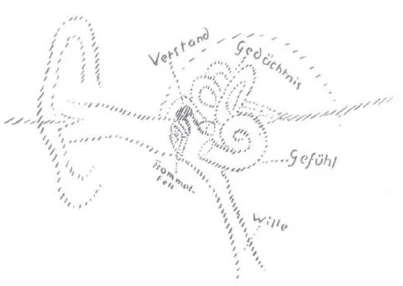
[ 10 ] Well, you see, here’s a strange thing. That would lead us back to the bones. There’s a hole that goes into the head, in the bone. The entire ear is contained within a bony cavity here. But here’s something strange—it’s like a real snail shell (see drawing). And the whole thing consists of two parts; here there’s a membrane (the spiral lamina), and there’s a chamber (the vestibular staircase), and there’s another chamber (the tympanic staircase). The whole thing is filled with water—living water, as I’ve described to you. And inside there is something like a snail shell, but made of skin. And inside that snail shell, there are all these fringes, all these kinds of fringes. That is extraordinarily interesting. If you were to pierce the eardrum and go further in, you would find a snail shell in there—this soft snail shell—and it is lined on the inside with these skin-like fringes. What exactly is that snail shell in there? Well, gentlemen, if you approach this matter with true science, you’ll realize what it is. It is, in fact, nothing other than a small piece of small intestine that has found its way into the ear. Just as we have our intestines in our abdomen, so we have a small piece of small intestine in our ear. The ear is thus designed so that, just as a human has a large intestine, it also has a small intestine. And this small intestine is filled on the inside with living water, just as it is surrounded on the outside by living water. This is extraordinarily interesting. And this entire snail shell—which is enclosed here (see drawing)—is filled entirely with water through a small membrane (oval window). Here, in turn, is another such membrane (round window). Just as when you tap a drum, the drumhead begins to vibrate, so too, when sound comes from both sides, this membrane can begin to vibrate.
[ 11 ] As I told you, there is a membrane right in the middle. This membrane encloses a space filled with thicker, living water, and there is thinner water; and there is, in turn, another thin membrane between the two spaces. Now comes something particularly interesting. There is, in fact, something—I would say—quite marvelous inside. On this thin membrane (of the oval window), there is actually something sitting on top of it: there are two very fine, tiny bones; they sit there like this and look like a stirrup. That is why people have also called it a stirrup. It is something entirely different; I will tell you later what it is. When this little membrane is there, this “stirrup” sits on top of it, and it actually has a bony process here. And this bony process is like the upper arm and the forearm. It sits right here on top of this thing, on this little membrane. So if you were to create a mental image of an arm like that—the upper arm here, the forearm there—curiously enough, there’s another bone here that sits freely. They’re connected to each other at the joint, but this one sits here freely. These are small, tiny bones. Now, the materialistic way of thinking, which views everything from an external perspective, calls this bone here—which rests directly on the eardrum and strikes it—the “hammer,” and that little piece of bone here it calls the “anvil.” And it calls this one the “stirrup.” So these three little bones are referred to by conventional science as the hammer, the anvil, and the stirrup.
[ 12 ] But conventional science doesn't really know what that is. That stirrup-shaped structure—which is, in fact, just the same thing found here in the upper arm, albeit shaped a little differently—is exactly the same. Look at how the joint is attached there—the joint sits on top of this little membrane. And here is the elbow; so that’s a kind of hand. And on top of that sits a free bone. We don’t have one of those in the hand, but we do have one in the kneecap. We might just as well say: This is a leg, a foot; then that would be a thigh, that would be the knee (drawing), the foot would sit on top of it, and there’s the kneecap.
[ 13 ] It’s very interesting, you see: Inside our ear cavity, we first have a sort of inner structure, and then a real hand or arm or a real foot. What is the whole thing for? Well, just imagine: a sound comes along. The sound strikes the eardrum. Everything in there starts to vibrate. So, without even realizing it, a person senses inside the ear what kind of vibrations are occurring. And think about it—you’ve probably felt this before when you’re standing somewhere on the street and something explodes in the distance—I mean, you’ve surely noticed it—you feel it in your guts! Yes, it’s even possible that such a vibration could make you sick in your gut. But the subtlest vibration—the one that runs through this arm—is sensed by the water inside this snail shell. This water in the snail shell resonates with the vibrations that a person experiences when they touch the eardrum with this hand. Can you understand that? (Yes!)
[ 14 ] But now I want to tell you something else. What is the purpose of this tube that goes from the mouth into the ear? Well, if it were just ordinary sound entering here, we wouldn’t really need this tube. But when we listen to one another—when one person speaks to another and we want to understand them, since we’ve learned to speak—if we hadn’t learned to speak ourselves, we wouldn’t be able to understand others very well; it is precisely because we’ve learned to speak that the sounds of speech travel through the Eustachian tube—the auditory tube—in that way; and when the other person speaks to me, the sound comes this way, vibrating there; it passes into this fluid. And because the air passes through—entering the ear via the Eustachian tube—and I have become accustomed to moving this air myself through my own speech, I can understand the other person. Inside the ear, what I am accustomed to from my own speech meets what comes from the other person’s speech. That is where they meet.
[ 15 ] You know, when I say “house”—I’m used to feeling certain vibrations inside my Eustachian tube; when I say “gunpowder”—a different kind of vibration. I’m familiar with these vibrations. When I say “house”—the vibration comes from outside, and I’m used to perceiving it when I say “house.” And that’s where the two come together—my understanding and the vibration from outside—and I understand what “the house” means. Isn’t that easy to understand? My tube, which runs from my mouth to my ear, is already there when we ourselves learn to speak as children, so that we can understand others at the same time. These things are extraordinarily interesting.
[ 16 ] But here’s the thing: Imagine that everything I’ve recorded for you were in your ear, but nothing else at first. At best, let’s say, you’d be able to understand others, and you’d also be able to listen to a piece of music; but you wouldn’t be able to remember what you were hearing. You would have no memory for language or sounds. If the ear were only like that, you would have no memory for language or sounds. For you to have a memory, there is something else in the ear. So that you can also retain what you hear in your memory, there is another mechanism there. Namely, there are three such arches here; they are up there (see drawing). You have to create a mental image of these arches as being hollow. There’s the second one, which stands perpendicular to the first; and there’s a third one, which in turn stands perpendicular to the other. They stand perpendicular to one another in all three directions. So this is yet another marvelous structure found inside the ear. These canals up there are hollow—naturally, since they are canals. And inside them is a fine, living fluid. It resides there.
[ 17 ] But the remarkable thing about this living water is that tiny crystals are constantly forming from it—tiny, tiny crystals. For example, when you hear the word “house,” or when you hear the letter “C,” such tiny crystals form inside; when you hear the word “human,” slightly different crystals form. In these three tiny channels, tiny crystals form, and these tiny crystals enable us not only to understand but also to retain what we have understood in our memory. For what does a person do unconsciously?
[ 18 ] Just create a mental image of yourself hearing, say, “five francs”; you want to remember what was said, so you write it down in your notebook. What you’ve written in your notebook with a pencil has nothing to do with the five francs, but you remember it because of the note. In exactly the same way, what we hear is inscribed into these fine canals by the tiny crystals, which are actually like letters. And through an unconscious mind, this is in turn read when we need it. So that we can say: In there (in the three semicircular canals), there lies the memory for tones and sounds. Here, in this arm or leg (drawing, ossicles), lies understanding. In there, inside this cochlea, lies a little piece of the human soul, a little bit of feeling. There, in this (part of the) labyrinth, in the fluid inside the cochlea, we sense the sounds. There, we sense the sounds. And when we speak and produce the sound ourselves, the will to speak passes through our Eustachian tube. The entire human psyche is contained within the ear: in this tube here, the will lives; in there (in the cochlea), feeling lives; in there (in this arm or leg, the ossicles), the intellect lives; and in there (in the three small semicircular canals), memory lives. And so that a person can bring this to consciousness once it is complete, a nerve runs from here through this cavity (see drawing), through this opening here. The nerve spreads out everywhere, permeates everything, goes everywhere. And through this nerve, the whole process then comes to our consciousness here in the brain.
[ 19 ] Look, gentlemen, at something most peculiar! We have a cavity inside our skull, within our skull bones; there is simply such a cavity there. You enter this cavity by going from the outer ear through the ear canal and piercing the eardrum. Everything I have shown you is contained within this cavity. First, we extend our hand to touch the sounds that enter, so that we can understand them. Then we transfer this sensation to the cochlea, to the living water; in this way, we feel the sound. We penetrate it with our will through our Eustachian tube. And through the tiny crystalline structures found in these three so-called semicircular canals, we recall what is spoken or sung, or whatever else reaches us as sound.
[ 20 ] So we can say: Inside there, we’re actually carrying another little human being—truly a little human being. For a human being has will, feeling, understanding, intellect, and memory. In this little cavity, we’re carrying another little human being inside. We’re simply made up of nothing but little human beings. Our “big” human being is merely the sum of all these little human beings. I will show you soon that the eye is also a little human being. The nose is also a little human being. And these little human beings are held together by the nervous system and thus form the whole human being. And these little human beings come into being because everything that forms inside there—as long as the human being is in the embryonic state within the mother’s womb—is still under the influence of the stars. For all these marvelous structures there—the channels that form the crystals, and this arm—cannot be formed by the Earth’s gravity or anything on Earth. They are laid down while still in the womb by the forces acting from the stars. And only that which belongs to the human being—that is, this part here, the cochlea and the Eustachian tube—is formed later. It is shaped by what emanates from the Earth, just as we, as whole human beings, acquire our entire form through Earth’s gravity, and just as we only begin to stand upright as children who have long since been born.
[ 21 ] You see, when you first understand how the entire human being originates from a single small cell—and one cell develops into the eye, another cell—there are actually ten clusters that develop; it’s not just one cell, but that doesn’t make much difference if you have a mental image of it as just one— so one transforms into the eye, another into the ear, a third into the nose—then you see how the human being gradually develops through the fact that it initially consists of a single cell, which produces a second one, and through the fact that, as it moves to another place and comes under a different influence, it now becomes something else: one becomes the ear, another the nose, a third the eye, and so on. But this is certainly not all derived from the forces of the Earth. The forces of the Earth could only form that which is round in the strict sense, just as the Earth forms our intestines within our abdomen. But everything else is still formed by the forces of the stars.
[ 22 ] Well, don’t you see, we know all this today precisely because we have microscopes that allow us to observe these things. These little bones are, after all, incredibly tiny. But the remarkable thing is that people in ancient times also knew this, and they knew it through a completely different kind of insight than we have today. And now, let’s say, for example, that the ancient Egyptians three thousand years ago also engaged with this kind of knowledge and, in their own way, already knew how marvelous the human ear is on the inside. And they then said to themselves: Human beings have ears, eyes, and other organs on their heads. If we want to explain these organs, we can only ask: How did the ear and the eye—as I said, I’ll explain this to you another time—come to be so different from the other organs on the body? They replied: These organs on the head—the ear and the eye—have become this way because what comes to the earthly realm from outside, from above, acts primarily upon these organs. - Then they looked up and said: “Up there, for example, an eagle is flying; it takes shape high in the air; one must look up there if one wants to observe the forces that form the organs in the human head.” — That is why, when they first drew a picture of a human being, they drew an eagle for the head.
[ 23 ] If we look at the heart and lungs, for example, they look quite different from the eye and the ear. When we look at the lungs, we can’t draw many parallels to the stars, and when we look at the heart, we can’t draw many parallels to the stars either. The power of the stars has a particularly strong effect on the heart, but we cannot relate its form or shape to the stars in the same way. The ancient Egyptians already knew this three thousand years ago: we cannot relate these organs to the stars in the same way as we do the organs of the head. So they reflected: Where is there an animal that particularly embodies those organs that are similar to the human heart and the human lungs, and so on? The eagle particularly embodies those organs that are similar to the human head. The animal—as the ancients discovered—that most fully embodies the heart, and is therefore also the bravest animal, entirely heart—is the lion. That is why they called this group of organs—lungs, heart, and so on—“lion.” So they said: Head = eagle. Then the lion, which represents the middle part of the human being. And then they said: But the human intestines look quite different. You see, the lion actually has very short intestines; its intestines are underdeveloped. So the intestines look quite different. In the ear, there is actually only the very small intestine; it is delicately formed. Our other intestines are not formed quite so delicately. If one wants to examine the intestines, one must compare their structure with that of animals that are particularly under the influence of their intestines. The lion is under the influence of the heart; the eagle is under the influence of the higher powers. Under the influence of the intestines—yes, if you look closely, after the cows have eaten, you can observe the oxen and cows: these animals are entirely under the influence of their intestines. They feel incredibly comfortable when they are digesting. That is why the ancients called what belongs to the intestines in humans the “bull-man” or “cow-man.”
[ 24 ] And now you have the three parts of human nature:
[ 25 ] Eagle = Head
Lion = Chest
Bull = that which belongs to the digestive system.
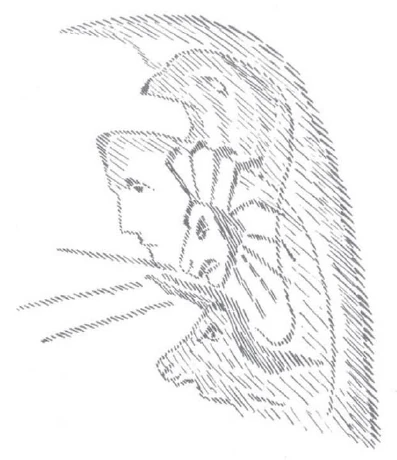
[ 26 ] Of course, these old people knew that, too: When I meet a person—the head isn’t really an eagle, and the middle part isn’t a lion, nor is the lower part a bull or an ox. They already knew that. That is why they said: Yes, if there were nothing else, we would all walk around with an eagle’s head on top, then a lion’s body, and then we would end in a bull. That is how we would all walk around. But now there is something else that transforms the head up there and makes it like a human head, and that, in turn, is what prevents us from being an actual lion and so on—that is the true human being. He then brings everything together. (See drawing on p. 70.)
[ 27 ] And it really is quite remarkable how these ancient people expressed certain truths—which we now recognize—by creating images. Admittedly, it was easier for them to create these images than it is for us. You see, we people today can certainly learn many things, but one cannot say that these ideas—which we usually learn today when we study them in school—truly touch our hearts. It was quite different for those ancient people. They were truly moved by these ideas, and that is why they also dreamed about them. And these people truly dreamed: they saw the whole human being in the image—an eagle gazing out from the forehead, a lion from the heart, and a bull from the abdomen. They then combined these into a single image of the whole human being—a very beautiful picture. So one can say: The ancients composed the human being from the human, the bull, the eagle, and the lion.
[ 28 ] This trend continued right into the accounts of the Gospels. People often took these things for granted. For example, they would say: Well, there is the Gospel according to Matthew, which actually describes the man Jesus just as a human being, and that is why the writer of the Gospel of Matthew was called “the Man.” But take John, the ancients said: Yes, he describes Jesus as if he were hovering above the earth, as if he were flying over the earth; he actually describes only what goes on in the human mind. That is the “eagle.” If you read the Gospel of Mark, you will see that Jesus is portrayed there as the warrior, the fighter, the “lion.” He describes him as one who primarily focuses on the chest organs. And Luke—how does he describe him? Luke has even been described as a physician who focuses primarily on healing. This is also evident in the Gospel. Healing must be achieved by introducing something into the digestive organs. Therefore, he describes Jesus as the “Bull,” who primarily introduces something into the digestive system. And so the four Gospels can be summarized as follows:
[ 29 ] Matthew = Man
Mark = Lion
Luke = Bull
John = Eagle
[ 30 ] Well, with this newspaper [at the top of which are depicted the four figures that were asked about], I was faced with the task of conveying what passes from one human spirit to another—what one person can say to another that is of value. That is also how people should be portrayed. So the figures depicted at the top are the eagle, then the lion, the bull, the cow, and finally the human being himself, who unites them all. This is so that one can see that this newspaper is meant to be something truly human. You will understand, gentlemen, that today we would like to tell people this—that we would like to say something human to them. For in what is often presented in the newspapers today, there is not much that is human. So this is what should be expressed: that in this newspaper, the human being should truly live out all his faculties to the fullest. What he says should not be foolish—that is, the eagle; nor should it be cowardly—that is, the lion. But it should not float away into thin air either; rather, it should stand firmly on the ground—that is, the bull, the cow. And the whole thing should give something to people; it should speak to them. That is what we want today—for everything, absolutely everything, to truly flow from person to person.
[ 31 ] Well, I’ve finally gotten around to addressing your question from that starting point, and I hope this has helped clarify the issue. Were you particularly interested in the story about the ears? It’s important to know what you actually carry within yourself!
Question regarding the lotus flowers that are sometimes mentioned—is there anything more that can be said about them?
[ 32 ] Dr. Steiner: I’ll get to that when I explain the individual organs to you. The next lecture will be on Saturday at 10:00 a.m.