

On Health and Illness
GA 348
2 December 1922, Dornach
Translated by Steiner Online Library
Fourth Lecture
[ 1 ] Gentlemen, someone here has written down a question regarding the thyroid gland:
The thyroid gland can swell, resulting in a goiter. Since this can constrict the trachea—and thus cause problems—surgery was performed, even though the purpose of the gland was not known. But soon after the surgery, a strange phenomenon became apparent. People who had their entire thyroid gland removed underwent changes in their mental state and physical appearance. Growth ceased, their limbs withered away, they no longer secreted sweat, and in some cases, mental deterioration set in. Once the cause had been discovered, attempts were made to reverse the damage by implanting thyroid glands from freshly slaughtered calves or sheep into these unfortunate individuals. The success was surprising. All harmful effects subsided; yet the success was only apparent. After a few weeks, it faded and proved unsustainable. Soon, the stomach also rebelled. They proceeded to implant pieces of the thyroid gland into the neck. Here, too, the effects were astonishing; yet signs of deterioration reappeared. Injections of thyroid secretion yielded no better results. An English factory had achieved surprising results with tablets, including in cases of cretinism. A brief interruption in the use of these tablets causes the healing process to stall. What can be expected upon resuming the tablet regimen?
[ 2 ] Well, gentlemen, based on what we’ve discussed so far, you can get a general idea of what this is all about. You see, until about seventy years ago—that is, until the 1840s and 1850s—the thyroid gland—the gland found here on the front of the human neck—was not considered to be of any particular significance. People thought that such a gland might be of similar importance to the appendix or something like that, that it stemmed from a former significance it had held for human ancestors, and so on. In short, no special significance was attributed to the thyroid gland until it was realized that its degeneration—that is, the formation of a goiter—has a particular influence even on human mental abilities. And the significance of the thyroid gland, as well as its proliferation and enlargement, was studied in cretins—in people who remained mentally deficient. You see, such phenomena—where people remain mentally deficient and have greatly enlarged, i.e., hyperplastic, thyroids—are found particularly in certain regions. It is, after all, widely known throughout the world that the “Halferstadt fools” have massive thyroids that they can even drape over their shoulders.
[ 3 ] The point is that people initially thought: Well, if thyroid degeneration or hyperplasia has such an influence on a person’s mental faculties, then one would do well—so people think in our time, when there is a particular preference for surgical interventions, for the art of surgery made the greatest strides in the 19th century and has actually become the most significant branch of medicine, which is truly commendable— to consider removal first. One does indeed first consider the removal of such organ systems to which one does not attribute any particular significance. The same approach is taken with regard to the functions of the appendix, and even today, if the appendix manifests any harmful effects, it is removed by surgical intervention.
[ 4 ] All of these things, of course, stem from a failure to adhere to something I have repeatedly pointed out here. You will recall: Those who observe the whole person sometimes see, in certain processes in children, that the consequences of these will become apparent at a later age. Conventional medical views, of course, focus only on what the present situation demands. So one undertakes what is beneficial in the present, without considering the long-term consequences. It is difficult to pass what I would call a radical judgment on such matters, for if one refrains from operating on someone who shows signs of harmful appendicitis, that person may die immediately from appendiceal necrosis, and one is then faced with that responsibility, isn’t that so? Of course, the point is simply to work toward resolving such issues in ways other than through surgery. For example, it has become apparent in recent times—as you know—that children should be allowed to walk around with their feet and legs as bare as possible, up to and above the knees. Yes, that breeds appendicitis! And then, once the appendix is already diseased, of course there’s nothing else to do but operate. But anyone who views these matters in a broader context knows how to address them in such a way that the problem simply doesn’t arise in the first place.
[ 5 ] As for the thyroid gland, the following must be said. It is true that the thyroid gland—as has been known, as mentioned, since the latter half of the previous century—is not insignificant, but rather that it is of great importance to the entire human organism; thus, a diseased thyroid gland prevents a person from using their body for mental activities in such a way that they can appear as a normal human being.
[ 6 ] Now, everything described in the question has indeed happened: They first attempted to surgically remove the thyroid gland. If any remnants of the thyroid gland remained, the patient did indeed show some improvement. The patient no longer suffered from the effects of the degenerated thyroid gland, and at the very least, he did not become any more mentally impaired than he already was. However, when the entire thyroid gland was surgically removed—so that absolutely nothing of the thyroid remained—he became even more mentally impaired than he already was. From this, it was naturally recognized that the thyroid gland, even when diseased, plays a significant role in the expression of a person’s mental and emotional qualities.
[ 7 ] Now, thyroid secretion—the term “secretion” refers to a fluid found inside a gland—has also been administered to humans in a wide variety of ways. In part, by—I would say—injecting thyroid substance into the human body, one has thereby caused this glandular fluid to spread throughout the body. However, it has turned out that this does not bring about any significant lasting improvement, because the body as a whole is simply unwilling to fully assimilate what is being introduced into it. The best results have actually been achieved by administering thyroid juice in a form that is introduced into the stomach—that is, through the tablets described here. By introducing the thyroid juice into the stomach and thereby into the entire bloodstream, the body becomes permeated by the substances contained in the thyroid juice. And this shows that the body needs this thyroid juice; it shows that when the thyroid gland is functioning properly in a person, its secretion passes into the blood and circulates throughout the entire body in very small, minute quantities. Now, if one introduces the thyroid juice into the stomach instead of directly into the body, it also circulates through the blood. But you see, the thing is, of course, that when I administer thyroid secretion through the stomach, its effect lasts only as long as it circulates in the blood. If, on the other hand, I stop taking the tablets, the secretion is also lost from the blood. So people who receive thyroid secretion in this way must take it continuously. And then it also has its specific effect.
[ 8 ] One might now say: Yes, that is indeed real proof of materialism; for one sees that if one supplies a person with only this or that substance, then their mental and emotional abilities are enhanced; or if they produce this substance within themselves, as is the case with thyroid hormone, then the same is true. But the fact is this: If one examines all the experiments conducted in this area even more closely, one actually sees something quite different. The thyroid glands are, after all, quite large; you know, of course, that they are quite large. But inside this large thyroid gland, which is located at the front of the neck, there are actually very small, tiny glands on the right and left. There are very tiny glands inside; they’re no bigger than the head of a pin. These tiny glands secrete a substance that is secreted in various parts of the body. Not the exact same substance, but similar substances are secreted in various parts of the body by very small, tiny glands. For example, in the so-called adrenal glands—which also contain such tiny glands—a similar substance is secreted; it is a different substance than the one secreted by the thyroid gland. And there are also such small, tiny glands in other parts of the body. In short, the human body contains very fine substances that are secreted in a wide variety of places. These substances found in the human body are called hormones; and such a hormone—such a substance, which is thus distributed very finely throughout the body—is also present inside the tiny glands of the thyroid.
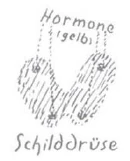
[ 9 ] Here’s a mental image: If you have a fish that’s used to living in water, it can’t survive in the air once you take it out; it will die. These hormone-producing glands—which are like tiny, minuscule living organisms—can only live in the thyroid gland, just as the fish can only live in water. So the thyroid gland is actually there so that these tiny little glands—which I’ve drawn here as yellow dots—can live inside it. If the thyroid gland is surgically removed, then the body no longer has thyroid hormone. If you remove these tiny glands along with the thyroid gland, the person won’t have the hormone and that’s the end of it; if you remove just enough so that these tiny glands remain, then things will improve. But there must be enough tissue left in the thyroid gland so that these tiny glands can still live inside it. So if you remove the entire thyroid gland, you also remove the hormone-producing glands—and then it’s all over; if you don’t remove too much and leave the hormone-producing glands inside, you have, if I may say so, postponed his death. So, the operation is actually most successful when you remove just enough of the thyroid gland to allow the hormone-producing glands to remain inside. If you are then able to replace—with pills—what the hormone-producing glands need and what is no longer present in the small amount of thyroid tissue that remains, so that the hormone-producing glands have something as the blood flows through them, then an improvement will occur. So the matter is quite complicated, and a great deal depends on how the secretion entering the thyroid gland is produced in the first place.
[ 10 ] If you take a mutton and do not remove the entire thyroid gland—that is, if you leave the hormone-producing glands inside—then the secretion is not as good as when you remove the entire thyroid gland. Because the moment you remove the entire thyroid gland from the sheep, the fluid contained within the hormone-producing glands flows into the secretion, resulting in a high-quality secretion; the hormone is already circulating in its blood. If you remove the thyroid gland in such a way that the hormone-producing glands remain inside, the thyroid secretion is of poorer quality, and the tablets are not as effective.
[ 11 ] So, as you can see, it’s not just about the thyroid gland; the thyroid actually only provides nourishment to the glands that are tiny. And as you can imagine, these glands—which are as tiny as pinheads—weren’t discovered for a long time. After all, how could anyone even be aware that these tiny glands exist?
[ 12 ] From this, however, you can see that human beings are creatures who simply need certain substances. You need only remember that a person’s mental and emotional capacities are also altered when, for example, they drink wine. When they drink wine, they become cheerful at first; later, perhaps, they feel differently. Their mental and emotional faculties the next day, however, show the opposite. Yes, it is exactly the same with this substance—which humans, admittedly, need only in very small amounts—that is found in the thyroid gland. Humans make use of this substance. They need it. Animals need it, too. And, of course, one can achieve a great deal if one can manipulate such substances within the human organism.
[ 13 ] Well, you see, this has led to people becoming much more aware of these very subtle substances in recent times. What, exactly, is the basis for the effect of such substances as those secreted by the endocrine glands? Well, gentlemen, you can only understand this if you realize that the human body is, in fact, constantly exposed to destruction. The human body is, in fact, constantly exposed to destruction, and toxins are constantly forming within it. That is, after all, a distinctive feature of the human body: that toxins are constantly forming within it.
[ 14 ] What comes from these small glands neutralizes the effects of the toxins that form in the human body. It is a very interesting fact that the human life process actually consists of the body continually poisoning itself from within, and that these small glands are in place to continually counteract the effects of those toxins. For example, such hormone-producing glands are also found in the adrenal glands. When these function properly, a person is just as you all are. But when these small adrenal glands stop functioning, a person’s skin turns brown—yellowish-brown. This disease exists. It is called Addison’s disease, because Addison was the first to observe it. There was even such a patient here once, from our community, who came here seeking a cure. This browning of the skin—the skin becoming darker and darker—stems from the presence of certain toxins in the body for which the countertoxins from the adrenal glands are lacking. And similarly, the mental dullness stems from the fact that the countertoxins from the thyroid gland are not being released into the body.
[ 15 ] So when you introduce tablets—namely, those that are still laced with such hormonal antidotes—they will simply exert this antidotal effect on the human body. And that has led to people paying more attention to such things in general. And it is indeed interesting that the question immediately arises in connection with Steinach’s theory. It is, in fact, somewhat related to it, and it is correct to consider them together. You see, Steinach’s theory is actually, as of these days—one might say, as of early December 1922—ten years old. About ten years ago, Steinach, the professor in Vienna, first sent the reports of his experiments at that time to the Academy of Sciences. This Steinach theory is also based on the fact that the human body is constantly permeated by hormones—that is, by the effects of very small, tiny glands.
[ 16 ] You see, it’s actually quite interesting: As a human being, you’re essentially constantly poisoning yourself from the inside out, through all your organs. But there are these tiny little glands all over the place, and they constantly act as antidotes. So, starting from the neck, you have the endocrine glands of the neck—the thyroid gland—which ensure that you don’t slur your words but speak clearly, that you can link your speech to your thoughts, and so on. You have hormone glands in the adrenal glands; these ensure that you do not turn black, but remain beautiful white people, and so on. And in the same way, small amounts of fine secretions originating from hormone glands flow from the animal and human reproductive organs. The reproductive system of animals and humans, in both males and females, contains what are called pubertal glands. These are still located inside the body. In children, they are still only slightly developed. And when a person reaches sexual maturity, around the age of fourteen or fifteen, these pubertal glands fully develop in both males and females. They are located inside the body; in men, they are situated above the testicles, in the scrotum. And these pubertal glands also contain small hormone-producing glands within them, from which a hormone is secreted that enters the entire bloodstream in very fine concentrations. And this hormone, which enters the bloodstream, has the property—as Steinach’s experiments have shown—of counteracting the signs of aging.
[ 17 ] You see, people have been studying the signs of aging for a very, very long time, and the Parisian physician and naturalist Metchnikoff published some extraordinarily interesting views on the signs of aging a long time ago, long before Steinach’s theories became known. Metchnikov assumed at the time that the human body is constantly poisoning itself. Specifically, he strongly believed that toxins—namely, toxic microscopic animals and plants—are continuously accumulated in the intestines through the digestive process, and that humans actually age under the influence of these toxins.
[ 18 ] Well, Steinach realized that it is possible to counteract this aging process—that is, this internal process of poisoning, which is entirely natural in humans. He conducted his experiments primarily on rats. Of course, with matters like this, one must always point out that animal experiments are not fully applicable to humans. Not everything that happens in animals—especially in animals such as rats—can be readily extrapolated to humans. After all, the animal organism is somewhat different from the human one. And it must be said that, no matter how insignificant a human may seem—in my view, when compared to the vastness of the universe—there is still a very slight difference between a human and a rat, even in their physical organization.
[ 19 ] So, the scientific data available has primarily been gathered from experiments on rats. Rats are particularly well-suited for these experiments. You see, a rat, if it develops healthily, lives to be about two and a half years old, and before it actually dies, it exhibits very pronounced signs of aging. These signs of aging in such a rat are evident, first and foremost, in the fact that the rat becomes somewhat less lively than it usually is. Rats are, after all, very active animals—and also very aggressive, combative animals. And when they grow old, when they become elderly rats, they become listless and sluggish. Then they lose their fur in certain spots, revealing patches of bare skin; in other areas, their fur becomes coarse, shaggy, and bristly. They also lose their appetite, and the aging of rats is particularly evident in the fact that, when confined in a cage with other male rats, they no longer fight; they withdraw; and if they are confined with females, one must lament—unless the females have also grown old—that the males no longer show any interest in them. Of course, one must be extremely careful when conducting experiments. Rats are susceptible to all kinds of diseases; they very easily contract tuberculosis, are very easily infested with tapeworms and intestinal worms, and, in particular, they also suffer from all kinds of so-called infectious diseases. So, if you have a rat that has grown as old as I have described, you must determine whether this is due to such diseases or whether it is a natural sign of aging.
[ 20 ] So, when conducting such experiments, one must first gather a large number of rats. And these rats must be constantly examined to see whether or not they have this or that type of intestinal worm; one must completely eliminate those whose coarse, shaggy fur or hair loss is caused by disease. And then, in fact, very few ever remain out of a large number, so that one ends up with a number of rats that are elderly rats.
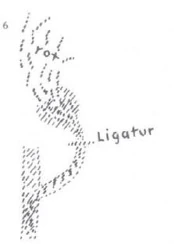
[ 21 ] Steinach initially conducted his experiments mainly on male rats. These elderly rats—who are weak and sometimes have bare patches of skin where their fur has fallen out, and who are no longer interested in females—are now being treated. And here’s how they’re treated, you see: So, in a rat, there is the pubertal gland. This pubertal gland is located inside the body, above the scrotum. Fluids continuously flow from this pubertal gland into fine ducts. One could draw it like this: If this is the pubertal gland, then fine ducts lead into the so-called spermatic cord, where the semen is also discharged. And so the hormone from the pubertal gland travels through these ducts and mixes with the semen that is ejaculated, so that the semen is permeated by this hormone. So when the animal is still young, the pubertal gland secretes this hormone. It travels through these ducts. These ducts are called the vasa deferentia; the hormone passes through them into the vas deferens. And the semen, which is ejaculated from the male organ and fertilizes the female, contains this hormone. But the hormone produced in the pubertal gland—which I have outlined in red here—also spreads throughout the entire body. So while the rat does indeed release the majority of this hormone into the seminal duct, this hormone is also finely distributed back throughout the entire body, so that the rat’s entire body has this hormone from the pubertal gland circulating in its bloodstream.
[ 22 ] Now imagine this: the rat grows old and flaccid. This flaccidity—the body’s growing flaccidity—manifests itself in the body’s inability to retain its bodily fluids; it can no longer keep them within itself. You may have heard that people who are executed have left their bodily fluids behind. When the body becomes flaccid, it can no longer retain these secretions. And when the rat—or the organism in general—grows old, too much of this hormone flows into the seminal duct, and too little returns to the body, so that the body then contains the toxins of old age, and this hormone, which comes from the pubertal gland, does not act sufficiently as an antidote. As a result, the rat—and the organism in general—grows old. It grows old due to the toxins it produces within itself. These toxins permeate the entire body, and thus a person cannot retain youth.
[ 23 ] When a child reaches puberty, a great deal of this hormone is released throughout the body. But that is actually less important. The body is healthy and retains what it needs of this puberty hormone, releasing only as much as it does not need itself.
[ 24 ] When the rat used in these experiments grows old, it secretes too much of the pubertal gland hormone. Now, Steinach did it this way, you see: He tied off this duct; it’s tied here with a fine thread, so that the rat’s pathway from the pubertal gland to the vas deferens is blocked. Now the hormone cannot leave the pubertal gland and flows back into the body. Do you understand how that works? Well, it’s just like when you seal off a pipe; then the whole thing flows back. And so he seals it off here—he ties off the vas deferens, performs a ligation, as it’s called—and all the hormone surges back into the body; the rat starts to become sexually active again, even grows hair back, and if you put it in a cage with females, it can’t fertilize them—since that pathway is blocked—but it regains its sexual drive and goes after the female rats again. That’s just how it is.
[ 25 ] So you see that the procedure is simply carried out by mechanically preventing the body, which is becoming flaccid, from losing too much fluid; but then the fluid flows back into it, and it regains a certain degree of youth—perhaps temporary, but a degree nonetheless. It is quite interesting to see how these male rats become fresh and agile again once the ligature is applied at the spot I marked.
[ 26 ] Well, this procedure here—this ligation—can be performed in a variety of ways. It can be done as I just described. That’s quite difficult, because, of course, surgery is required just to gain access. You have to make an incision from the outside to gain access, and then thread a suture around it to tie it off. But attempts have also been made in other ways, for example, by irradiating the testicles with X-rays. This causes them to die off, which in turn suppresses the hormone produced by the pubertal gland. This procedure has also been performed on humans, in particular.
[ 27 ] In short, the whole process is based on returning the fluid—the hormonal fluid—back into the body. You can see the connection here with the thyroid gland, where the goal is also to introduce the hormone into the bloodstream in some way. Here, too, the goal is to introduce the hormone from the pubertal gland into the bloodstream by simply reducing its secretion in old age, when a person has become frail. So, from a scientific standpoint, this is perfectly sound.
[ 28 ] Steinach has continued these experiments very successfully over the past ten years, and it can already be said today that what has been observed in rats has, in a certain sense, even been verified in humans. The procedure has also been carried out on humans, yielding results either through this method or by directly introducing pubertal gland secretions from a younger person into the pubertal glands. It can also be introduced through inoculation, or the testes can be inoculated—that is, by introducing testicular fluid from a younger animal into the human testes—in short, attempts have been made in a wide variety of ways to reintroduce this hormone into the body.
[ 29 ] And indeed, while the effects observed in humans are, of course, always exaggerated a bit, they certainly cannot be denied. The fact is that the experiments were not only conducted on rats, but also on elderly people who had lost their vitality, and who, as a result, regained some of their youth.
[ 30 ] Of course, this process won’t last forever, since the human body has a limited lifespan. It’s also by no means certain today whether this will actually extend one’s lifespan. It is possible to restore some youthfulness, but not to extend lifespan. However, it is also likely that this will make it possible to extend lifespan.
[ 31 ] But you see, all these things also have their downsides, because let me tell you something: There are people who have trouble sleeping, aren’t there? If you have young people who have trouble sleeping, and you give them a sleeping aid—opium, morphine—well, then they do sleep better; there’s no doubt about it—they sleep. There’s nothing wrong with that. But the fact is that if you repeatedly give young people morphine as a sleep aid—or any physical sleep aid at all—the body will eventually weaken. It will come to need more and more of that sleep aid. It can no longer function without it. It becomes dependent on that sleep aid, and later on you’re no longer dealing with a person who is in full possession of their faculties. That is why it is better to consider how to combat insomnia in a more inner way. And it can indeed be combated in an inner way. If you truly help a person to make the effort to think only of the same word over and over, then little by little they will gain the strength from within to fall asleep. And that is better. It does not weaken the person.
[ 32 ] So one can certainly say: The effect of sleeping pills is undeniable. It is completely out of the question that a person would not sleep better thanks to sleeping pills. But one should actually approach the matter in a completely different way. We should try to teach people how to sleep in a way that comes from within. Of course, this is more difficult and has something to do with parenting methods. For if children are raised properly, it simply follows that they can easily be encouraged to get their proper amount of sleep; and there will be no need to give people sleeping pills later on if they have been treated properly at school.
[ 33 ] One can indeed compare this very method of rejuvenation to administering sleeping pills. Yes, gentlemen, this is what makes it particularly interesting: As I already told you, Mechnikov was the first to study these signs of aging and prescribed a different remedy to people—at that time, Steinach’s experiments had not yet taken place. You may be very surprised to learn that a thoroughly materialistic doctor recommended that people read works such as Goethe’s *Faust*! Indeed, they should read works such as Goethe’s *Faust*; then they, too, will experience a kind of rejuvenation.
[ 34 ] Yes, there is, in fact, a tremendous amount of truth in that. For when, at the right age, one has something that completely absorbs one mentally and inwardly, something that also fills one with enthusiasm—enthusiasm is not called enthusiasm because it does not set the mind in motion, but precisely because it sets the mind in motion; otherwise it would be called “materialization”; even the materialists, when they deliver their public speeches, do not say: “Let us be imbued with materialization,” but rather—even though they do not believe in the spirit—they say: “Let us be imbued with enthusiasm.” So if one is truly imbued with enthusiasm, that is a source of rejuvenation. Of course, one cannot verify this in rats! But it is a source of rejuvenation in humans. And if one were to make such observations in life, one would find that whatever rejuvenation one can impart to a person—according to the measure of their strength and vital forces—can be imparted much more effectively if one allows them, in the proper way, the time to imbue themselves inwardly with a spiritual activity. For spiritual activity has the peculiarity of holding the gland walls together and keeping them strong.
[ 35 ] If a person is interested only in superficial things throughout his entire life, then his glands and all those blood vessel walls will become flaccid much sooner than if he were interested in intellectual pursuits. And with a person—first, if they were properly raised as a child, and second, if they were given time to properly immerse themselves in spiritual matters—with such a person, there is no need to perform such a ligation later on, because they maintain this channel strong and allow what they need to flow back into their body on their own.
[ 36 ] This is different from the case with the thyroid. With the thyroid, one does have to intervene from time to time, because it is extremely difficult to improve the thyroid—I would say—through spiritual means; but even there, results can be achieved. They have already been achieved. If one has people repeat certain things over and over again, every day, in a very specific way, using a song-like language, then the thyroid will also shrink.
[ 37 ] So one must indeed say: These things are just as true as the effectiveness of sleeping pills; but it would be better if humanity would finally consider not doing everything in such a materialistic way, but if humanity would finally consider giving civilization the opportunity for everyone to achieve their share of spiritual activity. Then people wouldn’t place such great value on these things in the first place, but would instead see that the fact that people break down in old age is actually caused by the harmful nature of our civilization. All these surgical procedures on humans are, after all, essentially intended only to compensate for the harm we have caused people by granting them a few months of rejuvenation in old age. Medically speaking, the approach is, of course, ingenious and magnificent; but it must be viewed within a broader cultural context. Then it takes on a different aspect.
[ 38 ] Of course, there’s something else to consider here. I said earlier that when you give a younger person sleeping pills, you’re actually weakening them. But when you apply such a rejuvenation treatment to elderly, frail people who can no longer really get around, it’s naturally a great joy for them to be able to start enjoying life a little again. There’s no need to worry too much that it might be harmful to the elderly, because such a rejuvenation treatment is administered at an age when it’s no longer really possible to determine whether it will harm them afterward or not. The materialistic worldview yields magnificent results today, but they must be viewed within a broader cultural context. Then they appear quite differently. That is why I always say that people should think about how to protect children—first in school and then later in life—from developing such premature signs of aging. This is not limited to certain social classes; even as early as age thirty—especially among those belonging to the so-called upper classes—people are walking around with terrible bald spots. This stems from the fact that even in high schools, education is conducted in an unnatural way. It would be much wiser to educate in such a way that the human body itself holds everything together as long as it possesses vital forces.
[ 39 ] That is all I can tell you about the matter. It is indeed very interesting to always look at these things from both sides.
[ 40 ] I’ll tell you whatever else there is to say next time. I have to be away for eight days, but then I’ll be back for a while, and we can continue talking about this.