

On Health and Illness
GA 348
2 December 1922, Dornach
Translate the original German text into any language:
Versions Available:
On Health and Illness, tr. SOL
Vierter Vortrag
Fourth Lecture
[ 1 ] Meine Herren, es hat hier jemand eine Frage aufgeschrieben in bezug auf die Schilddrüse:
[ 1 ] Gentlemen, someone here has written down a question regarding the thyroid gland:
Die Schilddrüse kann anschwellen, und es entsteht dann der Kropf. Da dieser auf die Luftröhre einen einengenden Einfluß haben kann, also störend wirkt, wurde ein operativer Eingriff gemacht, wußte man doch den Zweck der Drüse nicht. Aber bald nach dem operativen Eingriff zeigte sich eine merkwürdige Erscheinung. Leute, denen man die ganze Schilddrüse weggeschnitten hatte, veränderten sich an Geist und Gestalt. Das Wachstum hörte auf, die Gliedmaßen dunsteten auf, es sonderte sich kein Schweiß mehr ab, teilweise Verblödung trat ein. Als man die Ursache entdeckt hatte, wollte man den Schaden wieder beheben und gab den unglücklichen Menschen Schilddrüsen von frisch geschlachteten Kälbern oder Hammeln ein. Der Erfolg war überraschend. Alle schädliche Wirkung trat zurück; doch war der Erfolg nur scheinbar. Nach einigen Wochen verblaßte er, war nicht lebensfähig. Auch revoltierte bald der Magen. Man schritt dazu, Schilddrüsenteile in den Hals zu bringen. Auch hier verblüffende Wirkungen; doch traten auch hier wieder Verfallserscheinungen auf. Nicht besser ging es mit Einspritzungen von Schilddrüsensekret. Eine englische Fabrik hatte mit Tabletten überraschende Resultate erreicht, darunter bei Kretins. Eine kurze Unterbrechung im Benutzen dieser Tabletten läßt einen Stillstand der Heilung eintreten. Was ist beim Fortsetzen der Tablettenkur zu erwarten?
The thyroid gland can swell, resulting in a goiter. Since this can constrict the trachea—and thus cause problems—surgery was performed, even though the purpose of the gland was not known. But soon after the surgery, a strange phenomenon became apparent. People who had their entire thyroid gland removed underwent changes in their mental state and physical appearance. Growth ceased, their limbs withered away, they no longer secreted sweat, and in some cases, mental deterioration set in. Once the cause had been discovered, attempts were made to reverse the damage by implanting thyroid glands from freshly slaughtered calves or sheep into these unfortunate individuals. The success was surprising. All harmful effects subsided; yet the success was only apparent. After a few weeks, it faded and proved unsustainable. Soon, the stomach also rebelled. They proceeded to implant pieces of the thyroid gland into the neck. Here, too, the effects were astonishing; yet signs of deterioration reappeared. Injections of thyroid secretion yielded no better results. An English factory had achieved surprising results with tablets, including in cases of cretinism. A brief interruption in the use of these tablets causes the healing process to stall. What can be expected upon resuming the tablet regimen?
[ 2 ] Nun, meine Herren, mit dem, was wir bisher schon besprochen haben, können Sie ungefähr die Dinge verstehen, um die es sich da handelt. Sehen Sie, es war so ungefähr bis vor vielleicht siebzig Jahren, so bis in die vierziger, fünfziger Jahre des 19. Jahrhunderts, da schrieb man der Schilddrüse, also derjenigen Drüse, die hier an der Vorderseite des Halses beim Menschen zu finden ist, keine besondere Bedeutung zu. Man dachte sich, solch eine Drüse sei vielleicht von einer ähnlichen Bedeutung wie der Blinddarm oder so etwas, rühre her von früherer Bedeutung, die die Sache bei den Vorfahren des Menschen hatte, und dergleichen. Kurz, man schrieb der Schilddrüse keine besondere Bedeutung bei, bis man merkte, daß die Entartung der Schilddrüse, also die Kropfbildung, einen besonderen Einfluß sogar auf die geistigen Fähigkeiten des Menschen hat. Und man studierte die Bedeutung der Schilddrüse, der Wucherung und Vergrößerung der Schilddrüse bei Kretins, bei blöde gebliebenen Menschen. Sehen Sie, solche Erscheinungen, daß Menschen blöde bleiben und stark vergrößerte, also wuchernde Schilddrüsen haben, die findet man besonders in gewissen Gegenden. Es ist ja wohl weit in der Welt bekannt, daß die Halberstädter Trottel mächtige Schilddrüsen haben, die sie sogar über die Schultern hinüberlegen können.
[ 2 ] Well, gentlemen, based on what we’ve discussed so far, you can get a general idea of what this is all about. You see, until about seventy years ago—that is, until the 1840s and 1850s—the thyroid gland—the gland found here on the front of the human neck—was not considered to be of any particular significance. People thought that such a gland might be of similar importance to the appendix or something like that, that it stemmed from a former significance it had held for human ancestors, and so on. In short, no special significance was attributed to the thyroid gland until it was realized that its degeneration—that is, the formation of a goiter—has a particular influence even on human mental abilities. And the significance of the thyroid gland, as well as its proliferation and enlargement, was studied in cretins—in people who remained mentally deficient. You see, such phenomena—where people remain mentally deficient and have greatly enlarged, i.e., hyperplastic, thyroids—are found particularly in certain regions. It is, after all, widely known throughout the world that the “Halferstadt fools” have massive thyroids that they can even drape over their shoulders.
[ 3 ] Nun handelt es sich darum, daß die Leute zunächst gedacht haben: Nun, wenn die Schilddrüsenentartung, die Schilddrüsenwucherung einen solchen Einfluß auf die geistigen Fähigkeiten des Menschen hat, dann wird man ja gut tun — so denkt man in unserer Zeit, wo man besondere Vorliebe für operative Eingriffe hat, denn die Operationskunst hat ja den größten Fortschritt gemacht im 19. Jahrhundert und ist eigentlich der bedeutendste Teil der Medizin geworden, wirklich anerkennenswert —, zunächst an die Entfernung zu denken. Man denkt wirklich zunächst an die Entfernung solcher Organsysteme, denen man keine besondere Bedeutung zuschreibt. Dieselbe Sache wird ja in bezug auf die Blinddarmfunktionen gemacht, und der Blinddarm wird ja heute noch zunächst, wenn er sich irgendwie schädigend bemerkbar macht, durch operativen Eingriff entfernt.
[ 3 ] The point is that people initially thought: Well, if thyroid degeneration or hyperplasia has such an influence on a person’s mental faculties, then one would do well—so people think in our time, when there is a particular preference for surgical interventions, for the art of surgery made the greatest strides in the 19th century and has actually become the most significant branch of medicine, which is truly commendable— to consider removal first. One does indeed first consider the removal of such organ systems to which one does not attribute any particular significance. The same approach is taken with regard to the functions of the appendix, and even today, if the appendix manifests any harmful effects, it is removed by surgical intervention.
[ 4 ] Alle diese Dinge beruhen natürlich darauf, daß etwas nicht eingehalten wird, auf was ich hier immer wiederum aufmerksam gemacht habe. Sie werden sich erinnern: Derjenige, der den ganzen Menschen beobachtet, der sieht manchmal beim Kind in gewissen Vorgängen, daß sich das im spätesten Alter in seinen Folgen zeigt. Die gewöhnlichen medizinischen Ansichten gehen natürlich nur auf das, was augenblicklich die Gegenwart fordert. Also man nimmt dasjenige vor, was in der Gegenwart günstig ist, und man sieht dann nicht auf den weiteren Verlauf. Es ist schwer, über solche Dinge, ich möchte sagen, ein radikales Urteil abzugeben, denn wenn man bei irgend jemandem, der die schädigende Blinddarmentzündung zeigt, die Operation unterläßt, so kann er unmittelbar an der Blinddarmentartung sterben, und man hat dann die Verantwortung vor sich, nicht wahr. Es handelt sich natürlich nur darum, daß man darauf hinarbeitet, daß solche Dinge auch in einer anderen Weise behoben werden als durch Operationen. Zum Beispiel ist aufgetaucht in der neueren Zeit — das wissen Sie ja —, daß man die Kinder mit möglichst nackten Füßen, Beinen, bis über die Knie, herumgehen läßt. Ja, das züchtet die Blinddarmentartung! Und dann, wenn der Blinddarm schon krank ist, kann man natürlich nichts anderes machen als operieren. Aber derjenige, der die Sachen in einem größeren Zusammenhang sieht, der weiß, wie man diesen Dingen so begegnen kann, daß die Sache eben überhaupt nicht in dieser Weise auftritt.
[ 4 ] All of these things, of course, stem from a failure to adhere to something I have repeatedly pointed out here. You will recall: Those who observe the whole person sometimes see, in certain processes in children, that the consequences of these will become apparent at a later age. Conventional medical views, of course, focus only on what the present situation demands. So one undertakes what is beneficial in the present, without considering the long-term consequences. It is difficult to pass what I would call a radical judgment on such matters, for if one refrains from operating on someone who shows signs of harmful appendicitis, that person may die immediately from appendiceal necrosis, and one is then faced with that responsibility, isn’t that so? Of course, the point is simply to work toward resolving such issues in ways other than through surgery. For example, it has become apparent in recent times—as you know—that children should be allowed to walk around with their feet and legs as bare as possible, up to and above the knees. Yes, that breeds appendicitis! And then, once the appendix is already diseased, of course there’s nothing else to do but operate. But anyone who views these matters in a broader context knows how to address them in such a way that the problem simply doesn’t arise in the first place.
[ 5 ] Was nun die Schilddrüse betrifft, so muß man folgendes sagen. Richtig ist, daß die Schilddrüse — das weiß man, wie gesagt, seit der letzten Hälfte des vorigen Jahrhunderts — nicht bedeutungslos ist, sondern daß sie eine große Bedeutung hat für die gesamte menschliche Organisation, daß also eine entartete Schilddrüse dem Menschen nicht möglich macht, seinen Körper so zu den geistigen Tätigkeiten zu gebrauchen, daß er als ein normaler Mensch erscheinen kann.
[ 5 ] As for the thyroid gland, the following must be said. It is true that the thyroid gland—as has been known, as mentioned, since the latter half of the previous century—is not insignificant, but rather that it is of great importance to the entire human organism; thus, a diseased thyroid gland prevents a person from using their body for mental activities in such a way that they can appear as a normal human being.
[ 6 ] Nun ist alles das, was hier in der Frage beschrieben worden ist, ja geschehen: Man hat zunächst versucht, die Schilddrüse wegzuoperieren. Sind da noch Reste der Schilddrüse geblieben, so zeigte sich in der Tat für den Betreffenden eine Art von Besserung. Der Betreffende hatte nicht die Folgen der entarteten Schilddrüse, und er wurde wenigstens nicht dümmer als er schon war. Wenn man aber die ganze Schilddrüse wegoperierte, so daß also gar nichts mehr von der Schilddrüse drinnen war, dann wurde er blöder, als er schon war. Daraus erkannte man natürlich, daß die Schilddrüse dennoch, selbst wenn sie erkrankt ist, ihre Bedeutung hat für die Äußerung der geistigen und der seelischen Eigenschaften eines Menschen.
[ 6 ] Now, everything described in the question has indeed happened: They first attempted to surgically remove the thyroid gland. If any remnants of the thyroid gland remained, the patient did indeed show some improvement. The patient no longer suffered from the effects of the degenerated thyroid gland, and at the very least, he did not become any more mentally impaired than he already was. However, when the entire thyroid gland was surgically removed—so that absolutely nothing of the thyroid remained—he became even more mentally impaired than he already was. From this, it was naturally recognized that the thyroid gland, even when diseased, plays a significant role in the expression of a person’s mental and emotional qualities.
[ 7 ] Nun hat man auch wiederum das Schilddrüsensekret - man nennt eine Flüssigkeit, die in einer Drüse drinnen ist, Sekret - in der verschiedensten Weise den Menschen zugeführt. Man hat also teilweise dadurch, daß man Schilddrüsensubstanz dem menschlichen Körper, ich möchte sagen, eingeimpft hat, die Ausbreitung dieser Drüsenflüssigkeit im Körper wiederum bewirkt. Es hat sich aber herausgestellt, daß das keine besondere dauernde Besserung hervorruft, weil eben der ganze Körper doch nicht recht teilnehmen will an dem, was man da hineingibt. Den besten Erfolg hat eigentlich noch erlebt die Verabreichung von Schilddrüsensaft in der Form, daß man sie dem Magen einführt, also durch diese Tabletten, die da beschrieben worden sind. Dadurch, daß man den Schilddrüsensaft in den Magen einführt und dadurch in die ganze Blutzirkulation, wird der Körper durchdrungen von dem, was in dem Schilddrüsensaft drinnen ist. Und das zeigt, daß er ihn braucht, diesen Schilddrüsensaft, das zeigt, daß, wenn die Schilddrüse ordentlich in einem Menschen vorhanden ist, ihr Sekret ins Blut übergeht, und im Blut durch den ganzen Körper durch geht in sehr kleinen, feinen Mengen. Wenn man nun, statt direkt in den Körper, den Schilddrüsensaft in den Magen einführt, so geht dies auch durch das Blut durch. Aber sehen Sie, die Sache ist natürlich so, daß wenn ich durch den Magen Schilddrüsensaft einführe, das nur solange anhält, als eben die Sache im Blut drinnen zirkuliert. Höre ich wiederum auf mit dem Eingeben von Tabletten, dann verliert sich auch der Saft im Blute. Also solche Leute, die auf diese Weise Schilddrüsensaft kriegen, die müssen ihn fortwährend kriegen. Und dann hat er auch seine bestimmte Wirkung.
[ 7 ] Now, thyroid secretion—the term “secretion” refers to a fluid found inside a gland—has also been administered to humans in a wide variety of ways. In part, by—I would say—injecting thyroid substance into the human body, one has thereby caused this glandular fluid to spread throughout the body. However, it has turned out that this does not bring about any significant lasting improvement, because the body as a whole is simply unwilling to fully assimilate what is being introduced into it. The best results have actually been achieved by administering thyroid juice in a form that is introduced into the stomach—that is, through the tablets described here. By introducing the thyroid juice into the stomach and thereby into the entire bloodstream, the body becomes permeated by the substances contained in the thyroid juice. And this shows that the body needs this thyroid juice; it shows that when the thyroid gland is functioning properly in a person, its secretion passes into the blood and circulates throughout the entire body in very small, minute quantities. Now, if one introduces the thyroid juice into the stomach instead of directly into the body, it also circulates through the blood. But you see, the thing is, of course, that when I administer thyroid secretion through the stomach, its effect lasts only as long as it circulates in the blood. If, on the other hand, I stop taking the tablets, the secretion is also lost from the blood. So people who receive thyroid secretion in this way must take it continuously. And then it also has its specific effect.
[ 8 ] Man könnte nun sagen: Ja, das ist erst ein richtiger Beweis für den Materialismus; denn man sieht, daß man dem Menschen nur diesen oder jenen Stoff zuführen darf, dann heben sich seine geistig-seelischen Fähigkeiten; oder wenn er diesen Stoff selber in sich fabriziert, wie es beim Schilddrüsenstoff der Fall ist, dann ist das auch so der Fall. Aber die Sache ist so: Wenn man viel genauer noch die ganzen Versuche prüft, die nach dieser Richtung gemacht werden, so sieht man nämlich noch etwas ganz anderes. Die Schilddrüsen, die sind ja ziemlich groß; Sie wissen ja, daß die ziemlich groß sind. Aber in dieser großen Schilddrüse, die da vorne am Hals ist, sind nämlich noch ganz kleine, winzige Drüsen rechts und links da drinnen. Ganz kleinwinzige Drüsen sind da drinnen; die sind nicht größer als ein kleiner Stecknadelkopf. Diese kleinwinzigen Drüsen, die sondern einen Stoff ab, der an verschiedenen Stellen des Körpers überhaupt abgesondert wird. Nicht derselbe Stoff, aber ähnliche Stoffe werden an verschiedenen Stellen des Körpers von ganz kleinen, winzigen Drüsen abgesondert. So zum Beispiel wird in den sogenannten Nebennieren — da sind auch solche kleinwinzigen Drüsen drinnen - auch ein solcher Stoff abgesondert; es ist ein anderer Stoff als der, der von der Schilddrüse abgesondert wird. Und an anderen Stellen des Körpers sind auch noch so kleine, winzige Drüsen. Kurz, der menschliche Körper hat ganz feine Stoffe in sich, die an den verschiedensten Stellen abgesondert werden. Diese Stoffe, die der Mensch da hat, die nennt man Hormone; und ein solches Hormon, ein solcher Stoff, der also ganz fein im Körper verteilt ist, solcher Stoff ist auch da drinnen in den kleinen Drüsen der Schilddrüse.
[ 8 ] One might now say: Yes, that is indeed real proof of materialism; for one sees that if one supplies a person with only this or that substance, then their mental and emotional abilities are enhanced; or if they produce this substance within themselves, as is the case with thyroid hormone, then the same is true. But the fact is this: If one examines all the experiments conducted in this area even more closely, one actually sees something quite different. The thyroid glands are, after all, quite large; you know, of course, that they are quite large. But inside this large thyroid gland, which is located at the front of the neck, there are actually very small, tiny glands on the right and left. There are very tiny glands inside; they’re no bigger than the head of a pin. These tiny glands secrete a substance that is secreted in various parts of the body. Not the exact same substance, but similar substances are secreted in various parts of the body by very small, tiny glands. For example, in the so-called adrenal glands—which also contain such tiny glands—a similar substance is secreted; it is a different substance than the one secreted by the thyroid gland. And there are also such small, tiny glands in other parts of the body. In short, the human body contains very fine substances that are secreted in a wide variety of places. These substances found in the human body are called hormones; and such a hormone—such a substance, which is thus distributed very finely throughout the body—is also present inside the tiny glands of the thyroid.
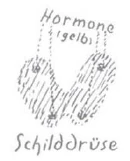
[ 9 ] Sie können sich das so vorstellen: Wenn Sie einen Fisch haben, der gewohnt ist im Wasser zu leben, so kann er, wenn Sie ihn herausnehmen, in der Luft nicht leben; da muß er sterben. Diese Hormondrüsen, die etwas wie kleine, winzige Lebewesen sind, die können ebenso nur in der Schilddrüse leben wie der Fisch im Wasser. Also die Schilddrüse ist eigentlich dazu da, daß diese kleinen winzigen Drüsen, die ich da als gelbe Punkte gezeichnet habe, in ihr leben. Operiert man nun die Schilddrüse heraus, dann hat der Körper das Schilddrüsenhormon nicht. Wenn man mit der Schilddrüse diese kleinen winzigen Drüsen herausoperiert, dann hat der Mensch das nicht und dann ist es überhaupt aus; wenn man nur so viel wegschneidet, daß diese kleinen winzigen Drüsen bleiben, dann wird es besser. Nur muß in der Schilddrüse so viel drinnen sein, daß eben diese kleinen Drüsen noch in der Schilddrüse drinnen leben können. Wenn Sie also die ganze Schilddrüse herausschneiden, so schneiden Sie auch die Hormondrüsen mit heraus — dann ist es aus; wenn Sie nicht zu viel herausschneiden und die Hormondrüsen drinnen lassen, haben Sie, wenn ich so sagen darf, seinen Tod aufgehalten. Also, die Operation gelingt eigentlich am besten, wenn man nur so viel wegschneidet von der Schilddrüse, daß die Hormondrüsen drinnenbleiben. Gelingt es dann, dasjenige, was die Hormondrüsen brauchen und was von der wenigen Substanz der Schilddrüse nicht mehr da ist, durch die Tabletten zu ersetzen, so daß die Hormondrüsen, während das Blut durch sie durchsickert, etwas haben, dann ist auch eine Besserung da. Also die Sache ist eben ziemlich kompliziert, und es hängt sehr viel davon ab, wie nun überhaupt das Sekret, das in die Schilddrüse hineinkommt, gemacht wird.
[ 9 ] Here’s a mental image: If you have a fish that’s used to living in water, it can’t survive in the air once you take it out; it will die. These hormone-producing glands—which are like tiny, minuscule living organisms—can only live in the thyroid gland, just as the fish can only live in water. So the thyroid gland is actually there so that these tiny little glands—which I’ve drawn here as yellow dots—can live inside it. If the thyroid gland is surgically removed, then the body no longer has thyroid hormone. If you remove these tiny glands along with the thyroid gland, the person won’t have the hormone and that’s the end of it; if you remove just enough so that these tiny glands remain, then things will improve. But there must be enough tissue left in the thyroid gland so that these tiny glands can still live inside it. So if you remove the entire thyroid gland, you also remove the hormone-producing glands—and then it’s all over; if you don’t remove too much and leave the hormone-producing glands inside, you have, if I may say so, postponed his death. So, the operation is actually most successful when you remove just enough of the thyroid gland to allow the hormone-producing glands to remain inside. If you are then able to replace—with pills—what the hormone-producing glands need and what is no longer present in the small amount of thyroid tissue that remains, so that the hormone-producing glands have something as the blood flows through them, then an improvement will occur. So the matter is quite complicated, and a great deal depends on how the secretion entering the thyroid gland is produced in the first place.
[ 10 ] Nimmt man einen Hammel und schneidet nicht die ganze Schilddrüse heraus, läßt man also die Hormondrüsen drinnen, dann ist das Sekret nicht so gut, als wenn man die ganze Schilddrüse herausschneidet. Denn in dem Moment, wo man beim Hammel die ganze Schilddrüse herausschneidet, rinnt also der Saft, der in den Hormondrüsen drinnen ist, in das Sekret hinein und man hat ein gutes Sekret; es zirkuliert schon das Hormon in seinem Blut. Schneidet man die Schilddrüse so heraus, daß die Hormondrüsen drinnen bleiben, dann ist das Schilddrüsensekret schlechter, und die Tabletten helfen nicht so gut.
[ 10 ] If you take a mutton and do not remove the entire thyroid gland—that is, if you leave the hormone-producing glands inside—then the secretion is not as good as when you remove the entire thyroid gland. Because the moment you remove the entire thyroid gland from the sheep, the fluid contained within the hormone-producing glands flows into the secretion, resulting in a high-quality secretion; the hormone is already circulating in its blood. If you remove the thyroid gland in such a way that the hormone-producing glands remain inside, the thyroid secretion is of poorer quality, and the tablets are not as effective.
[ 11 ] Also Sie sehen, es kommt nicht allein auf die Schilddrüse an; die Schilddrüse gibt eigentlich nur den Drüsen, die kleinwinzig sind, Nahrung. Und Sie können sich denken, daß man diese Drüsen, die kleinwinzig wie Stecknadelköpfe sind, auch lange nicht gefunden hat. Denn wie soll man denn darauf aufmerksam sein, daß da diese kleinwinzigen Drüsen sind?
[ 11 ] So, as you can see, it’s not just about the thyroid gland; the thyroid actually only provides nourishment to the glands that are tiny. And as you can imagine, these glands—which are as tiny as pinheads—weren’t discovered for a long time. After all, how could anyone even be aware that these tiny glands exist?
[ 12 ] Daraus aber können Sie sehen, daß der Mensch ein Wesen ist, das einfach gewisse Stoffe braucht. Sie brauchen sich nämlich an gar nichts anderes zu erinnern, als daß ja auch die geistig-seelischen Fähigkeiten eines Menschen verändert werden, wenn er zum Beispiel Wein trinkt. Wenn er Wein trinkt, wird er lustig zunächst; später vielleicht anders. Die geistig-seelischen Fähigkeiten am nächsten Tag, die zeigen ja das Gegenteil. Ja, geradeso ist es mit diesem Stoffe, den der Mensch ja allerdings nur in ganz feinen Verteilungen braucht, der da in den Hormondrüsen der Schilddrüse drinnen ist. Der Mensch bedient sich dieses Stoffes. Er braucht ihn. Die Tiere brauchen ihn auch. Und man kann natürlich sehr viel machen, wenn man im menschlichen Organismus mit solchen Stoffen manipulieren kann.
[ 12 ] From this, however, you can see that human beings are creatures who simply need certain substances. You need only remember that a person’s mental and emotional capacities are also altered when, for example, they drink wine. When they drink wine, they become cheerful at first; later, perhaps, they feel differently. Their mental and emotional faculties the next day, however, show the opposite. Yes, it is exactly the same with this substance—which humans, admittedly, need only in very small amounts—that is found in the thyroid gland. Humans make use of this substance. They need it. Animals need it, too. And, of course, one can achieve a great deal if one can manipulate such substances within the human organism.
[ 13 ] Nun, sehen Sie, das hat dazu geführt, daß man überhaupt in der letzten Zeit aufmerksamer geworden ist auf diese ganz feinen Stoffe. Worauf beruht denn eigentlich die Wirkung solcher Stoffe, wie sie da aus den Hormondrüsen herauskommen? Nun, meine Herren, das verstehen Sie nur dann, wenn Sie begreifen, daß eigentlich der menschliche Körper fortwährend der Zerstörung ausgesetzt ist. Der menschliche Körper ist eigentlich fortwährend der Zerstörung ausgesetzt, und im menschlichen Körper bilden sich fortwährend Gifte. Das ist schon einmal die Eigentümlichkeit des menschlichen Körpers, daß sich in ihm fortwährend Gifte bilden.
[ 13 ] Well, you see, this has led to people becoming much more aware of these very subtle substances in recent times. What, exactly, is the basis for the effect of such substances as those secreted by the endocrine glands? Well, gentlemen, you can only understand this if you realize that the human body is, in fact, constantly exposed to destruction. The human body is, in fact, constantly exposed to destruction, and toxins are constantly forming within it. That is, after all, a distinctive feature of the human body: that toxins are constantly forming within it.
[ 14 ] Was aus diesen kleinen Drüsen kommt, das nimmt die Wirkung der Gifte, die sich im menschlichen Körper bilden, weg. Das ist eine sehr interessante Sache, daß der menschliche Lebensprozeß eigentlich darinnen besteht, daß sich der Mensch innerlich fortwährend vergiftet, und daß ihm diese kleinen Drüsen eingesetzt sind, die die Wirkung der Gifte fortwährend wegnehmen. Zum Beispiel finden sich auch in den Nebennieren solche Hormondrüsen. Wenn diese ordentlich funktionieren, dann ist der Mensch so, wie Sie alle sind. Wenn aber diese kleinen Nebennierendrüsen aufhören zu funktionieren, so wird der Mensch braun von Hautfarbe, gelbbraun. Diese Krankheit gibt es. Man nennt sie Addisonsche Krankheit, weil der Addison sie zuerst beobachtet hat. Es war sogar ein solcher Patient einmal hier, aus unserer Gesellschaft, der hier Heilung gesucht hat. Dieses Braunwerden der Haut, immer Dunkler- und Dunklerwerden der Haut, das rührt davon her, daß gewisse Gifte im Körper sind, denen die Gegengifte fehlen aus den Hormondrüsen in den Nebennieren. Und ebenso rührt das Trottelhafte von dem her, daß die Gegengifte von diesen Hormondrüsen in der Schilddrüse nicht an den Körper abgeführt werden.
[ 14 ] What comes from these small glands neutralizes the effects of the toxins that form in the human body. It is a very interesting fact that the human life process actually consists of the body continually poisoning itself from within, and that these small glands are in place to continually counteract the effects of those toxins. For example, such hormone-producing glands are also found in the adrenal glands. When these function properly, a person is just as you all are. But when these small adrenal glands stop functioning, a person’s skin turns brown—yellowish-brown. This disease exists. It is called Addison’s disease, because Addison was the first to observe it. There was even such a patient here once, from our community, who came here seeking a cure. This browning of the skin—the skin becoming darker and darker—stems from the presence of certain toxins in the body for which the countertoxins from the adrenal glands are lacking. And similarly, the mental dullness stems from the fact that the countertoxins from the thyroid gland are not being released into the body.
[ 15 ] Wenn Sie also Tabletten einführen, namentlich solche, die noch durchsetzt sind von solchen Hormon-Gegengiften, dann werden sie eben einfach diese Gegengiftwirkung auf den menschlichen Körper ausüben. Und das hat dazu geführt, daß man überhaupt solche Dinge mehr beachtet hat. Und es ist ja interessant, daß die Frage gleich auftaucht im Zusammenhange mit der Steinachschen Theorie. Sie ist damit nämlich etwas verwandt, und es ist richtig, sie zusammen zu denken. Sehen Sie, die Steinachsche Theorie ist eigentlich in diesen Tagen, könnte man sagen, gerade im Anfang Dezember 1922, zehn Jahre alt. Vor etwa zehn Jahren hat der Steinach, der Professor in Wien, zum erstenmal die Mitteilungen von seinen Versuchen dazumal an die Akademie der Wissenschaften geschickt. Diese Steinachsche Theorie beruht nun auch darauf, daß der menschliche Körper von Hormonen, also von den Wirkungen ganz kleiner, winziger Drüsen fortwährend durchsetzt ist.
[ 15 ] So when you introduce tablets—namely, those that are still laced with such hormonal antidotes—they will simply exert this antidotal effect on the human body. And that has led to people paying more attention to such things in general. And it is indeed interesting that the question immediately arises in connection with Steinach’s theory. It is, in fact, somewhat related to it, and it is correct to consider them together. You see, Steinach’s theory is actually, as of these days—one might say, as of early December 1922—ten years old. About ten years ago, Steinach, the professor in Vienna, first sent the reports of his experiments at that time to the Academy of Sciences. This Steinach theory is also based on the fact that the human body is constantly permeated by hormones—that is, by the effects of very small, tiny glands.
[ 16 ] Sehen Sie, es ist ja interessant: Wie Sie dastehen als Mensch, da sind Sie eigentlich darauf aus, sich fortwährend innerlich von allen Organen her zu vergiften. Aber da sitzen überall solche winzigkleine Drüsen, und die wirken fortwährend als Gegengifte. So daß Sie, vom Hals her ausgehend, die Hormondrüsen des Halses, der Schilddrüse haben, die also bewirken, daß Sie nicht lallen, sondern sprechen, daß Sie mit Ihrer Sprache Gedanken verknüpfen können und so weiter. Sie haben Hormondrüsen in den Nebennieren; die bewirken, daß Sie nicht schwarz werden, sondern schöne weiße Menschen bleiben und so weiter. Und so gehen auch kleine Mengen feiner Säfte, die von Hormondrüsen herrühren, von den tierischen und menschlichen Geschlechtsorganen aus. Der Geschlechtsapparat der Tiere und der Menschen hat, sowohl beim männlichen wie weiblichen Geschlechte, dasjenige, was man Pubertätsdrüsen nennt. Die liegen noch im Innern des Körpers. Sie sind beim Kinde noch ganz wenig ausgebildet. Und wenn der Mensch geschlechtsreif wird, im vierzehnten, fünfzehnten Jahre, dann bilden sich sowohl beim weiblichen wie beim männlichen Geschlechte diese Pubertätsdrüsen voll aus. Sie liegen im Innern des Körpers, beim Manne oberhalb der Hoden, des Hodensackes. Und diese Pubertätsdrüsen, die haben auch solche kleinen Hormondrüsen in sich, und da wird ebenso ein Hormon abgesondert, das nun in die ganze Blutzirkulation geht in sehr feiner Verteilung. Und dieses Hormon, das da in die Blutzirkulation geht, das hat die Eigenschaft — das haben die Steinachschen Experimente gezeigt —, die Alterserscheinungen zurückzudrängen.
[ 16 ] You see, it’s actually quite interesting: As a human being, you’re essentially constantly poisoning yourself from the inside out, through all your organs. But there are these tiny little glands all over the place, and they constantly act as antidotes. So, starting from the neck, you have the endocrine glands of the neck—the thyroid gland—which ensure that you don’t slur your words but speak clearly, that you can link your speech to your thoughts, and so on. You have hormone glands in the adrenal glands; these ensure that you do not turn black, but remain beautiful white people, and so on. And in the same way, small amounts of fine secretions originating from hormone glands flow from the animal and human reproductive organs. The reproductive system of animals and humans, in both males and females, contains what are called pubertal glands. These are still located inside the body. In children, they are still only slightly developed. And when a person reaches sexual maturity, around the age of fourteen or fifteen, these pubertal glands fully develop in both males and females. They are located inside the body; in men, they are situated above the testicles, in the scrotum. And these pubertal glands also contain small hormone-producing glands within them, from which a hormone is secreted that enters the entire bloodstream in very fine concentrations. And this hormone, which enters the bloodstream, has the property—as Steinach’s experiments have shown—of counteracting the signs of aging.
[ 17 ] Sehen Sie, mit den Alterserscheinungen beschäftigt man sich ja schon sehr, sehr lange, und außerordentlich interessante Ansichten hat über die Alterserscheinungen der Pariser Arzt und Naturforscher Metschnikow schon vor langer Zeit veröffentlicht, lange bevor die Steinachschen Theorien bekanntgeworden sind. Metschnikow ist dazumal davon ausgegangen, daß der menschliche Körper sich fortwährend vergiftet. Namentlich ist er sehr davon ausgegangen, daß durch den Verdauungsprozeß in dem Darm fortwährend Gifte angesammelt werden, namentlich giftige mikroskopisch kleine Tiere, Pflanzen, und daß der Mensch eigentlich unter dem Einfluß dieser Gifte alt wird.
[ 17 ] You see, people have been studying the signs of aging for a very, very long time, and the Parisian physician and naturalist Metchnikoff published some extraordinarily interesting views on the signs of aging a long time ago, long before Steinach’s theories became known. Metchnikov assumed at the time that the human body is constantly poisoning itself. Specifically, he strongly believed that toxins—namely, toxic microscopic animals and plants—are continuously accumulated in the intestines through the digestive process, and that humans actually age under the influence of these toxins.
[ 18 ] Nun, Steinach ist darauf gekommen, daß man diesem Altwerden, das heißt, diesem innerlichen Vergiftungsprozeß, der ganz natürlich ist beim Menschen, auch entgegenarbeiten kann. Er hat seine Versuche vorzugsweise mit Ratten angestellt. Nun muß man ja bei solchen Dingen immer sagen: Die Tierversuche sind nicht vollständig für den Menschen anwendbar. Nicht alles, was bei Tieren, besonders bei solchen Tieren wie den Ratten vor sich geht, kann man ohne weiteres auch vom Menschen aussagen. Denn die tierische Organisation ist doch etwas anders als die menschliche. Und man muß schon sagen, wenn man auch von den Menschen eine noch so geringe Ansicht hat meinetwillen im Vergleich zu der Größe des Weltenalls - ein ganz geringfügiger Unterschied zwischen einem Menschen und einer Ratte ist denn doch noch immer auch in der physischen Organisation vorhanden.
[ 18 ] Well, Steinach realized that it is possible to counteract this aging process—that is, this internal process of poisoning, which is entirely natural in humans. He conducted his experiments primarily on rats. Of course, with matters like this, one must always point out that animal experiments are not fully applicable to humans. Not everything that happens in animals—especially in animals such as rats—can be readily extrapolated to humans. After all, the animal organism is somewhat different from the human one. And it must be said that, no matter how insignificant a human may seem—in my view, when compared to the vastness of the universe—there is still a very slight difference between a human and a rat, even in their physical organization.
[ 19 ] Also dasjenige, was wissenschaftlich vorliegt, ist vorzugsweise an Ratten experimentiert worden. Die Ratten eignen sich gerade zu diesen Experimenten am allerbesten. Sehen Sie, eine Ratte, wenn sie sich gesund entwickelt, wird etwa zweieinhalb Jahre alt, und sie zeigt, bevor sie wirklich stirbt, ganz ausgesprochene Alterserscheinungen. Diese Alterserscheinungen einer solchen Ratte zeigen sich darin, daß vor allen Dingen die Ratte etwas unlustiger wird, als sie sonst ist. Die Ratten sind ja sehr bewegliche Tiere, auch sehr aggressive, angriffslustige Tiere. Und wenn sie alt werden, solche Rattengreise werden, werden sie dann unlustig, schlapp. Dann verlieren sie an gewissen Stellen die Haare, so daß sie ganz nackte Hautstellen zeigen; an den anderen Stellen werden die Haare so ruppig, struppig, borstig. Dann haben sie keinen rechten Appetit mehr, und namentlich zeigt sich das Greiswerden der Ratten darinnen, daß sie, wenn man sie zusammensperrt in einen Käfig mit anderen Rattenmännchen, nicht mehr raufen; sie ziehen sich zurück; und wenn man sie mit Weibchen zusammensperrt, so hat man sich, wenn die Weibchen nicht auch schon alt geworden sind, darüber zu beklagen, daß sie sich nicht mehr für sie interessieren. Man muß natürlich außerordentlich achtgeben beim Experimentieren. Die Ratten sind allen möglichen Krankheiten ausgesetzt, sie werden sehr leicht tuberkulös, sehr leicht von Bandwürmern befallen, Eingeweidewürmern, und namentlich alle möglichen ansteckenden Krankheiten, wie man sie nennt, haben sie auch. So daß man, wenn man eine Ratte hat, die ein solcher Greis geworden ist, wie ich es beschrieben habe, achtgeben muß, ob das herrührt von solchen Krankheiten, oder ob es natürliche Alterserscheinung ist.
[ 19 ] So, the scientific data available has primarily been gathered from experiments on rats. Rats are particularly well-suited for these experiments. You see, a rat, if it develops healthily, lives to be about two and a half years old, and before it actually dies, it exhibits very pronounced signs of aging. These signs of aging in such a rat are evident, first and foremost, in the fact that the rat becomes somewhat less lively than it usually is. Rats are, after all, very active animals—and also very aggressive, combative animals. And when they grow old, when they become elderly rats, they become listless and sluggish. Then they lose their fur in certain spots, revealing patches of bare skin; in other areas, their fur becomes coarse, shaggy, and bristly. They also lose their appetite, and the aging of rats is particularly evident in the fact that, when confined in a cage with other male rats, they no longer fight; they withdraw; and if they are confined with females, one must lament—unless the females have also grown old—that the males no longer show any interest in them. Of course, one must be extremely careful when conducting experiments. Rats are susceptible to all kinds of diseases; they very easily contract tuberculosis, are very easily infested with tapeworms and intestinal worms, and, in particular, they also suffer from all kinds of so-called infectious diseases. So, if you have a rat that has grown as old as I have described, you must determine whether this is due to such diseases or whether it is a natural sign of aging.
[ 20 ] Man muß also erst, wenn man solche Versuche macht, eine ganze Menge von Ratten sammeln. Und diese Ratten muß man fortwährend prüfen, ob sie diese oder jene Eingeweidewürmer haben oder nicht; man muß überhaupt diejenigen ganz wegtun, welche von Krankheiten ihr ruppiges, struppiges Haar oder ihren Haarausfall haben. Und dann bleiben eigentlich immer ganz wenige von einer großen Zahl übrig, so daß man also dann eine Anzahl Ratten hat, die Rattengreise sind.
[ 20 ] So, when conducting such experiments, one must first gather a large number of rats. And these rats must be constantly examined to see whether or not they have this or that type of intestinal worm; one must completely eliminate those whose coarse, shaggy fur or hair loss is caused by disease. And then, in fact, very few ever remain out of a large number, so that one ends up with a number of rats that are elderly rats.
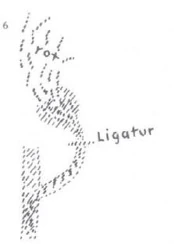
[ 21 ] Steinach hat die Versuche zunächst hauptsächlich mit männlichen Ratten gemacht. Diese Rattengreise, die also schlapp sind und zuweilen nackt sind auf der Haut, denen die Haare ausgefallen sind, die sich nicht mehr für die Weibchen interessieren, diese Rattengreise werden nun behandelt. Und zwar werden sie so behandelt, sehen Sie: Da ist also in einer Ratte die Pubertätsdrüse. Diese Pubertätsdrüse sitzt im Körper, oberhalb des Hodensackes. Von dieser Pubertätsdrüse gehen fortwährend Säfte in feineKanäle, Man könnte es so zeichnen: Wenn das die Pubertätsdrüse ist, so gehen da feine Kanälchen in den sogenannten Samenstrang, wo ja der Same auch abgelassen wird. Und das Hormon der Pubertätsdrüse geht also durch diese Kanäle und vermischt sich mit dem Samen, der abgelassen wird, so daß also der Same durchdrungen ist von diesem Hormon. Wenn also das Tier noch jugendlich ist, so sondert die Pubertätsdrüse dieses Hormon ab. Das geht durch diese Kanäle. Man nennt diese Kanäle die Vasa deferentia; es geht durch diese Kanäle das Hormon in den Samenkanal. Und der Same, der vom männlichen Organ abgelassen wird und das weibliche befruchtet, der enthält dieses Hormon. Aber das Hormon, das da in der Pubertätsdrüse erzeugt wird, das ich hier rot skizziert habe, das geht auch in den ganzen Körper über. So daß also die Ratte ja allerdings das Hauptsächliche dieses Hormons in den Samenkanal abläßt, aber es geht dieses Hormon auch fein verteilt zurück in den ganzen Körper, so daß der ganze Körper der Ratte eben in seiner Blutzirkulation dieses Hormon der Pubertätsdrüse hat.
[ 21 ] Steinach initially conducted his experiments mainly on male rats. These elderly rats—who are weak and sometimes have bare patches of skin where their fur has fallen out, and who are no longer interested in females—are now being treated. And here’s how they’re treated, you see: So, in a rat, there is the pubertal gland. This pubertal gland is located inside the body, above the scrotum. Fluids continuously flow from this pubertal gland into fine ducts. One could draw it like this: If this is the pubertal gland, then fine ducts lead into the so-called spermatic cord, where the semen is also discharged. And so the hormone from the pubertal gland travels through these ducts and mixes with the semen that is ejaculated, so that the semen is permeated by this hormone. So when the animal is still young, the pubertal gland secretes this hormone. It travels through these ducts. These ducts are called the vasa deferentia; the hormone passes through them into the vas deferens. And the semen, which is ejaculated from the male organ and fertilizes the female, contains this hormone. But the hormone produced in the pubertal gland—which I have outlined in red here—also spreads throughout the entire body. So while the rat does indeed release the majority of this hormone into the seminal duct, this hormone is also finely distributed back throughout the entire body, so that the rat’s entire body has this hormone from the pubertal gland circulating in its bloodstream.
[ 22 ] Nun denken Sie sich, die Ratte wird alt, schlaff. Die Schlaffheit, das Schlaffwerden des Körpers, das drückt sich darinnen aus, daß der Körper seine Abgänge nicht mehr halten kann; er kann sie nicht mehr bei sich halten. Sie werden gehört haben, daß Leute, die hingerichtet werden, ihre Abgänge hinter sich gelassen haben. Der Körper kann, wenn er schlaff wird, diese Abgänge nicht mehr halten. Und wird nun die Ratte beziehungsweise der Organismus überhaupt alt, so rinnt zu viel von diesem Hormon in den Samenkanal hinein, und zu wenig geht in den Körper zurück, so daß der Körper die Altersgifte dann in sich hat, und dieses Hormon, das von der Pubertätsdrüse kommt, wirkt zu wenig als Gegengift. Dadurch wird die Ratte und der Organismus überhaupt alt. Alt wird er durch die Gifte, die er in sich selber erzeugt. Diese Gifte dringen in den ganzen Körper ein und der Mensch kann dadurch also nicht Jugend haben.
[ 22 ] Now imagine this: the rat grows old and flaccid. This flaccidity—the body’s growing flaccidity—manifests itself in the body’s inability to retain its bodily fluids; it can no longer keep them within itself. You may have heard that people who are executed have left their bodily fluids behind. When the body becomes flaccid, it can no longer retain these secretions. And when the rat—or the organism in general—grows old, too much of this hormone flows into the seminal duct, and too little returns to the body, so that the body then contains the toxins of old age, and this hormone, which comes from the pubertal gland, does not act sufficiently as an antidote. As a result, the rat—and the organism in general—grows old. It grows old due to the toxins it produces within itself. These toxins permeate the entire body, and thus a person cannot retain youth.
[ 23 ] Wenn das Kind geschlechtsreif wird, dann geht sehr viel von diesem Hormonstoff in den ganzen Körper über. Aber das ist sogar weniger wichtig. Der Körper ist frisch und hält das, was er selber braucht von diesem Pubertätshormon, in sich, läßt nur so viel abgehen, als er selber nicht braucht.
[ 23 ] When a child reaches puberty, a great deal of this hormone is released throughout the body. But that is actually less important. The body is healthy and retains what it needs of this puberty hormone, releasing only as much as it does not need itself.
[ 24 ] Wenn die Ratte, an der diese Versuche gemacht worden sind, alt wird, dann läßt sie zu viel ab von dem Pubertätsdrüsenhormon. Nun hat der Steinach die Sache so gemacht, sehen Sie: Er bindet diesen Kanal ab; der wird dahier mit einem feinen Faden abgebunden, so daß die Ratte den Weg von der Pubertätsdrüse zum Samenkanal unterbrochen hat. Jetzt kann das Hormon von der Pubertätsdrüse nicht heraus und geht wiederum in den Körper zurück. Sie können verstehen, wie das ist? Also, es ist einfach so, wie wenn man ein Rohr abschließt; dann geht das Ganze zurück. Und so schließt er hier ab, das Vas deferens bindet er ab, macht eine Ligatur, wie man es nennt, und das ganze Hormon schießt in den Körper zurück; die Ratte fängt an, wieder lustig zu werden, kriegt sogar wieder Haare, und wenn man sie zusammensperrt mit Weibchen, so kann sie diese zwar nicht befruchten, denn dieses ist ja abgeschlossen, aber sie wird wieder geschlechtslustig und geht wieder los auf die weiblichen Ratten. Die Sache ist schon so.
[ 24 ] When the rat used in these experiments grows old, it secretes too much of the pubertal gland hormone. Now, Steinach did it this way, you see: He tied off this duct; it’s tied here with a fine thread, so that the rat’s pathway from the pubertal gland to the vas deferens is blocked. Now the hormone cannot leave the pubertal gland and flows back into the body. Do you understand how that works? Well, it’s just like when you seal off a pipe; then the whole thing flows back. And so he seals it off here—he ties off the vas deferens, performs a ligation, as it’s called—and all the hormone surges back into the body; the rat starts to become sexually active again, even grows hair back, and if you put it in a cage with females, it can’t fertilize them—since that pathway is blocked—but it regains its sexual drive and goes after the female rats again. That’s just how it is.
[ 25 ] Sie sehen also, daß die Sache einfach dadurch gemacht wird, daß man mechanisch verhindert, daß der schlaffwerdende Körper zu viel abläßt; da aber geht das in ihn zurück und er bekommt eine vielleicht vorübergehende, aber immerhin doch eine gewisse Jugend wieder zurück. Es ist ganz interessant, zu sehen, wie diese Rattenmännchen wiederum ganz frisch und beweglich werden, wenn ihnen die Ligatur gemacht ist an der Stelle, wo ich es angezeichnet habe.
[ 25 ] So you see that the procedure is simply carried out by mechanically preventing the body, which is becoming flaccid, from losing too much fluid; but then the fluid flows back into it, and it regains a certain degree of youth—perhaps temporary, but a degree nonetheless. It is quite interesting to see how these male rats become fresh and agile again once the ligature is applied at the spot I marked.
[ 26 ] Nun, diese Sache hier, dieses Abschnüren, kann in der verschiedensten Weise gemacht werden. Es kann so gemacht werden, wie ich es eben angedeutet habe. Das ist ziemlich schwer, denn es ist natürlich eine Operation notwendig, um erst beizukommen. Man muß von außen einen Schnitt machen, um hereinzukommen, und dann einen Faden herumführen, daß man die Sache abbindet. Aber es sind die Versuche auch in anderer Weise gemacht worden, zum Beispiel dadurch, daß man die Hoden mit Röntgenstrahlen bestrahlt hat. Dadurch sterben sie ab und dadurch wird auch das Hormon der Pubertätsdrüse zurückgedrängt. Diese Sache wurde namentlich auch bei Menschen gemacht.
[ 26 ] Well, this procedure here—this ligation—can be performed in a variety of ways. It can be done as I just described. That’s quite difficult, because, of course, surgery is required just to gain access. You have to make an incision from the outside to gain access, and then thread a suture around it to tie it off. But attempts have also been made in other ways, for example, by irradiating the testicles with X-rays. This causes them to die off, which in turn suppresses the hormone produced by the pubertal gland. This procedure has also been performed on humans, in particular.
[ 27 ] Kurz, das Ganze beruht darauf, daß man den Saft, den Hormonsaft wieder in den Körper zurückbringt. Sie sehen da die Verwandtschaft mit der Schilddrüse, bei der es sich auch darum handelt, daß man auf irgendeine Weise das Hormon in die Blutzirkulation hineinbringt. Hier handelt es sich auch darum, daß man das Hormon der Pubertätsdrüse dadurch in die Blutzirkulation hineinbringt, daß man im Alter, wenn der Mensch schwach geworden ist, das eben einfach abdrosselt. Die Sache ist also naturwissenschaftlich absolut in Ordnung.
[ 27 ] In short, the whole process is based on returning the fluid—the hormonal fluid—back into the body. You can see the connection here with the thyroid gland, where the goal is also to introduce the hormone into the bloodstream in some way. Here, too, the goal is to introduce the hormone from the pubertal gland into the bloodstream by simply reducing its secretion in old age, when a person has become frail. So, from a scientific standpoint, this is perfectly sound.
[ 28 ] Diese Versuche hat in den zehn Jahren der Steinach sehr gut fortgesetzt, und man kann heute schon sagen, daß dasjenige, was sich an Ratten gezeigt hat, in gewissem Sinne sogar an Menschen nachgeprüft werden konnte. Man hat die Sache auch an Menschen ausgeführt und konnte entweder damit Wirkungen erzielen oder dadurch, daß man direkt von einem jüngeren Menschen Pubertätsdrüsen-Sekret in die Pubertätsdrüsen einführte. Man kann es auch durch Einimpfen hineinbringen, oder man kann die Hoden impfen, daß man also Hodensaft von einem jüngeren Tier in die Hoden des Menschen einführt — kurz, auf die verschiedenste Weise hat man versucht, dieses Hormon in den Körper zurückzubringen.
[ 28 ] Steinach has continued these experiments very successfully over the past ten years, and it can already be said today that what has been observed in rats has, in a certain sense, even been verified in humans. The procedure has also been carried out on humans, yielding results either through this method or by directly introducing pubertal gland secretions from a younger person into the pubertal glands. It can also be introduced through inoculation, or the testes can be inoculated—that is, by introducing testicular fluid from a younger animal into the human testes—in short, attempts have been made in a wide variety of ways to reintroduce this hormone into the body.
[ 29 ] Und in der Tat, die Wirkungen, die sich dabei bei Menschen gezeigt haben, werden ja natürlich immer ein bißchen übertrieben, aber wegzuleugnen sind sie schon durchaus nicht. Es ist so, daß tatsächlich die Versuche nicht bloß mit Ratten gemacht worden sind, sondern auch mit alten, mit schlapp gewordenen Menschen, die wiederum einen Teil ihrer Jugend dadurch zurückgekriegt haben.
[ 29 ] And indeed, while the effects observed in humans are, of course, always exaggerated a bit, they certainly cannot be denied. The fact is that the experiments were not only conducted on rats, but also on elderly people who had lost their vitality, and who, as a result, regained some of their youth.
[ 30 ] Lange wird ja die Geschichte selbstverständlich nicht dauern, denn der menschliche Körper hat ja doch nur ein begrenztes Alter. Es ist auch durchaus heute noch nicht ausgemacht, ob man dadurch etwa die Lebensdauer verlängert. Man kann die Jugend etwas zurückgeben, aber nicht die Lebensdauer verlängern. Aber auch das ist wahrscheinlich, daß man dadurch die Lebensdauer wird verlängern können.
[ 30 ] Of course, this process won’t last forever, since the human body has a limited lifespan. It’s also by no means certain today whether this will actually extend one’s lifespan. It is possible to restore some youthfulness, but not to extend lifespan. However, it is also likely that this will make it possible to extend lifespan.
[ 31 ] Aber sehen Sie, alle diese Dinge haben auch ihre Schattenseiten, denn ich will Ihnen etwas sagen: Nicht wahr, es gibt Menschen, die schlecht schlafen können. Wenn man junge Menschen hat, die schlecht schlafen können, und man gibt ihnen ein Schlafmittel, Opium, Morphium, nun ja, dann schlafen sie halt besser; das ist untrüglich, sie schlafen dann. Es ist gar nichts einzuwenden. Aber die Sache ist doch so, daß, wenn man jugendlichen Menschen immer wieder als Schlafmittel Morphium gibt oder irgendwie überhaupt ein Schlafmittel, ein physisches, dann wird doch der Körper mit der Zeit schwach. Er braucht vorzugsweise dieses Schlafmittel immer mehr. Er kann nicht mehr sein ohne dieses Schlafmittel. Er wird abhängig von diesem Schlafmittel, und man hat es später doch nicht mit einem Menschen zu tun, der im vollen Besitz seiner Kräfte ist. Daher ist es schon besser, wenn man darüber nachdenkt, wie man die Schlaflosigkeit mehr auf innerliche Weise bekämpfen kann. Und man kann sie auch auf innerliche Weise bekämpfen. Wenn man den Menschen wirklich dazu bringt, daß er sich anstrengt, nur immer dasselbe Wort zu denken, dann kriegt er nach und nach von innen die Kraft, einzuschlafen. Und das ist besser. Dadurch schwächt sich der Mensch nicht.
[ 31 ] But you see, all these things also have their downsides, because let me tell you something: There are people who have trouble sleeping, aren’t there? If you have young people who have trouble sleeping, and you give them a sleeping aid—opium, morphine—well, then they do sleep better; there’s no doubt about it—they sleep. There’s nothing wrong with that. But the fact is that if you repeatedly give young people morphine as a sleep aid—or any physical sleep aid at all—the body will eventually weaken. It will come to need more and more of that sleep aid. It can no longer function without it. It becomes dependent on that sleep aid, and later on you’re no longer dealing with a person who is in full possession of their faculties. That is why it is better to consider how to combat insomnia in a more inner way. And it can indeed be combated in an inner way. If you truly help a person to make the effort to think only of the same word over and over, then little by little they will gain the strength from within to fall asleep. And that is better. It does not weaken the person.
[ 32 ] Man kann also schon sagen: Die Wirkung der Schlafmittel ist unbestreitbar. Es ist ganz ausgeschlossen, daß der Mensch nicht durch die Schlafmittel doch besser schläft. Aber man sollte eigentlich die Sache in einer ganz anderen Weise deichseln. Man sollte versuchen, dem Menschen den Schlaf auf innerliche Weise beizubringen. Natürlich ist das schwerer und hängt etwas mit der Erziehungsmethode zusammen. Wenn man nämlich die Kinder ordentlich erzieht, so ist es einfach so, daß man sie auch leicht dazu bringen wird, daß sie ordentlich ihr Quantum Schlaf absolvieren; und man braucht den Menschen später nicht Schlafmittel zu geben, wenn sie in der Schule ordentlich behandelt worden sind.
[ 32 ] So one can certainly say: The effect of sleeping pills is undeniable. It is completely out of the question that a person would not sleep better thanks to sleeping pills. But one should actually approach the matter in a completely different way. We should try to teach people how to sleep in a way that comes from within. Of course, this is more difficult and has something to do with parenting methods. For if children are raised properly, it simply follows that they can easily be encouraged to get their proper amount of sleep; and there will be no need to give people sleeping pills later on if they have been treated properly at school.
[ 33 ] Man kann schon gerade diese Verjüngungsmethode vergleichen mit dem Schlafmittelgeben. Ja, meine Herren, da ist ganz besonders das interessant: Ich sagte Ihnen schon, der Metschnikow hat zuerst sich mit diesen Alterserscheinungen beschäftigt und hat den Leuten ein anderes Mittel gegeben — dazumal gab es noch keine Steinachschen Versuche. Sie werden vielleicht sehr erstaunt sein: Ein ganz materialistischer Arzt hat den Leuten anempfohlen, sie sollen hauptsächlich so etwas lesen wie den Goetheschen «Faust»! Tatsächlich, sie sollen so etwas lesen, wie den Goetheschen «Faust»; dann werden sie auch zu einer Art Verjüngungskur kommen.
[ 33 ] One can indeed compare this very method of rejuvenation to administering sleeping pills. Yes, gentlemen, this is what makes it particularly interesting: As I already told you, Mechnikov was the first to study these signs of aging and prescribed a different remedy to people—at that time, Steinach’s experiments had not yet taken place. You may be very surprised to learn that a thoroughly materialistic doctor recommended that people read works such as Goethe’s *Faust*! Indeed, they should read works such as Goethe’s *Faust*; then they, too, will experience a kind of rejuvenation.
[ 34 ] Ja, daran ist nämlich ungeheuer viel Wahres. Wenn man nämlich im richtigen Alter so etwas hat, was einen geistig innerlich ganz in Anspruch nimmt, was einen auch in Begeisterung bringt — Begeisterung heißt ja nicht deshalb Begeisterung, weil es nicht den Geist in Bewegung bringt, sondern gerade weil es den Geist in Bewegung bringt, heißt es Begeisterung, sonst würde es «Bestofflichung» heißen; selbst die Materialisten, wenn sie ihre Volksreden halten, sagen nicht: Wir wollen uns durchdringen mit Bestofflichung, sondern sie sagen, trotzdem sie an den Geist nicht glauben: Wir wollen uns durchdringen mit Begeisterung —, wenn man sich also wirklich durchdringt mit Begeisterung, so ist das ein Quell der Verjüngung. Das kann man allerdings bei Ratten nicht nachprüfen! Aber es ist ein Quell der Verjüngung bei Menschen. Und wenn man die Beobachtungen im Leben dahin machen würde, würde man finden, daß das, was man einem Menschen überhaupt an Verjüngung beibringen kann nach dem Quantum seiner Kraft, seiner Lebenskräfte, daß man ihm das viel besser beibringt, wenn man ihm in der richtigen Weise Zeit läßt, innerlich sich zu durchdringen mit einer geistigen Tätigkeit. Denn eine geistige Tätigkeit hat nämlich die Eigentümlichkeit, daß sie die Drüsenwände zusammenhält und stark erhält.
[ 34 ] Yes, there is, in fact, a tremendous amount of truth in that. For when, at the right age, one has something that completely absorbs one mentally and inwardly, something that also fills one with enthusiasm—enthusiasm is not called enthusiasm because it does not set the mind in motion, but precisely because it sets the mind in motion; otherwise it would be called “materialization”; even the materialists, when they deliver their public speeches, do not say: “Let us be imbued with materialization,” but rather—even though they do not believe in the spirit—they say: “Let us be imbued with enthusiasm.” So if one is truly imbued with enthusiasm, that is a source of rejuvenation. Of course, one cannot verify this in rats! But it is a source of rejuvenation in humans. And if one were to make such observations in life, one would find that whatever rejuvenation one can impart to a person—according to the measure of their strength and vital forces—can be imparted much more effectively if one allows them, in the proper way, the time to imbue themselves inwardly with a spiritual activity. For spiritual activity has the peculiarity of holding the gland walls together and keeping them strong.
[ 35 ] Wenn einer sein ganzes Leben hindurch nur Interesse hat für oberflächliches Zeug, dann werden seine Drüsen, alle diese Gefäßwände viel eher schlaff, als wenn er für Geistiges Interesse hat. Und man braucht bei einem Menschen, wenn man ihn erstens als Kind ordentlich erzogen hat, und dem man zweitens Zeit gelassen hat, sich in der richtigen Weise mit dem Geiste zu durchdringen, bei einem solchen Menschen braucht man nachher nicht eine solche Ligatur zu machen, weil er diesen Kanal stark erhält, und selber in den Leib dasjenige zurückgehen läßt, was er braucht.
[ 35 ] If a person is interested only in superficial things throughout his entire life, then his glands and all those blood vessel walls will become flaccid much sooner than if he were interested in intellectual pursuits. And with a person—first, if they were properly raised as a child, and second, if they were given time to properly immerse themselves in spiritual matters—with such a person, there is no need to perform such a ligation later on, because they maintain this channel strong and allow what they need to flow back into their body on their own.
[ 36 ] Das ist anders als bei der Schilddrüsengeschichte. Bei der Schilddrüse, da muß man schon zuweilen eingreifen, weil es außerordentlich schwer ist, die Schilddrüse, ich möchte sagen, durch Geistiges besser zu machen; aber auch da wird man Resultate erzielen. Sie sind schon erzielt worden. Wenn man in einer ganz bestimmten Weise, in einer gesangartigen Sprache, immer und immer wieder, jeden Tag Sachen wiederholen läßt, dann geht auch die Schilddrüse zurück.
[ 36 ] This is different from the case with the thyroid. With the thyroid, one does have to intervene from time to time, because it is extremely difficult to improve the thyroid—I would say—through spiritual means; but even there, results can be achieved. They have already been achieved. If one has people repeat certain things over and over again, every day, in a very specific way, using a song-like language, then the thyroid will also shrink.
[ 37 ] So daß man also in der Tat sagen muß: Die Sachen sind ebenso richtig wie die Wirksamkeit der Schlafmittel; aber es wäre besser, wenn die Menschheit endlich daran denken würde, nicht alles auf solch eine materielle Weise zu machen, sondern wenn die Menschheit endlich daran denken würde, der Zivilisation die Möglichkeit zu geben, daß ein jeder zu seinem Quantum geistiger Tätigkeit kommen kann. Dann würde man überhaupt auf diese Dinge auch nicht einen so großen Wert legen, sondern dann würde man sehen, daß die Tatsache, daß man da zusammenklappt im Alter, eigentlich erst hervorgerufen wird durch die Schädlichkeit unserer Zivilisation. Alle diese Operationen am Menschen sind ja im Grunde genommen nur dazu da, daß man das, wasman auf der einen Seite verschuldet am Menschen, durch ein paar Monate Verjüngung im Alter wiederum ausgleichen will. Medizinisch ist die Sache natürlich genial, großartig; aber man muß sie in einem größeren Kulturzusammenhange sehen. Dann gewinnt sie eine andere Seite.
[ 37 ] So one must indeed say: These things are just as true as the effectiveness of sleeping pills; but it would be better if humanity would finally consider not doing everything in such a materialistic way, but if humanity would finally consider giving civilization the opportunity for everyone to achieve their share of spiritual activity. Then people wouldn’t place such great value on these things in the first place, but would instead see that the fact that people break down in old age is actually caused by the harmful nature of our civilization. All these surgical procedures on humans are, after all, essentially intended only to compensate for the harm we have caused people by granting them a few months of rejuvenation in old age. Medically speaking, the approach is, of course, ingenious and magnificent; but it must be viewed within a broader cultural context. Then it takes on a different aspect.
[ 38 ] Natürlich kommt da noch etwas anderes dazu. Ich habe zuvor gesagt, daß man, wenn man einem jüngeren Menschen Schlafmittel gibt, ihn eigentlich schwächt. Das ist ja, wenn man bei alten, zusammengeschrumpelten, nicht mehr recht tapsen könnenden Menschen eine solche Verjüngungskur anwendet, für diese natürlich eine große Freude, wenn sie wiederum anfangen können, ein bißchen lustig zu sein im Leben. Man braucht da nicht so stark besorgt zu sein, daß es für das Alter schaden könnte, denn eine solche Verjüngungskur wird in einem Alter angewendet, wo es sich nicht mehr recht ausprüfen läßt, ob es ihnen hinterher schadet oder nicht. Die materialistische Weltanschauung bringt großartige Resultate heute, aber sie müssen in einem größeren Kulturzusammenhang betrachtet werden. Dann nehmen sie sich anders aus. Deshalb sage ich immer, die Menschen sollten nachdenken, wie sie die Kinder in der Schule und dann im späteren Alter davor behüten, solche frühzeitigen Alterserscheinungen zu bekommen. Das ist nicht auf Klassen beschränkt, sondern schon mit dreißig Jahren, gerade wenn sie den sogenannten höheren Ständen angehören, laufen die Leute mit furchtbaren Glatzen herum. Das kommt davon her, daß schon in den höheren Schulen unnatürlich erzogen wird. Es wäre viel gescheiter, wenn so erzogen würde, daß der menschliche Körper selbst alles zusammenhält, solange er Lebenskräfte hat.
[ 38 ] Of course, there’s something else to consider here. I said earlier that when you give a younger person sleeping pills, you’re actually weakening them. But when you apply such a rejuvenation treatment to elderly, frail people who can no longer really get around, it’s naturally a great joy for them to be able to start enjoying life a little again. There’s no need to worry too much that it might be harmful to the elderly, because such a rejuvenation treatment is administered at an age when it’s no longer really possible to determine whether it will harm them afterward or not. The materialistic worldview yields magnificent results today, but they must be viewed within a broader cultural context. Then they appear quite differently. That is why I always say that people should think about how to protect children—first in school and then later in life—from developing such premature signs of aging. This is not limited to certain social classes; even as early as age thirty—especially among those belonging to the so-called upper classes—people are walking around with terrible bald spots. This stems from the fact that even in high schools, education is conducted in an unnatural way. It would be much wiser to educate in such a way that the human body itself holds everything together as long as it possesses vital forces.
[ 39 ] Das ist dasjenige, was ich Ihnen über die Sache sagen kann. Es ist ja sehr interessant, gerade diese Dinge immer von den zwei Seiten aus zu betrachten, die sie haben.
[ 39 ] That is all I can tell you about the matter. It is indeed very interesting to always look at these things from both sides.
[ 40 ] Was etwa noch zu sagen wäre, will ich Ihnen das nächste Mal sagen. Ich muß für acht Tage verreisen, werde dann längere Zeit da sein, und wir können dann weiter über die Sache reden.
[ 40 ] I’ll tell you whatever else there is to say next time. I have to be away for eight days, but then I’ll be back for a while, and we can continue talking about this.