

On Health and Illness
GA 348
24 October 1922, Dornach
Translated by Steiner Online Library
Second Lecture
[ 1 ] Well, gentlemen, it has been requested that we speak a little about the internal human organs, and I began to do so last time. Of course, one can only discuss such a subject—I would say—in broad terms. One can only discuss it in such a way that one truly addresses the subject from the very beginning. And I have told you—not only that it can happen that a person, so to speak, as I explained to you using the example of William Windom and another example, speaks from within himself like this Windom, who died during a speech and described his own condition almost entirely in words —I have not only told you that, but I have also told you certain things about the course of human life, such that we find that in the very earliest stages of life—that is, while a person is an infant or in early childhood—mortality is at its highest. That is when people die most frequently. And even though this declines later on, around the third, fourth, and fifth years, one can still say: The highest mortality rate persists until the teeth begin to fall out, around the age of seven.
[ 2 ] In fact, from the time a child’s baby teeth fall out until they reach sexual maturity, that is when a person is actually at their healthiest. That is indeed the case. If we do not ourselves make the children unhealthy in school—if we do not cause them, through all sorts of poor posture and the like, to develop deformities or internal illnesses due to poor air quality—if we are careful, then we can indeed expect that during the so-called compulsory schooling years, during elementary school, children are generally at their healthiest. The cases of illness that occur there are mostly caused by external factors. The great danger that people will once again make themselves sick actually begins anew around the ages of fifteen or sixteen. And then entirely different illnesses arise than those that occur in childhood.
[ 3 ] You see, here’s the thing: With very young children—as I’ve already mentioned in part—we find that they, for example, are very prone to blood infections. The blood becomes purulent. This can progress to the point where jaundice-like symptoms appear. Then, very often, children experience irregular digestion in the form of diarrhea. Then the children develop these small white pustules in various places—little blisters, as they’re called—and the like; and then the children develop yet another type of illness, the so-called “Fraisen”—these are childhood convulsions. Today, the so-called polio is particularly prevalent as a childhood disease; it also occurs at a later age, but it is a terribly debilitating illness. Children find themselves unable, for example, to move their legs. Their legs are completely paralyzed and so on. This disease is becoming increasingly prevalent today. You may have read reports from Thuringia stating that even schools had to be closed because polio has broken out in epidemic proportions.
[ 4 ] From all of this, and from many other factors as well, it is clear that childhood illnesses have a very special character. Childhood illnesses look different from the illnesses people contract later in life. Childhood illnesses include scarlet fever and measles—though measles is a disease that adults can also contract later in life, and we must ask ourselves: Why do children get them most frequently?
[ 5 ] You see, one can only understand these things if one knows how the forces actually work within the human body. If one considers the child as a human embryo before it is born—let’s even say, during the first, second, or third month—then the child is, in essence, something entirely different from the adult it will later become. In the first month—and even in the second—the child is such that it is essentially just a head, and the other organs are really just appendages to the head. Everything that will later become limbs—hands and feet—are just little stumps; and the actual chest and abdominal regions aren’t functioning yet, aren’t active yet. You see, when you have the embryo, it actually looks like this: here, I would say, is a kind of sac in which it is contained, and within this sac are blood vessels extending from the mother’s body. These blood vessels then enter the embryo and fill it out. The embryo receives blood from the mother, as well as nutrients. These are accessory organs that will later be shed. It all falls off. The head is enormous in proportion to the body in the embryo. That is the head (see drawing); the rest are merely appendages—they are not yet functional. The heart and the digestive system will develop there later. Blood circulation is supplied from the outside, from the mother’s blood circulation. There are only small stumps for hands and feet; these will develop later. So one must say: This is all the head, and everything else are insignificant organs, because everything related to the intake of food and air is provided to the child by the mother. So, in the first few months, the child is actually nothing but a head, provided by the mother.
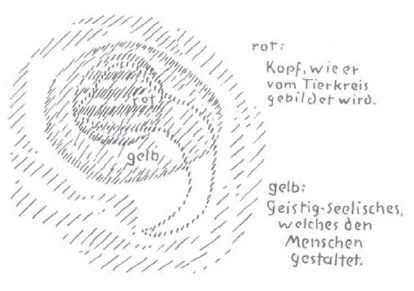
[ 6 ] You see, gentlemen, people are surprised that what are called mental illnesses are caused by heredity. But mental illnesses are always physical illnesses that manifest themselves when the body fails to perform its functions properly. The mind does not become ill, nor does the soul; mental illness is always a physical condition. So people are surprised that someone, as they say, becomes mentally ill through heredity. Yes, certainly, a person becomes mentally ill through heredity. If the parents—especially the mother—suffer from consumption, or if they suffer from any illnesses, let’s say, for example, arteriosclerosis—which is less common in youth, but it does occur in some people—so if the parents suffer from consumption, tuberculosis, or arteriosclerosis, the children will not necessarily suffer from consumption, tuberculosis, or arteriosclerosis again, but they may become mentally ill. That is what surprises people.
[ 7 ] Yes, gentlemen, is that really any surprise? Whatever a person can inherit, they must first inherit through the head. So if the mother suffers from consumption, it should come as no surprise that it does not affect the lungs—which are not yet fully functional—but rather affects the head, where it manifests itself. So there is really no need to be surprised that what is inherited are entirely different diseases than those the parents had and passed on.
[ 8 ] You see, if the parents, for example, have some kind of sexually transmitted disease, the children may develop an eye disease. That’s not surprising. How could one not be surprised when the parents have a sexually transmitted disease, and the child has developed a head—after all, the eyes are most exposed to what the parents have; they are, after all, in an environment affected by a sexually transmitted disease! So there is really no need to be surprised by this at all.
[ 9 ] And now the child is born. As each of you knows, when the child is born, the head is initially the most developed part. The rest of the body will experience its greatest growth at a later stage. The head is the most developed; it no longer grows as rapidly as the other organs—it grows much more slowly. And from all of this, one can see how a human’s internal organs actually function. Materialistic science cannot form a proper mental image of this. That is entirely impossible, because it fails to realize that in a child, all growth originates from the head. Everything is regulated from the head. In the embryo, it is most striking that everything is regulated from the head, because it has only the head. Later on, however, what takes place in the human body is still regulated from the head. Everything in the human organism is regulated from the head. The stomach, intestinal activity, and blood circulation—everything is regulated from the head.
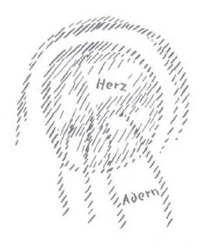
[ 10 ] Now suppose a child is born, and for some reason its blood circulation is too slow. So that can happen. It can happen that the child has too slow blood circulation due to heredity; that is one possibility. Now imagine that the child—I’ll draw some veins here—has veins like this, and the blood flows through them too slowly; there’s the heart, and the blood flows through it too slowly. But the heart is formed by the head. The head may be perfectly normal, yet the blood circulation is too slow. So it happens that although the heart is properly formed, the blood does not flow properly into it. This is very common in children in the very early infant stage: the head is perfectly normal, but proper blood circulation does not take place. This can happen simply because the child lives in stuffy air; as a result, the child cannot breathe properly, and blood circulation stalls. Or if the child does not receive the right nutrition, the blood cannot be properly transported throughout the body; blood circulation can stall. The head is perfectly fine and wants the heart to develop properly, but blood circulation stalls. Instead of substances being properly carried from the heart to the kidneys and excreted, they remain in the body, remaining in the blood. If substances that should not be in the body—that should already have been excreted—are still in the blood, the blood becomes infected.
[ 11 ] You see, this danger isn't as great later on—say, in the eighth or ninth year—as it is in early childhood. Why? Well, if the child has grown its permanent teeth properly, that's already proof that its body is actually strong. Otherwise, it wouldn't grow its permanent teeth properly. Why? Well, you see, the permanent teeth are actually driven up from the entire body. What’s inside a tooth comes from the whole body; it’s not just something in the jaw—when the permanent teeth come in, the whole body is at work. But that’s only the case with the permanent teeth. Not yet with the first set of teeth. The first teeth a child gets—the so-called baby teeth—are something entirely different from the permanent teeth. A child gets its first teeth through heredity, because its mother and father also have teeth. These are shed over the course of the first seven years, and only then does the child get its own teeth—the permanent teeth—which the body must produce itself.
[ 12 ] In fact, when you look at a child who is nine or ten years old, they already have their second body. The first one—the one they inherited—has been completely cast aside. Actually, the child doesn’t really develop its own body until around the age of seven. And during the entire period up to the age of seven, it becomes apparent that the child was born strong enough to tolerate the air and food. Once it has shown that it can grow its second set of teeth, the risk of getting sick is no longer as great, because it has already built up its body; by then, it already has its teeth. And that is why the danger is greatest of all for the infant. It must find its way in everything it previously did under the protection of the womb. The mind is actually always sound in the first stage; it only deteriorates later. Once a person grows old, the mind is no longer as sound. Then it is expected to think and engage with the outside world. It must first find its way there as well. That’s where things often go wrong! But in the very first years of life, the child doesn’t yet need dexterity for work, doesn’t yet need to go to school, and doesn’t yet need to learn anything. The mind works only on its own body. It’s usually good at that. But the child’s own body is at its worst during tender childhood, because that’s when one must first get used to the world.
[ 13 ] Well, not quite the way I’m describing it—because I’m telling you the facts exactly as they are—but that’s more or less how conventional science describes it, too. But this conventional science doesn’t really understand the whole process. The entire field of conventional science is actually baffled when it sees how humans are exposed to the most serious illnesses in their very first years of life. But that is because this conventional science believes that what is called the soul and the spirit is not really anything real.
[ 14 ] In reality, it is like this: When the child is still in the mother’s womb and is then born, the soul-spiritual aspect is primarily connected to the head. What is at work there are forces—that which cannot be seen. These forces, these soul-spiritual forces, are at work within the child.
[ 15 ] You might say: Yes, that’s a view one may or may not hold. But if you believe that one may or may not hold this view, then you’re guilty of the same error as someone who says: “There’s a piece of iron”; another comes along and says: “Give it to me—I want to shoe my horse with it!” — But the first one says to him: “Man, you’re really stupid if you want to shoe your horse with that! That’s actually a magnet; there’s a force inside it. This magnet is used for something completely different than shoeing horses!” — One knows it’s simply a horseshoe; the other knows it’s a magnet containing an invisible force. You can’t see that, of course. And the same goes for the person who, relying on materialistic science, says: “Well, the head is just a piece of meat.” — He’s just like the one who says: “That’s a horseshoe!” — A child’s head isn’t merely a piece of meat; rather, invisible forces are at work inside it, building up the entire human organism like a sculptor. They build it up anew during the first seven years. After all, a person retains some of this as the form and shape they have inherited. And the forces with which a person is built up anew—these are the soul-spiritual forces that emanate from the head, and a person brings these from somewhere entirely different than from their parents.
[ 16 ] If he inherited it from his parents—yes, gentlemen, if someone is a genius, have you ever seen that their children become geniuses too? Or if the children are geniuses, have you ever seen that the parents are as well? That is certainly not the case! Take Goethe, for example, who was certainly a genius: his father was a terrible philistine, his mother was no genius either—she was a dear, kind woman who could tell beautiful stories—and his son was stupid; he was no genius at all. So whatever is spiritual and soulful cannot be inherited; one brings it with oneself from entirely different worlds. It merely unites with what is inherited. Human beings, apart from their existence in the womb, have a prior existence as spiritual and soulful beings.
[ 17 ] You see, the reason people deny this today is simply because, throughout the entire Middle Ages, the Catholic Church claimed: One must not attribute a spiritual-soul existence to a human being prior to birth—because the Catholic Church assumed that the soul must be created at birth by some kind of God, as the Catholic Church itself conceived Him. And what the Catholic Church forbade people to accept throughout the entire Middle Ages—namely, that one had, as it was called back then, “pre-existence”—that is, existing beforehand—is now also observed by materialistic science, which considers itself terribly clever. The point is that people have no idea how they were initially conditioned to hold such a view, and subsequently believe that holding precisely this view makes them particularly clever.
[ 18 ] The truth is that just as a person has a physical existence in their parents, grandparents, and so on, they also have a spiritual-soul existence that they bring with them. This is at work within him. This is the spiritual-soul aspect. And anyone who does not recognize that the spiritual-soul aspect already exists before the body also fails to recognize that the spiritual-soul aspect remains after death; at best, he can only believe in it. Knowledge of the immortality of the human soul can only be gained by also knowing that it already exists beforehand. Of course, it would be within the power of a divine Creator, if He were to create human beings, to cause the soul to vanish again when a person dies; but if this soul must first be present in order for the body to be formed, then it naturally remains in existence even after the body dies.
[ 19 ] So you can say to yourself: From all the things that can be properly observed, the existence of the human soul follows quite naturally. And how could it possibly die, when it is the very thing that created the mortal body in the first place! One would have to go into entirely different worlds to realize that the soul could die. We will discuss in later lectures that it cannot die there either. But it cannot die through the body, because it is the soul itself that first creates the body.
[ 20 ] We have now learned about illnesses that arise when the spiritual-soul aspects are active in the head while the body is not functioning properly. But other things can happen as well. It can happen that the blood circulation is too slow and stagnation sets in—which, as I’ve told you, causes the blood to become putrid. But something else entirely can happen as well. It can happen that the child receives nourishment but is too weak to even get that nourishment from the intestines into the bloodstream. It doesn’t pass through the intestinal villi. The body is too weak. What happens then? First of all, the child develops diarrhea. Of course, what is not absorbed must come out; but it should actually remain in the body and be absorbed. Instead, it leaves the body unprocessed in the diarrhea. But this is also connected to something else. Certainly, the child gets a little diarrhea, more severe diarrhea, and may even experience vomiting and diarrhea. This is often only the first stage. But if the child is unable to process nutrients for an extended period, then the internal organs cannot be built up. The head is constantly striving to build them up. The internal organs cannot be built up because no material is passing through. It is as if you were, say, working on a statue and had no material with which to make it, so you were just waving your hands around in the air. That’s how the mind flails about in the air when, for example, the child doesn’t receive the material needed to form the organs. It wants to form the heart, to form the stomach. It flails about in the air because it doesn’t get any material—because it has been lost through diarrhea.
[ 21 ] Yes, if you’re a materialistic scholar, you can’t understand anything at all. You just say to yourself: I’m examining the child; well, it has diarrhea. Let’s give it some kind of remedy so it doesn’t have diarrhea anymore. - The only result will be that nutrients accumulate in the intestines, since they cannot be absorbed, and the child will develop a distended belly, but nothing else. You continue the examination and find, for example, that the lung has become nothing more than an empty sac. It needs to develop, but the necessary substances aren’t there. You find nothing but an empty sac in place of the lung.
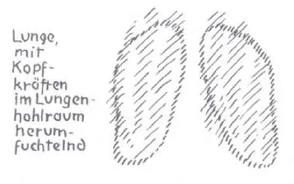
[ 22 ] So anyone who looks at the lungs and finds only an empty sac must understand that the very forces emanating from the head flow into these lungs. What emanates from the head enters the lungs, passing through them. Now the forces from the head want something through which they can act. They grasp at something that offers them no support. Here’s how it works: When I shake the chair, I have a foothold on the chair; but when I wave my arms around like this and can’t grab the chair, I have no foothold. Then you just see me waving my arms around like a fool. But when the head waves its arms around in the lungs and can’t find a foothold, that’s when spasms—the “Fraisen”—arise.
[ 23 ] You see, if anyone wants to explain the convulsions in a reasonable way, they must understand that the head is thrashing about and cannot find a foothold. Diarrhea can still be explained in a materialistic way; convulsions, however, can no longer be explained in a materialistic way.
[ 24 ] So this shows us that mental activity is at its peak in children. This activity ceases later on. For there is so much mental activity in a child that, from everything it eats up until the age of six or seven, only very small, tiny particles—fragments—are extracted, and these are then used to form the second set of teeth. Just think, gentlemen, if you had to do that yourselves! First of all, you’d have to be smart enough to know how magnesium salts and carbonic acid salts are present in the food. You could learn that if necessary, but you could only do so by first chemically analyzing the teeth and then learning it from the teeth themselves. For no one today can naturally say how to make such teeth, since the artificial teeth that are made are, of course, not teeth—not living teeth. So, from everything the child eats up to the age of seven, in very small portions, the substance that will become the second set of teeth is extracted.
[ 25 ] But it’s not enough just to know what substances are in there; you also need to know what they do in the stomach so that the right substance is excreted, or what do those tiny particles you’ve excreted do in the second, third year? Once you’ve excreted them, how do you keep them in the bloodstream long enough so that they continue on their way, entering the jaw precisely in the sixth, seventh, and eighth years, so that they develop into teeth? All of this has to be done, and it is done by the child’s spiritual-soul aspect, which is merely unconscious. But it is done. I don’t think you’ll feel offended at all if I tell you: You are not capable—if I were to say, “Let a single hair grow somewhere”—you are not capable of making that hair grow in any way! But the child is capable of doing this by directing the necessary substances to the place where the hair roots take hold, bringing these substances toward the light—for the hair grows and comes into being from light.
[ 26 ] So all of this takes place within the child. You see, this is something modern science does not want to talk about. It makes these things completely unclear to people. It knows nothing about it and does not want to talk about the fact that the spiritual-soul aspect is at work within the child, and that the spiritual-soul aspect is not inherited, but rather comes from a spiritual world.
[ 27 ] Well, I told you the example about hair. You see, humans generally aren’t hairy during their normal lives; hair remains only in certain places, and otherwise they’re hairless. But humans used to be hairy on Earth, too. They lost their hair. They used to be completely hairy. Once, in very ancient times, humans were also shaggy with hair—completely shaggy. They lost their hair. Yes, how did humans lose their hair? I don’t want to offer you a theory about this, because you can come up with your own, but I want to point out the facts. Other creatures, for example, which are also hairy when they roam freely in nature, lose their hair when they are domesticated: pigs are a case in point. Look at them in the wild: there they have hair; and when they are domesticated—that is, when they live in conditions in which they did not originally live—they lose their hair. Humans, too, did not originally live in conditions like those of today. For human beings are, in fact, like such a domesticated animal. But the fact that they grew hair—that they grew hair under the influence of light and warmth—is still evident in children today; for in the first few months, when they are almost entirely head, the entire embryo is covered with hair—in the womb, the child is even covered with hair during the first few months! It loses that hair again; it falls out. It is completely covered in hair. Just as I explained to you that plants in their first stage still have the light and warmth from the previous year, so the child receives light and warmth from the mother; thus it receives the light and only loses the hair later. So from this, too, you can see how the spiritual-soul aspect works in the body.
[ 28 ] Now I told you: During the school-age years, a person is actually, by nature, at their healthiest. That is true. Why? Well, it is true because only those people remain who have developed the forces that enable them to grow their permanent teeth—for those are powerful forces. One draws very powerful forces from within oneself. These forces must first be acquired through an incredibly intense process of habituation during childhood. In the early years of childhood, therefore, everything that the mind does within a person is most strongly developed. And it is truly the case that one must say—though, of course, the person knows nothing of this—: This head—it has to exert itself; it has to be a truly great artist. And the body constantly offers it resistance. The head must constantly struggle against this. Nothing helps it. In the first seven years, it cannot have anything that truly helps it. One must exert such a tremendous amount of force. And it is precisely under this exertion of force that all these illnesses I have told you about arise.
[ 29 ] But suppose now that the blood circulation is not disrupted because not enough is flowing out, but because too much is being transported. That is certainly possible. It is certainly true that parents are simply not as wise as the human organism actually is. Parents often believe that stuffing as much as possible into a child is the very best thing. Well, you can’t really blame anyone for that, because it’s generally difficult to know when a child has had enough. The child usually knows this only through its own instinct, through its own inner wisdom. If the child gets too much milk because the mother produces too much, the child develops an unreliable instinct and ends up eating too much. Then too much is crammed in, and the brain can’t keep up; it’s too slow to process all that food. Then the child has to fight back so that it’s expelled, so that it goes away. But by then it has already entered the bloodstream from the intestines; the child can no longer eliminate it through the natural processes of excretion or digestion, because it has already entered the bloodstream. What does the child do? It must expel it through the skin. Scarlet fever and measles develop! Scarlet fever and measles are entirely different illnesses than diarrhea or cramps. Diarrhea and cramps are illnesses that a child gets simply because the child is thrashing about inside and not getting enough nourishment. But when too much enters the body, it must be expelled, and that’s when such conditions arise—even what is eventually expelled through the lungs when there’s too much. Diphtheria and pneumonia are caused by the body’s attempt to help itself by expelling through the skin what it cannot otherwise get out. When one understands the human body, one understands how this actually works, and it is perfectly natural for a child to contract such illnesses.
[ 30 ] It can develop other illnesses as well. Just imagine: it just so happens that the child is too weak to push through its second set of teeth. It has already gotten its first set of teeth—which it inherited—so it doesn’t have to exert itself there. But it’s too weak to push through the second set. Now the energy that isn’t going there is directed to the lungs, and the child develops pneumonia. That can happen, too. The human body is an incredibly complex thing. So when a child gets pneumonia, one must not only examine the condition of the child’s lungs, but also the condition of the kidneys, the stomach, and so on. With any illness, therefore, one must examine the entire human body, not just the part where the illness is currently manifesting.
[ 31 ] But when the child is now seven years old, his respiratory organs have developed to the point where the entire body no longer has to take care of breathing from the head down. In very young children, the head must still constantly regulate the respiratory organs. Just as it must develop the teeth, so must it develop the respiratory organs. By the seventh or eighth year, the child has reached the stage where they are fully developed. Now the child can breathe properly. This is precisely the most important thing to realize: Once the child has gotten its permanent teeth, its respiratory system has come into proper order; it has received its “second set” of lungs, its “second set” of bronchi—everything is fully developed. It no longer breathes with the weak, inherited respiratory system, but rather with the second, fully developed respiratory system. As a result, the child is in a completely different state. Now it has a source of support. That is precisely the story. It is quite a different matter whether, because of a weak father or a weak mother, I have a respiratory system that I am supposed to control from the head but which is too weak, or whether, as a child, I have properly developed a second respiratory system just as I need it. For the head builds it up properly. And because this second respiratory organism is in good working order in children who live to that age—the others have died before then—these children between the ages of seven and fourteen are at their healthiest, for in children it is primarily the respiratory organism that becomes completely healthy. That is the benefit of this second stage of life: that the respiratory system becomes at its healthiest during this time.
[ 32 ] But once sexual maturity has set in, this sexual maturity actually diverts some of the nutrients for itself. Previously, when the child was not yet sexually mature, this did not happen. At that stage, sexual maturity did not yet divert any of the nutrients for itself. Now a completely different kind of digestion must take place. You can easily see this, because something entirely different has now come into play—the nutrients are being directed toward a different purpose. This new way of breathing means that, from the onset of sexual maturity onward, the digestive organs must first readjust; in other words, the proper counterpressure must first be established from the stomach and intestines, because some of the pressure that was previously present has been reduced. Now the proper counterpressure must be established. It is no wonder that anemia and other illnesses occur in girls at this age, because the organism must first adjust itself.
[ 33 ] Thus, the child is most protected during this period from the ages of seven to fourteen. For in the early years, the mind must exert such an incredibly strong influence on the organism. The child must first get used to this. During this period from the ages of seven to fourteen—that is, during elementary school—the child is at its healthiest. This second respiratory system is unimpeded by anything and can supply oxygen very efficiently. On the one hand, this has a beneficial effect on the brain; on the other hand, it supports digestion. As I said, one would have to deliberately spoil this process from the outside by imposing one’s own school curriculum.
[ 34 ] Now we come to sexual maturity. Look at the boy. Up until sexual maturity, his organism has developed with the healthiest vital forces a human being possesses. He has undertaken the task of renewing his organism for the first time. Nothing has spoiled this process, provided he has simply been left to his own devices. But now puberty is approaching. Look at the boy: his entire respiratory system is being affected by digestion. He doesn’t even keep his original voice—it deepens. The change in voice shows, after all, that digestion is affecting the respiratory system. So the second time he has to develop his organism, digestion interferes. This interference is precisely what is expressed in the change of voice. He must strike a completely different note. And now, once again, illnesses are closing in.
[ 35 ] And you see, only when you look at people in this way do you have the opportunity to even think about a question like the one one of the gentlemen asked last time. Before that, you can’t think about these questions at all, because you won’t get anywhere. If you know that it is simply the mind that has to work the hardest during the first seven years of life, what will you say to yourself?
[ 36 ] Yes, isn’t that right? In the mother’s womb, the form is created (pointing to the drawing); but the head that is formed in the mother’s womb—it is certainly not formed merely through fertilization, merely through the substance—but this head is formed from the entire universe. The mother’s substance merely provides the foundation upon which this formation can take place. But the human head is formed from the entire universe. It is, after all, a reflection; it is an image of the universe. It is round at the top because it is modeled after the universe. Upon this skull—which is sometimes covered by something so foolish in human beings—the entire starry world exerts its influence. The entire starry world truly exerts its influence there. This is not a figment of the imagination. It is just as true as what follows—I have told you this before: Imagine there were a magnetic needle here; you cannot bring this magnetic needle to a standstill at will. It always points from north to south. It would never occur to anyone to say that there are forces inside the magnetic needle that make it point from north to south; rather, everyone says: The Earth itself is a magnet, and the magnetic needle aligns itself with the Earth.—Everyone understands that. Only when it comes to what develops inside the mother’s womb are people so foolish as to say: That comes from fertilization. — That is just as sensible as saying: “The fact that the magnetic needle always points from south to north is due to forces within the magnetic needle!” — The fact that this head develops as a reflection of the entire world shows precisely that the entire world acts upon the human head. And the forces with which the head then continues to act within the child—these the human being has received from the universe. So when my lungs are formed, the head has received the force to form my lungs from the universe. Specifically, when, for example, the kidneys are formed, the human being has received these forces from bodies far out in the universe—from Jupiter, for example. So this is not mere fantasy. It can be investigated just as one investigates other physical phenomena. Thus, when a human being is born with a head, they truly carry within their head the forces of the entire world.
[ 37 ] Of course, it’s nonsense when someone says that the Moon, the Sun, or Jupiter have an effect on any human organ. So when people sit down and draw up a horoscope because they believe the Moon, the Sun, Jupiter, and so on have an effect, that’s utter nonsense! But the head is formed from the entire universe. And the forces imparted to the head from the entire universe then influence the human being during the first seven years. And in the second seven years, the human being becomes more accustomed to the Earth’s orbit, so that he grows out of the universe. Thus, whereas he was previously a “star-human,” he becomes more of an “air-human.”
[ 38 ] And then, if digestive substances play such a special role in humans that they even change their voices, what is that? Yes, it is nothing other than what we take in from the earth. What we take in from the earth, we must then process. I have shown you that this must first be broken down in the intestines and so on. This becomes particularly significant during the periods when a person reaches sexual maturity. That is when he becomes primarily dependent on the earth. As men, we initially have a voice derived from the air; the fact that the voice then becomes hoarse stems from the fact that, later on, the substances and materials of the earth begin to take effect within us.
[ 39 ] First, we come into the world as star beings, allowing the forces we initially brought in from the starry world to continue to work through our heads. Then we become air beings. And it is only upon reaching sexual maturity that we become earth beings, truly assigned to the earthly realm. Later, we are assigned to the things that bind us more closely to the earth. And so you see that the human being is first brought down from the world onto the earth.
[ 40 ] If one is not as narrow-minded as materialists often are—who fantasize that human beings grow and so on—then one can see how human beings grow into the earth. And when they become old enough, they actually grow out of it again in old age. What happens, for example, in old age? The forces we possess in old age are the same ones we had in youth; they have made our bone structures very, very hard; but the other parts remain soft. However, when in old age the force contained in the bones transfers to the rest of the body, the arteries harden first, and then what is called arteriosclerosis sets in. The brain can also calcify. The brain must always have a little of what causes calcification. You see, if a child does not have a little calcium sand in its head—which is dispersed and distributed by the pineal gland—if it does not have a little calcium sand in its head, then it remains stupid; then the soul cannot intervene, for the soul forms itself within the calcium. But if later on (in old age) too much calcium is deposited, then calcification sets in, and then again the soul cannot intervene because it is too intense. Then paralysis, a stroke, or something like that occurs, or one is simply overcome by senile dementia, because one can no longer grasp the brain, can no longer use it. But if calcification occurs in the rest of the body, it is the same. One is once again removed from the forces of the earth. So one can see how a person grows into the forces of the earth until sexual maturity, and how they then grow out of the earth again, as the deposited layers become thicker and thicker, preventing the soul from intervening.
[ 41 ] So you can actually see that one can study what a person possesses from the universe. He brings it in himself. One simply must not subscribe to the superstitious view that a star somehow influences the lungs of any 35-year-old person for my sake! But the lungs are structured according to the forces that first entered the child’s head from the stars.
[ 42 ] So if you look at the matter from a truly scientific perspective, then Spiritual Science does indeed exist. It exists, and it can be studied just like any other science. And the fact is, no matter how much one may complain about earlier times—certainly, we cannot bring back the times that once were—they were simply useful for the people who lived then, but not for us anymore. But the time in which we live is the only one that is useful to us. When there are people again who know something about the world—who do not merely believe that the human brain is produced as, I don’t know, just a little sphere in the womb—but who know something about the matter, there will be better politicians again. If you know nothing, you cannot be a proper politician. For whoever knows nothing about human beings also does not know what people should do. That is why it is so urgently necessary for people to emerge who, in turn, know something about the world. That is what we must absolutely strive for.
[ 43 ] Schools should once again teach people something that has value. Today, what is highly valued is the knowledge needed to build machines. The Spiritual Science has nothing to say against that, for it certainly has great value; but what enables people to get along with one another is not taught at all—instead, some abstract social science is taught, one that is invented because people do not know human nature. One must first get to know human nature, but in the way we do here. But what I am telling you here, unfortunately, is not taught. Think back to your own school days! Where is such a thing taught? And that is precisely what people lack today. What people learn today is just as harmful to them as if you were putting stones in their stomachs. A goose might be able to tolerate that, but not a human being. If you put stones in a person’s stomach, you ruin their digestive system. If you teach people what is taught today, you are actually ruining their minds. Isn’t it true that if I don’t use my arm, it grows weak? If I don’t use my mind properly, my mind grows weak. But the mind has already received stellar forces even during the time of the mother’s conception. If you tell them nothing and they cannot form thoughts about the stars, their minds remain weak, just like muscles do when they are not used. If you don’t teach a child anything about the world, their mind is bound to remain weak. And the greatest harm of the current state of affairs is—please don’t take this the wrong way—that people have weak minds and don’t understand one another; they separate themselves into classes and understand nothing of one another at all. It’s just as if I wanted to turn people into athletes but left their biceps completely weak. It’s the same with people I train whose minds I allow to remain weak, because then they don’t know precisely what they should know. That’s just how it is.
[ 44 ] Once children have completed the process of building their bodies through unconscious wisdom and have grown their permanent teeth, it is particularly important to consciously teach them some of what they previously applied unconsciously. Then they will become true human beings—people who do not think as wrongly as people do today, but rather people who think correctly, grounded in a healthy Spiritual Science.
[ 45 ] If we first undermine all social thinking, we will not be able to think rationally about what should be done. If we apply a proper Spiritual Science, much will improve in this regard.