

On Health and Illness
GA 348
10 February 1923, Dornach
Translated by Steiner Online Library
Eighteenth Lecture
[ 1 ] Does anyone here today have a question, gentlemen, that they'd like to discuss?
Question: I would like to ask what the world was like in ancient times. Did the planets—Venus, Mercury, and so on—deposit various metallic substances?
[ 2 ] Dr. Steiner: If one simply recounts this—as is often found in old books (since new ones say nothing about it, except in our anthroposophical books)—by saying, for example, that the planet Venus has something to do with copper as it is deposited in the Earth, then that is something one really just has to believe, because people have no other way of forming a mental image of it than by being told: “Older people used to know this, and today we don’t really know much about it anymore.” So the point is that when we discuss such matters, we really need to delve into the subject. And I’d like to draw your attention to the fact that even modern medicine doesn’t know very much about these things anymore. In a time that is actually only a few centuries ago, people still healed a great deal using such ancient remedies, knowing that: When this or that occurs as a disturbance or a symptom of illness in a person, one must apply this or that metal, or this or that substance from a plant.
[ 3 ] Today, virtually nothing remains of all this except the knowledge that certain symptoms—which occur particularly in so-called syphilitic diseases—require mercury treatments. So that is where the metal mercury is used. I would like to point out that, in fact, no one in medicine today can explain exactly how mercury works; rather, it is used because it has been observed to be effective. And with regard to this effect of mercury on syphilitic diseases, it must also be mentioned that in recent times, many alternatives to mercury have been introduced. However, the well-known newer agents that have replaced it are already recognized today as not being entirely effective, and very soon, medicine will have reverted to mercury treatments in this field as well.
[ 4 ] In a curious way, you can see for yourself that, when it comes to mercury, it is actually the healing instinct—not modern science, but the healing instinct—that is at work in a very, very powerful way. There are certain regions where, if a syphilitic-type illness occurs—I’m assuming such regions exist; today there are almost none left, but three or four decades ago they still existed—people who are not doctors do the following out of their instinct for healing: They take certain animals—salamanders or even toads—which live partly underground and absorb some of the earth’s substances through their food. People take these animals—salamanders, toads, or similar creatures—dry them, pulverize them, and administer the powder to the person suffering from syphilis. And this also produces a kind of remedy.
[ 5 ] Well, at first this is completely baffling; it only makes sense once you realize that in some areas, toads don’t help people with syphilis, while in other areas they help tremendously. And when you look into what kind of areas these are, they are areas where there are mercury mines. So you see, the curious thing is this: In areas where there is mercury, these animals absorb it, and the mercury then helps. It is not the toad that helps, but the mercury that the toad has eaten and processed in its body. That is what helps.
[ 6 ] So you can see two things from these examples: first, that there is a remarkable instinct for healing in people who have not yet been greatly influenced by conventional science; and second, that whatever one ingests as a living being—and a toad is also a living being—passes into the entire body and spreads throughout it. And this is indeed the case with human beings to an even greater degree. If, for example, this were to be cited specifically in connection with mercury therapy, I would like to say the following to you.
[ 7 ] It’s really only in the very last few decades that medicine has gotten as terribly bad as it is today. When I was still a little boy, it was actually better. For example, there was still an excellent anatomist in Vienna, Hyrtl, who still knew something—not very much anymore, but still something—about the older form of medicine. And with people who had undergone mercury treatments—if they could be admitted to the clinic—he would simply show their bones to the students after their death, break the bones apart, and there in the bones were the tiny mercury beads! This is how whatever a person absorbs spreads throughout the entire body. The same is true for other living beings. That is why toads, which absorb mercury throughout their entire bodies, could simply be used—in powdered form—as a remedy for syphilitic diseases.
[ 8 ] Now I would like to tell you how people in earlier times, when science was still very different, came to use mercury specifically for such diseases.
[ 9 ] You see, when you look at the entire planetary system as we learned about it in school, the way it’s usually presented is that the Sun is in the center. Closer to the Sun, Mercury—a small planet—orbits the Sun. A little farther out, Venus orbits the Sun. Mercury, then, is a small planet that orbits the Sun in a very short time—about ninety days. Then comes Venus, which orbits the Sun more slowly; and the next planet to orbit the Sun is Earth. Then, just beyond Earth, comes Mars. Beyond Mars, there are a whole host of tiny, minuscule planets orbiting. There are hundreds upon hundreds of them—very small, tiny planets—orbiting there. So now I would have to draw a whole cluster of planets. But there’s no need to pay them much attention. They aren’t as significant as the planets. And after this cluster of planets comes Jupiter, which orbits the Sun, and far out there, Saturn. And then there are—though the last two planets were only discovered very recently—Uranus and Neptune. I don’t need to draw them. They orbit farther out, and they exhibit such irregularities that, in reality, even today they can’t really be counted among the planets. So these are the planets that orbit the Sun. The Moon also orbits the Earth. It orbits the Earth just as the other planets orbit the Sun.
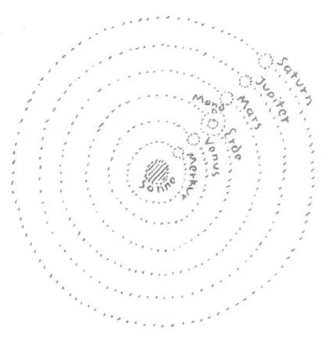
[ 10 ] Well, today astronomy studies such planetary systems and doesn’t pay much attention to the effects these planets have on the beings living on Earth. We calculate where a planet will be at a specific time so that, when we point the telescope in that direction, we can find it there. That can be calculated. One can calculate how to position the telescope so that, when looking through it, one sees a planet at a specific time. One can also calculate how fast a planet moves. All of this can be calculated. These are the calculations people focus on today.
[ 11 ] But you see, it wasn’t even that long ago—after all, a few millennia aren’t much in the context of the development of the entire world system—it wasn’t that long ago at all, two and a half to three and a half millennia, when people were pursuing a completely different science regarding the planets. Here’s what they did back then. For example, there were certain illnesses in which—let’s say—people suffered from poor digestion due to thick blood—I’ll explain why in a moment. I cannot go into further detail about these critical illnesses now, because they were not as prevalent in ancient times as they are in more recent times; so I will set them aside for now, since in the earlier periods when these observations were made, they were not as widespread as they are today. But one illness that was present where such observations were made—namely, in Babylonia, Assyria, Nineveh, and so on, as well as in Egypt—is that people suffered from poor digestion due to thick blood, due to improper blood formation. Specifically, this caused blood to enter the feces—the digestive waste—so that the bowel movements were somewhat mixed with blood; typhoid-like illnesses were, after all, much more common in ancient times than they are today. So let us assume that these ancient physicians, who were also philosophers, had to study this illness. They did not simply wait until the person in question had died, for they reasoned: Once someone has died, healing becomes difficult; and therefore they did not investigate further how the deceased was faring if they had had typhus, but instead took a different approach. They said to themselves: We see that patients suffering from vomiting and diarrhea, typhoid, dysentery, or similar conditions feel better at certain times; at other times, their general condition becomes terribly poor.
[ 12 ] So they said to themselves: Typhus sometimes has a favorable course, and sometimes it has an unfavorable one. For example, there are patients who, when they contract typhus or dysentery—that is, when they develop pathological diarrhea accompanied by colic—sometimes experience terrible bouts of dizziness. Their consciousness becomes completely clouded. That’s when things take a very bad turn. But some patients remain conscious. Their minds stay clear. You can do something for these patients.
[ 13 ] Now they said to themselves: Human beings do not merely live on Earth; they are not merely dependent on Earth, but are also dependent on the entire universe. That is why they began to observe. And now imagine: the Earth is there. We can certainly use today’s understanding of the planetary system—as taught in schools today—as our basis. After all, the Earth is illuminated by the Sun. The Sun’s rays then fall upon the Earth. And you know yourself that much depends on sunlight for human beings; we have always taken that as a basis in these considerations here. Well, these ancient physicians did not pay all that much attention to the Sun as such, for they said that all of this is quite obvious. But then they observed people who, for example, had very severe diarrhea, and they noted: these people experience bouts of dizziness at certain times, and their minds become clouded. Others have severe diarrhea but their minds remain clear; they do not experience bouts of dizziness. But this always happens—they observed—at different times. At a certain time, there’s really nothing that can be done for patients with diarrhea; there’s nothing you can do: they’re bound to get dizzy spells, and then they die. At other times, the diarrhea becomes particularly mild.
[ 14 ] Now they have begun to observe the stars and have found that during periods when cases of diarrhea or typhoid fever have a favorable course, Venus—the planet Venus—is always positioned in such a way that it is obscured by Earth. You see, when the Earth is positioned like this (see drawing, left), Venus can be positioned there. When a person stands there, they don’t receive any light from Venus. The Earth blocks Venus from them. The light from Venus cannot pass through the Earth to reach the person. They realized this, of course, because Venus could not be seen—it was obscured by the Earth. Now they said to themselves: Let’s consider a person suffering from typhus during the time when Venus is obscured by Earth: Good heavens, the typhus is progressing well then. But when Venus is positioned so that it is not obscured—for example—the person with typhus receives the light of Venus in addition to the sunlight (see illustration, right). Then the typhus takes a turn for the worse. The patient becomes dizzy and unwell, and the typhus cannot be cured.
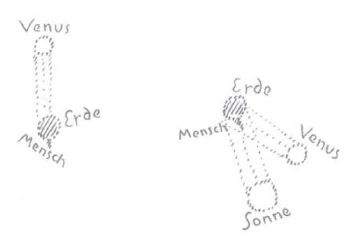
[ 15 ] They knew that much. So they said: Venus does shine, after all, and its rays pass right through the Earth. There must be something in the Earth that alters Venus’s rays. So they conducted an experiment. They didn’t experiment on the dead, but on the living: If I give lead to this typhoid patient, nothing happens. If I give iron to a typhoid patient—no matter where Venus is in the sky—nothing happens either. But if I give him copper, this copper has a very strange effect. It relieves his dizziness, and the typhoid patient begins to recover. “Aha,” these old people said to themselves, “copper is found in the earth. Copper acts within the earth in such a way that it influences typhus just as, conversely, the rays of Venus adversely affect it. When the rays of Venus shine directly upon it, they promote typhus. When copper is administered to a typhus patient, it prevents typhus.”
[ 16 ] Now they said: Venus is connected to copper in a certain way. It’s not as if people had held séances and a medium had told them, “If someone contracts typhus, you must use copper”—rather, they made observations of this kind that are simply no longer made today. They proceeded just as scientifically, guided by an ancient instinct. And they said to themselves: There is copper in the earth. This copper in the earth is connected to the force emanating from Venus. This can be seen from its specific effect on the disease.
[ 17 ] Then they conducted other observations. Let’s imagine, for example, that there was a case in which the patient developed, say, visual disturbances—problems with the eyes—such that he could not see properly. As you know, people can develop all sorts of eye diseases—such as blurred vision or constricted pupils. There are all kinds of eye diseases like that. So they conducted further experiments and found that when the Earth is in this position and Jupiter, for example, is such that the Earth blocks Jupiter, then a person with such an eye condition feels better than when Jupiter shines directly on the Earth. So they tried again: What is it in the Earth that counteracts Jupiter? — and found that it is tin, specifically when tin is extracted from plants.
[ 18 ] And so, based on their effects on human beings, they gradually identified the planets and the metals found in the Earth, and discovered that Venus is associated with copper, Jupiter with tin, and Saturn with lead. They discovered that, particularly when a person develops bone diseases—such as those that occur in cases of lead poisoning—this has something to do with Saturn’s radiation, and they identified Saturn’s influence as being that of lead.
[ 19 ] For Mars, which is associated in particular with blood disorders, this was easier to establish. Iron was identified as its element. Thus, Mars = iron. For the Moon, which is in a completely different relationship because it orbits the Earth, something similar was nevertheless found: silver. Thus, Moon = silver.
[ 20 ] Well, this way of looking at things was, of course, completely abandoned later on. But you shouldn’t think that it’s been too long since people stopped doing this. It was only three to four centuries ago that people stopped making such observations. In the 13th and 14th centuries, such observations were certainly still being made. What did people say at the time? They said: Everything that is now scattered out as planets was once contained within a primordial soup—the story of the primordial soup is, after all, true—within a cosmic nebula. One must simply not create a mental image of everything emerging from the cosmic nebula without any spiritual influence; otherwise, what I have already told you about the “cosmic schoolmaster” who spins comes into play! No, it was once understood that everything was dissolved in a kind of primordial soup. There was no sun, moon, or Earth; rather, everything was dissolved in a primordial soup. This later separated.
[ 21 ] Through the copper contained within the Earth, the metal copper still exerts an influence on the planet Venus today. When Venus was still dissolved in the primordial soup, it had a special affinity with copper. That is when the connection between copper and Venus came into being. And when the Moon was still dissolved within everything, silver had a special relationship to the Moon.
[ 22 ] This knowledge, then, was neither a divine revelation nor an arbitrary, authoritative dictate, but was based on ancient observations. And due to specific circumstances—namely, the fact that in recent centuries the so-called civilized peoples have come into greater contact with savage peoples—syphilitic diseases first emerged as a result of intermingling, specifically through sexual intermingling between civilized and savage peoples.
[ 23 ] Syphilitic diseases were less common when peoples were even more segregated into races. Isn’t it true that with diseases like syphilis, the course of the illness is such that they are initially caused by something, but then propagate on their own? They become contagious. Originally, however, they must be caused by something. Syphilitic diseases arose because people of distantly related races intermarried. And, for example, syphilitic infection cannot occur at all unless there is a small wound—no matter how hidden—or even just a slight erosion in the tissue. The syphilitic infectious agent must enter the bloodstream of a person who is not initially infected. So if you simply apply the syphilitic infectious agent to the skin, and the skin is completely intact, no infection can occur. Infection can only occur if the skin is thin enough in some place for the infectious agent to penetrate. From this you can see that the syphilitic infectious agent must first arise where foreign blood types come into contact. And then, of course, the toxin spreads further. But it originally arose when there was greater intermingling among peoples. And it would probably be interesting to examine the statistics regarding these cases of the disease now that, from certain quarters in Europe, all sorts of exotic people are being brought in—though one cannot always prevent all sorts of sexual excesses from occurring there as well, can one?
[ 24 ] You see, while isolated cases of syphilis had occurred earlier, the more widespread occurrence of syphilis has only emerged in recent times—specifically, in the recent past when people still knew something of this ancient science, so that observations had already been made indicating that syphilis patients feel better when Mercury is obscured from view by the Earth. And through this, it was discovered that mercury is associated with the planet Mercury. And in this way, the metals were gradually assigned to their respective planets:
[ 25 ] Mercury — Quicksilver
Venus — Copper
Jupiter — Tin
Saturn — Lead
Mars — Iron
Moon — Silver
[ 26 ] It was said: When all of this had dissolved into a primordial mass, it was simply the substance of Venus that caused copper to be deposited in the Earth, and the Moon that caused silver to be deposited on the Earth.
[ 27 ] You see, these observations could certainly be continued. It is very strange how, during a certain period, particularly in certain circles, there was a tendency to keep this ancient science hidden, so to speak. Even today, there are certain books that someone who isn’t familiar with anthroposophy can’t really read at all, because they can’t make sense of them. They contain all sorts of things, but people today can no longer read them. For example, a Swedish researcher obtained such a book by Basilius Valentinus—which is quite old—and wrote about it from the modern perspective of chemistry, saying: “What he says there is utter nonsense.” — And he’s actually right, when he says, “That’s utter nonsense!” — because the way today’s chemists use terms like ‘mercury,’ ‘iron,’ and so on, they have absolutely no connection to the human being. So someone who is a brilliant genius in chemistry today can’t make any sense of what’s written in books like those by Basilius Valentinus. He can’t make any sense of it at all, and he’s right when he says: “That’s complete nonsense.”
[ 28 ] But that is not the case; rather, Basilius Valentinus was writing at a time when it was known, for example, that a woman’s menstrual cycle occurs approximately every twenty-eight days. The moon also becomes full after twenty-eight days. The ancients were wise enough not to attribute a woman’s menstruation to the moon’s influence. Instead, they reasoned: since it occurs according to the same rhythmic cycle, there must have once been some connection between the two. Now, however, humanity has severed that connection. Well, that was one thing people knew—that a woman has a rhythm within her similar to the one the universe has in the moon’s phases. That was one thing people knew.
[ 29 ] The other thing people knew was this: It was said that if a woman was having a difficult labor—one in which the contractions lasted an awfully long time—and you gave her silver, her labor would become easier. That, too, was common knowledge. But it was also known that, under certain circumstances, for women who appeared likely to have prolonged labor, the labor pains would not be as severe if the moon were not visible in the sky—if, so to speak, the moon were covered. And so the effect of silver was seen in connection with the moon.
[ 30 ] And in Basilius Valentinus’s work, “silver” is often used instead of “moon,” and “moon” instead of “silver.” So when the Nordic scholar reads this, he naturally—even if he is very well-informed about how silver behaves in a chemical process—when he reads about silver in Basilius Valentinus’s writings, and when in certain places the author does not write “silver” at all but writes “moon”—well, then the Nordic scholar is at a loss. This is very complicated. But you see, the person who wrote the works of Basilius Valentinus was a Benedictine monk. In the Benedictine monasteries in particular, in ancient times, such subjects as this science were truly cultivated to a high degree. And the Benedictine monks were exceptionally knowledgeable in such matters.
[ 31 ] A Father Mager is currently traveling around German cities; he is also a Benedictine monk, but he gives the same lecture against anthroposophy everywhere he goes. Father Mager has been speaking out against anthroposophy in cities all over Germany—he was in Cologne just recently. The opponents are, of course, always very different. When the Jesuits speak out against anthroposophy, it is, of course, somewhat different than when the Benedictines speak out against it.
[ 32 ] Yes, that is the case today; today the Church is suppressing a science that extends beyond the Earth. Gentlemen, what began at a certain time? At a certain time, the Church authorities began to gradually suppress this science, which had flourished everywhere in the monasteries. After all, such a science requires time, and the monks had that time; they cultivated the ancient science and were thus of great benefit to humanity in times past. But it was gradually suppressed. And this suppression of spiritual science has, in fact, come about in this way on many occasions.
[ 33 ] Today’s secular scholars, who now rail just as vehemently against this science, are completely unaware that, in the proper sense, they are the disciples of such monks of the Church. So when such a monist association opposes anthroposophy, it naturally rails against the Church as well, but it does not realize that it is a genuine disciple of the Church. Today’s scientists are, in a certain sense, actually disciples of the Benedictines or the Jesuits. It’s just that they never attended a seminary with them; rather, one can truly adopt such a mindset today right out in the world. That, of course, is what one must take into account in such a matter.
[ 34 ] And from what has been said above, you can see that the Earth on which we live—which provides us with various metals—once crystallized out of the primordial soup. But what we see on the outside has remained within the Earth in the form of metals. What the Earth once created together with Venus has remained in the metal copper. Therefore, what is particularly brought about by Venus can be healed through copper.
[ 35 ] In particular, healing occurs when these metals are still extracted from plants today. Isn’t that right? Once the metal has been deposited in the soil, it has hardened. It loses some of its potency, although it is still effective for ailments of the head. But it is particularly effective when you know: there is a plant that has, for example, dissolved a fair amount of copper in its leaves—the amounts are always small, but you can still say: a fair amount. There are plants like this that have dissolved copper in their leaves. If remedies are made from such plants, they are particularly useful when thickening of the blood causes digestive disorders of the kind that lead to typhoid, dysentery, and so on.
[ 36 ] And so what one can truly know about plants is connected to healing. And from this alone you can see that things are no longer as they should be today, for if you open even the thickest book today—on botany or plant science, for example—you will read all sorts of things in it, but what is particularly important—what doctors, in particular, ought to learn—namely, which metals are dissolved in the flower or the root—you will not find that at all in these books. It is only occasionally mentioned in passing. But this is precisely what is so immensely important, because it shows us that a plant that still contains copper, for example, is connected to the planet Venus throughout its entire growth—namely, it actually resists the Venusian force. It develops its own Venusian force by absorbing the copper into itself.
[ 37 ] And so we can say: There was once a connection between the Earth and all the planets that now orbit the Sun, and this influence has been preserved in the metals. That is what needs to be said first regarding this question.
[ 38 ] You will see from this just how incredibly important it is to return to observations of this kind, as they once were. But we are no longer in the same situation today, because the healing instincts that once existed are now really only found in oxen, cows, and sheep—not in humans. Animals, you see, still possess wonderful healing instincts and do not eat what harms them. They avoid what is harmful to them. This is no longer the case with humans. They no longer possess this healing instinct; and today we must learn once again, through the detour of spiritual science, how all things here in the entire planetary system—indeed, in the whole world—are connected to the earthly realm. And we must start at the very beginning; we must truly begin right at the very beginning.
[ 39 ] For example, one must tell oneself the following. One must start with those diseases that affect the human abdomen. When one has such diseases that affect the human abdomen, one gains an insight that tells us: What is found in the flowers—or, at most, in the leaves—of the plant is particularly helpful for the human abdomen. When we extract certain substances from the flowers and leaves of the plant, we can use them to make effective remedies for conditions related to the human abdomen.
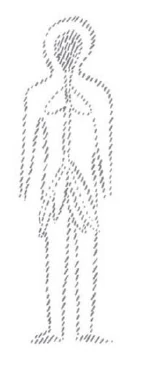
[ 40 ] But if we take our substances from the roots of plants, for example, we obtain particularly effective remedies for everything related to the human head. The situation is, in fact, reversed in plants and humans. In plants, the root is at the bottom and the flower at the top. Humans are, in fact, plants in reverse. What is the root-like part in a plant is actually located in the human head, and what is the flower-like part is more toward the lower abdomen. You can already see this from their outward appearance. Humans have their heads at the top and their reproductive organs at the bottom. The plant has its roots at the bottom, grows upward, and the flower contains the reproductive organs. These are at the top. You can see this, for example, as follows: If you take a human being and insert here (at the head) the root of a plant of corresponding size—the stem and the leaves—the flower will reach right down to the abdominal organs. For there is, in fact, an entire plant inside the human being; it just grows from top to bottom. The human being is also, in a certain sense, a plant. Isn’t that obvious? Isn’t it true that the human being is, in a certain sense, a plant! Yes, gentlemen, this is so obvious that everyone must immediately notice it. The animal, in fact, stands right in the middle. There, the plant is positioned horizontally.
[ 41 ] The fact is, however, that it doesn’t just look that way figuratively—this plant is actually inside the human being. Of course, it takes shape in accordance with the human form. But suppose I draw this plant neatly, give it a proper root tuber and then the various stems—in other words, I make a real tree that extends only from top to bottom, then tapers slightly at the top—and now I let it wither a little, let it die off bit by bit—there you have the nervous system! That, in fact, is the nervous system. The nervous system is, in fact, an inverted plant that is embedded within the human being and that is constantly dying off a little bit.
[ 42 ] Now you see, we know this for certain: Plants grow out of the earth. First, winter must come; then spring and summer follow. Spring and summer draw the plants out of the earth. The power of winter lies deep within the earth.

[ 43 ] This causes the plant to form a tuber; that is where its root power lies. Then the summer force arrives; the plant is lured out. Yes, all of this comes from the earth’s environment—that is why the plants are lured out. The metals are contained within it; let’s say, for example, that copper is contained within it. The sun could do nothing else but draw a plant that sits in the earth out into the open. Then, once it has been drawn out, the plant resists the forces of Venus. This plant grows from the winter force of the earth and the summer force of the whole world.
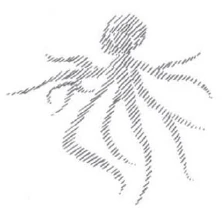
[ 44 ] Yes, gentlemen, but human beings must have this winter power within their heads, for they continue to grow throughout the entire year—for example, a small child can be born at any time of the year—and the root of their nerves continues to grow downward; therefore, human beings must have this winter power in their heads both in winter and in summer. Today, in summer, a person cannot acquire this winter force from outside sources. This means, then, that human beings must have absorbed this winter force at some point in earlier times—when they were still as I have described to you, in the primordial soup in which the Earth was still with the other planets—and have simply passed it down to the present day. So they have had this winter force in their heads since very ancient times. The human head was actually formed in ancient times and has remained as it is to this day. This brings us back to the point that the human head must be related to that which arose on Earth in ancient times and has now completely solidified on Earth.
[ 45 ] Well, if you go out into the ancient mountains, into Central Switzerland, you’ll find granite and gneiss there in particular. In this granite and gneiss, the most effective substance is silicic acid, which is then found on its own in quartz—silicic acid, silica. So this is also the oldest substance on Earth. It must be related to the human mental faculties. That is why head ailments can be most easily cured by making remedies from silica, because this addresses the human head. For in the time when silica still played a special role on Earth, when it was still within the primordial mass and not yet so hard—today it is hard within granite and gneiss—but back then, when silica still flowed like a liquid, the forces that are now present in the human head were formed—the winter forces—and have been preserved.
[ 46 ] And so one really must draw conclusions about human beings from the natural history of the entire Earth. This is also related to the question you asked. That is what I wanted to tell you regarding this question, gentlemen. Goodbye!