

Man's Life on Earth and
the Essence of Christianity
GA 349
14 March 1923, Dornach
Translate the original German text into any language:
Versions Available:
Man's Life on Earth and the Essence of Christianity, tr. SOL
4. Das Weltbild Dantes und das Heraufkommen des naturwissenschaftlichen Zeitalters
4. Dante’s Worldview and the Dawn of the Age of Science
Ich habe eine Frage in bezug auf die Farben bekommen und werde gebeten, darüber noch etwas zu sagen.
I received a question about the colors and have been asked to say a little more about them.
[ 1 ] Nun will ich zunächst eingehen auf die Frage, die hier zuerst gestellt worden ist. Das ist die Frage nach dem Weltbilde, das sich Dante gemacht hat. Also der Herr hat Dante gelesen. Und wenn man Dante, diesen Dichter aus dem Mittelalter, liest, so sieht man, daß er ein ganz anderes Weltbild gehabt hat als wir.
[ 1 ] Now I would like to begin by addressing the question that was first raised here. That is the question of the worldview that Dante held. So, the gentleman has read Dante. And when one reads Dante, this poet from the Middle Ages, one sees that he had a worldview quite different from our own.
[ 2 ] Nun bitte ich Sie, folgendes zu bedenken. Die Menschen, ich habe es Ihnen ja öfter gesagt, denken, daß dasjenige, was heute der Mensch weiß, eigentlich das allein Gescheite ist. Und wenn frühere Menschen anders gedacht haben, dann stellen sich die Leute vor: Nun ja, das war da einmal so. Und man hat gewartet, bis man etwas Vernünftiges über die Welt hat erfahren können.
[ 2 ] Now I ask you to consider the following. People—as I have often told you—think that what people know today is, in fact, the only sensible way of thinking. And if people in the past thought differently, then people imagine: Well, that’s just how it used to be. And they waited until they could learn something sensible about the world.
[ 3 ] Sehen Sie, dasjenige, was heute die Leute in der Schule schon lernen, was ihnen in Fleisch und Blut übergeht über das Weltbild, das ist eigentlich erst so seit der Zeit, als Kopernikus dieses Weltbild zuerst ausgedacht hat. Nach diesem Weltbild also aus dem 16. Jahrhundert hat man sich vorgestellt, daß die Sonne in der Mitte unseres ganzen Planetensystems steht. Um die Sonne laufen zunächst herum der Merkur (Zeichnung Seite 70), dann die Venus, dann die Erde. Um die Erde läuft wiederum der Mond herum. Dann kommt der Mars, um die Sonne herumlaufend. Dann sind viele, im Verhältnis zum Weltenraum winzige Planeten da, die man Planetoiden nennt - oid, das heißt ähnlich, ähnlich den Planeten. Dann kommt der Jupiter, dann kommt der Saturn. Und dann noch Uranus und Neptun; die brauche ich nicht zu zeichnen, So stellt man sich das heute vor, lernt es schon in der Schule, daß die Sonne in der Mitte stillsteht. Eigentlich sind diese Linien, in denen die Planeten herumlaufen, etwas langgestreckt. Auf das kommt es uns heute nicht an. Man denkt sich also, daß zunächst Merkur, dann Venus, dann die Erde um die Sonne herumläuft. Nun wissen Sie, daß die Erde um die Sonne in einem Jahr herumläuft, also in 365 Tagen sechs Stunden und so weiter. Der Saturn läuft in ungefähr dreißig Jahren einmal herum, also wesentlich langsamer als die Erde. Der Jupiter zum Beispiel läuft in zwölf Jahren herum, also auch langsamer als die Erde. Der Merkur läuft ziemlich schnell herum. Also je näher die Planeten der Sonne sind, desto schneller laufen sie herum.
[ 3 ] You see, what people learn in school today—what becomes second nature to them regarding our view of the world—has actually only been around since Copernicus first conceived of this model. According to this 16th-century view of the universe, a mental image existed of the Sun being at the center of our entire planetary system. Mercury (drawing on page 70) orbits the Sun first, followed by Venus, then Earth. The Moon orbits the Earth in turn. Next comes Mars, orbiting the Sun. Then there are many planets—tiny in relation to the vastness of space—called planetoids; “-oid” means “similar to,” similar to the planets. Next comes Jupiter, then Saturn. And then Uranus and Neptune; I don’t need to draw those. That’s how we imagine it today—we learn it in school—that the Sun stands still at the center. Actually, the orbits in which the planets move are somewhat elongated. But that’s not what matters to us today. So we imagine that first Mercury, then Venus, then Earth orbits the Sun. Now you know that Earth orbits the Sun in one year—that is, in 365 days, six hours, and so on. Saturn takes about thirty years to complete one orbit, so it moves much more slowly than Earth. Jupiter, for example, takes twelve years to orbit, so it’s also slower than Earth. Mercury orbits quite quickly. So the closer the planets are to the Sun, the faster they orbit.
[ 4 ] Nun, nicht wahr, diese Vorstellung hält man heute für die richtige, lehrt sie schon in der Schule. Wir brauchen aber nur bis zum 14. Jahrhundert zurückzugehen, also 1300 etwa, dann hat ein so außerordentlich großer Geist, wie Dante, der dieses Gedicht von der Göttlichen Komödie gemacht hat, noch eine ganz andere Vorstellung. Das liegt also ein paar Jahrhunderte zurück hinter Kopernikus. Und der allergrößte Mensch, der dem Geist nach allergrößte Mensch, Dante, hat eine ganz andere Vorstellung.
[ 4 ] Well, isn’t that right? That’s the mental image considered correct today—it’s even taught in school. But we need only go back to the 14th century—around 1300—to find that a mind as extraordinarily great as Dante’s, who wrote *The Divine Comedy*, still held a completely different mental image. That was a few centuries before Copernicus. And the greatest man of all—the greatest man in terms of intellect—Dante, held a completely different mental image.
[ 5 ] Nun wollen wir heute einmal zunächst gar nicht entscheiden, ob das eine richtig ist oder das andere richtig ist. Wir wollen uns jetzt nur einmal vorstellen, wie Dante, dieser bedeutendste Geist der damaligen Zeit, sich die Sache vorgestellt hat in einer Zeit also — jetzt haben wir 1900, damals 1300 -, die nur sechshundert Jahre zurückliegt. Wollen wir gar nicht denken, das eine ist falsch, das andere ist richtig, sondern uns nur hineinversetzen, wie Dante sich das vorgestellt hat. Der hat sich vorgestellt (Zeichnung Seite 73): Die Erde steht in der Mitte des Weltensystems. Und diese Erde ist nicht nur so da, daß der Mond zum Beispiel das Licht, das er von der Sonne bekommt, auf die Erde zurückwirft, sondern diese Erde, die ist nicht nur umgeben, sondern ganz eingehüllt von der Mondensphäre. Die Erde steckt ganz drinnen in der Mondensphäre. Den Mond hat sich Dante also viel größer vorgestellt als die Erde. Er hat sich vorgestellt: Das ist ein sehr feiner Körper, der viel größer ist als die Erde. Der ist also zwar fein, aber viel größer. Und das, was man sieht, das ist nur ein Stückchen, nämlich das feste Stückchen von dem Mond. Und dieses feste Stückchen, das läuft nur um die Erde herum. Können Sie sich das vorstellen? Bei Dante ist es so, daß die Erde im Mond drinnen ist, und das, was man sieht vom Mond, das ist nur ein kleines, festes Stückchen vom Mond. Das läuft herum. Aber eigentlich sind wir alle in den Kräften vom Mond drinnen. Die habe ich da rot gezeichnet.
[ 5 ] Today, let’s not even try to decide at first whether one is right or the other is right. Let’s just imagine for a moment how Dante—the most eminent mind of his time—created a mental image of things back then—we’re in 1900 now, but back then it was 1300—a time that was only six hundred years ago. Let’s not even think that one view is wrong and the other is right, but simply put ourselves in Dante’s shoes and imagine how he saw it. He created a mental image (drawing on page 73): The Earth stands at the center of the world system. And this Earth is not merely there in such a way that the Moon, for example, reflects the light it receives from the Sun back onto the Earth; rather, this Earth is not merely surrounded but completely enveloped by the lunar sphere. The Earth is entirely contained within the lunar sphere. So Dante had a mental image of the Moon as being much larger than the Earth. He imagined it as a very fine body, much larger than the Earth. So while it is fine, it is also much larger. And what we see is only a small part—namely, the solid part of the Moon. And this solid part is the only part that orbits the Earth. Can you picture that? According to Dante, the Earth is inside the Moon, and what we see of the Moon is just a small, solid fragment of it. That’s what orbits. But actually, we are all inside the Moon’s forces. I’ve marked those in red here.
[ 6 ] Und nun hat sich Dante vorgestellt: Ja, wenn die Erde nicht drinnensteckte in diesen Kräften vom Mond, so würden zwar einmal durch irgendein Wunder auf die Erde Menschen kommen, aber sie könnten sich nicht fortpflanzen. Die Fortpflanzungskräfte sind es, die da in dem Rotgezeichneten drinnen enthalten sind. Die durchströmen auch den Menschen, und die machen, daß er fortpflanzungsfähig ist. Also der Dante hat sich vorgestellt: Die Erde ist ein fester, kleiner Körper; der Mond ist ein feiner — viel feiner als die Luft -, ein feiner großer Körper, in dem die Erde wie ein Kern drinnen ist. Sie können sich das so vorstellen, als wenn die Erde ein Zwetschgenkern wäre in dem weichen Zwetschgenfleisch. Und da draußen ist das feste Stückchen; das läuft herum. Aber das da (Zeichnung Seite 73, Mond) ist auch immer da, und das bewirkt, daß der Mensch fortpflanzungsfähig ist, und die Tiere auch fortpflanzungsfähig sind.
[ 6 ] And now Dante has provided a mental image: Yes, if the Earth were not imbued with these forces from the Moon, then—though humans might one day come to Earth through some miracle—they would be unable to reproduce. It is the reproductive forces that are contained within the area marked in red. These forces also flow through human beings, and they are what enable them to reproduce. So Dante had this mental image: The Earth is a solid, small body; the Moon is a fine—much finer than air—a fine, large body, within which the Earth lies like a core. You can create a mental image of the Earth as a plum pit inside the soft flesh of a plum. And out there is that solid little piece; it orbits. But that (drawing on page 73, the Moon) is always there, too, and it is what enables humans to reproduce, and animals to reproduce as well.
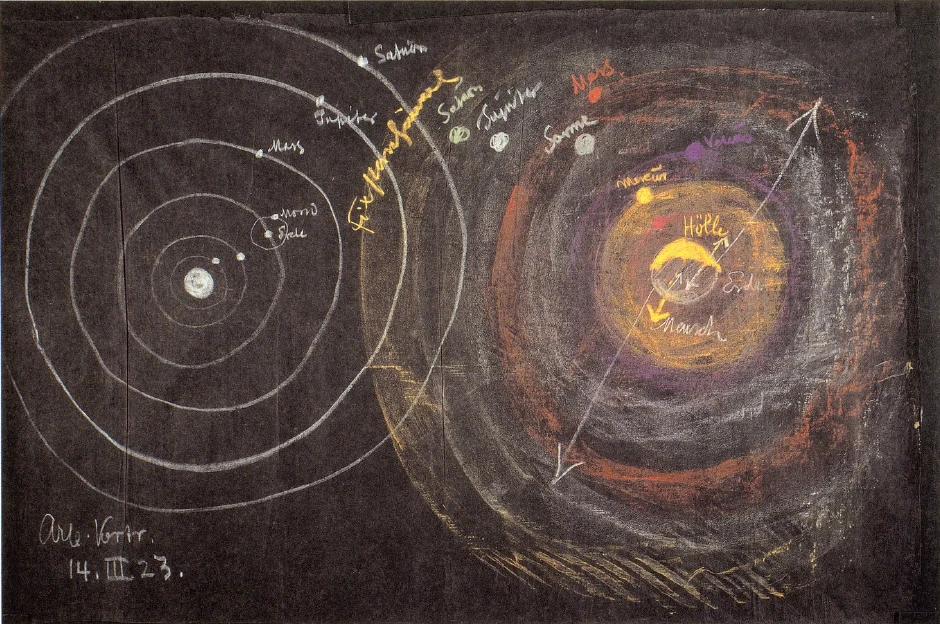
[ 7 ] Jetzt stellte er sich weiter vor: Die Erde ist jetzt nicht nur drinnen in Mondenkräften, sondern die Erde ist auch noch in weiteren Kräften drinnen — die will ich hier gelb zeichnen -, und die durchdringen das alles. Also die Mondenkräfte sind in dem drinnen, stecken da drinnen, so daß Erde und Mond wiederum da drinnen in diesem Gelben sind. Und da ist wiederum ein festes Stück. Dieses feste Stück ist der Merkur, und der läuft da herum. Und wenn der Mensch nicht fortwährend von diesen Merkurkräften durchdrungen wäre, so könnte er nicht verdauen. So daß sich also Dante vorgestellt hat: Die Mondenkräfte bewirken die Fortpflanzung; die Merkurkräfte, in denen wir auch immer drinnenstecken, die nur feiner sind als die Mondenkräfte, die bewirken, daß wir verdauen können, und daß die Tiere verdauen können. Sonst hätten wir in unserem Leib nur ein chemisches Laboratorium, stellte er sich vor. Daß es in unserem Leib anders zugeht als in einem chemischen Laboratorium, wo man nur die Stoffe mischt und wiederum voneinander trennt, das wird von den Merkurkräften bewirkt. Also der Merkur ist größer als die Erde und größer als der Mond.
[ 7 ] He went on to explain: The Earth is not only surrounded by lunar forces, but it is also surrounded by other forces—which I will draw here in yellow—and these permeate everything. So the lunar forces are contained within it, embedded there, so that the Earth and the Moon are in turn contained within this yellow area. And within that there is a solid body. This solid body is Mercury, and it orbits there. And if human beings were not constantly permeated by these Mercury forces, they would be unable to digest food. So Dante had this mental image: The lunar forces bring about reproduction; the Mercury forces—in which we, too, are always immersed, though they are finer than the lunar forces—enable us to digest food, and enable animals to digest food as well. Otherwise, he had a mental image of our bodies being nothing more than chemical laboratories. The fact that what happens inside our bodies is different from what happens in a chemical laboratory—where substances are merely mixed and then separated again—is brought about by the forces of Mercury. Thus, Mercury is larger than the Earth and larger than the Moon.
[ 8 ] Und nun ist das alles wiederum drinnen in einer noch größeren Sphäre, wie Dante es nannte. So daß wir also auch in den Kräften drinnenstecken, die von diesem Planeten, von der Venus, kommen. Also wir stecken in all diesen Kräften drinnen, die durchdringen uns. Wir sind also auch von den Venuskräften durchdrungen. Und daß wir von den Venuskräften durchdrungen sind, das macht, daß wir nicht nur verdauen können, sondern das Verdaute ins Blut aufnehmen können. Venuskräfte leben in unserem Blute. Alles, was mit unserem Blut zusammenhängt, kommt von den Venuskräften. So stellte es sich Dante vor. Und diese Venuskräfte, die bewirken zum Beispiel auch dasjenige, was der Mensch in seinem Blut als Liebesgefühle hat; daher «Venus».
[ 8 ] And now all of this is, in turn, contained within an even larger sphere, as Dante called it. So we, too, are immersed in the forces that come from this planet, from Venus. We are immersed in all these forces that permeate us. We are therefore also permeated by the forces of Venus. And the fact that we are permeated by the forces of Venus means that we are not only able to digest, but also to absorb what we have digested into our blood. The forces of Venus live in our blood. Everything connected with our blood comes from the forces of Venus. That is how Dante imagined it. And these forces of Venus also bring about, for example, what humans experience in their blood as feelings of love; hence “Venus.”
[ 9 ] Die nächste Sphäre ist dann diejenige, in der wir wiederum drinnenstecken, und da läuft wiederum als festes Stück die Sonne herum, Wir sind also überall in der Sonne drinnen. Die Sonne ist für Dante im Jahre 1300 nicht nur der Körper, der da auf- und niedergeht, sondern die Sonne ist überall da. Wenn ich hier stehe, bin ich in der Sonne drinnen. Denn das ist nur ein Stück von der Sonne, was da auf- und niedergeht, was da herumläuft. So hat er es sich vorgestellt. Und die Sonnenkräfte sind es vorzugsweise, welche im menschlichen Herzen tätig sind.
[ 9 ] The next sphere is the one in which we are once again contained, and within it the Sun moves as a solid body. We are thus everywhere within the Sun. For Dante in the year 1300, the Sun is not merely the body that rises and sets, but the Sun is everywhere. When I stand here, I am inside the Sun. For what rises and sets, what circles around, is only a part of the Sun. That is his mental image. And it is primarily the forces of the Sun that are at work in the human heart.
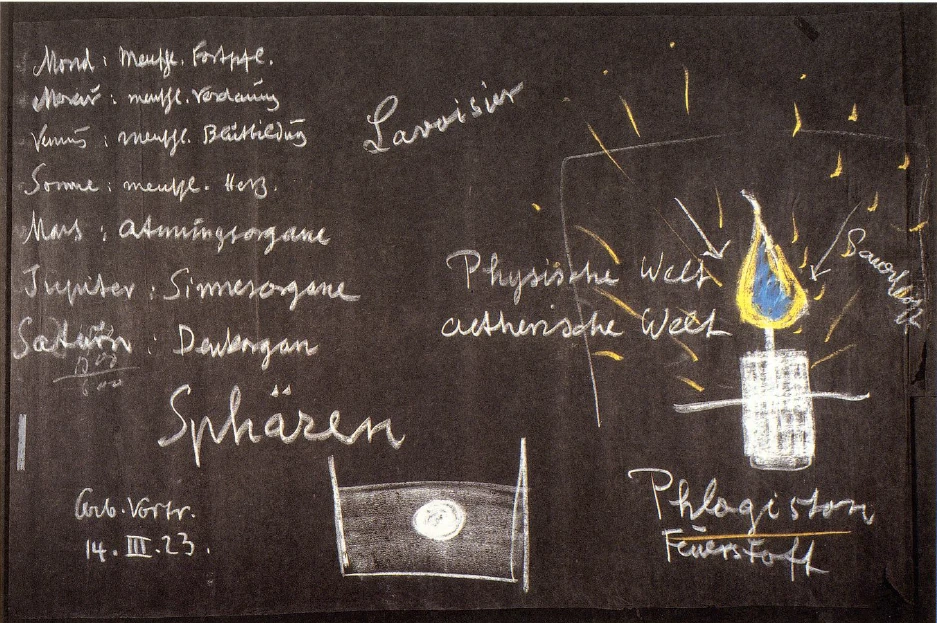
[ 10 ] Also Sie sehen: Mond, menschliche und auch tierische Fortpflanzung; Merkur: menschliche Verdauung; Venus: menschliche Blutbildung; Sonne: menschliches Herz.
[ 10 ] So you see: the Moon, human and animal reproduction; Mercury: human digestion; Venus: human blood formation; the Sun: the human heart.
[ 11 ] Jetzt hat sich Dante vorgestellt: Alles das ist wiederum in der riesig großen Marskugel drinnen. Da ist der Mars. Und dieser Mars, in dem wir also wiederum drinnenstecken, der hängt ebenso, wie die Sonne mit dem menschlichen Herzen zusammenhängt, mit alledem zusammen, was unsere Atmung und namentlich unsere Sprache betrifft, mit allem, was die Atmungsorgane sind. Das ist im Mars. Also Mars: Atmungsorgane. Und dann geht es weiter. Die nächste Sphäre ist dann die Jupitersphäre. Wir stecken wiederum in den Jupiterkräften drinnen. Nun, der Jupiter, der ist ja sehr wichtig; der hängt mit alledem zusammen, was unser Gehirn ist, eigentlich unsere Sinnesorgane, unser Gehirn mit den Sinnesorganen. Der Jupiter also hängt zusammen mit den Sinnesorganen. Und nun kommt der äußerste Planet, der Saturn. In dem ist wieder alles das drinnen. Und der Saturn hängt zusammen mit unserem Denkorgan.
[ 11 ] Now Dante has introduced himself: All of this, in turn, is contained within the enormous sphere of Mars. There is Mars. And this Mars, inside which we are, in turn, located—it is connected, just as the Sun is connected to the human heart, to everything that concerns our breathing and, in particular, our speech, to everything that constitutes the respiratory organs. That is within Mars. So Mars: respiratory organs. And then it continues. The next sphere is the sphere of Jupiter. We are, in turn, contained within the forces of Jupiter. Now, Jupiter is, of course, very important; it is connected to everything that constitutes our brain—actually, our sense organs, our brain together with the sense organs. Jupiter, then, is connected to the sense organs. And now comes the outermost planet, Saturn. All of that is contained within it as well. And Saturn is connected to our organ of thought.
[ 12 ] Mond: Menschliche Fortpflanzen
Merkur: Menschliche Verdauung
Venus: Menschliche Bluttbildung
Sonne: Menschliche Herz
Mars: Atmungsorgane
Jupiter: Sinnesorgane
Saturn: Denkorgane
[ 12 ] Moon: Human Reproduction
Mercury: Human Digestion
Venus: Human Blood Formation
Sun: Human Heart
Mars: Respiratory organs
Jupiter: Sensory organs
Saturn: Cognitive organs
[ 13 ] Also sehen Sie, dieser Dante, der nur sechshundert Jahre hinter uns zurückliegt, der stellte sich das ganze Weltgebäude anders vor. Der stellte sich zum Beispiel den Saturn als den größten Planeten vor, allerdings von feinem Stoff, aber als den größten Planeten, in dem wir drinnenstecken. Und diese Saturnkräfte, die bewirken unsere Denkorgane, die bewirken, daß wir denken können.
[ 13 ] So you see, this Dante, who lived only six hundred years ago, had a different mental image of the entire structure of the world. For example, he had a mental image of Saturn as the largest planet—admittedly made of fine matter, but still the largest planet, inside which we are situated. And these Saturn forces are what drive our thinking faculties; they are what enable us to think.
[ 14 ] Außerhalb nun von alledem, aber so, daß wir da auch drinnen sind, ist der Fixsternhimmel. Da sind also die Fixsterne, namentlich die Tierkreis-Fixsterne (Zeichnung Seite 73). Und noch größer ist dann dasjenige, was alles bewegt, der erste Beweger. Aber der ist nicht bloß da oben, sondern der ist auch hier überall der erste Beweger. Und hinter dem ist ewige Ruhe, die auch wiederum überall ist. So stellte sich das Dante vor.
[ 14 ] Beyond all of this—yet in such a way that we are also within it—lies the fixed-star sky. There, then, are the fixed stars, namely the fixed stars of the zodiac (illustration on page 73). And even greater than that is that which moves everything—the Prime Mover. But He is not merely up there; He is also here, everywhere, as the Prime Mover. And beyond Him is eternal peace, which, in turn, is everywhere. This is how Dante imagined it.
[ 15 ] Nun, nicht wahr, kann der heutige Mensch sagen: Das ist eben so, daß die Leute das alles noch unvollkommen gesehen haben; aber heute sind wir endlich dahin gelangt, daß wir wissen, wie die Sachen sind. — Gewiß, das kann man auf der einen Seite sagen. Aber Dante war eben auch nicht gerade dumm, und dasjenige, was die andern heute sehen, das hat er schon auch gesehen. Also dumm war er nicht gerade. Und die anderen, von denen er das genommen hat, die alle dazumal das geglaubt haben, die waren eben auch nicht alle törichte Menschen, sondern man hat sich das anders vorgestellt. Und jetzt ist die Frage: Ja, wie kommt es, daß es in der Weltgeschichte so eingetreten ist, daß die Menschen über das ganze Weltgebäude früher anders gedacht haben, und dann plötzlich im 16. Jahrhundert alles drunter und drüber werfen und eine ganz andere Vorstellung vom Weltbild bekommen?
[ 15 ] Well, people today might say: “That’s just the way it is—back then, people didn’t fully understand all of this; but today we’ve finally reached the point where we know how things really are.” — Certainly, one could say that, on the one hand. But Dante wasn’t exactly stupid either, and what others see today, he had already seen as well. So he wasn’t exactly stupid. And the others from whom he drew this—who all believed it back then—weren’t all foolish people either; they simply had different mental images. And now the question is: Yes, how is it that, in the course of world history, people used to think differently about the entire structure of the world, and then suddenly, in the 16th century, turned everything upside down and developed a completely different mental image of the world?
[ 16 ] Das ist ja natürlich eine sehr wichtige Frage, meine Herren. Und damit kommt man nicht zurecht, daß man sagt, nun ja, diese früheren Vorstellungen waren eben kindisch, sondern diese Leute haben eben noch ganz etwas anderes gesehen, als die heutigen Menschen sehen. Darüber muß man sich klar sein: die haben noch etwas ganz anderes gesehen. Die heutigen Menschen, die können so furchtbar gut denken. Ja, so gut denken, wie die heutigen Menschen, konnten diese alten Menschen nicht. Das Denken ist eigentlich erst aufgekommen. Vor dem Saturn, der mit dem Denkorgan zusammenhängt, haben die alten Menschen immer einen heillosen Respekt gehabt. Der Saturn, haben sie sich gedacht, der verdirbt den Menschen. Zuviel denken, das geht nicht. Der Saturn hat immer als ein finsterer Planet gegolten. Und die Kräfte, die von dem Saturn gekommen sind, von denen dachten sie, wenn die zu stark im Menschen sind, wird er ganz melancholisch. Er denkt immerfort und wird melancholisch. Also die Saturnkräfte, die hatten diese Leute gar nicht besonders gern, und sie stellten viel mehr in Bildern vor. Sie rechneten weniger. Heute rechnen wir ja alles aus. Dieses ganze Weltenbild hier von Kopernikus ist ja berechnet. Diese alten Menschen rechneten aber nicht. Aber diese alten Menschen wußten etwas anderes, was der heutige Mensch nicht weiß. Sie wußten, überall in der Welt, wo wir hinschauen, sind viele Kräfte da. Aber die Kräfte, die im Menschen drinnen sind, die sind nicht in dem da, was man mit dem Auge sieht, sondern die sind im Unsichtbaren drinnen.
[ 16 ] That is, of course, a very important question, gentlemen. And one cannot simply dismiss it by saying, “Well, those earlier mental images were just childish”; rather, those people saw something entirely different from what people today see. We must be clear about this: they saw something entirely different. People today are so incredibly good at thinking. Yes, those ancient people could not think as well as people today do. Thinking has actually only just emerged. Ancient people always had a profound fear of Saturn, which is associated with the organ of thought. Saturn, they thought, corrupts human beings. Thinking too much—that’s not good. Saturn has always been regarded as a dark planet. And the forces emanating from Saturn—they believed that if these were too strong in a person, he would become completely melancholic. He thinks constantly and becomes melancholic. So these people didn’t particularly like the forces of Saturn, and they represented them much more in mental images. They did less calculating. Today, of course, we calculate everything. This entire worldview here from Copernicus is, after all, calculated. But those ancient people didn’t do calculations. Yet those ancient people knew something else that modern people do not know. They knew that everywhere in the world, wherever we look, there are many forces at work. But the forces that are within a person—they are not found in what the eye can see, but rather within the invisible.
[ 17 ] Und so hat sich Dante gesagt: Es gibt eine sichtbare Welt, und es gibt eine unsichtbare Welt. Die sichtbare Welt, nun ja, die ist diejenige, die wir sehen. Wenn wir hinausschauen in der Nacht, so sehen wir die Sterne, den Mond, die Venus und so weiter. Das ist die sichtbare Welt. Aber die unsichtbare Welt ist auch da. Und die unsichtbare Welt sind diese - man nannte das damals Sphären. Die unsichtbare Welt, das sind diese Sphären. Und man unterschied zwischen derjenigen Welt, die man mit Augen sieht, und nannte diese die physische Welt. Das war die physische Welt. Und dann unterschied man diejenige Welt, die man nicht mit Augen sieht. Das ist die Welt, die Dante gemeint hat, und die nannte man die ätherische Welt. Also die ätherische Welt, die Welt, die aus einem so feinen Stoff besteht, daß man fortwährend durchschaut.
[ 17 ] And so Dante said to himself: There is a visible world, and there is an invisible world. The visible world—well, that is the one we see. When we look out at night, we see the stars, the moon, Venus, and so on. That is the visible world. But the invisible world is also there. And the invisible world consists of these—they were called “spheres” back then. The invisible world is these spheres. And a distinction was made between the world that can be seen with the eyes, which was called the physical world. That was the physical world. And then there was the world that cannot be seen with the eyes. That is the world Dante referred to, and it was called the ethereal world. So, the ethereal world—the world that consists of a substance so fine that one can constantly see right through it.
[ 18 ] Ja, meine Herren, ich weiß nicht, ob es Ihnen auch schon so gegangen ist, aber ich habe Leute kennengelernt, die haben behauptet, daß es keine Luft gibt, weil man sie nicht sieht. Die haben gesagt: Ja, wenn ich von da bis dort gehe, so ist doch nichts da; ich gehe doch da nicht durch etwas. — Sie wissen, daß da Luft ist, wo ich durchgehe. Aber, wie gesagt, ich habe schon Leute kennengelernt, die waren nicht so schulgebildet, wie die heutigen Menschen schulgebildet sind, und die haben nicht geglaubt, daß da Luft ist; die haben gesagt: Da ist doch nichts. - Dante, der wußte, daß wiederum nicht nur Luft ist, sondern Mond ist, Venus ist und so weiter. Es ist ganz dasselbe. Sie sagen: Ich gehe durch die Luft. Dante sagte: Ich gehe durch den Mond, ich gehe durch die Venus, ich gehe durch den Mars. — Das ist der ganze Unterschied. Und all das, was man nicht auf die gewöhnliche Weise sieht, und was man auch nicht wahrnehmen kann durch die gewöhnlichen physikalischen und chemischen Instrumente, das nannte man ätherische Welt. Also Dante schilderte eben eine ganz andere Welt, eine ätherische Welt. Und worauf beruht denn das also, daß vor sechs Jahrhunderten Dante die Welt anders gesehen hat? Das beruht darauf, daß er etwas anderes beschrieben hat, daß er das Unsichtbare beschrieben hat, die ätherische Welt. Und Kopernikus hat nichts anderes gesagt als: Ach, kümmern wir uns nicht um die ätherische Welt und beschreiben wir die physische Welt. Darinnen besteht der Fortschritt. — Man darf sich also nicht vorstellen, daß Dante ein «dummer August» gewesen ist, sondern er hat einfach die ätherische Welt beschrieben und nicht die physische. Die physische Welt war ihm nicht besonders wichtig. Er hat die ätherische Welt beschrieben.
[ 18 ] Yes, gentlemen, I don’t know if you’ve ever felt this way, but I’ve met people who claimed that air doesn’t exist because you can’t see it. They said: “Well, when I walk from here to there, there’s nothing there; I’m not walking through anything.” — You know there’s air where I’m walking through. But, as I said, I’ve met people who weren’t as well-educated as people are today, and they didn’t believe there was air; they said: “There’s nothing there.” — Dante, on the other hand, knew that it’s not just air, but the Moon, Venus, and so on. It’s exactly the same thing. You say: “I’m walking through the air.” Dante said: “I’m walking through the Moon, I’m walking through Venus, I’m walking through Mars.” — That’s the whole difference. And everything that cannot be seen in the ordinary way, and that cannot be perceived even with ordinary physical and chemical instruments—that was called the ethereal world. So Dante was describing a completely different world—an ethereal world. And what, then, is the reason that six centuries ago Dante saw the world differently? It is because he described something else—he described the invisible, the ethereal world. And Copernicus said nothing other than: “Oh, let’s not concern ourselves with the ethereal world; let’s describe the physical world.” That is where progress lies. — So one must not form a mental image of Dante as a “fool”; rather, he simply described the ethereal world and not the physical one. The physical world was not particularly important to him. He described the ethereal world.
[ 19 ] Nun, sehen Sie, diese Sache hat sich im Grunde erst am Ende des 18. Jahrhunderts wesentlich geändert. Bis zum Ende des 18. Jahrhunderts haben die Menschen immer noch etwas gewußt von dieser ätherischen Welt. Im 19. Jahrhundert haben sie nichts mehr von ihr gewußt. Wir kommen wiederum darauf durch die Anthroposophie. Im 19. Jahrhundert haben die Menschen nichts gewußt von dieser ätherischen Welt.
[ 19 ] Well, you see, this situation didn’t really change significantly until the end of the 18th century. Until the end of the 18th century, people still knew something about this ethereal world. In the 19th century, they knew nothing more about it. We are returning to this understanding through anthroposophy. In the 19th century, people knew nothing about this ethereal world.
[ 20 ] Zur anderen Frage:
[ 20 ] Regarding the other question:
[ 21 ] Wenn wir ins 18. Jahrhundert zurückgehen, da hat man zum Beispiel folgendes gemacht. Da hat man gesagt: Hier haben wir eine Kerze; da ist der Docht; da brennt die Kerze. Nun wissen Sie ja, wenn die Kerze brennt, ist sie in der Mitte bläulich, am Rand gelblich. Das können Sie sich fein zurechtlegen durch das, was wir über die Farben gesagt haben. Nämlich, da in der Mitte, da ist es finster, und hell ist es hier (außen am Rande). Und die Folge davon ist, daß man das Finstere durch das Licht sieht. Und Sie wissen, das habe ich Ihnen neulich gesagt, wenn man das Finstere durch das Licht sieht, erscheint es blau.
[ 21 ] If we go back to the 18th century, for example, this is what people did. They would say: Here we have a candle; there’s the wick; there the candle is burning. Now, as you know, when the candle is burning, it’s bluish in the middle and yellowish at the edges. You can understand this clearly based on what we’ve said about colors. Namely, it’s dark in the center, and it’s bright here (on the outer edge). And the result of this is that you see the darkness through the light. And as I told you recently, when you see the darkness through the light, it appears blue.
[ 22 ] Daher erscheint das Innere der brennenden Kerze blau, weil man da das Finstere durch das Licht sieht. Ich wollte Sie nur darauf aufmerksam machen, damit Sie sehen: die Farbgedanken, die Farbanschauungen, die ich Ihnen das letzte Mal gesagt habe, lassen sich auf alles an wenden. 77
[ 22 ] That is why the inside of a burning candle appears blue—because there, one sees darkness through the light. I just wanted to draw your attention to this so that you can see: the ideas about color and the perceptions of color that I told you about last time can be applied to everything. 77
[ 23 ] Nun aber wissen Sie, wenn die Kerze brennt, wird sie immer weniger und weniger. Oben ist die Flamme, und in die Flamme geht dasjenige, was hier (an der Kerze) abschmilzt, über. Zuletzt ist die Kerze nicht mehr da. Das, was in der Kerze ist, das hat sich in die Luft verbreiter.
[ 23 ] But you know, when the candle burns, it gets smaller and smaller. The flame is at the top, and whatever melts here (on the candle) is absorbed into the flame. Eventually, the candle is no more. What was in the candle has dispersed into the air.
[ 24 ] Denken Sie sich jetzt solch einen Menschen, sagen wir, im Jahre 1750, also vor noch nicht einmal zweihundert Jahren; der sagte: Ja, wenn da die Kerze verbrennt, und das alles in Luft aufgeht, dann geht etwas von der Kerze in den freien Raum hinaus. Zuletzt ist ja nichts mehr da. Es muß also die ganze Kerze in den freien Raum hinausgehen. Weiter sagte er: sie besteht aus ganz feinem Stoff, Feuerstoff. Dieser feine Feuerstoff verbindet sich mit der Flamme und geht nach allen Seiten heraus. So daß also der Mann im Jahre 1750 noch sagte: Da drinnen in diesem Wachs, da ist ein Stoff, der nur zusammengeschoppt ist, dicht gemacht ist. Wenn ihn die Flamme fein macht, geht er in den freien Raum hinaus. Diesen Stoff nannte man dazumal Phlogiston. Also es geht etwas von der Kerze fort. Der Feuerstoff, das Phlogiston geht fort von der Kerze.
[ 24 ] Now imagine such a person, say, in the year 1750—not even two hundred years ago—who said: “Yes, when the candle burns and all of it turns to air, then something from the candle goes out into open space. In the end, after all, there is nothing left.” So the entire candle must go out into open space. He went on to say: It consists of a very fine substance, a combustible substance. This fine combustible substance combines with the flame and goes out in all directions. So the man in the year 1750 still said: In there, inside this wax, there is a substance that is merely packed together, made dense. When the flame breaks it down, it escapes into open space. This substance was called phlogiston back then. So something leaves the candle. The substance of fire—the phlogiston—leaves the candle.
[ 25 ] Nun kam am Ende des 18. Jahrhunderts ein anderer. Der sagte: Nein, die Geschichte glaube ich nicht recht, daß da ein Phlogiston ist, das in die Welt hinausgeht. Das glaube ich nicht! - Was hat er gemacht? Er hat folgendes gemacht. Er hat das Ganze auch verbrannt, aber er hat es so verbrannt, daß er alles, was sich da gebildet hat, aufgefangen hat. Er hat es in einem abgeschlossenen Raum verbrannt, so daß er alles das, was sich da bilden konnte, auffangen konnte. Und dann hat er es gewogen. Und dann hat er gefunden, daß das nicht leichter wird. Er hat also zuerst die ganze Kerze gewogen, und dann hat er das Stückchen, das noch geblieben ist, gewogen, wenn die Kerze bis dahin verbrannt ist (es wird gezeichnet); und dasjenige, was sich da beim Verbrennen gebildet hat, das hat er aufgefangen, hat es gewogen und hat gefunden, daß es dann etwas schwerer ist als vorher. Also, wenn etwas brennt, sagte er, dann wird dasjenige, was sich bildet, nicht leichter, sondern es wird schwerer.
[ 25 ] Then, at the end of the 18th century, someone else came along. He said: “No, I don’t really believe that story about there being a phlogiston that goes out into the world.” “I don’t believe that!” — What did he do? He did the following. He also burned the whole thing, but he burned it in such a way that he collected everything that was produced. He burned it in a sealed chamber so that he could collect everything that might be produced. And then he weighed it. And then he found that it didn’t get any lighter. So first he weighed the entire candle, and then he weighed the small piece that was left after the candle had burned down to that point (this is illustrated); and whatever was produced during the burning, he collected it, weighed it, and found that it was actually slightly heavier than before. So, he said, when something burns, what is formed does not become lighter—it becomes heavier.
[ 26 ] Und dieser Mensch, der das gemacht hat, das war Lavoisier. Worauf beruhte denn also das, daß er eine ganz andere Ansicht bekam? Ja, das beruhte darauf, daß er zuerst die Waage anwendete, daß er alles wog. Und da sagte er: Wenn das schwerer ist, so muß nicht etwas weggegangen sein, muß nicht das Phlogiston weggegangen sein, sondern es muß etwas dazugekommen sein. Das ist der Sauerstoff, sagte er. Also man stellte sich vorher vor, daß das Phlogiston wegfliegt, und nachher stellte man sich vor, wenn etwas verbrennt, so dringt eigentlich der Sauerstoff herein, und die Verbrennung ist nicht die Zerstreuung von Phlogiston, sondern gerade die Anziehung von Sauerstoff. Das ist also dadurch gekommen, daß Lavoisier zuerst gewogen hat. Früher hat man nicht gewogen.
[ 26 ] And the person who did that was Lavoisier. So what led him to adopt a completely different view? Well, it was because he first used a balance to weigh everything. And then he said: If this is heavier, it doesn’t mean something has gone missing—it doesn’t mean the phlogiston has gone missing—but rather, something must have been added. That is oxygen, he said. So previously, people had a mental image of phlogiston flying away, and afterward, they had a mental image of what happens when something burns: oxygen actually enters, and combustion is not the dissipation of phlogiston, but rather the attraction of oxygen. This came about because Lavoisier weighed the substances first. In the past, people did not weigh them.
[ 27 ] Sehen Sie, meine Herren, da können Sie, ich möchte sagen, mit Händen greifen, was eigentlich geschehen ist. Am Ende des 18. Jahrhunderts hat man nicht mehr an erwas geglaubt, was sich nicht wägen läßt. Natürlich, das Phlogiston kann man nicht wägen. Das Phlogiston geht schon fort. Der Sauerstoff kommt auch heran. Aber den Sauerstoff, wenn er sich verbindet, den kann man auch wiegen. Das Phlogiston, das kann man nicht auffangen. Warum? Ja, alles dasjenige, was Kopernikus am Mars und Jupiter beobachtet hat, das ist dasjenige, was schwer ist, wenn man es wiegt. Was Kopernikus den Mars nennt, das ist dasjenige, was, wenn man es auf eine große Waage legen würde, etwas wiegen würde. Ebenso, was er den Jupiter nennt. Er hat die schweren Körper bloß allein beguckt.
[ 27 ] You see, gentlemen, here you can—I would say—touch with your own hands what actually happened. By the end of the 18th century, people no longer believed in anything that could not be weighed. Of course, phlogiston cannot be weighed. The phlogiston is already disappearing. Oxygen is also coming into play. But oxygen, when it combines, can also be weighed. Phlogiston, on the other hand, cannot be captured. Why? Well, everything that Copernicus observed on Mars and Jupiter is what is heavy when you weigh it. What Copernicus calls Mars is that which, if placed on a large scale, would weigh something. Likewise, what he calls Jupiter. He merely observed the heavy bodies.
[ 28 ] Dante hat nicht die schweren Körper bloß allein beguckt, sondern gerade dasjenige, was das Gegenteil hat von der Schwere, was immerzu fort will in den Weltenraum hinaus. Und das Phlogiston, das gehört einfach zu dem, was Dante beobachtet hat, und der Sauerstoff, der gehört zu dem, was Kopernikus beobachtet hat. Das Phlogiston ist das Unsichtbare, das sich zerstreut, der Äther. Der Sauerstoff ist ein Stoff, den man abwiegen kann.
[ 28 ] Dante did not merely observe heavy bodies, but rather that which is the very opposite of heaviness—that which constantly strives to escape into outer space. And phlogiston is simply part of what Dante observed, while oxygen is part of what Copernicus observed. Phlogiston is the invisible substance that disperses—the ether. Oxygen is a substance that can be weighed.
[ 29 ] So sehen Sie, wie der Materialismus entstanden ist. Das ist etwas, was Ihnen außerordentlich wichtig werden kann. Der Materialismus ist dadurch entstanden, daß man angefangen hat nur das zu glauben, was man wiegen kann. Nur kann man das, was Dante noch gesehen hat, eben nicht abwiegen. Wenn Sie hier auf der Erde herumgehen, kann man Sie auch abwiegen. Sie sind schwer, und wenn man bloß dasjenige, was schwer ist, Mensch nennt, dann hat man bloß den Erdenmenschen. Aber denken Sie sich, dieser Erdenmensch wird ein Leichnam. Alles Schwere, alles das, was man mit der Waage behandeln kann, wird ein Leichnam. Dann liegt der Leichnam da. Sie können dann immer noch leben in demjenigen, was nicht schwer ist, in demjenigen, was die Erde umgibt, und was der Materialismus ableugnet, wovon Dante noch spricht, wovon wir wieder sprechen müssen, daß es da ist. So daß wir sagen können: Wenn der Mensch seinen äußeren, schweren Leib, den man abwägen kann, ablegt, so bleibt er zunächst im Ätherleib zurück.
[ 29 ] So you see how materialism came into being. This is something that could become extremely important to you. Materialism arose because people began to believe only in what they could weigh. But what Dante still saw simply cannot be weighed. When you walk around here on Earth, you can also be weighed. You are heavy, and if one were to call only that which is heavy a human being, then one would have only the earthly human. But just imagine: this earthly human becomes a corpse. Everything heavy, everything that can be measured on a scale, becomes a corpse. Then the corpse lies there. You can still live on in that which is not heavy, in that which surrounds the Earth, and in that which materialism denies—that which Dante still speaks of, and which we must speak of again, acknowledging that it exists. So that we can say: When a human being sheds their outer, heavy body—the one that can be weighed—they initially remain in the etheric body.
[ 30 ] Nun will ich Ihnen aber sagen, was da eigentlich in diesem Ätherleib enthalten ist. Sehen Sie, wenn hier ein Stuhl ist, so kann ich diesen Stuhl sehen. Ich habe ein Bild in mir von diesem Stuhl. Doch wenn ich mich umdrehe, so sehe ich ihn nicht. Aber ich habe noch immer ein Bild von ihm drinnen in mir, richtig noch immer ein Bild. Dieses Bild ist das Erinnerungsbild.
[ 30 ] Now I want to tell you what is actually contained in this etheric body. You see, if there is a chair here, I can see this chair. I have an image of this chair within me. Yet when I turn around, I don’t see it. But I still have an image of it inside me—indeed, still an image. This image is the image of memory.
[ 31 ] Nun denken Sie an die Erinnerungsbilder. Denken Sie, Sie haben vor recht langer Zeit einmal etwas erlebt. Sie haben zum Beispiel erlebt, sagen wir, Sie waren irgendwo, haben auf einem Marktplatz lustige Menschen tanzen gesehen und so weiter. Ich könnte auch irgend etwas anderes nennen. Das Bild haben Sie behalten. Das ist ja nicht mehr da, meine Herren, was Sie da als Bild haben, namentlich nicht mehr da unter den Dingen, die man wiegen kann, die schwer sind, gar nirgends ist es mehr da. Nur in Ihnen kann es vorgestellt werden. Sie können heute herumgehen und können, wenn Sie eine lebhafte Phantasie haben, sich ganz gut vorstellen, wie das alles war, bis zu den Farben derjenigen, die da herumgesprungen sind. Sie haben das ganze Bild vor sich. Aber Sie werden keinen Augenblick daran denken, daß man das wiegen kann, was Sie damals gesehen haben. Das hier können Sie auf eine Waage legen. Die einzelnen Menschen sind schwer. Dasjenige, was Sie heute in sich tragen als Erinnerungsbilder, das können Sie nicht auf die Waage legen. Das gibt es nicht. Das ist geblieben, ohne daß die Sache selbst physisch noch da ist. Wie steckt denn das in Ihnen, was das Erinnerungsbild ist? Das steckt in Ihnen ätherisch. Nicht mehr physisch, sondern ätherisch steckt es in Ihnen.
[ 31 ] Now think about your memories. Imagine you experienced something quite a long time ago. For example, let’s say you were somewhere, saw people dancing in a market square, and so on. I could also mention something else. You’ve kept that image. It’s no longer there, gentlemen—what you have as an image—namely, it’s no longer among the things that can be weighed, that are heavy; it’s nowhere to be found anymore. It can only be created within you. You can walk around today and, if you have a vivid imagination, quite easily create a mental image of how it all was—right down to the colors of those who were jumping around there. You have the whole image before you. But you won’t for a moment think that what you saw back then can be weighed. You can place this here on a scale. Individual people have weight. But what you carry within you today as memories—you cannot place that on a scale. It does not exist in that form. It has remained, even though the thing itself is no longer physically present. How, then, does this memory reside within you? It resides within you in an etheric form. No longer physically, but etherically, it resides within you.
[ 32 ] Nun denken Sie sich einmal, Sie schwimmen, und durch irgendeinen Unglücksfall sind Sie nahe am Ertrinken; aber Sie werden gerettet. Solche Leute, die nahe am Ertrinken waren, und die gerettet worden sind, die haben zumeist von einem sehr interessanten Erinnerungsbild erzählt. Dieses Erinnerungsbild kann man dann ebenso wieder haben, wenn man nicht am Ertrinken ist, sondern wenn man sich geisteswissenschaftlich, anthroposophisch ausbildet. Diejenigen nämlich, die dem Ertrinken nahe waren, die haben einen Überblick über ihr ganzes irdisches Leben bis in die Kindheit. Es steigt alles auf. Auf einmal ist ein Erinnerungsbild da. Warum? Ja, meine Herren, weil der physische Leib, der jetzt im Wasser ist, etwas ganz Besonderes durchmacht. Und da müssen Sie sich an etwas erinnern, was ich Ihnen seinerzeit einmal gesagt habe. Ich habe Ihnen gesagt: Wenn man da hier Wasser hat und darinnen einen Körper, so wird der Körper im Wasser leichter. Er verliert von seinem Gewicht so viel, wie das Wasser wiegt, das als wässeriger Körper gerade so groß ist wie er selber.
[ 32 ] Now imagine you are swimming, and by some misfortune you are close to drowning; but you are rescued. Such people—those who were close to drowning and who were rescued—usually describe a very interesting memory. You can experience this same vivid memory not only when you are on the verge of drowning, but also when you are training in Spiritual Science and anthroposophy. For those who were close to drowning have an overview of their entire earthly life, all the way back to childhood. It all comes flooding back. Suddenly, a vivid memory is there. Why? Well, gentlemen, because the physical body, which is now in the water, is going through something very special. And here you must recall something I once told you. I told you: When there is water here and a body in it, the body becomes lighter in the water. It loses as much of its weight as the water weighs—the watery body being exactly as large as the body itself.
[ 33 ] Das ist eine schöne Geschichte, wie das entdeckt worden ist. Es ist schon im alten Griechenland entdeckt worden, daß jeder Körper im Wasser leichter wird. Archimedes hat viel nachgedacht über solche Dinge. Und einmal war Archimedes im Bade. Die Leute waren höchst erstaunt — ja, in Griechenland hat man so gebadet, daß die anderen es auch gesehen haben; es war übrigens auf Sizilien, das dazumal zu Griechenland gehörte -, die Leute waren höchst erstaunt, als Archimedes plötzlich aus dem Bad sprang und schrie: Heureka! Heureka! Heureka! Das heißt: Ich hab’s gefunden! — Die Leute dachten: Was hat denn der im Bad gefunden? Er war nämlich im Bad drinnen bis zum Kopf untergetaucht, hatte ein Bein herausgestreckt aus dem Wasser, und da hat er gefunden: Wenn er ein Bein aus dem Wasser herausnimmt, wird es schwerer; wenn er es wiederum herunternimmt, wird es wieder leichter. Da hat er zum ersten Mal gefunden im Bade, daß jeder Körper leichter wird, wenn er im Wasser ist. Das ist das sogenannte Archimedische Prinzip. Also jeder Körper ist leichter, wenn er im Wasser ist. Also auch, wenn einer ertrinkt, so wird sein physischer Körper leichter, sehr leicht. Nun kann noch immer, was er im Ätherkörper hat, sich halten, und da gehen ihm die ganzen Erinnerungen auf. Und sehen Sie, da gehen die Erinnerungen aus dem Grunde auf, weil er nicht mehr so schwer ist. Wenn der Mensch nun, wenn er stirbt, ganz draußen ist aus seinem physischen Körper, aus seinem physischen Leib, so ist er ganz leicht. Da lebt er ganz und gar in der Äthersphäre. Und da hat der Mensch nach seinem Tode jedesmal eine vollständige Erinnerung an das, was er auf der Erde erlebt hat bis zur Kindheit. Das ist das erste Erlebnis, das man nach dem Tode hat: eine vollständige Erinnerung.
[ 33 ] It’s a wonderful story about how this was discovered. Even in ancient Greece, people had already discovered that every object becomes lighter in water. Archimedes thought a great deal about such things. And one day, Archimedes was taking a bath. People were utterly astonished—yes, in Greece people bathed in such a way that others could see them; incidentally, this took place in Sicily, which at that time belonged to Greece—people were utterly astonished when Archimedes suddenly jumped out of the bath and shouted: “Eureka! Eureka! Eureka!” That means: “I’ve found it!”—People thought: “What on earth did he find in the bath?” He had, in fact, submerged himself up to his head in the bath, had one leg sticking out of the water, and that’s when he discovered: When he takes one leg out of the water, it becomes heavier; when he puts it back in, it becomes lighter again. That’s when he discovered for the first time in the bath that every object becomes lighter when it is in water. This is what’s known as Archimedes’ principle. So every object is lighter when it’s in water. So even when someone drowns, their physical body becomes lighter—very light. Now, whatever remains in their etheric body can still hold on, and that’s when all their memories come flooding back. And you see, the memories surface for this very reason: because they are no longer so heavy. Now, when a person dies and has completely left their physical body—their physical form—they are completely light. Then they live entirely in the etheric sphere. And there, after death, a person always has a complete recollection of everything they experienced on Earth, all the way back to childhood. That is the first experience one has after death: a complete recollection.
[ 34 ] Diese Erinnerung, die kann man prüfen. Nämlich die kann man so prüfen, daß man sich auf die Weise, wie ich das beschrieben habe in meinem Buche: «Wie erlangt man Erkenntnisse der höheren Welten?» ausbildet. Dann kann man diese Erinnerung immer haben. Dann weiß man, daß die Seele unabhängig wird vom Leibe. Da bekommt sie zunächst diese Erinnerung, denn sie lebt zunächst nicht in demjenigen Stoff, den man ablegen kann, sondern, im Gegenteil, der hinaus will in alle Welt. Das ist der erste Zustand nach dem Tode. Da erinnert man sich. Den zweiten Zustand, den möchte ich Ihnen das nächste Mal beschreiben. Jetzt will ich aber etwas, was uns vorbereitet, beschreiben. Denn die Frage, die gestellt worden ist, ist eine furchtbar schwerwiegende.
[ 34 ] This memory can be verified. Namely, it can be verified by training oneself in the manner I described in my book, *How Does One Gain Insight into the Higher Worlds?*. Then one can always retain this memory. Then one knows that the soul becomes independent of the body. There, it first regains this memory, for it does not initially dwell in the physical substance that can be cast off, but rather—on the contrary—seeks to go out into the whole world. This is the first state after death. There, one remembers. I would like to describe the second state to you next time. But now I want to describe something that will prepare us. For the question that has been asked is an extremely serious one.
[ 35 ] Wenn man sich vorstellt, daß Dante sich über die Welt etwas vorgestellt hat, was die heutigen Menschen für eine Kinderei halten, dann ist nämlich das, was er sich weiter vorstellt, erst recht eine Kinderei für die heutigen Menschen. Wenn nämlich da auf der Erde (es wird gezeichnet) ein Mensch steht für Dante, dann stellt sich Dante vor: Hier in der Erde, abgewendet — also wenn man da durchgeht -, so würde man da in der Erde drinnen das haben, was er sich als Hölle vorstellt, Also er denkt sich: Da draußen, da ist überall Himmelsäther. Aber wenn ich hineinbohren würde in die Erde, da ist auf der andern Seite da die Hölle. Bevor ich aus der Erde herauskomme, ist da die Hölle.
[ 35 ] If one imagines that Dante’s mental image of the world seems childish to people today, then what he goes on to imagine is all the more childish to people today. For when a person stands there on Earth (as depicted) for Dante, Dante imagines: Here inside the Earth, on the other side—that is, if you were to go through it—you would find inside the Earth the mental image he has of Hell. So he thinks to himself: Out there, there is celestial ether everywhere. But if I were to drill into the Earth, on the other side there would be Hell. Before I emerge from the Earth, there is Hell.
[ 36 ] Nun, dieses als kindisch aufzufassen, das wird ja dem heutigen Menschen furchtbar leicht. Man braucht nur zu sagen: Ja, aber Dante hätte nicht da zu stehen brauchen, sondern hier, dann hätte er da hineinbohren können, und dann wäre da (auf der andern Seite) die Hölle gewesen! - Natürlich, das kann der heutige Mensch sagen, weil der heutige Mensch weiß, auf der andern Seite leben auch Leute. Also kann er sehr leicht sagen: Ja, Dante war halt dumm; der hat noch durchaus nicht einsehen können, daß die Erde auf allen Seiten Menschen hat, und daß daher ebensogut hier die Hölle sein könnte wie dort. Denn der, der da steht, der kriegt nun den Himmel von der Seite, und für ihn wäre dann auf der andern Seite die Hölle.
[ 36 ] Well, it’s terribly easy for people today to dismiss this as childish. All one has to say is: Yes, but Dante didn’t need to be standing there—he should have been here instead; then he could have dug his way in, and then (on the other side) there would have been Hell!—Of course, people today can say that, because they know that there are people living on the other side, too. So it’s very easy for them to say: “Yes, Dante was just stupid; he simply couldn’t grasp that there are people on all sides of the Earth, and that Hell might just as well be here as there.” For the one standing there now faces Heaven from that side, and for him, Hell would then be on the other side.
[ 37 ] Sehen Sie, meine Herren, das ist so. Für die physische Welt kann es nur so sein: Wenn da der Himmel wäre, so könnte die Hölle nur hier sein; für die physische Welt könnte es nur so sein. Wenn ein Stuhl irgendwo steht, so kann er eben nur da stehen. Es gibt keinen zweiten Ort, wo er noch sein könnte.
[ 37 ] You see, gentlemen, this is how it is. As far as the physical world is concerned, it can only be this way: If heaven were there, then hell could only be here; as far as the physical world is concerned, it could only be this way. If a chair is standing somewhere, then it can only stand there. There is no second place where it could be.
[ 38 ] Aber so hat es sich Dante nicht vorgestellt. Er hat überhaupt nicht die physische Welt vorgestellt, sondern er hat sich Kräfte vorgestellt. Und er hat gesagt: Ja, wenn ein Mensch da steht, und er bewegt sich mit seinem eigenen Ätherleib in der Richtung nach oben, dann wird er immer leichter und leichter. Dann überwindet er immer mehr die Schwere. Wenn er aber hineingeht in die Erde, da muß er sich immer mehr und mehr anstrengen, und diese Anstrengung wird am größten, wenn er zum andern Ende gekommen ist. Da preßt ihn alles. Da wird die Schwere am allergrößten. Das hängt nicht davon ab, daß dort irgendeine besondere Hölle ist, sondern daß er erst das durchgemacht hat, um dorthin zu kommen. (Zeichnung auf Seite 73.)
[ 38 ] But that is not how Dante imagined it. He did not have a mental image of the physical world at all; rather, he imagined forces. And he said: Yes, when a person stands there and moves upward with his own etheric body, he becomes lighter and lighter. Then he overcomes gravity more and more. But when he goes into the earth, he has to exert himself more and more, and this effort becomes greatest when he has reached the other end. There, everything presses down on him. There, the heaviness becomes greatest of all. This does not depend on there being some special kind of hell there, but rather on the fact that he has had to go through all that just to get there. (Drawing on page 73.)
[ 39 ] Und wenn sich Dante das so vorgestellt hat, so könnte er ja auch da stehen (am andern Ende). Wenn er sich da hinausbewegt, wird er immer leichter und leichter, kommt er immer mehr und mehr in den Äther hinein. Wenn er sich aber da hineinbewegt in die Erde, dann muß er das durchmachen (das Schwererwerden). Dann tritt für ihn der Zustand, das Erlebnis da ein, wo ich grün gezeichnet habe; früher aber da, wo ich gelb gezeichnet habe. Also darauf kommt es an. Dante sagt nicht, daß hier an diesem Ort gerade die Hölle ist, sondern Dante will sagen: Wenn einer durch die Erde sich durcharbeiten muß mit seinem Ätherleib, dann ist das so schwer, daß, wo er auch hinkommt, ob oben oder unten, für ihn ein Erlebnis eintritt, das höllisch ist. Das ist erst wiederum in der neuesten Zeit gekommen, daß sich die Leute die Hölle vorstellen an einem bestimmten Ort. Dante hat an das Erlebnis gedacht, das man bekommt, wenn man sich als Äthermensch durch die Erde durcharbeiten muß.
[ 39 ] And if that is Dante's mental image of it, then he could very well be standing there (at the other end). As he moves outward from there, he becomes lighter and lighter, entering deeper and deeper into the ether. But as he moves inward toward the earth, he must go through that process (of becoming heavier). Then the state, the experience, begins for him where I’ve marked it in green; but earlier, where I’ve marked it in yellow. So that is what matters. Dante does not say that this particular place is Hell, but rather Dante means to say: When someone has to work their way through the Earth with their etheric body, it is so difficult that, wherever they end up—whether above or below—they experience something that is hellish. It is only in recent times that people have come to have a mental image of Hell as a specific place. Dante was thinking of the experience one has when, as an etheric being, one must work one’s way through the earth.
[ 40 ] Wenn einer sagt: Dante war dumm -, so fällt das auf ihn selbst zurück, weil er so dumm ist und sagt, Dante hätte sich vorgestellt, daß die Hölle am andern Ende der Erde sei. Sondern Dante hat sich vorgestellt: Wo ich auch immer über die Erde in den Himmel hinausfliege, werde ich seelisch leichter; wo ich in die Erde hineinkomme, wo ich auch immer ans andere Ende komme: höllisch.
[ 40 ] If someone says, “Dante was stupid”—it reflects badly on that person, because he is so stupid as to claim that Dante had a mental image of Hell being at the other end of the earth. But Dante had this mental image: Wherever I fly across the earth and beyond into heaven, my spirit grows lighter; wherever I descend into the earth, no matter which end I reach—it is hellish.
[ 41 ] Also die ganze Vorstellung wurde eine andere. Und dann erst, wenn Sie ein wenig Rücksicht nehmen können auf die ganz andere Art, wie sich die Menschen das vorgestellt haben, dann können Sie auch das einsehen, was ich Ihnen das nächste Mal beantworten werde: Was bleibt von dem irdischen Menschen zurück, wenn er durch die Pforte des Todes gegangen ist?
[ 41 ] So the whole mental image changed. And only then, when you can show a little consideration for the completely different way people have imagined this, will you be able to understand what I will answer for you next time: What remains of the earthly human being once he has passed through the gate of death?
[ 42 ] Wenn es heute etwas schwerer war als sonst, so müssen Sie darauf Rücksicht nehmen, daß dies an der Frage liegt. Ich hoffe, daß es ein bißchen klarer geworden ist. Wir wollen dann am Samstag weiterkommen und den Menschen betrachten, wenn er durch den Tod geht, und was dann mit ihm wird.
[ 42 ] If it was a little more difficult today than usual, please keep in mind that this is due to the nature of the topic. I hope things have become a little clearer. On Saturday, we’ll continue and consider what happens to a person when they pass through death, and what becomes of them thereafter.