

Man's Life on Earth and
the Essence of Christianity, tr. SOL
GA 349
14 März 1923, Dornach
Translated by Steiner Online Library
4. Dante’s Worldview and the Dawn of the Age of Science
I received a question about the colors and have been asked to say a little more about them.
[ 1 ] Now I would like to begin by addressing the question that was first raised here. That is the question of the worldview that Dante held. So, the gentleman has read Dante. And when one reads Dante, this poet from the Middle Ages, one sees that he had a worldview quite different from our own.
[ 2 ] Now I ask you to consider the following. People—as I have often told you—think that what people know today is, in fact, the only sensible way of thinking. And if people in the past thought differently, then people imagine: Well, that’s just how it used to be. And they waited until they could learn something sensible about the world.
[ 3 ] You see, what people learn in school today—what becomes second nature to them regarding our view of the world—has actually only been around since Copernicus first conceived of this model. According to this 16th-century view of the universe, a mental image existed of the Sun being at the center of our entire planetary system. Mercury (drawing on page 70) orbits the Sun first, followed by Venus, then Earth. The Moon orbits the Earth in turn. Next comes Mars, orbiting the Sun. Then there are many planets—tiny in relation to the vastness of space—called planetoids; “-oid” means “similar to,” similar to the planets. Next comes Jupiter, then Saturn. And then Uranus and Neptune; I don’t need to draw those. That’s how we imagine it today—we learn it in school—that the Sun stands still at the center. Actually, the orbits in which the planets move are somewhat elongated. But that’s not what matters to us today. So we imagine that first Mercury, then Venus, then Earth orbits the Sun. Now you know that Earth orbits the Sun in one year—that is, in 365 days, six hours, and so on. Saturn takes about thirty years to complete one orbit, so it moves much more slowly than Earth. Jupiter, for example, takes twelve years to orbit, so it’s also slower than Earth. Mercury orbits quite quickly. So the closer the planets are to the Sun, the faster they orbit.
[ 4 ] Well, isn’t that right? That’s the mental image considered correct today—it’s even taught in school. But we need only go back to the 14th century—around 1300—to find that a mind as extraordinarily great as Dante’s, who wrote *The Divine Comedy*, still held a completely different mental image. That was a few centuries before Copernicus. And the greatest man of all—the greatest man in terms of intellect—Dante, held a completely different mental image.
[ 5 ] Today, let’s not even try to decide at first whether one is right or the other is right. Let’s just imagine for a moment how Dante—the most eminent mind of his time—created a mental image of things back then—we’re in 1900 now, but back then it was 1300—a time that was only six hundred years ago. Let’s not even think that one view is wrong and the other is right, but simply put ourselves in Dante’s shoes and imagine how he saw it. He created a mental image (drawing on page 73): The Earth stands at the center of the world system. And this Earth is not merely there in such a way that the Moon, for example, reflects the light it receives from the Sun back onto the Earth; rather, this Earth is not merely surrounded but completely enveloped by the lunar sphere. The Earth is entirely contained within the lunar sphere. So Dante had a mental image of the Moon as being much larger than the Earth. He imagined it as a very fine body, much larger than the Earth. So while it is fine, it is also much larger. And what we see is only a small part—namely, the solid part of the Moon. And this solid part is the only part that orbits the Earth. Can you picture that? According to Dante, the Earth is inside the Moon, and what we see of the Moon is just a small, solid fragment of it. That’s what orbits. But actually, we are all inside the Moon’s forces. I’ve marked those in red here.
[ 6 ] And now Dante has provided a mental image: Yes, if the Earth were not imbued with these forces from the Moon, then—though humans might one day come to Earth through some miracle—they would be unable to reproduce. It is the reproductive forces that are contained within the area marked in red. These forces also flow through human beings, and they are what enable them to reproduce. So Dante had this mental image: The Earth is a solid, small body; the Moon is a fine—much finer than air—a fine, large body, within which the Earth lies like a core. You can create a mental image of the Earth as a plum pit inside the soft flesh of a plum. And out there is that solid little piece; it orbits. But that (drawing on page 73, the Moon) is always there, too, and it is what enables humans to reproduce, and animals to reproduce as well.
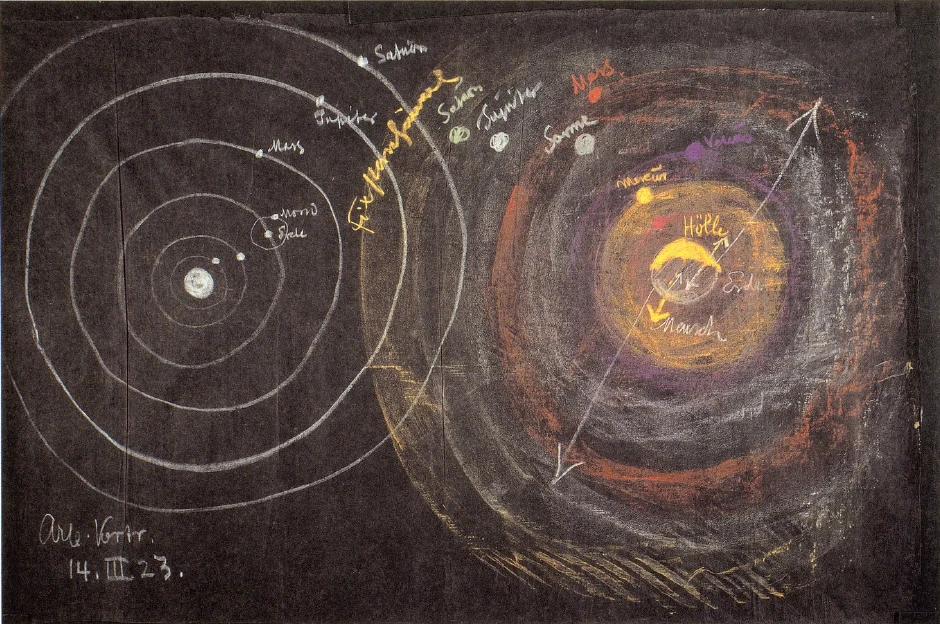
[ 7 ] He went on to explain: The Earth is not only surrounded by lunar forces, but it is also surrounded by other forces—which I will draw here in yellow—and these permeate everything. So the lunar forces are contained within it, embedded there, so that the Earth and the Moon are in turn contained within this yellow area. And within that there is a solid body. This solid body is Mercury, and it orbits there. And if human beings were not constantly permeated by these Mercury forces, they would be unable to digest food. So Dante had this mental image: The lunar forces bring about reproduction; the Mercury forces—in which we, too, are always immersed, though they are finer than the lunar forces—enable us to digest food, and enable animals to digest food as well. Otherwise, he had a mental image of our bodies being nothing more than chemical laboratories. The fact that what happens inside our bodies is different from what happens in a chemical laboratory—where substances are merely mixed and then separated again—is brought about by the forces of Mercury. Thus, Mercury is larger than the Earth and larger than the Moon.
[ 8 ] And now all of this is, in turn, contained within an even larger sphere, as Dante called it. So we, too, are immersed in the forces that come from this planet, from Venus. We are immersed in all these forces that permeate us. We are therefore also permeated by the forces of Venus. And the fact that we are permeated by the forces of Venus means that we are not only able to digest, but also to absorb what we have digested into our blood. The forces of Venus live in our blood. Everything connected with our blood comes from the forces of Venus. That is how Dante imagined it. And these forces of Venus also bring about, for example, what humans experience in their blood as feelings of love; hence “Venus.”
[ 9 ] The next sphere is the one in which we are once again contained, and within it the Sun moves as a solid body. We are thus everywhere within the Sun. For Dante in the year 1300, the Sun is not merely the body that rises and sets, but the Sun is everywhere. When I stand here, I am inside the Sun. For what rises and sets, what circles around, is only a part of the Sun. That is his mental image. And it is primarily the forces of the Sun that are at work in the human heart.
[ 10 ] So you see: the Moon, human and animal reproduction; Mercury: human digestion; Venus: human blood formation; the Sun: the human heart.
[ 11 ] Now Dante has introduced himself: All of this, in turn, is contained within the enormous sphere of Mars. There is Mars. And this Mars, inside which we are, in turn, located—it is connected, just as the Sun is connected to the human heart, to everything that concerns our breathing and, in particular, our speech, to everything that constitutes the respiratory organs. That is within Mars. So Mars: respiratory organs. And then it continues. The next sphere is the sphere of Jupiter. We are, in turn, contained within the forces of Jupiter. Now, Jupiter is, of course, very important; it is connected to everything that constitutes our brain—actually, our sense organs, our brain together with the sense organs. Jupiter, then, is connected to the sense organs. And now comes the outermost planet, Saturn. All of that is contained within it as well. And Saturn is connected to our organ of thought.
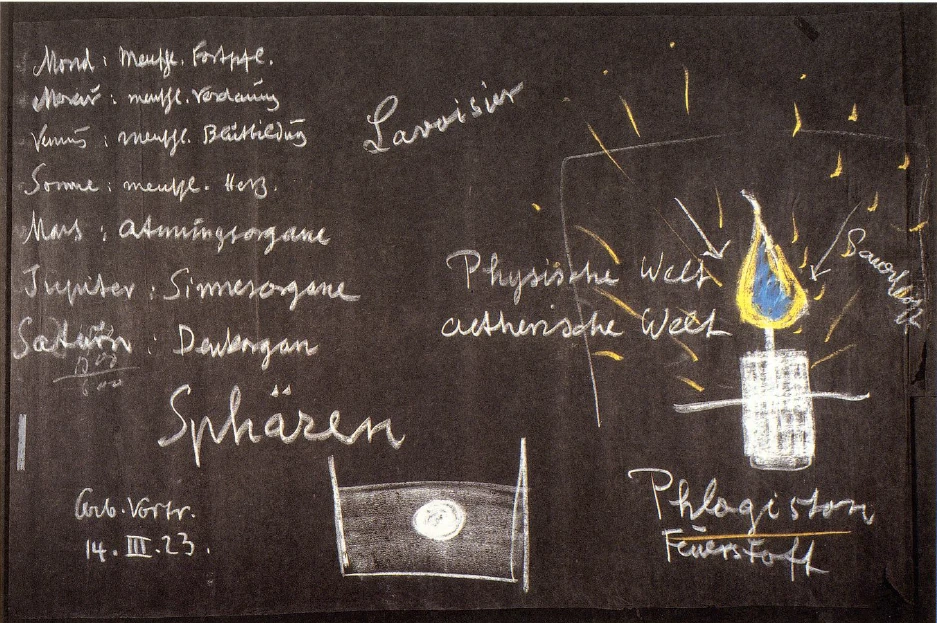
[ 12 ] Moon: Human Reproduction
Mercury: Human Digestion
Venus: Human Blood Formation
Sun: Human Heart
Mars: Respiratory organs
Jupiter: Sensory organs
Saturn: Cognitive organs
[ 13 ] So you see, this Dante, who lived only six hundred years ago, had a different mental image of the entire structure of the world. For example, he had a mental image of Saturn as the largest planet—admittedly made of fine matter, but still the largest planet, inside which we are situated. And these Saturn forces are what drive our thinking faculties; they are what enable us to think.
[ 14 ] Beyond all of this—yet in such a way that we are also within it—lies the fixed-star sky. There, then, are the fixed stars, namely the fixed stars of the zodiac (illustration on page 73). And even greater than that is that which moves everything—the Prime Mover. But He is not merely up there; He is also here, everywhere, as the Prime Mover. And beyond Him is eternal peace, which, in turn, is everywhere. This is how Dante imagined it.
[ 15 ] Well, people today might say: “That’s just the way it is—back then, people didn’t fully understand all of this; but today we’ve finally reached the point where we know how things really are.” — Certainly, one could say that, on the one hand. But Dante wasn’t exactly stupid either, and what others see today, he had already seen as well. So he wasn’t exactly stupid. And the others from whom he drew this—who all believed it back then—weren’t all foolish people either; they simply had different mental images. And now the question is: Yes, how is it that, in the course of world history, people used to think differently about the entire structure of the world, and then suddenly, in the 16th century, turned everything upside down and developed a completely different mental image of the world?
[ 16 ] That is, of course, a very important question, gentlemen. And one cannot simply dismiss it by saying, “Well, those earlier mental images were just childish”; rather, those people saw something entirely different from what people today see. We must be clear about this: they saw something entirely different. People today are so incredibly good at thinking. Yes, those ancient people could not think as well as people today do. Thinking has actually only just emerged. Ancient people always had a profound fear of Saturn, which is associated with the organ of thought. Saturn, they thought, corrupts human beings. Thinking too much—that’s not good. Saturn has always been regarded as a dark planet. And the forces emanating from Saturn—they believed that if these were too strong in a person, he would become completely melancholic. He thinks constantly and becomes melancholic. So these people didn’t particularly like the forces of Saturn, and they represented them much more in mental images. They did less calculating. Today, of course, we calculate everything. This entire worldview here from Copernicus is, after all, calculated. But those ancient people didn’t do calculations. Yet those ancient people knew something else that modern people do not know. They knew that everywhere in the world, wherever we look, there are many forces at work. But the forces that are within a person—they are not found in what the eye can see, but rather within the invisible.
[ 17 ] And so Dante said to himself: There is a visible world, and there is an invisible world. The visible world—well, that is the one we see. When we look out at night, we see the stars, the moon, Venus, and so on. That is the visible world. But the invisible world is also there. And the invisible world consists of these—they were called “spheres” back then. The invisible world is these spheres. And a distinction was made between the world that can be seen with the eyes, which was called the physical world. That was the physical world. And then there was the world that cannot be seen with the eyes. That is the world Dante referred to, and it was called the ethereal world. So, the ethereal world—the world that consists of a substance so fine that one can constantly see right through it.
[ 18 ] Yes, gentlemen, I don’t know if you’ve ever felt this way, but I’ve met people who claimed that air doesn’t exist because you can’t see it. They said: “Well, when I walk from here to there, there’s nothing there; I’m not walking through anything.” — You know there’s air where I’m walking through. But, as I said, I’ve met people who weren’t as well-educated as people are today, and they didn’t believe there was air; they said: “There’s nothing there.” — Dante, on the other hand, knew that it’s not just air, but the Moon, Venus, and so on. It’s exactly the same thing. You say: “I’m walking through the air.” Dante said: “I’m walking through the Moon, I’m walking through Venus, I’m walking through Mars.” — That’s the whole difference. And everything that cannot be seen in the ordinary way, and that cannot be perceived even with ordinary physical and chemical instruments—that was called the ethereal world. So Dante was describing a completely different world—an ethereal world. And what, then, is the reason that six centuries ago Dante saw the world differently? It is because he described something else—he described the invisible, the ethereal world. And Copernicus said nothing other than: “Oh, let’s not concern ourselves with the ethereal world; let’s describe the physical world.” That is where progress lies. — So one must not form a mental image of Dante as a “fool”; rather, he simply described the ethereal world and not the physical one. The physical world was not particularly important to him. He described the ethereal world.
[ 19 ] Well, you see, this situation didn’t really change significantly until the end of the 18th century. Until the end of the 18th century, people still knew something about this ethereal world. In the 19th century, they knew nothing more about it. We are returning to this understanding through anthroposophy. In the 19th century, people knew nothing about this ethereal world.
[ 20 ] Regarding the other question:
[ 21 ] If we go back to the 18th century, for example, this is what people did. They would say: Here we have a candle; there’s the wick; there the candle is burning. Now, as you know, when the candle is burning, it’s bluish in the middle and yellowish at the edges. You can understand this clearly based on what we’ve said about colors. Namely, it’s dark in the center, and it’s bright here (on the outer edge). And the result of this is that you see the darkness through the light. And as I told you recently, when you see the darkness through the light, it appears blue.
[ 22 ] That is why the inside of a burning candle appears blue—because there, one sees darkness through the light. I just wanted to draw your attention to this so that you can see: the ideas about color and the perceptions of color that I told you about last time can be applied to everything. 77
[ 23 ] But you know, when the candle burns, it gets smaller and smaller. The flame is at the top, and whatever melts here (on the candle) is absorbed into the flame. Eventually, the candle is no more. What was in the candle has dispersed into the air.
[ 24 ] Now imagine such a person, say, in the year 1750—not even two hundred years ago—who said: “Yes, when the candle burns and all of it turns to air, then something from the candle goes out into open space. In the end, after all, there is nothing left.” So the entire candle must go out into open space. He went on to say: It consists of a very fine substance, a combustible substance. This fine combustible substance combines with the flame and goes out in all directions. So the man in the year 1750 still said: In there, inside this wax, there is a substance that is merely packed together, made dense. When the flame breaks it down, it escapes into open space. This substance was called phlogiston back then. So something leaves the candle. The substance of fire—the phlogiston—leaves the candle.
[ 25 ] Then, at the end of the 18th century, someone else came along. He said: “No, I don’t really believe that story about there being a phlogiston that goes out into the world.” “I don’t believe that!” — What did he do? He did the following. He also burned the whole thing, but he burned it in such a way that he collected everything that was produced. He burned it in a sealed chamber so that he could collect everything that might be produced. And then he weighed it. And then he found that it didn’t get any lighter. So first he weighed the entire candle, and then he weighed the small piece that was left after the candle had burned down to that point (this is illustrated); and whatever was produced during the burning, he collected it, weighed it, and found that it was actually slightly heavier than before. So, he said, when something burns, what is formed does not become lighter—it becomes heavier.
[ 26 ] And the person who did that was Lavoisier. So what led him to adopt a completely different view? Well, it was because he first used a balance to weigh everything. And then he said: If this is heavier, it doesn’t mean something has gone missing—it doesn’t mean the phlogiston has gone missing—but rather, something must have been added. That is oxygen, he said. So previously, people had a mental image of phlogiston flying away, and afterward, they had a mental image of what happens when something burns: oxygen actually enters, and combustion is not the dissipation of phlogiston, but rather the attraction of oxygen. This came about because Lavoisier weighed the substances first. In the past, people did not weigh them.
[ 27 ] You see, gentlemen, here you can—I would say—touch with your own hands what actually happened. By the end of the 18th century, people no longer believed in anything that could not be weighed. Of course, phlogiston cannot be weighed. The phlogiston is already disappearing. Oxygen is also coming into play. But oxygen, when it combines, can also be weighed. Phlogiston, on the other hand, cannot be captured. Why? Well, everything that Copernicus observed on Mars and Jupiter is what is heavy when you weigh it. What Copernicus calls Mars is that which, if placed on a large scale, would weigh something. Likewise, what he calls Jupiter. He merely observed the heavy bodies.
[ 28 ] Dante did not merely observe heavy bodies, but rather that which is the very opposite of heaviness—that which constantly strives to escape into outer space. And phlogiston is simply part of what Dante observed, while oxygen is part of what Copernicus observed. Phlogiston is the invisible substance that disperses—the ether. Oxygen is a substance that can be weighed.
[ 29 ] So you see how materialism came into being. This is something that could become extremely important to you. Materialism arose because people began to believe only in what they could weigh. But what Dante still saw simply cannot be weighed. When you walk around here on Earth, you can also be weighed. You are heavy, and if one were to call only that which is heavy a human being, then one would have only the earthly human. But just imagine: this earthly human becomes a corpse. Everything heavy, everything that can be measured on a scale, becomes a corpse. Then the corpse lies there. You can still live on in that which is not heavy, in that which surrounds the Earth, and in that which materialism denies—that which Dante still speaks of, and which we must speak of again, acknowledging that it exists. So that we can say: When a human being sheds their outer, heavy body—the one that can be weighed—they initially remain in the etheric body.
[ 30 ] Now I want to tell you what is actually contained in this etheric body. You see, if there is a chair here, I can see this chair. I have an image of this chair within me. Yet when I turn around, I don’t see it. But I still have an image of it inside me—indeed, still an image. This image is the image of memory.
[ 31 ] Now think about your memories. Imagine you experienced something quite a long time ago. For example, let’s say you were somewhere, saw people dancing in a market square, and so on. I could also mention something else. You’ve kept that image. It’s no longer there, gentlemen—what you have as an image—namely, it’s no longer among the things that can be weighed, that are heavy; it’s nowhere to be found anymore. It can only be created within you. You can walk around today and, if you have a vivid imagination, quite easily create a mental image of how it all was—right down to the colors of those who were jumping around there. You have the whole image before you. But you won’t for a moment think that what you saw back then can be weighed. You can place this here on a scale. Individual people have weight. But what you carry within you today as memories—you cannot place that on a scale. It does not exist in that form. It has remained, even though the thing itself is no longer physically present. How, then, does this memory reside within you? It resides within you in an etheric form. No longer physically, but etherically, it resides within you.
[ 32 ] Now imagine you are swimming, and by some misfortune you are close to drowning; but you are rescued. Such people—those who were close to drowning and who were rescued—usually describe a very interesting memory. You can experience this same vivid memory not only when you are on the verge of drowning, but also when you are training in Spiritual Science and anthroposophy. For those who were close to drowning have an overview of their entire earthly life, all the way back to childhood. It all comes flooding back. Suddenly, a vivid memory is there. Why? Well, gentlemen, because the physical body, which is now in the water, is going through something very special. And here you must recall something I once told you. I told you: When there is water here and a body in it, the body becomes lighter in the water. It loses as much of its weight as the water weighs—the watery body being exactly as large as the body itself.
[ 33 ] It’s a wonderful story about how this was discovered. Even in ancient Greece, people had already discovered that every object becomes lighter in water. Archimedes thought a great deal about such things. And one day, Archimedes was taking a bath. People were utterly astonished—yes, in Greece people bathed in such a way that others could see them; incidentally, this took place in Sicily, which at that time belonged to Greece—people were utterly astonished when Archimedes suddenly jumped out of the bath and shouted: “Eureka! Eureka! Eureka!” That means: “I’ve found it!”—People thought: “What on earth did he find in the bath?” He had, in fact, submerged himself up to his head in the bath, had one leg sticking out of the water, and that’s when he discovered: When he takes one leg out of the water, it becomes heavier; when he puts it back in, it becomes lighter again. That’s when he discovered for the first time in the bath that every object becomes lighter when it is in water. This is what’s known as Archimedes’ principle. So every object is lighter when it’s in water. So even when someone drowns, their physical body becomes lighter—very light. Now, whatever remains in their etheric body can still hold on, and that’s when all their memories come flooding back. And you see, the memories surface for this very reason: because they are no longer so heavy. Now, when a person dies and has completely left their physical body—their physical form—they are completely light. Then they live entirely in the etheric sphere. And there, after death, a person always has a complete recollection of everything they experienced on Earth, all the way back to childhood. That is the first experience one has after death: a complete recollection.
[ 34 ] This memory can be verified. Namely, it can be verified by training oneself in the manner I described in my book, *How Does One Gain Insight into the Higher Worlds?*. Then one can always retain this memory. Then one knows that the soul becomes independent of the body. There, it first regains this memory, for it does not initially dwell in the physical substance that can be cast off, but rather—on the contrary—seeks to go out into the whole world. This is the first state after death. There, one remembers. I would like to describe the second state to you next time. But now I want to describe something that will prepare us. For the question that has been asked is an extremely serious one.
[ 35 ] If one imagines that Dante’s mental image of the world seems childish to people today, then what he goes on to imagine is all the more childish to people today. For when a person stands there on Earth (as depicted) for Dante, Dante imagines: Here inside the Earth, on the other side—that is, if you were to go through it—you would find inside the Earth the mental image he has of Hell. So he thinks to himself: Out there, there is celestial ether everywhere. But if I were to drill into the Earth, on the other side there would be Hell. Before I emerge from the Earth, there is Hell.
[ 36 ] Well, it’s terribly easy for people today to dismiss this as childish. All one has to say is: Yes, but Dante didn’t need to be standing there—he should have been here instead; then he could have dug his way in, and then (on the other side) there would have been Hell!—Of course, people today can say that, because they know that there are people living on the other side, too. So it’s very easy for them to say: “Yes, Dante was just stupid; he simply couldn’t grasp that there are people on all sides of the Earth, and that Hell might just as well be here as there.” For the one standing there now faces Heaven from that side, and for him, Hell would then be on the other side.
[ 37 ] You see, gentlemen, this is how it is. As far as the physical world is concerned, it can only be this way: If heaven were there, then hell could only be here; as far as the physical world is concerned, it could only be this way. If a chair is standing somewhere, then it can only stand there. There is no second place where it could be.
[ 38 ] But that is not how Dante imagined it. He did not have a mental image of the physical world at all; rather, he imagined forces. And he said: Yes, when a person stands there and moves upward with his own etheric body, he becomes lighter and lighter. Then he overcomes gravity more and more. But when he goes into the earth, he has to exert himself more and more, and this effort becomes greatest when he has reached the other end. There, everything presses down on him. There, the heaviness becomes greatest of all. This does not depend on there being some special kind of hell there, but rather on the fact that he has had to go through all that just to get there. (Drawing on page 73.)
[ 39 ] And if that is Dante's mental image of it, then he could very well be standing there (at the other end). As he moves outward from there, he becomes lighter and lighter, entering deeper and deeper into the ether. But as he moves inward toward the earth, he must go through that process (of becoming heavier). Then the state, the experience, begins for him where I’ve marked it in green; but earlier, where I’ve marked it in yellow. So that is what matters. Dante does not say that this particular place is Hell, but rather Dante means to say: When someone has to work their way through the Earth with their etheric body, it is so difficult that, wherever they end up—whether above or below—they experience something that is hellish. It is only in recent times that people have come to have a mental image of Hell as a specific place. Dante was thinking of the experience one has when, as an etheric being, one must work one’s way through the earth.
[ 40 ] If someone says, “Dante was stupid”—it reflects badly on that person, because he is so stupid as to claim that Dante had a mental image of Hell being at the other end of the earth. But Dante had this mental image: Wherever I fly across the earth and beyond into heaven, my spirit grows lighter; wherever I descend into the earth, no matter which end I reach—it is hellish.
[ 41 ] So the whole mental image changed. And only then, when you can show a little consideration for the completely different way people have imagined this, will you be able to understand what I will answer for you next time: What remains of the earthly human being once he has passed through the gate of death?
[ 42 ] If it was a little more difficult today than usual, please keep in mind that this is due to the nature of the topic. I hope things have become a little clearer. On Saturday, we’ll continue and consider what happens to a person when they pass through death, and what becomes of them thereafter.