

Man's Life on Earth and
the Essence of Christianity, tr. SOL
GA 349
3 March 1923, Dornach
Translated by Steiner Online Library
Third Lecture
[ 1 ] Good morning! Well, gentlemen, of course I haven't quite finished answering the last question about colors. Let's explore it a little further—or bring it to a conclusion.
[ 2 ] Today, we’ll start by considering what’s most interesting to us: human skin color itself. As you know, people all over the world have different skin colors. Europeans, to whom we belong, are said to be the “white race.” Well, as you know, in Europe a person isn’t actually considered completely healthy if they are as white as cheese; rather, they are healthy when they reveal their natural, fresh complexion—which they generate from within—through that whiteness on the outside.
[ 3 ] Now, however, in addition to this European skin color, we have four other main skin colors. And we want to take a closer look at that today, because one can truly understand the entire course of history and the whole of social life—including social life today—only if one can address the racial characteristics of human beings. And only then can one truly understand everything spiritual in the proper sense, once one has first examined how this spiritual aspect works in human beings precisely through their skin color.
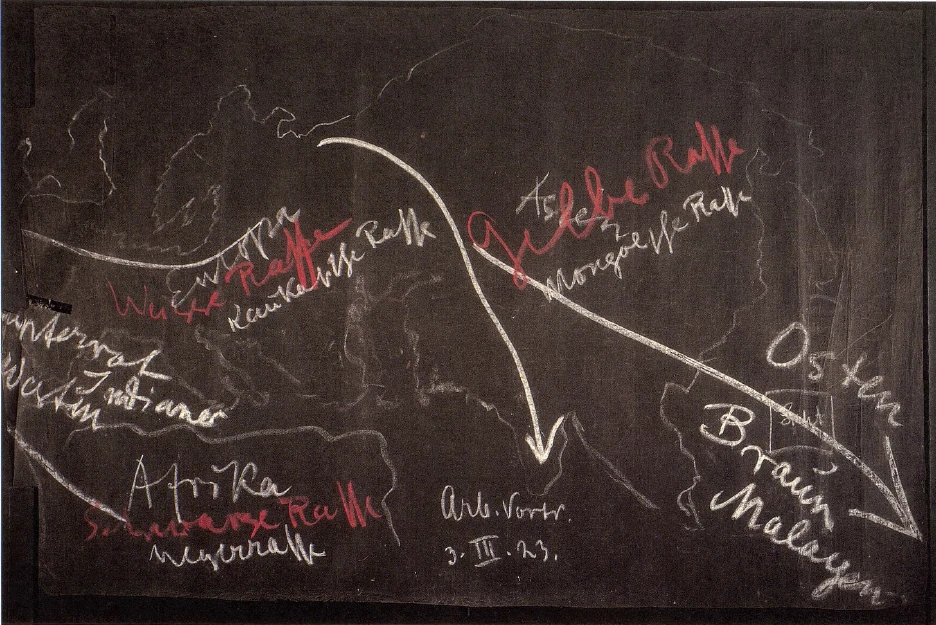
[ 4 ] I would now like to explain the diversity of peoples to you in the following way. Let’s start with Europe, where we ourselves live. So there we have—I can only sketch this out for you very schematically—first, Europe (see drawing), bordering on Europe is Asia; England, Ireland; here, Japan, China, the Indian subcontinent, the Indian subcontinent proper, Arabia; and here we have Africa bordering it. So: Europe, Asia, Africa. Now let’s sketch in the peoples as they are found in the respective regions. We ourselves in Europe call ourselves the white race. If we move over to Asia, we find primarily the yellow race there. And if we move over to Africa, we find the black race. These are also the original races. Everything else that lives in these regions is the result of immigration. So when we ask: Which race belongs to these continents?—we must simply say: Asia is home to the yellow race—the Mongols, the Mongolian race—Europe is home to the white race, or the Caucasian race, and Africa is home to the black race, or the Negro race. The Negro race does not belong to Europe, and it is, of course, sheer nonsense that it now plays such a major role in Europe. These races are, so to speak, native to these three continents.
[ 5 ] Now let’s take a look at the color of these three races. I already told you last time: Color has to do with light. When one looks through the illuminated parts of space at the darkness of space, it appears blue. When one looks at light—at illuminated objects—through the dark air, it appears reddish, as at dawn and dusk.
[ 6 ] Let’s just take a look at the colors of ordinary objects. First, you’ll distinguish, say, black and white. Those are, after all, the most striking colors: black and white. But what about a black object? The thing about a black object is that it absorbs all the light that falls on it and reflects none of it back. So if you have a black object here, it absorbs all the light that falls on it and gives nothing back. That’s why it appears black—because it doesn’t reflect any light. If you have a white object that says: “I don’t need the light; I only want to process what is within myself. I send all the light back.”—That is why it is white. So a white body sends all the light back. We therefore see its surface as bright and white. A black body absorbs all the light—and all the heat along with it—and it reflects back no light and no heat at all; thus, it appears black and dark.
[ 7 ] Look, you can study this in more detail if you consider the following. Suppose there is an object on Earth that absorbs all light. At first, it reflects a little light, so it appears bright. But it takes its time and absorbs as much light as possible. Now it has absorbed as much light as possible. When it can absorb no more, and you place it in the light, it appears black.
[ 8 ] Now imagine a tree. At first, it stands on the Earth’s surface, absorbing some light, but it absorbs a great deal of light and a great deal of heat. Well, this continues until it sinks into the ground. If it remains underground for a while—which means millennia or millions of years—what does it become? Black coal! It turns black because, when it was a tree, it absorbed light and heat. It doesn’t give that up unless we destroy it. If we burn it, then it releases them. But if we simply expose it to the air for a while, it doesn’t release them. It has absorbed so much light and heat that it gives nothing back. We have to destroy it. That is the state of coal.
[ 9 ] Let us assume that the body no longer absorbs light; it now reflects all of it back: then whatever has this property will be white. This is snow in winter. It reflects all light and absorbs neither light nor heat. So it becomes white. You can see from the difference between coal and snow what the relationship between objects on Earth and outer space is actually like.
[ 10 ] Let us apply this to human beings themselves in outer space. Let us first consider Black people in Africa. These Black people in Africa have the peculiarity of absorbing all the light and all the warmth from outer space. They take it in. And this light and heat from outer space cannot pass through the entire body, because a human being is always a human being, even if he is Black. It does not pass through the entire body, but remains on the surface of the skin, and there the skin itself then turns black. Thus, a Black person in Africa is a human being who absorbs as much heat and light as possible from outer space and processes it within himself. Because he does this, the forces of the universe act upon his entire being. (Drawing $56, left.) He absorbs light and warmth everywhere—everywhere. He processes this within himself. There must be something there that helps him with this processing. Well, you see, what helps him with this processing is, specifically, his hindbrain. In the Negro, therefore, the hindbrain is particularly well-developed. It extends through the spinal cord. And it is capable of processing all the light and warmth that is present within the human being. Consequently, in the Negro, everything related to the body and metabolism is particularly vividly developed. He has, as they say, a strong life of instincts. The Negro, then, has a strong instinctual life. And because he actually possesses the sunny qualities—light and warmth—right there on the surface of his body, in his skin, his entire metabolism proceeds as if the sun itself were cooking inside him. This is the source of his instinctual life. Inside the Negro, there is a constant, intense cooking going on, and what fuels this fire is the hindbrain.
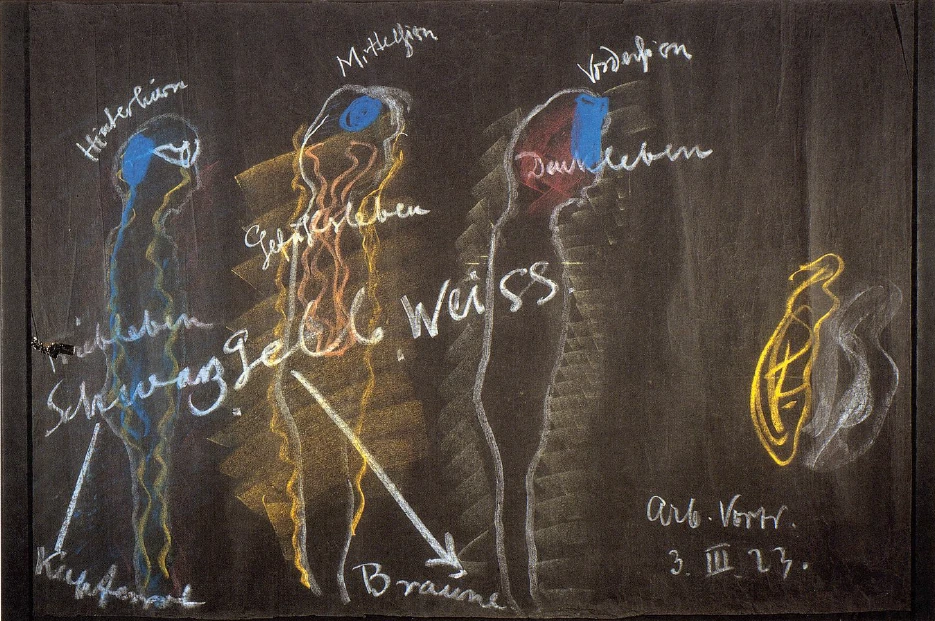
[ 11 ] Sometimes the human constitution still produces such byproducts. You can see this particularly in Black people. Black people not only have this “boiling” within their organism, but they also have a terribly shrewd and alert gaze. They look shrewd and very attentive. You might easily take that as a contradiction. But here’s the thing: When the optic nerve is located up front (see diagram on p. 56), the nerves actually enter the hindbrain, where they cross. So the nerve goes into the hindbrain. And because the Negro has a particularly well-developed hindbrain, that’s why he looks so shrewd, and that’s why he’s such a shrewd observer of the world.
[ 12 ] Once you begin to understand this, everything becomes clear. But contemporary science does not engage in the kind of reflections we are now undertaking once again. It therefore understands nothing of all this.
[ 13 ] Let’s now move from black to yellow. With yellow—which is already related to red—light is reflected to some extent, but much of it is absorbed. So in this case, a person reflects more light than a black person does. The Black person is an egoist who absorbs all the light and all the warmth. The Yellow person, from the Mongolian population, does reflect some light back, but still absorbs a great deal of light. This means that he is actually this kind of person (see drawing, center). So he absorbs a great deal of light but reflects some of it back. He is content with less light. This reduced amount of light cannot, however, sustain his entire metabolism. Consequently, the metabolism must rely on its own strength. This is manifested in the breathing and blood circulation. So in the Yellow race—the Japanese and the Chinese—the light and heat work primarily through the breathing and blood circulation. If you have ever met a Japanese person, you will have noticed how carefully he pays attention to his breathing. When he talks to you, he always holds back a bit to ensure his breathing is just right. He derives a certain sense of well-being from his breathing. So it is the case that less processing takes place deep inside. Everything is processed mainly in the chest. And this means that the Yellow Asian does not develop his hindbrain as strongly, but rather his midbrain. That is where the functions that regulate his breathing and blood circulation are located. So the Yellow Asian does, in fact, live quite inwardly. You can also tell this by his gait; he has a more relaxed way of walking. He does not rely as heavily on his limbs and metabolism. The Negro is much more focused on running and on external movement, which is governed by the instincts. The Asian—the yellow-skinned person—develops more of an inner, dreamlike life, which is why the entire Asian civilization has this dreamlike quality. So he no longer lives merely within himself, but already takes in something from the universe. And that is why Asians have such beautiful poetry about the entire universe. The Negro does not have that. He takes everything into his metabolism and, in fact, merely digests the universe. The Asian breathes it in; it flows through his bloodstream. That is why he can also express it in words. For language, after all, is merely transformed breath. Yes, they are beautiful, truly beautiful poems. They are, in every sense, inward-looking people. Asians today look down on Europeans because they say: “Those are outward-looking people.”—We will see why in a moment. So this, then, is the yellow race, and it is connected to color in the way I have described to you.
[ 14 ] Well, gentlemen, let us consider ourselves here in Europe. We are, in fact, a white race in relation to the universe, for we reflect all external light. We reflect all external light and, essentially, all heat as well. The heat must be quite intense if we are to absorb it. And if it is not there, we wither away, as is evident from the example of the Eskimos. So it is like this: human beings are such that, fundamentally, they reflect all light and all heat—only when it becomes powerful do they absorb it—; they reflect it and develop only that light and heat which arises within them through their own inner work. Yes, gentlemen, it is not breathing or blood circulation that comes to their aid, nor is it the generation of heat; rather, they must work out for themselves—through their brain, through their own head—what constitutes light and warmth. We, too, must therefore work out with our minds what constitutes light and warmth. We actually reflect all external light and warmth. We must give our blood its color ourselves. This then penetrates through the white, and through this we acquire this European skin color. It comes from within, then. That is why we are already like a white body that processes everything internally and reflects back all light and all warmth. We are already such a white body. And while the Mongol primarily uses the midbrain, we Europeans must use the forebrain (see drawing $56, right). But this leads to the following: The one who uses the hindbrain primarily has a life of drives, a life of instinct. The one here who uses the midbrain has a life of feeling, which is centered in the chest. And we Europeans—we poor Europeans—have a life of thought, which is centered in the head. As a result, we do not, in a sense, feel our inner being at all. For we only feel the head when it hurts, when it is sick. Otherwise, we do not feel it. As a result, however, we take in the entire external world and thus easily become materialists. The African will certainly not become a materialist. He remains a human being inwardly. He merely develops his instinctual life inwardly. The Asian will not become a materialist either. He remains rooted in his emotional life. He does not concern himself with external life as much as the European does. Of the European, he says: “Only someone who is preoccupied solely with external life becomes an engineer.” Precisely because he must develop his forebrain, he is primarily oriented toward the external world. And everything is initially connected to that.
[ 15 ] So we are the white race. Internally, our blood is white. Then there is the yellow race, the Mongols, and then there is the black race. And we can understand this quite well if we start with the colors. That explains the whole story.
[ 16 ] But now you just need to think about how this works. Black people live on a part of the earth where the sun bothers them very, very much—it penetrates them. So they surrender to it, absorb it completely into their bodies, become friendly with it, and reject nothing. For Asians, it stems more from the heat of the earth. They don’t give back as much. They don’t become as friendly with the sun. And for Europeans, the situation is such that they would actually receive nothing at all from the sun if they hadn’t developed their own humanity. That is why Europe has always been the starting point for everything that develops the human aspect in such a way that it simultaneously enters into a relationship with the outside world. Very few inventions have been made in Asia. History can then be processed; but inventions themselves—as I said, that which arises from experience with the outside world—the Asians cannot produce.
[ 171+ ] For example, there was once a case involving a screw steamer. The Japanese had copied it from the Europeans, and now they wanted to sail it on their own. Before that, the Europeans had always been in charge and called the shots. Now they wanted to try sailing it on their own. The English engineers stayed behind on the coast. Suddenly, the Japanese out at sea—who were now steering the ship—fell into utter despair, because the entire ship kept spinning around and around. They couldn’t figure out how to combine the rotation with proper forward motion. The Europeans, who knew this, were of course grinning wildly from the shore. So this independent thinking that Europeans develop in dealing with their environment—Asians do not possess it. The Japanese will therefore adapt all European inventions; but coming up with something on their own—that is something the Japanese will not do. It is simply the way of the human race that people all over the earth are actually dependent on one another. They must help one another. This follows naturally from their inherent nature.
[ 18 ] Well, you see, that’s connected to a person’s entire upbringing. Just imagine a black person. He develops his instinctual life in particular—that is, what’s churning inside him. That produces a lot of ash. The ash then settles in the bones. As a result, his bones will be more densely formed than those of a person belonging to the white race. The latter directs what he has inside more toward the blood. Therefore, his bones will be more finely developed. So the Negro has coarsely developed bones, while the European has more finely developed bones. And Asians—the yellow race—stand in the middle.
[ 19 ] Now, when you look at a Japanese person, you can see from the whole way he stands and walks that his bone structure places him right in the middle between Europeans and Africans. Africans have these strong bones that always stand out. Europeans, on the other hand, are more influenced by the circulatory system. The Japanese, in fact, have everything that acts on the breath and, from the breath, into the blood circulation.
[ 20 ] But now, gentlemen, people do not simply remain on Earth. If one were to go back to ancient times, one would find that the yellow race belongs to Asia, the white race to Europe, and the black race to Africa. But it has always been the case that people have migrated. And they can migrate in either direction (illustration on page 53)—the yellow people can migrate eastward, or the black people can migrate westward. That is likely how it once was. The yellow people have always migrated eastward. That is how they came to these islands, which lie between Asia and Australia. The yellow people migrate eastward. When the yellow people migrate eastward, they turn brown. That is how the Malays come into being; they turn brown. Why? Yes, why do they turn brown? What does it mean that they turn brown? Don’t you see, when they are yellow, they reflect a certain amount of light; the rest they absorb. When they turn brown due to the different way they now live under the sun—since they come from a different part of the world—they reflect less light. They absorb more light. So these brown Malays are emigrated Mongols who, because the sun affects them differently, are now getting used to absorbing more light and more heat. But consider that they are not naturally predisposed to this. They have already adapted to having a skeletal structure that allows them to absorb only a certain degree of heat. They are not naturally capable of absorbing as much heat as they now do as Malays. The consequence of this is that they are beginning to become useless human beings—they are beginning to become people whose bodies are crumbling away, whose bodies are dying. This is indeed the case with the Malay population. They are dying from the sun. They are dying from the influence of the East. So one can say: While the Yellow Race, the Mongols, are still human beings in their full vigor, the Malays are already a dying race. They are dying out.
[ 21 ] When Black people—which, admittedly, they are less able to do today, since conditions are different now, but in ancient times it was indeed as I describe it—migrate westward—there has always been sea travel, and besides, there were islands scattered throughout the Atlantic Ocean; after all, the Atlantic Ocean used to be a continent as well— so when Black people migrate westward, they can no longer absorb as much light and heat as they do in Africa. They receive less light and heat there. What is the result? Well, their nature is designed to absorb as much light and heat as possible. Their nature is actually designed to turn black as a result. Now they don’t get as much light and heat as they need to turn black. That’s why they turn copper-red; they become Native Americans. This happens because they’re forced to reflect some of the light and heat. That’s why they have that copper-red sheen. Copper itself is a substance that must reflect a little light and heat. They cannot endure this. That is why they die out as Native Americans in the West; they are, once again, a dying race, perishing because of their own nature, which receives too little light and heat—they perish because of the earthly aspect of their nature. The earthly aspect of their nature is, after all, their instinctual life. They can no longer properly develop this while their bones are still growing strong. Because a great deal of ash enters their bones, these Native Americans can no longer tolerate this ash. The bones become terribly strong—so strong, in fact, that the entire human being perishes because of them.
[ 22 ] You see, this is how things have developed: these five races have emerged. One might say that at the center are the black, yellow, and white races, with the copper-red as a side shoot of the black race, and the brown as a side branch of the yellow race—these are always the dying-out parts.
[ 23 ] It is actually the white people who develop their humanity within themselves. Therefore, they are dependent on themselves. When they emigrate, they adopt some of the characteristics of other regions, but they perish—not as a race, but rather as individual human beings. But they do something else as well. You see, gentlemen, everything I have just described to you—these are, after all, the things that take place within the human body. The soul and the spirit are more or less independent of this. Therefore, because the European is most fully engaged by his soul and spirit, he is best able to process them. He is best able to endure traveling to different parts of the world.
[ 24 ] That is why, starting from up there, a great migration of peoples once made its way all the way down to India. A stream of white people flowed into the region where people turn yellow. That is why the Indians emerged as a mixture of Mongoloid and Caucasian features. Hence the most beautiful Indian literature—the finest there is—but at the same time, something in which one senses that it has already become sluggish, precisely because the white element is not within its proper domain.
[ 25 ] And so one can say: White people can go anywhere; today they can even go over to America. The entire white population in America originated in Europe. So that is how white people came to settle in the American regions. But something happens to a person when he comes over to America from Europe, where he is naturally trained to develop everything internally. There, it is the case that, in a sense, his hindbrain must be engaged to some extent. In Europe, you see, as a European, he has mainly engaged his forebrain. Now, in America, those who were once the Indians—who were, in fact, on the verge of extinction—are actually thriving; that is to say, they are not thriving, they are perishing. When one arrives there, there is actually always a struggle between the forebrain and the hindbrain in the head. It is a peculiar phenomenon that when a family moves to America and settles there, the people who come from that family always develop slightly longer arms. The arms get longer. The legs also grow a bit more when a European settles in America—not in the person himself, of course, but in his descendants. This is because, when a European comes to America, history flows more through the midbrain to the hindbrain.
[ 26 ] But at the same time, something very peculiar happens to Americans. Isn’t it true that Europeans—especially when they become thinkers—live entirely within themselves? Even if they don’t become thinkers, they still reflect, but there is a part of their lives that remains unfulfilled. But as soon as a European settles in America, he can no longer afford to brood like that. This leads to the following: When you read a European book, everything is constantly being proven—you never seem to get out of the cycle of proving things. You read an entire book, four hundred pages, and it’s nothing but proofs; even if it’s a novel, everything is constantly being proven. Most of the time, though, by the end—on the four-hundredth page—nothing has actually been proven. The American doesn’t do that. When you read an American book, everything is presented as an assertion. It goes back, in a sense, to something closer to instinct. An animal doesn’t prove anything at all. The lion doesn’t prove that he wants to eat another animal; he eats it. The European—if he wants to do something, it must first be proven. Everything must first be proven. That is the great difference today between the European and the American: Europeans prove, Americans assert.
[ 27 ] But one cannot say that what they claim might not be just as true. It is simply understood more fully by the whole person. This is where the Americans have an advantage over the Europeans. On the one hand, they are approaching ruin—the Indians are, after all, perishing—but when one begins to perish, one becomes wise. Thus, the Europeans themselves become wise when they come over; they, after all, lose the habit of proving things.
[ 28 ] The desire to prove things isn't exactly a trait that helps move things forward. Isn’t that right? If you have something to do in the morning, you can start proving it in the morning, but by the time you go to bed at night, you still haven’t done it because you still have to prove it. An American won’t do that because he isn’t trained or conditioned to prove things. And that is why, at first, America will certainly have a head start over Germany. One can make some very interesting observations here. If you pick up a European book, it begins something like this—let’s say it’s a book, and such books are indeed written; it’s a report on the digestion of cockchafers—it begins like this: “The order of cockchafers does, of course, possess digestive organs; however, they elude ordinary observation.” One must delve deeper into the entire organization of cockchafers—and so it goes on; one must, in other words, prove everything. The American begins by saying: “If one dissects a cockchafer, one finds this and that within it.” — He makes his claims based on observation. And so, you see, the situation with Europeans is that, due to their entire constitution, they no longer develop their racial characteristics to the same extent. They develop their psychological and spiritual qualities more. That is why they are also able to penetrate all other parts of the world. The process of decline, of course, proceeds slowly.
[ 29 ] The sun always sends down to Earth, to a greater or lesser extent, what constitutes light or heat. As I have told you, the vernal equinox is now in Pisces. Before that, it was in Aries. After some time, it will be in Aquarius. Only then will true American civilization emerge. Until then, civilization will continue to shift more and more toward America. Anyone who wants to see this can already see today how powerful the Americans are becoming, and how Europe is gradually growing weaker and weaker. And the fact that there can be no peace in Europe at all right now is precisely because Europe no longer truly understands its own country. Now the entire civilization is shifting toward America. It will happen slowly; but when the sun has entered the sign of Aquarius at its vernal equinox, it will send its rays down upon the Earth in just the right way, so that American culture and civilization will then be particularly powerful. One can already see this today.
[ 30 ] You see, it really is so strange: Over here in Europe, one can develop what we call anthroposophy. This must be developed from the spirit. It can no longer be derived from racial characteristics. It must be developed from the spirit, and those people in Europe who do not want to draw near to the spirit will plunge Europe into misfortune.
[ 31 ] Americans don’t need that yet—especially those who travel over there. There, they can still rely even more on racial characteristics. And so, curiously enough, something strange is emerging over there in America. Anyone who reads American books very carefully, who reads congressional speeches attentively, who takes in anything at all of what is happening in America today, will say to themselves: Good heavens, that is something quite peculiar. We in Europe develop anthroposophy out of the spirit. Over there, they are developing something that is like a kind of wooden puppet version of anthroposophy. Everything becomes materialistic. But for those who are not fanatics, American culture has something in common with what anthroposophical science is in Europe. It’s just that over there, everything is made of wood. It is not yet alive. We in Europe can bring it to life from the spirit. Over there, they draw it from instinct.
[ 32 ] You see, you can observe this in every detail. The time will come when this American “wooden man”—which, in truth, everyone still is—will begin to speak. Then he will have something very similar to European anthroposophy to say. One could say: We in Europe develop anthroposophy in a spiritual way; Americans develop it in a natural way. That is why, so often when I explain anthroposophical concepts, I can point out: Well, this is how it is in anthroposophy, and this is the American caricature of it. That is the caricature of it.
[ 33 ] But if someone is a fanatic and finds their way into anthroposophy not through inner life but through fanaticism, then they will find precisely the harshest insults directed at Americanism, because—isn’t it true that people rail most against the monkey because the monkey resembles them, yet is a caricature? And so it really is such a curious story, like the difference between the North and South Poles, between what we achieve spiritually in Europe and what is achieved over there in America in a natural way.
[ 34 ] Science books in America look quite different from those in Europe. They actually talk about the spirit constantly, but they conceive of the spirit in a crude, materialistic way. That is why Spiritism has also emerged in America in recent times. For what does Spiritism do? It seeks to speak of the spirit and forms a mental image of the spirit as if it were a cloud formation; it would prefer everything to be like a cloud formation. That is why Spiritism is an American product; it addresses the spirit, but in a materialistic way. It is precisely this that is so interesting: in America, materialism is truly rampant, yet it is actually on the path toward the spirit, whereas when a European becomes a materialist, he dies as a human being. The American is a young materialist. In fact, all children are materialistic at first, then grow out of it into something that is not materialism. Thus, the blatant American materialism will grow into something spiritual. This will happen when the sun rises in the sign of Aquarius.
[ 35 ] Well, you see, this is how we can understand what our task is as Europeans. Our task as Europeans is not to constantly complain about the Americans, but rather—of course—to establish a civilization throughout the world that is composed of the very best.
[ 36 ] Of course, if you look at the matter the way the Prince of Baden did—who fell for the “American European” Wilson—then it doesn’t work. Because Wilson wasn’t a true American. He actually drew all his theories from Europe. That is why he came up with such unproductive theories. But true Americanism—that is what will one day unite with Europeanism, which will find its place in a more spiritual way. And then, when you study such things in this way, you see how one must actually conduct oneself in the world.
[ 37 ] And so it really is quite interesting: On the one hand, there is the black race, which is the most earthly. When it moves westward, it dies out. Then there is the yellow race, which is situated midway between the earth and the universe. When it moves eastward, it turns brown, becomes too closely aligned with the universe, and dies out. The white race is the race of the future; it is the race that creates through the spirit. When it migrated to India, it gave rise to the inner, poetic, literary, and spiritual Indian culture. If it now moves toward the West, it will develop a spirituality that does not so much capture the inner human being, but rather comprehends the outer world in its spirituality.
[ 38 ] And so, in the future, it is precisely from these racial characteristics that certain things will emerge—things one must know in order to adopt the right attitude toward life. People are increasingly losing a proper outlook on life. They simply want everything to come out of the blue; they don’t really want to learn.
[ 39 ] This came about because, in the last third of the 19th century, educated people—particularly those with a scientific education—were essentially no longer offered anything human. Isn’t it true that the study of humanity is so difficult these days? Even the materialist scholars are beginning to realize this. They’re at a dead end. And it was interesting at the last meeting of natural scientists. There was one of these natural scientists who noticed this particularly strongly: we’re no longer making any progress; we learn nothing about human beings through current science. But he didn’t say, “So we must turn to anthroposophy”; instead, he said, “Give us corpses so we can dissect them.”
[ 40 ] You see, that was all he could say: “Give us corpses!” People want more corpses. They want to study dead people. That was such a catchphrase: “Give us corpses!”—while we here can do without corpses, because we want to look at and study living human beings. To do that, one need only open one’s eyes—and through one’s eyes, glimpse the soul a little, for living human beings can be found everywhere. One encounters nothing but living human beings. One just has to be able to live with them so that they truly reveal to you what it means to be human. But the people who are scholars today actually have very weak eyes. They don’t see the human being. And then they plead longingly: “Give us corpses!” Then they can study them. “Give us corpses!” This is the situation educational institutions have been in over the past few decades. People there have taken in nothing human. That is why the human element has been lost from all the sciences.
[ 41 ] That is why I addressed this issue in the first chapter of my *Key Points of the Social Question*. I had to show how those who had nothing to do with science—but rather with labor—had come to this point. And now, of course, they wanted science. But the others—the bourgeoisie, who apparently possessed it—could not provide it to them. And that is what gave rise to the entire calamity in civilization. The workers demanded science, and it was not there, because the only science that existed was one devoid of humanity. I outlined this in the first chapter of *Key Points*, because one really must understand this first when speaking of the social question. Thus, it was necessary for *Key Points of the Social Question* to begin with this in the first chapter.
[ 42 ] Well, we've gone into a bit more detail on colors today, gentlemen.