

Man's Life on Earth and
the Essence of Christianity, tr. SOL
GA 349
21 February 1923, Dornach
Translated by Steiner Online Library
Second Lecture
[ 1 ] To ensure that the last question is answered correctly, I would like to say a few things about colors, as best I can.
[ 2 ] It is actually impossible to understand colors without understanding the human eye, because humans perceive colors exclusively through the eye. They do not know how else they perceive colors, because they do not perceive colors solely through the eye. Imagine, for example, a blind person. A blind person feels differently in a room that is lit than in a room that is dark. But this difference is so subtle that the blind person does not perceive it. It is such a subtle thing; yet it is of great significance to him, even though he does not perceive it. Nor could a blind person, for example, live in a basement all the time; he would miss the light there. And there is a difference between, for example, bringing a blind person into a bright room with yellow windows, and bringing them into a dark room—or, for that matter, into a brighter room with blue windows. This has a completely different effect on life; the color yellow and the color blue have completely different effects on life. But these are things one only learns to understand once one has grasped how the eye relates to color.
[ 3 ] Now, perhaps from what I have explained to you so far, you have seen that there are two things that are of the utmost importance in a human being. In his entire organism, these two things are the most important. The first is blood; for if a human being did not have blood, he would die immediately. They would not be able to renew their life at every moment, and life must be renewed at every moment. So, imagine the blood removed from the body—then a human being is a lifeless object. But even if you imagine the nerves removed, a human being might look exactly the same as they do now, but they would have no consciousness; they would be unable to form mental images, feel, or move. So we must conclude: For a human being to be a conscious being, he needs nerves. For a human being to be able to live at all, he needs blood. Thus, blood is the organ of life; nerves are the organ of consciousness.
[ 4 ] But every organ has nerves and blood. And the human eye is, after all, essentially a whole person in itself—it has nerves and blood—in such a way that, in your mental image of the eye coming out of the head here (drawing), the tiny blood vessels spread out within this eye. Many tiny blood vessels branch out. And then many nerves branch out. So you see, what you have in your hand—nerves and blood flow—you also have in your head.
[ 5 ] Now, here’s how it works with the eye: yes, just imagine—the outside world, which is illuminated, acts upon the eye. You see, it’s easiest to create a mental image of the outside world as being illuminated. However, during the day, the outside world in which you walk around is illuminated. But it is difficult to form a concept of this fully illuminated outside world. You can form a true concept of it when you have a mental image of the half-illuminated outside world in the morning and evening, when you see the morning and evening glow all around you. The morning and evening glow are particularly instructive.
[ 6 ] After all, what is actually happening during the morning and evening twilight? Create a mental image of a sunrise (drawing). The sun is rising. When the sun rises, it cannot yet shine directly at you. I’ll now draw its apparent path as we see it; in reality, the Earth is moving and the sun is standing still, but that doesn’t matter. So the sun first sends its rays this way, and then that way. So if you’re standing there, at dawn you don’t see the sun, but rather the illuminated clouds. There are clouds. The light actually rests on these clouds.
[ 7 ] Well, gentlemen, what exactly is this? It’s very instructive. Because the sun hasn’t quite risen yet, it’s still dark here; it’s still dark all around you, and there, in the distance, are the clouds illuminated by the sun. Can you understand that? So you see, when you stand there, through the darkness that surrounds you, you can see the illuminated clouds over there. You see light through the darkness. So we can say: At dawn—and it’s the same at dusk—you see light through darkness. And light seen through darkness—as you can see in the dawn and the sunset—appears red. Light seen through darkness appears red. So we can say: When you see light through darkness, it appears red. Light seen through darkness is red.
[ 8 ] Now I want to tell you something else. Imagine that dawn has already passed, it’s daytime, and you’re looking out into the open sky—as is the case today, for example. What do you see out there? You see what’s called the blue sky. It isn’t actually there, but you see it all the same. Although it extends to infinity, you see it as if it were draped around the Earth like a blue shell. Why is that?
[ 9 ] Well, you just need to think about what it’s like out there in the vastness of space: it’s dark, you see. The vastness of space is dark. The sun shines only on Earth, and because there is air surrounding the Earth, the sun’s rays are refracted and create light here, especially when they shine through the watery air. But out there in the vastness of space, it is absolutely black—dark. So that when you stand there during the day, you’re looking into the darkness, and you would actually expect to see black. But you don’t see it as black; instead, you see it as blue, because it is illuminated all around by the sun. The air and the water vapor in the air—they are illuminated.
[ 10 ] So you can clearly see darkness through the light. You look through the light, through the illumination, into the darkness. So we can say: darkness through light is blue.
[ 11 ] There you have the two fundamental laws of color theory, which you can easily observe in your surroundings. If you understand the morning and evening glow correctly, you’ll tell yourself: Light seen through darkness or through the gloom is red. When you look up at the black expanse of the sky during the day, you’ll tell yourself: Darkness or gloom seen through light—because everything around you is illuminated—is blue.
[ 12 ] You see, this completely natural view is one that people have always held—until they became “clever.” This view—that light appears red against darkness, and darkness appears blue against light—was held by the ancients over in Asia, back when they were still as “smart” as I described to you the other day. The ancient Greeks still held this view. This view persisted throughout the entire Middle Ages, until people became “smart”—around the 14th, 15th, 16th, and 17th centuries. And once they became “smart,” they stopped relying on what was natural and began devising all sorts of artificial sciences. And one of those who devised a particularly artificial science of colors was the Englishman Newton. Newton, out of his cleverness—you know how I’m using the word “cleverness” now, namely quite seriously—out of this particular cleverness, he said something like this: Let’s look at the rainbow—because, you see, when one becomes clever, one no longer looks at what is natural, what appears every day—the morning and evening glow—but when one becomes clever, one looks at what is particularly rare, that which one should only understand once one has progressed further—but anyway, Newton said: Let’s look at the rainbow. In the rainbow, you see seven colors: red, orange, yellow, green, blue, indigo, and violet. There are seven colors, which you see in that order in the rainbow (a diagram is drawn). When you look at the rainbow, you can easily distinguish these seven colors.
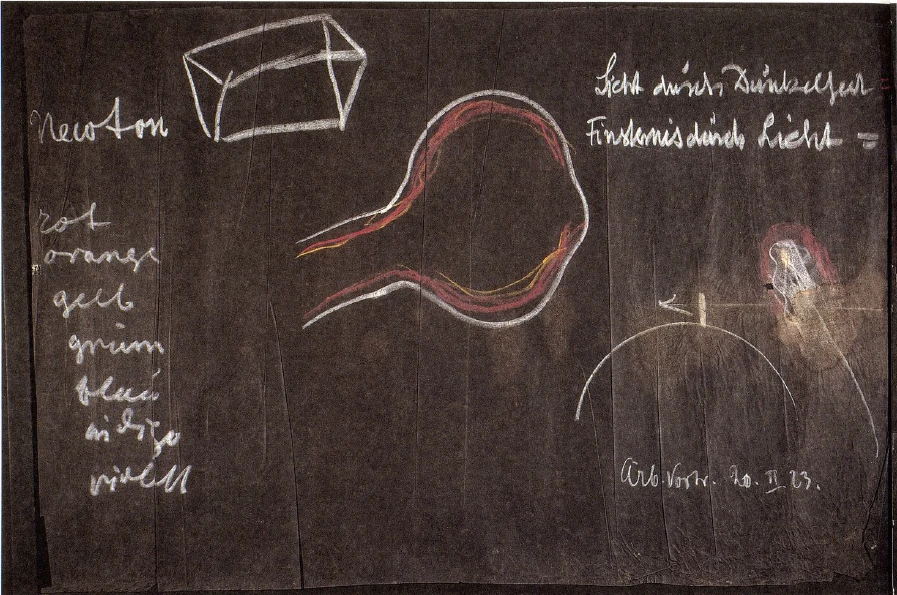
[ 13 ] Newton created an artificial rainbow by darkening his room, covering the window with black paper, and cutting a small hole in the paper. This allowed a very narrow strip of light to enter. He then placed what is called a prism—a piece of glass shaped like a triangle—into that sliver of light, and set up a screen behind it. So there was the window with the hole, that small stream of light, the prism, and the screen behind it. Then the rainbow appeared; then red, orange, yellow, green, blue, indigo, and violet—all these colors—appeared. What did Newton say to himself? Newton said to himself: “White light comes in here; with the prism, I get the seven colors of the rainbow.” So the seven colors of the rainbow are already contained within the white light, and I just need to draw them out. — You see, that’s the simplest explanation. You explain something by saying: It’s already inside the thing from which I’m extracting it.
[ 14 ] In reality, he should have said to himself: By placing not a plain glass plate but a prism—that is, a piece of glass with a surface that tapers to a point [the screen]—opposite it, on one side, when I look at it that way, light is turned red by darkness, so the color red appears; and on the other side, darkness is turned blue by light, so the color blue appears. And what lies in between are simply gradations. That is what he should have told himself.
[ 15 ] But at that time, everything in the world boiled down to explaining things in such a way that one was actually just looking for everything right there within it—the very thing from which one was supposed to explain it. Isn’t that right? That’s the simplest thing of all. If, for example, you’re supposed to explain how a human being comes into being, you say: Well, it’s already inside the mother’s egg; it just develops from there. That’s a neat explanation, in that you tell yourself … (gap in the text.)—As you’ve seen, we’re not so lucky. We have to draw on the entire universe, which then forms the egg from the mother. But natural science aims to put everything in there... (gap in the text.) So Newton said: The sun already contains all the colors; we just need to bring them out.
[ 16 ] But that’s not how it is at all. If the sun is to produce red through the dawn, it must first shine on the clouds, and we must see the red through the darkness. And if the sky is to appear blue, that is not due to the sun at all, for the sun does not shine there—it is black and dark there—and we see the blue through the illuminated air of the Earth. So there we see darkness through light = blue.
[ 17 ] The bottom line is this: we should conduct proper physics experiments where we could then see—as with a prism—light passing through darkness on one side and darkness passing through light on the other. But that’s too inconvenient for people. They prefer it when you say: Everything is already inside the light, and you just have to bring it out. —- Then one might as well say: Once upon a time, there was a giant egg in the world that already contained the entire world, and we just take everything out of it! —- That’s what Newton did with colors. But in reality, one can always see the secret of colors if one understands the dawn and the blue of the sky in the right way.
[ 18 ] Now we simply need to continue considering the whole matter in relation to our eyes, and indeed to human life as a whole. As you all know, there is a creature that is particularly agitated by the color red—where light acts through darkness—and that is the bull. As is well known, the bull is terribly agitated by the color red. You know that, for one thing. And humans, too, have a little something of the bull’s nature in them. They are not directly agitated by the color red, but you will immediately notice that when a person lives constantly in red light, they do become a little agitated. They become a little bull-like. I have even met poets who could not write poetry when they were in their usual physical state; they would always sit in rooms where they placed a red shade over the light fixtures. Afterward, they became agitated and were able to write poetry. Well, the bull becomes wild; in this way, a person can even become poetic when exposed to the color red! It just depends on whether one does this—this stimulation for writing poetry—from the outside or the inside! That is the case on the one hand.
[ 19 ] On the other hand, you will also know that when people who see through such things want to make others—who do not see through them—particularly docile, truly humble, they use the color blue, or the color black—plain black. For example, when Advent arrives in Catholicism—a time when people are supposed to become humble—the church, but especially the vestments, are made blue. People become subdued and humble. One then feels internally attuned to this spirit of humility. Especially when a person has first let loose like a bull—as might have been the case during Carnival, for example—Lent is then allowed to follow, and not just with dark vestments, [but even] black vestments. This is when the person becomes subdued after having let loose. However, in places where there are even two Carnival Sundays, Lent should also be extended to twice its length! I do not know if that happens. But you can see from this that it affects people in very different ways, depending on whether they perceive light through darkness—that is, the red—or whether they perceive darkness through light—that is, the blue.
[ 20 ] Now consider the eye. Inside it, you have nerves and blood. When the eye looks at something red—let’s say, at the dawn or at anything red—what does the eye experience? You see, when the eye looks at something red, those very fine blood vessels in the eye are permeated by the red light. And this red light has the peculiarity that it always damages the blood a little. But it also damages the nerve, because the nerve can only survive if it is supplied with blood. When the eye is confronted with red—when the red enters—the blood in the eye is always damaged to some extent, and the nerve is damaged along with it. When the bull is confronted with red, he simply feels: “Good heavens, all the blood in my head is being destroyed! I have to defend myself against that!”—So he becomes wild because he doesn’t want to let his blood be destroyed.
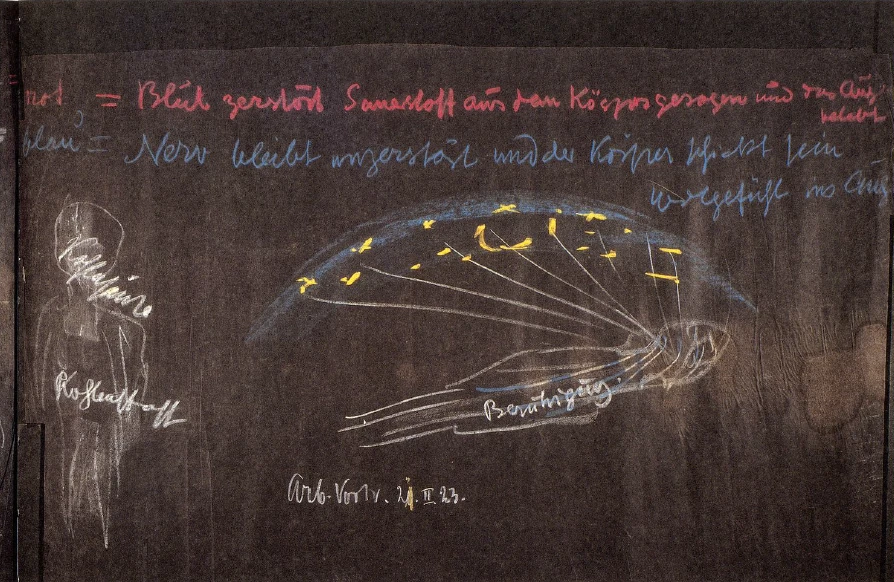
[ 21 ] Well, this is very good—if not exactly in the case of the bull, then certainly in humans and other animals. For when we look at the color red and our blood is slightly damaged, the entire body reacts in such a way that we are better able to direct oxygen into the eye, so that the blood can be restored.
[ 22 ] Consider what a wonderful process is taking place here: When light is perceived through darkness—that is, red—blood is first broken down, oxygen is drawn from the body, and the eye is revitalized by the oxygen. And now we know from the way our own eyes come alive: there is red out there. But in order for us to perceive this red, the blood in the eye must first be partially destroyed, and the nerve must be stimulated. We must send life into the eye—that is, send oxygen into it. And through the eye’s own revival, through this awakening of the eye, we realize: there is red out there.
[ 23 ] Well, you see, the fact that a person perceives the reddish light correctly—that a person is always able to take in the reddish light correctly—is actually the foundation of their health. For the oxygen absorbed by the body in this way then revitalizes the entire body, and the person himself takes on a healthy complexion. He is truly revitalized.
[ 24 ] This is true not only for those whose eyes are healthy and who can see, but also for those whose eyes are not healthy and who cannot see; for the light works through the bright colors; this then invigorates the mind, and this invigoration, in turn, affects the entire organism and gives it a healthy color. So, if we live in the light and are able to absorb it properly, we will acquire a healthy complexion.
[ 25 ] It is therefore very important that a person not be raised in dark rooms, where they might become lifeless and subdued, but rather that they be raised in bright, reddish, or yellowish rooms, where they can truly process the oxygen they have within them through the light. From this, however, you can see that everything related to the color red in human beings is actually connected to the development of the blood. In fact, when we perceive red, the nerve is destroyed.
[ 26 ] Now consider this: we perceive darkness through light—that is, blue. Darkness does not destroy our blood; darkness leaves our blood undamaged. The nerves therefore also remain undamaged, because their blood remains healthy. The result of this is that a person feels quite at ease inwardly. Because the blood and the nerve are not affected by the blue, a person feels quite at ease inwardly. And when it comes to humbling oneself, there is actually something subtle about it. For instance, if, let’s say, up there at the altar the priests are in blue robes or black robes and the people are sitting below, then—as long as they keep looking up at the blue robes—the blood vessels and nerves in their eyes are not destroyed, and naturally they feel incredibly comfortable inside. It’s actually designed with people’s well-being in mind. Just don’t think they don’t know that! After all, they still have the old science. Modern science, after all, only emerged among enlightened people—enlightened people like Newton, for example.
[ 27 ] And so we can say: Blue is what gives a person a sense of inner well-being, where they tell themselves—all of this is unconscious, but inwardly they say to themselves: I can live easily there, in the blue. That is how a person feels inwardly, whereas with red, they feel as if something were invading them. One could say of blue: The nerve remains undisturbed, and the body sends its sense of well-being to the eye and, through it, to the whole body.
[ 28 ] You see, that is the difference between the blue colors and the red colors. And yellow is, after all, just a shade of red, and green is a shade of blue. So one can say: Depending on whether the nervous system or the blood is active in a person, they perceive more red or more blue.
[ 29 ] You see, this can now be applied to pigments. So if I want to try to produce a red—a red paint—properly for painting, I must create a paint that contains the substances that stimulate people to generate oxygen internally. And so, little by little, one comes to realize that one actually obtains red paint for art by examining substances from the external world to determine how much carbon they contain. If I combine carbon with other substances in the right way, I uncover the secret of making my paint red. So when I use plants to produce paints, what matters above all is that I organize my processes—that is, grinding, burning, and so on—in such a way that the carbon is present in the paint in the correct manner. If I have the carbon present in the correct manner, I obtain the light, reddish color. If, on the other hand, I have substances that contain a lot of oxygen—that is, not carbon but oxygen—and if I succeed in incorporating the oxygen as oxygen, then I obtain the darker colors, namely blue.
[ 30 ] When I recognize the life within the plant, I can truly create my colors from it.
[ 31 ] Imagine this: I take a sunflower. It’s completely yellow, so it has a bright color. Yellow is close to red: light seen through darkness. Now, if I treat a sunflower in such a way that I somehow manage to capture the true process at work within the flower and incorporate it into my paint, then I’ll have a good yellow color that external light can’t do much to affect; for the sunflower—the flower itself—has already stolen from the sun the secret of producing yellow. So if I can correctly capture the same process that lies within the sunflower’s bloom in my paint, then—provided I apply it thickly enough—I can apply the yellow properly.
[ 32 ] But if I take another plant, for example chicory, which has blue flowers—that blue flower that grows along the waysides; it grows here, too—if I have this blue plant and want to make paint from the flower, I can’t; I get nothing from it. On the other hand, [I do get something from it] if I treat the root in the proper way; that is where the process lies that actually makes the flower blue.
[ 33 ] When yellow is present in the flower, the process that produces yellow takes place within the flower itself; but when blue is present in the flower, the process originates in the root and simply pushes its way up toward the flower. So, if I want to produce a blue paint, I must use the root of the indigo plant—from which I obtain a darker blue—or the root of the chicory, that blue flower. I must chemically process the root to the point where it yields the blue color.
[ 34 ] And in this way, through genuine study, I can figure out how to extract paint pigments from the plant. I can’t do that using Newton’s approach, which simply says: Well, everything is already in the sunlight; I just have to extract it. At most, you can apply that to your wallet. Everything I spend in a day, I have to have in my wallet in the morning. That’s the way the really smart people see it—like a bag with everything inside. But that’s not the case.
[ 35 ] You have to understand, for example, how the yellow is present in the sunflower or in the dandelion. You have to understand how the blue is present in the chicory. The processes that produce chicory or indigo blue take place in the root, whereas the processes that make the sunflower or dandelion yellow take place in the flower. And so, in a form of chemistry brought to life, I must imitate the plant’s flowering process to obtain the light color. I must imitate the plant’s root process, and that is where I obtain the dark color.
[ 36 ] You see, what I've just told you is, on the one hand, what presents itself to the real human mind, while, strictly speaking, this story about the rainbow—with its red, orange, yellow, green, blue, indigo, and violet—is not reality.
[ 37 ] Now, historically speaking, things played out in such a way that, during Goethe’s lifetime, everyone already believed what Newton had taught: The sun is a big sack, and the so-called seven colors are inside it. You just have to tease them out, and they’ll come to light. Everyone believed that. That’s what was taught, and it’s still taught today.
[ 38 ] Goethe was the kind of person who didn't just believe everything right away, but wanted to convince himself to some extent of the things that are taught everywhere. Otherwise, people say: We don't blindly follow authority. But when it comes down to believing what is taught in the lecture halls, people today are, of course, terribly prone to believing authority and accept everything that is taught. Goethe, however, did not want to believe everything without question, so he borrowed the apparatus used to demonstrate these phenomena—such as a prism and similar devices—from the University of Jena. He thought to himself: “Now I’m going to do what the professors demonstrate and see for myself how it actually works.”
[ 39 ] Goethe didn’t get around to it right away and kept the instruments for quite a while without ever getting to them. He simply had other things to do at the time. And Court Councilor Büttner, who needed the instruments back, grew impatient with the delay and wanted to have them picked up. So Goethe said, “Now I have to get this done quickly!” and yet, just as he was packing them up, he looked through the prism. He thought to himself: The white wall must appear as a beautiful rainbow when I look through it; instead of white, red, yellow, green, and so on must appear. — So he looked through it and was already looking forward to seeing the entire wall in these colorful hues, but he saw nothing: the wall was white as before; the wall was simply white. Naturally, he was utterly surprised. “What’s behind it, then?” he asked himself. And you see, this is where his entire theory of colors originated. He said, “We have to check the whole thing over again.” The ancients said: light seen through darkness = red; darkness seen through light = blue; if I gradually lighten the red, it becomes yellow; if I gradually darken the blue toward red, the blue becomes green on one side and violet on the other. These are gradations. And he has now developed his theory of colors—and indeed, a better one than existed in the Middle Ages.
[ 40 ] And now, today, we have a physicist’s theory of color—with the sack from which the seven colors emerge—which is taught everywhere, and we have Goethe’s theory of color, which correctly understands the blue of the sky and correctly understands the morning and evening glow, just as I have now explained to you myself.
[ 41 ] But there is a certain difference between Newton’s theory of color and Goethe’s theory of color. At first, other people don’t notice this; for other people, on the one hand, look to the physicists. There they are taught Newton’s theory of color, which is found everywhere in the books. One can easily imagine how red, orange, yellow, green, and so on appear in a rainbow. Well, the thing is, it’s not as if there’s a prism there! But people don’t think any further about it… (gap in the text.) The Newtonians already know this, but they won’t admit it to themselves. For when you look through the rain on one side, you see the darkness through the rain illuminated by the sun, and on the other side you see the blue of the rainbow. But then you also see the area in front of you where light shines through the darkness, and you see the red on the other side. So you have to explain everything according to a single principle: light shining through darkness is red, and darkness shining through light is blue.
[ 42 ] But as I said, on the one hand, people see physicists explaining everything to them, and on the other hand, they look at paintings where colors are used. Well, they don’t ask any further questions about the red and yellow and so on; they don’t connect the two things.
[ 43 ] Yes, gentlemen, the painter must bring them together. Anyone who wants to paint must bring them together. He must not only know: “There is a sack, and all the colors are inside it”—for he does not have that sack, anywhere—but he must extract the right elements from living plants or other living materials so that he can mix his colors correctly; he must understand... (Gap in the text.) That is why the situation today is such that painters really do think; there are also painters who don’t think, who simply buy their colors—; but the painters who think about how to obtain these colors and how to use them say: Yes, Goethe’s theory of colors has something to offer. It tells us something. We painters can’t make sense of Newton’s theory of color, the physicists’ theory of color. — So the general public simply can’t reconcile painting with the physical theory of color, but the painter can! And that’s why the painter also loves Goethe’s theory of color. The painter says to himself: Oh dear, as for the physicists, we don’t concern ourselves with them; they say things in their own field. They can do whatever they want. We stick to the old theory of color and Goethe’s theory of color. — It’s just that painters see themselves as artists and don’t really view themselves as needing to intervene in the teachings of physicists. That’s also inconvenient. It leads to conflicts and so on.
[ 44 ] So today, the situation lies somewhere between what the books say about colors and what is actually true. For Goethe, it was simply the defense of truth that drove him to rebel against Newtonian physics and all of modern physics. And one cannot truly understand nature without also coming to Goethe’s theory of colors. And that is why it is only natural that Goethe’s theory of colors is also defended in a Goetheanum. But then, when one does not remain confined to some religious or moral realm, but instead delves into the most minute details of physics, one also has the whole pack of physicists on one’s back.
[ 45 ] So, as you can see, defending the truth is something that is extraordinarily difficult in this day and age. But just take a moment to learn about the complicated way in which today’s physicists explain the blue of the sky! Of course, if I start from a false principle and then try to explain the simple fact that the blackness of outer space appears blue because of the brightness, then I have to turn it into a terribly complicated explanation. And don’t even get me started on dawn and dusk! These chapters usually begin by saying: “Well, we still can’t really explain the blue of the sky today; one could create a mental image of this or that.” — Yes, with all that physicists have—that little hole of theirs, which Goethe made such fun of, through which they let light into the room to study light in contrast to darkness—with all that, one simply cannot explain even the simplest thing. And so it comes to the point where one no longer understands anything about color at all.
[ 46 ] If one understands that the destruction of blood—and thereby, in particular, the revitalization... (gap in the text)—for when I have blood destroyed within me by the light, I draw upon all the oxygen within me, and I revitalize myself; this is how human health comes about. If I am surrounded by darkness or a constant bluish glow, then I will constantly be revitalizing myself; then I revitalize myself too much and become pale precisely because of this revitalization, because I am pumping too much life into myself. And so, on the one hand, one can understand the healthy redness of a person’s complexion as resulting from oxygen uptake when the person is properly exposed to light, and one can understand paleness as resulting from the constant intake of carbon dioxide. Carbon dioxide—the opposite of oxygen—now wants to enter my head. That is what makes me completely pale.
[ 47 ] Today, for example, almost all the children in Germany are pale. But you have to understand that this is caused by too much carbon dioxide. And when a person produces too much carbon dioxide—carbon dioxide consists of a compound of carbon and oxygen—then they use too much of the carbon within them to form carbon dioxide. So in such a pale child, all the carbon within them is constantly being converted into carbon dioxide. That’s what makes them pale. What must I do? I must teach them something that prevents this constant internal production of carbon dioxide, so that the carbon remains in the body. I can do this by giving them some carbonated lime. As a result, as I’ve told you from a completely different perspective, the bodily functions are stimulated once again, and the person retains the carbon they need, rather than constantly converting it into carbon dioxide. And because carbon dioxide consists of carbon and oxygen, the oxygen rises to the head and stimulates the mental processes—the life processes. But when the oxygen is released to the carbon dioxide, the vital functions are suppressed.
[ 48 ] So, for example, if I take a pale person to a place where there is plenty of light, they will be stimulated not to constantly release their carbon to carbon dioxide, because the light draws oxygen up to the head. Then they will regain a healthy complexion. Similarly, I can stimulate this process using carbonated lime by preserving the oxygen, so that the person has oxygen at their disposal.
[ 49 ] Everything must thus interlock. One must be able to understand health and illness from the perspective of color theory. You can only do this through Goethe’s theory of colors, because it is simply rooted in nature in a natural way; never through Newton’s theory of colors, which is simply a figment of the imagination and has no basis in nature at all—it cannot even explain the simplest phenomena, such as the morning and evening glow and the blue sky.
[ 50 ] But now I’d like to tell you something else. Imagine the ancient pastoral peoples who drove their herds out into the fields and then slept outdoors. While they slept, they were not even exposed to the blue sky, but to the dark sky. And up there are the countless, shining stars. So imagine the dark sky, with countless shining stars above it, and the sleeping person down below. From that dark sky comes the process of calming the person, of inner well-being during sleep. The whole person is permeated by the darkness, so that they become calm within. Sleep emanates from the darkness. But then these stars shine down on the person. And wherever a ray of starlight shines, the human being becomes a little stirred within. A ray of oxygen emanates from the body. And these starlight rays are met by rays of oxygen, and the human being becomes completely permeated within by such rays of oxygen. And he becomes, within, an oxygenic reflection of the entire starry sky.
[ 51 ] So the ancient pastoral peoples absorbed the entire starry sky into their tranquil bodies as if they were images—images that the flow of oxygen had etched into them. Then they awoke. And they had dreams of these images. And from this they developed their astronomy. That is how they developed this wonderful astronomy. They did not dream that Aries simply had so many stars; rather, they truly saw the animal Aries, saw Taurus, and so on, and through this they sensed the entire starry sky within themselves as images.
[ 52 ] This is what has been passed down to us from the ancient pastoral peoples as a form of poetic wisdom that sometimes contains an extraordinary amount of insight that can still be instructive today. And one can understand this when one knows: When a person allows a ray of light, every ray of starlight, to be met by a ray of oxygen, they become the heavens themselves—an inner sky of oxygen.
[ 53 ] And a person’s inner life is, after all, a life in the astral body, for during sleep they experience the entire heavens. We would be in a sorry state if we did not descend from these ancient pastoral peoples. For all human beings are descended from ancient pastoral peoples. We still possess, purely by inheritance, an inner starry sky to perceive. We are still developing this, though not as well as the ancients, and in our sleep, when we lie in bed, we still have a kind of recollection of the way the ancient shepherd once lay in the field and breathed in the oxygen. We are no longer shepherds, but we have inherited something, we still possess something—we just cannot express it so beautifully, because it has already faded and dimmed. But all of humanity belongs together. And if one wants to recognize what human beings still carry within them today, one must go back to ancient times. All people on Earth originated everywhere from this pastoral stage and have actually inherited in their bodies whatever could still stem from these pastoral peoples.