

Man's Life on Earth and
the Essence of Christianity
GA 349
21 February 1923, Dornach
Translate the original German text into any language:
Versions Available:
Man's Life on Earth and the Essence of Christianity, tr. SOL
Zweiter Vortrag
Second Lecture
[ 1 ] Damit die letzte Frage noch richtig beantwortet wird, will ich doch, so gut es geht, einiges über die Farben sagen.
[ 1 ] To ensure that the last question is answered correctly, I would like to say a few things about colors, as best I can.
[ 2 ] Die Farben kann man eigentlich nicht verstehen, wenn man nicht das menschliche Auge versteht, denn der Mensch nimmt die Farben ganz und gar nur durch das Auge wahr. Wie er sonst die Farben noch wahrnimmt, das weiß er nicht, denn er nimmt doch nicht allein durch das Auge die Farben wahr. Stellen Sie sich zum Beispiel einen Blinden vor. Ein Blinder fühlt sich anders in einem Raum, der beleuchtet ist, als in einem Raum, der dunkel ist. Aber das ist so schwach, daß es der Blinde nicht wahrnimmt. Es ist eine so schwache Sache; es hat für ihn aber doch eine große Bedeutung, doch er nimmt es nicht wahr. Auch der Blinde könnte zum Beispiel nicht immer im Keller leben; da würde ihm das Licht fehlen. Und es ist ein Unterschied, ob man einen Blinden zum Beispiel in einen hellen Raum, der gelbe Fenster hat, bringt, oder ob man ihn in einen dunklen Raum oder meinetwillen auch in einen helleren Raum bringt, der blaue Fenster hat. Das wirkt ganz anders auf das Leben; die gelbe Farbe und die blaue Farbe, die wirken ganz anders auf das Leben ein. Aber das sind Dinge, die man erst verstehen lernt, wenn man begriffen hat, wie sich das Auge zu der Farbe verhält.
[ 2 ] It is actually impossible to understand colors without understanding the human eye, because humans perceive colors exclusively through the eye. They do not know how else they perceive colors, because they do not perceive colors solely through the eye. Imagine, for example, a blind person. A blind person feels differently in a room that is lit than in a room that is dark. But this difference is so subtle that the blind person does not perceive it. It is such a subtle thing; yet it is of great significance to him, even though he does not perceive it. Nor could a blind person, for example, live in a basement all the time; he would miss the light there. And there is a difference between, for example, bringing a blind person into a bright room with yellow windows, and bringing them into a dark room—or, for that matter, into a brighter room with blue windows. This has a completely different effect on life; the color yellow and the color blue have completely different effects on life. But these are things one only learns to understand once one has grasped how the eye relates to color.
[ 3 ] Nun werden Sie ja vielleicht aus dem, was ich Ihnen bisher dargestellt habe, gesehen haben, daß das Allerwichtigste im Menschen zwei Dinge sind. In seinem ganzen Organismus sind zwei Dinge das Allerwichtigste. Das erste ist das Blut; denn würde der Mensch das Blut nicht haben, so müßte er sofort sterben. Er würde nicht sein Leben in jedem Augenblick erneuern können, und das Leben muß in jedem Augenblick erneuert werden. Also, denken Sie sich das Blut aus dem Körper fort, dann ist der Mensch ein toter Gegenstand. Aber auch wenn Sie sich die Nerven fortdenken, so könnte der Mensch zwar geradeso ausschauen, wie er ausschaut, aber er würde kein Bewußtsein haben; er würde nichts vorstellen können, nichts fühlen können, würde sich nicht bewegen können. Wir müssen uns also sagen: Daß der Mensch ein bewußter Mensch ist, dazu braucht er die Nerven. Daß der Mensch überhaupt leben kann, dazu braucht er das Blut. Also das Blut ist das Organ des Lebens; die Nerven sind das Organ des Bewußtseins.
[ 3 ] Now, perhaps from what I have explained to you so far, you have seen that there are two things that are of the utmost importance in a human being. In his entire organism, these two things are the most important. The first is blood; for if a human being did not have blood, he would die immediately. They would not be able to renew their life at every moment, and life must be renewed at every moment. So, imagine the blood removed from the body—then a human being is a lifeless object. But even if you imagine the nerves removed, a human being might look exactly the same as they do now, but they would have no consciousness; they would be unable to form mental images, feel, or move. So we must conclude: For a human being to be a conscious being, he needs nerves. For a human being to be able to live at all, he needs blood. Thus, blood is the organ of life; nerves are the organ of consciousness.
[ 4 ] Aber jedes Organ hat Nerven und hat Blut. Und das menschliche Auge ist ja eigentlich im Grunde genommen wirklich ein ganzer Mensch und hat Nerven und Blut, und zwar so, daß, wenn Sie sich vorstellen, hier kommt das Auge aus dem Kopfe heraus (Zeichnung), so breiten sich in diesem Auge die Blutäderchen aus. Viele Blutäderchen breiten sich aus. Und dann breiten sich viele Nerven aus. Also Sie sehen, was Sie in der Hand haben, Nerven und Blutströmungen, das haben Sie auch im Haupte.
[ 4 ] But every organ has nerves and blood. And the human eye is, after all, essentially a whole person in itself—it has nerves and blood—in such a way that, in your mental image of the eye coming out of the head here (drawing), the tiny blood vessels spread out within this eye. Many tiny blood vessels branch out. And then many nerves branch out. So you see, what you have in your hand—nerves and blood flow—you also have in your head.
[ 5 ] Nun ist es im Auge so: ja, denken Sie sich einmal, auf das Auge wirkt die Außenwelt, die beleuchtet ist. Sehen Sie, Sie können sich am besten die Außenwelt vorstellen, die beleuchtet ist. Allerdings, am Tage ist die Außenwelt, in der Sie herumgehen, beleuchtet. Aber es ist schwer, von dieser ganz beleuchteten Außenwelt einen Begriff zu bekommen. Einen wahren Begriff bekommen Sie, wenn Sie sich die halbbeleuchtete Außenwelt am Morgen und Abend vorstellen, wo Sie die Morgen- und Abendröte um sich herum sehen. Die Morgen- und Abendröte sind besonders lehrreich.
[ 5 ] Now, here’s how it works with the eye: yes, just imagine—the outside world, which is illuminated, acts upon the eye. You see, it’s easiest to create a mental image of the outside world as being illuminated. However, during the day, the outside world in which you walk around is illuminated. But it is difficult to form a concept of this fully illuminated outside world. You can form a true concept of it when you have a mental image of the half-illuminated outside world in the morning and evening, when you see the morning and evening glow all around you. The morning and evening glow are particularly instructive.
[ 6 ] Denn, was ist bei der Morgen- und Abendröte eigentlich vorhanden? Stellen Sie sich einmal den Sonnenaufgang vor (Zeichnung). Die Sonne kommt herauf. Wenn die Sonne heraufkommt, dann kann sie noch nicht geradehin auf Sie leuchten. Ich zeichne jetzt den scheinbaren Lauf, wie wir es sehen; in Wirklichkeit bewegt sich die Erde, und die Sonne steht still, aber das macht ja nichts. Also die Sonne schickt zuerst ihre Strahlen hierher, und dann hierher. Wenn Sie also da stehen, sehen Sie bei der Morgenröte nicht die Sonne, sondern Sie sehen die beleuchteten Wolken. Da sind Wolken. Auf diesen Wolken sitzt eigentlich das Licht.
[ 6 ] After all, what is actually happening during the morning and evening twilight? Create a mental image of a sunrise (drawing). The sun is rising. When the sun rises, it cannot yet shine directly at you. I’ll now draw its apparent path as we see it; in reality, the Earth is moving and the sun is standing still, but that doesn’t matter. So the sun first sends its rays this way, and then that way. So if you’re standing there, at dawn you don’t see the sun, but rather the illuminated clouds. There are clouds. The light actually rests on these clouds.
[ 7 ] Nun, meine Herren, was ist das eigentlich? Das ist sehr lehrreich. Weil die Sonne noch nicht ganz heroben ist, ist es hier noch dunkel; um Sie herum ist es ja noch dunkel, und da, in der Ferne, sind die von der Sonne beleuchteten Wolken. Kann man das verstehen? Sie sehen also, wenn Sie da stehen, durch die Dunkelheit, die um Sie herum ist, dort die beleuchteten Wolken. Sie sehen Licht durch die Dunkelheit. So daß wir sagen können: Bei der Morgenröte — und bei der Abendröte ist es ja ebenso — sieht man Licht durch Dunkelheit. Und Licht durch Dunkelheit gesehen, das können Sie an der Morgen- und Abendröte sehen, sieht rot aus. Licht durch Dunkelheit gesehen, sieht rot aus. Also wir können sagen: Wenn man Licht durch Dunkelheit sieht, so sieht das rot aus. Licht durch Dunkelheit gesehen ist rot.
[ 7 ] Well, gentlemen, what exactly is this? It’s very instructive. Because the sun hasn’t quite risen yet, it’s still dark here; it’s still dark all around you, and there, in the distance, are the clouds illuminated by the sun. Can you understand that? So you see, when you stand there, through the darkness that surrounds you, you can see the illuminated clouds over there. You see light through the darkness. So we can say: At dawn—and it’s the same at dusk—you see light through darkness. And light seen through darkness—as you can see in the dawn and the sunset—appears red. Light seen through darkness appears red. So we can say: When you see light through darkness, it appears red. Light seen through darkness is red.
[ 8 ] Jetzt will ich Ihnen etwas anderes sagen. Denken Sie sich, Sie haben die Morgenröte bereits vorbei, sind am Tage, sehen zum Beispiel, wie es heute der Fall ist, frei in die Luft. Was sehen Sie da draußen? Sie sehen den sogenannten blauen Himmel. Er ist zwar nicht da, aber Sie sehen ihn doch. Das geht zwar bis in alle Unendlichkeit fort, aber Sie sehen doch, wie wenn er sich wie eine blaue Schale um die Erde herumlegen würde. Warum ist das?
[ 8 ] Now I want to tell you something else. Imagine that dawn has already passed, it’s daytime, and you’re looking out into the open sky—as is the case today, for example. What do you see out there? You see what’s called the blue sky. It isn’t actually there, but you see it all the same. Although it extends to infinity, you see it as if it were draped around the Earth like a blue shell. Why is that?
[ 9 ] Nun, Sie brauchen sich nur zu überlegen, wie es da draußen ist im weiten Weltenraum: es ist nämlich finster. Der weite Weltenraum ist finster. Die Sonne scheint nur auf die Erde, und dadurch, daß um die Erde Luft ist, dadurch verfangen sich die Sonnenstrahlen und machen hier Licht, namentlich wenn sie durch die wässerige Luft scheinen. Aber draußen in dem weiten Weltenraum ist es absolut schwarz, dunkel. So daß, wenn man bei Tag da steht, man ins Dunkel hineinschaut, und man müßte eigentlich schwarz sehen. Aber man sieht es nicht schwarz, sondern blau, weil es ringsherum beleuchtet ist von der Sonne. Die Luft und das Wasser in der Luft, die sind beleuchtet.
[ 9 ] Well, you just need to think about what it’s like out there in the vastness of space: it’s dark, you see. The vastness of space is dark. The sun shines only on Earth, and because there is air surrounding the Earth, the sun’s rays are refracted and create light here, especially when they shine through the watery air. But out there in the vastness of space, it is absolutely black—dark. So that when you stand there during the day, you’re looking into the darkness, and you would actually expect to see black. But you don’t see it as black; instead, you see it as blue, because it is illuminated all around by the sun. The air and the water vapor in the air—they are illuminated.
[ 10 ] Da sehen Sie also ganz klar Finsternis durch das Licht durch. Sie schauen durch das Licht durch, durch die Beleuchtung durch in die Finsternis hinein. Also wir können sagen: Finsternis durch Licht ist blau.
[ 10 ] So you can clearly see darkness through the light. You look through the light, through the illumination, into the darkness. So we can say: darkness through light is blue.
[ 11 ] Da haben Sie die zwei Grundgesetze der Farbenlehre, die Sie einfach an der Umgebung ablesen können. Wenn Sie die Morgen- und Abendröte richtig verstehen, so sagen Sie sich: Licht durch Dunkelheit oder Licht durch Finsternis gesehen, ist rot. Wenn Sie am Tag hineinschauen in den schwarzen Himmelsraum, sagen Sie sich: Dunkelheit oder Finsternis durch Licht gesehen - weil es rings um Sie herum beleuchtet ist —, ist blau.
[ 11 ] There you have the two fundamental laws of color theory, which you can easily observe in your surroundings. If you understand the morning and evening glow correctly, you’ll tell yourself: Light seen through darkness or through the gloom is red. When you look up at the black expanse of the sky during the day, you’ll tell yourself: Darkness or gloom seen through light—because everything around you is illuminated—is blue.
[ 12 ] Sehen Sie, diese ganz natürliche Anschauung, die hat man immer gehabt, bis die Menschen «gescheit» geworden sind. Diese Anschauung, daß Licht durch Dunkelheit rot ist, Dunkelheit durch Licht blau ist, die haben die Alten gehabt, in Asien drüben, als sie noch so gescheit waren, wie ich es Ihnen letzthin einmal beschrieben habe. Diese Anschauung haben noch die alten Griechen gehabt. Diese Anschauung hat man noch durch das ganze Mittelalter hindurch gehabt, bis die Menschen gescheit geworden sind, bis so um das 14., 15., 16., 17. Jahrhundert herum. Und als sie gescheit geworden sind, da haben sie angefangen, nicht mehr auf das Natürliche zu gehen, sondern allerlei künstliche Wissenschaften auszudenken. Und einer derjenigen, der eine besonders künstliche Wissenschaft über die Farben ausgedacht hat, das ist der Engländer Newton. Newton, der hat aus der Gescheitheit heraus — Sie wissen, wie ich jetzt das Wort Gescheitheit gebrauche, nämlich ganz im Ernst -, der hat sich aus der besonderen Gescheitheit heraus etwa so gesagt: Schauen wir den Regenbogen an — denn nicht wahr, wenn man gescheit wird, schaut man nicht dasjenige an, was natürlich ist, was jeden Tag erscheint, Morgen- und Abendröte, sondern wenn man gescheit wird, schaut man das besonders Seltene an, dasjenige, was man erst verstehen sollte, wenn man schon weiter gekommen ist —, aber nun, der Newton sagte also: Schauen wir den Regenbogen an. Im Regenbogen sieht man nun sieben Farben, nämlich Rot, Orange, Gelb, Grün, Blau, Indigo, Violett. Es sind sieben Farben, die sieht man so nacheinander im Regenbogen (es wird gezeichnet). Wenn Sie den Regenbogen anschauen, können Sie diese sieben Farben ganz einfach unterscheiden.
[ 12 ] You see, this completely natural view is one that people have always held—until they became “clever.” This view—that light appears red against darkness, and darkness appears blue against light—was held by the ancients over in Asia, back when they were still as “smart” as I described to you the other day. The ancient Greeks still held this view. This view persisted throughout the entire Middle Ages, until people became “smart”—around the 14th, 15th, 16th, and 17th centuries. And once they became “smart,” they stopped relying on what was natural and began devising all sorts of artificial sciences. And one of those who devised a particularly artificial science of colors was the Englishman Newton. Newton, out of his cleverness—you know how I’m using the word “cleverness” now, namely quite seriously—out of this particular cleverness, he said something like this: Let’s look at the rainbow—because, you see, when one becomes clever, one no longer looks at what is natural, what appears every day—the morning and evening glow—but when one becomes clever, one looks at what is particularly rare, that which one should only understand once one has progressed further—but anyway, Newton said: Let’s look at the rainbow. In the rainbow, you see seven colors: red, orange, yellow, green, blue, indigo, and violet. There are seven colors, which you see in that order in the rainbow (a diagram is drawn). When you look at the rainbow, you can easily distinguish these seven colors.
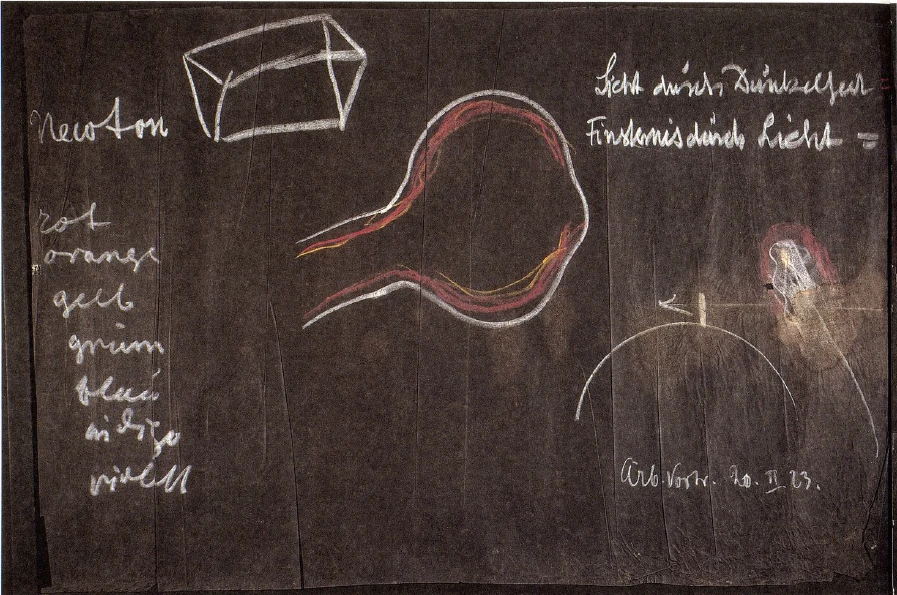
[ 13 ] Nun hat Newton einen künstlichen Regenbogen gemacht, dadurch, daß er sein Zimmer verdunkelt hat, finster gemacht hat, das Fenster zugeschlagen hat mit einem schwarzen Papier und in das Papier ein kleines Loch hinein gemacht hat. Da hatte er einen ganz kleinen Lichtstreifen. Nun tat er in diesen Lichtstreifen das hinein, was man ein Prisma nennt, ein Glas, das so ausschaut, so ein dreieckiges Glas, und hinter dem stellte er einen Schirm auf. So hatte er dort das Fenster mit dem Loch, diese kleine Lichtströmung, das Prisma, und dahinter den Schirm. Da erschien nun auch der Regenbogen; da erschien nun auch Rot, Orange, Gelb, Grün, Blau, Indigo, Violett, alle diese Farben. Was sagte sich nun Newton? Newton sagte sich: Da kommt das weiße Licht herein; mit dem Prisma kriege ich die sieben Farben des Regenbogens. Also sind die sieben Farben des Regenbogens schon in dem weißen Licht drinnen, und ich brauche sie nur herauszulocken. — Sehen Sie, das ist die einfachste Erklärung. Man erklärt etwas dadurch, daß man sagt: Es ist in dem, aus dem ich es heraushole, schon drinnen.
[ 13 ] Newton created an artificial rainbow by darkening his room, covering the window with black paper, and cutting a small hole in the paper. This allowed a very narrow strip of light to enter. He then placed what is called a prism—a piece of glass shaped like a triangle—into that sliver of light, and set up a screen behind it. So there was the window with the hole, that small stream of light, the prism, and the screen behind it. Then the rainbow appeared; then red, orange, yellow, green, blue, indigo, and violet—all these colors—appeared. What did Newton say to himself? Newton said to himself: “White light comes in here; with the prism, I get the seven colors of the rainbow.” So the seven colors of the rainbow are already contained within the white light, and I just need to draw them out. — You see, that’s the simplest explanation. You explain something by saying: It’s already inside the thing from which I’m extracting it.
[ 14 ] In Wirklichkeit hätte er sich sagen müssen: Dadurch, daß ich nicht eine richtige Glasplatte, sondern ein Prisma, also ein Glas mit einer solchen spitz zusammenlaufenden Fläche [dem Schirm] gegenüberstelle, wird auf der einen Seite, wenn ich so hingucke, Licht durch Dunkelheit rot gemacht, da erscheint die rote Farbe, und auf der anderen Seite wird Dunkelheit durch Licht blau gemacht, da erscheint die blaue Farbe. Und was dazwischen ist, sind eben Abstufungen. Das hätte er sich sagen müssen.
[ 14 ] In reality, he should have said to himself: By placing not a plain glass plate but a prism—that is, a piece of glass with a surface that tapers to a point [the screen]—opposite it, on one side, when I look at it that way, light is turned red by darkness, so the color red appears; and on the other side, darkness is turned blue by light, so the color blue appears. And what lies in between are simply gradations. That is what he should have told himself.
[ 15 ] Aber es ging um diese Zeit in der Welt alles darauf hinaus, so zu erklären, daß man eigentlich nur alles da drinnen schon suchte, woraus man es eigentlich erklären sollte. Nicht wahr, das ist ja das Allereinfachste. Wenn man zum Beispiel erklären soll, wie der Mensch entsteht, so sagt man: Nun ja, der ist schon im Ei der Mutter drinnen, da entwickelt er sich nur heraus. Das ist eine feine Erklärung, indem man sich sagt ... (Lücke im Text.) - Wir haben es, wie Sie gesehen haben, nicht so gut. Wir müssen den ganzen Weltenraum zu Hilfe nehmen, der dann das Ei aus der Mutter erst herausbildet. Aber die Naturwissenschaft geht darauf aus, alles da hinein ... (Lücke im Text.) Newton hat also gesagt: Die Sonne enthält schon alle Farben, wir brauchen sie nur herauszuholen.
[ 15 ] But at that time, everything in the world boiled down to explaining things in such a way that one was actually just looking for everything right there within it—the very thing from which one was supposed to explain it. Isn’t that right? That’s the simplest thing of all. If, for example, you’re supposed to explain how a human being comes into being, you say: Well, it’s already inside the mother’s egg; it just develops from there. That’s a neat explanation, in that you tell yourself … (gap in the text.)—As you’ve seen, we’re not so lucky. We have to draw on the entire universe, which then forms the egg from the mother. But natural science aims to put everything in there... (gap in the text.) So Newton said: The sun already contains all the colors; we just need to bring them out.
[ 16 ] Aber so ist es gar nicht. Wenn die Sonne Rot erzeugen soll durch die Morgenröte, muß sie erst auf die Wolken scheinen, und wir müssen durch die Dunkelheit das Rot sehen. Und wenn der Himmelsraum blau erscheinen soll, so ist das gar nicht von der Sonne, denn da scheint die Sonne nicht herein, da ist es schwarz, finster, und das Blau sehen wir durch die erhellte Luft der Erde. Da sehen wir also Finsternis durch Licht = Blau.
[ 16 ] But that’s not how it is at all. If the sun is to produce red through the dawn, it must first shine on the clouds, and we must see the red through the darkness. And if the sky is to appear blue, that is not due to the sun at all, for the sun does not shine there—it is black and dark there—and we see the blue through the illuminated air of the Earth. So there we see darkness through light = blue.
[ 17 ] Worauf es hinauskommt, das ist: man sollte eine ordentliche Physik machen, wo man dann sehen könnte, wie beim Prisma auf der einen Seite Licht durch Dunkelheit, auf der anderen Seite Dunkelheit durch Licht gesehen wird. Das ist aber den Leuten zu unbequem. Sie finden es am besten, wenn man sagt: Alles ist im Licht drinnen, und man holt es nur heraus. —- Dann kann man auch sagen: Einst gab es in der Welt ein riesiges Ei, da war schon die ganze Welt drinnen, und aus dem holen wir alles heraus! —- So hat es Newton mit den Farben gemacht. Aber in Wirklichkeit kann man das Geheimnis der Farben durchaus immer sehen, wenn man in der richtigen Weise die Morgenröte und die Himmelsbläue versteht.
[ 17 ] The bottom line is this: we should conduct proper physics experiments where we could then see—as with a prism—light passing through darkness on one side and darkness passing through light on the other. But that’s too inconvenient for people. They prefer it when you say: Everything is already inside the light, and you just have to bring it out. —- Then one might as well say: Once upon a time, there was a giant egg in the world that already contained the entire world, and we just take everything out of it! —- That’s what Newton did with colors. But in reality, one can always see the secret of colors if one understands the dawn and the blue of the sky in the right way.
[ 18 ] Nun muß man nur weiter die ganze Sache im Verhältnis zu unserem Auge betrachten, und überhaupt zu dem ganzen Menschenleben. Sie wissen ja alle, daß es ein Wesen gibt, das durch das Rot, wo also das Licht durch die Dunkelheit wirkt, besonders aufgeregt wird: das ist der Stier. Der Stier wird bekanntlich durch das Rot furchtbar aufgeregt. Das wissen Sie auf der einen Seite. Und so ein bißchen etwas von der Stiernatur hat ja der Mensch auch. Er wird zwar nicht durch das Rot direkt aufgeregt, aber Sie werden sofort wahrnehmen, daß der Mensch, wenn er immerfort bei rotem Lichte lebt, dann schon auch ein bißchen aufgeregt wird. Er wird ein bißchen stierhaft. Ich habe sogar Dichter kennengelernt, die haben nicht dichten können, wenn sie ihre gewöhnliche Körperverfassung hatten; da haben sie sich immer in Zimmer gesetzt, wo sie über die Beleuchtungskörper solch einen roten Schirm drüber gemacht haben. Nachher sind sie aufgeregt geworden und haben dichten können. Nun, der Stier wird wild; der Mensch kann auf diese Weise sogar dichterisch werden, wenn er sich dem Rot aussetzt! Es kommt nur darauf an, ob man es von außen oder innen tut, dieses Beleben zum Dichten! Das ist auf der einen Seite der Fall.
[ 18 ] Now we simply need to continue considering the whole matter in relation to our eyes, and indeed to human life as a whole. As you all know, there is a creature that is particularly agitated by the color red—where light acts through darkness—and that is the bull. As is well known, the bull is terribly agitated by the color red. You know that, for one thing. And humans, too, have a little something of the bull’s nature in them. They are not directly agitated by the color red, but you will immediately notice that when a person lives constantly in red light, they do become a little agitated. They become a little bull-like. I have even met poets who could not write poetry when they were in their usual physical state; they would always sit in rooms where they placed a red shade over the light fixtures. Afterward, they became agitated and were able to write poetry. Well, the bull becomes wild; in this way, a person can even become poetic when exposed to the color red! It just depends on whether one does this—this stimulation for writing poetry—from the outside or the inside! That is the case on the one hand.
[ 19 ] Auf der anderen Seite werden Sie auch wissen, daß wenn die Menschen, die solche Sachen durchschauen, andere Menschen, die es nicht durchschauen, besonders zahm, so recht demütig machen wollen, die blaue Farbe anwenden, oder die schwarze Farbe, direkt schwarz. So wird zum Beispiel, wenn im Katholizismus der Advent kommt, wo die Menschen demütig werden sollen, die Kirche, aber vor allem die Mefßgewänder blau gemacht. Die Menschen werden zahm, demütig. Der Mensch fühlt sich dann innerlich mit in der demutsvollen Stimmung. Besonders wenn der Mensch sich zuerst ausgetobt hat wie ein Stier, wie zum Beispiel bei der Fastnacht das der Fall sein konnte, dann läßt man darauf die richtige Fastenzeit folgen, und nicht nur dunkle Gewänder, [sondern sogar] schwarze Gewänder. Da wird dann der Mensch über sein Austoben zahm. Nur sollte dort, wo man sogar zwei Fastnachtssonntage hat, auch die Fastenzeit aufs Doppelte ausgedehnt werden! Ich weiß nicht, ob das geschieht. Aber Sie sehen daraus, daß das auf den Menschen in ganz verschiedener Weise wirkt, ob er das Licht durch das Dunkle wahrnimmt, also das Rote, oder ob er Finsternis, Dunkelheit durch das Licht wahrnimmt, also das Blaue.
[ 19 ] On the other hand, you will also know that when people who see through such things want to make others—who do not see through them—particularly docile, truly humble, they use the color blue, or the color black—plain black. For example, when Advent arrives in Catholicism—a time when people are supposed to become humble—the church, but especially the vestments, are made blue. People become subdued and humble. One then feels internally attuned to this spirit of humility. Especially when a person has first let loose like a bull—as might have been the case during Carnival, for example—Lent is then allowed to follow, and not just with dark vestments, [but even] black vestments. This is when the person becomes subdued after having let loose. However, in places where there are even two Carnival Sundays, Lent should also be extended to twice its length! I do not know if that happens. But you can see from this that it affects people in very different ways, depending on whether they perceive light through darkness—that is, the red—or whether they perceive darkness through light—that is, the blue.
[ 20 ] Betrachten Sie nun das Auge. Da drinnen haben Sie Nerven und Blut. Wenn das Auge auf das Rote schaut, also sagen wir, auf die Morgenröte oder überhaupt auf etwas Rotes schaut, was erlebt da das Auge? Sehen Sie, wenn das Auge auf das Rote schaut, dann werden im Auge diese ganz feinen Blutäderchen von dem roten Licht durchzogen. Und dieses rote Licht hat die Eigentümlichkeit, daß es das Blut immer ein bißchen zerstört. Es zerstört aber den Nerv mit, denn der Nerv kann auch nur leben, wenn er vom Blut durchzogen ist. Wenn das Auge dem Rot gegenübersteht, wenn das Rot hereinkommt, dann wird immer das Blut im Auge etwas zerstört, der Nerv mit zerstört. Der Stier empfindet einfach, wenn er dem Rot gegenübersteht: Donnerwetter, da wird mir ja mein ganzes Blut zerstört im Kopf! Da muß ich mich wehren dagegen! - Da wird er wild, weil er sich sein Blut nicht zerstören lassen will.
[ 20 ] Now consider the eye. Inside it, you have nerves and blood. When the eye looks at something red—let’s say, at the dawn or at anything red—what does the eye experience? You see, when the eye looks at something red, those very fine blood vessels in the eye are permeated by the red light. And this red light has the peculiarity that it always damages the blood a little. But it also damages the nerve, because the nerve can only survive if it is supplied with blood. When the eye is confronted with red—when the red enters—the blood in the eye is always damaged to some extent, and the nerve is damaged along with it. When the bull is confronted with red, he simply feels: “Good heavens, all the blood in my head is being destroyed! I have to defend myself against that!”—So he becomes wild because he doesn’t want to let his blood be destroyed.
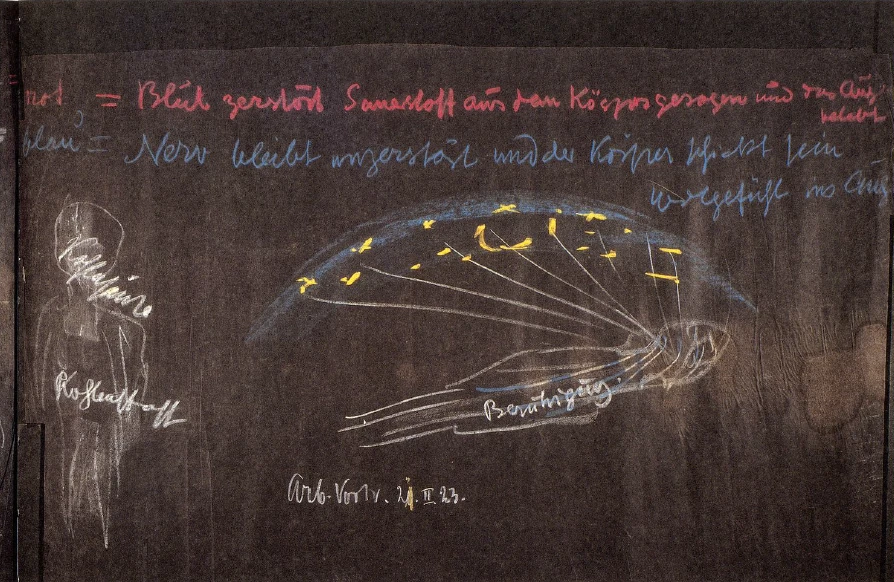
[ 21 ] Nun, dies ist aber sehr gut, wenn nicht gerade beim Stier, aber beim Menschen und bei anderen Tieren. Denn wenn wir nun ins Rote schauen und unser Blut etwas zerstört wird, dann wirkt auf der anderen Seite der ganze Körper so, daß wir wieder besser den Sauerstoff ins Auge hineinleiten, damit das Blut wieder hergestellt werden kann.
[ 21 ] Well, this is very good—if not exactly in the case of the bull, then certainly in humans and other animals. For when we look at the color red and our blood is slightly damaged, the entire body reacts in such a way that we are better able to direct oxygen into the eye, so that the blood can be restored.
[ 22 ] Bedenken Sie, was da für ein wunderbarer Vorgang geschieht: Wenn Licht durch Dunkelheit, also Rot, gesehen wird, so wird zunächst Blut zerstört, Sauerstoff aus dem Körper gesogen und das Auge belebt durch den Sauerstoff. Und jetzt wissen wir an unserem eigenen Lebhaftwerden im Auge: da ist Rot draußen. Aber damit wir dieses Rot wahrnehmen können, muß uns zuerst im Auge ein bißchen das Blut zerstört werden, der Nerv zerstört werden. Wir müssen ins Auge Leben hineinschicken, das heißt Sauerstoff hineinschicken. Und an unserem eigenen Aufleben des Auges, an diesem Aufwachen des Auges merken wir: da draußen ist Rot.
[ 22 ] Consider what a wonderful process is taking place here: When light is perceived through darkness—that is, red—blood is first broken down, oxygen is drawn from the body, and the eye is revitalized by the oxygen. And now we know from the way our own eyes come alive: there is red out there. But in order for us to perceive this red, the blood in the eye must first be partially destroyed, and the nerve must be stimulated. We must send life into the eye—that is, send oxygen into it. And through the eye’s own revival, through this awakening of the eye, we realize: there is red out there.
[ 23 ] Nun, sehen Sie, dadurch, daß der Mensch also richtig das gerötete Licht wahrnimmt, daß der Mensch immer richtig das gerötete Licht aufnehmen kann, darauf beruht ja eigentlich auch seine Gesundheit. Denn der Sauerstoff, der da aus dem Körper aufgenommen wird, der belebt dann den ganzen Körper, und der Mensch selber bekommt eine gesunde Gesichtsfarbe. Er kann richtig sich beleben.
[ 23 ] Well, you see, the fact that a person perceives the reddish light correctly—that a person is always able to take in the reddish light correctly—is actually the foundation of their health. For the oxygen absorbed by the body in this way then revitalizes the entire body, and the person himself takes on a healthy complexion. He is truly revitalized.
[ 24 ] Das ist nicht nur bei dem der Fall, dessen Auge gesund ist und der sieht, sondern das ist auch bei dem der Fall, dessen Auge nicht gesund ist und der nicht sieht; denn das Licht wirkt durch die hellen Farben; dann wird er belebt im Kopfe, und diese Belebung, die wirkt wiederum auf den ganzen Organismus und gibt ihm eine gesunde Farbe. So daß wir, wenn wir im Lichte leben und richtig das Licht aufnehmen können, dann die gesunde Farbe kriegen.
[ 24 ] This is true not only for those whose eyes are healthy and who can see, but also for those whose eyes are not healthy and who cannot see; for the light works through the bright colors; this then invigorates the mind, and this invigoration, in turn, affects the entire organism and gives it a healthy color. So, if we live in the light and are able to absorb it properly, we will acquire a healthy complexion.
[ 25 ] Es ist also schon sehr wichtig, daß der Mensch nicht in finsteren Räumen aufgezogen wird, wo er tot und demütig werden könnte, sondern daß der Mensch in hellen, rötlichen oder gelblichen Räumen aufgezogen wird, wo er den Sauerstoff, den er im Inneren hat, auch wirklich durch das Licht richtig verarbeitet. Daraus sehen Sie aber, daß alles, was mit dem Roten zusammenhängt, beim Menschen eigentlich mit der Entwickelung des Blutes zusammenhängt. Der Nerv wird eigentlich, wenn wir Rot wahrnehmen, zerstört.
[ 25 ] It is therefore very important that a person not be raised in dark rooms, where they might become lifeless and subdued, but rather that they be raised in bright, reddish, or yellowish rooms, where they can truly process the oxygen they have within them through the light. From this, however, you can see that everything related to the color red in human beings is actually connected to the development of the blood. In fact, when we perceive red, the nerve is destroyed.
[ 26 ] Jetzt denken Sie sich, wir sehen Finsternis durch Licht, also Blau. Die Finsternis zerstört uns das Blut nicht; die Finsternis läßt uns das Blut unzerstört. Der Nerv bleibt also auch unzerstört, weil sein Blut in Ordnung bleibt. Die Folge davon ist, daß der Mensch sich innerlich so recht wohl fühlt. Weil das Blut und der Nerv nicht angegriffen werden vom Blau, fühlt sich der Mensch innerlich so recht wohl. Und beim Demütigmachen, da ist eigentlich etwas Raffiniertes dabei. Wenn nämlich, sagen wir, da oben am Altare die Priester in den blauen Gewändern oder in den schwarzen Gewändern sind und unten die Leute sitzen, dann werden ihnen durch die blauen Gewänder, wenn sie immer hingucken, die Blutadern und die Nerven in dem Auge nicht zerstört, und natürlich fühlen sie sich furchtbar wohl darinnen. Es ist eigentlich auf das Wohlbefinden der Leute berechnet. Glauben Sie nur nicht, daß man das nicht weiß! Denn die haben ja noch die alte Wissenschaft. Die neuere Wissenschaft ist ja erst bei den aufgeklärten Menschen entstanden, bei solchen aufgeklärten Menschen wie zum Beispiel Newton.
[ 26 ] Now consider this: we perceive darkness through light—that is, blue. Darkness does not destroy our blood; darkness leaves our blood undamaged. The nerves therefore also remain undamaged, because their blood remains healthy. The result of this is that a person feels quite at ease inwardly. Because the blood and the nerve are not affected by the blue, a person feels quite at ease inwardly. And when it comes to humbling oneself, there is actually something subtle about it. For instance, if, let’s say, up there at the altar the priests are in blue robes or black robes and the people are sitting below, then—as long as they keep looking up at the blue robes—the blood vessels and nerves in their eyes are not destroyed, and naturally they feel incredibly comfortable inside. It’s actually designed with people’s well-being in mind. Just don’t think they don’t know that! After all, they still have the old science. Modern science, after all, only emerged among enlightened people—enlightened people like Newton, for example.
[ 27 ] Und so können wir sagen: Das Blau ist dasjenige, was dem Menschen innerliches Wohlbehagen bereitet, wo er sich sagt — das ist alles unbewußt, aber innerlich sagt er sich: Da kann ich leicht leben, in dem Blau. Da fühlt sich der Mensch innerlich, während er bei dem Roten fühlt, als ob in ihn etwas eindringen würde. Man könnte sagen beim Blau: Der Nerv bleibt unzerstört, und der Körper schickt sein Wohlgefühl ins Auge und dadurch in den ganzen Körper.
[ 27 ] And so we can say: Blue is what gives a person a sense of inner well-being, where they tell themselves—all of this is unconscious, but inwardly they say to themselves: I can live easily there, in the blue. That is how a person feels inwardly, whereas with red, they feel as if something were invading them. One could say of blue: The nerve remains undisturbed, and the body sends its sense of well-being to the eye and, through it, to the whole body.
[ 28 ] Sehen Sie, das ist der Unterschied zwischen den blauen Farben und den roten Farben. Und Gelb ist ja nur eine Abstufung des Roten, und Grün ist eine Abstufung des Blauen. So daß man sagen kann: Je nachdem Nerv oder Blut im Menschen tätig ist, je nachdem empfindet er mehr rot, oder er empfindet mehr blau.
[ 28 ] You see, that is the difference between the blue colors and the red colors. And yellow is, after all, just a shade of red, and green is a shade of blue. So one can say: Depending on whether the nervous system or the blood is active in a person, they perceive more red or more blue.
[ 29 ] Sehen Sie, das kann man nun auf die Farbkörper anwenden. Wenn ich also versuchen will, für die Malerei ein Rot, eine rote Farbe richtig zu erzeugen, so muß ich eine Farbe erzeugen, die diejenigen Stoffe enthält, welche den Menschen anregen, innerlich Sauerstoff zu entwickeln. Und da kommt man nach und nach darauf, daß man eigentlich rote Farbe bekommt für die Malerei, wenn man versucht, die Stoffe der Außenwelt darauf zu prüfen, wieviel Kohlenstoff sie enthalten. Wenn ich den Kohlenstoff in der richtigen Weise mit anderen Substanzen zusammen verwende, bekomme ich das Geheimnis des Rotmachens meiner Malerfarbe heraus. Wenn ich also Pflanzen verwende, um Malerfarben zu bekommen, so kommt es vor allen Dingen darauf an, daß ich meine Vorgänge, also Zerkleinerung, Verbrennung und so weiter, so einrichte, daß ich in der richtigen Weise dann in der Malerfarbe den Kohlenstoff darinnen habe. Wenn ich den Kohlenstoff in der richtigen Weise darinnen habe, so bekomme ich die helle, die rötliche Farbe heraus. Wenn ich dagegen namentlich solche Stoffe habe, die viel Sauerstoff haben - also nicht Kohlenstoff, sondern Sauerstoff -, wenn es mir gelingt, den Sauerstoff als Sauerstoff hineinzukriegen, so bekomme ich die mehr dunklen Farben, also das Blau heraus.
[ 29 ] You see, this can now be applied to pigments. So if I want to try to produce a red—a red paint—properly for painting, I must create a paint that contains the substances that stimulate people to generate oxygen internally. And so, little by little, one comes to realize that one actually obtains red paint for art by examining substances from the external world to determine how much carbon they contain. If I combine carbon with other substances in the right way, I uncover the secret of making my paint red. So when I use plants to produce paints, what matters above all is that I organize my processes—that is, grinding, burning, and so on—in such a way that the carbon is present in the paint in the correct manner. If I have the carbon present in the correct manner, I obtain the light, reddish color. If, on the other hand, I have substances that contain a lot of oxygen—that is, not carbon but oxygen—and if I succeed in incorporating the oxygen as oxygen, then I obtain the darker colors, namely blue.
[ 30 ] Wenn ich das Lebendige in der Pflanze erkenne, so kann ich von dem auch wirklich meine Farben erzeugen.
[ 30 ] When I recognize the life within the plant, I can truly create my colors from it.
[ 31 ] Denken Sie sich, ich nehme eine Sonnenblume. Die ist ganz gelb, hat also eine helle Farbe. Gelb ist nahe dem Roten: Licht durch Dunkelheit gesehen. Wenn ich nun eine Sonnenblume so behandle, daß ich den richtigen Vorgang, der in der Blüte sitzt, noch in meine Malerfarbe irgendwie hereinbekomme, dann habe ich eine gute gelbe Farbe, der das äußere Licht nicht viel anhaben kann; denn die Sonnenblume, die Blüte, die hat schon der Sonne das Geheimnis, Gelb zu erzeugen, gestohlen. Bekomme ich also denselben Vorgang, der in der Blüte der Sonnenblume sitzt, richtig in meine Malerfarbe hinein, so kann ich, wenn ich sie dick genug kriege, das Gelb ordentlich auftragen.
[ 31 ] Imagine this: I take a sunflower. It’s completely yellow, so it has a bright color. Yellow is close to red: light seen through darkness. Now, if I treat a sunflower in such a way that I somehow manage to capture the true process at work within the flower and incorporate it into my paint, then I’ll have a good yellow color that external light can’t do much to affect; for the sunflower—the flower itself—has already stolen from the sun the secret of producing yellow. So if I can correctly capture the same process that lies within the sunflower’s bloom in my paint, then—provided I apply it thickly enough—I can apply the yellow properly.
[ 32 ] Nehme ich aber eine andere Pflanze, zum Beispiel die Zichorie, die blau blüht — diese blaue Blume, die an den Wegrändern wächst; sie wächst ja auch hier —, wenn ich diese blaue Pflanze habe, und ich will aus der Blüte heraus eine Malerfarbe bereiten, so kann ich das nicht; ich bekomme nichts von ihr. Dagegen [bekomme ich etwas von ihr], wenn ich die Wurzel in der richtigen Weise behandle; da sitzt drinnen der Vorgang, der eigentlich die Blüte blau macht.
[ 32 ] But if I take another plant, for example chicory, which has blue flowers—that blue flower that grows along the waysides; it grows here, too—if I have this blue plant and want to make paint from the flower, I can’t; I get nothing from it. On the other hand, [I do get something from it] if I treat the root in the proper way; that is where the process lies that actually makes the flower blue.
[ 33 ] Wenn Gelb in der Blüte ist, so geht in der Blüte selber das vor, was Gelb macht; wenn aber Blau in der Blüte ist, so sitzt der Vorgang in der Wurzel und er drängt sich nur hinauf gegen die Blüte. Da muß ich also aus der Indigopflanze, wo ich ein dunkleres Blau bekomme, oder aus der Zichorie, aus dieser blauen Blume, wenn ich eine blaue Malerfarbe herstellen will, die Wurzel verwenden. Die muß ich chemisch so weit bringen, daß sie mir die blaue Farbe abgibt.
[ 33 ] When yellow is present in the flower, the process that produces yellow takes place within the flower itself; but when blue is present in the flower, the process originates in the root and simply pushes its way up toward the flower. So, if I want to produce a blue paint, I must use the root of the indigo plant—from which I obtain a darker blue—or the root of the chicory, that blue flower. I must chemically process the root to the point where it yields the blue color.
[ 34 ] Und auf diese Weise kann ich durch ein wirkliches Studium darauf kommen, wie ich aus der Pflanze die Malerfarben kriege. Das kann ich auf dem Wege von Newton nicht, der einfach sagt: Nun ja, in dem Sonnenlicht ist alles drinnen, ich muß es nur herausholen. Das kann man höchstens auf die Geldbörse anwenden. Alles, was ich ausgebe für einen Tag, muß ich morgens drinnen haben in der Geldbörse. So stellen es sich die ganz gescheiten Leute vor, wie einen Sack, in dem alles drinnen ist. Das ist aber nicht der Fall.
[ 34 ] And in this way, through genuine study, I can figure out how to extract paint pigments from the plant. I can’t do that using Newton’s approach, which simply says: Well, everything is already in the sunlight; I just have to extract it. At most, you can apply that to your wallet. Everything I spend in a day, I have to have in my wallet in the morning. That’s the way the really smart people see it—like a bag with everything inside. But that’s not the case.
[ 35 ] Man muß wissen, wie zum Beispiel das Gelb in der Sonnenblume drinnen ist oder in dem Löwenzahn. Man muß wissen, wie das Blau in der Zichorie drinnen ist. Die Vorgänge, die Zichorien- oder Indigoblau machen, liegen in der Wurzel; während die Vorgänge, die die Sonnenblume oder den Löwenzahn gelb machen, in der Blüte liegen. Und so muß ich in einer lebendig gewordenen Chemie den Blütenprozeß der Pflanze nachahmen und bekomme die helle Farbe. Ich muß den Wurzelprozeß der Pflanze nachahmen und erhalte da die dunkle Farbe.
[ 35 ] You have to understand, for example, how the yellow is present in the sunflower or in the dandelion. You have to understand how the blue is present in the chicory. The processes that produce chicory or indigo blue take place in the root, whereas the processes that make the sunflower or dandelion yellow take place in the flower. And so, in a form of chemistry brought to life, I must imitate the plant’s flowering process to obtain the light color. I must imitate the plant’s root process, and that is where I obtain the dark color.
[ 36 ] Sehen Sie, das, was ich Ihnen da erzählt habe, ist auf der einen Seite das, was sich dem wirklichen menschlichen Verstand ergibt, während im Grunde genommen diese Geschichte beim Regenbogen mit dem Rot, Orange, Gelb, Grün, Blau, Indigo, Violett keine Wirklichkeit ist.
[ 36 ] You see, what I've just told you is, on the one hand, what presents itself to the real human mind, while, strictly speaking, this story about the rainbow—with its red, orange, yellow, green, blue, indigo, and violet—is not reality.
[ 37 ] Nun hat sich in der Geschichte das so abgespielt, daß, als Goethe lebte, überhaupt schon alle Leute an dasjenige geglaubt haben, was Newton gelehrt hat: Die Sonne ist der große Sack, und da stecken die sogenannten sieben Farben drinnen. Die braucht man nur herauszukitzeln, da kommen sie zum Vorschein. Das haben alle Leute geglaubt. Das ist gelehrt worden, wird ja heute noch gelehrt.
[ 37 ] Now, historically speaking, things played out in such a way that, during Goethe’s lifetime, everyone already believed what Newton had taught: The sun is a big sack, and the so-called seven colors are inside it. You just have to tease them out, and they’ll come to light. Everyone believed that. That’s what was taught, and it’s still taught today.
[ 38 ] Goethe, der war nun so, daß er nicht gleich alles geglaubt hat, sondern er wollte sich so ein bißchen überzeugen von den Dingen, die überall gelehrt werden. Sonst sagen die Menschen: Wir sind nicht autoritätsgläubig. Aber wenn es darauf ankommt, das zu glauben, was an den Lehrstühlen gelehrt wird, dann sind die Leute natürlich heute furchtbar autoritätsgläubig, glauben alles, was gelehrt wird. Goethe hat nun nicht alles ohne weiteres glauben wollen und hat sich deshalb die Apparate, mit denen man das beweist, also solch ein Prisma und ähnliche Apparate, ausgeliehen von der Universität in Jena, hat also sich gedacht: Jetzt werde ich das auch einmal machen, was die Professoren vormachen, und sehen, wie es eigentlich ist.
[ 38 ] Goethe was the kind of person who didn't just believe everything right away, but wanted to convince himself to some extent of the things that are taught everywhere. Otherwise, people say: We don't blindly follow authority. But when it comes down to believing what is taught in the lecture halls, people today are, of course, terribly prone to believing authority and accept everything that is taught. Goethe, however, did not want to believe everything without question, so he borrowed the apparatus used to demonstrate these phenomena—such as a prism and similar devices—from the University of Jena. He thought to himself: “Now I’m going to do what the professors demonstrate and see for myself how it actually works.”
[ 39 ] Nun ist Goethe nicht gleich dazu gekommen und hat die Apparate ziemlich lange bei sich gehabt, ohne daß er dazu gekommen ist. Er hatte gerade anderes zu machen in der Zeit. Und da ist dem Hofrat Büttner, der die Apparate wieder gebraucht hat, die Zeit zu lang geworden, und er wollte die Apparate wieder abholen lassen. Da hat Goethe gesagt: Jetzt muß ich geschwind die Geschichte machen! und hat doch wenigstens, als er schon beim Einpacken war, durch das Prisma geschaut. Er sagte sich: Die weiße Wand muß dann schön in Regenbögen erscheinen, wenn ich da durchschaue; statt Weiß muß da Rot, Gelb, Grün und so weiter erscheinen. — Er hat also durchgeguckt und freute sich schon, daß er nun die ganze Wand in diesen bunten Farben sehen werde, aber er sah nichts: Die Wand ist weiß wie früher, die Wand ist einfach weiß. Da war er natürlich aufs höchste überrascht. Was ist denn da dahinter, fragte er sich. Und sehen Sie, aus diesem ist seine ganze Farbenlehre hervorgegangen. Er hat gesagt: Man muß die ganze Sache jetzt noch einmal kontrollieren. Die Alten haben gesagt: Licht durch Dunkelheit gesehen = Rot, Finsternis durch Licht = Blau; wenn ich das Rot etwas abstufe, wird Gelb; wenn ich das Blau bis zum Rot hinaufsteigere, so wird das Blau Grün nach der einen Seite, Violett nach der anderen Seite. Das sind Abstufungen. Und er hat nun seine Farbenlehre, und zwar besser, als sie früher im Mittelalter vorhanden war, ausgearbeitet.
[ 39 ] Goethe didn’t get around to it right away and kept the instruments for quite a while without ever getting to them. He simply had other things to do at the time. And Court Councilor Büttner, who needed the instruments back, grew impatient with the delay and wanted to have them picked up. So Goethe said, “Now I have to get this done quickly!” and yet, just as he was packing them up, he looked through the prism. He thought to himself: The white wall must appear as a beautiful rainbow when I look through it; instead of white, red, yellow, green, and so on must appear. — So he looked through it and was already looking forward to seeing the entire wall in these colorful hues, but he saw nothing: the wall was white as before; the wall was simply white. Naturally, he was utterly surprised. “What’s behind it, then?” he asked himself. And you see, this is where his entire theory of colors originated. He said, “We have to check the whole thing over again.” The ancients said: light seen through darkness = red; darkness seen through light = blue; if I gradually lighten the red, it becomes yellow; if I gradually darken the blue toward red, the blue becomes green on one side and violet on the other. These are gradations. And he has now developed his theory of colors—and indeed, a better one than existed in the Middle Ages.
[ 40 ] Und nun haben wir heute eine Physiker-Farbenlehre mit dem Sack, aus dem die sieben Farben herauskommen, die überall gelehrt wird, und wir haben eine Goethesche Farbenlehre, die richtig das Himmelsblau versteht, richtig die Morgen- und Abendröte versteht, wie ich es Ihnen selber jetzt erklärt habe.
[ 40 ] And now, today, we have a physicist’s theory of color—with the sack from which the seven colors emerge—which is taught everywhere, and we have Goethe’s theory of color, which correctly understands the blue of the sky and correctly understands the morning and evening glow, just as I have now explained to you myself.
[ 41 ] Aber es gibt einen gewissen Unterschied zwischen der Newtonschen Farbenlehre und der Goetheschen Farbenlehre. Den merken zunächst die anderen Menschen nicht; denn die anderen Menschen, die schauen auf der einen Seite auf die Physiker hin. Da wird ihnen die Newtonsche Farbenlehre gelehrt, die steht überall in den Büchern. Man kann sehr gescheit sich nun ausmalen, wie da Rot, Orange, Gelb, Grün und so weiter beim Regenbogen erscheint. Nun ja, da ist die Sache nicht so, daß ein Prisma da ist! Aber man denkt nicht weiter nach ... (Lücke im Text.) Die Newtonianer wissen es schon, aber sie gestehen sich es nicht ein. Wenn man nämlich durchschaut durch den Regen auf der einen Seite, da sieht man durch den von der Sonne beleuchteten Regen die Finsternis, sieht auf der Seite das Blau des Regenbogens. Dann sieht man aber auch vorne die Fläche, wo man Licht sieht durch die Dunkelheit durch, und sieht auf der anderen Seite das Rote. Also man muß alles nach dem einheitlichen Prinzip erklären: Licht durch Dunkelheit ist rot, Finsternis durch Licht ist blau.
[ 41 ] But there is a certain difference between Newton’s theory of color and Goethe’s theory of color. At first, other people don’t notice this; for other people, on the one hand, look to the physicists. There they are taught Newton’s theory of color, which is found everywhere in the books. One can easily imagine how red, orange, yellow, green, and so on appear in a rainbow. Well, the thing is, it’s not as if there’s a prism there! But people don’t think any further about it… (gap in the text.) The Newtonians already know this, but they won’t admit it to themselves. For when you look through the rain on one side, you see the darkness through the rain illuminated by the sun, and on the other side you see the blue of the rainbow. But then you also see the area in front of you where light shines through the darkness, and you see the red on the other side. So you have to explain everything according to a single principle: light shining through darkness is red, and darkness shining through light is blue.
[ 42 ] Aber wie gesagt, auf der einen Seite sehen die Leute, wie ihnen die Physiker alles erklären, und auf der anderen Seite gucken die Leute Gemälde an, wo die Farben verwendet sind. Nun ja, da fragen sie dann nicht weiter, wie das ist mit dem Rot und Gelb und so weiter, bringen die zwei Dinge nicht zusammen.
[ 42 ] But as I said, on the one hand, people see physicists explaining everything to them, and on the other hand, they look at paintings where colors are used. Well, they don’t ask any further questions about the red and yellow and so on; they don’t connect the two things.
[ 43 ] Ja, meine Herren, der Maler muß sie zusammenbringen. Derjenige, der malen will, muß sie zusammenbringen. Der muß nicht nur wissen: Da ist ein Sack, und da sind alle Farben drinnen — denn den Sack hat er ja nicht, nirgends —, sondern er muß aus der lebendigen Pflanze oder anderen lebendigen Stoffen das Richtige herausbekommen, damit er seine Farben richtig mischen kann, muß verstehen ... (Lücke im Text.) Deshalb ist der Zustand heute so, daß die Maler wirklich nachdenken, es gibt auch Maler, die nicht nachdenken, die einfach sich ihre Farben kaufen -; aber die Maler, die nachdenken, wie sie diese Farben bekommen und wie sie diese Farben verwenden sollen, die sagen: Ja, mit der Goetheschen Farbenlehre, da ist etwas anzufangen. Die sagt uns etwas. Mit der Newtonschen, mit der Physiker-Farbenlehre können wir Maler nichts anfangen. — Also das Publikum, das bringt eben das Malen und die physikalische Farbenlehre nicht zusammen, aber der Maler! Und der liebt daher auch die Goethesche Farbenlehre. Der Maler sagt sich: Ach Gott, um die Physiker, um die kümmern wir uns nicht; die sagen etwas auf ihrem eigenen Gebiet. Die mögen tun, was sie wollen. Wir halten uns an die alte und an die Goethesche Farbenlehre. - Nur betrachten die Maler sich als Künstler und betrachten sich nicht wirklich so, daß sie nun eingreifen müssen in die Lehren der Physiker. Das ist ja auch unbequem. Da kommen Gegnerschaften und so weiter.
[ 43 ] Yes, gentlemen, the painter must bring them together. Anyone who wants to paint must bring them together. He must not only know: “There is a sack, and all the colors are inside it”—for he does not have that sack, anywhere—but he must extract the right elements from living plants or other living materials so that he can mix his colors correctly; he must understand... (Gap in the text.) That is why the situation today is such that painters really do think; there are also painters who don’t think, who simply buy their colors—; but the painters who think about how to obtain these colors and how to use them say: Yes, Goethe’s theory of colors has something to offer. It tells us something. We painters can’t make sense of Newton’s theory of color, the physicists’ theory of color. — So the general public simply can’t reconcile painting with the physical theory of color, but the painter can! And that’s why the painter also loves Goethe’s theory of color. The painter says to himself: Oh dear, as for the physicists, we don’t concern ourselves with them; they say things in their own field. They can do whatever they want. We stick to the old theory of color and Goethe’s theory of color. — It’s just that painters see themselves as artists and don’t really view themselves as needing to intervene in the teachings of physicists. That’s also inconvenient. It leads to conflicts and so on.
[ 44 ] So liegen heute die Sachen zwischen dem, was über die Farben in den Büchern steht, und dem, was wahr ist. Bei Goethe war es einfach die Verteidigung der Wahrheit, was ihn dazu getrieben hat, gegen die Newtonsche und die ganze moderne Physik sich aufzulehnen. Und man kann nicht wirklich die Natur verstehen, ohne daß man auch zur Goetheschen Farbenlehre kommt. Und deshalb ist es ganz natürlich, daß in einem Goetheanum auch die Goethesche Farbenlehre verteidigt wird. Aber dann, wenn man nicht nur auf irgendwelchem religiösen oder sittlichen Gebiete bleibt, sondern nun auch noch eingreift in die einzelnsten Teile der Physik, so hat man auch noch die Meute der Physiker auf sich.
[ 44 ] So today, the situation lies somewhere between what the books say about colors and what is actually true. For Goethe, it was simply the defense of truth that drove him to rebel against Newtonian physics and all of modern physics. And one cannot truly understand nature without also coming to Goethe’s theory of colors. And that is why it is only natural that Goethe’s theory of colors is also defended in a Goetheanum. But then, when one does not remain confined to some religious or moral realm, but instead delves into the most minute details of physics, one also has the whole pack of physicists on one’s back.
[ 45 ] Also, Sie sehen, die Verteidigung der Wahrheit, die ist schon etwas, was in der heutigen Zeit außerordentlich schwierig ist. Aber Sie sollten sich nur einmal davon unterrichten, auf welche komplizierte Weise die Himmelsbläue erklärt wird von den heutigen Physikern! Natürlich, wenn ich von einem falschen Prinzip ausgehe, und ich will dann das Einfache erklären, daß der schwarze Weltenraum blau erscheint durch die Helligkeit durch, dann muß ich eine furchtbar komplizierte Erklärung daraus machen. Und erst Morgen- und Abendröte! Diese Kapitel beginnen meist so, daß da steht: Ja, das Himmelsblau kann man eigentlich heute noch nicht richtig erklären; man könnte sich dies oder jenes vorstellen. — Ja, mit alledem, was die Physiker haben mit ihrem kleinen Loch, über das sich Goethe so lustig gemacht hat, durch das sie ins Zimmer herein das Licht kommen lassen, um mit der Finsternis das Licht zu untersuchen, mit alledem kann man eben die einfachste Sache nicht erklären. Und so kommt es dahin, daß man überhaupt nichts mehr von der Farbe versteht.
[ 45 ] So, as you can see, defending the truth is something that is extraordinarily difficult in this day and age. But just take a moment to learn about the complicated way in which today’s physicists explain the blue of the sky! Of course, if I start from a false principle and then try to explain the simple fact that the blackness of outer space appears blue because of the brightness, then I have to turn it into a terribly complicated explanation. And don’t even get me started on dawn and dusk! These chapters usually begin by saying: “Well, we still can’t really explain the blue of the sky today; one could create a mental image of this or that.” — Yes, with all that physicists have—that little hole of theirs, which Goethe made such fun of, through which they let light into the room to study light in contrast to darkness—with all that, one simply cannot explain even the simplest thing. And so it comes to the point where one no longer understands anything about color at all.
[ 46 ] Versteht man, daß die Blutzerstörung und dadurch gerade die Belebung ... (Lücke im Text) — denn wenn ich zerstörtes Blut in mir habe durch das Licht, so rufe ich allen Sauerstoff in mir auf, und ich belebe mich, da kommt die Gesundheit des Menschen zustande. Habe ich Dunkelheit um mich oder immerfort Bläuliches, ja, dann will ich mich immerfort beleben; dann belebe ich mich zuviel und werde gerade durch das Beleben blaß, weil ich zuviel Leben in mich hineinschoppe. Und so kann man auf der einen Seite die gesunde Rötung des Menschen verstehen aus der Sauerstoffaufnahme, wenn der Mensch richtig dem Lichte sich aussetzt, und man kann die Blaßheit verstehen aus der fortwährenden Aufnahme von Kohlensäure. Kohlensäure, das Gegenteil von Sauerstoff, die will nun in meinen Kopf herein. Das macht mich nun ganz blaß.
[ 46 ] If one understands that the destruction of blood—and thereby, in particular, the revitalization... (gap in the text)—for when I have blood destroyed within me by the light, I draw upon all the oxygen within me, and I revitalize myself; this is how human health comes about. If I am surrounded by darkness or a constant bluish glow, then I will constantly be revitalizing myself; then I revitalize myself too much and become pale precisely because of this revitalization, because I am pumping too much life into myself. And so, on the one hand, one can understand the healthy redness of a person’s complexion as resulting from oxygen uptake when the person is properly exposed to light, and one can understand paleness as resulting from the constant intake of carbon dioxide. Carbon dioxide—the opposite of oxygen—now wants to enter my head. That is what makes me completely pale.
[ 47 ] Heute haben Sie in Deutschland zum Beispiel fast lauter blasse Kinder. Aber man muß verstehen, daß das von zuviel Kohlensäure herrührt, Und wenn der Mensch zuviel Kohlensäure entwickelt - Kohlensäure besteht aus einer Verbindung von Kohlenstoff und Sauerstoff —, dann verwendet er den Kohlenstoff, den er in sich hat, zuviel zum Kohlensäurebilden. Also Sie haben dann in einem solchen blassen Kinde allen Kohlenstoff, den es in sich hat, fortwährend in Kohlensäure verwandelt. Dadurch wird es blaß. Was muß ich tun? Ich muß ihm etwas beibringen, wodurch dieses ewige Kohlensäure-Entwickeln im Inneren verhindert wird, wodurch der Kohlenstoff zurückbleibt. Das kann ich machen, wenn ich ihm etwas kohlensauren Kalk gebe. Dadurch werden dann, wie ich Ihnen von einem ganz anderen Gesichtspunkte aus gesagt habe, die Funktionen wiederum angeregt, und der Mensch behält den Kohlenstoff, den er braucht, verwandelt ihn nicht fortwährend in Kohlensäure. Und dadurch, weil die Kohlensäure aus Kohlenstoff und Sauerstoff besteht, kommt der Sauerstoff in den Kopf hinauf und belebt die Kopfprozesse, die Lebensprozesse. Wenn der Sauerstoff aber an die Kohlensäure abgegeben wird, werden die Lebensfunktionen unterdrückt.
[ 47 ] Today, for example, almost all the children in Germany are pale. But you have to understand that this is caused by too much carbon dioxide. And when a person produces too much carbon dioxide—carbon dioxide consists of a compound of carbon and oxygen—then they use too much of the carbon within them to form carbon dioxide. So in such a pale child, all the carbon within them is constantly being converted into carbon dioxide. That’s what makes them pale. What must I do? I must teach them something that prevents this constant internal production of carbon dioxide, so that the carbon remains in the body. I can do this by giving them some carbonated lime. As a result, as I’ve told you from a completely different perspective, the bodily functions are stimulated once again, and the person retains the carbon they need, rather than constantly converting it into carbon dioxide. And because carbon dioxide consists of carbon and oxygen, the oxygen rises to the head and stimulates the mental processes—the life processes. But when the oxygen is released to the carbon dioxide, the vital functions are suppressed.
[ 48 ] Bringe ich also zum Beispiel einen blassen Menschen in eine Gegend, wo er viel Licht hat, dann wird er angeregt, nicht seinen Kohlenstoff fotwährend an die Kohlensäure abzugeben, weil das Licht den Sauerstoff in den Kopf hinaufsaugt. Dann wird er wieder eine gesunde Farbe kriegen. Ebenso kann ich durch den kohlensauren Kalk das anregen, indem ich den Sauerstoff erhalte, so daß der Mensch den Sauerstoff zu seiner Verfügung hat.
[ 48 ] So, for example, if I take a pale person to a place where there is plenty of light, they will be stimulated not to constantly release their carbon to carbon dioxide, because the light draws oxygen up to the head. Then they will regain a healthy complexion. Similarly, I can stimulate this process using carbonated lime by preserving the oxygen, so that the person has oxygen at their disposal.
[ 49 ] So muß alles ineinandergreifen. Man muß von der Farbenlehre aus Gesundheit und Krankheit begreifen können. Das können Sie nur von der Goetheschen Farbenlehre aus, weil die einfach auf naturgemäße Weise in der Natur drinnensteht, niemals mit der Newtonschen Farbenlehre, die einfach etwas Ausgedachtes ist, und die gar nicht in der Natur drinnensteht, die eigentlich die einfachsten Erscheinungen, Morgenund Abendröte und den blauen Himmel, nicht erklären kann.
[ 49 ] Everything must thus interlock. One must be able to understand health and illness from the perspective of color theory. You can only do this through Goethe’s theory of colors, because it is simply rooted in nature in a natural way; never through Newton’s theory of colors, which is simply a figment of the imagination and has no basis in nature at all—it cannot even explain the simplest phenomena, such as the morning and evening glow and the blue sky.
[ 50 ] Nun möchte ich Ihnen aber noch etwas sagen. Denken Sie sich jetzt die alten Hirtenvölker, die also ihre Herden hinausgetrieben haben und dann im Freien geschlafen haben. Die waren während ihres Schlafes gar nicht einmal dem blauen, sondern dem dunklen Himmel ausgesetzt. Und da droben sind die unzähligen, leuchtenden Sterne. Nun denken Sie sich also den dunklen Himmel, und da drauf unzählige leuchtende Sterne, und da drunten den schlafenden Menschen. Von dem dunklen Himmel, da geht jetzt aus der Prozeß der Beruhigung des Menschen, des innerlichen Wohlseins im Schlafe. Der ganze Mensch wird von der Finsternis durchdrungen, so daß er innerlich ruhig wird. Der Schlaf geht von der Finsternis aus. Aber da scheinen auf den Menschen diese Sterne. Und überall, wo ein Sternenstrahl hinscheint, da wird der Mensch innerlich ein bißchen aufgeregt. Da geht vom Körper aus ein Sauerstoffstrahl. Und diesen Sternenstrahlen kommen lauter Sauerstoffstrahlen entgegen, und der Mensch wird innerlich ganz von solchen Sauerstoffstrahlen durchzogen. Und er wird innerlich ein Sauerstoff-Spiegelbild vom ganzen Sternenhimmel.
[ 50 ] But now I’d like to tell you something else. Imagine the ancient pastoral peoples who drove their herds out into the fields and then slept outdoors. While they slept, they were not even exposed to the blue sky, but to the dark sky. And up there are the countless, shining stars. So imagine the dark sky, with countless shining stars above it, and the sleeping person down below. From that dark sky comes the process of calming the person, of inner well-being during sleep. The whole person is permeated by the darkness, so that they become calm within. Sleep emanates from the darkness. But then these stars shine down on the person. And wherever a ray of starlight shines, the human being becomes a little stirred within. A ray of oxygen emanates from the body. And these starlight rays are met by rays of oxygen, and the human being becomes completely permeated within by such rays of oxygen. And he becomes, within, an oxygenic reflection of the entire starry sky.
[ 51 ] Also die alten Hirtenvölker haben den ganzen Sternenhimmel aufgenommen in ihre beruhigten Körper wie in Bildern, in Bildern, die der Sauerstoffverlauf in sie eingezeichnet hat. Dann wachten sie auf. Und sie hatten den Traum von diesen Bildern. Und sie hatten daraus ihre Sternenwissenschaft. Da haben sie dann diese wunderbare Sternenwissenschaft ausgebildet. Sie haben nicht den Traum so gehabt, daß der Widder einfach so und so viel Sterne habe, sondern sie haben wirklich das Tier Widder gesehen, den Stier gesehen und so weiter, und haben dadurch in sich in Bildern den ganzen Sternenhimmel gefühlt.
[ 51 ] So the ancient pastoral peoples absorbed the entire starry sky into their tranquil bodies as if they were images—images that the flow of oxygen had etched into them. Then they awoke. And they had dreams of these images. And from this they developed their astronomy. That is how they developed this wonderful astronomy. They did not dream that Aries simply had so many stars; rather, they truly saw the animal Aries, saw Taurus, and so on, and through this they sensed the entire starry sky within themselves as images.
[ 52 ] Das ist dasjenige, was uns von den alten Hirtenvölkern als eine dichterische Weisheit geblieben ist, die manchmal außerordentlich viel enthält, was heute noch lehrreich sein kann. Und verstehen kann man das, wenn man weiß: Der Mensch läßt einem jeden Lichtstrahl, einem jeden Sternenstrahl einen Sauerstoffstrahl entgegenstrahlen, wird ganz Himmel, ein innerer Sauerstoffhimmel.
[ 52 ] This is what has been passed down to us from the ancient pastoral peoples as a form of poetic wisdom that sometimes contains an extraordinary amount of insight that can still be instructive today. And one can understand this when one knows: When a person allows a ray of light, every ray of starlight, to be met by a ray of oxygen, they become the heavens themselves—an inner sky of oxygen.
[ 53 ] Und des Menschen inneres Leben ist ja ein Leben im Astralleib, denn er erlebt während des Schlafes den ganzen Himmel. Uns ginge es schlecht, wenn wir nicht von diesen alten Hirtenvölkern abstammen würden. Alle Menschen stammen nämlich von alten Hirtenvölkern ab. Wir haben noch immer, bloß durch Erbschaft, einen inneren Sternenhimmel zur Erkenntnis. Wir entwickeln das noch immer, obwohl schlechter als die Alten, und wir haben im Schlaf, wenn wir im Bette liegen, noch immer so eine Rückerinnerung an die Art und Weise, wie einmal der alte Hirte so im Felde gelegen hat und den Sauerstoff in sich hereinbekommen hat. Wir sind nicht mehr Hirten, aber haben noch etwas geerbt, haben auch noch etwas, können es nur nicht so schön ausdrücken, weil es schon abgeblaßt und abgedämmert ist. Aber die ganze Menschheit gehört eben zusammen. Und wenn man das, was der Mensch heute noch in sich trägt, erkennen will, muß man zurückgehen in die alten Zeiten. Alle Menschen auf der Erde sind überall von diesem Hirtenstadium ausgegangen und haben eigentlich in ihren Leibern dasjenige geerbt, was noch von diesen Hirtenvölkern stammen konnte.
[ 53 ] And a person’s inner life is, after all, a life in the astral body, for during sleep they experience the entire heavens. We would be in a sorry state if we did not descend from these ancient pastoral peoples. For all human beings are descended from ancient pastoral peoples. We still possess, purely by inheritance, an inner starry sky to perceive. We are still developing this, though not as well as the ancients, and in our sleep, when we lie in bed, we still have a kind of recollection of the way the ancient shepherd once lay in the field and breathed in the oxygen. We are no longer shepherds, but we have inherited something, we still possess something—we just cannot express it so beautifully, because it has already faded and dimmed. But all of humanity belongs together. And if one wants to recognize what human beings still carry within them today, one must go back to ancient times. All people on Earth originated everywhere from this pastoral stage and have actually inherited in their bodies whatever could still stem from these pastoral peoples.