

Man's Life on Earth and
the Essence of Christianity, tr. SOL
GA 349
17 March 1923, Dornach
Translated by Steiner Online Library
5. The Structure of the Human Being
[ 1 ] Good morning, gentlemen! I’d like to say a few more things about the second part of the question asked recently. The fact is that when major questions of life are raised, one always has to talk about these major questions at great length; for, strictly speaking, one should always draw upon the entirety of science when dealing with these questions, since the whole of science exists to answer the major questions of life.
[ 2 ] Well, I have told you: Anyone who wants to understand the true spiritual and soul life of the human being must truly study human beings. We did that last time with regard to memory. And I showed you how memory is, in fact, something purely spiritual in human beings. Today I would like to look at human beings from a completely different angle and demonstrate to you some of what we have already discussed. But we must keep these things in context.
[ 3 ] Let’s compare the development of animals with that of humans today. Even though animals learn many things in life, they can actually do the most important things on their own. Animals would be able to learn very little if they didn’t already know so much. Just imagine a chick hatching from an egg—it immediately picks out the right grains. That ability is already inherent in it. Humans, on the other hand, must first learn all of this. Now, there are three things that humans must learn in the course of their very first earthly life. The first is what we call walking. Animals have it easier because they can walk more easily. They stand on four legs, and it’s easier to walk on four legs than on two. When you walk on two legs, you first have to find your balance. Animals are already balanced because they have four legs.
[ 4 ] Now you might say: But there are animals that use their forelimbs in a similar way to humans, for example, monkeys or other animals. Yes, but you must always keep in mind that a monkey is actually clumsy with its forelimbs in relation to its overall body structure. Even if it doesn’t always shuffle along the ground on its front limbs, it still needs to hold onto something with them. And if it isn’t holding on, if it isn’t climbing, then it is indeed quite clumsy. It cannot use its front limbs properly. But most animals do walk on all fours, and humans also walk on all fours at first. They must first learn to walk by maintaining their balance. That is what humans must learn in life: first, they must learn to walk.
[ 5 ] Second, however, you all know that humans learn something that animals cannot, at least not in the same way; only dreamers can claim that animals acquire it in the same way: that is human language. I am not saying that animals cannot communicate. I have presented enough evidence to show you that animals can communicate. But they do not communicate through language. They communicate through scent or something similar, but they do not communicate through language. So the second thing that humans must learn is language.
[ 6 ] The third thing a person must learn—and which animals do not possess to the same degree—is thinking. So there are three things a person must learn: walking, speaking, and thinking.
[ 7 ] You might say: Yes, the thinking that humans do—it’s not so easy to distinguish that from that of animals. We can’t know for sure whether animals don’t think as well. But the person who says: ‘You can’t know whether animals also think,’ when looking at animals—speaks much like someone who says: ‘If my grandmother had four wheels and a drawbar in front, she’d be a bus!’—Of course, you can say anything if you don’t look at the facts. Of course, if you don’t look at the facts, you can say: ‘Why shouldn’t a stone also speak or think?’ — But if you look at the facts, the reality is that animals do everything in such a way that it is not a personal reason that dwells within them, but a universal reason. They do not act personally; that is why what they do is perhaps much wiser, but it is simply not personal. They think a great deal, as we have heard, but their thinking is not personal.
[ 8 ] You see, there are three things a person must first learn: walking, speaking, and thinking.
[ 9 ] A child who develops normally first learns to walk, then to speak, and only after that to think. It is completely wrong to believe that humans think first and then speak; rather, they first learn language through imitation. They imitate the words they hear, and it is only through these words that they learn to think. Humans first learn to think through language. That is why all of humanity learned to think so late. Even primitive peoples spoke, but humans did not learn to think until later. It was through language that they learned to think.
[ 10 ] Now consider: what would human life be like if a person did not learn these three things as a child—walking, speaking, and thinking! But you will also realize that for these three—walking, speaking, and thinking—a person needs his or her body. When it comes to walking, this is obvious to you. The very structure of the body shows you that a person needs their body to walk. You cannot even create a mental image of walking without a body. So, to walk, a person needs their body. To speak—well, I have described to you how speech comes about—a person needs their larynx, their tongue, and all sorts of other things. So people also need their bodies to speak. And people need their bodies to think as well. For thinking, they need their brain and their nervous system. You can easily see this for yourself: If someone cannot think properly, and you examine their brain, you will find that it has turned to mush. They cannot think because it has turned to mush. So people need their bodies precisely for what they learn on Earth.
[ 11 ] But now we need to understand what is actually happening when, for example, we walk—when we move at all. Whenever we move, something within us is always being destroyed. If I were standing here and walked only to that spot, and then examined my body afterward, I would find more ash in my body after walking than was there before, because substances inside have been burned in the meantime. I cannot move at all; I cannot relate balance or gravity to myself unless I burn something inside me. So I must cause a burning process within myself if I am to make use of what I acquire in life through walking and proper movement. But if I were only constantly active—and thus constantly burning things within myself—well, I would soon perish from it. I must also constantly replenish what I have burned.
[ 12 ] But you see, the external world does not do that for me. The external world does not restore to me what I have burned within myself. For you need only look at what a human corpse looks like. It is completely at the mercy of the external world. It burns it. For the outer world burns the body. You will say: Well, not all people are cremated; some are also buried. But decomposition in the grave is merely a slow process of burning. It is, in fact, exactly the same process. When one is cremated quickly, well, then the body burns up in a short time. Those who are laid to rest in a grave burn slowly. It is always true burning, as I explained to you last time using the example of a flame; only in one case is it burned quickly and completely, while in the other, it burns slowly in the grave.
[ 13 ] Well, when we surrender ourselves to the earth as a corpse, we burn. When we walk, when we move, we also burn. But we can no longer bring the corpse back to life, because we cannot perform the other process—the one that reverses the burning—along with it. We can bring the physical body back to life at any time if we reverse the process of burning. Yes, you see, we can reverse the burning as long as we are alive. Then we can truly reverse the burning. Why? If we had only the body that we lay in the grave, we could not reverse the burning. In addition to the physical body we lay in the grave, we also have the etheric body. This is a subtle body. So that when we want to depict a human being accurately, we first have their physical body and then their etheric body. Because we have this etheric body, we can fully compensate for the process of combustion that we constantly carry out through our movement. So we do not have only a physical body; we also have an etheric body. When we sleep, our etheric body continually restores what the metabolic processes have consumed during the day. This means that we also have our etheric body while we sleep. Thus, both the physical body and the etheric body of a person lie in bed.
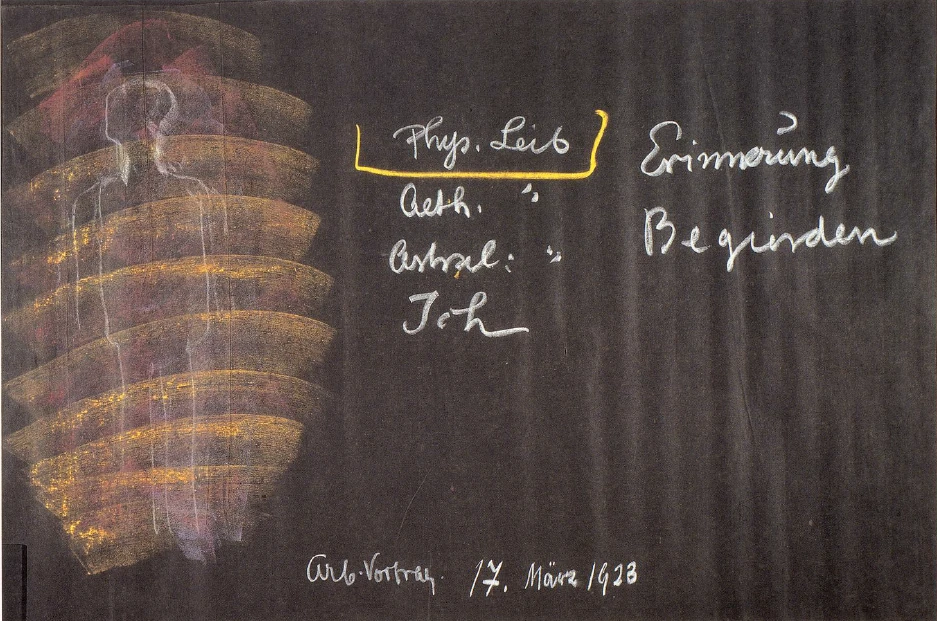
[ 14 ] Well, how does the etheric body differ from the physical body? You can feel it: that which causes you to feel a burning sensation when you surrender to the external world—that is heaviness. And the etheric body has no heaviness. - And if you now truly take a close look at the thoughts you recall, you must admit that they do not belong to the physical body; they belong to the etheric body. And that is why, in his recollection, a person is not subject to heaviness either. You can work and think at the same time, even though it is difficult—but that stems from something else. We can discuss that later. But one can work and think at the same time. Everyone knows this, because work initially wears down only the physical body. The etheric body is not worn down by work. That is the important point. The etheric body is so active within the human being that, through it, the human being possesses something that first and foremost enables them to have their memory.
[ 15 ] But now let’s move on to the second thing a person can learn: language. When we learn to speak, it’s not like learning to walk. When we walk, we move within the external world. When we work, we also move within the external world. We come into contact with something in the external world that offers us perceptible resistance. We speak language out loud, and even when we’re in thick air, we don’t even notice that speaking becomes difficult for us. We notice from other things what the air does to us when it is too thick—how disruptive it is. We do not notice this with regard to language. And yet, without the air, we could not speak, for we move the air with our speech.
[ 16 ] Well, it’s not as if only external combustion processes are constantly taking place within us; rather, when you eat something, it must first pass through the mouth into the stomach. There it must be processed. Then it must be distributed throughout the entire body. This is an internal process; it also consumes the physical body. If the etheric body were to cease functioning for even a moment, well, then it would be the end of the human being. Then the person would constantly be killing themselves through their own combustion processes. Everything a human being actually does in the earthly world is geared toward killing.
[ 17 ] This is not the case with speech. If a person were to interrupt the activity of the heart—that is, if the combustion caused by the heart’s activity were not immediately compensated for by the etheric body—the heart would stop beating. But we cannot say the same about speaking; for someone who speaks continuously would soon become a nuisance to us. And he would not exactly be doing himself any favors either. When it comes to speaking, it is not the case that a person must speak continuously. He can speak when he wants to, and he can also refrain from doing so. However, he cannot refrain from the etheric body’s compensation of the heart’s activity. He must carry this out from the beginning of his earthly life until its end.
[ 18 ] So there is a big difference between what a person does internally when they speak and when they simply live. We live by going through the processes of combustion. We speak when we want to. But when we speak, we also destroy something within ourselves. We truly destroy something within ourselves. You see, when we breathe, we constantly take in oxygen, bind it to the blood, and release carbon dioxide. We cannot use the nitrogen in the same way during this process. But when we speak, we always take in too much nitrogen. That is the strange thing about speaking—that we take in too much nitrogen. In a certain sense, we are poisoning ourselves. Taking in too much nitrogen means, in fact, becoming more like cyanide. For cyanide is just as much a compound of carbon and nitrogen as carbon dioxide is a compound of carbon and oxygen. A person is constantly cyaniding themselves when they speak. And they must, in turn, compensate for this. When a person sets their speech organs in motion, they are also, in a certain sense, killing themselves, just as they kill themselves through the combustion that occurs during movement. They must compensate for this. And that is what the astral body does. — You need not take offense at the word “astral.” I could call it something else. That is not the point. So that is what the astral body does. This astral body is also present in the human being, and it lives in breathing and speaking.
[ 19 ] And now you can see the great difference that exists between the astral body and the etheric body. If, at night while we sleep, we did not continuously replenish the energy expended during the day, we would not sleep but die. So we must always keep the etheric body with the physical body during our earthly life. We cannot speak at night while we are asleep; we must first wake up to do so. Speech is connected to the astral body. So at night we simply withdraw our astral body from our physical and etheric bodies. That is why we also breathe somewhat differently at night. We exhale less carbon dioxide at night than during the day. In short, we have a third body within us, an astral body (illustration on page 89). And the astral body is what gives life to our speech.
[ 20 ] When we look at an animal, it can, of course, walk and move; it just doesn’t need to learn how to do it—it does so instinctively. But if you look at animals, yes, they can’t speak. Yet they do have vocal organs. One really has to wonder why the dog doesn’t speak, why the dog only barks. It cannot use its astral body to speak. It doesn’t learn to speak. So we, as human beings, have to learn to move, to walk; we have to learn to speak. The animal learns nothing for its etheric body, learns nothing for its astral body. We humans, however, do learn something.
[ 21 ] Well, you see, the fact that we can learn something stems from the fact that we form thoughts. All learning consists in a person forming thoughts. When he speaks, he merely needs to imitate. When he thinks, he must be active himself. So a person learns through thoughts. He also learns to walk and to speak through thoughts; he just doesn’t realize it yet. He does not yet have thoughts while walking and speaking. And the reason we can learn what animals cannot is that, in addition to the physical body, the etheric body, and the astral body, we also have an “I” that permeates us entirely. So we also have an “I” (illustration on page 89). Then we have the four true members of the whole human being: the physical body, the etheric body, the astral body, and the “I.”
[ 22 ] What I have just told you is based on a correct view of the whole human being, on true science. Ordinary science, however, is not true science. It pays no attention to what the facts actually are. There is no question that anyone who learns anything at all should say: Human beings have a physical body, an etheric body, an astral body, and an “I.” But they do not say this, precisely because people do not concern themselves with the facts.
[ 23 ] And now let’s consider what actually happens at the moment of death. You see, one cannot truly grasp this unless one continues one’s education a little further than is customary today. It is certainly true that today’s “cultured people,” as they call themselves, are terribly complacent. What do today’s “cultured people” actually do? They don’t really concern themselves much with how a person learns to walk, because that just happens naturally in children through imitation of adults. No special care is taken in this regard.
[ 24 ] The fact that humans learn to speak does not particularly surprise people. There was once a time on Earth when not all humans could speak yet. Back then, there was a kind of sign language. Then people learned to speak. But that has long since been forgotten by humanity. Today, people view history simply by looking at the people of ancient times, who were already able to speak. And the fact that language is something one must actively learn—people today don’t give that a second thought. That is the reason for the conflict among peoples. If only the peoples would realize that they have learned language, and that language is something people have learned, then they would not be so arrogant about language and would not want to distinguish themselves according to ethnic groups. People have simply forgotten entirely that language must be learned from within.
[ 25 ] If one wants to approach anthroposophy, then one must, I would say, learn the language all over again. For you will see that when any of today’s scholars gives a lecture, well, my goodness, it comes out just like it’s coming from a machine. Just observe it for a moment: it comes out like it’s from a machine. It’s different from when someone presents something to you from Spiritual Science, from anthroposophy. There, one must constantly search for the words; one must continually take up the words anew within oneself. And afterward, once you’ve formed the words, you become even more afraid that they might not actually have expressed the right thing. In anthroposophy, the relationship with those who are listening is entirely different from what it is with today’s scholars. Today’s scholars no longer care about language. In anthroposophy, one must always be mindful of language.
[ 26 ] You see, that is precisely what comes to light in a special way when I write my books; then I am in a constant—I would say—inner turmoil to shape the language correctly, so that people can understand what is written. It is something new that one must create with language. Today’s scholars simply say that my style is poor, that I don’t write proper German, because they’re accustomed to stringing words together just as the mechanism of speech does. They don’t speak from the heart. That’s why they’re not used to people forming their sentences somewhat differently than they do. And so you see that people today no longer care much about language.
[ 27 ] But now for the third: thinking. Yes, people today are particularly proud of their thinking. But I say: People today do not think at all. Most of the time, people today do not think at all. I want to show you with an example that people today do not think at all. This can be seen in the example of religion. Religions exist. Yes, they weren’t always there. People first developed their own religions. And if you really study history, you will see how people struggled to form their religious convictions. That is why, in the past, there was also what amounted to a struggle to arrive at religious convictions. What do people do today? Well, they simply inherit what was once considered religious. But they are unwilling to embrace new ideas about the supersensible or anything of that nature. If people had always been like this, they would still be animals today—and that is indeed true—because they would never have embraced ideas about the supersensible. Today, people are incapable of embracing ideas about the supernatural. They accept only what has been conservatively preserved for them in the churches—that is, what was thought about this or that in earlier times. Scientists, of course, will tell you: “We are completely independent of the church.” We have thoughts that we form ourselves.”—That is not true. For anyone who truly knows the Church will see that the thoughts formed by today’s scholars are merely the thoughts of the Church of old.
[ 28 ] There was a great scholar in Berlin some time ago. His name was Du Bois-Reymond. He was truly a great scholar. Above all, he spoke very elegantly, because it came naturally to him, because it was part of his heritage—just as it pleases the great-aunt, because the pastor in the pulpit says only what she already knows; if he were to say anything new, she would probably like it less, and she would fall asleep in the process. So Du Bois-Reymond, a great scholar, gave a major speech at the Natural Scientists’ Congress in Leipzig in the 1870s. This speech became very famous. He said something like this: What we perceive with our senses, we can understand as human beings. We cannot understand anything supernatural. We are unfamiliar with that.”—The speech became famous as the “Ignorabimus” speech—“ignorabimus,” meaning: we will never know anything. That was the conclusion: Ignorabimus!
[ 29 ] Yes, why did Du Bois-Reymond give that speech? If one of you had gone up to Du Bois-Reymond and said, “You are a disciple”—or, for all I care, one of you could have said, “Your Excellency, you are a disciple of the Doctor of the Church, Thomas Aquinas!” Du Bois-Reymond would have turned bright red and become terribly upset at the suggestion that he was a disciple of Thomas Aquinas, the Catholic Doctor of the Church. He would not have wanted that. He did, however, once say in another speech: “German scholars are a scientific auxiliary force of the Hohenzollerns.” — That is a statement referring to the very same scholars to whom he belongs. But even though he gladly identified himself with the Hohenzollerns, he would not have identified himself with the Catholic Doctor of the Church, Thomas Aquinas.
[ 30 ] Yes, but look—what did Thomas Aquinas teach? He also taught: Human beings can perceive the sensory world through their own faculties; to perceive the supersensory world, however, they need divine revelation; they cannot arrive at that on their own! Now, if you strike “ecclesiastical revelation” from that sentence and say that human beings can only know the sensory world—they cannot know the supersensory world on their own; though I do not accept Church doctrine—then you have the same thing that Du Bois-Reymond taught. He simply crossed out one thing because it was a bit inconvenient for him. He is truly a disciple of Thomas Aquinas. For it is not true that modern science has its own ideas. It, too, takes its ideas from the Church. People just don’t realize it. Independent thought is only being developed anew through anthroposophy. People don’t realize that they have no thoughts of their own.
[ 31 ] And so today, no attention is paid to how a person learns to walk and move, how a person learns to speak, and how a person learns to think. That is precisely the point: if one pays attention to how language takes shape from within, if one pays attention to how one must in turn balance the burning from within, and if one pays attention to how thinking, in particular, takes shape from within, then one arrives at the eternal, immortal aspect within the human being. But if one pays no attention to these things at all, it is quite understandable that one cannot arrive at the eternal, immortal aspect. It is precisely thoughtlessness and inattention toward language and the way a person walks that lead to a person not paying any attention to the fact that they have something within them that makes them more than the corpse that is laid in the grave when they are dead. After all, they must fight this corpse at every moment; otherwise, they would die every minute. And they must fight it through their etheric body, their astral body, and their “I.” Thus, human beings must continually fight death within themselves. Death is, after all, ever-present. We could die at any moment. But we do not die as long as we can properly connect our etheric body, astral body, and “I” in both sleep and wakefulness.
[ 32 ] So what remains to us in death? First of all, we are left with the etheric body. But this etheric body is strongly drawn to the world. It has no weight, no gravity. But it immediately seeks to expand once it is free, once we cease to live. What does that mean? It means: We draw the etheric body out. But we must die immediately when we draw the etheric body out, for it is this body that keeps us alive. To die, then, means first of all to draw our etheric body out of the physical body. The physical body now begins to burn properly because the etheric body is no longer inside it. But this etheric body immediately strives to expand into the entire world. This is why a person still retains their memory after death, for it is bound to the etheric body, as I have told you. However, the etheric body rapidly expands throughout the entire world. That is why this memory fades after a few days. So at first, a person retains a memory of their last earthly life for a few days, just as a drowning person does. I already explained this to you recently.
[ 33 ] You see, this is what a person who is an anthroposophist claims; he doesn’t just make this up out of thin air—but what does he do? Well, he learns something in addition to what one usually learns. In ordinary life today, a person walks. He walks—that is, he watches as he is constantly being consumed. But they never observe how the combustion is balanced out again. If they were to observe how the combustion is balanced out again—that is, what happens when I simply move my foot and must then, through the etheric body, infuse the balancing force for the combustion—then they would indeed begin to perceive the etheric body. But people today forget this. They do not look at their etheric body. And this is what anthroposophical learning consists of: one learns to look at the etheric body. One learns to observe how a process directed against death is constantly taking shape within the human being. And now one conducts experiments just as one does in a physics or chemistry laboratory. I would like to describe one such experiment to you. I have described the entire method for conducting such experiments in my book *How Does One Gain Knowledge of the Higher Worlds?*. But I would like to show you once again how these things are done.
[ 34 ] So suppose I’ve done something during the day, some kind of work—it could be more physical, or it could be more mental. In the evening, before falling asleep, you create a mental image of it very clearly: There, there you are, this guy. But you create a mental image of him from the outside. And now you picture how you moved your legs, how you moved your hands, how you thought—you create a mental image of all of that. And by visualizing it again, a completely different mental image gradually arises of its own accord—namely, the idea of how all of this must be made right. You get a sense of your etheric body, a small part of your etheric body. You can actually bring this about.
[ 35 ] But people today say: Oh, if only people have learned to observe external life, then that’s enough! With children in school, people simply don’t pay attention to the fact that they are learning about something else. That’s the easiest thing to do, after all. Because people who learn more become rebellious. — One would only need to cultivate this capacity in the earliest years of childhood, and then everyone would be able to perceive the etheric body.
[ 36 ] You see, you may have done the most extensive exercises to become aware of everything you do—in terms of physical movement, work, or even mental work; you may have formed very clear mental images, but the situation is actually the opposite, because after three days, you’ve forgotten those images. When you learn something—something you’ve internalized from the physical world—it remains within you if you’ve internalized it correctly. The mental images you form of the supersensible world—that is, even those concerning the etheric body—vanish within three days; if you don’t first transform them into physical mental images, they vanish. Why? Because it’s exactly the same when you artificially produce them as an experiment as it is after death. After death, these etheric mental images also fade away. They fade away just as quickly when one artificially evokes them. Just as one, let’s say, learns about the compounds of oxygen in a laboratory through physical science, so one learns about this through Spiritual Science when one then performs the corresponding experiments on oneself. But that means not stopping at what ordinary science is. That is why my book *How Does One Gain Knowledge of the Higher Worlds?* is a continuation of what people learn—but a kind of continuation like this fact: that a person only has the experiences of their etheric body for two to three days; these can be replicated, and then they become science.
[ 37 ] Well, you see, that is how one can experience the etheric body. But one can also experience the astral body. When a person looks at water, he usually does not know that it contains hydrogen and oxygen. He must first separate the two substances from one another using a galvanic apparatus. Then they have the hydrogen and oxygen side by side in two vessels. In the same way, one must first be able to separate the astral body from the physical body in order to perceive it. So one must engage in genuine scientific inquiry regarding these matters. For example, one must pay attention to the following: You consumed water—you drank water—at a certain time during the day. Then you did not drink for a long time. You became thirsty. When you become thirsty, you want to drink again. Just as, for speech to emerge, you must first will for speech to come. It is exactly the same. In speech, you must will to speak; when you are thirsty, you want to drink. Thirst means nothing other than that you want to drink. Thirst is the will to drink. And so one can say that one notices within oneself that one develops desires—true desires. Note that first we have memory. Memories come to us sometimes when we want them, but mostly all on their own. They rise up, these memories. They have to do with the etheric body. Desires—such as thirst, hunger, or spiritual and emotional desires—arise within a person in such a way that they are like the act of willing. It is there that a person’s will expresses itself. The desire remains until it is satisfied, until the will has been fulfilled.
[ 38 ] Now consider what one actually wants when one is, say, thirsty. What does one want in that situation? Well, one experiences a condition within the body that one wishes to remedy. What does one actually desire when one is thirsty? When one is thirsty, one desires for water to circulate inside, in the same way that water circulates in the body. Because it isn’t circulating, one is thirsty. What does one actually want? One wants one’s body to function properly. When one is hungry, one also wants one’s body to function in a certain way. One actually always wants something for oneself. Now, you see, what one wants for oneself—the body cannot bring that about. The will, the desire—the body cannot develop that. Isn’t it true that if the body had to go on constantly just to satisfy desire, it would wear itself out? The body cannot develop desire.
[ 39 ] So where do desires come from? They come from the soul. And not from the etheric body. The etheric body is the source of something like memory. Desires come from the astral body. Nor is desire always present, whereas the life that comes from the etheric body is always there. Desire alternates with satisfaction because it is associated with the astral body. This is how we recognize the connection between desire and the astral body.
[ 40 ] But what does desire actually want? It wants a certain state of the astral body. Now, if a person continues to learn in the same way that I have described to you regarding learning about the etheric body, they can also continue to learn with regard to desires. Strangely enough, as a person continues to learn in this way, they go further and further back in their life, returning to the point where they were in childhood. Back then, they were full of desires. In fact, during that time—which one cannot remember—they were full of desires. Back then, one thrashes and wriggles, full of desires. A child is nothing but desire when it enters the world. And one returns to that state of desire. And there one becomes acquainted with one’s astral body.
[ 41 ] One cannot come to know one’s astral body unless one applies what I have described in *How to Gain Knowledge of the Higher Worlds*, for one can only recall back to that point in childhood when the astral body had already become so united with the physical body that one can no longer distinguish between them. But once you have developed this ability, you will be able to go back and remember how, as a very small child, you willed your entire physical body. And then you will begin to understand what you do after death, when your memory is taken from you after just a few days. For you will continually long for your physical body from your last life. And that lasts longer. You can try this out for yourself.
[ 42 ] For if someone, say, has reached the age of sixty and carries out this inner experiment—recalling back to his childhood and thereby accessing his astral body—then he comes to know this astral body quite well. But they notice that now, having reached the age of sixty, the experience is quite different from what it would have been if they had done it ten years ago. This changes with age. Namely, at sixty, it is easier to return than at fifty. And at twenty-five, it is almost impossible to return. At twenty, you cannot return to the astral body. So this changes over the course of one’s life.
[ 43 ] So one can come to know the astral body, and then one can say: The astral body changes as one grows older. The older one gets, the more desires one develops; and therefore, after passing through death—once one has grown older—one has more desires than when one is still very young. At that stage, one has fewer desires. And as long as a person has not yet reached the point where they no longer desire their physical body, they continue to live in their astral body after death. Next time, I will show you why we must say: After death, a person spends one-third of their lifetime in the astral body and only a few days in their etheric body. There isn’t enough time today to go into that in more detail.
[ 44 ] And then the person becomes completely free from his desires. He no longer craves his physical body, and then something very peculiar happens. Although he no longer feels the desire for the physical body he once had, he gains the ability to make provisions for the physical body he will receive in the future. And in the spiritual world, they now undertake a process that enables them to receive a physical body again in their next earthly life. This is the longest part of the process. Thus, they return to an earthly life.
[ 45 ] Next time, I will explain to you that what is called “eternity” can be quite well substantiated. I will then conclude this discussion next time. This is, in fact, part of the question that was posed to me.
[ 46 ] But, gentlemen, I have explained the matter to you in such a way that I actually led you first to the spiritual realm. I told you: In addition to the physical body, we also have the etheric body, the astral body, and the I. These are already present not only before a person is born, but even before they have taken on an embryonic life—before they are conceived and received. They are already there.
[ 47 ] Yes, but you see, there is a certain church dogma that has a very peculiar content. This arose quite soon after Christianity had spread. Namely, the Roman Church forbids people from believing in a life before this earthly life. Why? You see, people don’t care much about life before this earthly existence. They say: Well, I’m here now; what does life before this earthly existence have to do with me? — On the other hand, people care very deeply about life after death, because they don’t want to stop living. That’s what interests people.
[ 48 ] But one cannot come to know life after death without first coming to know life before birth—that is, before conception. One is not possible without the other. So what happened, then, when this dogma was established—that one should not look into life before earthly life, that one should not believe in life before earthly life? Thus, humanity’s entire perspective on the supernatural has been cut off. Yes, does it make sense that the Church, of all institutions, would cut off this prospect of the supernatural? Oh yes, it makes sense, because then—since people do long for a life after death—the Church can take the entire process of dying under its control. Then people know nothing of what lies beyond death and are dependent on the Church to tell them. Then people develop a longing to believe, above all else, in the Church. So it was very good—for the Church, that is—that this dogma was established: that human beings live on after their earthly life. For through this, the Church has taken the process of dying under its control.
[ 49 ] I once had a conversation with a famous astronomer. He didn’t believe in anthroposophy at all. But the thing about astronomers is that they are the ones who most readily recognize that one cannot stop at the physical realm. We spoke about the church and the state. His attitude toward both was such that he quite liked the state, but liked the church less, because it leads people merely to blind faith, not to knowledge. And then this astronomer said something very beautiful: “Oh, the church has it good, much better than the state, for the state has only to administer life, whereas the church administers death.” And because the church manages dying, it has much more left over for itself; it is much more successful.
[ 50 ] Spiritual Science, anthroposophy, seeks to lead people to the realization that they themselves are in charge of their own dying. That is the story. You see, gentlemen, that will be real progress. Then people will no longer want to feel merely dependent, but will want to take their lives into their own hands. And that is what matters.
[ 51 ] Today, people are already realizing that things can’t go on the way they used to. In the past, they used to think: “For a while in life, I’ll work—that’s just the way it has to be, because if I didn’t work, life wouldn’t go on—but later on, I’ll retire with a pension from the government.” — That was basically the idea. And when I die, they told themselves, the Church will retire my soul. After all, there they are retired into eternal bliss without any insight of their own, without any effort on their part.
[ 52 ] That is precisely what true progress should be: that human beings take control of their own lives, do not allow themselves to be governed by the state or the church, but rather achieve something out of their own understanding, out of their own will, and out of themselves. And in doing so, they must also scientifically comprehend their own immortality.