

Man's Life on Earth and
the Essence of Christianity, tr. SOL
GA 349
21 March 1923, Dornach
Translated by Steiner Online Library
6. Human Life in Sleep and Death
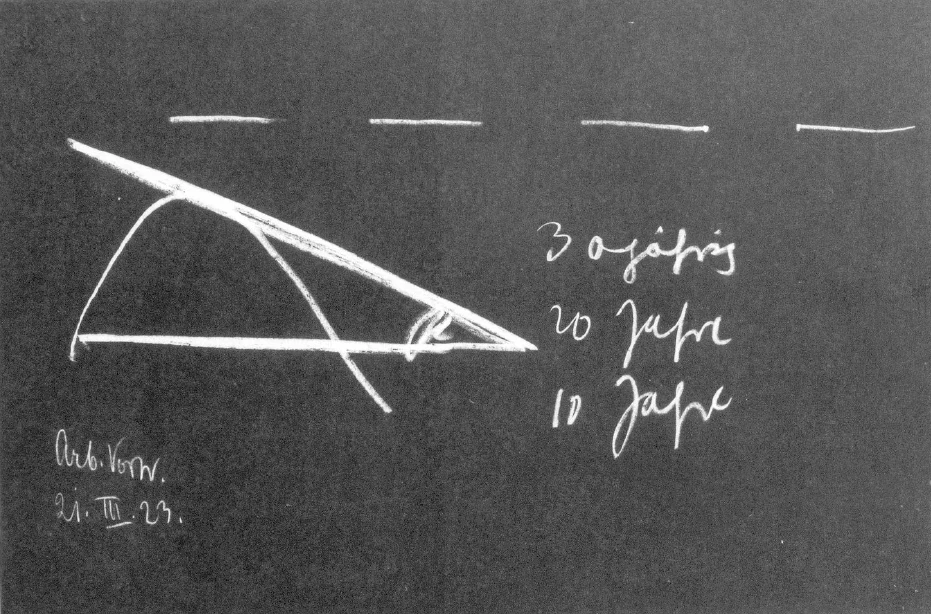
[ 1 ] Good morning, gentlemen! Now let’s try, at least for the time being, to bring to a conclusion what we have begun to examine. You see, understanding life comes about only by—as I have mentioned to you many times before—beginning to examine human sleep. For when one is so deeply immersed in life from morning till night, one usually believes that sleep restores one’s strength, dispels fatigue, and so on. But sleep actually does much more than that. You need only think about it for a moment. Think about it: when you recall your life, the dreams you’ve had while sleeping don’t always come to mind. Dreams are something we quickly forget, as you all know. At most, you might remember having had a particular dream here or there—one you’ve often told others about. Then you remember it through telling the story. But the dreams you don’t share fade away very quickly. If you look back on your life all the way to your childhood, certain memories from that time will come to mind, right up to your later life. But this memory always has a gap. When you think back today, there’s the time during which you were asleep. That’s a gap you don’t remember. The memory only starts again last night and goes up to yesterday morning. Then there’s another gap. So when you look back, you don’t actually have your entire life; rather, whatever happened during the night is always left out of this recollection. If you trace a line of memory, a period from evening to morning passes without recollection, then there’s memory from morning to evening, followed by another gap from evening to morning, and so on. We actually remember our lives only in such a way that we do not recall an entire part of our lives at all. That is quite clear. That is the time we have slept through.
[ 2 ] Now let’s consider someone who can’t sleep. As you know, some people complain that they can’t sleep. But many of these complaints shouldn’t be taken too seriously, because some people tell you they never sleep at all at night. And when you ask them how long they’ve been unable to sleep at night, they say, “Well, for ten years now.”—Well, anyone who couldn’t sleep for that long would have been dead long ago. People do sleep, but because they have such vivid dreams while asleep, it seems to them as if they had been awake. You should say to such a person: “Just lie down for once—you don’t need to sleep; just lie down.”—For they are already asleep, and even if they don’t realize it, they are still asleep. I just wanted to tell you this so you can see that human beings truly need sleep for life. Sleep is as necessary for life as food. And anyone who couldn’t sleep couldn’t live.
[ 3 ] Well, how much time do we actually spend sleeping throughout our entire lives, from birth to death? Yes, gentlemen, you see, this sleeping lasts the longest in very young children. When a child is born, it sleeps almost all the time. Then, gradually, the time spent sleeping decreases, and the child sleeps less and less. And when you’ve gotten a little older and look back, you have to admit that you’ve actually spent a third of your life asleep. That’s healthy, too. You’ve actually spent a third of your life asleep.
[ 4 ] People have known this for quite some time. It’s just that today, people don’t like to remember things they’ve known for a long time. Even in the 19th century, right at the very beginning, people who wrote about this said: A person should work 8 hours, spend 8 hours on themselves, and sleep 8 hours. That adds up to 16 hours awake and 8 hours asleep—so 3 times 8 equals 24 hours.
[ 5 ] So that leaves one-third of 24 hours for sleep. That was a very accurate observation. A person spends one-third of their entire life sleeping. Well, isn’t it true that people don’t care about how important sleep is for life, because these days they don’t care at all about what the soul and spirit are? They are only concerned with what a person experiences physically while awake, but not with what the soul and spirit are. It’s just as people often say in everyday life today: “God, yes, sleeping—that’s all well and good, but you don’t need more than the necessary drowsiness to do it.” And so they drink this much or that much beer in the evening so they can sleep. But what matters is not having the necessary drowsiness, but realizing just how important sleep actually is.
[ 6 ] And now let’s take a moment to clarify what sleeping actually means. You see, gentlemen, people basically like themselves quite a lot. You can see this especially in sick people. Sick people show you just how much they like themselves, because when something hurts them, they take terrible care of themselves and so on. That’s all quite true, but it does show that people love themselves terribly much. What is it, actually, that people love when they love themselves? Well, it’s their bodies that they love. And that, I would say, is the great secret of life: that people love their bodies. And the love that people have for their bodies becomes evident when those bodies aren’t quite right.
[ 7 ] But there are also some drawbacks to this fondness for the body. The body is in motion all day long. The body works itself to the bone all day long. And as a result, over the course of the day—without the person even realizing it—the soul-spirit within grows less and less fond of the body. That is the strange thing, and it is important to know this. While a person lives through the day and must constantly keep active, the soul and spirit grow less and less fond of the body. That is why a child sleeps so much. A child loves its body very much and always wants to enjoy it. Whenever you see a child, you can always see how the child is enjoying its body. Just think for a moment about what it’s like when a child has drunk its milk and falls asleep. In this sleep, the child experiences the pleasant sensation of digestion. It enjoys what is happening inside its body. And it only wakes up again when it becomes hungry. For what happens when it is hungry is something it likes less. That is why it wakes up again. So you see, the child wants to continue enjoying its body even while asleep. You can make the most wonderful observations. But scholars don’t do this because they lack the ability to do so.
[ 8 ] Just watch a herd of cows out in a pasture as they graze, and then as they lie down so comfortably and enjoy the process of digestion. That’s when they’re savoring what’s happening inside their bodies.
[ 9 ] Here’s what you need to know: that human beings actually want to enjoy their bodies. But with humans, it’s a little different than with cows, and with adults, it’s a little different than with children. A small child doesn’t work yet, so it enjoys its body while sleeping. Cows do everything by instinct; therefore, they enjoy their digestion even while sleeping. Human beings never get around to enjoying their digestion. Human beings are actually such that, when they use their bodies all day long, by evening they have reached the point where their bodies are no longer appealing to them. They no longer love them. And you see, that is why they sleep. They sleep because their bodies are no longer appealing to them. The antipathy that humans develop toward their bodies throughout the day causes them to fall asleep at night, and they sleep until they have overcome this antipathy in their souls; they wake up again when the affection for their bodies has returned. This is what one must understand first and foremost: that waking up is based on a person once again developing affection for their body. And this affection extends to every single organ of the body. Therefore, when a person wakes up, they slip, so to speak, into their organs,
[ 10 ] Just think for a moment about what dreams are like when you’re waking up. Dreams when you’re waking up are such that, for example, you dream about snakes. You slip into your intestines and dream about snakes. The snakes represent the intestines.
[ 11 ] So, out of a sense of affinity with his body, a person slips his spiritual-soul aspect back into his body when he wakes up. A person must have this sense of affinity; otherwise, he would always want to leave his body.
[ 12 ] And now imagine this: The person has died; they have left their body behind; the body is no longer connected to the person. I have already told you that the first thing that happens is that the person retains their thoughts as memories of their entire life. And those memories are lost after just a few days. They scatter throughout the world. But then what remains is a sense of connection to what his body experienced. And this sense of connection to what his body experienced—he must now gradually lose it. That is what we go through first after death: we must lose our sense of connection to our body.
[ 13 ] How long does it take for this sympathy with the body to be reestablished when we live for one day? It takes one-third of the day. That is why the loss of this connection after death also takes a third of one’s entire life. If a person has, say, lived to be thirty years old, it takes him about ten years to let go of his entire body—to no longer have any connection whatsoever with the world and life—though, of course, these are all rough estimates. So after death, a person first has a few days during which they have memories of the past, and then they go through this process of weaning themselves away from—as I would say—those memories, which takes a third of the entire life they spent on Earth. Now, while this is generally true on average for individual people, it can be longer for some and shorter for others, because one person has more affection for their body—loves themselves more—while another loves themselves less, and so on. So after death, we go through something that could be called: the person weans themselves off all the things that bind them to their body.
[ 14 ] But now you might say: What you’re telling us here is actually still somewhat theoretical. How can we know that a person still has something within them after they have shed their physical body? How can one know that? — Well, gentlemen, to answer that, one simply has to study how a person develops throughout their life.
[ 15 ] There is the first period of life in which a person develops, the first stage of life; this lasts until the person gets their permanent teeth. First they have baby teeth, then they get their permanent teeth. Yes, you see, in this case we can say that a person’s baby teeth are inherited. But their permanent teeth—those are no longer inherited. The permanent teeth come from the etheric body. The etheric body is active within the person and provides the permanent teeth. So we have the physical body, as I wrote down for you the other day; it provides the first set of teeth. Then there is the etheric body; it gives the person the permanent teeth—the teeth that remain.
[ 16 ] Now one must simply acquire the ability to see—today, people acquire only the ability to think abstractly and formulate theories, but not to see what I have just described in my book *How Does One Gain Knowledge of the Higher Worlds?*. If one truly observes a child as it gradually grows its second set of teeth, one can see this supersensory activity of the etheric body. And this is the same body that a person retains after death—retains for a few days—and which then disperses throughout the entire world. So if one studies properly what gives a person their second set of teeth, one discovers that after death a person retains their etheric body for a few more days and then sheds it a few days later—that is, it disperses throughout the world.
[ 17 ] Now he also has his astral body and his “I.” This astral body is what is always longing for the physical body. With the “I” residing within it, it always yearns for the physical body. So we can say: The human being develops—as I told you recently—needs within his astral body. All needs are developed by the astral body. The needs are not located in the physical body. When the physical body is a corpse, it no longer has any needs.
[ 18 ] So we can say: That which gives a person their permanent teeth is also gone a few days after death. What remains, then? Here we must once again study what begins to be particularly active in a person from the moment they have their second set of teeth until the moment they reach sexual maturity. This, too, is an important period of human life. Modern science cannot study such things because it pays no attention to them at all.
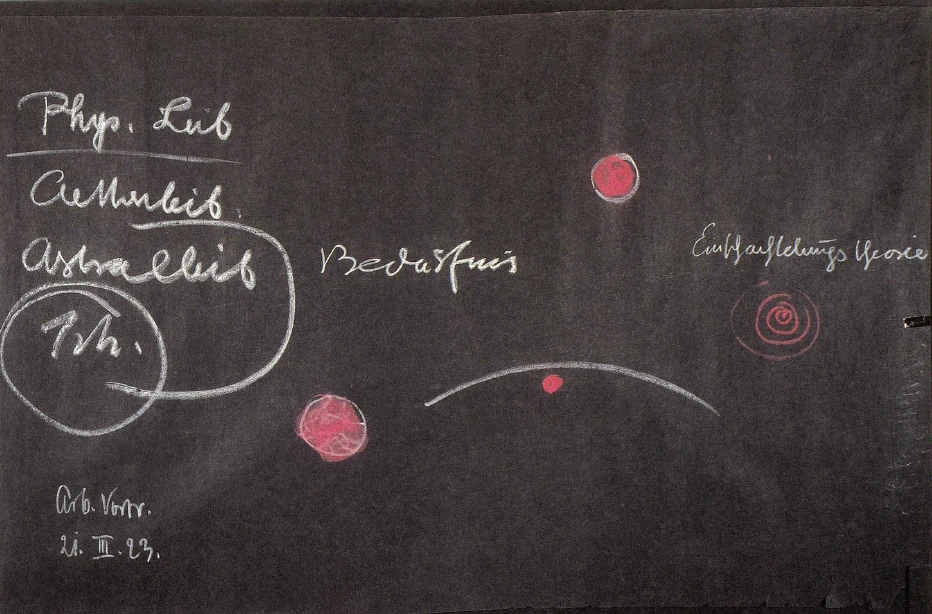
[ 19 ] You see, from the time a child gets its second set of teeth until it reaches sexual maturity, something supernatural is at work within the child. And what does this supernatural force want? It wants to gradually take hold of the entire body. It is not yet fully present; when the child gets its second set of teeth, it begins to draw this astral body into its entire physical body, so that it permeates it. Then the child becomes more and more mature. And once the astral body is fully within the physical body, the child has reached sexual maturity. This is precisely the important point to understand: the astral body is what brings about sexual maturity in the child in the first place.
[ 20 ] Of course, these things cannot be studied the way today’s scholars would like to study them. Today’s scholars want to study only what is tangible. They do not observe human life. But anyone who has truly learned to observe what it is that works its way into the body from the time of the second set of teeth until sexual maturity knows that this is precisely the astral body. It is this body that gives rise to all these needs. Of course, the child already has needs before getting its second set of teeth, because the astral body is located primarily in the head; but later it spreads throughout the entire body. You can perceive this very clearly in a boy as the astral body expands. The boy’s voice changes, and with that he also reaches sexual maturity. This is the astral body penetrating the entire physical body. In women, you can observe this through the development of the secondary sexual organs—the breasts and so on. This is the astral body penetrating the physical body. And the human being retains this astral body after death, once the etheric body has already been shed.
[ 21 ] You see, it is this astral body that seeks to re-enter the physical body every morning. For while a person sleeps, they have no needs—neither sexual nor any other. These arise when one is awake. They arise when the astral body seeks to enter the physical body in the morning. And so, throughout life, this astral body is entirely focused on entering the physical body every morning. Naturally, it also wants to do this after death, and it must first break this habit.
[ 22 ] If a person is thirty years old, how long has he been in his physical body? He was in it for twenty years; for ten years, he was not in it. Those ten years that he was not in his physical body—which he slept through—he wants to spend back in it after death. And so, after death, he spends a third of the life he lived here on Earth in his astral body. After this time, the astral body is satisfied. Then the person lives only in his or her “I.” Thus, after spending about a third of his or her lifetime after death, the person continues to live only in his or her “I.”
[ 23 ] But this “I”—this very essence of the human spirit—now needs an immense amount if it is to continue living. You see, it is not without reason that I have been telling you all along that reason, intellect, and thought are actually spread throughout the world. I have told you how everything in the world, when studied properly, is actually arranged in a rational way. I have made this clear to you using the animal kingdom as an example. The whole world is such that we should not believe our intellect is the only one; rather, the intellect we possess is merely a portion drawn from the intellect that is spread throughout the world. Intellect is everywhere. And anyone who believes that his intellect is the only one is as foolish as someone who believes: “I have a glass of water here; this glass of water was empty at first, then it became full—that is, the water grew out of the glass.” - One must first draw the water from the well, from the entire body of water. And in the same way, one must first draw the intellect one possesses from the intellect of the entire world.
[ 24 ] We just don’t notice any of this while we’re alive. Why not? Because that’s what our body does. Gentlemen, if you were to know—and I’ve explained this to you before—what your body does with a tiny piece of sugar that you’ve swallowed, how that tiny piece of sugar is not only dissolved in your body but transformed into all sorts of other substances—if you knew everything that goes on there, you’d be amazed. You’re already amazed after I’ve told you—I’d say—just the basics of everything that goes on in the human body. But no matter how much of what’s happening in the human body you consider, you’re always looking at just a small part of it. You breathe in. The air you inhale must constantly be utilized throughout your entire body. Just think about it: you breathe in about eighteen times a minute. What you breathe in must constantly be utilized throughout your entire body. This requires an immense intelligence—a truly immense intelligence.
[ 25 ] Well, our body does all of that. Our body truly works for us with tremendous intelligence. It’s truly amazing what one must feel when one realizes just how much intelligence the human body actually possesses. It’s absolutely enormous. Well, it takes a lot off our hands throughout our lives.
[ 26 ] But now, after death, we no longer have it. Now we no longer even have the etheric body. We do not have the astral body, nor even a longing for the physical body. So we have nothing at all but the “I,” and the “I” now realizes that it does not have a body and is beginning to familiarize itself with everything that is necessary for the body.
[ 27 ] And this is where the profound aspect comes in—the one we must understand. Modern science takes a particularly simplistic approach to this. Modern science says: Where does the human being come from? —Well, the human being comes from what arose in the mother as fertilization, as a fertilized embryo. So science says: There is the fertilized embryo, and inside it, well, somehow the human being is already predisposed. — If one knows nothing, one says: There is a predisposition there; that is where the whole human being comes from. — Yes, you see, people have understood this quite clearly for a long time, but in their own way—that is to say, they have made it unclear.
[ 28 ] Just imagine that this were the mother egg (it is drawn) from which you yourself emerged. So you would have been inside it, having been there, as it were, as a tiny little human being. But this mother egg, in turn, was born from a mother egg. So that little human must have been inside the womb as well, and that mother egg—that is, the mother—must have been inside the grandmother, and further back to the great-grandmother, great-great-grandmother, all the way back to Eve. And you come to the remarkable fact that the entire human race was contained within the primordial mother Eve, but nested in this way. Mr. Müller was inside that egg, which in turn was inside the egg along with all the other human eggs—only it was nested like that. The entire human race was contained within the primordial mother, Eve. This theory was originally called the theory of evolution, but later, mockingly, the “nesting theory.”
[ 29 ] So, at the beginning of the 19th century, people realized: It’s simply impossible to create a mental image of the entire human race being contained within the primordial mother Eve—that one person was always nested inside another, and in such vast numbers; that just doesn’t work. So they adopted a different theory. They said: No, there’s actually nothing inside the egg yet; but when it is fertilized, all the external conditions—wind and weather, sun and light, and everything else—come into play. And it is precisely from the influence of all of nature on this egg that a human being comes into being.
[ 30 ] Yes, gentlemen, that is something that suits materialism very well, if it can create a mental image of such a thing. But it does not hold up to closer scrutiny. For just think what we will become if the whole of nature is constantly acting upon us. We will, in fact, become what people today nervously call a “fidget.” Anyone who is sensitive to every breeze and every ray of light will not become a real human being, but rather a fidget. The surrounding natural world turns us into fidgets. So that can’t be it either.
[ 31 ] A proper study actually shows us something quite different. A proper study shows that there is absolutely nothing inside this egg at all. Before it is fertilized, it is still—I would say—somewhat such that one can perceive all sorts of things inside it. It has form. In the unfertilized egg, you can still perceive all sorts of strands and so on. But when the egg is fertilized, these strands are destroyed, and the entire egg is then nothing but a real “mess,” if I may put it that way. To put it more elegantly, it is chaos. It is a completely disordered substance.
[ 32 ] You see, a substance like this, which is completely disordered, simply doesn’t exist anywhere else in the world. All substances are, in a certain way, internally ordered and arranged. If you take any substance at all—even just a speck of dust—and look at it under a microscope, you’ll see how finely and artfully it’s structured on the inside. The fertilized egg is the only thing that’s completely chaotic on the inside. And the substance must first become completely chaotic; it must no longer retain anything of its own if it is to become a human being. People are always pondering egg white, for example. They are always eager to study how egg white is structured internally. Yes, egg white is structurally organized internally as long as it remains unfertilized. Once it is fertilized, it becomes precisely what I have called a “mess”—that is, chaos, a substance that is absolutely disordered. And from this, a human being emerges. Even in the case of the first mother, Eve—if she ever existed at all—the entire human race was not present, nor was it contained in any way within an egg cell that would later be fertilized; rather, the egg cell is completely chaotic and disordered, and it was also disordered in the case of the first mother, Eve. And if a human being is to emerge from this germ, then this must be brought about from the outside—that is, the human being must enter into this germ. A proper study of the natural sciences, in fact, shows that the human being must enter this germ from the outside. This means that the human being comes from the spiritual world. He does not come from matter. For matter must first be destroyed.
[ 33 ] That is exactly how it is with plants. With plants, you have the soil, and within the soil, the plant seed. Yet people still do not study properly what happens to the plant seed in the soil. For it must first be destroyed, and then the new spring causes the new plant to emerge from the destroyed matter—spiritually, from the outside in. This is how it is with animals, and this is especially true of human beings. The only difference is that it is easier for plants. The entire universe shapes their form. In the case of human beings, the entire universe does not initially shape their form. They must shape it themselves. Human beings must actually enter this destroyed substance themselves; otherwise, no human being could emerge from this destroyed substance. Human beings must therefore first emerge from the spiritual world and enter this destroyed substance. The entire process of conception serves only to present the human being who wishes to enter the world with a destroyed substance—so that they have a destroyed substance. He could do nothing with undestroyed matter. He cannot enter the world like a plant, for then he could only become a plant. He must truly form the entire universe within himself. And he does form it. It is truly marvelous how the human being now forms the entire universe within this destroyed matter.
[ 34 ] I want to show you with an example how human beings project the universe into this destroyed substance. If you have the Earth’s surface here (it is drawn), we can depict it as flat, because if you overlook even a small piece of the Earth, it looks flat. In the morning, the sun rises, climbs to a certain height, and then sets again. This is a certain angle up to which the sun rises. It is very interesting that the sun always rises to a certain angle and then sets again. The angle is, of course, slightly higher in summer than in winter, but the sun rises up to a certain angle. This angle, then, is the inclination of the sun relative to the Earth.
[ 35 ] We actually find this angle elsewhere as well. You see, when light enters our eye, there is—where the optic nerve enters the eye from the brain—the so-called blind spot. That’s where you can’t actually see. We see most clearly only in areas that are somewhat removed from this blind spot, where the optic nerve enters. And here’s the interesting part: the same inclination that the Sun has toward the Earth in its orbit is the same inclination that this point—where we perceive the brightest light within ourselves—has toward the blind spot.
[ 36 ] And one more thing. If you take the heart, you’ll see that it’s actually slightly tilted. It has the same tilt as the sun has toward the Earth. I could show you countless examples like this, from which you would see: Everything that exists out there in the universe, we somehow carry within us. We carry the sun’s inclination in the inclination of our eyes and in the inclination of our hearts. We are formed entirely from the rational order of the universe.
[ 37 ] Oh, gentlemen, this is where one begins—when one gradually gains some insight—to truly realize how a human being is, in fact, a whole little world. Everything that exists in the outside world is reproduced within the human being. Just think: if you were given this “rubbish”—this destroyed matter—and were asked to reproduce it inside yourself! You wouldn’t be able to do it. You see, when the “I” is alone after death, it must learn from the entire world how to reproduce the entire world. So, after having shed its attachment to the body during this third part of its previous life, the human being now begins to learn from the entire universe how to become a human being once again. And that takes longer than a lifetime on Earth, because on Earth—well, things are such that one can learn a great deal or very little. Actually, most people today learn very little. And as strange as it may seem, scholars learn the very least of all, for what they learn is all useless. It serves only to understand what a corpse looks like, but not how a living body functions internally. Yet this is precisely what the “I” must learn after death. It must learn from the whole world the secrets of how a body is constructed. And here one can point to this time that the “I” now spends learning from the whole world how a human being functions and lives internally.
[ 38 ] You see, when a person manages—through the exercises I have described in the book *How Does One Gain Insight into the Higher Worlds?*— to remember a time one would otherwise not recall—when one was a very small child—then one comes to understand what this life of an infant actually consists of: an infant who knows nothing of the world yet, who uses only his body, who merely wriggles, who lives solely through his eyes and ears, but understands nothing of all this. In ordinary life, a person does not think to look back. They say: “Oh, what does my childhood have to do with me? I’m here now, that’s all.”—But when one looks back with insight into that brief period—which one otherwise doesn’t remember—one realizes what one was actually doing there. Yes, one actually gets a terribly unpleasant feeling at first when one realizes this. For this fidgeting of the very small child consists in striving to forget all this knowledge of the universe. One hands it over to the body, and the body knows it afterward. That is why it can take it on later in life.
[ 39 ] The small child imparts a whole world of wisdom to the body. It is so terribly painful, so terribly sad, that modern science has no idea what is happening in life—how the small child imparts the wisdom of the world it has acquired to the body, how it gradually grows into the eyes, into the hands. Gradually it grows into them, imparting the entire wisdom of the “I” to the body, whereas the “I” actually once possessed the entire wisdom of the world.
[ 40 ] It may seem strange to you, but it is actually true: If you truly have a firm grasp of anthroposophy, how can you tell people about the universe? One can speak about the universe simply because one recalls the earliest days of childhood, infancy, when one still knew the whole from prior experience, before one entered the physical body. And anthroposophy actually consists in gradually retrieving from the body all this cosmic wisdom that one had surrendered to it.
[ 41 ] Yes, gentlemen, conventional science offers no guidance on this today. It offers no guidance whatsoever on how to rediscover within the body the knowledge that one has oneself placed there in the first place. It leads people to experimentation, and they are supposed to learn only what they experience externally; whereas the correct approach would be to guide people into the living body. Our students are led to the dead body—which is already a corpse—and learn nothing about the living human being. That would indeed be a more difficult course of study, because there the person must practice self-knowledge, must look within themselves, since the person is meant to become more perfect. But that is precisely what modern people do not want: they do not want to become more perfect; they want school to drill them a little, and then they want to stop there—they do not want to become more perfect. People don’t want that because, in the education they enjoy today, I would say they are already far too arrogant to admit in any way that they should strive for perfection.
[ 42 ] Well, with that, I have—I would say—told you a little bit about myself for now. But we’ll talk more about these things in the coming hours, so you’ll hear much more and gradually find everything easier to understand.
[ 43 ] You see, I’ve told you just a little bit about what the “I” has to do during the time until the human being comes back down to Earth. But there are people who say: “Oh, I don’t care what the ‘I’ has to do later on! You can just wait until you’ve died; then you’ll see.” — That’s what people say.
[ 44 ] Yes, gentlemen, that would be just as if the embryo, after it has been conceived and fertilized, and the human being has taken shape within the mother’s womb, were to say: “Oh, it’s too boring for me to live in my mother’s womb; I’m going to leave early.” — Yes, but if it doesn’t want to live out its full nine months in the mother’s womb, it cannot become a human being. It must go through that first. Nor can the “I” experience anything after death if it does not live here in a way that prepares it for that. Therefore, it is completely wrong when someone says: “I’ll wait until death comes, and then I’ll see whether I’m something or nothing, and so on.” People aren’t very logical, after all. People today are actually just as logical as the person who asserted—who swore—that he didn’t acknowledge any God, and who swore: “As surely as there is a God in heaven, I am an atheist!” That’s pretty much how people are today. They parrot the old sayings. Completely unconsciously, they parrot these sayings, even when they contradict them. And so people believe: You can just wait, and then you’ll see whether I’m still something or nothing. Don’t people say to themselves: Do I believe in immortality, or do I not believe in immortality? Yes, if I don’t believe in immortality, and it turns out there is one after all, then I could be in trouble. But if I believe in immortality and there isn’t one, it doesn’t hurt. So in any case, it’s better if I believe in immortality.
[ 45 ] But, you see, one must not play around with this idea; rather, what matters is that one truly comes to understand the facts. And so one must say: Here on Earth, human beings must receive the inspiration that their “I” can truly enter the world alive after death. And modern science thoroughly dispels this inspiration, especially since people today are no longer made aware of how the facts really are. No one admits it, but there is actually an interest today in keeping people as ignorant as possible, so that after death they remain asleep and have no idea how to penetrate the mysteries of the entire universe in order to become truly human once again.
[ 46 ] You see, gentlemen, if humanity were to continue living as it does today—concerned only with outward things—then one day in the future, people will be born who will no longer be able to lift a finger at all, because they will have learned nothing by the time of their next life.
[ 47 ] We’ll come back to the idea of how lives repeat themselves later. Today I simply wanted to provide you with some concepts so that you can see that this is not merely a frivolous assertion about what the “I” is like after death, but rather that one can point to it based on the very knowledge that the human being descends once more and must shape his or her own life within the tangled substance. This is truly recognized on the basis of objective facts.
[ 48 ] That is what this is all about. It just doesn’t happen that quickly, but I will answer the question fully if we take into account what we know about the end of human life—how a person gradually loses their etheric body and astral body, and how the “I” must then descend to form its astral body and so on. Then one comes to understand how human beings descend again and again. And over time, one also comes to understand when human beings are liberated from their entire earthly existence—when they no longer have to descend. The question of when they first began—we will answer that as well. They must have begun at some point as a kind of plant. They do not need to be human to do so. - But I have also described to you once how the Earth was a great plant, and we will see how the Earth will once again become a plant, and how human beings will then be liberated from their human existence.
[ 49 ] I will then examine the entire issue once again from a different angle. Of course, you’ll have to be patient and not say during the first few hours, “I just can’t keep up with this.” — You’ll see that the more detailed it gets, the more plausible it will seem to you.