

Man's Life on Earth and
the Essence of Christianity, tr. SOL
GA 349
4 April 1923, Dornach
Translated by Steiner Online Library
7. The Structure of the Human Being
[ 1 ] Gentlemen! Science is willing to accept only what can be seen with the eyes and touched with the hands. It takes a special ability to investigate even that which cannot be seen with the eyes or touched with the hands, and people are unwilling to acquire this ability. Medieval theology held that there was a science for everything earthly, and a doctrine of faith—which is what is written in Scripture. And even today, people still hold this view. People no longer dare to embrace a science that cannot be grasped with the hands, because they have not yet moved beyond a science that can be grasped with the hands. I would like to explain what I have told you a little further through something that is, of course, already old by today’s standards; but with regard to these matters, the decisive developments occurred precisely in the last third of the 19th century. I need only read you the final sentences of a book, and you will immediately see what the attitude of modern science is in this regard. It says: There is no path that leads us beyond the limits of our knowledge. Into the pathless... (gap in the postscript) we can only let ourselves be carried by inexhaustible hope in a mystically sweet half-sleep, on the wings of imagination—and so on.
[ 2 ] So what does the Lord say? He says: That which can be grasped with one’s hands—that is science. The rest is a figment of the imagination. Everyone can imagine this—or be led to imagine it—because, after all, we can know nothing about any of it. And if people find comfort in all sorts of supernatural things, well, there’s no need to take that away from them.
[ 3 ] It is truly appalling to see the confusion this matter has descended into. But now I would like to show you that these people have completely lost the ability to think when it comes to this science. I’d like to demonstrate this to you with another passage from this book. For what does this gentleman do—who pushes everything that cannot be grasped with the hands into the realm of religious belief? He says: To speak of a “self” that is supposed to dwell within a person as an eternal self is, in fact, scientific nonsense, for the “self” is merely the synthesis of everything else that is within us. We are accustomed, from beginning to end, to synthesizing all the mental images and feelings we have into a single whole. And then, once we have synthesized it into a single whole, we call it the “I.”—So says the Lord.
[ 4 ] Now, however, he wants to illustrate this. He wants to show that the word “I” really just serves to summarize everything one experiences. For then the “I” is merely a word, if one merely summarizes it in this way. So he draws a comparison. He compares everything a person experiences to a military unit, to a company of soldiers. So what I experienced in my youth as a child—what I played, what I felt while playing—that is one squad of soldiers; what I experienced a little later is another squad of soldiers, and so on; up to the present day, I summarize all of this—just as the individual soldiers are grouped together into a company—and call it the “I.”—That’s what he says. So he compares all the individual experiences of the soul to a company of soldiers, and he summarizes them just as one would group them together, not saying “Müller” and “Lehmann” and so on, but rather: “Company 12” and so on. In this way, he groups everything experienced in the soul as the “I” into a company of soldiers. Then he goes on to say: “On the other hand, a word must be said here about the ‘I,’ insofar as this can also be understood to mean the fact that, from the period of life when consciousness is somewhat developed, a person always feels themselves to be the same personality, the same ‘I.’” So he says: We must finally wean people from feeling that they are an “I”; we must accustom them to the idea that this is merely like grouping a company of soldiers together.
[ 5 ] “From our point of view, this fact should in no way be particularly surprising. First of all, if one wishes to examine the matter more closely, one must be clear about what one is actually supposed to understand by the ‘individual personality’ in relation to the external world.” So, to begin with, he quite elegantly points out that one must form a mental image of it. He gives the answer: “It is the result of all sorts of individual mental images, but especially those that synthesize the organism’s direct interactions with the external world into a more or less compact whole. In our view, the mental image of the ‘I’ is nothing other than an abstract mental image—and one of the highest order—built upon the sum of all an individual’s thinking, feeling, and willing, but especially upon all the mental images of the interrelationships between one’s own body and the external world. The term ‘I’ encompasses all of this, just as the term ‘plant kingdom’ encompasses the infinite sum of all plants. The word “I”—now this is where it gets interesting!—“is the representative of all these mental images, much as the military commander is the representative of all the individual soldiers. Just as one can say of a military commander’s actions that they always form the more or less obscure, unconscious backdrop for the mental images of individual soldiers and military units, so too does the mass of individual concrete mental images and feelings form the backdrop for the concept of “I.”
[ 6 ] Well, gentlemen, take a look at how this man thinks. So the book is very scholarly—that much must be assumed—and is entirely in line with the latest scientific findings. The man says: You have a company of soldiers and the commander. But you only consider the soldiers as a whole; the commander is merely their representative. The same is true of mental images and feelings. You consider all the mental images and feelings as a whole, and the “I” is merely their representative.
[ 7 ] Yes, but if the “I” is merely a representative, just a word, then one must also regard the commander of a company of soldiers as nothing more than a word. Have you ever realized that the commander leading a company of soldiers is merely a word composed of all the individuals? Well, one could certainly imagine that the commander isn’t exactly particularly clever. The “I” isn’t particularly clever either, sometimes. But to imagine that the commander is nothing but a mere word—and he needs this as a comparison to illustrate the “I’s” relationship to mental images—that proves that even the smartest people, when they start talking about the supernatural, become completely daft. For, isn’t it true that one can show them that when they make a comparison, it lacks all logic? There isn’t the slightest bit of logic in it.
[ 8 ] After the Lord has drawn this beautiful analogy, he goes on to say: “It follows that the concept of the ‘I’ in each case is entirely determined by the underlying mental image. This is most clearly evident in how it gradually develops in a child. But every thinking adult can also reflect on how they feel, in every respect, as a different self today than they did ten years ago.”
[ 9 ] Now I ask Mr. Erbsmehl or Mr. Burle: Do you feel like a completely different person than you were ten years ago? Surely you can tell whether you are a completely different person now than you were ten years ago! But today you come across passages like this at every turn in books. There, the most ordinary facts of life are turned upside down. Of course, it’s utter nonsense for someone to say that they feel like a completely different self today than they did ten years ago. But that’s what these gentlemen say. Yet the moment one begins to reflect on the self—whether it is the same today as it was ten years ago—one can no longer bring oneself to say, nor does one have the opportunity to say: “The self dies when the body perishes.” — Why is that?
[ 10 ] I have already explained to you, gentlemen, that your nails grow, your skin sheds, and so on; all of this happens over the course of seven to eight years. Not a single particle of matter remains in you today that was in you ten years ago. Just as your skin sheds, so too does your inner being continually move away from your body. You see, your body works like this: the top layer sheds; then the next layer moves forward, and that one sheds as well; then the next one moves forward, sheds again, and after seven to eight years, everything has shed. Where is it? Where is the body you had ten years ago? Yes, it has followed the same path—albeit in a somewhat more complicated way—that a corpse takes when it is laid to rest in a grave. The corpse dissolves into the earth. For if you were to break the corpse down into such tiny pieces as the flakes that are constantly falling off you, or as the nails you cut off—if you were to break it down into such tiny particles—you wouldn’t even notice that the corpse is going anywhere. You could simply blow it away. And so, over the course of seven to eight years, the physical body dissolves into the external world.
[ 11 ] But if you still feel like a “self” today, even though your physical body died two or three years ago, then that “self” has absolutely nothing to do with the physical body as it is there. That’s one way to put it. But you see, it has so much to do with the fact that, for example, when you pick up a piece of chalk, you’ll say: “I picked up the chalk.” Everyone says that. I had a schoolmate—I think I’ve told you this before—who, when he was about nineteen or twenty years old, was on his way to becoming a true materialist. We went for walks together a lot, and he always said: “It’s perfectly clear to me—we don’t have an ‘I’; we only have a brain; the brain thinks.” — I always told him: “Yes, look, you say, ‘I’m walking’; you even say, ‘I’m thinking’; so why are you lying? If you’re really telling the truth, you’d have to say, ‘My brain is thinking!’” — You wouldn’t even have to say “my,” because “my” already implies a ‘self’; there has to be a ‘self’ there if you say “my.” People never say: “My brain thinks,” “My brain walks,” “My brain picks up the chalk.” - It doesn’t even occur to them, because a person cannot be a materialist in life; he would immediately be talking nonsense if he were a materialist.
[ 12 ] But in theory, people rationalize materialism and do not consider that true science, in fact, knows that we no longer have the body we had eight to ten years ago—and that, therefore, the “I” has remained. And in the same way, you can recall events all the way back to your early childhood—to your second, third, fourth, and fifth years. It would never occur to you to say that the “I” running around as a boy back then is not the same “I.” But let’s suppose you’ve now turned forty; by the age of thirty-three you have lost one body, by the age of twenty-six you have lost a second body, by the age of nineteen you have lost a third body, by the age of twelve you have lost a fourth body, and by the age of five you have lost a fifth body. You have lost five bodies, and your “I” has always remained the same. Thus, throughout your entire life on Earth, this “I” persists.
[ 13 ] But this “I” can also do something with your body. The “I” can continue to direct the body it is losing. You see, when I walk, even though my legs are already old, in reality they are physically no more than six or seven years old. But I direct them with the old “I” that was already there when I used to run around as a boy. That “I” is still running around. The “I” directs the body during earthly life.
[ 14 ] Now, I have told you that during a time we no longer remember, a child learns to walk, to speak, and to think. Of course, one cannot remember the time when one was not yet able to think. So one learns to walk, to move at all, to use one’s body, to speak, and to think. That is what one learns. And in doing so, one must direct the body as well. When you are a child still crawling on all fours, you cannot straighten your body without your will. When you move your hand, the “I” says: “I am moving my hand”—the “I” with its will. But this is also how it happens in the child with the will—that it sits up. The child learns to speak through the will. The child learns to think through the will. So we must ask: How is it that the child learns all of this?—And this leads us to the realization that throughout “the entire earthly life,” even though the body is constantly being replaced, the ‘I’ always remains the same; that this ‘I’ is still the same during the time when we have learned to think, to speak, and to walk. This ‘I’ was already active in the body.
[ 15 ] Gentlemen, I have explained to you how one actually acquires a body. You see, science creates a mental image—as I already illustrated to you last time—of how, well, you simply get your body from your mother and father. It’s already all set up. You’re already a little person. You inherit that; you inherit the body. — Yes, this science, which claims that one inherits the body, isn’t worth a shot of gunpowder in reality; rather, the fact is that if you just look at a single bone—you must now recall some of what I’ve told you before—if you look, for example, at the femur, you’ll find that it presents a marvelous sight. A femur like that has an entire framework. The scaffolding of the Goetheanum was nothing compared to the beautiful framework that the entire femur possesses when viewed under a microscope—a marvelous framework, beautifully constructed.
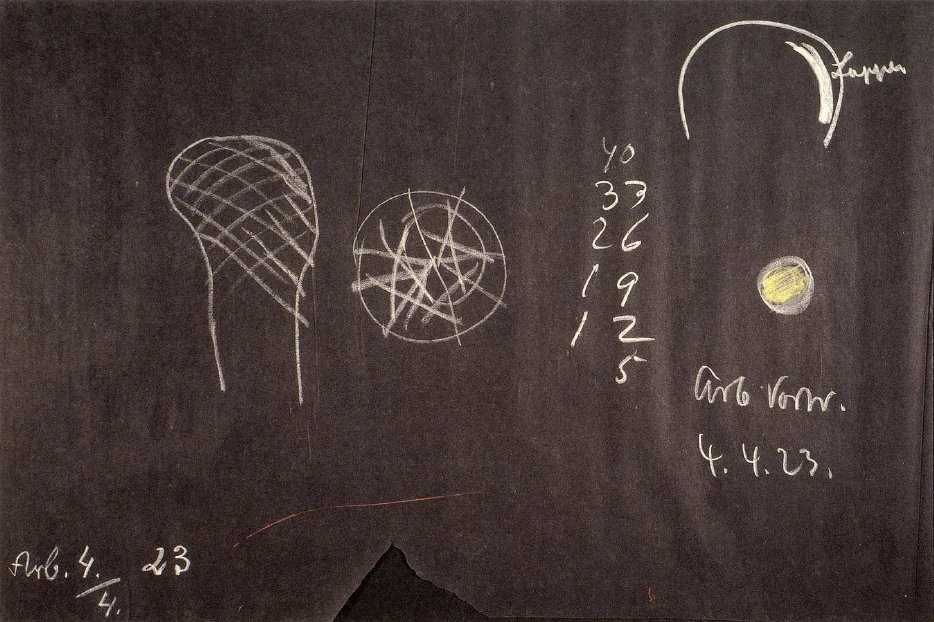
[ 16 ] If you cut off the tip of your nose—it only needs to be a tiny bit, doesn’t it? Because cutting off too much isn’t healthy, but you can cut off just enough that it doesn’t harm you—and examine it under a microscope, you’ll again find such a marvelous structure with a framework, beautifully constructed. Yes, gentlemen, you have no idea how beautiful even the tiniest part of the tip of your nose is! Admirably beautiful! And so it is with every part of the human body. It is beautifully constructed, beautifully arranged. Even the best sculptor could not do it better.
[ 17 ] There is only one structure in the human organism where everything must be destroyed and where only pure substances must remain—I already pointed this out to you last time—and that is the egg from which a human being arises. And during fertilization, the final act takes place; there, everything that the substance possesses in terms of form is eliminated.
[ 18 ] So one can say: The bone is beautiful; every individual part is beautiful. The tip of the nose is not as beautiful as the bone, but it is still very beautiful. But the egg, from which a human being will later develop, contains only a completely disordered substance, because everything within it is fragmented. There, everything is an atom; there is no structure at all inside. Why?
[ 19 ] A human soul cannot simply enter a bone. Superstitious people sometimes believe that a little devil is hiding somewhere in their bones or limbs. Well, that is sometimes true in a somewhat figurative sense, but in any case, a human being cannot enter such a bone. Nor can a human being enter the tip of your nose.
[ 20 ] I did know a lady who claimed she had a little spirit in her left index finger, and she would always ask it whenever she wanted to know something. If she was going for a walk, she would ask it, and so on. But that is, of course, nonsense, a superstition. What we must tell ourselves is this: No human being, no human soul, no human spirit can enter directly into such a well-formed bone—or even into the tip of our nose. The fact is this: the human soul-spirit, the true “I,” can only enter the embryo because there the substance is nothing but dust—world dust. This is where the soul begins to work on the world dust with the powers it has brought with it from the spiritual world.
[ 21 ] If people believe that what makes a human being is simply the result of ordinary heredity from father and mother, then one must assume that the human being is, in fact, already a tiny little human being. But that goes against science. Science, after all, states that the protein is completely pulverized. And it is from this pulverized protein that the soul—which comes from the spiritual, the supersensible world—actually builds the human body.
[ 22 ] Now you might say: But why does the child resemble its mother or father? Yes, gentlemen, it is because the child always clings to imitation. The person who says, “This child is the spitting image of its father”—well, that person could also say something else. You see—let’s wait a little while with this child—here we have a child who, let’s say, looks very much like his father or mother, even though the resemblance isn’t that pronounced; children become much more alike later on than when they’re still very small. But such matters are of no concern to the learned gentlemen. But, you see, let’s wait a bit; let’s not pass judgment when the child is eight or fourteen days or a month old—let’s wait until the child is three or four years old. By then, the child has started to speak. Then someone comes along and says: “Good heavens, the father is German, and the child is starting to speak German too—it must have gotten that from the father; it inherited it from the father, because the father is German.” Isn’t that absolutely marvelous! Since the child came from the single cell, the language must have already been present in that single cell. It’s just amazing that when the child emerged from that seed—from its mother’s womb—it couldn’t speak yet! But, you see, the child didn’t actually inherit speech; the child acquired it through imitation. The language is similar to that of the father and mother. But it wouldn’t occur to anyone to say that the child inherited the language.
[ 23 ] The face is similar as well. But why is the face similar? Well, because when the soul is born through a mother or conceived through a father—in this case, Mr. Müller—it makes the face resemble that of the father or mother, just as the child later makes its speech resemble that of the father and mother. You just have to think about that. In speech, the child works out the sounds and words by making itself resemble its parents or caregivers. But even earlier, the soul works unconsciously, like a sculptor, on the face or even on the gait and so on. And because the child is born into the family and makes itself similar to its parents while it still has no consciousness, the resemblance arises in the same way that the resemblance in language arises.
[ 24 ] You see, gentlemen, this is how one comes to realize that human beings actually emerge from the spiritual, from the supersensible world, and build their own bodies with all their characteristics. Now take a look at a small child. The small child is born. When children are born, even though all mothers find them very beautiful, one sometimes cannot really tell them apart from little animals. Isn’t it true that human beings are like little animals when they’re born—relative to how they’ll be later, of course? These little children really are quite unattractive. But gradually, the soul works within them and makes everything more and more like a human being, until the moment comes when the child learns to walk; that is, as I told you last time, it finds its place in the Earth’s equilibrium. Then the child learns to speak. It learns to use its chest organs, for these organs are located in the chest. Then the child learns to think—that is, it learns to use its head organs.
[ 25 ] Well, let’s think about this for a moment. A child learns to walk—that is, to maintain balance and move. What does the child learn by walking? Well, by walking, the child learns to use its limbs. But one cannot use one’s limbs without simultaneously engaging the metabolism. When we use our limbs, something within us is always being burned. Substances are burned. Even if you move just one arm, substances are being burned inside it. Metabolism is connected to the limbs. Walking, maintaining balance, and moving are all related to metabolism and the limbs.
[ 26 ] Then the child learns to speak. What does this have to do with anything? Speaking has to do with the chest organs, with breathing. The child can already breathe even when it is very small. But the child learns to connect words with the air it exhales using the chest organs. So: maintaining balance is connected to the limbs, speaking to the chest, and thinking to the head and the nerves.
[ 27 ] Now then, we have three aspects of the human being. Just note: three aspects. First, we have the limbs and metabolism; second, we have the chest; third, we have thinking, the head. We have three aspects of the human being.
[ 28 ] Now let’s take a look at the child. With a child, it’s like this: when it is born, it is not only outwardly unlike an adult. The cheeks are different, the whole figure; the forehead is different; isn’t it true that the child is different on the outside? But on the inside, it is even more dissimilar. The brain matter in a child is more like a brain paste. And by the age of seven, when the child gets its permanent teeth, this paste—this brain paste—is beautifully formed. For the human brain truly has a wonderful structure from the age of seven onward. This is what the soul and the spirit have created within it—the soul-spiritual has shaped it from within.
[ 29 ] But you see, gentlemen, we could not possibly develop this brain so wonderfully in a child up to the age of seven if we were not constantly in contact with the world. If, for example, you have a child born blind, you can see right away that the optic nerves—and with them a whole section of the brain—remain in a sort of pulpy state. It does not develop properly. If a person is born deaf, the auditory nerves—that is, the nerves that run from the ear, cross here (as shown in the diagram), and then continue on over there—remain a sort of brain pulp along that path. So it is only through having our senses that we can properly develop our brains during the first seven years of life.
[ 30 ] But the things you can physically grasp with your hands out there—those are not what develop your brain. You could, for all I care, stuff tangible substances into the brain through your nostrils—you’d ruin the brain, but that wouldn’t help it develop. So no tangible matter helps you in this development of the brain during the first seven years. What comes into play here is the finest matter—that which lives in light, for example. That’s where the ether comes into play.
[ 31 ] You see, this is very important. We take in the ether through all our senses. So what is it, then, that works from our head? In the child—and extending into the rest of the organism—it is not the physical body that is at work. The physical body is not at work in the child while the child is so wonderfully developing its brain; rather, it is the etheric body that is at work. The etheric body—which, as I have told you, we retain for two or three days after death—is at work within the child, and it causes the child to develop a perfect brain, thereby becoming a thinking human being. So we can say: The etheric body is at work in thinking.
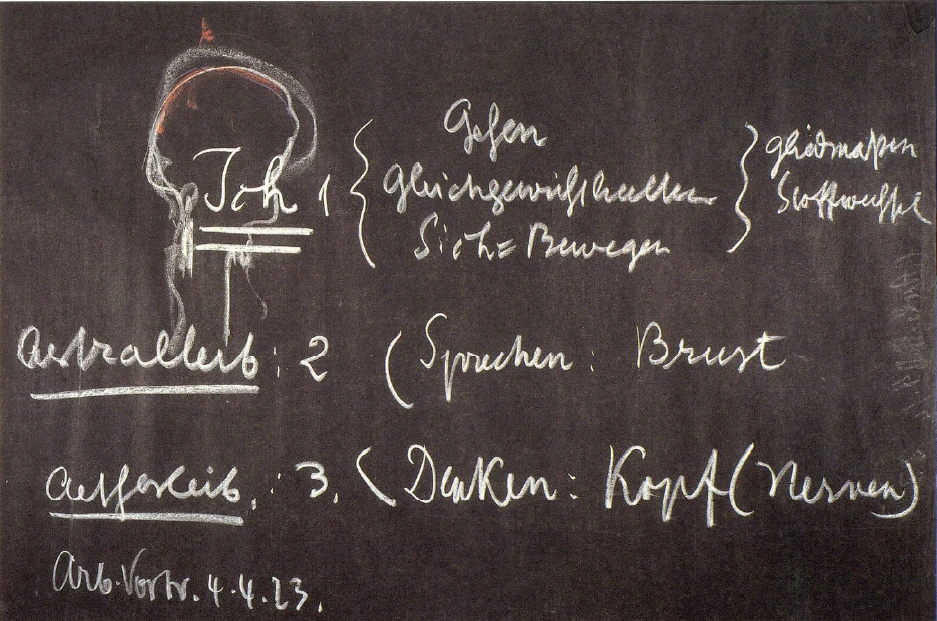
[ 32 ] Here we have rediscovered the first supersensible aspect of the human being: the etheric body. The child could not develop its brain; it could not have a human brain within it if it were not able to interact with the ether surrounding it. Later on, by exerting the muscles, you can strengthen them through physical, tangible means. But, let’s say, for example, the left parietal lobe of the brain—you cannot strengthen that through physical, tangible means. If you want to strengthen a muscle, you can do so by attaching a weight to it and lifting it over and over again, thus overcoming the force of gravity. But you have to strengthen the muscle through sensory-tangible means. Just as you have this muscle here—the biceps—and can strengthen it by lifting and lowering weights, so too, when you look at the front of the head, you have a lobe of the brain here. It hangs down here just as the arm hangs here. You can’t attach a weight to it. And yet, what happens during the development of the arm muscle cannot be compared at all to what happens with this lobe of the brain! At first, when we come into the world, it is a mass of pulp; by the time we are seven years old, it is wonderfully developed. Just as the arm muscle becomes stronger by lifting and lowering weights—that is, by handling something tangible, something visible—so the brain becomes stronger through what exists in the ether. Just as a person is connected to the environment through their physical body, so too are they connected to the environment through their etheric body. And from this comes their thinking. Through this, they develop the inner workings of their head during the first seven years.
[ 33 ] Once a person has developed the ability to think, they return, I would say, to speech. Learning to speak is something entirely different from learning to think. Learning to think, after all, works specifically on the development of our body. This thinking, so to speak, shapes us like a sculptor, I would say. This process works within us so that by the age of seven we become fully developed human beings. During this time, we also learn to speak. But you see, it is not possible for us to learn to speak in the same way that we learn to think. For when it comes to speaking, what actually happens? Well, gentlemen, you see, when you lift a heavy weight or strike out with tremendous force with your arm, your arm hurts. To feel pain means to have a sensation. We truly have a sensation when we strain a limb too much and thereby injure it in some way. Whenever you feel pain, you have injured something, even if only very slightly. That’s when you have a sensation. But, gentlemen, language as a whole arises from sensation. If you listen to a child, you can hear how language springs from sensation. The child will learn: “Ei, ei”—in its own language. What is it trying to express when it says, “Ei, ei”? It’s snuggling up. It likes the person to whom it says “ei, ei.” It rests its little head on them when it says “ei, ei.” And so it is with all words; so it is with everything that is spoken: a feeling underlies it. Yes, the feeling does not come from the brain, nor does it come from that which the brain develops from.
[ 34 ] You see, if there were no sunlight shining through our eyes, the ether that surrounds us would not be able to work on us. We would not be able to fully develop during the first seven years. During the first seven years, a child also has more than just feelings. It learns language through imitation. But within this imitation, feeling is at work. And we must say: Light cannot evoke feeling. If we learn language through feeling, then there is something else within us. That which then works within language, enabling a person to speak, is not merely the etheric body; it is the human astral body. So we can say: Second, for learning to speak, we have the astral body—that is just a term; I could just as easily say something else—we have the astral body, which acts primarily in the chest, in the breathing, which is then transformed into speech.
[ 35 ] You see, it’s always the belief that a person, with their physical body, experiences, say, hunger and thirst. But that’s nonsense. Just imagine a machine that’s powered by water. You have to give the machine water. All right, then it runs, and if you don’t give it water, it stops running. What does it mean for the machine to stop running? It means you have to give it water again; you have to give it something to drink. But the machine wasn’t thirsty to begin with. The machine isn’t thirsty; it does stop running, but it wasn’t thirsty beforehand—otherwise it would be crying out. It doesn’t do that. It isn’t thirsty.
[ 36 ] What, then, is the connection in the case of human beings? When a child is thirsty, it does not behave like a machine. It doesn’t just stand there. On the contrary, the child starts screaming loudly when it is thirsty. What is the connection, then, between being thirsty and screaming? The screaming is not inherent in matter, nor is it inherent in the ether. The ether can form the structure; it can thus form what constitutes our physical form. But the ether does not cause us to cry out. If the ether were to cause us to cry out, there would be a terrible—perhaps not a roar, but a constant hissing—in the world. For when we look, it is the ether that, together with our eye, enables us to see. The ether constantly enters our eye. That is why we see. Yes, but when the ether enters our eye, it doesn’t start inside the eye: s-s-s-e-] —, does it? That’s not the human etheric body; it doesn’t lisp. Just imagine if, simply by looking, there were a constant whispering in a hall—that would be quite a spectacle! So the etheric body doesn’t cry out or whisper. There is something else there. That is the astral body. And when a child is thirsty and cries out, it is a feeling of thirst in the astral body. And this crying out is what brings the child’s feeling to our ear.
[ 37 ] But everything I have just described to you might not yet lead to my actually leaving. For, you see, if I were to form my body from my head down through my etheric body, I could remain like a statue for my entire life. My body could be formed, I could roar like a lion; my roar could still be produced from the astral body. But if I want to find my balance as a child—if I want to use my will to walk, to grasp, to find my balance, always saying: “I walk, I grasp, I find my balance”—then it is the “I” that comes into play, which is something other than the etheric body and the astral body. And this “I” lives in the limbs and in the metabolism. When you move your limbs, it is the “I.” So you have three parts of the human being besides the physical body: you have the etheric body, the astral body, and the “I” (diagram, page 138).
[ 38 ] And you see, these three parts of the body can also be perceived if one simply trains oneself to do so. But modern science does not want this training. And now I want to tell you how modern science actually behaves when it does not want this.
[ 39 ] I’m sure you’ve all had dreams before. While you’re dreaming, you believe that it’s all real. Sometimes you wake up in utter terror—for example, when you’re standing on the edge of a precipice, feel dizzy, and fall. Then you wake up, drenched in sweat. Why? Well, because you mistook the precipice for reality. You’re lying peacefully in bed—it’s not dangerous at all—but you wake up because of the danger you saw in your dream. Just think—if you were to sleep your whole life away—that would be a nice prospect for some people. After all, there are those who sleep their whole lives away.
[ 40 ] Once upon a time, there was a guy who had studied the Copernican theory and was a terribly lazy fellow. Well, one day he was lying in a ditch. Another guy came by and said, “Why are you lying there?” “Because I have so much to do!” “Come on, man, you’re just lying there—you’re not doing a thing.” Then he said, “I have to go along with the Earth’s revolution around the Sun, and I want to stay behind! That’s inconvenient for me—it’s too much work!”
[ 41 ] Isn't it true that some people don't even want to go along with the Earth's orbit around the Sun! But we go along with it our entire waking lives. You see, if we were to spend our whole lives just dreaming, then we in Europe could lie in bed, and someone would take our bodies—perhaps even along with the bed itself, so as not to wake us—and bring us on a ship to America—of course, angels would have to do this, because humans couldn’t manage it so quietly—but we could be shipped off to America. We’d be dreaming away over there; all of that could be done to us—after all, we know absolutely nothing about ourselves. If we were dreaming there, we’d never know how to touch our nose, how to touch our left hand with our right hand. And yet, gentlemen, we’d have a whole life. If we were to spend our entire lives dreaming, it would be something else entirely—we’d be able to fly in our dreams, for example. It’s just that on Earth you can’t fly; in a dream, you do. We’d think of ourselves as entirely different beings, and so on.
[ 42 ] But consider this: there would indeed be a world around us if we were dreaming our entire lives. And we wake up. Let’s say: I wake up and I dreamed that during the night—I’ll use a very telling example right away—I was hanged or beheaded. Let’s suppose one dreams that he has been beheaded. Well, gentlemen, if one were to dream one’s entire life, one would naturally always believe that one had been beheaded. It wouldn’t bother one as much as it does here, though. One might, after all, experience it more often—dreaming that one is being beheaded—and one would believe that it doesn’t really matter. Now one wakes up—and lo and behold, one has brought a book to bed with oneself. It ended up at the back of the bed while one was tossing and turning. Now one is lying with one’s head resting on the edge of the book, and the fact that one is lying uncomfortably there feels, in the dream, as if one had been beheaded. Once one has woken up, one realizes what the dream means; after waking, one can explain to oneself where the dream came from.
[ 43 ] So first you have to wake up. Waking up is what matters. People who spent their entire lives dreaming would consider the dream world to be their only reality. We only begin to regard the dream world as a fantasy world when we wake up.
[ 44 ] Well, gentlemen, in bed, a person wakes up on their own and because the surrounding world stirs them. But from the life we are living right now—the one we believe consists only of what is tangible—we only wake up when we make an effort. And I have just described how one wakes up in that way in the book *How Does One Attain Knowledge of the Higher Worlds?* Just as one wakes up from a dream and knows that the dream is a world brought about by wakefulness, so one wakes up from wakefulness through higher knowledge and then knows that our ordinary world arises from what one now perceives of the higher state of wakefulness. That is precisely what one knows.
[ 45 ] Therefore, future science must not merely continue to daydream about the world, constantly asking, “How can this be done in the laboratory, in the physics lab?” — but rather, it must guide people to wake up. Then people will no longer say: “Human beings are merely physical, material bodies,” but instead people will say: “Human beings consist of physical matter, the etheric body, the astral body, and the I.” And regarding these, one can then say: We now know what awakens from the physical body, even when we die. For the etheric body first had to approach the physical body and shape it through the head. The astral body first had to approach the physical body, had to burrow a little into the chest; that is when the human being learned to speak. And the ego had to approach the physical body and bring it into balance with the external world. Through this, the human being learned to move his limbs and to adapt his metabolism to his movements. So human beings bring their etheric body, their astral body, and the “I” with them from the spiritual world, and they shape the chaotic, pulverized substance into an etheric body, an astral body, and an “I.” And what they bring with them when they enter the world, they carry out again through death. I have already hinted to you how this works. The fact is that when one truly takes this higher science of awakening to heart, one can speak of life after death and before earthly life just as one speaks of this earthly life. That is what we will do next time. Then the question of what a human being is like when he has no body—namely, before conception—will be fully answered.
[ 46 ] The next lecture will be on Monday at nine o'clock. Of course, it's a little difficult right now, but that doesn't matter. The reason it's difficult is simply that people are never prepared for these things in their youth. If they were prepared, it wouldn't be difficult for them at all. People today, I would say, have to struggle so that they can learn later on what they were not prepared for in their youth. But when you see that people today can only manage to say, “The military commander is merely the head of a company of soldiers,” then you will also see that modern science is in need of improvement. And that is what truly leads to an understanding of the supersensible.