

Man's Life on Earth and
the Essence of Christianity, tr. SOL
GA 349
9 April 1923, Dornach
Translated by Steiner Online Library
8. Dream, Death, and Return
[ 1 ] Let us now continue to explore the topics we have been discussing recently. I spoke to you in rather general terms about how the spiritual-soul aspect of the human being relates to sensory-physical life. Today I would like to elaborate on this further. I have already pointed out to you that if one wants to know anything about these things, one cannot say: “Yes, the intellect that I possess must decide everything, and whatever it cannot decide does not exist.”—One must simply remember that one has also undergone a process of development in ordinary life. Just imagine for a moment what it would be like if we had remained at the level of a three-year-old child! We would view the world quite differently. A three-year-old child sees the world quite differently than an adult. A three-year-old child can be taught all sorts of things. In a sense, it is still asleep when it comes to life. A three-year-old child cannot even speak properly yet; it has to be taught to speak. In general, a three-year-old child is humble and not arrogant. It is open to learning. It probably wouldn’t be so humble if it weren’t half asleep, and would say: Why should we even learn? We already know everything! — But that is exactly what people today say: We already know everything; and since we cannot comprehend the spiritual-psychic realm with our intellect, then there is simply no spiritual-psychic realm.
[ 2 ] Well, if I were a three-year-old child and said, “I don’t want to learn anything else”; if I said, “Daddy, Mommy,” and a few other things—mashed potatoes and so on—that would be enough—that would be a child’s point of view. But once you’ve acquired ordinary common sense, you can truly develop something further within yourself. And if you go on to develop the ordinary powers of cognition that you possess even further, then you end up making—I would say—a leap just like the one from a small child to an adult. All of this, of course, depends on gaining this insight and incorporating it from the very foundation into the entire process of human education. Today, people can’t help but be arrogant in this regard and say: “I already know everything, and what I don’t know is none of my business.” —- Today, people can’t help but say this because, starting in elementary school, they’ve been educated to attribute everything to the intellect they possess and to say of the other: “Well, you can believe in that, but you can’t truly understand it.”
[ 3 ] You see, one must simply be very clear that there really is such an awakening from ordinary, everyday life to true knowledge, just as there is an awakening from sleep and dreaming to ordinary life. You simply have to come to terms with the fact that one can only truly know anything about the world when one sees through what is happening from a higher vantage point, just as one must see through a dream from the vantage point of wakefulness. Only then does one know that the dream is not reality, that the dream is something that depends on waking life—if one can become awake. I told you recently: If one could never wake up, one would consider what one dreams to be the only reality.
[ 4 ] But now let’s see what a dream actually is. You see, gentlemen, people have thought an awful lot about dreams. But actually, everything that’s said about dreams is, at the end of the day, just a kind of nonsense. It really is a kind of nonsense, because people might say: Well, if the brain just starts to vibrate a little bit, then a person dreams. Yes, but why does the brain start to vibrate just a little bit? — So what is said about dreams is actually a kind of reasoning. But if you realize that a person does not only have this physical body, which one sees and can touch in life, but that they also have those aspects of their being to which I have drawn your attention—that a person also has an etheric body, an astral body, and an “I”—and if you then say to yourself: it is precisely this “I” and this astral body that are outside the physical body and the etheric body during sleep, then you can, first of all, explain why a person does not walk in their sleep. They do not walk because the “I” is not inside the physical body. You can also explain why a small child does not walk. Because the “I” has not yet awakened in the small child. So you can explain why a person walks: they walk because the “I” slips into their physical body. You can also explain why a person does not think while asleep. They do not think because the astral body is not inside their physical body.
[ 5 ] Doesn't that show you that one must, so to speak, distinguish between what constitutes the physical body and the etheric body—which remain in bed—and the “I” and the astral body, which are outside the body during sleep.
[ 6 ] Now imagine what it’s like when you wake up or fall asleep. When you fall asleep, it’s as if the “I” and the astral body are just leaving. So there is also a state where they are halfway out. Only afterward does the state come where they are completely outside—the “I” and the astral body. So there is also such a state where they are still halfway in and already halfway out. That is when one dreams.
[ 7 ] People usually think that they only dream at night. Actually, one only dreams when falling asleep and when waking up. And what does one dream about then? Well, you see, gentlemen, people believe that one dreams then because, while awake, one uses one’s brain—so today’s scholars say—but while asleep, one uses only one’s spinal cord. That is what people think.
[ 8 ] But these people are completely incapable of observing! Take a real dream, for example. Take the dream of a raging fire. You dream of a whole raging fire; you dream of all sorts of things. And you wake up—and someone outside is shouting, “Fire!” In reality, you didn’t perceive anything else—you didn’t know anything about fire or anything like that—so, because your ear was open, you just half-heard that “Fire!” Because you’re used to it, you associate it with the fire, but only vaguely. And what you dream about the fire may, under certain circumstances, be something entirely different from what you actually see. For example, you might dream that the fire stems from a volcanic eruption. You might dream something entirely different. And if you dream about something you experienced many years ago, then you’ll know just how confused the dream is. Perhaps once, as a young boy—let’s say—you had some kind of minor quarrel with someone else. Now, years later, you dream about that quarrel; but you dream about it as if you had been killed, or as if you had killed the other person. The dream confuses everything. And you can see this everywhere in dreams—that they make everything confusing.
[ 9 ] Well, when we dream as we’re falling asleep, the story remains confusing. When we dream as we’re waking up, it corrects itself because we’re actually seeing what’s right in front of us. We dreamed that someone was murdering us. He shoves a ball of something into our mouth; then he comes back and attacks us with some kind of instrument—we wake up and, unfortunately, have a corner of the comforter stuck in our mouth.
[ 10 ] You see, the dream takes a small trigger, adds a lot to it, and confuses the story. For example, if the air is stale in the room where you sleep, you experience what is known as “sleep paralysis.” But in your dream, you don’t say to yourself, “The air is stale here; I can’t get a good night’s sleep”—instead, you get the impression that an evil spirit is sitting on your chest and pressing down on you. You’re all familiar with the legend of the Trut. It stems from the idea that stale air has entered the lungs. Sleep paralysis is based on the same principle.
[ 11 ] What, then, is the basis of dreaming?
[ 12 ] Well, gentlemen, let’s now consider the waking state. In this state, the “I” and the astral body are just slipping into it and are not yet fully inside. These are the dreams we know the most about. When you are fully inside your physical body, you look out through your eyes. But if you’re not quite inside, then you don’t look out through your eyes. You have to create a mental image of it this way: When you enter your physical body, you sort of turn around and look out through your eyes. But if you’re still halfway outside, you pass through your eyes—you slip right through them—and everything appears blurry. That’s when all sorts of confused mental images take hold. But when we enter our bodies from nighttime sleep, we have nothing else but these confused mental images. And how do we make sense of them at all? We can’t make sense of them. Only our body makes sense of them for us. Otherwise, we’d be seeing Vesuvius spewing fire forever whenever we heard “Feurio” from outside. Our eyes are so wonderfully designed that it is only through them that we can see what is real. In other words, if we were outside our bodies our entire lives, we would spend our whole lives indulging in all sorts of fantastical things. It is the body that enables us to see life clearly.
[ 13 ] So you see, when we look at ourselves from outside our body, we are in reality within our self and our soul; we are dreamers who conjure up all sorts of confused mental images within our self, and who simply have to be realigned in our body every morning when we wake up. It is thanks to our body that we see things clearly. In reality, we are dreamers in our earthly life. Dreams show us what we are really like in our earthly life.
[ 14 ] When one finally comes to truly understand these things—by having, in a certain sense, awakened later in one’s cognitive development—one sees all the more clearly: In his earthly life, a human being is what he dreams. He is, in fact, a dreamer, and he must always allow himself to be guided by his body. And when he is completely asleep, he is actually completely powerless. Then he cannot perceive anything of the world at all. Only when he retains a small part of his body does he perceive the world in a fantastical way.
[ 15 ] But precisely when we know this, we ask ourselves: What, exactly, is a dream? What, exactly, does a dream reveal? A dream shows us that we actually know nothing at all about our bodies; for if we knew anything, we would be able to see clearly what is out there. We could recreate the eyes in our thoughts and in our minds. But we cannot do that; we are entirely dependent on our body to give us the power of sight. Thus, the dream shows us how little we know about our body.
[ 16 ] But now remember that I said recently that we must create this body for ourselves. Heredity is nothing. What is present when a human being begins his existence on earth is, as I have explained to you, matter worn down to dust. The spiritual and soul elements must first be infused into it. A person must first build up all of their matter themselves. If they understand the dream, they know that they cannot do this. And when one comes to see through the dream, one learns something else as well.
[ 17 ] Think for a moment about how difficult it is to transport yourself back to your earliest childhood years. Suddenly, an event comes to mind about which you know: My mother didn’t tell me about that—I saw it myself. For some people, it happens in the third year; for others, in the fourth, and so on. Yes, gentlemen, before that you were completely asleep—truly asleep. But when you look at a three-year-old child, who is actually still capable of sleeping deeply—because you don’t remember it, just as you don’t remember ordinary sleep—when you consider this three-year-old child in relation to life, they can do something that you can no longer do later on.
[ 18 ] I told you: The brain develops its fine structure until the teeth come in, until the age of seven. Look at the brain of a newborn child and the brain of a seven-year-old child. Something has happened in this seven-year-old child that has shaped this brain. The brain itself cannot do anything. The brain is like a dynamo. A dynamo generates magnetism, and the entire operation of the factory depends on this dynamo. But first, an electric current must flow through it; otherwise, the dynamo comes to a standstill. The brain comes to a standstill if the current of spiritual life does not flow through it. In a child, the current of spiritual life flows much more powerfully, for the child develops the entire brain up until the time of tooth replacement, and most intensively in the very first years of life. That is why I told you that Jean Paul, who was a very intelligent man, said: “A person learns much more in their first three years than in their three years at university.” The work one must do during this time is far more intricate than anything one will ever have to tackle externally later on.
[ 19 ] Then one says to oneself: Yes, we used to have that; we’ve lost it. Just as we became self-aware, we lost that inner spiritual work. We no longer have it. And whoever comes to this realization notices that they are increasingly unable to do it. When one later gains the ability to look back on one’s life, one feels quite dizzy at the thought of what has transpired. For when one was a fourteen-year-old boy, one might still have been able to do some of what one could do in abundance when one was a three-year-old child or even just a newborn. That’s when you were capable of the most; by the age of fourteen, you were already capable of much less. By the time you’ve reached thirty, you can barely do enough to get by—but you can no longer really work things out. By the time you’ve reached fifty or sixty, you’ve become a real donkey when it comes to this work of shaping the human body. You only realize how much of a donkey you’ve become over the course of your earthly life! It’s actually necessary to come to this realization: If you go through the period from twenty to thirty years of age, you lose some of your wisdom. If you go through the period from thirty to forty, you lose even much more. And afterward, you’ve already become a terrible fool when it comes to everything you’re supposed to process internally.
[ 20 ] But if you start with the realization—when you acquire the ability to look back on your life—you’re actually filled with respect for what a clever being you were when you were a very small child. You used to be terribly ugly; but you were able to change everything, even if you were an ugly little thing. At fifteen, you can no longer make yourself beautiful. As a small child, you can do just that. All small children can do that.
[ 21 ] So it’s important to realize: What a fool you’ve become over the course of your life. That’s an important aspect of life. It doesn’t make you immodest; rather, it makes you a terribly humble person. When you truly recognize this, you realize: When you were a small child, you were actually sitting on the donkey and driving it yourself. Now that you’ve become an old man, you’ve turned into the donkey yourself. — You see, you have to put it that bluntly; otherwise, nothing comes of it.
[ 22 ] This is also how one comes to understand what a dream means. You’ve probably experienced this yourself; in a dream, you might even think you’re the Emperor of China or something else entirely. There are many other kinds of dreams. You can dream all sorts of things. But what does a dream actually reveal to us? To find out, you simply have to observe how the dream changes over the course of one’s earthly life.
[ 23 ] Toddlers’ dreams are truly wonderful. Toddlers’ dreams show us that the child still possesses the powers within to shape its own body. They are truly cosmic. The child dreams of what it experienced before descending to Earth, because these powers are still within it. It needs these powers to develop its brain. When you have this wonderfully formed brain, which is located at the very top of the skull (drawing on page 152), it has the eye there, but here are the nerves needed for seeing. All of this must be finely worked out. It must be finely worked out. Yes, gentlemen, this cannot be worked out using earthly knowledge. With earthly knowledge, one can design machines here and there; but with earthly knowledge, one cannot design the brain. In the dreams of small children, one can still see it clearly: in their dreams, they are working out their brains. Later on, dreams also become very strange if a person does not lead an orderly life; they become increasingly disordered. And the fact that the dream is confused actually stems from the fact that one knows so little about one’s physical body, because one is not inside it.
[ 24 ] So that is the reason why one knows so little about one’s physical body: because what one received as wisdom when one descended into earthly life has been lost over the course of one’s life and transformed into donkey-like stupidity. When you wake up and say to yourself: Well, if you believe all that you just dreamed—that you’re the Emperor of China—then of course you’re a fool. But we ourselves can do nothing other than develop foolishness, because we don’t have the body. Since we aren’t inside it, we can’t help but be confused by the dream. We have completely lost the ability we had as small children to properly build up our bodies. It must come to us from the outside. When we wake up, it comes to us from the outside. But when we come back down to earth, it does not come to us from the outside. Instead, we encounter destroyed matter in the egg coming toward us from the outside. We have to build it up piece by piece.
[ 25 ] Yes, gentlemen, that is precisely what we must learn between two earthly lives. Between two earthly lives, we must learn what the dreaming human being cannot. You see, there are enemies and opponents of anthroposophy who say: “Oh, they’re just people who want to dream; they make up all sorts of fantastical things about the world.”—Yes, but the very essence of anthroposophy is that we no longer rely on dreams, because dreams show that we cannot do what we are capable of when we enter earthly life—when we enter it with that dark, unconscious knowledge we possess as small children. We are clear about the fact that we acquired this in a world that is not the world on Earth, for in the world on Earth we can only become fantasists with regard to our true self. As beautiful as this world is, we can only become fantasists with regard to our true self. The relationship to our body—our entire relationship to our body—is something we must acquire in another world.
[ 26 ] Now I want to tell you that anyone who sees through the whole thing—and thus also understands how the process of becoming a donkey keeps advancing further and further—knows this: It is easy to lose this knowledge. Well, it’s not much different from when someone takes an exam. When someone takes an exam, they often study for it for two years. Yet they forget it again quickly—terribly quickly. The same is true of the knowledge we need to build up our bodies: we can forget it quickly. Only here, “quickly” means something different than in the case of a test or an exam. “Quickly” refers to our entire earthly life. By the time we die, we have largely forgotten what we brought down into physical life at our birth. Our lifetime is roughly the time of forgetting.
[ 27 ] Now imagine that one of you has an experience that you know about: You’re growing up as a child; the earliest thing you remember happened, let’s say, when you were four years old. Suppose you’ve already turned sixty, and at the age of sixty you look back on an event; he was just four years old at the time. Now it has taken him fifty-six years after those four years to forget—to forget inwardly. For fifty-six years, the process of forgetting has grown stronger and stronger. For fifty-six years, he has become more and more like a donkey. So how many times more time did he need to forget what he still had until the age of four? Well, it took him as many times longer as 4 is contained in 56: it took him fourteen times his early childhood to forget. When he reaches the age of sixty, it will take him another fourteen times as long to regain in the spiritual world what he forgot there. So he needs 60 times 14 years—840 years. Then, in the spiritual world, he has once again acquired the ability to possess something similar to what the small child had during its first four years, in order to build himself up. This means that after 840 years, he can return to Earth.
[ 28 ] One can only calculate this with full responsibility—as I have just written on the board—if one truly realizes that this is the case, if one can examine what lies within dreams and how dreams increasingly distance us from the spiritual world.
[ 29 ] And you see, if someone walks around and, at a certain time, cannot enter their physical body at all, then they are a medium. If someone enters their physical body at the right time and uses it again, well, then they are a normal person. But if someone constantly goes about in this state without the “I” having entered the physical body—one can even walk around as a sleepwalker; one can even speak as a sleepwalker, or speak while lying in bed—then there’s no need to be surprised by this; for if, say, you throw a ball and the ground is level, it will continue rolling on its own. So under certain circumstances—if a person is not entirely healthy, if everything comes easily to them, if their body lacks the proper firmness—the activity that is otherwise present in consciousness may continue to have an effect. But then the person is an automaton. A sleepwalker is not a human being, but an automaton. And someone who speaks in their sleep does not speak anything human. Just try it once: when someone speaks in their sleep, you may hear the silliest things, because they become an automaton, and their “I” and their soul are not present within their body.
[ 30 ] But if that is even half true—if a person is only half an automaton—since the process of moving forward actually occurs from the back, meaning that a person moves forward from the rear part of the brain—if a person only moves forward halfway, then they can close their eyes, and because the optic nerves are located there in the back (on the right), they perceive something that is, however, fantastical. And then they can also tell you all sorts of fantastical things, because, after all, they aren’t actually seeing—they’re merely receiving images. The sense of hearing is located here (center). And the sense of speech is located here (left). That’s how they can talk you into things. That is why mediums speak, but they are not fully present in the world. Therefore, there is absolutely no credence to be given to what mediums say, because they are only half within their physical bodies. Absolutely no credence should be given to it. What mediums say is simply what the person perceives in his—I must use this expression again and again—in his donkey-like nature.
[ 31 ] Yes, gentlemen, but I’ve also heard of media outlets that say truly wonderful things. That’s true, too—the media do say wonderful things—but that shouldn’t surprise anyone. Because, you see, if, for example, a powerful earthquake strikes somewhere, the animals are the first to flee; the people stay behind and let the earthquake destroy them. Animals are prophetic from the outset because intelligence is everywhere; they have not yet crammed that intelligence into themselves. Thus, a medium is something that descends all the way down to the level of an animal. It can do wondrous things; it can even recite verses that are more beautiful than Goethe’s—well, because it descends to the level of animal intelligence.
[ 32 ] For those who are to attain knowledge in the anthroposophical way, the opposite is true. They must not merely slip in halfway, as in their dreams, but must know everything just as other people know it, and, in addition, what one can know when one wakes up a second time. When you wake up a second time, you get a mental image of what that is like. You say to yourself: Yes, if you have devoted a little time in your earthly life to getting to know human beings, that will help you after death. Then it will be easier for you after death to get to know the human body again. But what one must come to know between death and a new birth is precisely the inner nature of the human body. And you must be clear about this: getting to know the world is a vast undertaking. Students break out in a real sweat when they’re supposed to learn about the outer world, when they’re supposed to learn how to calculate the movements of the stars and so on; when they’re supposed to learn what the Earth looked like before the current crabs and such existed. There’s a lot to learn there. Yes, but, gentlemen, what one has to learn here on Earth about what lies outside the human being is nothing compared to what one has to learn about the inner nature of the human being.
[ 33 ] Now you might say: Yes, but you do learn about the inner workings of a human being when that person is dead; that’s when you learn everything about them. You dissect the person, and you learn from the corpse what the human being looks like on the inside. — But there is a big difference. For with all the knowledge you gain from a corpse, you can never bring a living human being into being. Of course, conception is necessary to bring a living human being into being. But in conception, the human being who has first learned in the spiritual world between death and a new birth—that person plays a part. On Earth, one can only gain insight into that which is dead. One cannot gain insight into that which is alive, let alone into that which feels and thinks.
[ 34 ] And I would not have dared to write down these figures here for you if it were not for the deeper insight that shows how a person moves further and further away from the spiritual world during his earthly life. By the time he grows old, he has moved the farthest away. When they are still a child—let’s suppose they die at the age of sixteen—well, then it’s different if they can remember back to their fourth year. They might die at sixteen, remember back twelve years—that’s three times four—and if they’ve lived to be sixteen, they actually only need forty-eight years to reappear. It’s true that you can actually work it out that way!
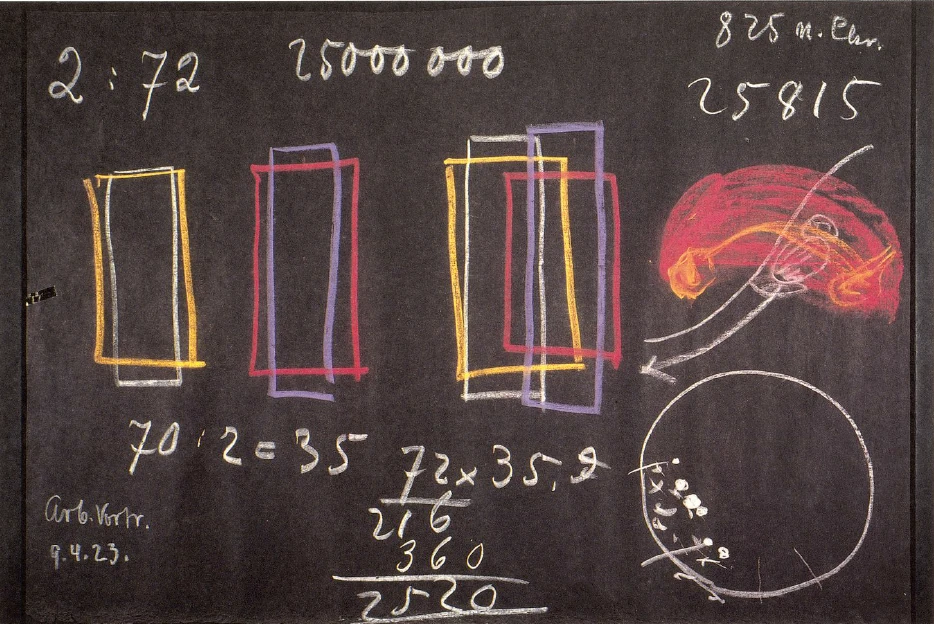
[ 35 ] But now, gentlemen, we discover something most peculiar. It is this: As you know, since ancient times the age of a patriarch has always been considered to be about 72 years. Once a person has reached the age of 72, any years beyond that are essentially a gift. Isn’t that right? That is the age of a patriarch—72 years. Now let’s suppose that such a patriarch were a truly exceptional person, as there certainly were in ancient times. We, who are so inattentive today, remember very little from our childhood. But these people could recall events all the way back to their third or second year of life. And so they had 70 years to forget the wisdom of childhood, the supersensory wisdom. That number contains two instances of 35. So they go through a period when they are in the spiritual world—once they have reached the age of 72, they can remember far back, much farther than we can today—which is 35 times 72 years, or over 2,000 years.
[ 36 ] Look, gentlemen, when you observe the sun in the spring, it now rises in the constellation of Pisces. Long ago, it used to rise in the constellation of Aries. In fact, the calendar still lists Aries as the point of rising today. But that is not correct. The sun did, in fact, rise in the constellation of Aries until the 15th century. Back then, it was correctly said: “The sun rises in the constellation of Aries.” And since then, astronomers have become lazy, and they’ve stuck with that, even though the sun no longer rises in the constellation of Aries today, but rather in the constellation of Pisces,
[ 37 ] Suppose the constellation Pisces—it has a certain size. There are twelve such constellations. When the Sun rises next year, as I said, it will be somewhere in the constellation of Pisces on March 21. And when you observe it next year, it will have moved a little further along; it will no longer rise at the same spot, and last year it was a little further back—it didn’t rise at the same spot as it does this year. It takes the Sun a certain amount of time to pass through a constellation. At first, it was at the very beginning of Pisces, and later, at some point in the future, it will be at the end of Pisces. Then it will have advanced so far that it will no longer rise in Pisces, but in Aquarius. So now it is passing through the constellation of Pisces, then later through the constellation of Aquarius, and even later through the constellation of Capricorn, and so on. To pass through such a constellation, the Sun takes about as long as it takes a human, on average, to return after reaching a very old age.
[ 38 ] It is therefore highly significant that the Sun moves from one constellation to another. In my book *The Secret Science*, I first explained that this is connected to the Sun’s cycle and to when a person returns. And we may therefore assume—as this insight also shows us—that when a person dies now, they receive from the influences of Pisces precisely what they need to learn in order to rebuild their body. And then they return when they can no longer learn anything from Pisces, but must learn from Aquarius. And then they return when they must learn from Capricorn. Then again from Sagittarius. And then they return again when they must learn from Scorpio. And then again when they must learn from Libra; then from Virgo, then from Leo, then from Cancer, then from Gemini, then from Taurus, then from Aries. Then they return to the beginning. By then, of course, they have learned a great deal. In 25,815 years, he has made a full circuit and has gone through approximately twelve earthly lives—eleven to twelve earthly lives. Now someone might say: “Yes, you’re telling us that human beings always learn what they need on Earth from a different constellation—a constellation that looks completely different.” - If you look up at the constellation of Pisces, it looks completely different from Aquarius or Capricorn, and so on.
[ 39 ] Yes, but, gentlemen, just imagine: you were there, let’s say, 800, 1,000, 1,500, or 2,000 years ago. Things were very different on Earth back then. You would have led a completely different life. Maybe you would have been some tiny, contented farmer, would have fattened up a little belly, and would have become a very contented fellow. Now you’re part of the industrial labor movement. That’s what you’ve learned from the fish. Back when you would have fattened up that little belly and been a contented farmer, you would have learned that from Aries. That’s how humans learn what they experience on Earth—precisely from the constellations.
[ 40 ] You see, now we can say: Human beings gradually come full circle. So, for example, if you had been around in 825 A.D.—that is, in the 9th century—you would have been that little farmer with the chubby belly; now you have returned under the influence of Pisces. But if you keep going around like that, after 25,815 years you’ll end up back with the Pisces. But by then you will have learned so much that you no longer need to become what you were before; instead, you will now stand as a human being on a much higher level. We simply have to acknowledge this: After 25,815 years, when we are ready to descend to Earth again, we will no longer need to come down to Earth in that way, because we will have learned everything in the corresponding constellation.
[ 41 ] And you see, this brings up the point I’ve already brought to your attention before. Isn’t it true that those who have studied geology in a very scholarly way today tell us: 25 million years ago, the Earth was like this and that. Well, how did people come to the conclusion that 25 million years ago the Earth was a molten mass? I’ve spoken to you about similar things, but not over such long periods of time. How did people come to that conclusion?
[ 42 ] For example, they’re studying Niagara Falls. The waterfall plunges down. Now they take the rock over which it has rolled and calculate how much of it is eroded each year, and then they calculate: if so much is eroded each year, how far the rock must have moved back when the water had not yet formed a body of water but existed as vapor. And from that, they arrive at these 25 million years.
[ 43 ] It’s just like when I examine a person’s heart. Today is April 9. If we examine the heart today, then again in a month, it will have changed a little; and then, another month later, it will have changed a little more. And from these small changes, we make calculations and determine what the heart was like 300 years ago. But of course, it didn’t exist back then. The calculation is correct. That’s often how scientific calculations work: The calculation is correct, but the things in question didn’t exist yet. And that’s how it is with what the Earth looked like 25 million years ago. The calculation is exactly right, but the Earth didn’t exist yet. And that’s how we calculate what the Earth will be like in 25 million years. We simply work backward from there. But the Earth won’t exist by then. Just like with the heart, which gets a little worse every day—you can calculate what it will be like in 300 years—except that in 300 years, you, as a physical human being, will no longer be here. The calculations are entirely correct. That is precisely what is so dazzling, so deceptive—that the calculations are terribly accurate; but human beings do not last as long as the calculations indicate. When you reappear after 25,815 years, the Earth will have disintegrated in the meantime, and you will already have had to discover, in your successive lives, how you must relate to the Earth in a different way. The Earth will no longer be there; you will be freed from the Earth. You will have ascended to a higher life.
[ 44 ] And so, if one truly delves into the matter, one can—in a perfectly scientific way—gain insight into the time period of which ancient legends still speak: that human beings go through a series of earthly lives, but then no longer need to return to Earth. By then, a person must have learned enough to be able to endure the fact that they will no longer receive a physical body. But by that point, a person must have gradually come to no longer have such crazy dreams as we do today, and must not have distanced themselves so far from the spiritual world in the first place.
[ 45 ] But that leads you to a very important conclusion, gentlemen. You must tell yourselves: Those people who resist becoming acquainted with the spiritual world do not want that knowledge to reach humanity. They want human beings to remain like donkeys on Earth and be unable to return. For by having already acquired something about the human being while still on Earth—and specifically something living, not merely knowledge of the dead body—they are increasingly able to consciously perceive, after death, what they must go through there.
[ 46 ] If, as certain dark-minded people claim, a person must once become a donkey on Earth and therefore remain a donkey, then these dark-minded people lead him to lose his spiritual existence altogether. They promise him eternal bliss. But just as they promise him bliss, they are in fact taking away from him precisely what has been allotted to him. That is how they must speak; it is a terrible thing!
[ 47 ] That is why anthroposophy must show people how they truly correspond to knowledge, so that they may gradually become capable once again of entering the spiritual world. You see, that is why anthroposophy is truly already a great task for humanity and has great social significance. For the entire intellect will eventually disappear. And because the intellect wants only to remain within, because what is presented as human wisdom is merely what comes from the corpse—it is actually this—and nothing else—that has caused humanity to live in such darkness and not know at all what to do. For example, in order to move beyond the endless holding of conferences and so on, and to actually achieve something, we must first truly awaken people. But people hate waking up. For, isn’t it true that when people sit down at meeting tables, it’s not just a matter of sitting down together, but of discussing something sensible; whereas people today are such that they simply won’t admit they first need to awaken, to make their minds more flexible, so that they, in turn, can regain a sense of the social question. That is why everything else is, in essence, just window dressing. But what is necessary is that people truly come to a realization of their inner being already here on Earth, so that they are prepared for what they have to do in the spiritual world. That is already the case.
[ 48 ] It does not even occur to anthroposophy to convert the individual. The individual can do nothing, but many can; and anthroposophy seeks only to help many people acquire true knowledge. Then it will be possible on this earth to truly bring about better times.
[ 49 ] I wanted to mention this to you as well, gentlemen. Now I have to travel to Zurich, St. Gallen, and Winterthur. When I get back, I’ll continue with these lectures. Perhaps in the meantime you can think about some questions you’d like to ask.