

Man's Life on Earth and
the Essence of Christianity, tr. SOL
GA 349
14 April 1923, Dornach
Translated by Steiner Online Library
9. A Symptomatic Analysis of the Astral Body
[ 1 ] Today, gentlemen, I would first like to tell you a very interesting story that took place in front of witnesses, so it cannot be scientifically disputed. Once upon a time, there was a fisherman who was holding his fishing rod. After a while, he grew frustrated that absolutely nothing was biting, until suddenly there was a tremendous tug. Something very heavy had taken the bait. He reeled in the line and was already very happy that he had caught a big fish. But what did he pull out? A very large turtle.
[ 2 ] Well, that big turtle—it stayed on the line; it had swallowed the fishhook. The hook was inside its belly, and the fisherman couldn’t get it out. The turtle pulled its head back a little further. At first, he tried to reason with the turtle, but it wouldn’t budge at all—it wouldn’t let go of the hook. So he had no choice: he hung it from a tree branch, cut off its head with his sharp knife, and let it fall to the ground.
[ 3 ] They’ll all admit: If that had happened to a human being—say, during the French Revolution or some other time when heads were rolling—well, that person would have been dead. What did the turtle do? The turtle stood up, calmly marched back into the water, and disappeared into it. It didn’t bother her at all that her head had been cut off.
[ 4 ] So you can see from this, gentlemen, that this turtle didn’t need its head at all to continue living. How long it lived afterward was, of course, not determined at the time, but in any case, you can see from this: for everything—such as walking, for example—the turtle does not need its head at all. It can walk without having a head.
[ 5 ] I’ve told you many stories about animals doing all sorts of things—including incredibly intelligent things—and you can conclude from this story about the turtle that animals don’t do these things with their heads at all, because you can easily cut off a turtle’s head, and it will still move and do everything else just fine. After all, the turtle didn’t just run off blindly, but headed straight back into the water, where it had come from. It couldn’t have done that any differently—or any better—with its head.
[ 6 ] Now you might say: This is a one-time occurrence. - But it is not a one-time occurrence, because these experiments have been conducted, and people are doing the same thing now. Anyone who can grasp the whole matter intellectually doesn’t actually need these experiments. But these experiments are constantly cited to contradict the matter. They do not contradict it; on the contrary, they confirm it. The experiments I am about to describe to you have been conducted countless times. You take a frog and cut off its head with a razor. Now the frog is there without a head. You put it back on the table. At first, it behaves extremely defiantly without a head. It sinks down a little at the front, and at the back—quite defiantly with its hindquarters—it lifts itself up and hops in place. But if you now take a corrosive acid and dab it a little on the frog’s side (it’s being drawn)—the headless frog is there, with its legs, but no head—so if you dab it a little with a corrosive acid, which would normally hurt, the frog first uses its hind leg to scratch itself there, even without a head. You can repeat this over and over—the frog uses its hind leg to scratch itself there, without a head. And if you apply even more acid, it’ll also use its front leg to help. Then, of course, it tips over to the side. If you pour even more on it, it’ll even use the leg on the other side to help itself. Then, of course, it’ll tip over. So you see, the headless frog does everything it would normally do, regardless of whether it has a head or not.
[ 7 ] Don't you see: When we go down from mammals to lower animals, these lower animals—without a head—actually do exactly the same thing that humans do with their heads and that higher mammals do with theirs.
[ 8 ] Now, however, we must be absolutely clear about what is actually going on here. So this proves something. It proves that, on top of everything else, when we ourselves feel pain here, we raise our hand and rub the spot—and we don’t need our head to do that, because a headless frog can do the same thing. So this proves that one can do that without a head. We certainly do not need our heads to scratch ourselves; we do not need our heads to walk or run. After all, the turtle or the frog can run without a head. So we do not need our heads at all to walk. Admittedly, we can’t quite live up to the fable about Lazy Hans—which you’re surely familiar with—who was too lazy to walk but very diligent when it came to eating. Someone once advised him to walk with his mouth and eat with his feet in order to develop a different habit. Of course, that’s not possible, but the point is that we absolutely do not need our heads to walk. Nor do we need our head to move our hands. What, then, do humans and higher animals need their heads for? What is the difference—now with regard to the head—between humans and higher animals compared to lower animals? Well, the difference is that higher animals and humans die if they don’t have their heads, but the frog, the turtle, and all lower animals continue to live. If you take even lower animals, for example worms—you can cut them in half—and then each half of the animal starts moving on its own. So you see, you don’t need the head at all for what the body actually does. But the problem is that you do need the head to live as a higher animal or as a human. You need it to live. And since you need it to live, you die if you no longer have it. It’s not because you don’t have a head that you can no longer wipe off the acid when you’re smeared with it as a human—it’s because you die without a head. A human no longer wipes off the acid when he no longer has a head. A human would have behaved differently if he had swallowed a fishhook and his head had been cut off. In any case, something different would have happened even before that, unlike with the turtle.
[ 9 ] So we can say: In higher animals and in humans, everything related to the head is not at all the reason we perform movements with our bodies; rather, we owe it solely to the head that we are alive. If we no longer have it, we simply no longer live. Thus, in higher animals, life resides in the head. In lower animals, however, life resides in each individual limb of the body.
[ 10 ] But now I would like to tell you something else from which you can see that there is, once again, a great difference between higher animals and human beings with regard to everything pertaining to the head and the entire organism.
[ 11 ] You have certainly already encountered this somewhat unpleasant illness in children, known as whooping cough; in some regions, it is called spasmodic cough. For children of this age, spasmodic cough is actually not that serious, since it usually resolves on its own. The real problem is actually what remains if proper care isn’t taken—that is, by doctors or whoever else is responsible—while whooping cough is present. Here’s what can happen. What exactly is whooping cough? Whooping cough is characterized by the fact that inhalation always proceeds normally—you can have a child with even the most severe whooping cough: they inhale normally; you can confirm this by examining the child—but when the air tries to come out during exhalation, it gets stuck; it doesn’t come out properly, and that’s when the coughing fit occurs. And because the air cannot come out properly, fresh air cannot come in, and that is what causes this whooping cough; that is what it consists of.
[ 12 ] But what is the underlying cause when a child gets whooping cough? You see, the underlying cause is that the inner lining of the respiratory tract—those tubes that lead into the lungs and back out again—becomes extremely sensitive. When air flows in, it also passes over these sensitive areas, because the chest cavity is empty inside, and you can always fill that emptiness with air. Just think of an air pump. An air pump consists of a glass dome here (it is drawn); you pump the air out of it. Now it is empty of air. You can then start by creating a small opening. When you remove the stopper, the air rushes in with a whoosh. There doesn’t need to be anything else under the glass dome except empty space. When we exhale, our lungs become an airless space; so the air rushes in on its own. There’s nothing special you need to do to get the air in. So you shouldn’t be surprised that air also rushes in through the sensitive windpipe, because the air doesn’t sense that. But if you want to get the air out of the air pump again, you have to do something—you have to pump it out. Likewise, you must expel the air that is inside the lungs. But now the child’s airways have become sensitive. They are just as sensitive as when you scratch yourself somewhere. So the inside of the airways is a little scraped open; they are sensitive. Instead of the volitional impulse that expels the air actually driving the air out, it scratches at the windpipe; instead of expelling the air, it focuses on scratching the sensitive spot. You see, while the child is trying to scratch, it forgets to expel the air, and then the air gets stuck inside. That’s when those spasms characteristic of whooping cough occur. Then the body tries to force the air out, whereas in normal life, what I recently called the astral body expels the air. When you look at a child with whooping cough, you can clearly distinguish where the physical body is and where the astral body is. When the child does not have whooping cough, the astral body expels the air; the physical body isn’t affected at all. When the child has whooping cough, there is a sensitive spot. The astral body wants to clear it away; the physical body must first spring into action and forcefully expel the air. This can even lead to muscle spasms, which in turn can result in a secondary illness.
[ 13 ] So you see, it is by no means the case that one can say the physical body does everything. Otherwise, one could never understand whooping cough. When someone has contracted whooping cough, there is a strange mental image to consider. One must ask: What actually happened to his astral body? Their astral body has become headless—just like the other part of the astral body in a frog! Just as a frog flaps its legs, so the astral body flaps internally within the windpipes, and the physical body is then forced to expel the air. So one can distinguish this very clearly.
[ 14 ] But now you might say: Give us some proof that the astral body—that is, the soul—is really involved here. Let me tell you what can happen when a child has had whooping cough and therefore has sensitive areas in the windpipe, and every time the astral body tries to clear that out, the child experiences these convulsive fits. Suppose, for example, that while the child had whooping cough, the parents bought a cat, or a cat wandered into their home—I’m telling you something that happens quite often. While the child had whooping cough, the parents bought a cat or a dog. As a result, the child became sensitive to the exhaled breath of the dog or cat. This wouldn’t have happened if the child hadn’t had that particular sensitivity at the time. Now the child has become sensitive during the whooping cough. Well, the whooping cough heals, but sometimes something strange remains. If the child wasn’t already accustomed to cats, and a cat comes into the house while the child has whooping cough, the result is that the child develops a condition—it doesn’t appear immediately after recovery, but later on, what is known as asthma, a recurring shortness of breath.
[ 15 ] Well, when this shortness of breath occurs—asthma is, after all, something that occurs periodically; it comes and goes—then you can examine the patient, and sometimes you find something strange. For example, a man might suddenly develop asthma, and at first you don’t know where it’s coming from. If you pay close attention, you’ll notice that whenever a cat is near him or in the room, his asthma flares up again. If you remove the cat, the asthma goes away. There, you see, he is reminded, and he doesn’t need to use his mind for that. He doesn’t even need to know that the cat is in the room. The cat can be in the room—he knows nothing about it—but he still gets asthma.
[ 16 ] Yes, I can tell you an even more remarkable case—one that’s quite strange. There was once a child who had contracted whooping cough, and during the time the child had whooping cough, a lot of buckwheat was being eaten in the house. As a result, the child became particularly sensitive to buckwheat and developed a tendency—a sort of predisposition—to asthma whenever buckwheat was in the room, or even just in the house. And then something very strange happened once, when he was already a young man, already a medical student. He lived on the top floor. Down on the lowest floor, two flights of stairs below, was the kitchen. One day, the young man upstairs had an asthma attack—a terrible one. That’s exactly how it had always happened before—whenever buckwheat was in the house. Naturally, everyone was terribly distressed. All the cooks had been forbidden to prepare any dish containing buckwheat. Buckwheat was not to be brought into the house at all. What had happened? A new cook had arrived who didn’t know this. She had buckwheat downstairs on the ground floor, and the young medical student developed asthma upstairs on the second floor! Such things seem as if they were fairy tales. But they are absolutely true.
[ 17 ] And now you will also understand how human health and illness are connected to the entire environment. It does make a difference to our health whether, for example, there are rats in our environment or not. You see, the story I told you about cats—which is so well known—is that cats are particularly sensitive to human respiratory organs—in fact, there’s even a name for it in medicine. You’ll definitely find the term “cat asthma” in medical books. This is the asthma that people get when cats are nearby. Of course, there are many types of asthma.
[ 18 ] The fact is, one really has to say: For the average person, a dog or a cat—or even buckwheat, if they are nearby—is often something completely taken for granted. This has no effect on their psyche. But if something is not right in their psyche, then it makes an impression on their psyche completely unconsciously. So what actually happens to a person who develops either cat asthma or buckwheat asthma?
[ 19 ] Well, you see, whooping cough can be cured in the following way. Let’s say you’re a child with a sensitive windpipe; the windpipe, bronchi, and bronchioles are somewhat scratched by coal dust. That can immediately cause whooping cough. Things like this arise from very tiny things. So the child has scratched tracheas. What happens when a part of the body is injured in this way? You can see that when you cut yourself. If there were only a physical body, it wouldn’t be able to hurt you at all. Imagine you’re pulling off a fairly thick glove finger. You can shape the glove just like skin. You can cut into it, and it won’t hurt you. But why does your hand hurt when you cut into it? Well, your hand hurts because, in addition to the physical body being there, the astral body is also inside. The astral body is accustomed to being inside. Now, if you cut into the physical body—you can’t cut through the astral body—it suddenly realizes: “Good heavens, there’s no physical body here! This doesn’t add up!” That hurts. Because only what constitutes the astral body can cause pain. It hurts until it has healed back together.
[ 20 ] So the story is actually this: wherever there is an injury, the astral body is left to its own devices. It emerges from the physical body.
[ 21 ] Now imagine this: you get this crack, this fissure inside the windpipe; this causes the astral body to become somewhat loose within the windpipe. Now, healing can take place this way if one proceeds very carefully: Let’s say you have a child with whooping cough; first, you put the child to bed and let it sweat properly—you can observe this step by step—so you put the child to bed, and it begins to run a fever. The astral body unites easily with heat, but with difficulty with cold. If you let the child run around outside or even just in a cold room, the astral body cannot approach the physical body because the warmth is not there. But if you wrap the child up especially warmly—people do this instinctively; they often tie a stocking around the child’s neck to trap the warmth—then the astral body begins to be drawn toward the warmth. The astral body is not drawn to anything else—such as water or air—but it is drawn to warmth. So if you let the child lie there like this for a while, and the astral body has been continually drawn to the warmth, it will have realigned itself with this limb here. Then you must take a cloth, pour some warm water mixed with a few drops of lemon juice onto it, and wrap the cloth around the area. This will draw together the incision, which in turn will absorb the astral body, and you can effectively cure the whooping cough. You just have to do all of this in the correct order.
[ 22 ] When it comes to healing, what matters is being able to see through the whole person and doing things in the right order. - And then, throughout the entire procedure, you must take great care to ensure that the child does not get frightened. For if the child gets frightened, the astral body always emerges slightly, and this in turn reverses the entire healing process.
[ 23 ] Well, if you treat it correctly, then whooping cough can run its course and the child won’t develop asthma later on. But if one treats it incorrectly, these “cracks” in the trachea, bronchi, and bronchioles do heal, and the child appears healthy—yet the astral body has not fully integrated; it always remains slightly outside. If the person is very frail—if the child is frail—then they immediately develop asthma because they never exhale properly. After all, the astral body is not sufficiently present. The part of the astral body that remains outside cannot properly participate in exhalation. But if the child is somewhat stronger, it simply uses the other part of the astral body, and the result is that only when a new illness arises later in life—for example, if the child later gets the flu or something similar—does the remaining astral body prove to be too weak, and then the child develops asthma.
[ 24 ] This way, you can really get inside people. You can figure out when the soul is at work and when it isn't.
[ 25 ] But now take a look at a person with asthma. That’s the astral body at work. It’s constantly scratching internally, just as a frog scratches externally when you splash acid on it. You see, there you have it, gentlemen; there you have the astral body, which behaves like a frog, like a turtle. We can actually study how our astral body behaves by observing lower animals. If the head could be involved in this activity of the astral body, then things would proceed quite differently. But we simply cannot access it with our head. That is the point: with our astral body, we are not yet human. With our physical body, we are human on Earth, but with our astral body, we are not human on Earth.
[ 26 ] What is the result of this? Well, it causes even this astral body to behave like an imperfect being. It behaves in an animalistic way. So imagine you are “educating” a person by, say, constantly beating them. It is, in fact, remarkable how widespread this kind of “spanking education” still is. There is a man today—I don’t usually find him likable; he bores me—but he is very interesting. He has also traveled around Europe; he was even in Basel: Rabindranath Tagore, who captivates people today. Isn’t it true that an Asian like that is something else entirely; everyone rushes to see him! A European could certainly achieve much more; but an Asian—that’s what interests them—he’s a rare breed! You see, he has now published his autobiography. The autobiography is actually rather boring as well; but it is nevertheless very important to read the first chapters of this autobiography. There he recounts, in fact, how he was constantly beaten by everyone. Precisely a man who is now one of those learned Asians, one of those learned Indians, traveling all over Europe, recounts that the entire educational system was actually designed to constantly beat the children. So this isn’t just a European peculiarity. Precisely from this autobiography, one can see that Asians, too, were terribly beaten.
[ 27 ] Well, isn’t it true that Tagore went on to become a poet, became all sorts of things, and as a result, this aspect no longer comes across so clearly. But if a child is constantly beaten, this affects not only the physical body—precisely because the child’s mind is not constantly active—but also the astral body. And the result is that the astral body becomes like a beaten dog. You can tell the difference between a beaten dog and a lovingly raised dog very clearly. It is the same with human beings. It is also true of human beings that if they are beaten as children—later life may make them a little more courageous—their astral body remains battered throughout their entire life, because it is still at the animal level.
[ 28 ] Yes, you see, gentlemen, this is where you realize that it is not only physical beatings that affect the astral body. Physical beatings cause, at most, welts. It is not the physical impact that leaves the astral body battered, but the moral impact. In this astral body, we carry with us our moral imprint of our entire earthly life. And it is indeed true: one person was beaten as a child; later on, he has an astral body like that of a beaten dog. Another person beat his teachers—there are such people, after all—and he has an astral body like that of a lion. One looks inwardly like this—one could also say, in terms of the soul, or let’s say astral, because “soul” has already become a very abstract word and people no longer associate any meaning with it—one becomes inwardly astral in such a way that one takes on one form or the other, depending on the moral impressions one has had in life.
[ 29 ] But that is true of life as a whole. If a person has a servile nature, he accepts everything differently than someone with a free, independent nature. If a person has a servile nature, they put up with everything. Then their astral body becomes stooped, taking on something dog-like simply through that. If a person has a free nature, they do not put up with everything. Their astral body, however, becomes more human-like precisely because of that. There we see what actually happens to a person during their earthly life.
[ 30 ] But now, gentlemen, we are dying. We have made this clear to ourselves; only the physical body is falling away from us. It is departing. But this form, which I have now described here, remains. You will pass through death with it. And anyone who has acquired higher knowledge through the methods I have described—which are described in detail in my book, *How Does One Attain Knowledge of the Higher Worlds?*—can now distinguish precisely what kind of character a person carries with them through death. The moral imprint of their life is contained within it. Now you must enter the world from which you will shape your next earthly life.
[ 31 ] Yes, gentlemen, if you were to enter the world from which you shape your next earthly life with an astral body that had been shaped by the hardships of life, you might become a dog. But a human being cannot become a dog; that is the whole story. Through death, a human emerges from the moral impression of their life in such a way that they could become anything derived from that moral impression. If someone has been brave, they could become a lion. Perhaps some people might actually find it pleasant to become a lion in their next life. But a human simply cannot become a lion, because they are not predisposed to it by the world, by the cosmos. Another person feels a bit like a cat; he would like to become a cat.
[ 32 ] Isn’t it true that ignorant people accuse the anthroposophists of believing that the soul follows along and enters into animals, and that the transmigration of souls consists in the soul subsequently entering into animals? That is, of course, nonsense. What is true about this is that the soul retains an impression of it: after death, one is lion-like, cat-like, tiger-like, or crocodile-like. And since one must become human again, one must first shed these qualities. And this is precisely what one sheds during that one-third of one’s life that I told you about last time. When someone has reached the age of sixty, it takes them twenty years to do so. This is not just a figure of speech; we know this because, curiously enough, when a person falls asleep at night, that is exactly what happens. That is simply how they prepare for it. And sleep lasts, in total, one-third of a person’s life. Such a one-third of a person’s life—such a period of time, which thus takes up one-third of one’s lifetime—is what is needed to free oneself from this moral impression.
[ 33 ] But, gentlemen, when you’re asleep, you simply aren’t aware of the whole story that unfolds between falling asleep and waking up. And that’s a good thing. Because that way, the moral impression you have comes through only a little, like a conscience. If you had to watch it all unfold, it would have a much stronger impact.
[ 34 ] And why is it that only a faint sense of what one experienced in sleep comes through as a kind of conscience after waking up? Because one is submerged in the physical body, which obscures it. Otherwise, when waking up in the morning, one would remember everything that sleep had revealed—what a dreadful person one really is. You actually experienced all of that during sleep. It sometimes creeps into your dreams. And such dreams—in which something like that creeps in, revealing just what a dreadful person you really are—are particularly interesting to study. But generally speaking, one is unaware of this. However, when one no longer has a physical body after death, everything that is in the astral body enters the “I,” and one now holds it within the “I.” Now one must go through the entire period. Once one has shed the astral body, what one has shed remains only within the “I.” But one can now, in turn, prepare oneself thoroughly for the proper physical body of the next life. This takes as long as I explained to you last time.
[ 35 ] So you see, one need only look closely at human beings as they are now in their earthly lives to gain a very accurate mental image of how these four aspects of the human being—the physical body, the etheric body, the astral body, and the I—are connected.
[ 36 ] Look, gentlemen, I want to tell you something else: Imagine there is a heart inside a person. So it’s sitting there. Two nerve strands lead to the heart. They start from the back, run down, and head toward the heart. One of them goes there and then spreads out within the heart. Then there’s another one that also branches out into the heart. Now imagine that I’m sending an electric current through the nerve. I notice something strange: The heart starts to beat faster and faster. Why? Because the electric current stimulates the nerve, causing the heart to beat faster and faster. The electric current stimulates the nerve.
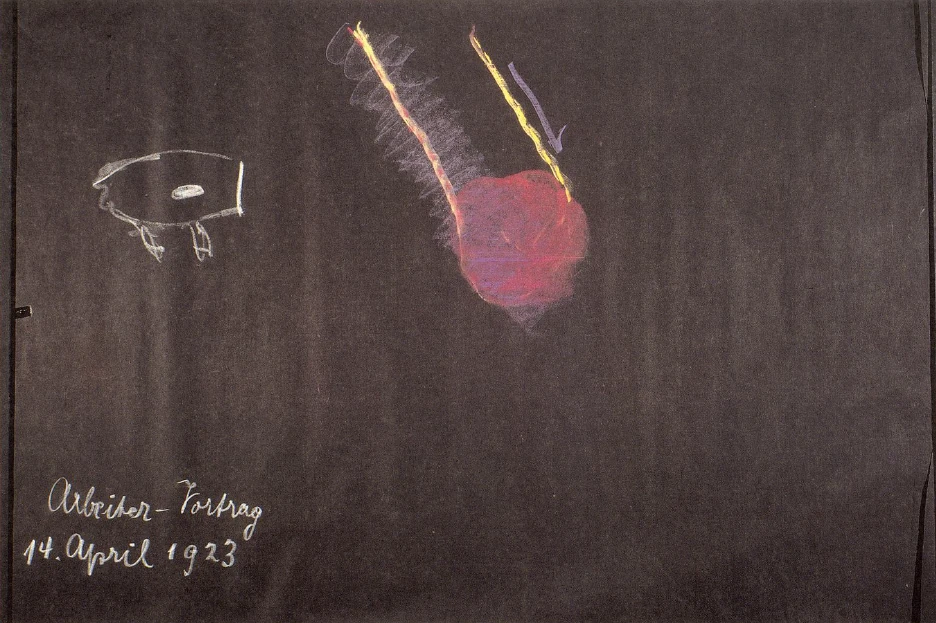
[ 37 ] But now imagine this: I’m not stimulating this nerve, but rather the other one—the second one. You might think, “A nerve is a nerve. I’m stimulating it there.” And you might assume, right, that the heart would start beating faster and faster again. But that’s not the case. When I apply an electric current to this nerve here (the first one), the heart beats faster and faster. But when I apply an electric current to this one here (the second one), the heart beats slower and slower. And if I apply a very strong current, the heart stops beating altogether. I have to stop quickly, otherwise the person will die of cardiac arrest. Yet the fact is that there is absolutely no difference in the structure between this one nerve and that other one. They’re both structured in the same way. So, what’s going on here?
[ 38 ] You see, this is how it works: When this area here is electrified, the astral body enters it and stimulates the heart to beat faster, because the electric current, so to speak, relieves it of a task that it would otherwise have to perform itself. Thus, the heart can work faster. But now suppose this part were electrified (the other nerve). Now the astral body wants to make the heart beat faster; but from the other side, an obstacle is placed in its path. As soon as it tries to make the heart beat faster, it cannot get through on the other side. This stimulation (at the first nerve) benefits it because it relieves it of some work. This stimulation (the second one), however, harms it because it works against it. If I could enter the heart and stimulate it from there, that would also make the heart beat faster and faster. But if I stimulate this nerve from the outside, then this astral body cannot move the heart, because it faces an ever-increasing obstacle.
[ 39 ] From this you can see that it is possible to recognize quite precisely how things actually take place in the human body, how the astral body intervenes on one side just as if, say, I wanted to turn a wheel: I give it a push here, and I keep turning it; but if I turn it in the opposite direction, it won’t work. It is the same with the heart, the same with the lungs, and the same with every organ. Every organ is supplied with nerves from two sides; but what actually intervenes is the astral body.
[ 40 ] Now you might say: But isn’t it perhaps the head that is actually active in the astral body at that very moment? — No, gentlemen, if it were the head, you would have to apply an electric shock at the top, near the head. But that wouldn’t help you at all; you must apply the electric shock from there. If you cut off the head from the astral body, it still affects the same spot, just as it does with a frog or a turtle. You must apply electricity where the nerve is still located—the one that even the frog retains. This spot is called the medulla oblongata, or the elongated medulla. That is where you must apply electricity, and the head need not be aware of any of this at all.
[ 41 ] Incidentally, it’s also very easy to see from other sources that the head doesn’t need to know anything. Yes, just think: first of all, if you had to make your heart beat from your head, that would be quite a story. The heart would have to beat seventy-two times every minute, so you’d have to think about it seventy-two times every minute. That simply wouldn’t work. And when you sleep, your heart would have to stand still. So the mind has no part in these movements that take place within a person. They are carried out just as they are in a frog or a turtle.
[ 42 ] When we have asthma, these internal movements occur in a pathological manner, whereas when we are healthy, they occur normally. You can see from this that everything that takes place within a person—movements and so on—occurs unconsciously and is guided by the astral body.
[ 43 ] And it is this astral body that, after death, must, so to speak, first convey to the “I” the moral impression it has received from the world. Then the “I” can once again form a human life on Earth. These years after death, during which a person lives in such a way that they can shed this inner astral form they acquired during their lifetime, are therefore a time for them to prepare once more for a new life on Earth, where they can truly be human.
[ 44 ] And how does one bring into this new human life what one had in the previous life? Well, you see, gentlemen, the fact is that the child sleeps at the beginning of its life. If the child were conscious, it could not carry out what the “I” has brought with it; after all, it has only been weaned from the astral body. In the astral body, the “I” is still present; however, the “I” does not need to be active before conception—rather, the astral body must work, the astral world must work, just as I told you recently, from the stars. The child must enter the world asleep; it learns to walk, learns to speak, learns to think. As it does so, it pours into the acts of walking, speaking, and thinking that which constitutes the moral impulse from its previous life and works it out. That is our destiny.
[ 45 ] This does not infringe upon our freedom. I believe I’ve told you this before. We carry our destiny within us; we shape our own destiny. But our freedom is not impaired, any more than our freedom is impaired by the fact that we have black or blond hair, brown or blue eyes, or cannot reach the moon. Likewise, our freedom is not impaired by the fact that we bring this or that with us from our previous earthly life—this or that aspect of being human. But people differ in that they bring this or that with them from their previous earthly life.
[ 46 ] Now you might say: But that leads us back to the idea that we will continue to return to further earthly lives for all eternity. — No, gentlemen, there was once a time on Earth when human beings had not progressed any further than a small child does today. Back then, at the beginning of Earth’s history, in primeval times, he could not yet walk, speak, or think. He was in such a state that—because the Earth—now remember what I’ve told you before about the Earth—was still thick, not surrounded by air but by a thick sauce, as I told you back then—he did not need to learn to walk. Back then, this thick sauce carried him. He was also more animal-like, guided more by his astral body. In relation to the physical body, he has become human today. In relation to the astral body, however, he still stands at the animal stage where he once stood. He did not bring anything with him from that time; rather, it developed gradually. As the human being learned to walk, speak, and think, what constitutes his destiny also came into being. And when the human being now learns once again to take in something spiritual during his life, he also weans himself off the animal nature, and then he acclimates himself to a world in which he no longer lives in the way of walking, speaking, and thinking, but in a different way.
[ 47 ] So there is an in-between space between these two states, and in a certain life we find ourselves in that in-between space again and again.
[ 48 ] Well, you see, gentlemen, there’s still one more question. We’ll have to discuss it next time, next Wednesday at nine o’clock. It’s that important question that keeps coming up, when someone says: “Well, it’s easy for you to talk about your previous earthly life, but I don’t remember it. What I don’t remember, I don’t believe in.”—Next time, I’ll explain to you how this matter of remembering works and what it’s all about. Then we’ll have made a bit more progress. Then we’ll have more or less settled the question we’ve been preparing for.