

Man's Life on Earth and
the Essence of Christianity, tr. SOL
GA 349
18 April 1923, Dornach
Translated by Steiner Online Library
10. Why Can't We Remember Our Past Lives?
[ 1 ] Good morning, gentlemen! Now let’s expand on what we’ve been discussing. As I told you at the end of the last session, people mainly object: “That may all be true about life before we enter an earthly body, and also about previous earthly lives, but why don’t we remember it?”—And today I will first answer this question in detail: why we do not remember, and what this memory is like.
[ 2 ] Now we must first consider something about the human body, because this is really a matter of expressing oneself scientifically.
[ 3 ] You see, in this regard—the question of repeated earthly lives—people today are downright ridiculous in the way they judge those who knew or know something about these repeated earthly lives. There was a truly great mind within German civilization, Lessing, who lived in the 18th century. This Lessing achieved an extraordinary amount intellectually. He is still widely recognized today. And when professors of German literary history lecture at universities, they often spend months lecturing on Lessing. You probably also know that one of the Lessing scholars—as they say—has written a book that can even be found in social democratic literature, by Franz Mehring, titled *The Lessing Legend*. In it, Lessing is portrayed from a different perspective. One cannot say that what is presented there is correct; but in any case, even within the social democratic literature of Franz Mehring, there is a very thick book about Lessing. In short, Lessing is held up as a truly great man. But this Lessing—whose plays are still performed everywhere in theaters today and are highly regarded—wrote a shorter work when he was already very old: *The Education of the Human Race*. And at the end of it, he states that one cannot really come to terms with the contemplation of the soul, that one cannot truly know anything about spiritual life without assuming the existence of repeated earthly lives, and that, if one thinks about it further, one actually arrives at the very views that primitive people already held. For they all believed in repeated earthly lives. This is something from which people only later departed, as they became “modern.” And Lessing said: Why should something be considered foolish simply because the oldest, the earliest humans believed in it? — In short, Lessing himself said that he can only make sense of the spiritual life of human beings if he adheres to this primordial belief in repeated earthly lives.
[ 4 ] Now, as you can imagine, this is a terrible predicament for our so-called researchers today. Because these researchers say: “Lessing was one of the greatest men of all time. But the idea of repeated earthly lives—that’s nonsense.” — Yes, how does one deal with that? — Well, Lessing was just old by then. He had become senile. We don’t accept the idea of repeated earthly lives! — You see, that’s how people are. As long as something suits them, they accept it and label the person in question a great man. But if he just happened to say something that didn’t suit them, then he’s considered to have become senile at that time.
[ 5 ] But sometimes very strange things happen there. For example, there’s a great natural scientist, William Crookes. Well, I don’t agree with everything he says, but in any case, he’s considered one of the greatest natural scientists. He lived during our time, at the end of the 19th century. Well, he always spent his mornings working on the natural sciences. He’d have to go to his laboratory, and that’s where he made great discoveries. We wouldn’t have any of this—X-rays and so on—if he, Crookes, hadn’t laid the groundwork for it. But in the afternoons, he always devoted himself to the study of the soul. As I said, I don’t agree with everything he said, but in any case, that’s what he was concerned with. So people had to say, didn’t they: “Yes, he must have been smart in the mornings and stupid in the afternoons—smart and stupid at the same time!” That’s just the way things are.
[ 6 ] Now here’s something else. You’ll hear this everywhere—I’ve already explained it to you when I was talking about colors—natural scientists regard Newton as the greatest natural scientist of all time. He isn’t, but that’s how they see him. Now here’s another problem. This Newton, whom people regard as the greatest natural scientist, has also written a book about what usually forms the end of the Bible—the Apocalypse. So, yet another problem!
[ 7 ] In short, those people who reject any possibility of conducting research into the soul at all place even the greatest natural scientists—and even the greatest historians—in a terrible predicament, a truly terrible predicament, because if one truly takes science seriously, one has no choice but to extend that science to the spiritual realm as well. And opportunities to do so can be found everywhere. I have told you: One simply has to observe. Now, one cannot always foresee everything in everyday life, especially if one has not first learned how to do so. But nature—and sometimes humanity itself—conducts experiments for us that one should not attempt to bring about artificially; yet once they have taken place, one can study them. One can use them as a guide, or at least draw inspiration from them. Now there is an experiment that is actually important—and characteristic—if one wants to accept anything about the inner life of human beings. As for the physical body, everyone accepts it, for otherwise they would all have to deny the existence of human beings. That is not a matter of dispute. Everyone has one. Now, modern science says: The physical body is the only reality; we must explain everything in terms of the physical body.
[ 8 ] Now there is something that, if we observe it correctly, suddenly shows us that human beings also have the three other bodies: the invisible etheric body, the astral body, and the “I.” There is one thing that can be observed entirely from a scientific perspective—there are many such things, but one in particular that can be observed in this way, and which then shows how a human being can actually enter states in which he reveals to us that an etheric body, an astral body, and an “I” exist.
[ 9 ] You see, there are people in Europe who feel the need to numb themselves. Nowadays, of course, other substances are often used as well. I’ve told you that people now use cocaine, for example, to numb themselves; but opium has been used in Europe throughout history to numb oneself. There have always been people who, when they were dissatisfied with life or had too many worries and didn’t know what to do, would simply get high on opium. They took a little opium—always just a small amount. What happened then? First of all, when someone takes a small amount of opium, they enter a state of inner experience; they stop thinking and begin to dream in wild images. They like this very much; it makes them feel very good. These dreams become increasingly intoxicating. For some, this leads to a sense of gloomy misery; they begin to turn inward and behave like sinners; others start to rage and run wild, even developing a desire to murder. And then people fall asleep. So this opium use actually consists of people using an external poison to violently bring themselves into a state that involves slowly drifting off to sleep.
[ 10 ] When you consider everything that is actually going on inside a person, you come to the conclusion—as we can see—that a person first enters a state of very vivid dreams, begins to fantasize, and then falls asleep. So something has left them. Precisely that which makes them a rational human being—that which lives within them, enabling them to be a rational human being—has left them. It is gone. But before it leaves, and even after it has left, they live in the wildest, most agitated dreams. After some time, he wakes up and is, to a certain extent, restored—until he begins taking opium again. So he transforms himself, albeit turbulently, into a sleeping person.
[ 11 ] Now one can see: When a person falls asleep under the influence of opium, it is not the part of him that makes him rational that is at work, but rather the part that sustains his life; otherwise he could not wake up again, otherwise he would have to die. It is the part that sustains his life at that moment that is at work within him. And one can see how, even at night, there is a certain struggle within the body so that one can wake up again. So something is at work within the person where reason is not involved—that which, in turn, animates the body. The poison causes the body to wither somewhat. This drives reason out. But the life-giving force is still within him, for otherwise he could not wake up again. So what has been influenced by a small dose of opium? The life-giving principle. A small dose of opium has affected the etheric body.
[ 12 ] Now imagine that someone takes too much or deliberately poisons themselves with opium. The same thing doesn’t happen; rather—and this is quite strange—what happens is what ultimately happens with a mild dose of opium. What happens last in that case happens first with a strong dose of opium: the person falls asleep immediately. So it doesn’t slowly erode one’s rationality; rather, rationality vanishes rapidly—very rapidly. But something remains within them now that wasn’t there at all with a mild dose of opium. You can see that, too.
[ 13 ] Physical body, etheric body: mild opium use; astral body: heavy opium use; I: habitual opium use
[ 14 ] So let’s assume that someone takes so much opium that they are truly poisoned. The first thing that happens is that they fall asleep. But then the body begins to become restless and irrational; they wheeze and snore; then convulsions set in. And at that point, you notice something quite peculiar: the face turns completely red and the lips turn completely blue.
[ 15 ] Now, remember everything I told you last time. I told you: All breathing disorders occur during exhalation. Well, what exactly is snoring, for example—first a wheezing sound, then snoring—what exactly is that? You see, people who can’t exhale properly are the ones who snore. When a person exhales properly—if they’re using their mouth—the air goes in, and after a while, it comes back out; the uvula, which you can see when you look inside the mouth, is involved in the airway. And then up there is something that moves up and down—the soft palate; that moves. The uvula and the soft palate move continuously as a result of inhaling and exhaling, when this happens normally and correctly. But if inhalation occurs and then exhalation doesn’t happen properly—if it gets stuck—then these parts here, the soft palate and the uvula, start to tremble, and that’s what causes the rattling and then the snoring.
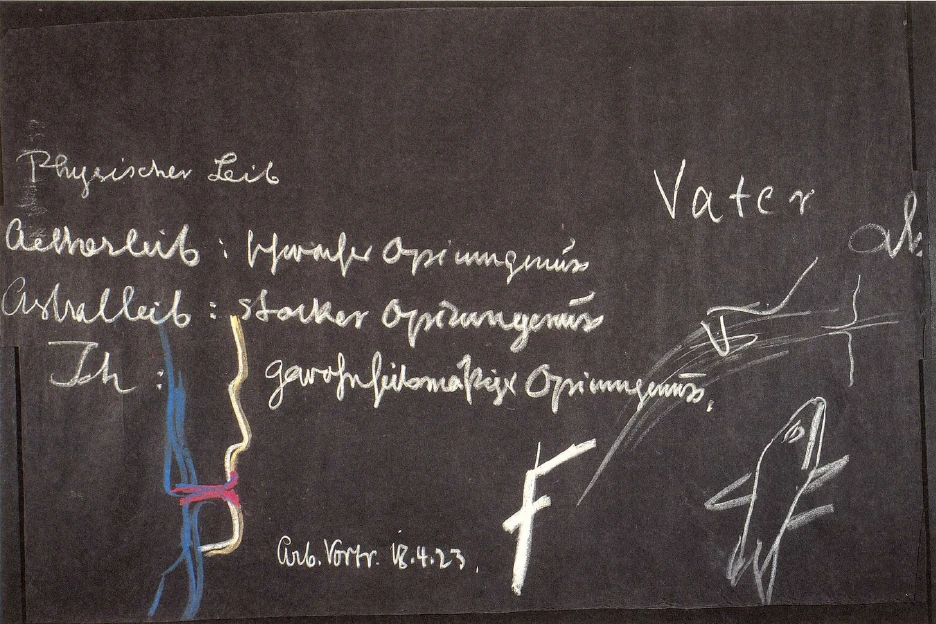
[ 16 ] So you can see from this that it has something to do with breathing. For anyone who induces an opium high with just a little opium enters the other states I have described to you: a kind of opium delirium, a frenzy. He slowly falls asleep. But if they fall asleep quickly after consuming a large amount of opium, they begin to snore and experience convulsions; their face turns red, and their lips turn blue. If you recall everything I’ve told you, you’ll attach great significance to the fact that the face turns red and the lips turn blue. For I have told you: Human blood is red because oxygen is inhaled. When blood mixes with oxygen, it turns red; when blood mixes with carbon dioxide, it turns blue. When it is exhaled, it is blue. So when you see someone with a red face and blue lips, what does that mean? It means there is too much inhaled air in the face—too much red blood resulting from inhalation. And what does it mean that the lips are blue? There is too much of the blood that is actually supposed to be expelled. It’s stagnating inside. It could continue on to the part of the lung where carbon dioxide is released, where it can be exhaled. — So, in a person poisoned by opium, the entire respiratory process comes to a standstill. And as a result, on the one hand, the red blood appears in the face, and on the other hand, the blue blood appears in the lips.
[ 17 ] This is extraordinarily interesting, gentlemen. What exactly are the lips? You see, the lips are very peculiar organs on the face. If you have a face, you actually have to draw it this way, and everywhere else the skin faces outward; everywhere else it is covered with skin on the outside. But the lips, in fact, are a piece of inner skin. There, the inside comes to the outside. There is a small piece of inner skin. Humans open up their inner self to the outside by having lips. So if your lips are blue instead of red, that means that everything inside is too heavily filled with blue blood. — So you see: In someone poisoned by opium, the body functions in such a way that it sends all the unused blood outward—it pushes to the surface—and sends all the blue blood inward.
[ 18 ] Even the people of old knew these things—the story of blue blood within. If someone had too much blue blood inside, they would say: “The one who has too much blue blood inside is, first and foremost, a person with little soul—one whose soul has departed.” That is why “blue-blooded” became a term of derision. And when people referred to the nobility as the “blue-blooded,” they meant to say: Their souls are gone. —- It is very remarkable how these things live on in folk wisdom in such a wondrous way. That is very interesting. You can learn an immense amount from language.
[ 19 ] But now you can see: there is something that has an effect in human beings but not, for example, in plants. For if you introduce a toxin into a plant, the toxin remains somewhere near the top and does not spread throughout the plant. You’ll find, for example, a very poisonous plant in what’s called belladonna, or deadly nightshade. Yes, the deadly nightshade keeps its poison right at the top; it doesn’t let it permeate its entire being. When a human ingests such a poison, it affects the body in such a way that it drives the red blood outward and the blue blood inward. Yes, plants are alive, too. These plants have their etheric body within them; they contain within themselves that which remains blue—which stems from the mild use of opium, not from the strong. That is what first produces the sensation in humans. If the plant had blood, it would also have a sensation like that of humans and animals. Humans and animals experience this without the use of opium when the etheric body conflicts with the physical body; the blood is immediately forced outward, and something remains behind in the body, causing this disorder within the body. And that is the astral body. So one can say: The astral body is influenced by the strong use of opium.
[ 20 ] Now there is a third way of consuming opium. This method of opium consumption is actually very widespread throughout the world—though not in Europe—but rather, for example, among a certain class of Turks and, in particular, in Asia and the East Indies, among the Malay peoples. These people always take just enough opium to barely tolerate it—enough so that they can wake up again properly and not die from it. In this way, they experience, in a strange and interesting manner, everything that an opium user generally goes through. Only they gradually become accustomed to it, and as a result, they go through the experience more consciously. The Turks then describe it this way: “Yes, when I have taken opium, I have been in paradise.” — So this is already the case in these fantastical manifestations. And the Malays in the East Indies—they, too, would like to see all of that. As a result, they become accustomed to opium use because they, too, want to see all of that. Now, this can be carried on for a relatively long time, and as a result, one comes to say to oneself: “Well, yes, there is simply something else.”
[ 21 ] But one must say: If these people, who habitually consume opium—for they do consume it out of habit—if these dreamers could only see that, then after a while they would come to their senses. But, you see, this is very strange. For these people are descended from the first humans on Earth who still knew something of the eternal soul—the soul that passes through the various earthly lives. They knew something of this. Now this knowledge has been lost to humanity. These people, who have not experienced European civilization, use opium to put themselves into a state where they can sense something of the soul’s eternity. It is terrible, of course—but they are repeatedly bringing illness upon themselves. Because the healthy body in the present, if it does not exert itself spiritually, can know absolutely nothing of the immortality of the soul, these people gradually ruin their bodies so that, little by little, the spiritual is forced to the fore.
[ 22 ] Now, one can observe something very peculiar when looking at people who habitually take opium in this way and are therefore able to tolerate it for a while: after some time, they become very pale. Even if they once had a healthy complexion, they now become pale.
[ 23 ] 1This means something entirely different for a Malay than it does for a European. A Malay really does look like a ghost when he turns pale, because his skin is yellowish-brown. Then, after some time, people look as if the area around their eyes were completely hollow. Then they begin to lose weight, after having already started to have difficulty walking; they walk with a limp. Then they begin to lose the will to think and become very forgetful. And finally, they suffer a stroke.
[ 24 ] That is how the symptoms manifest. It is very interesting to observe. Before the limbs become stiff, so that they can no longer walk properly, they experience severe constipation; in other words, the bowels are no longer functioning. From what I have described to you, you can see that the entire body is gradually being undermined.
[ 25 ] Now, however, there is something most peculiar. There isn’t much experience in this regard yet, because people don’t pay attention to it; but such experiments could be conducted very easily. For how these people become habitual opium users is well known—it has been described many times. But now people should just try it once—which they do very frequently today in other contexts—: If they give an animal the same dose of opium that a person takes for habitual use, then the animal will either become only slightly more lively—that is, enter the first stage, where the etheric body is thrown into disarray—or, if it receives enough, it will enter the second stage and die. In animals, there is no such effect as that experienced by the opium user—the habitual opium user—as I described to you just now. In animals, this does not occur.
[ 26 ] What does this show, gentlemen? Yes, it shows this: When opium, as potent as it is here, enters the astral body and causes an imbalance between blue and red blood, blue and red blood constantly rush through the animal’s body in a jumbled, horizontal direction. In humans, who learn to walk upright, the blue and red blood do not flow entirely in the direction shown in the diagram, but rather—because they stand upright—intermingle; no longer horizontally, but from top to bottom and from bottom to top. This means that humans, too, can become habitual opium users.
[ 27 ] But I have already told you: It is because human beings stand upright that they have an “I.” Animals have no “I” because their backs are horizontal. So what, then, is influenced by this habitual opium user? The “I.” Thus we can say: “I” – habitual opium use. And now, through opium, we have discovered all three of the human bodies that are supersensory: the etheric body for light opium use, the astral body for heavy use, and the “I” for habitual opium use. You see, if one can only observe correctly, this can be wonderfully elucidated through the natural sciences.
[ 28 ] But you can see now, too: A Malay like that, with his habitual opium use, ends up with something enormous. He arrives at the “I.” And what does he get? What is this Malay or this Turk looking forward to when he habitually uses opium? What is he looking forward to? Yes, he looks forward to it because then his memory awakens in a wonderful way. He quickly surveys his entire earthly life and much more besides. On the one hand, it is terrible because he achieves this by making his body sick; on the other hand, however, the desire to know the “I” is so strong within him that he cannot resist it at all. He is already looking forward to the moment when this vast memory is established.
[ 29 ] But you see, it’s like this: When a person does something to excess, it ruins them. When a person works too much, it ruins them; when a person thinks too much, it ruins them. And when a person constantly forces their memory to work too hard, it ruins their body. All the symptoms I’ve described to you are simply the result of an overly active memory. That’s what’s there at first. And later—as I’ve described to you—a person becomes careless in the way they walk. They no longer remember inwardly how to move their legs forward. That is, after all, unconscious memory. And then they become forgetful. So it is precisely what they have achieved that ruins them. But one can foresee, become aware of, and recognize that the “I” is present when habitual opium use is taking place.
[ 30 ] What does modern science do? Well, if you open a book, you’ll find exactly what I’ve told you described there; you’ll find it described that with a small dose of opium, a person falls into a delirium and so on, and that with a strong dose of opium, a person first falls asleep, and then his body is immediately destroyed. He dies after his face turns red and his lips turn blue. And with habitual opium use, all these things also occur. But what do these people describe? They describe only what happens to the physical body; they describe how the opium addict gasps for breath, has convulsions, and snores. They describe how the habitual opium user wastes away, can no longer walk, becomes forgetful, and finally suffers a stroke because the memory destroys his brain; this is how we must view it. All of this is described, but it is all attributed to the physical body.
[ 31 ] But that is simply nonsense; for otherwise one would have to attribute everything that is physical solely to the physical body. We also observe all the phenomena that occur there in plants. Yet we cannot say either that human beings are merely plants. For when opium is consumed in large quantities, the effect manifests in the astral body, and only in humans does what occurs with habitual opium consumption become apparent. For if animals derived any benefit from habitual opium consumption—if they did not perish immediately from it—then you would see that there are many animals that would simply enjoy the opium found in plants. Why would they enjoy it? Well, because animals determine what they want to eat based on habit. So if animals derived any benefit from it, they would eat the opium contained in the plants. If they do not, it is simply because they derive no benefit from it.
[ 32 ] All of this can be understood through the natural sciences. But the question now is: Can all of this—the memory that the Malay creates through illness—be achieved through healthy means? Here we must remember that the Earth’s indigenous peoples knew that human beings live on Earth again and again. And Lessing, as I told you earlier, said: Why should it be foolish simply because the original humans believed in it?—These original humans did not yet have thoughts as abstract as ours. They had no natural science yet. They viewed everything through a mythological lens. When they looked at a plant, they didn’t analyze it—saying, “There are such-and-such forces within it”—but rather they said, “There is such-and-such a spiritual essence within it.” — They saw everything in images. They lived even more in the spiritual realm. ... (Gap in the transcript.) The fact is that, with progress, human beings can develop in such a way that they live more in the physical realm. Only through this could they become free human beings; otherwise, they would always have been influenced. People in primeval times were not free; but they could still perceive the spiritual. Now, gentlemen, as we are today, we really do have the abstract thoughts that are drummed into us already in school. You see, we can even say: The most important activities of which humanity is so proud today are actually something abstract.
[ 33 ] Yesterday I said to the educators who are here: Yes, when the child is about seven years old, it should learn something. After having spent its entire life so far learning that the person standing before it—whom it knows—is its father, the child is now supposed to learn that this here (it’s written) means “father.” The child is suddenly supposed to learn this. It has absolutely nothing to do with this “father.” These are very strange symbols that have nothing to do with the father at all! The child is supposed to learn this all of a sudden. It resists this. Because the father—that’s this man, the one with that kind of hair, that kind of nose; that’s what it has always seen. The child resists the idea that what is written is now supposed to mean “father.”
[ 34 ] The child has learned to exclaim “Ah!” when surprised. Now, all of a sudden, it is expected that this here should be A. That is entirely abstract; it has absolutely no connection to what the child has known so far. First, you have to build a bridge so that the child can come to the point of learning something like that. I’d also like to tell you how to build that bridge.
[ 35 ] For example, you say to the child: “Look, what is this?”—(See drawing.) If you draw this for the child and ask, “What is this?”—what will the child say?—“A fish!” “That’s a fish!”—it won’t say, “I don’t recognize anything in that.” It can’t say, “I recognize my father” in the written word “father.” But it does recognize the fish in the drawing of the fish.
[ 36 ] Now I say: Say the word “Fisch” to me; now leave out the “i” and the rest—just say the “F” that starts the word “Fisch.” Look, I’ll just write this down for you: F. — So I’ve isolated the “F” from “Fisch.” The child first draws the fish and then isolates the “F.” You just have to do it sensibly, so that it isn’t abstract and so that it emerges from the picture; then the child will naturally enjoy learning. You can do this with any letter. You just have to master it step by step.
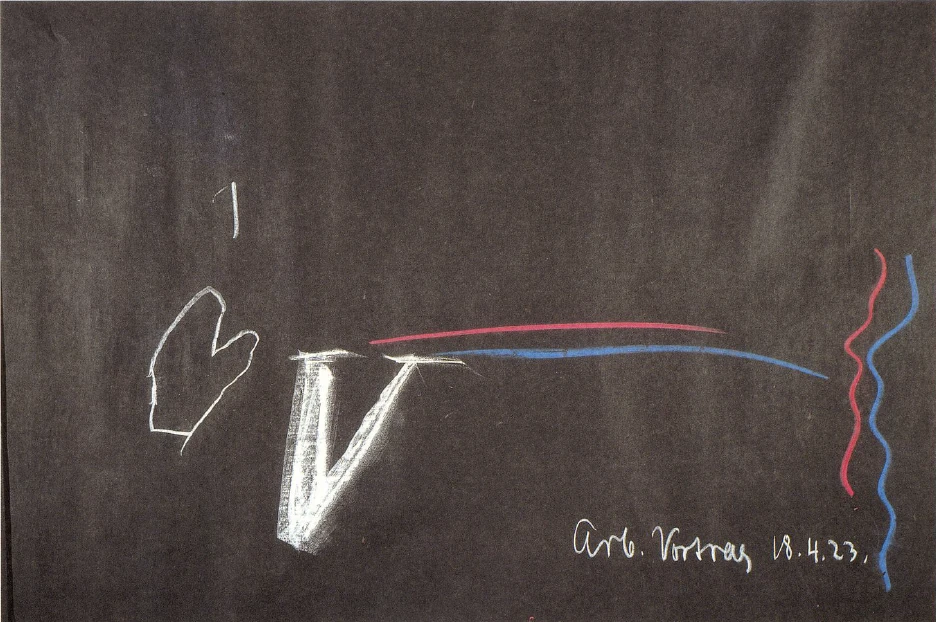
[ 37 ] Here at our Waldorf school, one of the teachers once explained very beautifully how Roman numerals gradually came into being. But when it came to V, it suddenly didn’t work. How can a V be formed? Well, look—what is that right here? (Dr. Steiner holds up his hand.) Of course, you’ll say: a hand is still just a hand. But isn’t there something inside it? 1, II, III, III, V fingers. Now I’ll draw this hand on the board (see drawing), so that I have these two parts extended (the thumb, and next to it the four other fingers). Now I have a hand; the V is inside it; that’s five, to put it plainly. Now I’ll make it a little simpler, and you’ve derived the Roman numeral V from the hand that has five fingers.
[ 38 ] So you see, gentlemen, the point is that today we are suddenly thrust into a completely abstract world. We learn to write, we learn to read; that has nothing to do with life. But as a result, we have forgotten what people knew who could not yet read or write.
[ 39 ] But now you mustn’t go saying, like those other people out there—the sort who are our opponents—that “Steiner told us just now that people were smarter back when they hadn’t yet learned to read and write”; then they’ll immediately say: “Yes, he wants people to stop learning to read and write!”—That’s not what I want. People should, of course, always keep pace with civilization—and certainly learn to read and write. But we mustn’t lose what we are bound to lose through reading and writing. We must first rediscover, through spiritual means, what human life is really like.
[ 40 ] And now I want to tell you something very simple about two people. One of them undresses in the evening and takes off his shirt collar, which has two little buttons—one in the back, one in the front—I’m using this example because it’s obvious to me, since I wear a shirt collar like that myself. This person does it completely without thinking—unbuttoning the first button, then the second. Now he gets into bed. Then in the morning, well, he runs all around the room looking for them and asking, “Where are my shirt buttons?”—He can’t find them. He doesn’t remember. Why? Because he did it without thinking.
[ 41 ] Now another one. He hasn’t exactly gotten into the habit of always putting his shirt buttons in the same spot—you could do that, of course, but that would mean being lazy—but he tells himself: When I take off the shirt button, I’ll put one next to my candlestick, and I’ll put the other one over there. —So he gives it some thought; he doesn’t just put them down mindlessly, but gives it some thought. Yes, he gets up in the morning, goes straight there, picks up the shirt buttons again from where he put them, and doesn’t have to search all over the room: “Where are my shirt buttons? Where did I put my shirt buttons?” —What’s the difference, then? The whole difference is that one person thought about the matter and remembers it, while the other didn’t think about it and doesn’t remember it. Yes, but you can only remember it in the morning. It does you no good to lie down at night and try to remember; you can only remember it in the morning if you thought about it the night before.
[ 42 ] Gentlemen, let’s take a brief look at history. As I told you last time, all of our souls were already here at a time when only a few people had yet learned to think. People didn’t think at all back then. In ancient times, people lived in the spiritual realm. But it was considered abnormal for anyone to think back then. In the Middle Ages, people didn’t think at all. They’ve only been thinking since the 15th century; people didn’t think in the thoughtful way we do today. This can be historically proven. No wonder you don’t remember your past lives today! Now people have learned to think. We’ve reached the point in historical development where people have learned to think. In their next life, they will remember their present earthly life just as a person remembers the button on their shirt this morning. That is to say, the story is this: if someone now learns to think correctly about the things of the world—to think as I have shown you—then it is just as if they were thinking about their shirt button. And the way today’s natural scientist goes about it is just like not thinking about shirt buttons at all. If someone merely describes: ‘A delirium sets in, one’s lips turn blue, one’s face turns red, and so on’—then it is the case that in the next life they will not think of the most important things, that they will not be able to recall anything at all, and will bring everything into confusion, just like the other person who throws everything into disarray because they have to leave in a hurry and cannot find their things. But the one who realizes that this simply stems from the etheric body, the astral body, and the I learns to think in such a way that he can remember clearly in his next earthly life. Only then will it become apparent. And only a few are being guided at present, since in the last earthly life there were very few who understood the matter. They are coming to realize this today and can draw others’ attention to it. And then, if they do as described in my books—if they follow the instructions in *How to Gain Knowledge of the Higher Worlds*—it may happen that people will realize even in the present that they have already lived in previous earthly lives. But we are just beginning with anthroposophical Spiritual Science. Therefore, people will gradually begin to remember again.
[ 43 ] Now it is said: Yes, but one cannot remember it; and if a person has no memory of previous earthly lives, then he cannot have had any previous earthly lives. — But then one might also say: A person cannot do arithmetic; one can prove that a person cannot do arithmetic—and now someone brings in a four-year-old child as proof and shows that the child cannot do arithmetic at all. It is a human being and yet cannot do arithmetic! People will say: “He’ll learn to do math eventually.” If you understand human nature, you know that he will learn to do math. — If someone today points to a person who cannot remember his past earthly lives, you must tell him: “Yes, but nothing was done in the past to enable people to remember.” On the contrary, there are still so many stragglers from earlier times who want to keep people ignorant, so that they know nothing at all about the spiritual realm—so that they have no idea what they are supposed to remember in their next earthly life, and become completely confused, just like the man with the shirt button. First, a person must learn to think in this life about what they are supposed to remember later.
[ 44 ] So anthroposophy exists to make people aware of what they should remember later on. And those who want to prevent anthroposophy—they simply want to keep people ignorant so that they won’t remember anything. And that is the important thing, gentlemen: to realize that human beings must first learn to use their thoughts correctly. Today, people demand that thoughts be defined and insist that books contain correct definitions. Yes, gentlemen, this was already known in ancient Greece. There, one person in particular wanted to train people in the art of defining. Today, in school, they say: “You must learn: What is light?” — I once had a friend; we went to elementary school together, then I went to a different school, and he trained to become a teacher at the teachers’ college. I met him again when I was seventeen; by then he was already a fully-fledged teacher. So I asked him: “What did you learn about light?”—And he said: “Light is the cause of seeing objects.” - There’s certainly nothing wrong with that. You could just as easily say: “What is poverty?” Poverty comes from “pauvret@”! It’s pretty much the same thing when someone defines it that way. But you have to learn a lot of stuff like that.
[ 45 ] Well, even back in ancient Greece, someone once mocked this kind of clever learning. The children learned in school: What is a human being? A human being is a living creature that has two legs and no feathers. - Now, a boy who was particularly clever thought about this, took a rooster, plucked it, and the next day brought it—still plucked—to the teacher and said: “Teacher, is this a human? It has no feathers and has two legs!” - That was the strength of the definition. The things that are generally still found in our books today are roughly in line with those definitions.
[ 46 ] In all books—including those on social issues—the conditions of life are described in a way that roughly follows the definition: A human being is a living creature that has two legs and no feathers. Then one draws further conclusions. Of course, if you start with a book containing a definition, you can logically deduce all sorts of things from it; but it will never apply to a human being—it might just as well apply to a rooster that has just been plucked. That’s how our definitions are! What matters is that you have to see things as they really are.
[ 47 ] In reality, the situation is such that one must say, as for example here (diagram on page 183): the physical body; the etheric body, which is affected by mild opium use; the astral body by heavy opium use; and the “I” by habitual opium use. And when one engages in spiritual science—when one truly learns to understand human beings in such a way that one does not merely describe them as if in a dream—“Such states occur”—but rather gains real insight— Then the astral body is active, the etheric body is active, the “I” is active within—then one has true thoughts, not merely definitions. And then, if one has absorbed true thoughts today, in this present earthly life, one will remember this present earthly life correctly. Just as one now only gradually recalls past earthly lives with great effort, as I have described, so will one remember them well later on—provided one does not make oneself ill, as through the use of opium, and provided one does not influence the body, but rather leads the soul, through spiritual exercises, to truly come to know the spiritual.
[ 48 ] This is how you can see how a true spiritual science truly emerges in anthroposophy. You must keep in mind that anthroposophy, in particular, is not interested in promoting superstition. So, for example, when people come across reports of something extraordinary regarding spiritualist matters, they begin to say: “That’s just as if the spiritual world were revealing itself.”—But the spiritual world reveals itself in human beings! When people sit around a table and make it knock, they say, “There must be a spirit sitting inside.”—But if four people are sitting around, there are four spirits there! You just have to get to know them! But instead, people prefer to put others into a trance; a medium has to be present. Take a look at the newspaper clipping you gave me a few weeks ago. It describes, for example, how people somewhere in England were thrown into a state of great agitation because, during the night, objects fell off the shelves, window panes were smashed, and so on. “Spiritual demons must be at work,” the people said. —What struck me most about the story—though one can’t say anything more precise until one has seen it oneself—but what struck me most about the story was that it also mentioned that the people had a whole army of cats! Well, if you have a whole army of cats, and two or three of them go rabid, just wait and see how all these “ghostly apparitions” play out! But as I said, one would have to know the details first; only then can one go into it.
[ 49 ] You see, I was once strongly urged to attend a séance. Well, I said I would do it—because, after all, you can’t really judge such things until you’ve seen them for yourself. So there was this medium—actually, a terribly famous one, a truly renowned medium—and after the people had taken their seats and had been lulled into a trance by some music that had been played—everyone was sitting there in a trance—the medium began, just as the people wanted, to make flowers fly down from the air over and over again! Now, every medium has a so-called impresario, if it’s a genuine medium. Well, the people paid their fee after they’d had their fun. For those who had organized the event, the main thing was that the fee was paid. And I said—people get terribly fanatical then; they start to fight with you if you try to set them straight; those are the worst of all—but to a few reasonable people I said they should take a look, not at the end, but at the beginning; there they’ll find the flowers inside the impresario’s hump! —That’s how you’ll find things everywhere.
[ 50 ] One must move beyond superstition, gentlemen, if one wishes to speak of the spiritual world. One must not be taken in by anything—neither by rabid cats nor by a hunchbacked impresario—but one can only reach the spirit by no longer falling for superstition and proceeding everywhere with true science.