

Man's Life on Earth and
the Essence of Christianity, tr. SOL
GA 349
21 April 1923, Dornach
Translated by Steiner Online Library
11. Sleeping and Waking — Life After Death — The Christ Being — The Two Jesus Boys
[ 1 ] Good morning, gentlemen! Have you thought of a question?
Questioner: The doctor was kind enough to explain to us what happens when the spirit has left the body. The last lecture was very clear to me and my colleagues. But in *Theosophy* there is a statement that, when the spirit has departed from the body, the soul still retains desires. That is still a very tough nut for us to crack.
I have one more question—something completely different.
[ 2 ] Dr. Steiner: Great, please go ahead and ask me the second question!
[ 3 ] The Questioner: I happened to come across a pamphlet by a Dr. Heuer. I assume that the doctor has read the pamphlet, so that this is already known. This Hauer portrays the doctor as if he weren’t saying anything new, as if everything he says in anthroposophy were already known—as if people were already familiar with it all. And yet, among other things, he says that what he finds most unbelievable about anthroposophy is the story of the two Jesus children.
[ 4 ] However, the questioner must also say that he himself does not understand, regarding the two Jesus boys, how one of them could have come from another world. — The doctor will have the brochure.
[ 5 ] Dr. Steiner: I have that brochure, too, but I haven't opened it yet.
[ 6 ] The questioner continues: If it is not too presumptuous, he would like to ask the doctor to say something about the family of Jesus.
[ 7 ] Another question: My colleagues have been asking me about the Christ-Essence over the past few days. I would be very grateful if Dr. [Name] could say a few words about the Christ-Essence.
[ 8 ] Dr. Steiner: Are there any other questions we should ask so we can address this in context?
[ 9 ] So now I would like to address the first question concerning desires. The fact is this: If you look at what human beings experience differently from what stones and plants can experience, you will find that human beings experience their world of thoughts. Plants do not show that they have a world of thoughts. Thoughts are there, living within the plant. But to look for conscious thoughts in a plant would be nonsense.
[ 10 ] It is true, however, that something peculiar has come about in the outward manner in which science proceeds today, at least in part. There are all kinds of scholars today, and since there are also those who cannot quite believe that everything is merely physical—mineral, inanimate processes—they at least assume that there is such a thing as the soul. But since they know nothing about the soul itself, they say: The soul expresses itself through some being performing this or that action.
[ 11 ] There are plants that behave in a most peculiar way. For example, there is a plant called the “Venus flytrap” precisely because it behaves so strangely. This Venus flytrap has rosette leaves that bear a leaf blade at the end of their widened stem. It consists of two parts. On both sides of the leaf blade are three bristle-like projections. When an insect lands on the leaf and touches these projections, the two wings of the leaf blade snap shut so quickly that the small insect is trapped. So, this really does exist.
[ 12 ] Those who speak of the soul only in a superficial way and know nothing about it say: Just as there is a soul in a human being, so too is there a soul in a plant. - To these people I always say just one thing: I know of a small device into which you place a piece of bacon that has been lightly browned—a mousetrap—and when the mouse nibbles at the bacon, the mousetrap snaps shut on its own. So anyone who concludes from things like the Venus flytrap that there must be a soul inside it would also have to say: the mousetrap has a soul, because it also snaps shut on its own. It always depends on the reasons for which one accepts a given idea.
[ 13 ] You see, this is precisely what characterizes anthroposophy: that it proceeds from inner causes in every instance, whereas the others—even if they do, after all, assume the existence of a soul—know nothing about the soul and thus attribute a soul even to a plant like this one, in which, when an insect approaches, something similar to what happens in a mousetrap takes place. But in anthroposophy, it is not external appearances that lead to this conclusion; rather, it is the genuine understanding of the soul. Part of this understanding of the soul is also that human beings develop desires. Desire is what we feel, for example, when we are thirsty. When I am thirsty, I have the desire to drink water or something else. Well then, fine; the water satisfies the thirst. All of this is desire—when, from within one’s own organism, one wishes for something, wants something; that is always desire.
[ 14 ] You see, there is something people never stop to think about. They do not consider what mental state underlies the moment a person wakes up. Isn’t it true that when a person wakes up, people examine how much more carbon dioxide is in the blood and so on—that is, they examine only the physical conditions. But the truth is this: a person wakes up because they have a desire for their physical body. When you fall asleep at night, you no longer have a desire for your physical body. It is completely filled with fatigue-inducing substances. It is no longer a pleasant place to be. The soul—that is, the “I” and the astral body—wants to rest outside the physical body. In the morning, when the physical body has recovered—which the soul, being outside the physical body, perceives from the condition of the skin because it is close to it—the soul re-enters the physical body because it has a desire to be inside the physical body as long as the physical body is at all capable of living. Thus, throughout its entire life, the soul has the desire to live within the body.
[ 15 ] Take another example: You cut your finger, and it hurts. There is the finger (drawing $. 202). Now you cut into it, and it hurts. What happened there? Well, a small part of the physical body has been torn apart. You can cut into the physical body, but not into the astral body. I will now draw the astral body inside the physical body. If I draw this enlarged, there is a gap, and the astral body is inside it. But the astral body has the desire to be able to enter even where the physical body has been torn open. It has the desire to be inside the body, but cannot do so because the body is torn open there. That is what causes the pain.
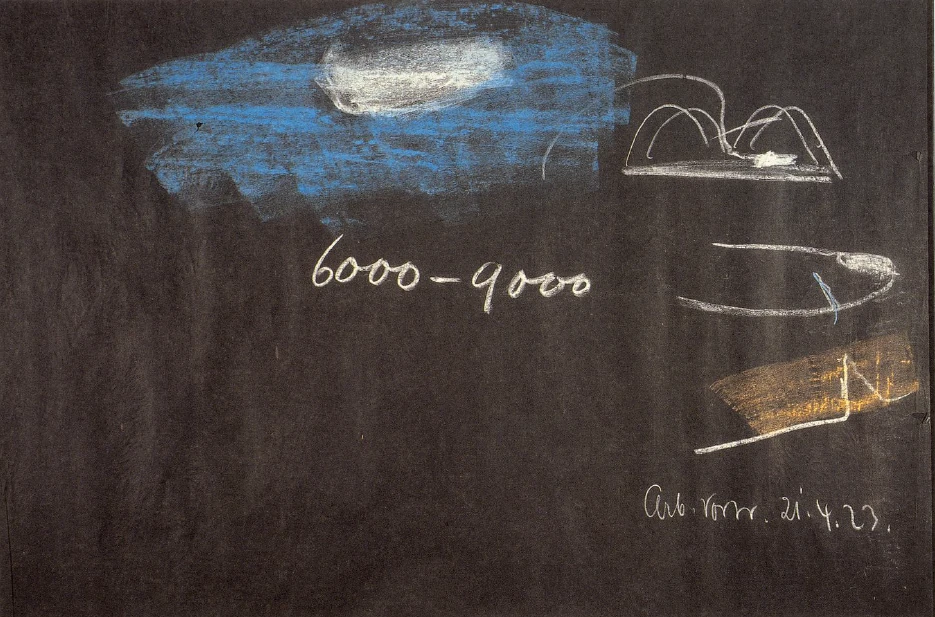
[ 16 ] Now, just think: if the soul longs for the physical body throughout its entire life, then something must surely happen after death.
[ 17 ] If, as a child, you develop a craving to eat as much sugar as possible, then you develop a craving to get sugar. And even if, at a certain stage in your life, someone decides it would be good for you to stop eating so much sugar, you will still have that craving for sugar. Let’s say you’ve developed diabetes, and you’re therefore supposed to stop—well, it takes a long time to break that habit! You always have a craving for sugar and have to wean yourself off it slowly. You know, if someone drinks a lot, they’ve developed a craving for it; they have to wean themselves off it slowly. If someone uses opium, as I told you the other day, and is weaned off it, they go completely crazy from sheer craving for the opium.
[ 18 ] Throughout one’s entire life, a longing for the body resides in the ego and the astral body. After death, the soul wants to awaken in the body again and again. It must first break this habit. This process of breaking the habit takes about one-third of one’s entire life. For one-third of one’s entire life is spent in sleep. On the first day after death, one wants to return. One wants to do what was done on the last day of life; on the second day, one wants to do what was done on the day before that, and so on. Thus, one must break the habit of this desire for this one-third of one’s life. So after death, you may not have a craving for thirst or hunger, but you do have a constant craving for everything you experienced through your physical body. After death, it is like this: throughout your entire life, you have grown to love the immediate surroundings of your hometown. You have always seen that. Yes, you saw that through your physical body. Only a Turk would believe that after death he has something much more beautiful in terms of meadows and flowers and so on than he has here on earth. So you must wean yourself off all of that. And it is precisely this process of weaning off that is why we must speak of the fact that the desires still remain. Isn’t that understandable? (Answer: Indeed!)
[ 19 ] So after death, the desires for the physical body and for life in general remain—not hunger and thirst, because those require a stomach; one no longer has a stomach—it has been placed in the coffin. But after death, one still has, in particular, the desire to see everything one saw during one’s lifetime.
[ 20 ] But now there is something else to consider: After death, one cannot yet see properly in a spiritual way in the spiritual world one has just entered, any more than a child here in the physical world can see immediately. One must first acquire this ability. One must first grow into the spiritual world. Thus, the first state after death—lasting one-third of a lifetime—consists of still being blind and deaf to the spiritual world, yet still longing for the physical world. This occurs after two or three days, during which, as I have described, the deceased looks back. And only when they have outgrown this habit do they begin to grow into the spiritual world and are then able to perceive in a spiritual way. Then they no longer have a longing for the physical world. So whoever can assess the life of the soul can also assess what remains of the physical life. And of course, it is not only pleasant things that remain. If someone has had the desire to constantly beat people, that desire to beat remains with them, and then they must slowly wean themselves off it. These are precisely the things one comes to realize.
[ 21 ] Anthroposophy is always aimed at recognizing what can truly be seen in the soul—that is, what is truly visible. That is what it is all about.
[ 22 ] As for the other question—the question of Christ Jesus—we will address it today as well, so that you may be fully satisfied. However, I must first preface this with a historical point.
[ 23 ] I have told you about all kinds of conditions that existed on Earth in very ancient times. Now, the fact is this: The conditions we have on Earth today—even according to scientific observations—are no older than about six to eight or nine thousand years; so let’s say six to nine thousand years. I’ve already pointed this out to you before. Before that time, you couldn’t go very far from here without entering what’s known as the glacial region. Switzerland—the very area where you can walk around today—was completely covered by glaciers all the way down. The glaciers flowed through valleys where the rivers are now; the Aare, the Reuss, and so on are, in fact, remnants of the diluted glacial streams of the past.
[ 24 ] But this period, during which a large part of Europe was covered by these glaciers, was preceded by a completely different era. For the Earth is, after all, constantly—though one must consider very long periods of time—in a state where its surfaces rise and fall, rise and fall. For example, if there is the sea here (it is drawn), and land up there, then that land is floating in the sea. All land, in fact, floats in the sea. Can you create a mental image of that? It is not that the land goes all the way down to the bottom; rather, the land—all the land—floats in the sea. There is also sea beneath the land.
[ 25 ] Now you might ask: Why doesn’t it float back and forth like a ship? Let me tell you something else first. In fact, countries do float in the sea, but let’s say this is Great Britain, England (it is drawn). England is an island. It does indeed float like this in the sea, though it floats near Europe, and the distance doesn’t change. But even according to scientific views, it wasn’t always the way it is now; there were also times when the water covered it. Back then, England was down there under the sea. If you crossed that little stretch of sea, you would naturally reach the bottom. So the fact is, there were times when England was under the sea.
[ 26 ] Yes, the fact is this: If you examine the soil of England, you will find certain fossilized animals in that soil. But they are not all the same. If you examine a sample of soil from England here, and then another sample further up, you’ll find completely different types of fossilized animals; and even further up, there are yet other fossilized animals; and even higher up still, yet another type of fossilized animals. You can find four successive layers of fossilized animals in the soil of England!
[ 27 ] Where do these fossilized animals come from? When the sea floods a landmass, the animals die. Their shells fall to the ground, and the animals become fossilized. If I find four successive layers in the ground, then that land must have been flooded by the sea four times. Each time, a layer was deposited. And so, in England, we find that the land has been above and below water four times. Four times England was above water; it has risen again and again.
[ 28 ] Now you might ask: Why doesn’t such an island, which is actually floating in the water, move back and forth like a ship? Well, it isn’t held in place by the Earth. If it depended solely on the Earth, one can’t even create a mental image of how everything would be shaken up! England would soon be flung against the coast of Norway, then swept off toward America, and so on, and all the countries would be thrown into disarray if it depended solely on the Earth. But it does not depend solely on the Earth; rather, the constellations in the sky emit forces that hold a country in a specific place. So it is not due to the Earth. It depends on the constellation of the stars. And one can always prove it: When the situation has changed, the constellation of the stars has changed—not that of the planets, of course, but that of the fixed stars. Anyone who wants to know nothing about this world simply acts like the people who say that the powers of thought come solely from the brain. If I’m standing on soft ground and leave only my footprints, and someone from Mars happens to come down here and thinks the footprints come from the Earth—that the Earth sometimes pushes the sand up and sometimes pulls it down—that’s not how it is at all; I pushed it in from the outside. And so, too, the convolutions of my brain have come from outside, from spiritual thinking. The same is true of the lands that have come to Earth: they are held in place by the constellations. We must therefore see Spirit not only in the people on Earth, and on Earth in general, but in the entire universe.
[ 29 ] Just think about it, gentlemen: strangely enough, older people knew these things, but they understood them in a completely different way than we do today. I’ll give you proof of that. There was a great Greek philosopher who lived several centuries before the birth of Christ; his name was Plato. He knew a great deal, of course. He recounts that one of the wisest of his countrymen, Solon, the lawgiver of Greece, once visited an Egyptian. The Egyptians were the older civilization back then; it’s just that the Greeks behaved more wisely than we do. Isn’t it true that the Greeks held the Egyptians in high esteem—we’ll see that in a moment—but they didn’t learn Egyptian, the ancient language of the Egyptians? The Greeks didn’t learn Egyptian! Our scholars, on the other hand, all have to learn Greek! The Greeks were, in fact, much wiser. We don’t follow the example of what they did in that regard; instead, we imitate their language. Our scholars are precisely hindered by the fact that they do not grow into what is originally theirs on earth, but are distracted from what is inherent to human beings by having to immerse themselves in a very ancient language. Well, in Switzerland they are now fighting against this; but it took a long time. Our young men, if they wanted to become doctors, first had their minds twisted by having to learn Greek. I’m not saying this because I once had to learn it myself—I love the Greek language very much. But it should be learned by those who want to benefit from it, not by those who want to become doctors or lawyers and will forget it again later in life.
[ 30 ] Plato recounts that Solon visited an Egyptian, and this wise Egyptian is said to have told him: “You Greeks, you may be advanced people, but you are still children, for you know nothing of the fact that the lands are constantly being pulled out of the sea and sinking back again, that upheavals are always taking place.”
[ 31 ] So the ancient Egyptians still knew it; the Greeks no longer did. Only Plato did. He knew something about the fact that out there in the Atlantic Ocean—where ships now sail from Europe to America—there used to be land, and that the western coast of Europe was thus connected to the eastern coast of America by land. But those ancient truths have simply been forgotten. And that was because people back then possessed a form of knowledge that was even more unconscious. We have acquired abstract knowledge. We need that for our freedom. For the people back then were not free; but they simply knew more. And Lessing, as I told you, believed that those ancient people knew more than those who came later.
[ 32 ] This leads us to say to ourselves: The fact is that there were times in the past when people knew, by their very nature, that a spiritual realm pervades everything. People have known this for quite a long time.
[ 33 ] For example, there was a Roman emperor named Julian in the 4th century A.D. This Julian was taught by people who still possessed some Asian knowledge. And this Julian said: There is not one, but three suns. The first sun is the physical sun, the second is a soul sun, and the third is a spiritual sun. The first is visible to us; the other two are invisible. That is what Julian said.
[ 34 ] Now something very strange has happened. Julian has been slandered throughout history because he did not believe in Christianity. But he believed in what people knew before Christianity. And when Julian once had to lead a military campaign in Asia, he was suddenly assassinated. It was a kind of assassination. But this assassination was carried out by those who hated him because he had still acquired the ancient knowledge.
[ 35 ] You just have to keep in mind that even back in those ancient times, things were handled quite differently than they are today. The Egyptians were such incredibly intelligent people, as I’ve told you. But they didn’t have a writing system like ours; instead, they had a pictographic script. The symbol always resembled what it represented. And the scribes in Egypt were taught that writing is a sacred act; they had to reproduce the symbols with absolute fidelity. And do you know what happened to anyone who, out of carelessness, made a mistake while copying the pictographic script back then? He was sentenced to death! Well, today people would be quite surprised if someone who made a spelling mistake were sentenced to death for it. But human history unfolds differently than one might imagine. In fact, the ancient Egyptians were wise and cruel in a certain respect. Of course, there has been progress in humanity. But precisely because writing was something so sacred to them, we must not deny that they were also wise in other respects and knew things that are only now gradually coming to light in anthroposophy, in a completely different way. For they had dreamed it, and we know this; it was a completely different kind of experience.
[ 36 ] Well, you see, Julianus was right. It is indeed true: just as you have a soul and a spirit within your body, so too does the sun have a soul and a spirit. This is precisely what someone who understands the spiritual realm says. He does not say that the Venus flytrap has a soul, because it is nonsense to claim that everything that moves in any purposeful way has a soul. But he knows that when the light shines, it has a soul, that it moves in a spiritual way; for he perceives this. And so it was known: The sun contains a living being.
[ 37 ] Now, as you know, the story goes that Jesus of Nazareth was born in Palestine at a certain time. You see, gentlemen, Jesus of Nazareth grew up—and we can verify today that what is written in the Gospels is true—as a rather simple boy. He was the son of a carpenter. That is true. He grew up as a fairly simple boy. Yet he still possessed a great deal of the ancient wisdom. That is why it is also true that, at the age of twelve, he was able to answer the scholars very wisely. After all, it still happens today that a twelve-year-old boy gives more sensible answers than a “forgotten” scholar! But this showed that he was a very gifted boy. He continued to grow up, and when he was thirty years old, something changed within him quite suddenly. That is a fact; something changed within him quite suddenly.
[ 38 ] What changed within him when Jesus was thirty years old? When Jesus was thirty years old, it suddenly dawned on him—though he had been prepared by his earlier great knowledge—what was no longer known at that time, what only a few hidden scholars possessed from an ancient wisdom, which Julian was later able to rediscover. It dawned on him through an ancient body of knowledge: the entire universe and the sun contain soul and spirit. He was permeated by what lived in the universe because he knew this. If you know it, you also possess it.
[ 39 ] Back then, in those days, people had to be taught things through pictures. What I am telling you today could only be expressed in this way starting in the 15th century. Before that, these concepts did not exist. So it was expressed by saying: A dove descended, and he received the Holy Spirit within himself. Of course, anyone who could perceive this knew: Something had happened to him. He expressed it that way, and it is written in one of the Gospels: A voice rang out from heaven: “This is my beloved Son, in whom I am well pleased”—correctly translated: “This is my beloved Son; today I have given birth to him.” This means that what happened there at the age of thirty was rightly understood as a second birth. With Jesus’ birth, only Jesus was born—he who was more gifted than the others, but who did not yet possess this inner feeling. This was perceived as something extraordinarily important. And that is the baptism of John in the Jordan.
[ 40 ] There was once something that caused me great concern. Such concerns do exist in academia, gentlemen! As you know, there were the four Gospels: the Gospel of Matthew, the Gospel of Mark, the Gospel of Luke, and the Gospel of John. Isn’t that right? Today everyone knows that these four Gospels contradict each other. If you start reading the Gospel of Matthew and see Jesus’ genealogy there, and compare it with Jesus’ genealogy in the Gospel of Luke, you’ll find that they actually contradict each other. People say: “That contradicts itself.” - But they don’t think any further about why they contradict each other. At most, they say: “One of them made this up, the other made that up; one must have made something different up than the other, which is why the accounts contradict each other.”
[ 41 ] But that’s not actually the case. Here’s how it is: Goethe, for example, says of himself: “I got my build from my father”—that is, he looked somewhat like his father—
[ 42 ] From my father I got my stature,
A serious approach to life,
From my dear mother, her cheerful nature
And a love of storytelling.
[ 43 ] Well, Goethe may not have been able to make up stories at the age of three; but perhaps he could at the age of nine. Then he must have said: “Well, I got the love of storytelling from my mother; it was passed down to me from my mother; it came into me from my mother.”
[ 44 ] I am telling you this because it will help you understand how my concern regarding the contradictions in the Gospels was resolved.
[ 45 ] So I began by examining these two Gospels—the Gospel of Matthew and the Gospel of Luke. Unless one simply and carelessly claims that they are fabrications, no one can explain why these two accounts contradict each other. And I have now investigated, from a perspective of Spiritual Science, what lies behind this, and have found: It was not just one boy who was born, but two boys named Jesus. Both boys were named Jesus. There is no need to be surprised by this; for if, in Austria for example, one boy is named Joseph, then one is not surprised either if another boy, born at the same time, is also named Joseph. There’s no need to be surprised if two boys are named Seppl or Franz. So there was really no need to be surprised at all if, back then, two boys were named Jesus. Two boys named Jesus were indeed born. And both lived together until they were twelve years old. And that’s when something peculiar happened: because they lived together, the gift that one possessed suddenly appeared in the other. Just as a son can inherit from his mother, so, for example, one of the boys named Jesus inherited the gift from the other. And the one boy named Jesus—from whom the other had inherited the gift—did not live much longer; he died at the age of twelve, shortly thereafter. Thus, the other boy remained, and through the shock of the other’s death, the wisdom of the other had been kindled within him. It was precisely this that enabled him to shine before the scholars.
[ 46 ] The parents might have asked: Where on earth did he get all that? — If one attributes it to spiritual influences, then it can be explained. And such spiritual influences simply exist. One of the Jesus boys did not possess this wisdom until he was twelve; the other died, and the wisdom has now passed on to the one remaining Jesus boy—partly due to the shock of the other’s death, and partly because they had been close friends. And he underwent baptism in the Jordan. Two “Jesus boys” were born, not just one; in the twelfth year, one died, and the other suddenly awoke as a result of this shocking event and possessed the wisdom of the other.
[ 47 ] And then you discover: one of the evangelists, Matthew, described one of the “Jesus boys” during Jesus’ childhood, and the other, Luke, described the other “Jesus boy.” And so the two accounts agree with one another. I didn’t make this up. It emerged as a result of my research. And that is why I speak of the two “boy Jesuses”—precisely on the basis of a certain scholarly insight that others simply lack.
[ 48 ] And from this you can see that the same principles followed in the natural sciences—namely, that when causes are present, effects occur—are also applied in the Spiritual Science. One does not simply assume that, well, two people just made something up—that the Jesus of Matthew’s Gospel is a figment of the imagination, and the Jesus of Luke’s Gospel is a figment of the imagination. — At the time the Gospels of Matthew and Luke were written, there was absolutely no question of such “invention.” People spoke figuratively; but they did not invent anything, for people took these matters so seriously that a few centuries earlier in Egypt, anyone who wrote down anything that was not true was sentenced to death. When it comes to earlier times, one must not be so reckless as to say that people invented something. They expressed it in imagery; but it would never have occurred to them to invent anything. So anyone who says that the Gospels of Matthew and Luke might have been invented is speaking as a complete ignoramus. Yet that is precisely what today’s scholars and theologians say. Because they have no other choice, they must admit the contradictions. But the fact that we know there are, in fact, two “Jesus figures”—one from the Gospel of Matthew and the other from the Gospel of Luke—clarifies the story in the best possible way.
[ 49 ] Now along comes Mr. Hauer, who, in addition to being a private lecturer in Tübingen, is also an itinerant teacher, and who has spoken out—after all, speaking in favor of anthroposophy doesn’t pay anything these days, but speaking against it does bring in some money—so he has spoken out against anthroposophy; this Mr. Hauer now comes along and says: “That’s something peculiar.” — Yes, gentlemen, of course it’s peculiar, because no one else has thought of it! It’s naturally peculiar when I claim that there were not one, but two young Jesus figures, one of whom died at the age of twelve. That is, of course, peculiar—needless to say. There’s really no need to be surprised that it’s something peculiar. But it’s precisely peculiar because not everyone has said it. That’s why Hauer finds it peculiar. You’ll find this on one page of Hauer’s book.
[ 50 ] On the other hand, you’ll find: Yes, Steiner says nothing at all that we didn’t already know. Yes, gentlemen, whatever Mr. Hauer didn’t already know, he finds strange. He rails against it. Based on what he has pieced together from here and there—because, after all, we’ve had this old wisdom, which is of course documented everywhere today—I don’t piece it together, but he does!—he comes to the conclusion: “Yes, Steiner says nothing other than what others have already said.” — That’s how we’re at the mercy of these people. Whenever something needs to be said, they say: “He’s not saying anything new.” — If I write a geometry textbook, I must, of course, include the Pythagorean theorem; it was discovered by Pythagoras 600 years before the birth of Christ. Of course, even if I include a number of new ideas in it, I must also include the Pythagorean theorem; I’ll prove it a little differently today, but it’s in there. Surely one can’t be blamed for rediscovering something that was already there after it had been forgotten! And so it is that many of the things that Spiritual Science asserts today are found—in a different way, for it is not exactly the same—among the ancient Gnostics, who were, after all, the writers of an earlier era. At the time when Christ was here, such Gnostics still existed, and even later. They wrote down this ancient wisdom, but not based on scientific inquiry, rather from ancient knowledge—unlike anthroposophy. Now people compare what anthroposophy says with what is written by the Gnostics. It is somewhat similar to what is found among the Gnostics, precisely because it is true. And then they say: “Well, he’s not saying anything different from what the others said!” — But when it comes to the two Jesus boys, Mr. Hauer cannot say: “Steiner has come up with something that the others already knew!” — because he has no idea that anyone else ever knew that before.
[ 51 ] I haven’t even opened the whole book yet, but from what I’ve seen of it, it’s teeming with contradictions like this. It makes no sense at all when you compare one page with another. But that’s how today’s scholars operate. On the one hand, they say: “Others have said this many times before.” - And on the other hand, they say: “He isn’t saying anything new; we already knew all that!” — Well, if they already knew all that, why are they complaining about it? And on the other hand, when something comes up that they didn’t know, they find it unbelievable.
[ 52 ] But you see, after I had discovered this—truly discovered it entirely through spiritual research—about the two boys named Jesus who lived side by side until the age of twelve, I knew nothing else but that this was a fact. Then one day we saw a painting in Turin. The painting is quite remarkable. It depicts the mother of Jesus and two boys, one of whom is not John—for John is recognizable from all the paintings where Jesus and John appear together—but there are two boys in the painting who look quite similar to each other, yet cannot be brothers, for they look alike and yet not alike. It is made quite clear that these are two little friends. Whoever first realized that there were two “Jesus boys” will then understand what this painting means. This painting was created relatively late in history; but back when people still knew that there were two “Jesus boys,” an Italian painter depicted the two of them in a single painting.
[ 53 ] If Hauer knew today, based on his prior knowledge, that this was still the case, he would say: “Steiner simply saw the painting in Turin!”—He would say he already knew that anyway. Then, in the same breath, he would say: “Steiner isn’t claiming anything new at all; he’s just stating things that were already known.”—That’s how people are!
[ 54 ] It is actually quite appalling to look into these apparently foolish contradictions with which people today attack anthroposophy. For on the one hand, what I say is supposedly just a fabrication—a fabrication of my own. Well, let’s assume it is a fabrication of mine; but then the same person cannot say in the same book: “He isn’t saying anything new at all!”—because he himself claims that I have fabricated these things and accuses me of doing so. And then he goes on to say that others already knew this. — What is being done here is, in fact, utter nonsense. Whereas, if one truly approaches the Christ event and investigates it the way one otherwise investigates facts, then it becomes clear: this immense gift, which the boy Jesus already possessed, arose precisely through the interaction between the two boys.
[ 55 ] I want to prove to you that such an exchange can take place without other people having any idea about it. Look—I’ll tell you about one such case, though there are many like it—there was once a little girl who already had older siblings; those other siblings learned to speak quite well. At first, this girl didn’t learn to speak properly at all; but a little later, when the other children learned to speak, she began to speak. But she spoke a language that none of the adults understood. She invented her own language. For example, she would say “Papazzo,” and when she said “Papazzo,” she meant the dog. And in a similar way, she invented her own names for all the animals. These are scientific facts. You won’t find these names anywhere else.
[ 56 ] After some time, this girl got a little brother. And the little brother learned this language very quickly from his little sister. And they spoke to each other in this language. The little brother then died when he was about twelve years old, and the little sister gradually stopped using that language and adopted the language of the others as well. She later got married and became a very ordinary woman who told people that this was how it was. She went through it herself. That’s how it is. The two children communicated in this language, spoke to each other in this language; no one else understood it. Gentlemen, that can be the greatest wisdom! Only the two of them understood it and agreed upon it among themselves.
[ 57 ] From this you can see how one is influenced by the other. Why shouldn’t that young Jesus, who died at the age of twelve, have known something that no human being has ever understood! That’s something you still experience today, if you know the facts.
[ 58 ] So, nothing is being claimed other than what, in the most eminent sense, can truly be scientific. Well, people who do not accept this as scientific simply cannot ever piece together the facts. Anyone who knows that such a thing exists—that is, that two children speak a language no adult understands and share a spiritual connection in which adults do not participate—anyone who understands that understands everything I say about the two Jesus boys up to the age of twelve. And the fact that this was an extraordinary event is hardly surprising. It doesn’t happen every day. And in the way it occurred—it has happened only once in the history of the earth—that this immense enlightenment came upon this man specifically at the age of thirty.
[ 59 ] Well, you see, that is where the story of Christ is transformed into true science, into true knowledge. And there’s nothing one can do about it; it simply transforms itself through knowledge.
[ 60 ] Now one might say: All right, so Jesus, at the age of twelve, had in a sense already been enlightened beforehand by the other one who had died. But at the age of thirty, yes, he had suddenly become someone else again, which the Gospel writer expresses by saying: A dove flew down and alighted upon him.
[ 61 ] Yes, gentlemen, the fact is that he has become a different person. What happened there? I have already explained to you: When a child is born, the seed is there. The spirit of the universe must act upon that seed. It is no wonder that the spirit of the universe acts there, when it even acts upon the island of England, as we have seen. From an earthly perspective alone, it was impossible to explain what happened to Jesus in the thirtieth year of his life. Just as a human being comes into being through fertilization, in which one thing influences another, so the entire universe exerted an influence on the thirty-year-old Jesus at that time, fertilizing him with soul-spiritual forces, and through this he became Jesus Christ—or, more accurately, Christ Jesus. For what does that mean? “Christ” means “the one who is enlightened.” And “Jesus” is a common name, as it was in Palestine—just as today in Austria one might be called “Sepperl,” meaning Joseph, or in Switzerland this or that, where similar names are found in every household. So many were named Jesus, and he was called “Christ” precisely because this enlightenment occurred.
[ 62 ] Yes, gentlemen, if you read my book *Christianity as a Mystical Fact*, you will find evidence there that this enlightenment had already been artificially induced in certain people in the past, albeit to a lesser degree. This was then called “mystery wisdom.” The difference between those who were educated in the highest forms of wisdom in ancient times, and the difference between them and Jesus Christ, lay in the fact that these “mystics” were taught by others in the schools that were called “mysteries” at that time. With Jesus, it happened of its own accord. Therefore, it was a different process.
[ 63 ] In the ancient mysteries, those who had ascended to the highest knowledge simply became “Christ”; just as you need not be surprised today, for example, if someone has studied until the age of twenty-five—before that, he was the perfectly ordinary Joseph Müller; now he is suddenly Dr. Müller. That is how one became “Christ” in the ancient mysteries—though not in such an innocent, that is, simple way; for one can, of course, be the biggest fool and still become a doctor at the age of twenty-five! That was not possible in the ancient mysteries; there it was a profound, profound wisdom. There, one became “Christ.” It was a title bestowed upon the highest sages, just as the title “Doctor” is bestowed today after completing a certain course of study; only back then, if it was done correctly, it was true wisdom. And in the case of the Christ, it simply came of its own accord. But that means it is what was otherwise given from the earth, by human beings—it was given from the vastness of the worlds. That happened only once. As a result, world history took a different turn. And no one can deny this mystery—not even those who are not Christians—that world history took a different turn.
[ 64 ] The Romans did not take this into account; they were unaware of it. Over in Asia, Christianity was founded through Jesus Christ. At the same time, the Romans transitioned from the old republican state to the empire, and they persecuted the Christians. The Christians had to build catacombs deep underground. There they reflected on what their Christianity truly was. Up above, on the surface, what was happening there? There, circuses were held, and people—slaves—were tied to columns and burned as a spectacle for those sitting in the circus. That was up on the surface. And down in the catacombs, the Christians practiced their religion—the wisdom that was relevant to the enslaved people of that time. After all, “religion” simply means “connection”—religere = to connect—; down below, the Christians practiced their religion.
[ 65 ] And what about a few centuries later? The Romans are no longer there in the old way. What they used to watch for their amusement in the circuses—people being burned alive—was gone, because the Christians had taken their place. That’s how things go in the world.
[ 66 ] And that is exactly what will happen: Those people who speak today the way Dr. Hauer does—whom you mentioned earlier—will be swept away. And that which must take effect today—even if not physically, but spiritually in the catacombs—will certainly take effect! But one must simply recognize that this is true science; and how those who do not learn much today are annoyed that something like this is coming to light!
[ 67 ] When I get back, I'll be able to continue with that. But essentially, you'll already have seen where this is headed.