

Man's Life on Earth and
the Essence of Christianity, tr. SOL
GA 349
7 May 1923, Dornach
Translated by Steiner Online Library
12. On the Nature of Christ, Ahriman, and Lucifer in Their Relationship to Humanity
[ 1 ] Good morning, gentlemen! Have you thought of anything else we should discuss today?
Question: Perhaps the doctor would say something about the nature of Christ, Ahriman, and Lucifer in relation to human beings.
[ 2 ] Dr. Steiner: We need to approach the nature of the human being from another perspective as well; otherwise, this will naturally strike you as a kind of superstition. Based on what we have already discussed, I would like to say the following to you.
[ 3 ] You see, gentlemen, people today tend to think of human beings as if they were thoroughly uniform creatures. They are not; rather, human beings are actually constantly in a state in which they come to life and die again. One does not merely come to life at birth and die only at death, but—as I have explained to you many times before—one dies continuously and comes to life again.
[ 4 ] Well, if we look at our head, for example, the head is actually, on the inside, made up entirely of what is called nervous tissue. As you know, nerves usually run through the body as mere threads, but the head is entirely nerve tissue on the inside. If you were to draw this, it would actually look like this (Drawing $. 220): the head, the forehead; internally, the head is entirely nerve, a dense mass of nerves; then part of this nerve mass extends through the spinal cord. But then the nerve fibers extend throughout the entire body. So what runs through the entire body only as fibers is present in the head as a unified mass. That is the nerve mass.
[ 5 ] For example, if you look at the inside of the human abdomen, you’ll see that there are also a great many nerves there. There’s what’s called the solar plexus. There are still a great many nerves in there. But in the arms and hands, and in the legs and feet, the nerves simply branch out in a thread-like manner.
[ 6 ] If you now look at something else—the blood vessels—you will find that in the head, the blood vessels are quite fine. In contrast, the blood vessels are particularly well-developed in the region of the heart; and then, of course, there are thick veins in the limbs. So one can say: On the one hand, we have the nervous system; on the other, the circulatory system.
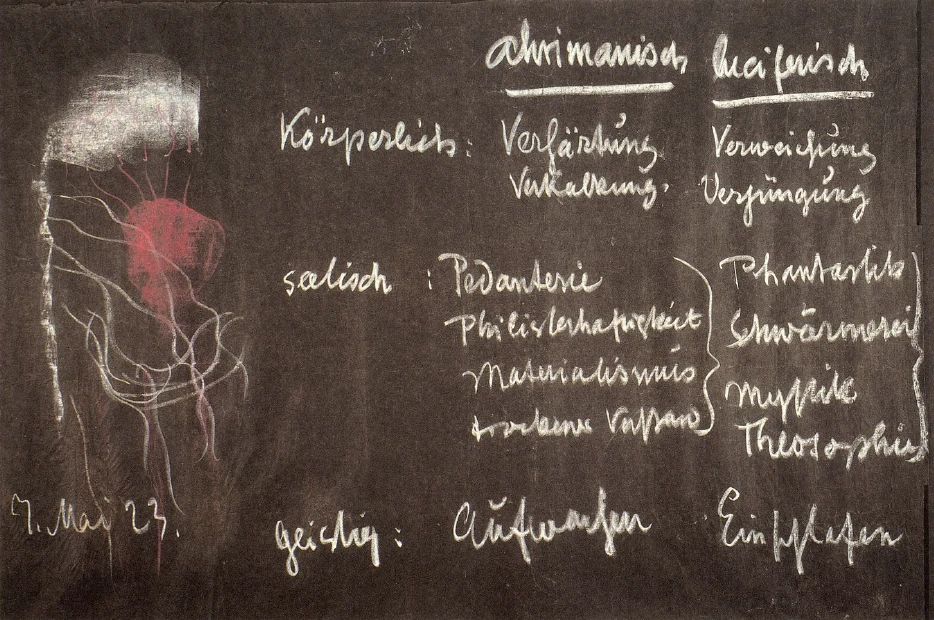
[ 7 ] The fact is that we are continually reborn through the blood—every day, every hour. Blood always signifies renewal. So if we were made up solely of blood, we would be like beings that are constantly growing, becoming larger, staying fresh, and so on. But you see, gentlemen, if we were merely nerves—if we consisted solely of nerves—then we would be constantly strained and tired; in fact, we would be constantly dying. So we have two opposing principles within us: the nervous system, which causes us to grow old constantly—even constantly subjecting us to death—and the circulatory system, which is connected to the digestive system and causes us to grow young constantly, and so on.
[ 8 ] The concept I’ve just explained to you can be elaborated on further. As you know, as people age, some become so that one has to say they’ve “calcified.” Calcification sets in—sclerosis. When their arteries—as they say—become calcified, that is, when the walls of their blood vessels calcify, people very easily find themselves unable to move properly. And when particularly severe calcification sets in, the person suffers a stroke, as they say. They have a stroke. The stroke that a person suffers consists simply of their blood vessels calcifying and no longer holding up.
[ 9 ] What actually happens to a person when they develop calcification, when they become sclerotic? You see, it’s as if the walls of their blood vessels were trying to turn into nerves. That’s the strange thing. Nerves, on the other hand, must constantly die off. In a sense, nerves must remain in the same state throughout their entire life—a state in which blood vessels simply must not be. Blood vessels must remain fresh. Nerves, on the other hand, must be constantly prone to dying off. If, on the other hand, a person develops nerves that are too soft—that is, that are not sufficiently, if I may put it that way, calcified—then he goes mad. So you see, nerves must not be like blood vessels, and blood vessels must not be like nerves.
[ 10 ] That is precisely what compels us to say that human beings have two principles within them. One is the nervous principle. This causes them to, in a sense, grow old continuously. From morning to evening, one actually becomes a little older all the time. At night, the body recharges through the blood. It’s always like this, like the swing of a clock’s pendulum: growing old, growing young, growing old, growing young. Of course, when we’re awake from morning to evening, we simply grow older, and when we sleep from evening to morning, we grow younger again; but a little bit always remains. So the night does make up for it to some extent; but a little bit of aging remains from every day. And when that accumulates to a sufficiently large total in a person, then he truly dies. That’s the story. So we have two things in a person that work against each other: growing old and growing young.
[ 11 ] But we can also look at this from a psychological perspective. I have now explained it to you in physical terms. You see, if the process of becoming young takes hold too strongly in a person, then he or she develops pleurisy or pneumonia. The fact is that things which are quite good—even excellent—when they remain within their limits—become a source of illness when they get out of hand. Illness in a person is nothing other than something they always need getting out of hand. A fever arises because the process of growing young becomes far too strong within us. We can no longer tolerate it. We begin to feel too vigorous throughout our entire body. Then we develop a fever, accompanied by pleurisy—that is, inflammation of the pleura—or pneumonia.
[ 12 ] Well, you can also look at the whole thing from a spiritual perspective. You see, a person can also wither away spiritually, or he can become like he otherwise does physically when he has a fever. There are certain traits in people—people don’t like to hear about them because so many people have them, especially today—namely: one becomes pedantic; one becomes a philistine. You know that there are, after all, philistines today. Philistines do exist. One becomes a philistine; one becomes a pedant. While one should actually be a fresh-spirited fellow as a schoolteacher, one withers away precisely in that role. Yes, that is, in turn, the same as when our blood vessels calcify and harden. We can also wither away spiritually. And then, in turn, we can also soften spiritually. That is when one becomes an enthusiast, a mystic, or a theosophist. Yes, what is the point of that? There, one doesn’t want to think properly. There, one wants to reach out into all worlds with one’s imagination, without thinking properly. That is the same as when one gets a physical fever. To become a mystic, to become a theosophist, means to get a spiritual fever.
[ 13 ] But we must always possess both of these qualities within ourselves. We can’t possibly recognize anything if we can’t use our imagination, and we can’t possibly work together in any way if we aren’t a little pedantic—if we don’t take all sorts of things in and so on. If you do it too much, you’re a pedant, a philistine. If you do it just in the right measure, you’re simply a genuine soul.
[ 14 ] The point is that there is always something that must be present in a person in just the right measure, but which, if it gets out of hand, causes physical or mental illness.
[ 15 ] The same goes for the spiritual realm, gentlemen. We can't always sleep; sometimes we have to wake up, too. Just think what a jolt it is when you wake up! Just imagine what it’s like when you’re asleep: you’re lying there, completely unaware of your surroundings. If you’re sleeping soundly, someone could even tickle you and you wouldn’t even wake up. Think what a difference that makes! Then you wake up, see everything around you, hear everything around you. That’s a huge difference. Now, when you wake up—yes, we must have this power to wake up within us; but if it’s too strong—if you’re always waking up, if you can’t sleep at all, for example—then the power to wake up is simply too strong within us.
[ 16 ] Then again, there are people who simply cannot wake up properly at all. There are, after all, people who spend their entire lives dozing and daydreaming, who would like to sleep forever. Yes, these people cannot wake up. We must have the ability to fall asleep properly; but we must not have this ability to fall asleep too strongly either. Otherwise, we’ll sleep forever and never wake up again.
[ 17 ] So one could say: We can distinguish certain states in human beings in three ways. First, physically. On the one hand, we have the nervous system. It is something that constantly tends toward hardening, toward calcification. So we say:
[ 18 ] You see, you’re all so old now—with the exception of the one sitting down there among you—that your nervous systems must have calcified a bit. Because if you still had the nervous system you had when you were half a year old, you’d all be crazy. You can no longer have such a soft nervous system. People who are crazy simply have a childlike nervous system. So we must have within us the power of hardening, of calcification. And on the other hand, we must have the power of softening, of rejuvenation. These two forces must maintain a balance.
[ 19 ] If we look at the matter from a psychological perspective, we can say that, on a psychological level, this hardening corresponds to pedantry, narrow-mindedness, materialism, and a dry intellect.
[ 20 ] You have to keep track of all of this. We have to be a little bit philistine, otherwise we’d be a scatterbrain. We have to be a little bit pedantic, otherwise we wouldn’t even be able to keep our things in order properly. Instead of hanging our coat in the right closet, we’d hang it in the stove or down the chimney. So being a little bit philistine and a little bit pedantic is all well and good, but it just can’t be too extreme. Then we’ll also have the inner strength for fantasy, for enthusiasm, for mysticism, and for theosophy. If these forces become too strong, then we’ll simply become a dreamer, a fanatic. We mustn’t become that. But we mustn’t lose all our imagination either.
[ 21 ] I once knew a person who hated imagination, and he never went to the theater, for example—and certainly not to the opera—because he said, “None of that is true.” — He simply had no imagination at all. Yes, but if you have absolutely no imagination, then you become a completely dry person; you become someone who just drifts through life, not a real, genuine human being. So that, too, mustn’t get out of hand.
[ 22 ] If we now consider this from a spiritual perspective, we have the power to harden ourselves as we wake up. When we are awake, we take firm control of our body and use our limbs. And the strength that is otherwise present in the body—in its softening and rejuvenation—we possess when we fall asleep. Then we drift off into dreams. Then we no longer have control over our body.
[ 23 ] One could say that human beings are, in fact, constantly at risk of falling into one extreme or the other—either becoming too soft or too hardened.
[ 24 ] If you have a magnet, you know that it attracts iron. We say that there are two kinds of magnetism in a magnet. And that’s true. We have positive magnetism and negative magnetism. One attracts the magnetic needle, the other repels it. They are opposites.
[ 25 ] Isn’t it true that, in the physical realm, we have absolutely no qualms about giving things names? We need names. I have just described to you something—physical, emotional, and spiritual—that each of you can always perceive, always see, and about which each of you can be clear. But we need names. When we have positive magnetism, we must be clear that this is not the iron itself; it is inside the iron. Something invisible is inside the iron.
[ 26 ] Anyone who won’t admit that there’s something invisible inside the iron will say, “You’re a stupid guy! Is there really magnetism inside the iron?” That’s a horseshoe. I use it to shoe my horse. — Isn’t that right? Anyone who doesn’t admit that there’s something invisible inside the iron—and who uses it to shoe his horse—is an idiot. You can use this horseshoe for something completely different from shoeing a horse if there’s magnetism inside it.
[ 27 ] Well, in the same way, you see, there is something invisible, supersensible, within that hardening. And this invisible, supersensible, essential quality—which one can observe if one has the gift to do so—is called Ahrimanic. Ahrimanic, then, are the forces that constantly seek to turn human beings into a kind of corpse. If only Ahrimanic forces were at work, we would constantly become corpses, and we would become pedants, completely petrified human beings. We would constantly be awake; we would be unable to sleep.
[ 28 ] The forces that now soften us, rejuvenate us, and inspire our imagination—these are the Luciferic forces; these are the forces we need so that we do not become living corpses. But if only the Luciferic forces were present, well, then we would remain children our entire lives. So in the world, the Luciferic forces are necessary so that we are not already old men by the age of three. In the world, the Ahrimanic forces are necessary so that we do not remain children forever. These two opposing forces must be present in the human being.
[ 29 ] The point is that these two opposing forces must be in balance. What, then, constitutes this balance? Neither of these forces must prevail over the other.
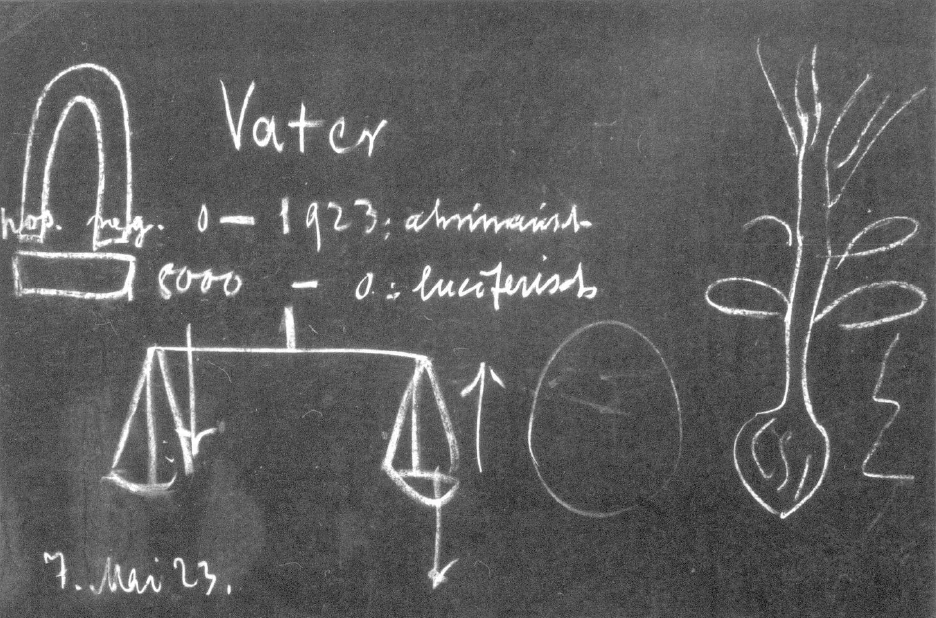
[ 30 ] You see, we are now, aren’t we, in 1923. The entire period from the turn of the era until 1923 is actually such that humanity is in danger of falling prey to the Ahrimanic forces. Just consider this: today, wherever there is no Spiritual Science, people are actually being raised in an Ahrimanic way. Just think about it: our children go to elementary school and have to learn things that must seem quite strange to them—as I’ve already hinted at—things in which they can’t possibly have any interest. They’ve always seen their father, as I’ve told you; yes, he looks like this, has hair, ears, eyes, and then they’re supposed to learn that this here (written): “Father”—that’s the father. It’s completely foreign to them. They have no interest in it. And that’s how it is with everything children are initially supposed to learn in elementary school. They have absolutely no interest in it.
[ 31 ] And this is precisely why we must once again establish sensible schools where children first learn what they might be interested in. If teaching were to continue as it is today, people would simply grow old very early, become senile, and grow old, because that is Ahrimanic. That is what makes people old. The way children are educated in school today—it’s all Ahrimanic. For the past nineteen hundred years, the entire development of humanity has been moving in an Ahrimanic direction. Before that, it was different.
[ 32 ] If you go back, say, from the year 8000 to the turn of the era, things were different then; people were at risk of not living to old age. There were no schools in the modern sense in those ancient times. Schools existed only for those who had already reached a respectable age and were destined to become true scholars. Schools existed for them. In ancient times, there were no schools for children. They simply learned through life. Whatever they saw, that is what they learned. So there were neither schools nor any effort made to teach children anything that was foreign to them. There was a danger that people would fall entirely into the Luciferic realm, that they would succumb to fanaticism—that is, to the Luciferic. And that’s how it was. In those olden days, there was a great deal of wisdom—I’ve already told you that. But of course, this Luciferic tendency had to be reined in first; otherwise, they would have wanted to spend the whole day telling ghost stories! That was what people loved most of all.
[ 33 ] So one can say: From very ancient times, roughly from 8,000 B.C. to the turn of the era, there was a Luciferic age, and then came an Ahrimanic age.
[ 34 ] Let’s now take a look at the Luciferic Age. You see, the scholars of those ancient times had certain concerns. The scholars of that era lived in tower-like buildings. The Tower of Babel, which is mentioned in the Bible, is just one of these buildings. That is where these scholars lived. These scholars said: Well, we have it good here. Our imagination tends to run wild as well. We’re always drawn toward the ghostly, toward the Luciferic. But we have our instruments. We look out at the stars and see how they move. That reins in our imagination. For when I look at a star and want it to move a certain way, it simply doesn’t move that way. So our own imagination is thus reined in.
[ 35 ] So the scholars knew that they allowed their imagination to be reined in by the phenomena of the world. Or they had physical instruments. They knew: If I create a mental image of having a very small piece of wood and heat it up a little, a huge fire will result—I can say that in my mental image, but if I actually do it, that small piece of wood will simply produce a small fire.
[ 36 ] So that was actually the purpose of these ancient educational institutions: to rein in the runaway imagination of these people. And the concern these people had was that they said: “Well, there are all the others—they can’t all become scholars!” And so they put forth teachings that were sometimes honest, sometimes dishonest. These are the old religious teachings, which certainly stem from science, though naturally the priests also went astray. And so the dishonest teachings—the honest ones have been lost, for the most part—have been passed down to posterity. That was the reining in of the Luciferic principle.
[ 37 ] And you know, of course, what the Ahrimanic is like. Today’s science is increasingly moving toward the Ahrimanic. In fact, our entire science is something that is drying us up today. For this science really knows only the physical—that is, the ossified, the material. And that is precisely what constitutes the Ahrimanic in our entire civilization.
[ 38 ] Between the two lies what is truly called “Christianity.” You see, gentlemen, true Christianity is all too little known in the world. If one were to call that which is known in the world “Christian,” then one would naturally have to fight against Christianity—that goes without saying.
[ 39 ] But that being—about whom I also spoke to you a little last time—who was born at the turn of the ages and lived for thirty-three years; this personality was not at all as people describe her, but had actually intended to give teachings to all people that would make possible a balance, an equilibrium, between the Ahrimanic and the Luciferic. And to be Christian means precisely to seek a balance between the Ahrimanic and the Luciferic. For one cannot truly be Christian in the way people often speak of it today.
[ 40 ] What, for example, does it mean to be Christian in a physical sense? To be Christian in a physical sense means that I acquire knowledge about human beings. Human beings can also become ill. A person can develop pleurisy. What does it mean when someone develops pleurisy? It means there is too much Luciferic influence within them. If I know that there is too much Luciferic influence within them—that is, if they develop pleurisy, there is too much Luciferic influence within them—then I must say: If I have a scale (Figure $. 230) and the needle swings too far up here, then I must remove some weights. If it drops too far down, I must add weights there. Now I tell myself: If a person has pleurisy, the Luciferic is too strong and the Ahrimanic is too weak. I must add something Ahrimanic, and then the balance will be restored.
[ 41 ] So let’s assume I correctly diagnose: This person has pleurisy; how can I help him? I take, let’s say, a piece of birch wood. Birch wood grows vigorously in the spring. Birch wood, in particular, is very beneficial, especially when it’s close to the bark; there are very powerful growth forces within the bark. I neutralize those forces—that is, I carbonize the birch wood. Then I have birch charcoal. What have I done with this fresh, constantly regenerating birch wood? I made birch charcoal out of it; I made something Ahrimanic out of it. And now I make a powder from this birch charcoal and give it to the person who has too much Luciferic influence within them due to pleurisy. Then I have added the Ahrimanic to the excess of Luciferic influence they possess.
[ 42 ] You see, that is how I created the balance. Just as I have to add something to the scales when they swing too high on one side, so too, when there is too much Luciferic influence in the pleurisy, I added birch charcoal. I transformed the birch wood into a mineral by charring it. It has been made Ahrimanic.
[ 43 ] Or suppose a person takes on such a weary, paralysed appearance that I can say to myself: a stroke is coming for him soon. There is too much Ahrimanic in him. Now I must infuse him with something Luciferic to restore the balance. What, then, will I do?
[ 44 ] Look, when I have a plant: there’s the root. You know, the root is hard. It contains many salts. That’s not Luciferic. The stem and the leaves aren’t Luciferic yet either. But if I go further up, I find a fragrant, strongly scented flower. It wants to escape, just as the imagination wants to escape; otherwise, I wouldn’t be able to smell it at all. Now I extract the sap from the flower. That is Luciferic. Then I administer it in the proper way, thereby balancing out the Ahrimanic force, and I can heal him.
[ 45 ] What does modern medicine do? Modern medicine—well, it experiments. A chemist comes up with the idea of discovering acetylphenetidine. I don’t need to explain to you what that is; it’s a complex substance. Now they take it to a hospital. Let’s say there are thirty patients there. All thirty patients are given acetylphenetidine; then they take the thermometer, measure the temperature, record the results, and if anything comes of it, they consider it a cure.
[ 46 ] But we have absolutely no idea how things actually work inside the human body. We don’t look inside the human body. Only when we know that pleurisy involves too much Luciferic influence—and that we must add Ahrimanic influence to it— in the case of a stroke, there is too much Ahrimanic influence, so one must add Luciferic influence—only then is it right. That is what humanity lacks today. In this sense, humanity is not Christian enough, because Christianity is about balance. You see, I am showing you what the Christian aspect of physical healing consists of. The Christian aspect consists in seeking balance.
[ 47 ] You see, that is exactly what I wanted to depict in this wooden figure, which is supposed to be under construction. At the top is Lucifer, the Luciferic—that is everything in human beings that is feverish, imaginative, and sleep-inducing; and at the bottom is everything that seeks to harden, the Ahrimanic. And in between is the Christ.
[ 48 ] That is what leads one to understand what one should do in medicine, in the natural sciences, in sociology—in every field. And today, it is simply part of being human to understand how the Luciferic and the Ahrimanic are present within human nature.
[ 49 ] But what do people really understand about these things? Once, a pastor who was very famous in Basel and even beyond—his name was Frohnmeyer, a very famous pastor—gave a lecture. He didn’t bother to look at this figure himself, but he read in a text by someone else—who perhaps hadn’t looked at it either, but had simply copied it—that a figure is depicted here: Luciferic at the top, Christ in the middle, and Ahrimanic at the bottom. There are, in fact, three figures stacked one above the other, and—aren’t there?—there are actually several: Ahriman twice, and Lucifer twice as well. But this Frohnmeyer was so certain of it that he wrote: “Steiner is doing something truly terrible out there in Dornach—a Christ figure that has Luciferic traits at the top and animalistic characteristics at the bottom.”
[ 50 ] Well, the figure of Christ has no Luciferic traits at all, but rather a completely human head. But he got that mixed up. He believed that the figure of Christ had Luciferic traits at the top and animalistic features at the bottom. — But the Christ figure isn’t finished at all toward the bottom; it’s still just a block of wood!
[ 51 ] This is how this Christian pastor, who strives for the truth, described the matter, and now the whole world says, “That must be true, after all—it was a pastor who wrote that!” — It’s just hard to counter that when people won’t see reason, won’t understand. They always run to the pastors because they believe what the pastors say. But here you have an example of slander so pitiful that one cannot even imagine anything worse.
[ 52 ] And these people have some strange views. Pastor Frohnmeyer—he’s the one who wrote this. Now, back when he wrote this, Dr. Boos was still here at the Goetheanum. As you know, Dr. Boos has a habit of coming down hard on things. One can certainly have one’s own opinion on whether one should strike with a club or with a beard brush. The beard brush is softer, more Luciferic; the club is hard, more Ahrimanic. So it depends on what one uses to strike. But anyway, he once told Frohnmeyer the truth—told him the truth with a bit of a club. - Who gets a letter from Frohnmeyer? Me! I get a long letter from Dr. Frohnmeyer telling me that I should get Dr. Boos to stop being so rude to Dr. Frohnmeyer.
[ 53 ] Just imagine what kind of ideas people have. It’s hard to believe what they think. They slander someone, just as I’ve told you, and then they come to you asking that action be taken against the person who sets the record straight!
[ 54 ] That is precisely the difficulty: the public—especially the middle-class public—doesn’t even bother to examine these matters for itself, but simply accepts them as they are; because the authorities have designated the people involved, it must be right. That is why our civilization is so incredibly frivolous, so vulgar in so many ways.
[ 55 ] The point is that today’s entire way of thinking must be steered into a course where people once again realize: all this talk about Christianity is meaningless; instead, one must approach it objectively. So one must know that medicine can become Christian if, for example, one knows the following. Let’s say someone demonstrates quite precisely that if a person has regularly consumed sugar—perhaps even as a child—they will develop liver cancer—which is a process of the liver becoming Ahrimanic—and now one must know what to apply against it: the corresponding Luciferic force. Just as a person distinguishes between warmth and cold, one must distinguish between becoming Luciferic and becoming Ahrimanic. Isn’t it true that when one’s limbs have become stiff, one has become Ahrimanic? If one then applies warm compresses or warm cloths, that is the Luciferic force that counteracts it. And so, in all fields and under all circumstances, one must know the true nature of the human being. Then medicine becomes Christian.
[ 56 ] Education and the school system must likewise become Christian. This means that children must be raised in such a way that they do not become like old people from their earliest childhood. Therefore, in school, they must be introduced to things that are familiar to them, that interest them, and so on.
[ 57 ] You see, if one looks at it this way, there is nothing at all superstitious about the use of the terms “Ahrimanic,” “Luciferic,” and “Christian”; rather, it is entirely scientific. And that is indeed the case.
[ 58 ] So how did things unfold historically? Well, you see, there was a period—from the earliest Christian times all the way through the 12th and 13th centuries, and even into the 14th century—when Christians were forbidden to read the Bible. Reading the New Testament was forbidden. Only the priests were allowed to read it. Ordinary believers were not allowed to read the Bible. Why? Well, because the clergy knew that the Bible must be read correctly. The Bible was written at a time when people did not think the way they do today, but rather thought in figurative terms. So one must read the Bible correctly. If people were to read the Bible without being properly prepared, they would conclude that the Bible has four Testaments: the Gospel of Matthew, the Gospel of Mark, the Gospel of Luke, and the Gospel of John. Well, these contradict one another. Why do they contradict one another? Yes, gentlemen, one just has to understand this correctly. Even a person who wasn’t entirely out of their mind could have seen this “contradiction” as early as the 4th or 5th century. Of course they contradict one another.
[ 59 ] But just imagine: I took a picture of Mr. Burle from the front and am showing it to all of you. Now, based on that picture, you recognize Mr. Burle. Now someone comes along and takes a picture of him from the side, so that you see his profile, right? I’ll show it to you, and you’d all say: “That’s not Mr. Burle—he looks completely different; you have to look at him from the front—that’s what he looks like there.” “But what you’re showing me from the side—that’s not Mr. Burle!”—Yes, that’s Mr. Burle too, but he’s just shown from two different angles! And if I were to take a picture of him from behind, you’d say, “But he has a nose, doesn’t he? It’s not just hair!” But that’s just from different angles!
[ 60 ] If one “photographs” mental processes from different angles, they appear differently. One must simply understand that the Gospels describe events from four different perspectives. Therefore, they are bound to contradict one another, just as a picture of Mr. Burle taken from the front, from the side, and from the back all differ from one another.
[ 61 ] But now the time has come when people have said: “There’s no such thing as preparing yourself first to read the Gospels.” Today, we don’t prepare ourselves for anything at all anymore. We let ourselves be prepared in school—we let ourselves be trained there—but once we’ve moved beyond that training, once we’re past fourteen or fifteen, there’s nothing left to prepare for; we’re supposed to understand everything. —Well, that’s pretty much the prevailing view these days.
[ 62 ] Why shouldn't that also lead people to think: There's a Goetheanum; it's not children who go there for classes, but ancient, bald old men who still want to be taught. Yes, a school where children don’t go, but only old people—that must be a madhouse! —You see, they say this because they can’t even form a mental image of people still wanting to learn something. That’s already the case today. And this is what we must be clear about: To read something like the Gospels, one must first properly prepare oneself, because they are meant to be figurative. Just as if someone today wanted to read a Chinese document, they would first have to learn the characters. If one were to take the Gospels today as they are written, it would of course be nonsense, just as Chinese writing is just scribbles if one doesn’t look at it properly. But if one understands these things correctly, one comes to realize that everything in Christianity boils down to this: You must learn to always strike the right balance between the Ahrimanic and the Luciferic, so that one does not dominate and the other is suppressed.
[ 63 ] And that is why anthroposophy has no qualms about speaking of Christianity in this sense. It emphasizes that Christianity does not consist in constantly having the name of Christ on one’s lips and so on. People do, after all, accuse anthroposophy of speaking so little about Christ. Well, I always say: Yes, you see, anthroposophy doesn’t speak much about Christ because it knows the Ten Commandments. And you speak so much about Christ because you don’t even know the commandment: ‘You shall not take the name of the Lord your God in vain.’
[ 64 ] When a Christian pastor preaches today, the name of Christ is constantly spoken. One should utter it only when one truly understands what is at stake! That is precisely what distinguishes anthroposophy—which truly seeks to be Christian in the right sense, but without being superstitious or pious, seeking only to be truly scientific, and in this sense, truly only scientific. And in this way it also views what has come to stand between the old era, which was Luciferic, and the new era, which is Ahrimanic; it regards precisely this event in Palestine as the defining moment in world history.
[ 65 ] And once people truly understand what actually happened here on Earth, only then will they—I would say—come to their senses. People are, after all, completely absorbed in their purely external science right now. We’ll continue discussing this next Wednesday at nine o’clock. That is what I wanted to say in response to the question. I believe one can already understand the whole matter.