

Man's Life on Earth and
the Essence of Christianity, tr. SOL
GA 349
9 May 1923, Dornach
Translated by Steiner Online Library
13. On Christ's Death, Resurrection, and Ascension
Question: Is there more information available about the personality of Jesus Christ?
[ 1 ] Dr. Steiner: As you can see, gentlemen, the question being raised is very timely, and so we will discuss it today. I must say from the outset that what I am about to say will be fully understandable only to those who have been here for some time, while those who have just arrived today will gradually find their way into the subject we are discussing.
[ 2 ] So the question that has been put before me, and which we will discuss, is that of the person of Christ, who lived to be thirty-three years old and then died.
[ 3 ] “On the third day, he rose from the grave—he was resurrected. How did this happen, and where did this figure acquire such strength and power? And then, would you be so kind as to tell us about his Ascension forty days later?”
[ 4 ] Since the time is right, I’ll discuss this exactly as it happened, after we’ve already covered the other topic; but, as I said, it can only be fully understood by those who have been here for a while. The others will get there eventually, once we meet here more often.
[ 5 ] Well, you see, to begin with, the whole matter of Christ’s personality and his fate in those very earliest days—after it had taken place—was actually quite unknown. You shouldn’t view the matter the way people do today, because today there is a sense that the events in Palestine connected to the person of Jesus became known throughout the world all at once. That is not the case, however; rather, the reality is that back then, at the time when the events surrounding Christ Jesus took place, the so-called Roman Empire—a powerful world empire—spanned a vast territory, and Palestine was also part of this powerful Roman world empire.
[ 6 ] As you know, we still have a rather troublesome legacy from the Roman Empire: so-called Roman law. You may be aware that university students studying what is known as “jurisprudence” must spend a great deal of time studying so-called Roman law. Well, Roman law was devised at a time when social conditions were quite different, so that Roman law has naturally become highly unsuitable for the present day. But justice is still administered today according to Roman law.
[ 7 ] So this is the one legacy we have inherited from the Romans. We have many others as well; but this one legacy—what is known as Roman law—is something that may strike all of you as noteworthy.
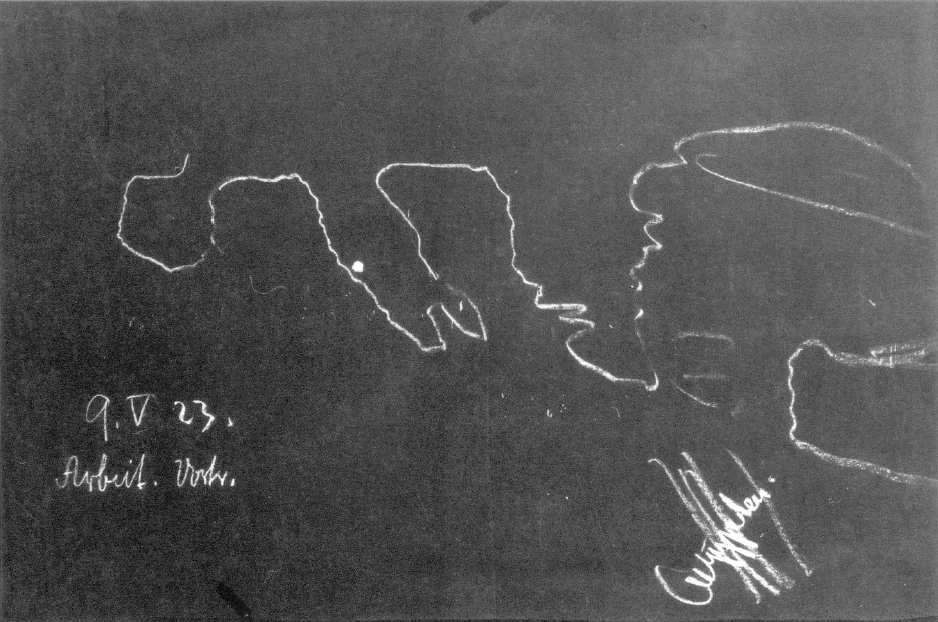
[ 8 ] Well, Roman rule was, after all, extraordinarily extensive. I’d just like to give you a brief idea of just how extensive Roman rule was. You need only create a mental image of southern Europe: Here we have Spain (it’s being drawn), here we have Italy; over there we have Greece, and over there we have the Black Sea. Then we have a multitude of small islands. Asia Minor juts out over there, and over there, in the area I’m about to highlight, lay the small country of Palestine with Jerusalem, Nazareth, and so on.
[ 9 ] Roman rule had now spread across all these lands. The Romans had brought all these lands under their control. So it was a very extensive Roman empire! Rome, of course, is located there. Of course, everything related to government affairs and so on took place in Rome—very far away from Palestine. And very, very little of what happened in Palestine was known in Rome at that time. And those writers who wrote in Rome didn’t write anything about it for about a hundred years after the events involving Jesus Christ had already taken place in Palestine! It wasn’t until about a hundred years later that people in Rome took notice of this event that had taken place in Palestine. And at that time in Rome, they didn’t treat it much differently than by simply saying: “Well, over there in Palestine, an unknown person was crucified.”—Being crucified back then meant something similar to what it meant later: being hanged. So it didn’t cause much of a stir. It was only then, after a hundred years had passed, and Roman rule had become increasingly tyrannical and increasingly luxurious, that it became apparent that in the meantime—while people in Rome were living their lives of luxury—Christianity had slowly, little by little, spread here, and it was actually in Rome that the Christians were first noticed. And the situation for Christians in Rome was such that at first they were not tolerated at all. Anyone who was a Christian was severely persecuted in Rome. And now I must explain to you why Christians were persecuted in Rome, because—after all—otherwise you would not be able to understand at all the reasoning behind the view that emerged at that time: that a god had died in Palestine, in Jerusalem. You must realize what the prevailing views in the world actually were back then.
[ 10 ] You see, for a Roman in that first Christian century—that is, for a Roman at the time this was written—people didn’t write it that way back then, they calculated according to the Roman calendar, but if our calendar system had already existed, they would have written 1 or 10 or 50, for all I care—so if you had asked a Roman back then: “Who is God?”—he would have said: “Augustus,” or “Tiberius.” —Just as even today [1923], if you ask a Chinese person, “Who is God?”—he points to the Emperor of China. So you must realize that, in those days, for the Romans, the ruler, the one in power, was at the same time their god. And that was the very thing the Romans first noticed about the Christians, the first thing they became aware of regarding the Christians: that the Christians did not believe that a human being on earth could be a universal god. The Romans knew only that any person sitting on the throne, wielding powerful authority, was God—the supreme being who must be worshiped. Indeed, the Romans bestowed a form of worship upon their ruler.
[ 11 ] Yes, that was the case all over the world back then. Over there in the Orient, where the great empires once stood—the Persian Empire, the Assyrian Empire, the Babylonian Empire, and so on in ancient times—it was also the case that the ruler was God. “God” meant nothing other than the one to whom one turned when one needed something. He was the supreme being. He was regarded as a helper. He wasn’t always a helper, but he was regarded as one.
[ 12 ] I would like to point out that you are probably familiar with the word “God” in your language. When children are baptized, people must serve as godparents. Now there are regions—I believe even here in Switzerland—where the man is called “Gott” (God) or “Herr Gott” (Lord God), and the woman is called “Gottel.” This means that those who are the child’s godparents are expected to provide help. This is the same “Gott.” And “Gott” was simply the one who served as the universal godparent of the world. If you want to understand the ways of earlier times, you must always put yourself back in that time. So “Gott” was the universal godfather. The name Goethe—the name of the German poet Goethe—also comes from the same word.
[ 13 ] And that was the first thing people heard about the Christians—that they did not believe a human being on earth could be a universal god. For the Romans, this was something they simply could not comprehend. Such terrible people, who do not acknowledge the emperor as a god—yes, they are truly dangerous people. And the Christians, for their part, invoked the saying: “Render to Caesar what is Caesar’s, and to God what is God’s.”—So, if you look at Jesus’ saying, the distinction between Caesar and God is clearly drawn. God is the invisible. God is that which does not dwell in a visible human being on earth. That is what the Christians claimed. And that was the great difference between the Romans and the Christians. And the consequence of this was that the Romans regarded the Christians as the most dangerous people of all, who undermined state authority because they did not offer sacrifices to the emperor in the temple. The sacrifices in the temples were, after all, offered to the emperor by the people. Now, the Christians offered sacrifices to a God who died in Palestine, who cannot be seen anywhere at all. That was something the Romans could not comprehend. And so the early Christians had to perform their sacrificial rites underground. These underground passages that they dug out—where they buried their dead and performed their sacrifices—are called catacombs. In Rome—and throughout Italy in general—there are such vast underground catacombs, as extensive as small cities. It was there that the early Christians performed their sacrificial rites in the first centuries, while above ground the Romans had large circuses—huge circuses— And in such circuses, for example, they took great pleasure in tying a person they despised to a stake or a column and, after coating him with pitch, setting him on fire and burning him alive. And people watched this in the circuses, just as people watch bullfights today. That was something that was quite commonplace.
[ 14 ] Just imagine this scene: up above, the savage Romans in the circuses, tying those coated in pitch to a column and burning them alive. That amused them greatly. And below, the Christians, who held their services in the catacombs. That was a difference, gentlemen, between what was underground and what was above ground—one could not imagine a sharper contrast. One need only consider this.
[ 15 ] It is true that things got quite terrible in the Middle Ages with the Inquisition. But as badly as the Romans behaved at the height of the Roman Empire, the Christians did not behave quite as badly later on. That much must be noted. It is simply true.
[ 16 ] So the first thing people heard in Rome was: “The Christians refuse to acknowledge a visible God.” Of course, it has become increasingly clear what was actually meant by this Jesus Christ, and I’ve already told you quite a bit about it. For example, I pointed out to you that there were actually two boys named Jesus—the name Jesus was just as common in Palestine as names like Sepperl or Michel are today—one of whom died very young, and they were, one might say, playmates, exceptionally capable and gifted children.
[ 17 ] Now, you see, this story—which you all know from the Bible—about the twelve-year-old Jesus teaching the scribes in the temple is something that is certainly based on truth. Of course, you shouldn’t think: If a twelve-year-old boy were to go to a university today, the faculty wouldn’t have much respect for him. The education of today simply cannot be compared to that of back then. You really don’t have to think that I hold conservative views, let alone reactionary ones, but I must tell you the facts as they are. Isn’t it true that today we simply have to send our children to school as a matter of course? There, gifted children in particular learn an extraordinary amount of things that don’t come naturally to them at all. One must, as we do in Waldorf schools, present the material in such a way that it suits the children. But in general, children learn an extraordinary amount of things that don’t come naturally to them at all. The things that don’t come naturally to them are, of course, things that adults can do better than children. But what is driven out of the children as a result of their learning to read and write the way we do today—well, gentlemen, people today don’t pay any attention to that at all. If you know how to listen to them properly, children tell you extraordinarily wise things. They brought these with them from their spiritual life before they came down to earth. And this one boy named Jesus brought an extraordinary amount with him. And because the two boys named Jesus were playmates, they actually knew the same things deep down. Now one of them has died. And so the Gospels now tell the story—because people preferred it that way—of only one boy named Jesus. But that is not how one understands the Gospels. If you read the Gospels of Matthew and Luke today, you’ll see that they contradict each other. The entire genealogy of Jesus in the Gospel of Matthew is described differently than in the Gospel of Luke. Why? Well, because these accounts actually refer to two Jesus boys.
[ 18 ] I told you that I have really been studying this question from a perspective of Spiritual Science for years, and I have come to the conclusion that there were two boys named Jesus, and that the Gospel of Matthew is about a different boy named Jesus than the Gospel of Luke.
[ 19 ] Now one of them died in his twelfth year, and the other survived. So when the Gospel says, “Jesus grew in wisdom, spirit, and strength,” this refers only to the one who survived.
[ 20 ] You see, I found this a long time ago, just as I told you—that there are two such “boy Jesuses.” No one knew that anywhere in history it was recorded that there are two “Jesus boys” until we once came across a painting in northern Italy. It depicts the story of Jesus in the temple, where he is teaching the scribes. And, strangely enough, there is this second “Jesus boy.” He’s walking away. One is teaching, and the other is walking away—that’s not the usual boy Jesus we’re familiar with! So there are two boys depicted as Jesus in it, which means we can say that in certain centuries, people still knew that a second boy Jesus had existed. He’s walking away. It wasn’t until I discovered this that I realized this second boy Jesus was depicted there. So you see, gentlemen, people have known this for centuries. But the Church has never really allowed such things—which correspond to the true reality—to come to light.
[ 21 ] Well, as I’ve already told you, there are simply certain moments in a person’s life when you might say, “That’s when enlightenment strikes.” Of course, people don’t accept that. But you see, such moments of enlightenment—they simply do exist—one can speak of such moments of enlightenment, and I want to share an example with you that was just given to me yesterday by a member here. I could give you hundreds of examples, but I want to share this most recent one with you. Mr. Pfeiffer, I can say that, can’t I?
[ 22 ] There is a very prominent chemist, Kekulé, an impeccable scholar—simply a true chemist—who has written many books on chemistry. Now, there are two important scientific views that stem from Kekulé. I don’t need to go into these views in further detail; that would take us hours, and that’s not what matters right now. These two
[ 23 ] important chemical theories concerning the structure of substances—specifically benzene, for example—at their smallest levels. And these theories, which Kekulé formulated, play an extraordinarily important role in chemistry. Anyone familiar with chemistry knows that people are talking about Kekulé’s theories everywhere today.
[ 24 ] Well, what did Kekulé himself experience? Kekulé recounts that he was once in London, where he lived quite far out—he hadn’t yet formulated any of his theories at that point—and had to take one omnibus after another at night to get to the other end of the city. He had an acquaintance there whom he visited in the evenings. That’s why he always had to travel so far—because he spent the night there. One time, he was on his way home after talking at length about chemistry with his acquaintance, who was also a chemist. He rode home and sat on the upper deck of the omnibus on the outside. He dozed off and began to fall asleep. And as he began to fall asleep up on the bus, he had a dream: there was an atom, then another, then a third atom; and then there were small atoms held together by the large ones (he drew a diagram). He dreamed about matter—about what it’s made of. He dreamed all of this while sitting upstairs on the bus. As soon as he got home, he wrote it all down carefully. That was one theory. You see, he dreamed it. It was inspired to him—a completely materialistic theory.
[ 25 ] The second is the so-called benzene theory. He dreamed this up on another occasion—not in London, but while he had dozed off somewhere else.
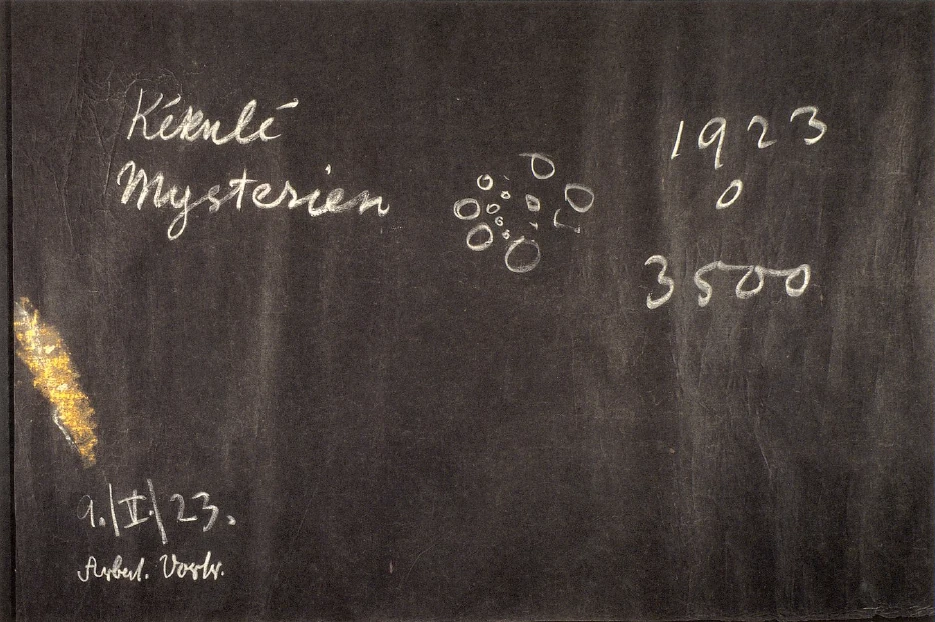
[ 26 ] Yes, gentlemen, as you can see, even a thoroughly materialistic chemist had to admit that he would never have come up with these ideas through his own thinking or reasoning alone; rather, it was through a dream that he gained insight into these two things. It was all a true flash of inspiration.
[ 27 ] Now I’d really like to know why people object when it’s said that the Jesus who remained became something completely different in his thirtieth year. Of course, Kekulé didn’t immediately become a completely different person, because the inspiration was, after all, a small one. But when Jesus was thirty years old, the knowledge of the entire world entered into him. In those earlier times, that was something that was entirely possible, and similar things are still possible today. So you need only imagine that the Jesus of Nazareth, who had remained, was enlightened at the age of thirty with all that is called the Christ. It entered into him, just as the benzene theory entered into Kekulé. Through this, he had become a completely different person. And those who now understood something of the matter said: The Romans have a god on the throne. The god on the throne, they said, came into being through the ordinary earthly powers. Such gods on the throne usually do not have enlightenments; at least not in most cases, do they? They do not have such enlightenments at the age of thirty.
[ 28 ] Well, the Christians said: Our God was not appointed by human beings; He was appointed by the powers of the world themselves.
[ 29 ] But now they had to say something else. You see, what people said about Jesus back then wasn’t as vague as what I’m telling you right now. I have to explain it to you slowly and gradually, which is why—isn’t that right?—the matter seems vague at first. But it was actually more specific in the following way. You see, today we have universities so that individuals can become educated according to the standards of our time. After having already been educated for a long time in what is called a “Gymnasium” or a “Realschule,” one goes on to college. There, one receives the final polish of education. But you will not always find that the people who then emerge from the university have become different people during their time there; rather, they have merely learned something on the surface.
[ 30 ] That was not the case in earlier times, however. In earlier times, there was no distinction at all between churches, theaters, and schools; rather, they were all one and the same, and this was called the Mysteries. That is where people were educated back then. And the most important thing that was taught to people in the Mysteries was what is known as the knowledge of the Sun.
[ 31 ] You see, when we were talking about scientific matters, I always told you about the influence the sun has on everything that happens on Earth. Plants don’t just grow because they’re pushed up from the ground below, but because the sun pushes them up. The power of the sun is within all of us, just as the power of the Earth is. And I have pointed out to you that this power of the sun is not merely a dead force, but a wise, living force. I have given you many examples. You have been able to see that what happens among animals happens in a wise, intelligent, and sensible way. Yes, when one looks up at the sun, scholars have a mental image of it as a ball of gas. Yes, gentlemen, that is about as sensible as if all of us together could—it’s not possible, of course, but let’s suppose we could do it just as Jules Verne described it—board a large airplane and fly up to the moon, go about our business on the moon, and I were to say to you: “There, gentlemen, down there—see, that’s the Earth.” The Earth is a sphere; there’s nothing else on it. — You wouldn’t believe me, gentlemen, because you came up here with me. You’d believe that there are people on it after all. People who have souls are on Earth.
[ 32 ] But that is exactly what scholars do with the sun today. They sit here on Earth, look up at the sun, and say: “There is nothing up there but burning gas.” — But that is utter nonsense. The sun, even if not inhabited by the kind of people one can see with the naked eye, is nevertheless inhabited.
[ 33 ] And this knowledge of the sun was what was primarily imparted to the students in the ancient mysteries. And that is why these students were called “sun students.” It was said: Up there on the sun are the forces—the forces of spring, the forces of the sun—and there lies that which draws everything out of the earth. And so, in ancient times, one who had learned the mysteries of the sun was called a “Sun Disciple,” and later, once he was fully trained, a “Sun Master.” And what Jesus of Nazareth suddenly knew at the age of thirty was this wisdom of the sun. This wisdom of the sun had come upon him. Now, you may have already noticed that when plants—which are beautifully green and vigorous above ground—are placed underground in a cellar, they turn quite whitish and seem paralyzed. Well, that is precisely because the power of the sun does not flow into them. This power of the sun, in the mystical, spiritual sense, was drawn into Jesus. And those who understood this said: Now the Christ has been drawn into Jesus.
[ 34 ] You see, this is where that strange thing came in. The Jews, who lived mainly here in Palestine (the chart is pointed to), had long heard from their prophets that something like this must happen one day, so that the earth could be taught from outer space itself. But you can be absolutely certain that if someone were to write a “William Tell” today—the way Schiller wrote it—and it were performed in a theater, people would say: “That’s a piece of drivel; it’s terrible.” They wouldn’t accept it. And “William Tell” was initially recognized only by the few people who knew Schiller; then it spread. It is simply the way of things in our social order—and has always been so—that the majority of people have allowed themselves to be led by the scruff of the neck. The Jews, too, allowed themselves to be led by the nose, and when that happened—when they were no longer guided by the mysteries, but instead someone appeared who possessed this knowledge of the sun—they said: “Here, at last, is someone who claims that everything he says is true!” — You know, of course, what is done to such people who speak a truth that is not yet known among the people. It was a great truth and wisdom that Jesus of Nazareth—in whom the Christ now lived—had to proclaim. Well, and so they crucified him. And he did indeed pass through death.
[ 35 ] This brings me to the question as it was posed to me directly. You see, gentlemen, today’s enlightened theologians are, for the most part, perhaps even worse than the unenlightened ones. The unenlightened theologians say: Well, they laid Christ in the tomb, and after three days he rose again in the flesh and blood, just as he was. — Well, of course, the enlightened people said: We don’t believe that, because no one ever comes out of the grave. — But, I would like to say, it is at least something one can profess. It may be open to question, but it is something one can profess.
[ 36 ] But what do enlightened theologians say? You see, one of the most enlightened theologians, who is well-known and often cited, is Harnack. What does he say about the Resurrection? You see, Harnack says: What happened on the third day in the Garden of Gethsemane—for that is where the tomb was—we simply cannot know. So this is what the enlightened theologian says: “What happened on the third day in the Garden of Gethsemane—one cannot know that, of course.” But many people have gradually come to believe that Christ rose from the dead there. So that is the Easter faith, and we assume that one should adhere to this Easter faith.
[ 37 ] You see, I once raised this question—it was quite a long time ago now—at the Berlin Giordano Bruno Society. The chairman there was a scholar who believed he knew a great deal about these matters, and he said: “Harnack can’t possibly have claimed that, because what would that even mean if Harnack claimed that one shouldn’t believe what actually happened, but only what people believe about it!” That would be just like the Holy Robe of Trier, where people also say: “Well, whether the Holy Robe of Trier is really the one that Christ wore, we don’t know, but since so many people believed in it, we believe in it too!” — That’s what the Protestant said about the Catholic belief in the Holy Robe of Trier. Or take another example: the bones of Saint Anthony. When they were examined closely, they turned out to be calf bones. Even the people who believed in them didn’t make much of it, but said that what matters isn’t whether it’s true, but whether people believe it.
[ 38 ] But that’s not the point at all—what matters is what actually happened! Now, the Bible actually tells the story in a wonderful way; it’s just that people don’t pay attention to how it’s told there. The Bible doesn’t say, “This and that happened,” but throughout it says: “People saw this and that—they saw it clearly.” That is what is told.
[ 39 ] So the story goes that the women went out and saw what was at the tomb—interpret that as sophistry if you will! The story goes that Christ met the disciples on the road to Emmaus, and so on; the story goes that Christ was seen.
[ 40 ] Now remember that I told you: a human being does not consist solely of this material, physical body that is laid in the tomb, but also consists of the etheric body, the astral body, and the I. I have described this to you in great detail. Now, the physical body of Jesus of Nazareth was indeed laid in the tomb. I have given this question a great deal of thought, and it is extraordinarily significant that the Gospel itself states that an earthquake occurred. There was indeed such an earthquake. It caused a fissure, and the body was taken up by the earth—so it was truly no longer there. And the disciples did not see this physical body, but rather the etheric body, the supersensible body. The women and the disciples saw the Christ in the etheric body—no longer Jesus of Nazareth, but the Christ, that which was now the transformed inner human being.
[ 41 ] Of course, you have to create a mental image of what happened there, which was something extraordinarily magnificent for the disciples. Just consider this: if there were someone among you with whom you had grown so close as friends, and that person were torn away from you by crucifixion—or, as we would say today, by the gallows—and you were deeply connected to him—that would certainly create a certain state of mind. This state of mind made the disciples virtually clairvoyant regarding these things. And time and again—more often than is recorded in the Gospels—they truly saw the Christ in those early days. But it was the supersensible Christ.
[ 42 ] And you see, when you read the Epistles of Paul, you read about the famous event in Damascus that Paul experienced. Near Damascus, he fell into a kind of trance, and Christ appeared to him in the clouds. And pay attention to how Paul recounts this. He once said: “No one can take away my faith in Christ, for I have seen Christ, just as the other apostles have.”
[ 43 ] So Paul does not say that the other apostles saw Christ in the physical body; otherwise, he would have to claim that he, too, had seen Christ in the physical body. He explicitly states that he saw Christ in the clouds—that is, the supernatural Christ—and by saying that he and the other apostles saw Christ, he is already indicating that the other apostles, just like him, saw Christ in His supernatural body. And isn’t it true that people believe it is an objection to this that the unbelieving Thomas had to put his hands into the wound marks? That simply means: the presence—the fact that Christ was there—that experience was so powerful that even Thomas could have the strong faith that he was touching him. So it all pertained to the supersensible Christ.
[ 44 ] Isn’t it true that the wounds were something that really touched the hearts of the disciples, especially the apostles? It would have been much less vivid if the account hadn’t mentioned that it was precisely the wounds that could be touched. Why the wounds in particular? Why not place their hands on his face or something like that? He would have felt that something was there in that case, too. He placed his finger on the wounds because they made a special impression, and it actually depended on the higher vision—on what the disciple truly perceived of Christ at that moment.
[ 45 ] So one can say: For forty days in a row, the disciples were certain that the Christ was still there.
[ 46 ] And from this arose the Christian doctrine—which is the original Christian doctrine, to which what I told you last Monday relates—from this arose the Christian doctrine: When Christ is buried, there is only the corpse in the tomb, which of course disappears; Christ himself has shown us the immortal; he walked among us in his immortal form for forty days. We saw him. And he even appeared to Paul much later. So he is always there.
[ 47 ] And so we can say even today: He is always there. It’s just that, because this power of seeing had faded within them, the disciples no longer saw him after forty days. Then they said: Now he has left us—the Ascension. This is an event that naturally filled the disciples with great sadness. They said: Even though he died, even though his enemies crucified him, he was still among us for forty days. Now he is no longer among us. Now he has returned once more to the vastness of the world.
[ 48 ] And then they became truly sad. Not just ordinary sadness, but a very deep sadness. And those ten days we are now speaking of—those ten days were a time for the disciples and apostles to look deep within their hearts, to reflect with inner strength on everything Christ had ever said to them. These ten days were enough for them to say to themselves afterward: “Yes, we can know all of this ourselves; this wisdom”—they told themselves, moved by the powerful impression—“this wisdom dwells within us.” And after ten days, they now felt the strength to teach this wisdom as well. The tongues of fire—that is the image for it—descended upon their heads. That is Pentecost, the idea of Pentecost, the tongues of fire. Through their deep sorrow, as they had reflected on the fact that they would never again see Christ, they had turned so deeply inward that they were able to teach on their own.
[ 49 ] And it is beautifully recounted that they then began to “speak in all languages.” But here one must simply understand a little how people spoke in those days. Of course, you must not think that the text is claiming the apostles began to speak Chinese or Japanese—or even German—but rather, in the manner of speech of those times, it means that through everything they had reflected on during the ten days between the Ascension and Pentecost, they had become tolerant. Now there was no longer any distinction between religions for them; instead, they proclaimed one religion for all people. This is what is meant by their being able to speak in all languages: they proclaimed one religion for all people.
[ 50 ] And that is, after all, the most beautiful idea of Pentecost: religion for all people. You see, what has harmed people the most is always religious fanaticism, the exclusivity of religion—the fact that there is Christianity, Buddhism, Judaism, and all sorts of other religions. Why is it that there are so many religions? The reason there are so many religions is that these religions are earthly religions—truly earthly religions.
[ 51 ] What do I mean when I say “earthly religions”? Well, you see, there is a time—if we go back, for example, to, say—it is now the year 1923—to the time I told you about when Jesus Christ lived in Palestine, that is, the turn of the era. Now let’s go further back, say, to the year 3500 B.C., that is, back to antiquity. There were people down in Egypt who, some 3,000 or 3,500 years before Christ, also spoke of their god—only in ancient terms. They called him Ra, for example. They spoke of their god, but they said: “The god is in the city of Thebes, for example,” and in the city of Thebes, there was a kind of building with a distinctive artistic, tomb-like structure. The god dwelt inside it. That was the oldest form of worshiping the god—believing that he was in a specific place.
[ 52 ] Yes, gentlemen, if someone had lived where we live today, he probably wouldn’t have said, “The god is in Thebes,” because that was a place that people in ancient times not only couldn’t reach but about which they knew absolutely nothing. People knew nothing about Thebes. So those who lived down here, in Egypt, where the Nile flows, would have said: “The god who dwells in Thebes.” And those who lived here, in our region, also had such local deities. For example, there was a local deity in what is now Alsace, or in Münster. So people worshiped God in a specific place. Yes, that’s what leads to there being different religions: the Theban religion, the Münster religion, the Alsatian religion. That’s where the religions split off.
[ 53 ] And later, when people began to migrate more widely across the earth, they could no longer accept any particular place as God, for that would have been a contradiction in terms. They had moved on, and by then they no longer accepted that place as God, but rather the person who led them. And so, gradually, the divine dignity passed to the emperor and the princes. For each people, the prince became the emperor. Many princes emerged.
[ 54 ] As you can see, traces of this religion still remained in Rome, since the Romans continued to worship their emperor as a god.
[ 55 ] But what was Christianity? Christianity said nothing of the sort. That which is to be worshiped—the Divine—is not bound to any place on Earth, nor to any human being on Earth, but to the power of the sun, the vitality of the sun, which Christ absorbed into himself. And the sun is, in fact, universal. For no one in Europe, when the sun shines upon their head, can say that it is a different sun than the sun of the Egyptians, the Chinese, or the Australians. Anyone who truly recognizes that the Christ-force comes from the sun must recognize the universal religion for all people.
[ 56 ] It was the universal religion for all people, even if people did not always understand it. And the disciples came to understand quite well that the religion of the Sun exists. This is expressed by the fact that they were able to speak in all languages. They were able to bring a religion of reconciliation and tolerance for all people. That is the idea of Pentecost. But as you know, the idea of Pentecost has not yet been fulfilled today. And it must be fulfilled. It must become absolutely clear that what Christ brought to Earth does not depend on a doctrine at all, but on a fact.
[ 57 ] When European missionaries approach an Indian or a Chinese person today, they demand that they believe what is said about Christ in Rome. The Indians or the Chinese cannot bring themselves to do this, because it has developed out of European circumstances. You cannot win people over with that. But if one were to put it the way I have explained it to you today, it could be understood throughout the world. For what applies to all people is the idea of Pentecost.
[ 58 ] Now I have tried to explain to you the concept of the Ascension—how it is to be understood—and the concept of Pentecost, which is exactly what the Lord who recorded the question wanted to know. I also find this very fitting, because today is the day before the Ascension, and Pentecost will follow in ten days. It was a great pleasure for me to be able to share this with you.
[ 59 ] Now I have to go to Norway. I'll let you know when the next lecture will be. Goodbye!