

Rhythms in the Cosmos and in the Human Being
GA 350
10 September 1923, Dornach
Translate the original German text into any language:
Versions Available:
Rhythms in the Cosmos and in the Human Being, tr. SOL
15. Druidenweisheit — Mithraskult — Katholischer Kultus — Kultus der Freimaurer — Kultus der Christengemeinschaft
15. Druidic Wisdom — The Cult of Mithras — Catholic Worship — Freemasonry — The Christian Community
[ 1 ] Meine Herren, haben Sie vielleicht während der langen Zeit, in der wir keine Vorträge haben konnten, etwas Besonderes aufstellen können an Fragen, das Sie gern besprechen möchten?
[ 1 ] Gentlemen, during this long period when we were unable to hold lectures, have you perhaps come up with any specific questions you would like to discuss?
[ 2 ] Fragesteller: Ich möchte fragen, ob der heutige Kultus mit seinen Handlungen noch zur geitiugen Welt Beziehung hat und wie die verschiedenen Kulte der verschiedenen Völker zueinander stehen?
[ 2 ] Questioner: I would like to ask whether today’s religion, with its practices, still has any connection to the spiritual world, and how the various religions of different peoples relate to one another?
[ 3 ] Dr. Steiner: Ja, meine Herren, dabei ist interessant, einmal darauf Rücksicht zu nehmen, wodurch überhaupt ein Kultus entsteht, was ein Kultus will.
[ 3 ] Dr. Steiner: Yes, gentlemen, it is interesting to consider what actually gives rise to a cult and what a cult seeks.
[ 4 ] Bei dieser Gelegenheit darf ich Ihnen vielleicht gleich etwas sagen, was jetzt insofern bei uns aktuell ist, als es anknüpft an die letzte Reise nach England, die ich hinter mir habe. Der Kursus in Penmaenmawr war ja geeignet, gerade in der Nähe einer alten Kultusstätte abgehalten zu werden, nämlich an der Westküste von England, in Wales, wo eine Insel vorgelagert ist, Anglesey heißt sie, und an der Stelle finden sich noch überall auf den Bergen ringsherum alte Kultusstätten. Sie sind verfallen, und sie sind heute nur noch, ich möchte sagen, in Trümmern zu sehen, aus denen man aber, wenn man Anthroposophie kennt, durchaus sehen kann, was sie eigentlich gerade dort bedeutet haben.
[ 4 ] On this occasion, perhaps I may take a moment to share something with you that is currently relevant to us, as it ties in with the recent trip to England that I have just returned from. The course in Penmaenmawr was, after all, ideally suited to be held near an ancient place of worship—namely, on the west coast of England, in Wales, where there is an island off the coast called Anglesey, and where ancient places of worship can still be found all over the surrounding mountains. They have fallen into disrepair, and today they can only be seen—I would say—in ruins; yet if one is familiar with anthroposophy, one can certainly discern what they actually signified in that very place.
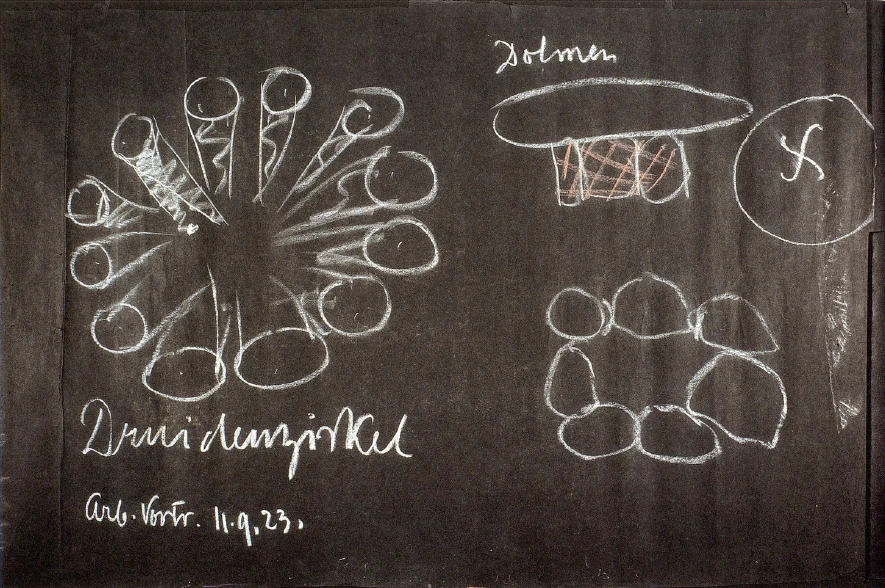
[ 5 ] Sehen Sie, es wäre gerade so, wie wenn man hier hinausgehen würde zu diesen Bergen und dort oben solche Kultstätten finden würde. Dort findet man sie sozusagen überall auf den Bergen, und zwar hauptsächlich dort, wo der Berg oben solch eine Ausflachung hat, wo oben auf dem Berg eine Mulde, eine Ebene ist, die noch extra etwas vertieft ist. Da standen dann diese alten Kultusstätten. Heute sind sie ein Trümmerhaufen von Steinen, aber man sieht noch ganz deutlich, wie sie ausgesehen haben. Die kleineren bestehen aus Steinen, die wahrscheinlich vom Eis einmal an die betreffende Stelle hingetragen worden sind, aber außerdem an die Stelle geschleppt worden sind, wo man sie verwenden wollte. Diese Steine stellte man so auf, daß sie eine Art Viereck bilden, so nebeneinander (siehe folgende Zeichnung). Wenn ich von der Seite daraufschaue, so schaut es dann so aus: Da ist ein Deckstein, der deckt das Ganze da oben zu. Das sind die kleinen. Die großen Kultstätten, die bestehen dann aus Steinen so ähnlicher Art (Zeichnung unten), die im Kreis ringsherum gestellt sind, und zwar gerade zwölf. Das ist ein Kultus, der wahrscheinlich in seiner Blütezeit drei bis vier Jahrtausende hinter unserer Zeit dort getrieben worden ist, in einer Zeit, als die Bevölkerung dort eine wenig dichte war, eine sehr dünne Bevölkerung, in einer Zeit außerdem, in der es kaum etwas anderes gab als etwas Ackerbau und Viehzucht. In dieser Bevölkerung war das Schreiben und Lesen in der Blütezeit, als dieser Kultus getrieben worden ist, ganz unbekannt. Also Schreiben und Lesen — man hat gar nicht daran gedacht, daß es so etwas geben könnte!
[ 5 ] You see, it would be just like going out here to these mountains and finding such places of worship up there. You find them, so to speak, all over the mountains—mainly where the mountain has a sort of plateau at the top, where there’s a hollow or a plain that’s slightly more sunken than the rest. That’s where these ancient ritual sites used to stand. Today they’re just a pile of rubble, but you can still see quite clearly what they looked like. The smaller ones consist of stones that were probably once carried to that spot by the ice, but were also dragged to the exact location where they were to be used. These stones were arranged to form a sort of square, placed side by side like this (see the following drawing). When I look at it from the side, it looks like this: There’s a capstone that covers the whole thing up there. Those are the small ones. The large ritual sites, on the other hand, consist of stones of a similar type (drawing below), arranged in a circle all around—exactly twelve of them. This is a cult that was likely practiced there during its heyday three to four millennia before our time, at a time when the population there was sparse—a very thin population—and at a time, moreover, when there was hardly anything else besides some farming and livestock raising. Among this population, reading and writing were completely unknown during the heyday when this cult was practiced. So reading and writing—no one even imagined that such a thing could exist!
[ 6 ] Nun kann man fragen, was dieser Kultus eigentlich zu bedeuten hatte. Ich sage Ihnen ausdrücklich: Lesen und Schreiben hat es dazumal nicht gegeben. — Nun wissen Sie ja, daß man, wenn man in der allergünstigsten Weise zum Beispiel Feldfrüchte zum Wachsen, zum richtigen Gedeihen bringen will, man sie in verschiedenen Zeiten säen muß, in verschiedenen Zeiten das eine oder andere mit ihnen tun muß. Und bei dem Vieh muß man auch mit den verschiedenen Zeiten rechnen, daß es begattet wird und so weiter. Das hängt ab von dem Zusammenhang der Erde mit der ganzen Weltumgebung, wovon ich Ihnen öfter erzählt habe. Nun, heute hat man seinen Bauernkalender, da schaut man nach, da weiß man, was für ein Tag im Jahre ist, und die Leute vergessen dann, daß das ja nicht abhängt von der menschlichen Willkür. Man kann nicht die Tage festsetzen wie man will, sondern man muß die Tage festsetzen so, wie es aus dem Sternengang folgt, aus dem Mondenstand folgt und so weiter. Nun, heute geht der Kalendermacher so vor, daß er das nach den alten Überlieferungen berechnet. Man hat Berechnungen, nach denen man ausrechnen kann, wann dieser oder jener Tag ist. Das rechnet man nach, weil die Leute es einmal nach dem Sonnenstand bestimmt haben. Man kann heute auch nach dem Sonnenstand bestimmen, aber die Menschen, die im allgemeinen sich nach so etwas richten, richten sich nicht nach dem Sonnenstand oder Sternenstand, sondern einfach nach dem, was man berechnet, nach dem Kalender. Nun, das war dazumal undenkbar, weil es Lesen und Schreiben überhaupt nicht gegeben hat. Solche Dinge kamen ja erst später. Also das führt uns zurück, wie ich sagte, drei- bis viertausend Jahre vor der jetzigen Zeit. Und das Lesen und Schreiben in diesen Gegenden führt uns kaum auf etwas mehr als zwei- bis dreitausend Jahre zurück. Das sind sehr alte Verhältnisse, und das Lesen und Schreiben, das es dazumal gab, das war natürlich gegenüber dem heutigen durchaus nicht etwas, wovon man eigentlich ordentlich reden kann. Jedenfalls die Mehrzahl der Bevölkerung hat es nicht gekannt.
[ 6 ] Now one might ask what this cult actually meant. Let me be very clear: Reading and writing did not exist back then. — Now, as you know, if one wants to grow crops—for example—in the most favorable way, so that they grow and thrive properly, one must sow them at different times and tend to them in various ways at different times. And with livestock, one must also take different times into account for breeding and so on. This depends on the relationship between the Earth and the entire cosmic environment, which I have often told you about. Well, today people have their farmers’ almanacs; they look them up, they know what day of the year it is, and people then forget that this does not depend on human whim. You can’t set the days however you want; rather, you have to set them according to the movement of the stars, the position of the moon, and so on. Well, today, calendar makers calculate this based on ancient traditions. There are calculations that allow one to determine when this or that day falls. These calculations are based on the fact that people once determined these dates according to the position of the sun. One could still determine them by the sun’s position today, but people who generally go by such things do not rely on the position of the sun or the stars, but simply on what is calculated—on the calendar. Well, that was unthinkable back then, because reading and writing didn’t exist at all. Such things didn’t come about until later. So that takes us back, as I said, three to four thousand years before the present day. And the history of reading and writing in these regions goes back barely more than two to three thousand years. These are very ancient conditions, and the reading and writing that existed back then was, of course, nothing compared to today’s standards—it’s hardly something one can really speak of in any meaningful way. In any case, the majority of the population was unfamiliar with it.
[ 7 ] Wenn Sie sich einen solchen Kreis oben auf dem Berg anschauen, dann können Sie sich denken: Die Sonne geht scheinbar — wir wissen ja, sie steht still, aber nicht wahr, man kann davon reden, weil die Sachen ja trotzdem so sind —, die Sonne geht also im Kreis ringsherum im Weltenraume. Dadurch wirft sie von diesen Steinen aus immer einen anderen Schatten, und diesen Schatten, den kann man verfolgen den Tag hindurch. Man kann sagen: Wenn die Sonne morgens aufgeht, so ist da der Schatten, jetzt geht sie etwas weiter, so ist da der Schatten und so weiter. — Aber der Schatten ändert sich auch im Laufe eines Jahres, weil die Sonne da jedesmal an einem anderen Punkte aufgeht. Dadurch ändert sich der Schatten. Er ist im März so geworden, etwas später so geworden. Und die Weisheit des Gelehrten oder Priesters, wie Sie wollen, des Druidenpriesters, der dazumal aufgestellt war zur Beobachtung dieser Dinge, bestand darinnen, daß er diesen Schatten beurteilen konnte, daß er also wissen konnte: Wenn der Schatten, sagen wir zum Beispiel auf diesen Punkt da auffällt, dann muß dieses oder jenes im Frühling vorgenommen werden auf den Äckern. — Das konnte er den Leuten sagen. Er konnte das nach dem Sonnenstand sehen. Oder wenn der Schatten, sagen wir, an diesen Punkt fiel, dann mußte der Stier herumgeführt werden, mußten die Tiere begattet werden, weil das an einem bestimmten Tag des Jahres sein mußte. Also der Priester las von diesen Dingen ab, was im ganzen Jahre zu geschehen hatte.
[ 7 ] When you look at a circle like this high up on the mountain, you might think: The sun seems to move—we know, of course, that it stands still, but isn’t it true that we can talk about it this way, since that’s how things appear anyway?—so the sun moves in a circle through space. As a result, it always casts a different shadow from these stones, and you can follow that shadow throughout the day. You could say: When the sun rises in the morning, the shadow is here; now it moves a little further, so the shadow is there, and so on. — But the shadow also changes over the course of a year, because the sun rises at a different point each time. That’s why the shadow changes. It looked like this in March, and a little later it looked like that. And the wisdom of the scholar or priest—call him what you will—the druid priest who was stationed there at that time to observe these things, lay in his ability to interpret this shadow, so that he could know: If the shadow falls, say, on this spot here, then this or that must be done in the fields in the spring. — He could tell the people that. He could tell by the position of the sun. Or if the shadow fell, say, on this spot, then the bull had to be led around, the animals had to be mated, because that had to happen on a specific day of the year. So the priest read from these signs what had to happen throughout the year.
[ 8 ] Dadurch wurde aber überhaupt das ganze Leben eigentlich nach dem Sonnenumgange bestimmt. Heute denken eben, wie ich Ihnen sagte, die Leute nicht daran, daß sie das ja selber auch tun, weil sie die Sache im Kalender finden. Aber dazumal mußte man an die Quellen selber gehen, mußte sozusagen vom Weltenall die Sache ablesen.
[ 8 ] As a result, however, life as a whole was actually determined by the passage of the sun. Today, as I told you, people don’t even realize that they do this themselves, because they find this information in the calendar. But back then, one had to go to the sources oneself; one had to, so to speak, glean this information from the universe itself.
[ 9 ] Zu einer ganz bestimmten Zeit, sagen wir zum Beispiel im Herbst, wurde genau bestimmt, was mit den Äckern zu geschehen hatte; da wurde auch zu einer bestimmten Zeit des Jahres das sogenannte Stierfest festgesetzt aus den Angaben dieser Leute. Da wurde dann der Stier herumgeführt; sonst wurde er weggehalten von dem Vieh und so weiter. Nach diesen Dingen wurden auch die alten Feste eingerichtet, die aber durchaus im Zusammenhange mit solchen Dingen stehen. — So eine Anordnung nennt man heute Druidenzirkel, Druidenkreis. Dieses dahier (es wird auf die Zeichnung verwiesen) ist ein Dolmen oder Tafel 23 Kromlech. Das ist das Eigentümliche, daß die Steine so stehen und oben bedeckt sind, daß drinnen im Inneren Schatten ist.
[ 9 ] At a very specific time—let’s say, for example, in the fall—it was precisely determined what was to be done with the fields; based on the information provided by these people, the so-called Bull Festival was also set for a specific time of year. The bull was then paraded around; otherwise, it was kept away from the livestock and so on. The ancient festivals were also organized according to these customs, which are certainly connected to such practices. — Today, such an arrangement is called a druid circle. This one here (referring to the drawing) is a dolmen or kromlech. What is peculiar about it is that the stones are arranged and covered on top in such a way that there is shade inside.
[ 10 ] Nun, sehen Sie, meine Herren, die Menschen, die wissen ungefähr, daß das Sonnenlicht manchmal stärker, manchmal schwächer ist, weil sie das spüren an der Art, wie sie schwitzen oder frieren. Aber was die Leute nicht wissen, das ist das, daß der Schatten geradeso wie das Licht verschieden ist. Je nachdem das Licht verschieden ist, ist der Schatten verschieden. Aber die Leute haben es sich heute abgewöhnt, die Verschiedenheit des Schattens zu bestimmen. Die alten Menschen haben sich zunächst einmal die Fähigkeit angeeignet, die Unterschiede des Schattens zu bestimmen. Im Schatten drinnen aber sieht man das Geistige. Die Sonnenstrahlen haben nicht nur ein Physisches, sondern sie haben ein Geistiges. Und da drinnen hat der Druidenpriester die Geistigkeit der Sonnenstrahlen beobachtet, von der wiederum abgehangen hat, ob man in einem bestimmten Lande besser diese oder jene Pflanze anbaut, denn das hängt von der Geistigkeit ab, die von der Sonne zu der Erde heruntergetragen wird. Und außerdem waren in diesem Schatten außerordentlich gut die Mondenwirkungen zu beobachten. Die Mondenwirkungen haben zum Beispiel wiederum einen großen Einfluß gerade auf die Begattung des Viehs, und das wurde zu Hilfe genommen, um die Zeit der Begattung zu bestimmen. So daß eigentlich das ganze Jahr nach diesen Sonnenbeobachtungen eingeteilt worden ist.
[ 10 ] Well, you see, gentlemen, people know roughly that sunlight is sometimes stronger and sometimes weaker because they can feel it in the way they sweat or shiver. But what people don’t know is that shadows vary just as much as light does. Depending on how the light varies, the shadow varies as well. But people today have lost the habit of discerning the variations in shadows. The ancients, however, first acquired the ability to discern the differences in shadows. And within the shadow, one sees the spiritual. The sun’s rays have not only a physical aspect but also a spiritual one. And within that, the Druid priest observed the spirituality of the sun’s rays, which in turn determined whether it was better to cultivate this or that plant in a particular country, for that depends on the spirituality carried down from the sun to the earth. Furthermore, the effects of the moon could be observed exceptionally well within this shadow. The effects of the moon, for example, have a major influence specifically on the mating of livestock, and this was used to determine the mating season. Thus, the entire year was actually divided according to these solar observations.
[ 11 ] Wenn man nun hineingraben würde unter einem solchen Kromlech, dann würde man außerdem finden, daß er noch nebenbei eine Grabstätte war. Man hat namentlich da, wo man zugleich die Menschen begraben hat, diese Dinge aufgestellt. Das hat wiederum die Bedeutung, daß tatsächlich, wenn auch der Mensch seinen Leib verlassen hat, dieser Leib eine andere Zusammensetzung hat als irgend etwas anderes. Die Seele, der Geist hat die ganze Lebenszeit in dem Körper gewohnt. Wenn sich der Leib auflöst, dann hat er andere Kräfte als diejenigen, die in der übrigen Gebirgsgegend sind. Und diese Kräfte namentlich haben gefördert, wenn sie da hinaufströmten, daß man im Schatten drinnen richtig sehen konnte. Diese Leute haben eben noch ganz andere Naturkräfte gekannt, als man später gekannt hat.
[ 11 ] If one were to dig beneath such a cromlech, one would also find that it served, incidentally, as a burial site. These structures were erected specifically in places where people were also buried. This, in turn, signifies that even though a person has left their body, that body has a different composition than anything else. The soul, the spirit, has dwelt in the body throughout one’s entire lifetime. When the body disintegrates, it possesses forces different from those found in the rest of the mountainous region. And it was precisely these forces, as they flowed upward, that enabled one to see clearly even in the shade. These people were simply familiar with forces of nature quite different from those known later on.
[ 12 ] Und wenn man an mancher Bergstätte — das ist übrigens dann weiter ausgeprägt über das Land, das sah ich in Ilkley, wo der erste Kursus stattfand während der englischen Reise — so einzelne Steine sieht hoch oben, aber so, daß der Platz gut ausgewählt ist — man konnte von solchen hoch oben weithin das ganze Land übersehen —, dann findet man solche Zeichen, Hakenkreuze, Swastiken, mit denen heute in Deutschland so viel Unfug getrieben wird. Dieses Hakenkreuz wird getragen von Leuten, die keine Ahnung mehr davon haben, daß dieses einmal ein Zeichen war, wodurch angegeben werden sollte für den, der von weither kam: Da sind Leute, die verstehen diese Dinge, die sehen nicht nur mit den physischen Augen, die sehen auch mit den geistigen Augen — ich habe diese geistigen Augen in meinem Buche «Wie erlangt man Erkenntnisse der höheren Welten?» als Lotusblumen beschrieben — und sie wollten aufmerksam darauf machen: Wir können sehen mit diesen Lotusblumen.
[ 12 ] And when you come across certain hilltop sites—which, by the way, are more widespread across the country; I saw this in Ilkley, where the first course took place during the trip to England—where you see individual stones high up, but in such a way that the location is well chosen—from such heights one could look out over the entire countryside—then you find such symbols, swastikas, swastikas—with which so much mischief is being caused in Germany today. This swastika is worn by people who no longer have any idea that it was once a symbol intended to indicate to those coming from afar: There are people who understand these things; they see not only with their physical eyes but also with their spiritual eyes—I have described these spiritual eyes as lotus flowers in my book *How Does One Gain Knowledge of the Higher Worlds?*—and they wanted to draw attention to this: We can see with these lotus flowers.
[ 13 ] So sehen Sie hier einen Kultus, der im wesentlichen darin bestanden hat, daß die Leute das Geistige aus der Weltumgebung für ihre sozialen Verhältnisse, für ihre Lebensverhältnisse hereinbekommen wollten auf die Erde. Dies kann man den Dingen heute noch ansehen, und deshalb ist diese Gegend dort außerordentlich interessant. Es waren das schon die letzten solcher Kultstätten, denn es sind diejenigen, nach denen man sich an die Westküste zurückgezogen hat, weil dann vom Osten herüber diejenigen Menschen gekommen sind, welche die Schrift ausgebreitet haben in der alten Zeit. Man nennt diese erste Schrift Runen. Durch Zusammenlegen von Stäbchen waren die Buchstaben gebildet, also ganz anders als in der heutigen Zeit. Und da ist dann dasjenige erst aufgekommen, was jetzt beschrieben wird als die nordische Mythologie: Wotan, Thor und so weiter. Das kam erst später, und das kam, indem die Schrift dahin verpflanzt worden ist.
[ 13 ] Here, then, you see a cultural tradition that essentially consisted of people seeking to bring the spiritual elements from the surrounding world down to Earth to shape their social and living conditions. You can still see this reflected in the surroundings today, which is why this area is so extraordinarily interesting. These were already the last of such places of worship, for they are the ones from which people retreated to the west coast, because people then came from the east who spread writing in ancient times. This earliest form of writing is called runes. The letters were formed by arranging sticks together—quite different from how writing is done today. And it was then that what is now described as Norse mythology first emerged: Wotan, Thor, and so on. That came later, and it arose as a result of the writing system being transplanted there.
[ 14 ] Wenn ich da von dem Schatten rede, so braucht man sich nicht weiter darüber so furchtbar zu verwundern, denn etwas im Schatten sieht schon das Tier. Sie müssen nur einmal achtgeben darauf, wie sich ein Pferd merkwürdig benimmt, wenn es abends irgendwo an einer Straße steht, wo es beleuchtet ist, und es sieht an einer Wand auf seinen Schatten hin. Man muß nur wissen: Das Tier, das Pferd sieht seinen Schatten nicht so, wie wir ihn sehen. Wir haben die Augen so, daß wir nach vorn schauen, das Pferd hat die Augen so, daß es nach der Seite sieht. Das bewirkt, daß es den Schatten als solchen überhaupt gar nicht sieht, aber es nimmt das Geistige im Schatten wahr. Natürlich sagen die Leute: Das Pferd fürchtet sich vor seinem Schatten. — Aber es ist wirklich so, daß es den Schatten gar nicht sieht, sondern es nimmt das Geistige im Schatten wahr. Und so haben eben auch diese primitiven Menschen da im Schatten Verschiedenheiten wahrgenommen das Jahr hindurch, wie man in der Sonnenhitze und in der Kälte Verschiedenheiten wahrnimmt. Das ist ein Kultus, der dort gepflegt worden ist. Und Sie sehen daraus, wie ich Ihnen schildere, schon ein, daß solche Kulte, die in alten Zeiten entstanden sind, notwendig waren. Sie waren da, weil man sie brauchte. Sie ersetzten alles dasjenige, was später gelesen werden konnte, denn das war zu gleicher Zeit der Verkehr der Menschen mit den Göttern. Die Leute beteten weniger, aber sie teilten dasjenige mit, was dann ins Leben überfloß, was zum Leben eine Beziehung, eine Bedeutung hat.
[ 14 ] When I speak of the shadow here, there’s no need to be so terribly surprised by it, because the animal can already see something in the shadow. You only need to pay attention to how strangely a horse behaves when it stands somewhere along a street in the evening where it is lit, and it looks at its shadow on a wall. You just have to know this: the animal—the horse—does not see its shadow the way we see it. Our eyes are positioned so that we look straight ahead, whereas a horse’s eyes are positioned so that it looks to the side. This means that it does not see the shadow as such at all, but it perceives the spiritual aspect within the shadow. Of course, people say: “The horse is afraid of its shadow.” — But the truth is that it does not see the shadow at all; rather, it perceives the spiritual aspect within the shadow. And so these primitive people, too, perceived differences in the shadow throughout the year, just as one perceives differences in the heat of the sun and in the cold. This is a cult that was practiced there. And as I describe it to you, you can already see that such cults, which arose in ancient times, were necessary. They existed because they were needed. They replaced everything that could later be read, for at the same time they constituted humanity’s communion with the gods. People prayed less, but they communicated that which then flowed into life—that which has a connection to and meaning for life.
[ 15 ] Nun ein anderer Kultus, den Sie vielfach noch in Überresten, namentlich in Mitteleuropa, finden. Da finden Sie solche Kultstätten, da finden Sie bestimmte Abbildungen. Diese Abbildungen zeigen einen Stier, und auf dem Stier sitzt oben eine Art Reiter mit einer sogenannten phrygischen Mütze, mit einer Art Revolutionsmütze. Diese ist von da später übernommen worden. Und dann sieht man auf demselben Bilde unten eine Art Skorpion, der beißt gerade in den Geschlechtsteil des Stieres hinein. Dann sieht man auch, wie der, der oben sitzt, ein Schwert in den Vorderleib des Stieres hineinstößt. Und wenn also dieses so ist, daß da der Stier ist (es wird gezeichnet), da oben dieser Reiter, da hier der Skorpion, da das Schwert, das stößt, dann sieht man, wie der Sternenhimmel dadrüber gebildet ist. Oben breitet sich der Sternenhimmel aus. Das sind wiederum die sogenannten Mithraskulte. Das erste also sind die Druidenkulte; und was ich jetzt beschreibe, sind die Mithraskulte. Während die Druidenkulte im Westen an den Küsten sind — wir finden sie ja auch in anderen Gegenden, aber ich erzählte es Ihnen gerade von der Gegend, wo ich sie selbst nun habe prüfen können —, finden sich diese Kulte von Asien herüber der ganzen Donau entlang, also durch das heutige Südrußland, Bulgarien, Ungarn, Bayern, die Gegenden im Odenwald, Schwarzwald und so weiter. Da waren diese Kulte, diese Mithraskulte einmal ausgebreitet. Und damit war etwas ganz Bestimmtes gemeint. Denn sehen Sie, warum haben die Leute gerade einen Stier dort hingesetzt? Das müssen wir uns zunächst fragen.
[ 15 ] Now, another cult that you can still find in many places in its remnants, particularly in Central Europe. There you will find such places of worship, and you will find certain depictions. These depictions show a bull, and atop the bull sits a sort of rider wearing a so-called Phrygian cap—a kind of revolutionary cap. This was later adopted from there. And then, at the bottom of the same image, you see a sort of scorpion that is biting right into the bull’s genitals. You also see the figure sitting atop the bull thrusting a sword into the bull’s front. And so, when this is depicted—with the bull (as drawn), the horseman above, the scorpion here, and the thrusting sword—you see the starry sky forming above it all. The starry sky spreads out above. These, in turn, are the so-called Mithraic cults. The first, then, are the Druidic cults; and what I am now describing are the Mithraic cults. While the Druidic cults are found on the western coasts—we do find them in other regions as well, but I was just telling you about the area where I have now been able to investigate them myself—these cults extend from Asia all along the Danube, that is, through what is now southern Russia, Bulgaria, Hungary, Bavaria, the regions of the Odenwald, the Black Forest, and so on. These cults—the Mithraic cults—were once widespread there. And this signified something very specific. For you see, why did people place a bull there in the first place? That is the question we must ask ourselves first.
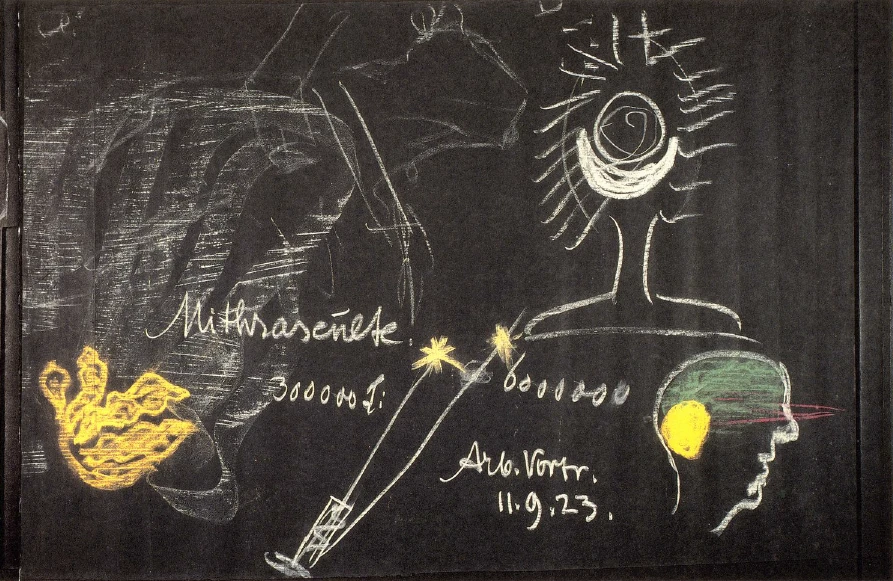
[ 16 ] Ich sagte Ihnen: Die Sonne geht im Frühling in einem bestimmten Sternbilde auf, heute eigentlich im Sternbild der Fische. — Die Astronomen zeigen noch das Sternbild des Widders. Das ist aber falsch, in Wirklichkeit ist es das Sternbild der Fische. Lange Zeit hindurch, durch zweitausend Jahre, ging die Sonne auf im Sternbilde des Widders, noch früher im Sternbilde des Stiers. Und da haben sich die Leute gesagt: Die Sonne geht immer im Frühling, wenn das Wachsen beginnt, im Sternbild des Stieres auf. — Und sie haben das, was im Menschenleib lebt, nicht im Kopf, aber im übrigen Menschenleib lebt, was namentlich mit dem Wachstum zusammenhängt, das haben sie ganz richtig darauf bezogen, daß die Sonnenstrahlen verändert werden, daß da das Sternbild des Stieres dahinter ist. Und deshalb haben sie gesagt: Wenn wir den tierischen Menschen bezeichnen wollen, müssen wir den Stier hinzeichnen, und der eigentliche Mensch, der von seinem Kopf beherrscht ist, der sitzt dann erst darauf. — So daß der Stier den niederen tierischen Menschen darstellt, und derjenige, der da oben sitzt mit der phrygischen Mütze, der stellt den höheren Menschen dar. Das Ganze ist aber eigentlich nur ein Mensch, niederer Mensch und höherer Mensch.
[ 16 ] I told you: In the spring, the sun rises in a specific constellation—actually, in the constellation of Pisces. — Astronomers still point to the constellation of Aries. But that is wrong; in reality, it is the constellation of Pisces. For a long time—two thousand years—the sun rose in the constellation of Aries; even earlier, it rose in the constellation of Taurus. And people used to say: The sun always rises in the constellation of Taurus in the spring, when growth begins. — And they correctly associated what lives within the human body—not in the head, but in the rest of the body, specifically that which is connected to growth—with the fact that the sun’s rays change and that the constellation of Taurus lies behind them. And that is why they said: If we want to depict the animalistic human, we must draw the bull, and the actual human, who is ruled by his head, sits atop it. — So that the bull represents the lower, animalistic human, and the one sitting up there wearing the Phrygian cap represents the higher human. But the whole thing is actually just one human being: the lower human and the higher human.
[ 17 ] Und nun sagten sich die Leute: Oh, schlimm ist es, wenn der niedere Mensch die Herrschaft hat, wenn der Mensch sich ganz seinen tierischen Trieben hingibt, wenn der Mensch nur seinen Leidenschaften folgt, die aus dem Bauche, aus der Sexualität und so weiter kommen! Es muß der höhere Mensch den niederen Menschen beherrschen. — Daher drückten sie das so aus: Dieser, der da reitet, der hat das Schwert und stößt es dem niederen Menschen in die Weichen. — Das heißt, der niedere Mensch muß klein werden gegenüber dem höheren Menschen. Außerdem ist der Skorpion da, der in die Geschlechtsteile hineinbeißt, um zu zeigen: Wenn der niedere Mensch durch den höheren nicht klein gemacht wird, nicht beherrscht wird, dann schädigt sich auch der niedere Mensch dadurch, daß die Naturkräfte über ihn kommen und ihn zerstören. — Also dieses ganze Menschenschicksal zwischen dem niederen und höheren Menschen wurde ausgedrückt in diesem Bilde.
[ 17 ] And now people said to themselves: Oh, how terrible it is when the lower human being is in control, when a person gives in completely to their animal instincts, when a person follows only their passions that arise from the gut, from sexuality, and so on! The higher human being must rule over the lower human being. — That is why they expressed it this way: The one riding there holds the sword and thrusts it into the lower man’s groin. — That is to say, the lower man must be made small in comparison to the higher man. Furthermore, there is the scorpion, which bites into the genitals to show: If the lower self is not made small by the higher self, if it is not mastered, then the lower self also harms itself, as the forces of nature overwhelm it and destroy it. — So this entire human destiny, the interplay between the lower and higher self, was expressed in this image.
[ 18 ] Darüber war der Sternenhimmel. Das ist sehr bezeichnend, daß da der Sternenhimmel ausgebreitet war. Die Sonne geht im Frühling auf in einem bestimmten Punkt, ist also dazumal aufgegangen im Sternbild des Stieres. Aber sie rückt jeden Tag ein Stückchen vor. Zweifach ist dieses Vorrücken. Einmal rückt der Frühlingspunkt vor. Die Sonne geht im nächsten Frühling ein Stückchen weiter weg von dem Punkt auf, in dem sie im vorigen Jahr aufgegangen ist, so daß also vor dreitausend Jahren die Sonne im Widder aufgegangen ist, noch früher im Stier. Heute geht sie im Frühling in den Fischen auf. Dadurch kommt sie allmählich ganz herum. Im Laufe von 25 920 Jahren kommt die Sonne ganz herum. Aber in jedem Jahre geht sie auch herum, so daß die Sonne am nächsten Tag nicht im Frühlingspunkt aufgeht — da geht sie nur am 21. März auf —, am nächsten Tag geht sie etwas weggerückt von diesem Punkt auf und so weiter. Das ganze Jahr geht sie auch im Tierkreis um alle Tierkreisbilder herum.
[ 18 ] Above it was the starry sky. It is very significant that the starry sky stretched out there. In spring, the sun rises at a specific point; at that time, it rose in the constellation of Taurus. But it moves forward a little bit every day. This advance occurs in two ways. First, the vernal equinox advances. Next spring, the sun rises a little farther away from the point where it rose the previous year, so that three thousand years ago the sun rose in Aries, and even earlier in Taurus. Today, it rises in Pisces in the spring. As a result, it gradually completes a full cycle. Over the course of 25,920 years, the sun completes a full cycle. But it also moves through the zodiac every year, so that the sun does not rise at the vernal equinox the very next day—it rises there only on March 21—but the next day it rises slightly shifted from that point, and so on. Throughout the entire year, it also moves through the zodiac, passing through all the zodiac signs.
[ 19 ] Nun mußten diejenigen, die den Mithraskult zu bedienen hatten, beobachten, wann der niedere Mensch, der tierische Mensch, schwerer zu beherrschen ist: wenn die Sonne im Sternbild des Stiers steht, also besonders zu den Wachstumskräften treibt. Wenn jedoch die Sonne, sagen wir, im Sternbild der Jungfrau aufgeht, also im Oktober, mehr gegen den Dezember zu dazumal, da wirkte der niedere Mensch nicht so stark, da brauchte die Herrschaft nicht so stark ausgebildet zu werden. Die Bevölkerung hatte kein Gefühl für diese Dinge, aber diejenigen, die den Mithraskult beobachteten, die mußten das wissen. Und so konnten diejenigen, die da diesen Mithraskult bedienten, sagen: Jetzt ist es schwer, den niederen Menschen zu beherrschen, jetzt ist es Frühling; jetzt ist es leichter, jetzt ist eine bestimmte Zeit im Winter. — Und so wurde da beim Mithraskult der Mensch selber dazu benutzt, um die Jahreszeiten wiederum kennenzulernen, wie überhaupt den ganzen Gang von Sonne und Mond durch die Sternbilder. Bei den Druiden wurden mehr die äußeren Zeichen benützt, die Schatten; hier beim Mithrasdienst wurde mehr die Wirkung auf den Menschen benützt. Und so stand auch dieser Mithraskult durchaus im Zusammenhang mit dem Leben.
[ 19 ] Now, those who were to serve the cult of Mithras had to observe when the lower human being—the animalistic human—is more difficult to control: when the sun is in the constellation of Taurus, that is, when it particularly stimulates the forces of growth. However, when the sun rises, say, in the constellation of Virgo—that is, in October, closer to December at that time—the lower human being did not exert such a strong influence, so the need to exercise control was not as great. The general population had no sense of these things, but those who observed the Mithraic cult had to know them. And so those who served this Mithraic cult could say: “Now it is difficult to control the lower human; now it is spring; now it is easier—now is a specific time in winter.” — And so, in the Mithras cult, human beings themselves were used to learn about the seasons once again, as well as the entire course of the sun and moon through the constellations. Among the Druids, the external signs—the shadows—were used more; here, in the Mithras cult, the effect on human beings was used more. And so this Mithras cult, too, was thoroughly connected with life.
[ 20 ] So gab es die allerverschiedensten Kulte. Man muß ja natürlich sich klar sein darüber: Wenn man solche Dinge beobachten will, wie sie bei den Druiden beobachtet wurden, da braucht man ganz bestimmte Gegenden der Erde. — Das kann man heute noch sehen. Wenn man dort in Wales lebt — vierzehn Tage hat der Kursus dort gedauert —, dann hat man fortwährend den raschen Wechsel zwischen, ich möchte sagen, kleinen Wolkenbrüchen und Sonnenschein. Das wechselt stundenweise, so daß man eine ganz andere Luft hat als hier; die ist immer mehr von Wasser angefüllt. Wenn man eine solche Luft hat, wie sie dort ist, wo die Druiden waren, dann kann man solche Beobachtungen machen. In den Gegenden, in denen sich der Mithraskult ausgebreitet hat, hätte man solche Beobachtungen nicht machen können, weil das Klima ein anderes war. Da mußte man die Beobachtungen mehr dem Inneren des Menschen entnehmen. Der war empfindlicher für solche Dinge. Und so waren je nach den verschiedenen Gegenden die Kulte eben verschieden. Dieser Mithraskult ist ja ausgebreitet gewesen in den Donaugegenden, in Bayern, bis hier in die Schweiz herein, hier wohl weniger, in älteren Zeiten wohl auch. Nun, dieser Mithraskult, der war noch lange, als schon das Christentum in diesen Gegenden heraufkam, ausgebreitet. Die letzten Reste fanden sich durchaus noch in den Zeiten, als das Christentum sich ausgebreitet hat, besonders in den Donaugegenden zum Beispiel. Da findet man ja eben diese Bildnisse heute noch in Höhlen, in Felsenhöhlen drinnen enthalten. Denn diese Beobachtungen und Kulte wurden in Felsenhöhlen drinnen geübt. Da brauchte man nicht das äußere Sonnenlicht, sondern gerade die Ruhe und Stille in der Felsenhöhle drinnen. Die geistigen Wirkungen der Sonne und der Sterne gehen auch da hinein.
[ 20 ] There were, in fact, a wide variety of cults. Of course, one must be clear about this: if one wants to observe such things as were observed among the Druids, one needs very specific regions of the earth. — You can still see that today. If you live there in Wales—the course lasted fourteen days there—you constantly experience rapid shifts between, I would say, brief downpours and sunshine. This changes by the hour, so that the air is quite different from what it is here; it is increasingly saturated with moisture. When you have an atmosphere like the one there, where the Druids were, then you can make such observations. In the regions where the cult of Mithras spread, such observations would not have been possible because the climate was different. There, the observations had to be drawn more from within the human being. People there were more sensitive to such things. And so, depending on the different regions, the cults were simply different. This cult of Mithras was widespread in the Danube regions, in Bavaria, and all the way up here into Switzerland—though perhaps less so here, although it was certainly present in earlier times as well. Well, this cult of Mithras remained widespread long after Christianity had already taken hold in these regions. The last remnants were still to be found even during the time when Christianity was spreading, particularly in the Danube regions, for example. There, one can still find these images today, preserved inside caves and rock caverns. For these observances and cults were practiced inside rock caverns. There, one did not need the light of the sun from outside, but rather the peace and quiet inside the rock cave. The spiritual influences of the sun and the stars also penetrate there.
[ 21 ] Wenn ich Ihnen diese zwei Kulte angegeben habe, so können Sie ja den Sinn des Kultus überhaupt einsehen. Es gab die verschiedensten Kulte. Die Neger haben heute noch ihre Kulte, die einfacher, primitiver sind, die aber auch in einfacher Weise zeigen, wie man da die geistige Umgebung des Weltenalls kennenlernen will. Dann hat sich in einer bestimmten Zeit — diese Zeit liegt wiederum etwa eineinhalb bis zwei Jahrtausende zurück — aus den verschiedensten Kulten, die namentlich in Asien und Afrika waren, aus allen diesen Kulten gewissermaßen etwas ergeben, wo sie zusammengeschmolzen waren. Man hat ein Stück aus diesem Kultus genommen, ein anderes Stück aus jenem Kultus genommen, und aus dem Zusammenschmelzen der verschiedensten Kulte, namentlich der ägyptischen, persischen Kulte ist dann der Kult entstanden, den Sie heute als den katholischen Kultus kennen. Er ist zusammengeschmolzen aus alledem. Sie können sehen, wie er zusammengeschmolzen ist, wenn Sie zum Beispiel den Altar ansehen. Sie brauchen gar nicht besonders weit zu gehen, so werden Sie es dem Altar heute noch ansehen, daß er etwas ist wie ein Grabstein. Wenn auch darunter keine Leiche ist, so ist er doch in seiner Form einem Grabstein ähnlich. Wie man in alten Zeiten gewußt hat, daß von dem Leichnam Kräfte ausgehen, so hat man das in der Form noch festgehalten.
[ 21 ] Now that I have mentioned these two cults, you can surely grasp the essence of cults in general. There were a wide variety of cults. Black people still have their cults today; these are simpler and more primitive, but they also demonstrate in a straightforward way how people sought to understand the spiritual environment of the universe. Then, at a certain point in time—this period, in turn, dates back about one and a half to two millennia—something emerged, as it were, from the wide variety of cults, particularly those in Asia and Africa; these cults had, in a sense, fused together. They took one element from this cult, another from that cult, and from the fusion of the most diverse cults—namely the Egyptian and Persian cults—the cult emerged that you know today as the Catholic cult. It is a fusion of all these elements. You can see how it has been fused together if, for example, you look at the altar. You don’t have to look very far; even today you can see that the altar resembles a tombstone. Even though there is no corpse beneath it, its form is still similar to that of a tombstone. Just as people in ancient times knew that forces emanate from the corpse, this was preserved in its form.
[ 22 ] Sie finden in den katholischen Kirchen das Merkwürdige, daß angedeutet ist die Beziehung zur Sonne und zum Mond. Sie werden ja aus den katholischen Kirchen kennen, was bei den besonders festlichen Gelegenheiten auf dem Altar steht (Zeichnung $. 282): die Monstranz, das sogenannte Sanktissimum. Ja, meine Herren, das ist nichts anderes als eine Sonne, und im Mittelpunkt der Sonne die Hostie, als Sonne gedacht, und hier unten der Mond, zum Zeichen dafür, daß dieser Kultus stammt aus einer Zeit, in der man direkt die Sonne und den Mond so beobachten wollte, wie ich es Ihnen für den Druidenkultus gezeigt habe. Nur haben die Leute das vergessen. Als die Schrift und das damit Zusammenhängende sich ausgebreitet hat, da haben sie nicht mehr in die große Natur geschaut. In ein Buch — und schließlich ist ja das Evangelium auch nur ein Buch —, in das haben sie geschaut. Aber das Andenken ist noch erhalten in dem Zeichen von Sonne und Mond, das im Sanktissimum, in der Monstranz auf dem Altar steht.
[ 22 ] What is remarkable about Catholic churches is that they allude to the relationship with the sun and the moon. You are surely familiar from Catholic churches with what is placed on the altar on particularly festive occasions (drawing $ 282): the monstrance, the so-called Santissimum. Yes, gentlemen, this is nothing other than a sun, and at the center of the sun is the Host, conceived as the sun, and down here is the moon, a sign that this cult dates back to a time when people wanted to observe the sun and the moon directly, just as I have shown you in the case of the Druidic cult. Only people have forgotten this. As scripture and everything associated with it spread, they no longer looked to the great natural world. Instead, they looked into a book—and after all, the Gospel is also just a book. But the memory is still preserved in the symbol of the sun and moon, which stands in the Sanctissimum, in the monstrance on the altar.
[ 23 ] Und so kann man durch alle, alle Einzelheiten gerade im katholischen Kultus nachweisen, wie er zurückführt auf die alten Kulte, die noch ihre Beziehung zum großen Weltenall hatten. Das ist natürlich gänzlich vergessen worden. Es ist so gewesen, daß in den drei oder vier ersten nachchristlichen Jahrhunderten die Leute überall noch viel gewußt haben von diesem eigentlichen Sinn des Kultus, denn damals hat sich mehr von Rom aus der jetzige Kultus gebildet und verbreitet, ist zusammengestellt worden aus den verschiedensten einzelnen Kulten. Aber hier herum zum Beispiel und namentlich in den Donauländern hat man ja noch den Mithraskult gekannt. Dem hat man es angesehen, daß er eine Beziehung zum Weltenall hat. Daher wurde in ganz systematischer Weise in den ersten Jahrhunderten das, was von alten Kulten vorhanden war, ausgerottet, und es blieben nur diejenigen Kulte, denen man nicht mehr ansah, wie sie im Verhältnis zum Weltenall standen. Und so, nicht wahr, schauen sich heute die Leute den katholischen Kultus an und es wird ein großer Wert darauf gelegt, daß man ihn nicht, gerade nicht versteht, daß man also nicht einsieht, daß das sich einmal auf die Sonne und auf den Mond bezogen hat. Denn Religion und Wissenschaft waren in alter Zeit eines, und die Kunst gehörte dazu.
[ 23 ] And so, through every single detail—especially in the Catholic liturgy—one can demonstrate how it traces back to the ancient cults, which still maintained a connection to the vast universe. This, of course, has been completely forgotten. The fact is that in the first three or four centuries A.D., people everywhere still knew a great deal about this true meaning of worship, for it was then that the current form of worship took shape and spread from Rome, having been compiled from a wide variety of individual cults. But in this region, for example—and particularly in the Danube countries—the cult of Mithras was still known. It was evident that this cult had a connection to the universe. Therefore, in a very systematic manner during the first centuries, whatever remained of the ancient cults was eradicated, and only those cults remained that no longer revealed their relationship to the universe. And so, isn’t it true, people today look at Catholic worship, and great importance is placed on the fact that one does not—precisely does not—understand it, that one does not realize that it once referred to the sun and the moon. For in ancient times, religion and science were one, and art was part of that.
[ 24 ] Natürlich ist dann eine Zeit gekommen, in der sich die Leute gesagt haben: Ja, wozu ist denn das alles? Das ist doch zu nichts! Die Feste, die Zeiten, wo das oder jenes geschehen soll, das liest man ja im Kalender! — Das ist ja zu nichts —, sagten die Leute. Und da kam die Kultstürmerei, die Bilderstürmerei, da kam dann der Protestantismus, das evangelische Prinzip, das gegen den Kultus losging. Man begreift nun, warum auf der einen Seite für den Kultus einmal alles Volk eingetreten ist und später sich alles Volk gegen den Kultus gewendet hat, wenn man diesen Hergang sich vor die Seele stellt. In der Zeit, wo ich Ihnen gesagt habe, daß der Druidenkultus geherrscht hat — ja, meine Herren, dasjenige, was heute manchmal aufgebracht wird an Begeisterung, sagen wir für diese oder jene Bewegung, das ist alles nichts gegen die große Begeisterung, die bei den Leuten geherrscht hat für ihren Druidenkultus in der damaligen Zeit! Die hätten sich alle steinigen und köpfen lassen für diesen Druidenkultus. Aber warum? Weil sie gewußt haben: Man kann, ohne auf ordentliche Weise genau zu wissen, was im Weltenall vorgeht, überhaupt nicht leben, man kann nicht das Stierfest zur richtigen Zeit feiern, man kann nicht sein Korn, seinen Roggen zur richtigen Zeit aussäen.
[ 24 ] Of course, there came a time when people said to themselves: “Well, what’s the point of all this? It’s all for nothing! The holidays, the times when this or that is supposed to happen—you can just read about them in the calendar!” “That’s all for nothing,” people said. And then came the iconoclasm, the destruction of images; then came Protestantism, the evangelical principle that turned against the cult. One now understands why, on the one hand, the entire people once stood up for the cult and later turned against it, when one reflects on this course of events. In the era I told you about, when the Druidic cult reigned—yes, gentlemen, the kind of enthusiasm that is sometimes stirred up today, say, for this or that movement, is nothing compared to the great enthusiasm that prevailed among the people for their Druidic cult back then! They would all have let themselves be stoned and beheaded for this Druidic cult. But why? Because they knew: One cannot live at all without properly knowing exactly what is happening in the universe; one cannot celebrate the Festival of the Bull at the right time; one cannot sow one’s wheat and rye at the right time.
[ 25 ] Später ist das eben verwischt worden, und dadurch haben die Leute gesagt: Ja, eine Sache muß doch einen Zweck haben im Leben! — und sind losgegangen dagegen. Daß sich die Menschheit zu verschiedenen Zeiten so ganz verschieden verhält zu diesen Dingen, das kann man eben nur daraus einsehen, daß solche Vorgänge stattgefunden haben, daß die Sache vollständig vergessen worden ist und man heute nur noch in diesen, wie man es nennt, Symbolen sehen kann, was eigentlich gewesen ist. Wo Symbole stehen, da ist nur noch das schwächste Verständnis vorhanden, aus dem Grunde, weil, wo man Wirklichkeiten hat, man nicht Symbole braucht. Wenn man den Altar wie bei den Druiden aufstellt, um wirklich die Sonne zu beobachten, stellt man nicht ein Bild der Sonne hin!
[ 25 ] Later, this was simply glossed over, and as a result, people said: “Yes, surely a thing must have a purpose in life!” — and set out to oppose it. The fact that humanity behaves so differently toward these things at different times can only be understood from the fact that such events have taken place, that the matter has been completely forgotten, and that today one can only see what actually happened in these so-called symbols. Where symbols exist, only the faintest understanding remains, for the simple reason that where reality exists, symbols are unnecessary. When one sets up an altar, as the Druids did, to actually observe the sun, one does not place an image of the sun there!
[ 26 ] Ja, das ist es, was zum Beispiel dann dazu geführt hat, daß sich gewisse Kulte, außer dem katholischen, mit einer großen Starrheit bis in die heutige Zeit herein erhalten haben.
[ 26 ] Yes, that is what has led, for example, to certain religions—other than Catholicism—surviving to this day with great rigidity.
[ 27 ] Sehen Sie, dieser Druidenkultus, der war ein reiner Ackerbau- und Viehzüchter-Kultus, wie er in seiner Blüte stand, denn das Leben bestand aus Ackerbau und Viehzucht. Dann kam später in solchen Gegenden, wo früher Ackerbau und Viehzucht allein war, wo also dieser Kultus ganz besonders berechtigt war, dasjenige auf, was dann mehr Handwerk wurde. Als der Druidenkultus besonders geblüht hat, da war ja alles Ackerbau und Viehzucht, und die Leute bedeckten sich mit Tierfellen und so weiter. Alles, was Handwerk war — Maschinen gab es nicht —, das war ja natürlich noch so: Was der einzelne selbst machte, das richtete sich nach dem anderen. Wenn er Zeit hatte, verfertigte er sich, was er zum Anziehen oder als Gegenstand brauchte, zum Beispiel sein Messer aus einem harten Stein, den er bearbeitete und so weiter. Wichtig waren die Zeiten für Ackerbau und Viehzucht; das wollte er von seinen Göttern erfahren, wann er da mit den nötigen Maßnahmen vorzugehen habe. Dann aber wurde das Handwerk wichtiger. Nun sehen Sie, meine Herren, das Handwerk, das hat ganz selbstverständlich keine so große Beziehung zum Sternenhimmel wie Ackerbau und Viehzucht. Aber auf der anderen Seite waren die Gewohnheiten geblieben, und so hat man dann auch für das Handwerk eine Art Kultus aufgestellt, den man wieder diesen alten Kulten, die zum Himmel eine Beziehung hatten, entnommen hat. Und einer derjenigen Kulte, die am starrsten stehengeblieben sind, ist der Freimaurerkult. Der besteht aber in reinen Symbolen. Da weiß man gar nicht mehr in Wirklichkeit, worauf sich diese Symbole beziehen. Namentlich als man angefangen hatte, Kunstbauten zu bauen, hat man das, was man gewohnt war, in diesem Kultus zu treiben, angewendet auf das Bauen von Kunstwerken. Und bei der Baukunst hat es ja tatsächlich, wenn man ganz fein vorgehen will, doch auch einen gewissen Sinn. Man bildet die Bauformen nach dem, was die Sterne ausdrücken und so weiter, wenn man wirklich bauen will. Und so hat sich der Freimaurerkultus herausgebildet. Aber die Leute haben, als der Freimaurerkultus sich herausgebildet hat, eben nicht mehr gewußt, was die einzelnen Symbole bedeuten. Und so besteht der Freimaurerkultus heute aus lauter Symbolen, und die Leute wissen gar nicht, worauf sich die Symbole beziehen, reden das konfuseste Zeug über die Sachen. Man kann schon sagen: Je mehr die Kulte wohlgepflogen sind, desto weniger versteht man von den Sachen. — Und so ist von den Kulten, die in der Gegenwart am meisten gepflogen sind, eigentlich überall das Verständnis am meisten verlorengegangen.
[ 27 ] You see, this Druidic cult was purely a cult of agriculture and livestock farming at its peak, because life consisted of farming and raising livestock. Later, in regions where farming and livestock raising had previously been the sole occupations—where this cult was therefore particularly justified—what eventually became more of a craft began to emerge. When the Druidic cult was at its peak, everything revolved around farming and livestock raising, and people clothed themselves in animal skins and so on. As for crafts—there were no machines—it was naturally still the case that what one person made depended on the others. When he had time, he would make for himself whatever he needed to wear or use, for example, a knife from a hard stone that he worked on, and so on. The seasons for farming and livestock raising were important; he wanted to learn from his gods when he should take the necessary measures. But then craftsmanship became more important. Now, gentlemen, craftsmanship, of course, has no such close connection to the starry sky as farming and livestock raising do. On the other hand, however, the customs had remained, and so a kind of cult was established for craftsmanship as well, one that was again derived from those ancient cults that had a connection to the heavens. And one of the cults that has remained the most rigid is Freemasonry. Yet it consists entirely of symbols. In reality, people no longer even know what these symbols refer to. Especially once people began constructing architectural works, they applied the practices they were accustomed to in this cult to the building of works of art. And in architecture, if one wishes to proceed with great precision, it does indeed make a certain amount of sense. If one truly wants to build, one models the architectural forms on what the stars express and so on. And that is how the Masonic cult developed. But when the Masonic cult took shape, people simply no longer knew what the individual symbols meant. And so today the Masonic cult consists entirely of symbols, and people have no idea what the symbols refer to; they spout the most confused nonsense about these things. One could certainly say: The more widespread the cults have become, the less people understand about them. — And so, of the cults that are most widespread today, understanding has actually been lost the most everywhere.
[ 28 ] Aber nicht wahr, diese alten Leute, die haben den Kultus für ihr Leben in der Außenwelt gebraucht. Wenn man heute wieder einen Kultus haben will — und wir sind ja daran, an einer Erneuerung des Christentums, in Deutschland hat es schon einzelne Kirchen unter der Leitung von Dr. Rittelmeyer —, ja, wenn man daran geht, heute noch einen Kultus zu bilden, so muß der wiederum einen etwas anderen Sinn haben als die alten Kulte. Denn die alten Kulte, die haben gewirkt, und man weiß eben heute einfach aus der Berechnung heraus, wann ein Tag fällt, wann der 21. März ist und so weiter, aus der gewöhnlichen Sternkunde. Das konnten die Alten nicht. Die mußten in der alten Zeit auf diesen Schatten weisen, wie ich es Ihnen ja beschrieben habe. Aber heute ist erwas anderes notwendig. Heute ist das notwendig, daß die Leute überhaupt dazu kommen können, wiederum irgend etwas überhaupt zu verstehen von dem, was es im geistigen Weltenall gibt. Keine Astronomie, nichts sagt den Menschen heute etwas von dem, was im Weltenall vorgeht!
[ 28 ] But isn’t it true that those old people needed religion for their lives in the outer world? If one wants to have a cult again today—and we are, after all, in the process of renewing Christianity; in Germany there are already individual churches under the leadership of Dr. Rittelmeyer—yes, if one sets out to establish a cult today, it must have a somewhat different meaning than the ancient cults. For the ancient cults were effective, and today we simply know—based on calculation—when a day falls, when March 21 is, and so on, from ordinary astronomy. The ancients could not do that. In ancient times, they had to point to this shadow, as I have described to you. But today something else is necessary. Today, what is necessary is for people to be able to come to understand, at all, something of what exists in the spiritual universe. No astronomy, nothing tells people today anything about what is happening in the universe!
[ 29 ] Da geben sich die Leute den größten Irrtümern hin. Sie richten zum Beispiel Teleskope hinaus in die Sternenwelt. Jetzt schen sie in einer bestimmten Richtung einen Stern. Ja, meine Herren, ich drehe das Teleskop, das Fernrohr, da sehe ich in einer anderen Richtung wieder einen Stern. Und auf der anderen Seite wird berechnet, daß die Sterne so weit sind, daß das überhaupt nicht mehr klar gesehen werden kann, sondern nur nach Lichtjahren berechnet wird, nach dem, wie rasch der Lichtstrahl sich fortbewegt. Man rechnet aus, wie groß der Weg ist, den der Lichtstrahl in einem Jahr zurücklegt. Das ist ein Weg, der noch schwieriger auszudrücken ist in Zahlen, als wenn man heute in Deutschland ein Mittagsmahl bezahlt in deutscher Valuta. Das ist schon schwer genug auszudrücken! Aber dieses auszudrücken, wie rasch sich ein Lichtstrahl bewegt, welch einen großen Weg der in einem Jahr zurücklegt, diese Zahl geht in riesige Milliarden. Man redet daher auch nicht von ihr, sondern man sagt nur: Ein Stern liegt so weit, daß das Licht so und so viele Lichtjahre brauchen würde. Ja, meine Herren, jetzt richte ich mein Fernrohr in der Richtung, ich gucke hinein und sehe den Stern. Der braucht, sagen wir, 300 000 Lichtjahre, um hierher zu kommen; das Licht braucht so lange. Der andere Stern, der ist aber vielleicht weit zurück, der braucht vielleicht 600 000 Lichtjahre. Dann schaue ich dahin, bekomme aber doch gar nicht die gegenwärtige Gestalt des Sterns, sondern eine vergangene. Und wenn ich dort hinschaue, da ist jetzt gar nicht dasjenige in Wirklichkeit, was ich sehe. Der Stern erscheint mir trotzdem, aber ich sehe nur das, was er früher war, weil das Licht 300 000 Jahre gebraucht hat, um hierher zu kommen. Da sehe ich also einen Gegenstand, der in Wirklichkeit gar nicht da ist, der erst die 300 000 Jahre gebraucht hat, um da sichtbar zu werden!
[ 29 ] This is where people fall into the greatest errors. For example, they point telescopes out into the starry sky. Now they see a star in a certain direction. Well, gentlemen, I turn the telescope, and there I see another star in a different direction. And on the other hand, it is calculated that the stars are so far away that they can no longer be seen clearly at all, but are measured only in light-years, based on how quickly the light beam travels. One calculates how far the light beam travels in one year. That is a distance that is even harder to express in numbers than paying for a midday meal in Germany today using German currency. That’s hard enough to express! But to express how fast a beam of light moves—what a vast distance it travels in a year—that number runs into enormous billions. That’s why we don’t actually talk about it in those terms; instead, we simply say: A star is so far away that its light would take so many light-years to reach us. Yes, gentlemen, now I point my telescope in that direction, look through it, and see the star. Let’s say it takes 300,000 light-years for that light to reach us; that’s how long it takes. The other star, however, may be much farther away; it might take 600,000 light-years. Then I look in that direction, but I don’t see the star’s current appearance at all—only a past one. And when I look there, what I see isn’t actually what’s there right now. The star appears to me nonetheless, but I see only what it used to be, because the light took 300,000 years to reach us. So I’m seeing an object that isn’t actually there at all—it took 300,000 years for it to become visible to me!
[ 30 ] Also Sie sehen, wenn man mit dem Teleskop herumschaut, so sieht man doch gar nicht die wahre Gestalt des Sternenhimmels! Das ist das eine. Das andere ist dieses: Die Leute glauben nämlich, da wo sie die Sterne sehen, da ist etwas. Aber die Wahrheit ist diese, daß nichts dort ist, daß dort wo man Sterne sieht, gerade der Äther aufhört! Das bezieht sich nicht auf Sonne und Mond, auf die Sonne etwas, auf den Mond gar nicht, aber auf die Sterne bezieht es sich: da ist gar nichts! Da ist ein Loch im Weltenall. Es ist merkwürdig, wie da die Anthroposophie mit der wirklichen Wissenschaft geradezu wie zusammenkommt. Als wir in Stuttgart unsere Institute gegründet haben, habe ich gesagt: Eine unserer ersten Aufgaben ist, nachzuweisen, daß, wo ein Stern ist, überhaupt nichts ist, daß da das Nichts erglänzt. Weil ringsherum etwas ist, sieht man dort, wo nichts ist, eine Art Licht. — Nun, nicht wahr, wir sind eigentlich arme Leute mit unseren Forschungsinstituten, und die Amerikaner sind reich. Seit jener Zeit ist von Amerika die Nachricht gekommen, daß man auch mit der gewöhnlichen Wissenschaft schon darauf gekommen ist, daß eigentlich dort nichts ist, wo Sterne sind.
[ 30 ] So you see, when you look around through a telescope, you don’t actually see the true form of the starry sky! That’s one thing. The other is this: People believe that wherever they see stars, there is something there. But the truth is this: there is nothing there; precisely where you see stars, that is where the ether ends! This does not apply to the sun and the moon—it applies somewhat to the sun, not at all to the moon—but it does apply to the stars: there is absolutely nothing there! There is a hole in the universe. It is remarkable how anthroposophy and real science actually converge in this regard. When we founded our institutes in Stuttgart, I said: One of our first tasks is to prove that where there is a star, there is absolutely nothing—that nothingness shines there. Because there is something all around it, one sees a kind of light where there is nothing. — Well, isn’t it true that we are actually poor people with our research institutes, and the Americans are rich? Since that time, news has come from America that even conventional science has already concluded that there is actually nothing where stars are.
[ 31 ] So arbeitet gerade Anthroposophie mit der allerfortgeschrittensten Wissenschaft. Nur kann man eben durch Anthroposophie die Dinge besser beurteilen. Nicht wahr, diese Dinge sage ich Ihnen aus dem Grunde, weil Sie daraus sehen, daß ja jetzt eigentlich die Leute gar nichts wissen über das Weltenall. Sie beurteilen ja alles falsch im Weltenall. Und woher kommt das?
[ 31 ] Anthroposophy, in particular, works with the most advanced science. It’s just that through anthroposophy, one can judge things better. Isn’t that right? I’m telling you these things because I want you to see that, in fact, people today know next to nothing about the universe. They misjudge everything in the universe. And where does that come from?
[ 32 ] Sehen Sie, meine Herren, das kommt von einer ganz bestimmten $ache. Denken Sie sich: Da ist ein menschlicher Kopf, da ist das Gehirn. Wenn der Mensch etwas Äußeres wahrnimmt, zum Beispiel durch das Auge, so nimmt er das Äußere wahr, braucht das Gehirn dazu, damit er die Wahrnehmung haben kann. Aber im Gehirn drinnen befindet sich ein kleines Gehirn, gerade dahinten (siehe Zeichnung). Das ist ganz anders gebaut als das große Gehirn. Dieses kleine Gehirn hat einen sehr merkwürdigen Bau. Es ist so wie aus Blättern zusammengesetzt, wenn man es durchschneidet. Das sitzt also dahinten drinnen.
[ 32 ] You see, gentlemen, this stems from a very specific $ache. Just imagine: There is a human head, and there is the brain. When a person perceives something external—for example, through the eye—he perceives that external thing and needs the brain to do so, in order to have that perception. But inside the brain there is a small brain, right at the back (see drawing). It is structured quite differently from the large brain. This small brain has a very peculiar structure. If you cut it open, it looks as if it were composed of layers. So it sits back there inside.
[ 33 ] Dieses kleine Hirn, das nimmt nichts von außen wahr. Das große Hirn, das ich hier in der Zeichnung grün gemacht habe, das brauchen wir, um die äußeren irdischen Eindrücke zu haben. Das kleine Hirn, das nimmt nichts von außen wahr. Aber wenn der Mensch sich innerlich vertieft, wenn er so vorgeht, wie ich das in meinen Büchern beschrieben habe, dann fängt dieses kleine Hirn an besonders tätig zu sein, und man spürt innerlich, wie scheinbar dieses kleine Hirn immer größer und größer wird, wie wenn es wachsen würde. So wächst das, und man fühlt, wie wenn man nach und nach unter einem Baum stehen würde. Daher schildern die Orientalen den Buddha unter dem Bodhibaum. Der hat noch dieses Kleinhirn als ein Wahrnehmungsorgan gekannt. Das entdeckt man heute wiederum. Dieses kleine Hirn, das fängt an tätig zu sein, wenn man sich innerlich menschlich vertieft. Da nimmt man aber nicht das Äußerlich-Materielle wahr, sondern das Geistige. Da fängt man an, mit dem kleinen Hirn das Geistige wiederum wahrzunehmen, und in dem Geistigen eben wiederum Gesetze und so weiter wahrzunehmen. Die muß man heute in einen Kultus hineinbringen. Gerade das Allerinnerste im Menschen muß heute in einen Kultus hinein, weil der Mensch mit seinem Inneren eben in seinem kleinen, von dem großen Hirn getrennten Hirn den Weg hat, das Organ hat, das in die geistige Welt hinausführt.
[ 33 ] This small brain does not perceive anything from the outside. The large brain—which I have colored green in this drawing—is what we need to take in external, earthly impressions. The small brain does not perceive anything from the outside. But when a person delves inward—when they proceed as I have described in my books—then this small brain begins to be particularly active, and one senses inwardly how this small brain seems to grow larger and larger, as if it were actually growing. It grows in this way, and one feels as if one were gradually standing beneath a tree. That is why the people of the East depict the Buddha under the Bodhi tree. He still recognized this cerebellum as an organ of perception. This is being rediscovered today. This cerebellum begins to become active when one delves inwardly into one’s humanity. But then one does not perceive the external, material world, but rather the spiritual. There, one begins to perceive the spiritual once more with the cerebellum, and within the spiritual, to perceive laws and so on. These must be incorporated into a form of worship today. It is precisely the innermost part of the human being that must be incorporated into a form of worship today, because it is through this innermost part—in the small brain, separate from the large brain—that the human being has the path and the organ that lead out into the spiritual world.
[ 34 ] Heute kann man also höchstens wiederum am Anfang stehen, wie man einen Kultus vom Inneren des Menschen aus dann aufbaut. Dann wird dieser Kultus innere Wahrheiten enthalten. So wie man durch den Druidenkultus gewußt hat, wann man den Stier zu bekränzen hat, das Stierfest festzusetzen hat, den Stier zu führen hat durch die Gemeinde, damit in der richtigen Weise die Fortpflanzung geregelt wird, so wird man wissen — gerade wenn man in dieser Weise einen Kultus einrichtet, der nun die geistige Wahrnehmung, die durch das Kleinhirn unterhalten wird, entwickelt —, was man zu tun hat im sozialen Menschenleben. Vorher wird man nur spekulieren, wird nur allerlei ausdenken, wird es so machen wie in Rußland. Wenn man zugeben wird, daß man das erst wissen muß auf geistige Art, was in der Menschheit zu geschehen hat, weil es aus dem Weltenall fließt, dann wird man auch erst eine richtige Sozialwissenschaft haben, die wiederum gewollt sein wird aus der Weltenumgebung.
[ 34 ] So today, at best, we can only start from the beginning again—figuring out how to build a cult from within the human being. Then this cult will contain inner truths. Just as the Druidic cult provided the knowledge of when to crown the bull, when to hold the bull festival, and when to lead the bull through the community so that procreation might be regulated in the proper way, so will we know—precisely when we establish a cult in this manner, one that develops the spiritual perception sustained by the cerebellum— what one must do in social human life. Before that, one will only speculate, will only come up with all sorts of ideas, will do it the way they do in Russia. When one admits that one must first know in a spiritual way what is to happen within humanity—because it flows from the universe—only then will one have a true social science, which in turn will be willed by the cosmic environment.
[ 35 ] So muß man lernen denken. Und sobald man so etwas sieht, wie heute etwa die zerstörten Gesteine herumliegen, so daß man nur noch aus den Spuren sehen kann, was einmal war, wie auf der Insel Anglesey oder in den anderen in den Küstengegenden dort gelegenen Orten, in Penmaenmawr, wo der Kursus war — ja, wenn man an solche Dinge herankommt, dann sieht man: Es ist vieles untergegangen in der Menschheit, was man aber braucht, und heute braucht man gerade in geistiger Beziehung neue Erkenntnisse. Es muß gearbeitet werden mit neuen Erkenntnissen.
[ 35 ] That is how one must learn to think. And as soon as one sees something like the scattered, shattered rocks lying around today—so that one can only tell from the traces what once was—as on the island of Anglesey or in the other coastal towns there, in Penmaenmawr, where the course was held—yes, when one encounters such things, then one sees: Much has been lost in humanity that is, however, necessary, and today we need new insights, especially in the spiritual realm. We must work with these new insights.
[ 36 ] Das wollte ich Ihnen auf diese Frage antworten. Ich glaube, daß Sie daraus verstehen können, wie ein Kultus geradeso notwendig war wie ein Messer, das man zum Leben brauchte, und wie die Nutzlosigkeit des Kultus später gerade dazu geführt hat, daß man ihn ausgelöscht hat und ihn dann fortgesetzt hat, ohne daß man ihn mehr verstand.
[ 36 ] That is what I wanted to say in response to your question. I believe you can see from this how a cult was just as necessary as a knife needed for survival, and how the futility of the cult later led precisely to its eradication and then to its continuation without anyone really understanding it anymore.
[ 37 ] Wann ich die nächste Stunde haben kann — ich muß in diesen Tagen wiederum nach Stuttgart, aber ich komme in den nächsten Tagen zurück —, das werde ich Ihnen nächste Woche wiederum ankündigen lassen.
[ 37 ] I’ll let you know next week when I’ll be able to hold the next class—I have to go back to Stuttgart again these days, but I’ll be back in the next few days.