

Human History and the
World Views of Civilized Nations
GA 353
5 May 1924, Dornach
Translated by Steiner Online Library
10. Toward the Establishment of a Spiritual Science-Based Astronomy
[ 1 ] Good morning, gentlemen! Has anyone come up with any ideas today?
[ 2 ] Mr. Erbsmehl: I would like to ask why people today view the starry sky the way they do, when the ancient Babylonians viewed it quite differently?
[ 3 ] Dr. Steiner: Well, the question pertains to saying anything at all about the complete shift that has taken place in our view of the world. You have this astronomy course here taught by Dr. Vreede—and you will see how difficult it actually is today to work through the computational and mathematical considerations.
[ 4 ] You see, if one wants to gain clarity about these things, one must first and foremost create a mental image of people in the past being indeed much—one might even say—more spiritual than people today. For a relatively long time, people were aware of certain forces in nature that are actually completely unknown today. I would like to draw your attention to a few things in this regard. For one cannot understand what the ancient Babylonians and Assyrians intended with their astronomy unless one understands certain things that are actually completely unknown today.
[ 5 ] Rousseau, for example, recounts the following: He claims that in Egypt—that is, in a warmer region, about which we heard such remarkable things just last class, didn’t we?— managed, through his gaze—by looking at the animals in a certain way, for example, toads that came toward him—to make them freeze by staring them straight in the eyes, so that they could no longer move at all. The toads were as if paralyzed. He always succeeded in doing this in warmer regions, in Egypt for example. There he was able to paralyze the toads and later even kill them. But he wanted to do the same thing in Lyon. Then a toad came toward him. He looked at it, stared at it, and lo and behold, he was paralyzed! He could no longer move his eye; he was paralyzed, as if he were dead. It was only when people came to his aid and fetched a doctor, and he was given viper venom—snake venom—which snapped him out of the spasm, that he recovered. That’s when the situation turned around. So you see, all it takes is a trip from Egypt to Lyon, and the effects emanating from natural beings simply reverse themselves.
[ 6 ] So we can say: There are indeed effects that are very closely connected to the human will—for it is, after all, an unfolding of the human will. Such effects do exist. And these forces—they are simply there as well. For isn’t it true that what was there a century ago is still there today and will always be there as long as the Earth exists? But people today no longer want to know anything about such things and no longer concern themselves with them.
[ 7 ] But, you see, gentlemen, this is connected to a number of other things. If we want to understand how certain things are, we must take into account the place where they are made. So, in a certain sense, we must turn to geography for help. But not the kind of geography that is accepted today, for that does not speak of the difference in the effects of toads—whether originating from humans or directed toward them—but speaks only of entirely external things.
[ 8 ] Now I’d like to share another example along these lines with you. You see, there was a scholar in the 17th century named van Helmont. This scholar still possessed much of what people used to know. For in fact, the knowledge of earlier times was not completely lost until the 19th century. In the 17th century, they were still quite strongly present, and in the 18th century, their decline had already begun. But it was only in the 19th century that people became truly wise, in their own opinion!
[ 9 ] This van Helmont pondered how one might know more than what can be known through ordinary human reason. Today, people don’t think about how one might know more than what can be known through ordinary reason, because they believe that human reason can know everything. But van Helmont, who was a physician, didn’t place much value on this human reason. He sought spiritual knowledge.
[ 10 ] But acquiring spiritual knowledge in a spiritual way, as we attempt to do today in anthroposophy, was not yet possible back then. Humanity had not yet reached that stage. So van Helmont used even older methods. He did the following—which, of course, I in no way wish to recommend that anyone imitate. It cannot be done. Today, it no longer has the same effect as it did back then. But van Helmont still did it.
[ 11 ] You see, he took a certain plant that is a poisonous medicinal plant. It is prescribed for certain illnesses. He took it. Of course, since he was a doctor, he knew that he couldn’t eat this plant because it would cause death. But he licked the tip of the root, the lower part of the root. And now he describes the state he entered into as follows. He says he felt as if his head had been completely shut down, as if he had become headless. He had become completely headless as a result. Of course, his head hadn’t actually fallen off, but he could no longer feel it. He could no longer perceive anything through his head. But now his abdominal region began to function like a head. And lo and behold, he received great insights in the form of images—what we in anthroposophy today call “imagination”—in the form of images from the spiritual world. And this gave him a great jolt in life, a tremendous jolt; for now he knew: One can not only say something about the spiritual world through the intellect, but one can also actually see the spiritual world. He did not think through the nervous system, which is part of the human metabolic-limb system, but rather he gazed upon and actually saw the spiritual world. Thus, through this, he received imaginations from the spiritual world.
[ 12 ] That took two hours. After those two hours, he experienced a very slight bout of dizziness. Then he recovered. Now, as you can imagine, this naturally gave his life a significant jolt; for from that moment on, he knew that one can see the spiritual world. But he knew something else as well. He knew that the mind, with its thinking, is an obstacle to seeing the spiritual world.
[ 13 ] Of course, we don’t do it the way van Helmont did—by licking a plant root—as some people believe, but that’s nonsense—rather, mental exercises are used to shut down the thinking of the head itself. The mind is there only to grasp what is perceived—what is looked upon—by the rest of the human organism. Thus, the same process is brought about spiritually that van Helmont brought about in the ancient way.
[ 14 ] I am not telling you everything today that would be necessary to draw your attention once again to Spiritual Science training; that can be done on another occasion. But today I am telling you this in response to Mr. Erbsmehl’s question. The two things I have just described to you are, in fact, connected to the influence of the stars. And since people today deny the influence of the stars altogether, they no longer pay attention to these things.
[ 15 ] Van Helmont had now experienced this great upheaval in his life, and because he enjoyed it, he wanted to repeat the experience more often, so he nibbled on that plant root tip yet again. But he was no longer able to achieve the same result.
[ 16 ] Yes, what does it mean, then, that he was no longer able to achieve the same result? You see, it means that van Helmont did something later on that no longer quite matched what he had done before. Van Helmont himself has no explanation for this. Now, of course, I can’t tell you—you can deduce for yourself from van Helmont what I’m about to say—when van Helmont first nibbled on the tip of a plant root, because he doesn’t specify the date. But based on what else is known from Spiritual Science, the following can be said.
[ 17 ] You see, the first time van Helmont tasted that root tip, it was most certainly a full moon. And he didn’t take that into account. Later, he didn’t do it during a full moon anymore, and then he wasn’t able to achieve the same result. Something remained with him from that first time; he was able to glimpse into the spiritual world again and again. But he never again experienced such a jolt as he did the first time.
[ 18 ] By the 17th century, however, people no longer knew that this depended on the moon and believed that it stemmed solely from plant roots. But in earlier times, people knew such things very well. And that is why, in earlier times, the belief that the stars have a definite influence on the lives of humans, animals, and plants was very much alive everywhere.
[ 19 ] If one were to examine how such things happen, one would have to say to oneself: We do not eat poisonous plants, but we do eat plants—and we also eat the roots of plants. And while poisonous plants can only be used for healing, we use the other plants—those that are not poisonous—as food. You see, gentlemen, the matter is this: When one eats a plant root, it is just as much under the influence of the moon as the root of a poisonous plant. The moon influences the growth of plant roots. That is why certain plant roots are essential for people with a certain constitution. As you know, for example, there are worms in the intestines—that is, in the digestive organs—which can be quite a nuisance. Well, for people who are prone to worms, beets are a good food. When beets enter the intestines, the worms become agitated, are paralyzed, and are then expelled with the stool. So you can see that the root also has an influence on the lives of these lower animals, the worms. The beetroot does not poison us, but it does poison the worms. And again, you will find that the strongest effect for expelling worms comes from those plant roots that we eat during the full moon. Such things must certainly be taken into account.
[ 20 ] Well, you see, one could say: When you study plant roots, you find that plants provide us with something that has a very powerful effect on the metabolic-limb system. One could even provide great help to people with certain illnesses by putting them on a root diet—giving them roots to eat—and doing so in such a way that it is given during the full moon and suspended during the new moon.
[ 21 ] Well, you see, everything that can be observed in plants also has significance for human beings—namely, for human reproduction and human growth. Children who have a tendency to remain small could also be nourished with a root-based diet so that they would grow more easily; one must simply do this during the appropriate stage of youth, between birth and the age of seven. The forces of the Moon have a great influence on everything in the plant world, and on everything in the animal and human worlds that has to do with reproduction and growth. So one must not only study the Moon by pointing a telescope at it, but by studying what effects it has on Earth. And among the Babylonians and Assyrians, the scholars—who were called “initiates” at that time—knew exactly: this plant is influenced by the Moon in this way, another in that way, and so on. They did not speak of the Moon as a mere sphere frozen up there in outer space, but rather they saw the Moon’s effects everywhere. And these lunar effects manifest themselves primarily on the Earth’s surface. They do not penetrate deeper into the Earth. They extend just far enough to stimulate the roots of plants. They do not penetrate into the Earth at all.
[ 22 ] For example, you can find proof that the moon’s forces do not penetrate the Earth at all if you ask swimmers who swim in the moonlight. They soon come back out because they always feel as if they’re sinking. The water is pitch black. It doesn’t penetrate the water; it doesn’t go any deeper at all; the moonlight doesn’t merge with the Earth. And so you see that the situation is such that animals and plants are under the influence of the moonlight, which doesn’t act from within the Earth at all, but only from the very outermost surface down to the roots of the plants. Well, this gives you a first insight into the starry sky.
[ 23 ] Let’s now turn to the example I gave you of Rousseau, who could paralyze—and even kill—toads in the tropical zone, but who himself was paralyzed in the temperate zone, in Lyon. What is the underlying reason for this?
[ 24 ] Yes, gentlemen, you need only consider this: If the Earth—which is, after all, a sphere, or nearly so—is illuminated by the Sun, the Sun’s rays strike the hot zone almost perpendicularly. There they have a completely different effect than in the temperate zone, where they strike the Earth obliquely, at a very different angle. And just as growth and reproduction in plants and humans are influenced by the Moon, so too are a person’s inner animalic forces—which are reflected in their gaze—influenced by the Sun. These animalistic, these bestial forces—which are, after all, actions—depend on the sun. Thus, the sun’s forces cause people in Egypt to be able to easily fascinate, paralyze, and even kill toads, whereas in the temperate zone they must submit to the influence of the toads themselves. This, in turn, depends on the sun.
[ 25 ] And then you will know that sometimes thinking itself—indeed, your entire inner life—is more difficult, and sometimes easier. That, in turn, depends on Saturn, depending on where it is.
[ 26 ] And so, for everything that occurs in human, animal, and plant life, there are stellar influences. Only minerals are subject to earthly influences. Therefore, a science that is limited solely to the earthly realm cannot possibly lead to a true understanding of human beings. Nor can one know what the stars do unless one observes their effects.
[ 27 ] Just imagine for a moment—it’s not such a big deal anymore, but back then it could still happen—that someone might become a great statesman because of me. One might have asked those who lived in the house with him, those who cooked for him—the cook, for example, who wasn’t at all interested in statecraft—what the man actually does. She might have said: He has breakfast, lunch, and dinner; other than that, he does absolutely nothing; the rest of the time, he’s out. Other than that, he does nothing. - She simply wouldn’t have known what else he did.
[ 28 ] Today’s scholars speak only of what they can calculate about the stars; that is all they know. The others—the people of earlier times—were interested in what else the stars do. And that is why they had such a science of the stars. They knew that the Moon is related to the plant aspect of the human being, the Sun to the animal aspect, and Saturn to the fully human aspect. And so they continued.
[ 29 ] Now they said to themselves: So the sun has a connection to the animal nature in human beings. When the sun shines directly overhead, human beings in the hot zone can have a strong effect on animals.
[ 30 ] Well, you see, in Europe, for example, humans have a strong influence on horses; but the kind of intimate connection with horses that exists among the Arabs—that is, in the hot climate—can never come to be in Europe, because that relationship between humans and animals simply cannot take place there. This depends on the vertical incidence of the sun’s rays and the effects of the sun.
[ 31 ] Please continue, gentlemen. In Babylonia and Assyria, people knew that certain effects and certain forces emanated from the sun. But now people have observed the sun (it is being drawn). They said to themselves, there is the constellation of Leo—that is, a group of stars out in the sky—and there is, for my sake, the constellation of, let’s say, Scorpio. Now there is a certain time of year when the sun is in the constellation of Leo—that is, it obscures Leo, so you can see Leo behind the sun. At another time, the sun obscures the constellation of Scorpio, or the constellation of Sagittarius, or some other group of stars.
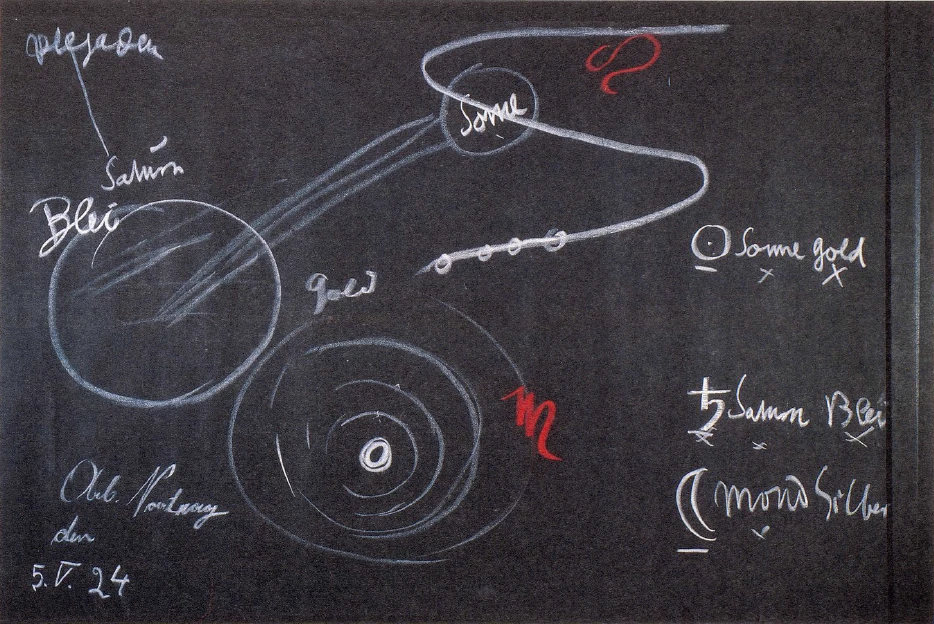
[ 32 ] Now the Babylonians and Assyrians knew that these effects exerted by humans on animals are strongest when the sun is in Leo; they grow weaker as the sun moves on and enters Virgo or Scorpio. So they knew not only that there is a connection between the planets and human actions, but they also knew that there is a connection to the position of the sun—whether it is in Leo or in Scorpio—because that is when these things change.
[ 33 ] What do people do today? Today, people simply calculate: The Sun is in the zodiac signs of Aries, Taurus, Gemini, Cancer, Leo, Virgo, Libra, Pisces, and so on; they calculate how long it remains in each constellation, when it enters each one, and so on. We know that on March 21 the Sun is in the constellation of Pisces, but that’s all we know. The ancient Babylonians and Assyrians, for example, also knew that when Saturn is in a certain constellation—called the Pleiades—the human mind is at its freest. They knew all of this. They could easily assess it because they lived in a hotter region than we do and had developed a certain science through which they understood the whole human being from the heavens.
[ 34 ] So if one can say that this science was such that it was applied to human beings—well, this science has gradually been forgotten. Back then, however, people had a comprehensive understanding of the planetary system, and they also had a comprehensive understanding of the fixed-star sky. It was known that, depending on where a planet was situated, it signified this or that for human life. It was known that when the Sun is in Leo, it exerts the strongest influence on the human heart.
[ 35 ] The thing is this: People have now tried to figure out how things stand with minerals. They told themselves: The stars have an effect on plants, animals, and humans; they have no effect on minerals. Only the Earth has an effect on minerals. But the minerals in the earth didn’t just come into being today; they formed much earlier and were also plants in ancient times. All minerals were once plants. You know, of course, that coal was once a plant. But just like coal, all other minerals were once plants as well. The moon had an influence on them, and in even earlier times, the sun did too, and in times even earlier than that, Saturn did as well. And now people wanted to know which mineral, in much earlier times when it was still a plant, had been influenced by the Sun. So they examined the mineral’s effect on human beings and discovered, for example: When the Sun is in Leo and exerts a strong influence on the heart, one observes the same effect on the heart as when gold is administered to a person. From this they concluded that the Sun once had a great influence on gold. Or when Saturn is in the constellation of the Pleiades, it exerts the strongest influence on the human head. The mind, in fact, becomes clearer. And then they investigated which mineral, back when it was still an animal—for before they were plants, minerals were animals—might have been most strongly influenced by Saturn. They then discovered that it is lead. And in this way, one finds that lead also works to make the human head freer. Therefore, one must give lead to someone whose mind becomes dull—a condition arising from the fact that, due to illness, they are carrying out certain digestive processes in the head that should no longer be taking place there.
[ 36 ] And so, for each planet, you get a metal. That is why the Babylonians and Assyrians represented the sun with this symbol:®. But they also used this symbol to represent gold. So they knew that, now that the Earth exists, the stars no longer have any influence on minerals—but they once did. They wrote the sun and gold this way:®. We simply write the sun and gold using the letters in our alphabet; but the ancients always used this symbol:®. Nor did they write “lead”; instead, they used this symbol:, which signifies both Saturn and lead. It would never have occurred to anyone in ancient times to write “Saturn” or “lead” using ordinary letters. If they wanted to write that, they wrote this symbol: Ahin. If they wanted to write “silver,” they wrote this symbol: C. This symbol represents both the Moon and silver. Thus, the Earth—insofar as it is metallic—was also related to the stars.
[ 37 ] Yes, you see, gentlemen, one really doesn't know very much about human beings and their relationship to the universe if one cannot address such matters.
[ 38 ] Now, let’s continue. These things were common knowledge in antiquity. The fact is this: When Christianity first began to spread, such knowledge was also widespread in the more southern regions of Europe. For example, there is a book about nature dating back to the first Christian centuries—it contains much of this. One must be familiar with it today, otherwise one cannot make sense of the confused information in it, for it is quite convoluted; but it contains much of this ancient wisdom. But then came the time when Christianity confined itself solely to the intellect and sacrificed everything else to dogma. That was the time when virtually all traces of such ancient science were eradicated in Europe. Between the 5th and the 11th or 12th centuries, efforts were actually made to eradicate this ancient science in Europe. And this was indeed largely successful. For, you see, the situation was this: those people who practiced this ancient science in ancient Greece, in Rome, and in Spain—that is, in southern regions—were, at the same time, already completely morally and physically corrupt. The history of Rome during this period is actually a terrible one; these were people who were morally utterly corrupt. Although they still possessed the ancient science, they could no longer sustain themselves as human beings—figures such as the autocratic rulers Nero or Commodus.
[ 39 ] Take Commodus, for example, the Roman Caesar; the following can be said about him. This Commodus, like all Roman emperors, was an “initiate.” But what does “initiate” mean in this context? It is similar to holding some title merely in name today. Every Roman emperor was considered an initiate from the outset, simply because he was emperor. This certainly attests to the fact that knowledge was held in very high regard in those days. However, the Roman emperors—with the exception of Augustus—did not possess this knowledge. Yet they were also admitted into the mysteries; they were even able to initiate others themselves. Now there was a certain stage in the initiation where the initiate had to be struck on the head. This is a symbolic act. Emperor Commodus delivered this blow in such a way that the person in question collapsed and died. This could not be punished, precisely because it was Emperor Commodus. Just as they were “initiates,” so too were they human beings.
[ 40 ] Further to the north lived those people who would later evolve into Central European culture, but who at that time were still completely uncivilized. But the Germanic tribes later conquered Italy, Greece, and Spain. Only those who relied on pure logic and pure thought survived. That was to be the sole dogma; the rest was not to be understood. Thinking was restricted solely to the most external of things. And so it came to pass that ancient knowledge was eradicated from schools and monasteries everywhere. And one can see how, in fact, only through back channels—I might say, through smuggling—did any of this Babylonian science find its way to Europe. But as a rule, it did not get very far. In Babylonia, such science was cultivated for a relatively long time.
[ 41 ] But even well into the Middle Ages, there was a Greek empire in Constantinople. Yes, you see, gentlemen, they were quite remarkable figures! Just as Polish Jews sometimes come to us in their caftans with their old scrolls—who, admittedly, aren’t always held in high regard but are deeply versed in Judaism—so too did such figures arrive in Constantinople time and again during the period when everything was being wiped out. They arrived with large, imposing parchment scrolls on which they had written down many things. Well, you see, these parchment scrolls were all taken from these strange figures in Constantinople and unrolled there. And so everything that had come over from Babylonia and Assyria was preserved in Constantinople. And no one paid any attention to it. And in Europe, everything was wiped out. It was not until the 12th and 13th centuries, and later in the Middle Ages, with the fall of the Empire, that these parchments became available again, and then various people snatched them up. They then traveled around Europe. That is the origin of everything that, at that time, was deciphered not by the learned but by the uneducated from these parchment scrolls.
[ 42 ] And so, once again, a small body of knowledge spread during the Middle Ages. This limited knowledge then served as a source of inspiration for others; otherwise, there could never have been figures like van Helmont, Paracelsus, and so on, had these people not brought the parchment scrolls they had pilfered to Europe and sold them there for a high price. As a result, many things found their way to Europe. And to this day, some secret societies still draw on all that came to Europe back then. There are all sorts of orders—Freemasons, Odd Fellows, and so on—who would have no knowledge at all if it hadn’t been for what came over from Constantinople to Europe in the parchment scrolls that were sold for a high price back then.
[ 43 ] But this knowledge was not valued. Even if you were a learned canon like Copernicus, you still wouldn’t go to the people who had such parchment scrolls. You weren’t allowed to do that. You would have lost all respect. Yes, but as a result, traditional science also lost all its prestige. And a man like Copernicus was the one who first laid the foundations for the science that we still have today—indeed, still have today.
[ 44 ] But then something very strange happened, gentlemen. The most remarkable thing about it is that Copernicus established a certain branch of astronomical science, and this was such that he no longer knew everything that had previously been known about it—just as we no longer know it today. But later generations did not even understand what Copernicus had said. Two of Copernicus’s propositions were understood; the third was no longer understood. For if one understands Copernicus’s two propositions, one believes that the Sun stands at the center, and that Venus, Mercury, the Earth, and so on revolve around the Sun. That is what is taught in all schools today. But if one understands Copernicus in his entirety, the matter is not like that at all; rather, Copernicus himself points out that the Sun is there (it is drawn), behind it Mercury, behind that Venus, here the Earth, and so on. In reality, all of these bodies revolve with the Sun through space in a spiral path. One can actually read this in Copernicus’s work, if one wishes. So we are faced with the strange fact that Copernicus himself had already trampled the old science underfoot, yet the later scholars did not even understand Copernicus. Now people are beginning to understand Copernicus—that is, to realize that he made three statements, not just two; the third statement was too difficult for people to grasp. And so astronomy has gradually become what it is today: mere calculation.
[ 45 ] And now you can probably imagine: What remains of the old science was not attained in the same way that we seek to attain things today. Today we must attain knowledge with complete clarity of the soul. The ancients proceeded more instinctively. And so it is no longer at all clear what the ancients meant by “knowledge.”
[ 46 ] A few years ago, there was a very interesting example of this. A Swedish scholar came across an old alchemical book that contained all sorts of information about lead and silver—what happens when you turn lead into silver, what happens when you add gold, and so on. What did the scholar do? He said, “We’ve written these things down; let’s try them out!”—And he tried them out in his laboratory, taking lead as we have it today, silver as we have it today, and treating them in the fire as described there—but nothing came of it!
[ 47 ] Nothing could have come of it anyway, because what he read there were symbols like these. He believed that this symbol © stood for gold; so I take gold and process it chemically. This symbol r. stands for lead; so I take lead and process it chemically.
[ 48 ] But the terrible thing was simply this: the man from whom the Swedish scholar had read this the alchemist, did not mean metals in this instance, but rather the planets, and meant that if one mixes solar forces with Saturn’s forces and the Moon’s forces—for what is described here refers specifically to the human embryo—if solar and lunar forces act upon the child in the womb, then such-and-such happens.
[ 49 ] It so happened, then, that this Swedish scholar wanted to reproduce in the retort, using the external metals, what this ancient alchemist described as relating to germination in the human womb. Of course, that couldn’t have been right, because he would have had to observe the process in the human womb; only then could he have arrived at that conclusion. You see, even today we understand so little of what this ancient science actually meant.
[ 50 ] All of this will now show you how the question posed by Mr. Erbsmehl should actually be answered. The answer is, in fact, that one must realize: Modern science is all well and good—today we can calculate exactly where a star is located; we can calculate its distance from another star; we can use a spectroscope to determine the color of its light rays; and from this, we can infer the stars’ chemical composition. But how the stars affect the Earth—that is something we must investigate anew! And we must not investigate it the way many people do today, by simply consulting old books. It would, of course, be easy to simply consult old books and learn from them what people no longer know today. But that is no longer of any use when it comes to Paracelsus, because people no longer understand him when they read him with today’s eyes; rather, the point is to learn anew how to investigate what influence the stars have on human beings. And that can only be done through Spiritual Science, through anthroposophical Spiritual Science.
[ 51 ] This leads us once again to explore not only where the moon is, but also how the moon relates to the whole human being. This leads us to realize that the child experiences the influence of the moon for ten lunar months—that is, ten times four weeks—in the womb, and experiences this influence in such a way that during this time, the full moon is experienced eight, nine, or ten times. Now, the child floats in the amniotic fluid; it is therefore a completely different being before it is born, protected from the forces of the Earth. The important thing is that it is protected from the forces of the Earth, and there—preeminently, though it is also influenced by the other stars—it is influenced by the Moon.
[ 52 ] You see, it should be the case that today, at our universities and in our schools—and even in elementary schools to a certain extent, as far as that is possible—things would be studied quite differently: that human beings would be studied above all else—the human heart, the human mind—and, in connection with that, the stars would be studied. And at the universities, there would first have to be a description of how the human embryo develops from the very tiny human seed through the first, second, third, fourth, fifth weeks, and so on. That description exists, but the other description—of what the Moon does during the same period—does not. Therefore, one can only have a science of the physical origin of the human being if, on the one hand, one describes what takes place in the womb, and on the other hand, one describes the actions of the Moon.
[ 53 ] And again, one can only truly understand—for example, how teeth change around the age of seven—if one does not merely describe—as is done today—how the baby tooth is there, how the other one grows in to replace it, but rather if one has a knowledge of the sun; for this depends on the forces of the sun.
[ 54 ] And similarly, when a person reaches sexual maturity, today we describe only the purely physical processes. But these depend on Saturn; that’s why we need a science of Saturn. So we cannot proceed as we do today, describing each thing in isolation. Because then, of course, what happens is what occurred in a hospital in a major European city. A man came to the university hospital with what he believed to be a spleen disease. He asked, “Which department should I go to with a spleen disease?”—and he was told to go to just any department. Unfortunately, he happened to mention in passing that he also had a liver disease. They told him, “We can’t help you here; you’ll have to go to a completely different hospital—that one’s for people with liver disease, and the patients here are only those with spleen disease.” He was now “between two bales of hay,” like the famous donkey, between two bales of hay that were the same size and indistinguishable from one another. - It’s a famous logical analogy about free will! People have said: What does a donkey do when it stands between two bales of hay that are exactly the same size and smell exactly the same? If it wants to choose the one on the left, it thinks to itself: the one on the right tastes just as good; if it wants to choose the one on the right, it thinks: the one on the left is just as good. And so it keeps going back and forth and dies of starvation between those two bundles of hay! —That’s how it was with this man suffering from the two diseases; he didn’t know which way to turn, and could actually have died while still trying to decide whether he belonged in the liver disease ward or the spleen disease ward!
[ 55 ] I just want to mention this to show that today, everyone knows only a tiny bit about the world. But you can’t really know anything that way! Because if you want to know something about the moon today, you have to go to the observatory and ask the people there. But they, in turn, know nothing about the origin of humankind. So you have to ask the gynecologist, the obstetrician, or the professor of women’s studies. But they know nothing about the stars. Yet these two things belong together.
[ 56 ] That is precisely the root of the problem with knowledge today: everyone knows a little bit about the world, but no one knows the whole picture. That is why—and this is the reason—science today, when presented in popular lectures, is so terribly boring. Of course, gentlemen, the subject is bound to be boring if people only tell you a tiny bit of it.
[ 57 ] Suppose you want to know what a chair looks like that isn’t right here, and someone describes the wood to you; but you want to know how it’s designed. Then you’ll find it boring if the person standing by the chair only describes the wood to you. Similarly, it is boring today to study what is now called anthropology—the science of the physical human being—because what really matters is not included in the description. And even when it is included, it has no bearing on the subject at hand.
[ 58 ] So astronomy will only be successful if it is combined with the study of human nature. And that is the crux of the matter; that is the way I can properly answer this question for you today. It is truly the case that such important things as those I have told you about—Rousseau and van Helmont—which do indeed exist and which cannot be understood at all from here on Earth—must be understood. People have already become materialistic even when it comes to words. What, for example, did people call that phenomenon whereby a person was able to paralyze animals with his gaze? It was called magnetism. Yes, but later on, the word “magnetism” was applied only to iron, to magnets. And when people speak in scientific terms today, they talk only of limiting it to iron and not misusing the term “magnetism.” Only charlatans still talk about “magnetizing” a person; but they can no longer create a mental image of what that actually means. To see through such things, one needs precisely a spiritual science.
[ 59 ] Next time at 9:00 a.m. on Wednesday.