

Human History and the
World Views of Civilized Nations
GA 353
8 May 1924, Dornach
Translated by Steiner Online Library
11. On the Nature of Judaism
[ 1 ] Well, gentlemen, what questions have you prepared for today?
Questioner: What caused the sun to be darkened for three hours at the time of Christ’s death?
[ 2 ] Dr. Steiner: Yes, gentlemen, that is, of course, a very significant question: What caused the sun to be eclipsed for three hours at the time of Christ’s death? — You see, as you can imagine, this question has also preoccupied me very, very much. I can imagine that it is also a very important question for the person asking it, because it does show that, for people today, such things are no longer credible at first glance. That is why the 19th century resolved the matter very simply by saying: Well, it’s just not true; it’s merely a metaphor, and one need not attach much importance to such things. - Yes, but, gentlemen, that’s not how it is! Precisely when one carefully traces everything that can be known from Spiritual Science, one comes to the conclusion that Christ’s death was accompanied by a solar eclipse—or at least by a significant obscuring of the sun—so that during the time of his death, the region was in darkness. And one cannot simply brush aside such things by denying them; rather, one must, of course, explain them.
[ 3 ] Now I’d like to draw your attention to something I’ve mentioned several times before in your presence: You’ll find throughout older news reports that great consideration is given to the time of day, the season, and so on. People today don’t even notice that. As you know, the New Testament contains many accounts of Christ’s healings—of the way he healed the sick. And great emphasis is placed there on the fact that he also developed a very specific human approach to healing the sick. Healing was much easier back then than it is today, and that is precisely what people today no longer take into account. Today, we simply have to heal humanity—which has already developed in this way, particularly in Europe—starting from the body. But that wasn’t always the case. Back when Christ was on Earth, and even more so in earlier times, it was still quite possible to heal starting from the soul. The soul simply no longer has such a strong influence on people today because, due to their entire upbringing, people today have abstract thoughts. You see, the kind of thoughts that all people have today simply did not exist back then. Back then, people were inwardly moved by what they thought. Something called “logical thinking”—that did not exist in those days. And so people’s inner lives were quite different. Today, you can say the most weighty things to a person—it has no effect on their body, because they have separated their soul from their body. It is believed that the people of old were instinctively clairvoyant because they were freer from their bodies. But that is not true at all; they were more deeply rooted in their bodies, they felt everything more keenly through their bodies, and were therefore able to exert an enormous influence from the soul upon the body. When a certain name was spoken, an image would immediately appear before the older person’s soul. Today, well, when you say any word, you don’t have an image. Older people had a complete image right away, and this image would send a shiver down their spine, or make them laugh, or something like that: it all immediately passed into the body. You see, these things were used very extensively for healing. But one could only use them if one properly harnessed the forces present in the human environment. That is why, when speaking of Christ’s healing of the sick, it is said: “When the sun had set, he gathered the suffering.” So he did not gather them in full, bright sunshine; his words would have had no effect on their souls then. Only when the people came to him in the darkness, at twilight, did it have any effect.
[ 4 ] People today completely overlook such things. But the fact is that these things are indeed connected to human life. Whether it is bright sunshine or twilight, whether it is spring, autumn, and so on—all of this has a tremendous influence. And so do the other phenomena of nature. So that we can say: We observe the life of Christ as it unfolded from his birth to his baptism by John, and then through the three years until his death—everything came to a head in a certain way. But not merely what the Sanhedrin decided at that time, not merely what was brought about, let’s say, by the revolution of the people there and so on, but also the phenomena in the heavens and throughout nature—these all played a part.
[ 5 ] Now I have told you, gentlemen: The forces of the Moon influence human beings, first while they are in the womb and then after they are born. Later, the forces of the Sun influence human beings. I have spoken to you about how other celestial forces also influence human beings. But all phenomena found out in nature exert an influence on human beings.
[ 6 ] You see, it is sometimes quite strange how people today, because they cannot break free from their abstract thinking, struggle with natural phenomena. For example, it is now known that sunspots—which are, after all, spots on the sun—appear again and again in large numbers every eleven to twelve years. But even though we know that whenever sunspots appear, something unsettling is always happening on Earth, we still cannot bring ourselves to truly take into account the extraterrestrial influence on Earth that is expressed through the sunspots. But this influence is definitely there! Isn’t it true that when it rains, human consciousness leads to certain activities being suspended on Earth? You can’t very well do gardening or similar work when it’s pouring rain; those activities must be put on hold. Yes, nature does have an influence on human conscious life. But the entire cosmos, including the world of the stars, exerts a great influence on human unconscious life. And so the sunlight—which, of course, has significance for human beings—reaches them quite differently when it is partially obscured than when it shines through completely.
[ 7 ] One cannot say that such things affect freedom; but where deeper, spiritual effects come into play, a person must rely on these effects with his freedom just as he relies on the fact that he cannot say, when he is on the first floor: “There should be a hole in the floor so that I can go down through it to the lower floor.” The laws of nature must simply be taken into account—including the great ones that exist out there in the world.
[ 8 ] And so one can say: Everything in nature has come to a head precisely at the time when what has happened has been reflected in certain hearts in Palestine, leading to the greatest sorrow. But this was accompanied by the greatest sadness in nature. These two things were in perfect harmony; they were in harmony in reality. And so one can say: Just as blood flows through the body and a person’s health depends on this blood, so too does that which lives in the sunlight flow into the blood. It does indeed flow into the blood.
[ 9 ] Imagine that someone is about to die. Well, if you were to test their blood two months beforehand, you would see that it is already on its way to becoming lifeless. Just as the blood is on its way to becoming lifeless before a person’s death, so too was that which lives in the light already—even at the time of Christ’s birth—on its way to developing in such a way that his death coincided with twilight. Thus, natural phenomena were simply in an intimate connection with Christ’s life. And one might say: Just as Christ consciously chose twilight to heal the sick, so his unconscious in the soul chose the solar eclipse to die. This is the mental image one must have of these things; then one arrives at a correct explanation. And that is important, gentlemen! Of course, one cannot explain these things in an external, crude manner, but must explain them in an intimate way.
[ 10 ] Question: Has the Jewish people fulfilled its mission in the development of humanity?
[ 11 ] Dr. Steiner: Yes, you see, that is a question which, of course, when discussed, unfortunately all too quickly veers into agitation. But what must be said quite objectively in this regard has nothing to do with any kind of agitation.
[ 12 ] When one looks at how the Jewish people developed in ancient times, one must say that they developed in a way that laid the groundwork for Christian development to an extraordinary degree. Before Christianity entered the world, the Jews had a very spiritual religion, but a religion—as I have already described to you—that actually took into account only the spiritual law of nature. If one asked a Jew, “Where does spring come from?” he would say, “Because Jehovah wills it!”—“Why is this person a bad person?” “Because Jehovah wills it!”—“Why does a famine break out in a country?” “Because Jehovah wills it!”—Everything was traced back to this one God. And as a result, the Jews lived in hostility with their neighboring peoples; they were not understood by them. Nor did they understand these neighboring peoples, because the neighboring peoples did not actually acknowledge this one God in the same way, but rather acknowledged the spiritual entities in all natural phenomena—many spiritual entities.
[ 13 ] Yes, you see, gentlemen, these many spiritual beings in natural phenomena simply exist, and those who deny them are denying something that is real. Denying these spiritual entities in natural phenomena is just like if I were to say right now: “There isn’t a single person sitting in this hall!”—Of course, I can say that, and if I bring in a blind person and say, “There isn’t a single person sitting in this hall!” and you don’t start laughing so loudly that he hears it, then he might believe it. - There are, after all, deceptions in this area as well. Friedrich Nietzsche, who had very poor eyesight—he was a professor in Basel at the time—always had very few listeners; even though his lectures were very interesting, the young listeners were not particularly diligent. He was always lost in thought, would go up to the podium, and deliver his lectures. This happened once again—and there wasn’t a single person inside! But he didn’t notice it until he walked out, because his eyesight was so poor. — And even a blind person could be made to understand that there isn’t a single person in the hall. This is how one makes it clear to people that there are no spiritual effects anywhere, because education and everything that happens today first blind them to these spiritual effects.
[ 14 ] But on the other hand, it is also important for human beings to realize that, although they have much to do with all these numerous nature spirits, there is a power within them that overcomes everything these nature spirits bring about in human beings. And through this, human beings come to the one God of humanity. And the Jews initially came to the one God of humanity in a very powerful way and denied all other spiritual beings in natural phenomena. Through this, they initially earned great merit for their recognition of the one God of humanity, Yahweh or Jehovah. After all, Yahweh simply means: “I am.”
[ 15 ] Well, this matter has become very important for world history: the belief in one deity, along with the denial of all other spiritual beings. Just imagine: there are two nations at war with each other; each acknowledges the one God, and only one of these nations can prevail. The victorious people say: “Our God has granted us victory.”—If the other people had won, they too would have said: “Our God has granted us victory.” But if it is the one God who grants victory to one people and brings defeat upon the other, then it is God Himself who defeats Himself! So if the Turks have their God and the Christians have their God, and both peoples have the one God, and one people prays, “May the one God grant us victory”—and the other people prays, “May the one God grant us victory”—then they are both demanding that the same God defeat himself! One must be clear about this: We are not dealing with a single spiritual being. But this is already evident in everyday life: One person wants it to rain and prays for rain, while another wants the sun to shine and prays for sunshine on the very same day. Yes, that’s impossible! If people realized this, there would already be more clarity in these matters. But they simply don’t realize it. In major matters, people give themselves over to thoughtlessness, living in a state of thoughtlessness that they would never allow themselves in minor matters. They probably wouldn’t put both salt and sugar in their coffee at the same time; instead, they’d just add sugar—they’d do only one thing. But in the big picture—and this is where the great confusions lie—people aren’t inclined to devote themselves to just one kind of clarity. Thus, the Jews have established what is called monotheism—that is, the belief in the one God.
[ 16 ] I told you recently that Christianity actually envisaged three divinities: It has the Father God, who lives in all natural phenomena; the Son God, who lives in human freedom; and the Spirit God, who is meant to make human beings aware that they possess a spiritual aspect independent of their bodies. Thus, three things would be understood. Otherwise, one would have to attribute to the one God the act of causing a person to die in the body, and also the act of raising them from the dead out of the same resolve. Whereas, if one has three persons, dying falls to one God, death to another, and being raised in the Spirit to yet another. Thus, Christianity was compelled to conceive of the spiritual deity as having a mental image of itself in three persons. In three persons—it is only today that people do not understand this, but originally it meant “three-form,” and people had a mental image of the Godhead appearing in three forms.
[ 17 ] Now, because Judaism conceived of only this one God, it was compelled not to form any mental image of this one God at all, but rather to comprehend this one God solely through the innermost depths of the soul, through the intellect. But it is also easy to see that this actually intensified human egoism to the highest degree; for a person becomes alienated from everything outside himself when he perceives the spiritual only within his own person. And this has indeed given rise to a certain national egoism in Judaism—that cannot be denied—but the Jews are thereby also better suited to absorb that which is not figurative, while they are less suited to absorb the figurative. When a Jew becomes a sculptor, nothing particularly remarkable comes of it, because he is not yet predisposed to it. He lacks this pictorial predisposition; it simply does not come naturally to him. When a Jew becomes a musician, he usually becomes an excellent musician, because music is not pictorial; it is not represented externally. Thus, you can find great musicians among the Jews, but you will hardly find great sculptors among them—not even painters—during the period when the arts flourished! Jews paint quite differently from—in my view—Christian or even non-Christian, such as Oriental, painters. They paint in such a way that, in a painting by a Jew, the color itself actually has no great significance; rather, what matters is what it expresses—what one actually intends to convey through the image. This is what particularly characterizes Judaism: bringing into the world that which is non-pictorial, that which takes place entirely within the human self. But as easy as it may seem, it is not so easy to uphold this confession of faith in the one God; rather, people actually become pagans immediately if this confession of faith in the one God is not strictly enforced upon them. The Jews, of all people, have become pagans the least. In Christianity, on the other hand, there is a tendency toward paganism. If you look closely, you can see this everywhere. Take, for example, the reverence Christianity has for ceremonies. Didn’t I tell you: The monstrance actually represents the sun, and within it, the moon?—People don’t even know that anymore. But the person who is not enlightened in this regard actually worships the monstrance—that is, something external. People are very easily inclined to worship the external. And so it has actually come to pass that, over the course of the centuries, Christianity has taken on a very pagan character. Judaism, on the other hand, has always exerted a counteracting influence.
[ 18 ] Let’s just consider this for a moment in a very specific area where it’s easiest to understand: The Christians of the West—that is, the Christians who came from Greece, Rome, and central Germany—were actually quite incapable of carrying on the ancient tradition of medicine because they could no longer perceive the spiritual aspect in medicinal herbs. It was impossible for them to still perceive the spiritual aspect in medicinal herbs. But the Jews who came from the East—from Persia and so on—saw the spiritual aspect everywhere, that is, they saw their own Jehovah. If you look at the development of medicine in the Middle Ages, you’ll see that the Jews played an immensely significant role in it. The Arabs contributed significantly to the development of other sciences, while the Jews contributed significantly to the development of medicine. And what the Arabs contributed to medicine, they in turn developed with the help of the Jews. But through this, medicine has become what it is today. Medicine has indeed remained spiritual, but it has, I would say, remained monotheistic. And today, if you observe medicine, you can see that—with the exception of a few remedies, very few indeed—everything is attributed to all the other remedies! People no longer know how a particular remedy works, just as in Judaism they did not know what the individual nature spirits were like. Thus, an abstract spirit, an abstract service to Jehovah, has also taken hold in medicine, and it is actually still present in medicine today.
[ 19 ] It would be quite natural, for example, for the number of Jewish doctors in the various countries of Europe not to exceed their percentage of the population. I do not mean to say—please do not misunderstand me!—that this should be stipulated by law; that would never occur to me. But a natural perspective would suggest that the number of Jewish doctors should correspond to the number of Jews. Yet that is not the case at all. In most countries, a much larger proportion of Jews are doctors. This dates back to the Middle Ages; they are still very drawn to medicine because it corresponds to their abstract way of thinking. Their entire way of thinking is actually adapted to this abstract “Jehovah medicine”; it suits them. And only here in anthroposophy, where we return to the individual nature spirits, do we once again recognize the natural forces contained in individual herbs and stones. There, we bring things back to solid ground.
[ 20 ] The Jews, then, worshiped the one God, Jehovah, and thereby prevented people from getting lost in polytheism. Now, of course, this also meant that the Jews have always distinguished themselves from other peoples, and as is often the case—just as anyone who stands out tends to provoke aversion and antipathy—they have provoked such aversion and antipathy. But today the point is to recognize that such a way of preventing culture from being torn apart—but rather holding it together, as the Jews have done for centuries—will no longer be necessary in the future; rather, in the future, it must be replaced by a strong spiritual insight. Then, too, the relationship between the one God and the many spirits will reveal itself to human understanding and consciousness. Then there will be no need for a single people to act in the unconscious. That is why I have found it troubling from the very beginning that the Jews, when they no longer knew which way to turn, founded the Zionist movement. To establish a Jewish state means to engage in reaction in the most brutal way, to return to reaction in the most brutal way—and in doing so, one sins against everything that is necessary in this realm today.
[ 21 ] You see, a very respected Zionist, who was a friend of mine, once explained to me his ideals of going to Palestine and founding a Jewish empire there. He himself was very actively involved in the founding of this Jewish kingdom, is still involved today, and even holds a very prominent position in Palestine. I told him: Such a cause is completely out of step with the times today; for what is in keeping with the times today is something that every person—regardless of race, nationality, class, and so on—can join. That is really the only thing one can advocate today—something to which every human being, without distinction, can subscribe. But surely no one can demand of me that I join the Zionist movement. For then you are once again singling out a portion of all humanity!—For this simple, obvious reason, such a movement cannot really succeed today. It is, in essence, the most barbaric form of reaction. Of course, such people then respond with something strange; they say: Yes, over time it has turned out that people do not want anything like a universal humanity at all, but demand that everything should develop out of what is specific to the people.
[ 22 ] This conversation I have just recounted to you took place before the Great War of 1914–1918. Yes, you see, gentlemen, the fact that people no longer want the great universal human principles, but instead want to isolate themselves and develop national forces—that is precisely what led to the Great War! And so the greatest calamity of the 20th century arose from what the Jews themselves also desire. And so one can say: Since everything the Jews have done could now be done consciously by all people as an example, the Jews could actually accomplish nothing better than to merge with the rest of humanity, to mix with the rest of humanity, so that Judaism as a people would simply cease to exist. That is what would be the ideal. Many Jewish customs still stand in the way of this today—and above all, the hatred of other people. And that is precisely what must be overcome. Things will not be overcome if everything remains the same. And if, for example, Jews feel offended when someone says, “You are not sculptors; you can’t achieve anything in that field”—well, one might say: Not everyone has to be a sculptor! They can certainly achieve something elsewhere through their personal abilities! — So Jews are simply not suited to sculpture; after all, they included that one commandment in the Ten Commandments: “You shall not make for yourself an image of your God,” because they simply do not want to depict anything supernatural in pictorial form. But this very fact leads one back to the personal.
[ 23 ] Isn’t it true that you can create a mental image very easily: When I create an image—even just a verbal one, as often happens in Spiritual Science—then the other person can commit that image to memory, be inspired by it, recognize themselves in it—whatever they want. But if I do not create an image, then I must always be personally present in the effect itself; then it does not separate itself from me. Therefore, it takes on a personal character. Judaism has this as well; everything among the Jews also takes on a personal character. People must come to see the spiritual in other people. Today, racial considerations still dominate all aspects of Jewish life. Above all, they marry among themselves. Thus, they still see the racial aspect, not the spiritual. And this is what needs to be said in response to the question: Has the Jewish people fulfilled its mission in the development of human knowledge?—It has fulfilled it; for in the past, there had to be a single people that brought about a certain form of monotheism. Today, however, spiritual knowledge itself must take the lead. Therefore, this mission is fulfilled. And therefore, this Jewish mission as such—as a Jewish mission—is no longer necessary for human development; rather, the only correct course is for the Jews to assimilate into other peoples through intermarriage.
Question: How did this people come to face the fate of being forced into exile?
[ 24 ] Dr. Steiner: Yes, you see, gentlemen, one must take a close look at the entire nature, the entire character of this exile. The Jewish people who lived at the time of Christ—under whose rule Christ died—lived right in the midst of a completely different people, the Romans. Now imagine if the Romans had simply conquered Palestine, killed the people they intended to kill, expelled the others, and the Jews had already had the intention or the impulse back then to intermix with other peoples—what would have happened? Well, the Romans would have conquered Palestine; some of the Jews would have been killed; others would have been expelled—as we say today, which is what all countries do—and would have been able to live somewhere else.
[ 25 ] Now, the Jews had neither the intention nor the urge to mix with others; rather, wherever there were even just a few Jews, they lived exclusively among themselves. Now they have been scattered in all directions; simply because they lived only among themselves and intermarried, it has been noticed that they, as Jews, are themselves strangers. Otherwise, no one would have noticed at all that they were in exile in any way. It was thus because of this tendency of the Jews that people noticed: they are in exile. This is inherent in the very character of Judaism. And later generations are now astonished that the Jews were driven out and had to live in foreign lands. Yes, but that has happened almost everywhere! It’s just that other peoples have intermingled with the rest of the population, and no one noticed. It is inherent in the character of Judaism that it has tenaciously held together everywhere. In this regard, one must say: Because these people stick together, things that would otherwise go unnoticed are, in fact, noticed.
[ 26 ] Certainly, it is lamentable and heartbreaking to read about how Jews lived in ghettos throughout the Middle Ages—that is, in the sections of cities where they were permitted to reside. They were not allowed to enter other parts of the cities; the gates of the ghettos were even closed, and so on. But look: people talk about this because the Jews stuck together in the ghetto, because that’s what was noticed! And other people fared just as badly—not exactly in this way, but in other ways. The Jews, you see, stayed in their ghettos and stuck together there, and everyone knew: they weren’t allowed to leave. But other people, who had to work every day from early morning until late at night, couldn’t get out either, even though there were no gates; they suffered just as much! So one has to say: Such things are often based solely on appearances, based only on appearances, just as so much in world history is based on outward appearances.
[ 27 ] Today is the time when we must shed light on all these things in the light of reality. And that leads us to this conclusion: Where a destiny is fulfilled, it is actually the case that it is truly, as we say using an Eastern expression, a karma, an inner destiny. This fate of exile came about for the Jews because of their own character; they are tenacious, and they have persevered in foreign lands. That is why it was so strongly noticed in later times and is still talked about today.
[ 28 ] This, of course, has led to the situation where people distinguish them from others and thus attribute all sorts of things to them—things whose causes are unknown. Isn’t it true that if a person is murdered somewhere in a superstitious region and no one can figure out who the perpetrator is, and an unpopular Jew lives there, people say: “The Jews need human blood at Passover; they killed the man.”—Yes, these are, of course, the kinds of things that are said because people distinguish Jews from others. But the Jews themselves have contributed tremendously to the fact that they are distinguished from others.
[ 29 ] Today, it is absolutely essential that, when dealing with these issues, we emphasize not racial or national aspects, but rather what is common to all humanity.
Question: What was the global significance of the seventy souls of the original Israelite family, who make up humanity?
[ 30 ] Dr. Steiner: Well, gentlemen, the situation is this: Since time immemorial, there have been diverse peoples on Earth. From this point forward, these diverse peoples will lose their significance. I have just said as much: what should come to the fore is the universal human. But if we now look back at the development of humanity, we find the Earth’s population divided into the most diverse peoples. Just as the spiritual lives within natural phenomena, so too does the spiritual live within the peoples. In every people there is simply a guiding national spirit. That is why I said in my *Theosophy*: The national spirit is not merely an abstract term! Isn’t that right? What does the French people mean today to the materialistic person? Well, it means so-and-so many—forty-two million people—who are gathered together in a cluster in Western Europe. And only then, when one takes this entirely abstract concept, does one study the peculiarities of this people. But that is not how it is! Rather, just as there is a seed for a plant, so too is there something seed-like for the spiritual essence of a people, which then develops. A real spirit lives within the entire people.
[ 31 ] Well, if you take into account, gentlemen, what I have just said—that the Jewish people have, for some time now in the course of human history, had the mission of spreading a deity—then you will understand that this Jewish people must also have been prepared for this as a nation. That is why it has come to pass that the various national spirits, which otherwise concern themselves individually with different peoples, originally—when the Jewish people first emerged in the world—concerned themselves with the entire Jewish people. Isn’t it true that if we take the Babylonians (it is illustrated), then we come to the Assyrians, the Egyptians, the Greeks, the Romans; so we say to ourselves: the Indian national spirit, the Babylonian national spirit, the Assyrian national spirit, the Egyptian national spirit, the Greek national spirit, the Roman national spirit, and so on. These national spirits are thus distinct from one another, and each individual national spirit has concerned itself solely with that particular people. But when we consider the Jewish people, we find that in the region of Syria where the Jewish people developed, all these national spirits exerted their influence on the people, so that the will of all these national spirits was already alive within the single Jewish people.
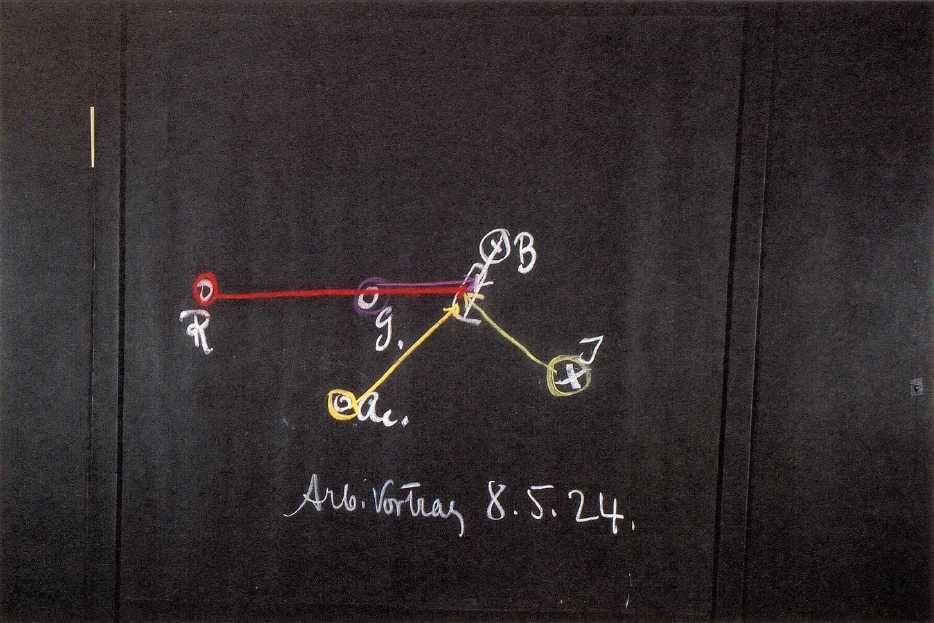
[ 32 ] I’d like to illustrate this with an analogy. Imagine that each of you goes home and does whatever you need to do there. Now, each of you—Mr. Dollinger, Mr. Erbsmehl, Mr. Burle, and so on—will be part of a specific circle. That was the case with these national spirits. But now, let’s say you want to represent the interests of the working class: You don’t stay in your own home; instead, you hold a meeting, you come together, discuss matters with one another, and whatever then emanates from you originates from your community. So one can say: What these national spirits brought about among the other peoples, each did for himself in the community centers; what they brought about through Judaism, they did by holding a spiritual gathering—it had a greater effect on one Jew than on another. The Bible expresses this by saying: Seventy national spirits enter the Israelite people; they all exert an influence. — But this influence, which was very strong, has in a certain sense already made the Jews a cosmopolitan people, in that they have remained so resilient. They were able to come together anywhere and preserve Judaism there, because in this way they had everything within themselves.
[ 33 ] It is also remarkable what Judaism encompasses! For example, if you enter such societies—Masonic or Odd Fellows societies—which do not possess new knowledge from the Spiritual Science but rather possess ancient knowledge in a form they themselves no longer understand, you will find, apart from the words, elements from all manner of peoples: Egyptian elements, ceremonies, words; Assyrian and Babylonian words and symbols, ceremonies, and so on; but most of all you will find Jewish elements within them—the so-called Kabbalah and so on. Jewish culture is truly cosmopolitan in this sense—it adapts to everything, yet also retains its original essence, precisely because it already possesses that essence within itself. This is also true of the Hebrew language, because the Hebrew language originally contains so much—both spiritual and physical—that a single Hebrew word always conveys a great deal. And the Jews, of course, have the peculiarity of writing only the consonants; the vowels were then later supplemented by symbols. These vowels were not actually written down on paper at all. Everyone could pronounce them for themselves, so that one person would say “Jehovah,” another “Jeheva,” a third “Jehave,” and a fourth “Johave.” The vowels varied depending on how they were perceived. And that is why what the priests had established—the name “Jehovah”—was called the “unpronounceable name,” because one was no longer allowed to use the vowels as one pleased.
[ 34 ] Judaism, then, already had something in its tenacity that pointed to the way in which the various Folk-souls had participated in this single nation. When you see Jews in a wide variety of fields, you really need a keen eye to still recognize what is Jewish—those Jews who have assimilated and contributed alongside others. As you know, the most significant statesman of the 19th century was a Jew. So these Jews who have become absorbed into the others—you really can’t distinguish them anymore. The connoisseur knows, from a single sentence spoken by a Jew, that there is a Jewish style to it—provided it isn’t an imitation; of course, people today imitate a great deal. But Jews imitate very little. You can notice how the Jew proceeds everywhere from what one can inwardly fix in one’s thoughts. That is a peculiarity. And it’s connected to this gathering of Folk-souls, all of whom actually played a part in it; so that even today the Jew still believes that when he says anything, it must necessarily be valid. Isn’t that right? He proceeds from what is decided by the individual. It’s very interesting! Suppose there’s a group of people together—three, four, or five people; the others aren’t Jewish, and one is Jewish. Now, let’s say these are representatives of some community. I’m not telling you things I’ve made up, but things I’ve actually experienced. Within this community, there are differing opinions. Now suppose these five people—one of whom is Jewish—are talking. One will say: “Yes, it’s very hard to bring all these people together; you have to persuade the minority and the majority so that a compromise can be reached.”—Compromises are, after all, reached when people talk to one another like this. The second non-Jew will say: “Yes, but I’ve lived among the people who are in the minority there; I know how difficult it is to convince people!”—The third, who represents the minority, says: “We certainly don’t feel like participating in this anymore—none of this is working!”—The fourth says: “You just have to decide whether to start from this side or that side.” —So say the four non-Jews. Now the Jew begins: “That’s all nonsense! The concept of compromise: Compromise consists of people with different opinions finding common ground and giving in a little.” - He presents it abstractly: “The concept of compromise”—he doesn’t start from this or that; he begins with: “The concept of compromise”—omitting the article, thereby also demonstrating his inherent stubbornness. If someone says, “What is the concept of compromise?” and so on—then they already have a view within themselves; then they want to examine it. But the Jew does not begin this way; instead, he says: “The concept of compromise!”—thus establishing the Jehovah perspective: “Jehovah says!”—One does not reflect on “How does this work in detail?” but simply posits what is established in the concept. That is why the Jew always thinks he can develop everything from the concept itself. As long as the Jews remain among themselves, this will naturally be the case; but when they have assimilated among other people, they will not say, “The concept of compromise”—rather, they will simply have to be like other people. This is precisely what is connected to the fact that the Folk-souls are influencing them.
Mr. Dollinger: What significance does the Tree of Sephiroth hold for the Jewish people?
[ 35 ] Dr. Steiner: Let's start with that next Saturday.