

Human History and the
World Views of Civilized Nations
GA 353
10 May 1924, Dornach
Translated by Steiner Online Library
12. About the Sephirot Tree
[ 1 ] Well, gentlemen, of the remaining questions, we still have those concerning the Jewish Tree of Sephiroth. In this Tree of Sephiroth, the Jews of antiquity actually encapsulated their highest wisdom. Indeed, one could say: They encapsulated in it the wisdom concerning the relationship of human beings—the relationship of human beings to the world. We have often emphasized that human beings do not consist solely of the visible parts that can be seen with the eye, but also of invisible, supersensible components. We have referred to these supersensible components as the etheric body, the astral body, the “I,” or the “I-organization.” Well, people were already aware of all these things in ancient times—albeit not in the same way we are today—but they knew of them instinctively. This ancient knowledge has simply been completely lost. And today people believe that something like this Jewish Tree of Life, the Tree of Sephiroth, is actually a figment of the imagination. But that is not the case.
[ 2 ] Today, let’s try to understand what the ancient Jews actually meant by this Tree of Sephiroth. Didn’t they think of it this way: Human beings stand here in the world, but the forces of the world act upon them from all sides. When we look at human beings as they stand in the world (it is drawn), we can create a mental image of them, schematically, like this. So this is how we imagine the physical human being standing in the world. The ancient Jews had a mental image of this human being, which was acted upon by the forces of the world from all sides. Here I’ll draw an arrow that goes right into the heart: so the forces of the world act upon the human being; down here is the force of the earth.

[ 3 ] Now the Jews have said: First, three forces act upon the human head—I have indicated these in the drawing with arrows 1, 2, and 3—and three forces act upon the human center, upon the chest, primarily affecting respiration and blood circulation (arrows 4, 5, and 6 in the drawing). Then there are three more forces acting on the human limbs (arrows 7, 8, 9), and a tenth force that acts on the human being from the earth (arrow 10, from below). Thus, the ancient Jews imagined that ten forces act on the human being from the outside.
[ 4 ] Let us first consider the three forces that come, so to speak, from the farthest reaches, from the most distant parts of the universe, and act upon the human head—forces that actually make the human head round, like an image of the entire round universe. These three forces—that is, 1, 2, and 3—are the noblest; they come, so to speak—to use a later term, a Greek term for example—from the highest heavens. They shape the human head by making it a round image of the entire round universe.
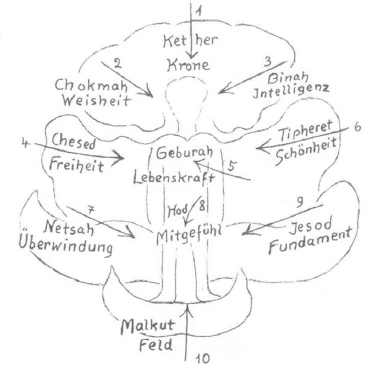
[ 5 ] But now we must immediately introduce a concept that might bother you if I were to simply state it to you. For, you see, among these ten concepts that the Jews have placed at the pinnacle of their wisdom, the first one there (1) is one that was later terribly abused; for later, those people who succeeded in seizing power dragged the symbols of that power—and also the words denoting that power—down into the realm of external power. And so certain people, who appropriated the power of the peoples and passed it on to their descendants, appropriated for themselves what is called a “crown.” In ancient times, “crown” was a word for the highest spiritual gift that could be bestowed upon a human being. And only those who had undergone initiation in the sense I have explained to you—that is, those who had attained the highest wisdom—were permitted to wear the crown. It was a symbol of the highest wisdom. I have already explained to you how all the orders originally had a meaning, and how they were later established out of vanity and no longer mean anything. But we must consider this in particular in relation to the term “crown.” For the ancients, the crown was the epitome of all that is superhuman and descends from the spiritual world into human beings. No wonder the kings placed the crown upon their heads. As you know, they were not always wise and did not always embody the highest heavenly gifts, but they did wear this symbol. And when such a thing was expressed according to ancient customs, one must not confuse it with what it has become through misuse. So the highest—the highest gifts of the universe, the highest spiritual gifts—that can descend upon human beings, which they can unite with their minds when they possess great knowledge—this was called Kether, the Crown, in ancient Judaism. Well, you see, that was the highest. That was what spiritually shaped the mind from the universe at large.
[ 6 ] And then this human head needed two other forces. These two other forces came to it from the right and from the left. It was thought that the Highest comes down from above; from the right and the left come the other two forces, the two world forces that are spread throughout the entire universe. Now, the one that enters as if through the right ear was called Chokmah = Wisdom. Today, if we were to translate the word, we would say: Wisdom. And on the other side, coming in from the world, was Binah. Today we would say: intelligence (2 and 3 in the drawing). The ancient Jews distinguished between wisdom and intelligence. Today, anyone who is intelligent is also regarded as if they were wise. But that is not the case. One can be intelligent and yet think the most foolish things. The greatest follies are conceived in a very intelligent way. Especially when one looks into much of today’s science, one must say that this science is actually intelligent in all fields, but it is certainly not wise. The ancient Jews distinguished Chokmah and Binah—ancient wisdom and ancient intelligence—from one another very early on. So the human mind—in fact, everything that belongs to the human sensory system, including the nerves that extend throughout it—all of this was designated by the three terms Kether, Chokmah, Binah: Crown, Wisdom, and Intelligence.
[ 7 ] According to the ancient Jews, the human head is thus formed from the universe itself. There must therefore have been a strong awareness—otherwise such a teaching would not have developed—that human beings are a part of the entire universe. We can ask, for example, regarding the human body: What about the liver? Well, the liver receives its veins from the blood circulation; it draws its strength from the human environment. Thus, the ancient Jews said: Human beings draw from the world around them the forces that then bring about the formation of the head, first in the womb and later as well.
[ 8 ] Well, then there are three other forces (4, 5, 6 in the diagram); these act more upon the middle man, upon the human being in whom the heart and the lungs are located. They thus act upon the middle man; they come down less from above and are more present in the surrounding environment. They exist in the sunlight that travels across the earth; they exist in the wind and the weather. This brings us to the three forces mentioned by the ancient Jews: Chesed, Geburah, Tiphereth. If we want to express this in modern terms, we could say: Chesed = freedom; Geburah = power; Tiphereth = beauty.
[ 9 ] Let us start here, above all, with the middle force, Geburah. I told you that I want to draw the arrow so that it pierces the heart! The strength that a human being possesses—this heartiness, which is both spiritual and physical strength—is symbolized by the human heart. That is why the Jews imagined: When the breath enters a person, when the breath flows into the heart, it is not only these physical forces of breath that enter from the outside, but also the spiritual force, Geburah, which is connected to the breath. So, to put it even more precisely, we would say: the life force, the power through which a person is able to do something—that is Geburah. But on one side of Geburah is what was called Chesed, human freedom. And on the other side is Tiphereth, beauty. After all, in his form, man is truly the most beautiful thing on earth! The ancient Jew had a mental image: When I hear the heartbeat, I perceive the life force entering the human being. When I extend my right hand, I sense that I am a free person; as the muscles stretch, the power of freedom arises. The left hand, which moves more gently and can grasp more gently, embodies what humans create in beauty.
[ 10 ] So these three forces: Chesed = freedom, Geburah = life force, Tiphereth = beauty—they correspond to that within the human being which is connected to the breath and the circulation of blood, to everything that is in motion and constantly repeats itself. This certainly includes the movement of sleep and the alternation of day and night. That, too, is part of this movement; human beings are also included in it.
[ 11 ] But then, human beings are also beings who can change their position in space, who can walk around, who—unlike plants—do not have to remain in one place all the time. Animals can, of course, move around as well. This is something humans share with animals. Animals do not possess Chokmah, Tiphereth, or even Chesed, but they do possess Geburah—the life force. And the three qualities I have mentioned here are shared by humans and animals only insofar as humans possess the others.
[ 12 ] This—the fact that one can move about, that one is not bound to a single place—is what the Jews called “Netsah,” and it means overcoming the earth’s fixed position, moving (arrow 7 in the drawing). Netsah is overcoming. Now, that which acts more on the center of the human being, where his center of gravity is—it’s interesting, you know: that is the point located roughly here; it is slightly higher when awake and sinks lower when asleep, which also attests to the fact that something is outside of us when we sleep—that which acts in the center of the body, which also brings about procreation in humans, and which is thus connected to sexuality; the ancient Jews called this Hod. Today we would describe it with a word that would roughly express “compassion.” You see, the terms are already becoming more human. — So Netsah refers to outward movement—we go out into space—while Hod refers to inner feeling, inner movement, and inner compassion toward the outside world; all of that is Hod (arrow 8). Then, under 9: Yesod; this is what a person actually stands upon—the foundation. Here, then, the human being feels bound to the earth; the fact that he can stand on the earth is the foundation, is Yesod. That he has such a foundation stems precisely from the forces that approach him from the outside.
[ 13 ] And then the forces of the Earth itself act upon him (arrow 10)—not only the surrounding forces, but the forces of the Earth itself act upon him. This was then called Malkuth. Today we would translate it as: the field in which human beings act, the earthly external world; Malkuth—the field. It is difficult to coin a proper term for this Malkuth; one might say “realm” or “field,” but all these terms have actually been misused, and today’s names no longer convey what the ancient Jew felt: that the Earth itself actually acts upon him.
[ 14 ] We need only create a mental image of the center of the human being here; this is where the thighbone begins, on either side of the person—it extends down to the knee, where the kneecaps would be. All these forces also act upon these bones; but the fact that it is actually pierced through in this way—that it is essentially a tube—is due to the penetration of the earth’s forces. So everything where the earth’s forces penetrate—that is what the ancient Jew referred to as Malkuth, the field.
[ 15 ] So you see, one must start with human beings if one wants to speak of this Tree of Sephiroth! All ten together—that is, Kether, Chokmah, Binah, Chesed, Geburah, Tiphereth, Netsah, Hod, Yesod, and Malkuth—were called the ten Sephiroth by the Jews. These ten forces are what actually connect the human being to the higher, spiritual world. Only the tenth force, Malkuth, is rooted in the earth. So, basically, this here is the physical human being (pointing to the drawing), and this physical human being is surrounded by the spiritual human being—at the bottom, first as the forces of the earth, but then as the forces that are closer to the earth yet still act upon us from the surrounding environment: Netzach, Hod, Yesod. All of this—the way these forces act upon us—is thus spiritually part of the human being. Then there are the forces that act upon his blood circulation and respiration: Chesed, Geburah, Tiphereth. And then the noblest forces that act upon the human being, those that act upon his head: Kether, Chokmah, Binah. Thus, the Jews actually conceived of the human being—as I have illustrated here in color—as connected to the world on all sides. Human beings are indeed such that they also contain a supersensible element within themselves. And this is the mental image they had of that supersensible element.
[ 16 ] But now we may ask: Aside from explaining to humanity its relationship to the world, what else do the Jews actually hope to achieve with the ten Sephiroth? For every Jewish student had to learn the ten Sephiroth, but not merely so that he could list them; you would have a completely false mental image if you believed that instruction in the ancient Jewish schools had been such that what I have drawn on the board was the central focus. If one were simply to answer the question: “What is the Tree of Sephiroth?”—one could have finished quickly; you would have known it in a flash. People today are satisfied with that: they ask, “What is the Tree of Sephiroth?” It contains this and that, as I have just told you. - But that has nothing to do with human beings! Instead, people just give ten words and all sorts of fantastical explanations for it! But in relation to human beings, what I have told you is the correct understanding. Yet this was not simply brushed aside in the schools; rather, the Jewish student, who was supposed to study science in the sense of that time, had to learn much more about it.
[ 17 ] Just imagine, gentlemen, that you had merely learned what the alphabet is and knew, if someone asked you, “What are A, B, C, D, and so on?”—that is, the letters A, B, C, D, and so on. You would have gotten to the point where you could recite the twenty-two or twenty-three letters in a row. But you wouldn’t be able to do much with that! If someone could only recite the twenty-three letters, they wouldn’t be able to do much with that, would they? But that is exactly how an old Jew would have been viewed if he could only have said: Kether, Chokmah, Binah, Chesed, Geburah, Tiphereth, Netsah, Hod, Yesod, Malkuth—that is, if he could have listed these ten Sephiroth. Anyone who had answered only that way would have seemed to the Jews like someone who can say: A, B, C, D, E, F, G, H, and so on. After all, one has to learn more than just the alphabet, doesn’t one? One has to learn to use the alphabet for reading; one has to learn how to use the letters to read. Well, gentlemen, just think for a moment how few letters there are, and how much you have already read in your lives! You just have to consider that. Take any book—take, for example, Karl Marx’s *Capital*—and look at it when you have the book in front of you: there is nothing on the pages but the twenty-two letters, absolutely nothing else! There are only the letters in that book. But what’s written inside is a great deal, and it’s all brought about by the fact that the twenty-two letters are jumbled together: sometimes A comes before B, sometimes before M, sometimes M before A, L before I, and so on—and that’s how all the complexity in the book comes about. If someone knows only the alphabet, he picks up the book and might say: “Everything in this book is clear to me: there’s A, B, C, just arranged differently; I know everything that’s in this book.” - But everything that is truly contained within it in terms of meaning—that he cannot read; he does not know it. You see, one must learn to read by understanding what the letters are; one must truly be able to shuffle the letters around in one’s head and in one’s mind in such a way that meaning emerges from them. And that is how the ancient Jews had to learn the ten Sephiroth; for them, these were letters. You will say: Yes, those are words. But in the past, letters were also designated by words! That was only lost by people when the letters came to Europe, to Greece.
[ 18 ] Isn't it true that during the transition from Greek to Roman culture, something very significant happened? The Greeks did not call their A “A,” but “Alpha,” and “Alpha” actually means “the spiritual human being”; and they did not call their B “B,” but “Beta,” which is something like a house. And so every letter had a name. And the Greeks could not have imagined that a letter was anything other than what was designated by a name. It was only then, when the transition from Greek to Roman culture took place, that people no longer said “Alpha, Beta, Gamma, Delta,” and so on; they no longer referred to the letters by their names—where each name indicated what such a letter meant—but instead said “A, B, C, D,” and so on; the whole thing became abstract. Just as Greek civilization came to an end and was absorbed into Roman civilization, a great cultural upheaval arose in Europe. In this vast upheaval, the spiritual was lost along the path from Greek to Roman civilization.
[ 19 ] And you see, Judaism in particular was great in that regard. When they wrote down their “Aleph,” their first letter, they meant by it the human being. That is Aleph. They knew: wherever they used this letter to represent the sensory world, whatever they expressed through this letter had to apply to human beings. And so every letter used to represent the expressions of the physical world also had a name. And these names were: Kether, Chokmah, Binah, Chesed, Geburah, Tiphereth, Netsah, Hod, Yesod, Malkuth—these were the names for the spiritual letters, for what one had to learn in order to read in the spiritual world. And so the Jews had an alphabet: Aleph, Beth, Gimel, and so on—an alphabet with which they comprehended the outer world, the physical world. But they also had the other alphabet, in which they had only ten letters, ten Sephiroth, and with which they comprehended the spiritual world.
[ 20 ] You see, gentlemen, when I list these names for you—Kether, Chokmah, Binah, Chesed, and so on—well, it’s just like A, B, C, D, and so on. But an old Jew like that would have known, as we shuffle the letters, to say: Kether, Chesed, Binah. And if he had said: Kether, Chesed, Binah—if he had shuffled them that way—he would have said: In the spiritual world, the highest spiritual power brings about intelligence through freedom. - And with that, he would have referred to the higher beings who do not have a physical body, in whom the highest heavenly power brings about intelligence through freedom.
[ 21 ] Or he would have said: Chokmah, Geburah, Malkuth—which would have meant: Through wisdom, the spirits bring forth the life force through which they act upon the earth. - He knew how to mix all these things up just as we mix up letters. Thus, these disciples of the ancient Jews, through these ten spiritual letters, understood Spiritual Science in their own way. This tree, the Tree of Sephiroth, was therefore for them what the tree of the alphabet with its twenty-three letters is for us. Things have taken a very curious turn with these matters, you see: In the first two centuries after the emergence of Christianity, all these things were known. But when the Jews then dispersed throughout the world, this way of knowing through the ten Sephiroth was also scattered. Individual Jewish students—who, as you may know, were called Chachamim once they became the rabbi’s disciples—these Chachamim still learned these things; but even then, people no longer really knew how to interpret the ten Sephiroth. For example, as late as the 12th century, a major dispute arose over two sequences; the first sequence was: Hod, Chesed, Binah. Maimonides recorded this sequence. His opponent, on the other hand, claimed: Chesed, Kether, Binah. So people were already arguing over these sequences. It is important to know: These sequences are derived from the Tree of Sephiroth; one person interpreted it one way, another another way, arranging the elements in various combinations. But by the Middle Ages, this art of interpretation had essentially been forgotten. And what is interesting is that later, in the middle of the Middle Ages, a man appeared—Raimundus Lullus—a very interesting person, this Raimundus Lullus!
[ 22 ] You see, gentlemen, getting to know a person like that is actually extremely interesting. Let’s imagine there were a very curious person among you who would say to himself: “Now I’ve heard of Raimund Lullus; I’m going to read up on him now!”—First, you’d consult an encyclopedia, and then some books that mention Raimund Lullus: Well, if you read what’s written about Raimund Lullus in today’s books, you’ll be holding your sides with laughter, because he would have been the most ridiculous person one could possibly imagine! You see, people say: This Raimundus Lullus wrote ten words on slips of paper, and then he used something like what you have in games of chance—a kind of roulette where you spin the wheel and shuffle the order—and he would shuffle these ten slips of paper around, and whatever came up, he would write down, and that was supposed to be his wisdom of the world. Well, when you read something like that—that words were simply written on ten slips of paper and shuffled, and the man wanted to discover something special through that—you have to hold your sides with laughter, because that’s a ridiculous person who would do such a thing.
[ 23 ] But that was not the case with Raimundus Lullus. What he actually said was this: No matter how much you explore everything that your earthly alphabet provides, you still cannot find the truth. - And then he said: Your ordinary mind is not capable of finding the truth. This ordinary mind is like a roulette wheel—you spin it, but there’s nothing inside, so there’s nothing you can pick out to win. - Lullus told his fellow human beings: “You have all essentially become empty-headed; your minds are nothing anymore—there is nothing left inside them. And you must first put concepts such as these ten Sephiroth into your minds; then you must learn to turn your minds from one Sephiroth to another until you learn to use the letters.” - Raimundus Lullus told them this again. It is also written in his works. He used only one image to illustrate this, and the philosophers took that image seriously and believed he really meant a kind of roulette wheel where you spin it around to mix the slips of paper, whereas this “roulette” he was referring to is actually supposed to be the supersensible cognition within the mind!
[ 24 ] This Tree of Life, this Tree of Sephiroth, is thus the spiritual alphabet. The people who lived more in the West—in Greece—had already had a spiritual alphabet in ancient times. And during the time when Alexander the Great and Aristotle lived, ten concepts were also defined there in the Greek manner. You can still find them recorded everywhere today in all the school systems of logic: Being, Property, Relation, and so on—ten such terms—only they are different because they are suited to the West. But in the West, these ten Greek letters of the spiritual alphabet were understood just as little as the ones mentioned earlier.
[ 25 ] But you see, it’s actually quite an interesting story that’s unfolding among humankind. Over in Asia, those who still knew something learned to read the spiritual world through the Tree of Sephiroth. And in the early centuries of Christianity, people who still knew something about the spiritual world learned to read according to the Aristotelian Tree of Life—over in Greece, in Rome, and so on. But little by little, everyone—those who followed the Tree of Sephiroth and those who followed the Aristotelian Tree—forgot what these things were actually for; they could only list the ten concepts. And now we simply have to use these things in such a way that we learn to read in the spiritual world; otherwise, little by little, people will come to know nothing at all about them. You see, the following is a very interesting statement. When a Jewish sage wrote or said: “Geburah, Netzah, Hod”—today one would have to translate that by saying in German: “The life force incubates dreams in the kidneys.”—But when one says today: “The life force incubates dreams in the kidneys”—one means physical forces, physical effects. But when the ancient Jew said, “Geburah, Netzah, Hod,” he meant: That which is the spiritual being within the human being is what brings about what appears in dreams. Everywhere it was a spiritual assertion expressed through the arrangement of letters.
[ 26 ] It is indeed true that only through Spiritual Science is it possible today to gain any insight into these matters at all. For no one today will tell you that these ten Sephiroth were such letters for the spiritual world. You cannot hear this anywhere else; in fact, no one knows this today! So one can say that the situation is this: modern science no longer knows most of the things that humanity once knew, and these must first be regained.
[ 27 ] Just take this letter that I have drawn for you here: Aleph 8. What does this Aleph mean for the sensory world? Well, there stands the human being. $o stands he, radiating his power. That is this line (drawing). He raises his right hand: that is this line; he extends his other hand downward: that is this line. So this first letter, Aleph, expresses human beings. And every letter—even in Greek—expressed something, just as the first letter expresses “human beings.”
[ 28 ] You see, gentlemen, people today have completely lost their sense of how things are connected. The Hebrews called the first letter representing the human being “Aleph,” the Greeks called it “Alpha,” and by this they meant that which moves spiritually within the human being—that which is spiritual behind the physical human being. But there is also an old German word. It is first used when a person has unusual dreams. When a spiritual being presses down on them, this is called an “Alpdruck,” the “Alp.” People say that something comes over the person that makes them possessed. But then “Alp” evolved into “Elp,” and then “EIf,” the “EIf,” the “Elfe”—these spiritual beings, the elves; human beings are merely condensed elves. This word “Elf,” which traces back to “Alp,” may remind you of “Alpha” in Greek. You need only omit the “a,” and you have: “Alph”—“ph” is the same as our “f”—a spiritual entity. Because the “f” was added, one says: the “Aleph” in human beings, the “Alp” in human beings. If, as is customary in Jewish tradition, you omit the vowels everywhere, you get directly “Alph” = “EIf” for the first letter. People pronounce it “Elf” for this spiritual being. We speak of elves. Of course, today people say: These are beings that the ancients invented out of their imagination. We no longer believe in them. — But the ancients said: You need only look at the human being itself, and there you have the Alph—only that the Alph is contained within the body and is not a subtle, ethereal being, but rather a dense, physical being within the human being. — But people have long since forgotten how to perceive the human being at all.
[ 29 ] That’s when you come across the most ridiculous things, gentlemen. Just imagine that in the second half of the 19th century, the following practice emerged—I’m not saying anything against it; things like that can happen—: They took a table, and people—let’s say eight of them—sat around it; they placed their hands on the tabletop so that their fingertips touched, and then the table began to dance! Then they counted the table’s dance steps and formed words—including letters—from them. These are spiritualist séances. What do people believe? They believe: Well, if we think for ourselves, no real insight will come of it; real insight must just come to us from somewhere. — Now, the truth is that the people who say this could certainly be speaking about themselves, for they are mostly those who are thoughtless and who do not want to think—who would like the truth to just fall into their laps from somewhere without any effort on their part. So eight of them sit around a table, then they have the table “tap”—first “A,” then “B,” then “C,” and so on—and from these they form words—and these are then spiritualist revelations. Isn’t that right? Wisdom has simply fallen into their laps; they haven’t attained it themselves!
[ 30 ] But look, what is one actually supposed to say to such people? Such people want to come to know the spiritual world; that is, after all, their sincere intention—to come to know the spiritual world. You can’t see spirits; you can’t see or hear them because they have no physical body. So people think: Well, they can use the table as a body, and that way they can make themselves understood to some extent. - By the way: Most of the time, very general things come up that can be interpreted this way or that! - But in any case, one must say to these people: There you sit, eight people, around the table; you want a spirit to come and make itself heard: Well, aren’t you yourselves spirits, too? You yourselves are spirits, sitting there! Take a look at yourselves and seek the spirit within yourselves. There you will be able to find a much greater spirit. You shouldn’t assume that you’ll only be seen when you bang on a table, but rather when you use your limbs, your voices, and above all your powers of thought in a human way! - Therefore, it is indeed true—and there is no need to doubt it—that when eight people sit around a table, the table begins to dance because the subconscious forces are acting upon it—that much is true; but what emerges is not something that would not emerge in a much higher sense if a person were to summon their own Alpha or Aleph within themselves.
[ 31 ] But during the transition from Greek to Roman culture, people forgot what Aleph meant. The first letter means “A”—yes, just believe it—the first letter means nothing more than “A,” which is just a way to keep the fools entertained! But nothing comes of it. A wife once got fed up with her husband constantly giving lectures based on academic knowledge. He had learned a great deal and was always giving lectures. She found this terribly distasteful. And so one day she said to him: “You’re always giving lectures!—if you really want to give something, then shut your mouth!”—Yes, actually, the substance of it has been completely lost. The Greeks never thought of an A, an Alpha, without thinking of the human being. It immediately reminded them of the human being. And they never had a Beta without thinking of a house in which a human being lives. Alpha is always the human being. They created a mental image of something similar to a human being. And with beta, they created a mental image of something that surrounds the human being. Thus, the Jewish beth and the Greek beta became the envelope surrounding the alpha, which remains inside as a spiritual being. In the same way, the body would be the beth, beta, and the alpha would be the spirit within it. And today we speak of the “alphabet”—but for the Greeks, this means “the human being in his house,” or also “the human being in his body,” in his outer shell.
[ 32 ] Well, gentlemen, it’s actually terribly funny. If you pick up an encyclopedia today, you can look up all the wisdom humanity possesses in alphabetical order. If someone—though you wouldn’t do this—were to start at A and stop at Z, they would possess all that wisdom within themselves. Yes, but how should this wisdom be organized within a person? According to the alphabet—according to what one can know about human beings. It’s very interesting: People have managed to spread all this wisdom because they no longer realized that it actually points to what comes from the alphabet. —If you translate “alphabet,” what emerges—to put it somewhat differently—is: human wisdom, human knowledge—expressed, in turn, with a Greek word: anthroposophy, human wisdom. And that is what every dictionary says. Actually, every dictionary should include the term “anthroposophy,” because it is arranged solely according to the alphabet, according to human wisdom—“the human being in his body.” So it’s terribly amusing: Actually, every dictionary represents a dead skeleton, where, in the alphabetically arranged science, the old wisdom has vanished. All the flesh and blood are gone; all the muscles and nerves have fallen away. Now go to the dictionary; there’s nothing left inside but the dead skeleton of the old science. - Now a new science must emerge—one that does not merely have a dead skeleton, like the dictionary, but truly possesses everything of the human being again—flesh and blood and so on: that is anthroposophy! That is why one would most like—even though we need them today—to throw all these dictionaries to the devil, because they are the dead skeleton of an old science. A new science must be established!
[ 33 ] You see, gentlemen, this is precisely what one can learn from the Tree of Sephiroth when one understands it correctly. It is very helpful that Mr. Dollinger asked this question, for it has led us a little deeper into anthroposophy.
[ 34 ] Next time, then, on Wednesday at nine o'clock.