

Human History and the
World Views of Civilized Nations
GA 353
14 May 1924, Dornach
Translated by Steiner Online Library
13. On Kant, Schopenhauer, and Eduard von Hartmann
[ 1 ] Mr. Burle: April 22 marked the [200th] anniversary of Kant’s birth. May I ask Dr. [Name] to tell us something about Kant’s philosophy, what its opposing views might be, and whether it could be considered a contemporary anthroposophical philosophy.
[ 2 ] Dr. Steiner: Yes, gentlemen, if I am to answer this question, then you’ll just have to follow me a bit into a difficult-to-understand area today. But Mr. Burle, who also asked the question about relativism—he always asks such difficult questions! So today you may have to be prepared for the fact that things aren’t as easy to understand as what I usually discuss. But you see, it’s impossible to talk about Kant in an easily understandable way, because he himself is simply not easy to understand. It’s true that today the whole world—or rather, those who even pretend to be interested in such things, though I don’t want to say they’re actually interested, because in reality very few people are, but who pretend to be interested—speaks of Kant as if he were, in the most eminent sense, of great, great concern to the world. And as you know, on the occasion of this bicentennial, a great many articles have been written intended to make clear to the world just how immensely significant Immanuel Kant was for intellectual life as a whole.
[ 3 ] You see, even as a boy, I often heard my literature teacher say at school: “Immanuel Kant was the emperor of literary Germany!”—I once slipped up and said, “King of literary Germany.” He corrected me right away and said, “Emperor of literary Germany!”
[ 4 ] Well, I’ve been studying Kant quite extensively lately, and—as I mentioned in my autobiography—I had a history teacher for a while who really just read aloud from other books; I figured I could read those myself at home. And once, when he stepped out, I looked up what he was actually reading aloud and got a copy for myself. That turned out to be cheaper. I’d picked up Kant’s *Critique of Pure Reason* from *Reclam’s Universal Library*; I took it apart, and then I stapled it into my textbook, which I had lying in front of me during class, and now I read Kant while the teacher was teaching history. That’s why I also felt quite confident talking about Kant—about whom everyone is always talking in such a way that, whenever you say anything related to intellectual matters, people respond: “Yes, but Kant said.” —Just as people always say in theology, ‘Yes, but the Bible says’—so, in fact, many enlightened people say, ‘Yes, but Kant said.’ —Twenty-four years ago, I gave some lectures; there I met a man who sat in the auditorium and was always asleep, always listening while asleep; sometimes, when I raised my voice a little, he would wake up, especially toward the end. I also said a few things about spiritual matters—and he woke up again, jumped up like a roly-poly toy, and exclaimed: “But Kant said!”—So it’s true that people make an extraordinary big deal out of Kant.
[ 5 ] Now let’s try to picture how Kant actually viewed the world. He did say, with some justification: Everything we see, everything we feel—in short, everything we perceive through the senses—that is, the entire natural world outside of us—is not reality, but rather an illusion, an appearance. But how does it come about? Well, it arises—and this is the tricky part, so you’ll have to pay close attention—because something he called the “thing-in-itself”—that is, something completely unknown about which we know nothing—makes an impression on us; and it is this impression that we actually see, not the thing-in-itself.
[ 6 ] So you see, gentlemen, if I were to describe it to you, this is how it is: There is the human being—one could just as well use hearing and feeling, but let’s use sight—and somewhere out there is the thing-in-itself. But we know nothing about it; it is completely unknown—we know nothing about it. Yet this thing-in-itself now makes an impression on the eye. We know nothing about this impression either, but it is made on the eye. And inside the person, a phenomenon now arises, and this phenomenon—we project it out into the whole world. (Pointing to the drawing): We know nothing about the red; only about what we have there as a phenomenon; so what I’m now drawing as violet—that’s what we know something about. So actually, according to Kant, the whole world is, at its core, made by human beings. You see the tree. You know absolutely nothing about the tree in itself; the tree merely makes an impression on you—that is to say: something unknown makes an impression on you, and you form this impression into a tree, and you place the tree there in your perceptions. So consider this, gentlemen: Here is a chair, an armchair—a thing in itself. We don’t know what is actually there; but what is there makes an impression on me. And I am the one who actually places the chair there. So when I sit down on the chair, I don’t know what kind of thing I’m actually sitting on. The thing-in-itself—that which I’m sitting on—is actually what I have placed there.
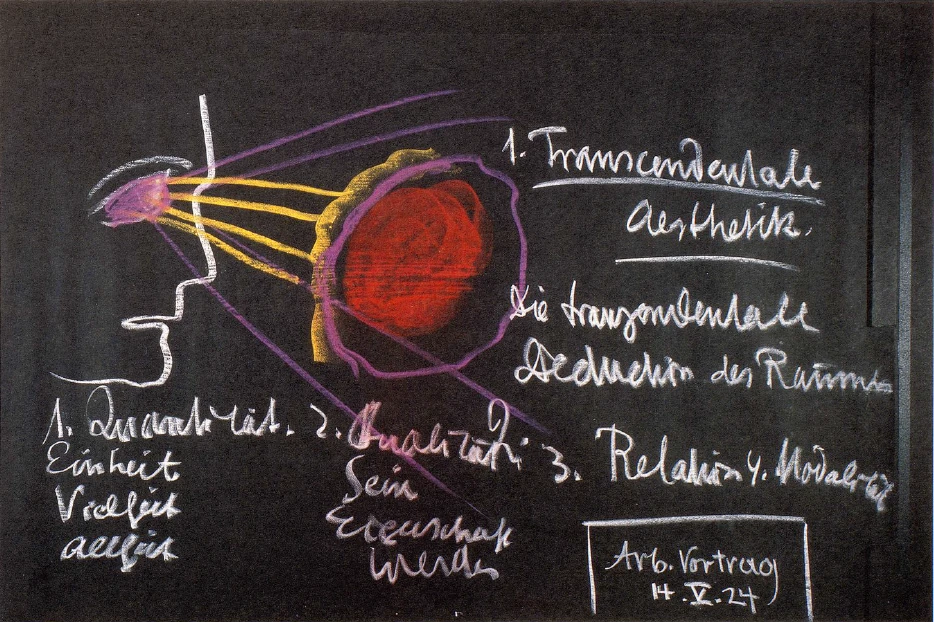
[ 7 ] You see, Kant speaks of the limits of knowledge in such a way that one can never know what the thing-in-itself is, because everything is, in fact, merely a world created by humans. It is very difficult to explain this matter in a way that is truly understandable. And when one is asked about this Kant, the fact is that if one is to truly describe him—to truly characterize him—one actually has to say some quite strange things. For when one looks at the real Kant, it’s actually hard to believe that this is the case. But the fact is that Kant simply asserts, based on theory and on thought: No one knows anything about the thing-in-itself; rather, the entire world is made up solely of the impressions we receive from things.
[ 8 ] I once said: If one does not know what the thing-in-itself is, then it could be anything at all; it could, for example, consist of pinheads! — The same is true of Kant. One could quite reasonably say: According to him, the thing-in-itself could consist of all sorts of things. But here comes the next point: If you stick with this theory, then all of you here, as I see you here, are merely my appearance; I have seated all of you on these chairs, and I do not know what lies behind each of you as a thing-in-itself. And conversely, when I stand there, you also do not know what kind of thing-in-itself that is, but you see the appearance that you yourselves have placed there. And what I am saying is precisely what you yourselves are hearing! So, what I am actually doing there—the thing-in-itself, what it is actually doing there—none of you know; but this thing-in-itself makes an impression on you. You then project this impression back here; you are, in essence, hearing what you yourselves are producing!
[ 9 ] Well, taking this example in particular, one could—speaking in the Kantian sense—say something like this: You’re sitting out there having breakfast and say, “Yes, now let’s go into the hall and listen to this and that for an hour.” We cannot know what this “thing-in-itself” is that we are going to hear; but we will look over at Steiner so that—at least for an hour—we have this experience, and afterward we will listen to what we want to hear. —That is essentially what Kant says at first, because he asserts: One never knows anything about the thing-in-itself!
[ 10 ] You see, one of Kant’s successors, Schopenhauer, saw the matter so clearly that he said: “There’s really no room for doubt here!” “It is absolutely certain,” he says, “that when I see blue, there isn’t something out there that is blue; rather, the blue comes from me when a thing-in-itself makes an impression on me. When I hear someone out there moaning and in pain, the pain and the moaning do not come from him, but from me! That,” says Schopenhauer, “is actually quite clear.” And when a person closes their eyes and sleeps, the whole world is dark and silent; then there is nothing at all there for them.
[ 11 ] Well, gentlemen, according to this theory, you can create and destroy the world in the simplest way possible. You fall asleep, and the world is gone; then you wake up again, and you have created the whole world anew—at least the part you see. Apart from that, there is only the thing-in-itself, about which you know nothing. Yes, Schopenhauer saw that quite clearly. But Schopenhauer did get a little dizzy in the process. He wasn’t entirely comfortable with that assertion. So he said: At least something is out there—blue and red, and not all cold and warmth is out there; when I’m cold, I create the cold myself—but what is out there is the will. Will lives in everything. And the will is a completely free, demonic force. But it lives in all things.
[ 12 ] So he did, in a way, put something into “the thing-in-itself.” He regarded every mental image we create as merely an appearance; but he did, at least, endow the thing-in-itself with will. There were many people—and there still are many people today—who don’t really grasp the consequences of Kant’s doctrine. I once met a man who was truly—as one ought to be when one has a doctrine—completely imbued with this Kantian doctrine, and he said to himself: “I’ve created everything myself: the mountains, the clouds, the stars—everything, everything—and I’ve created humanity myself as well, and everything that exists in the world, I’ve created myself. But now I don’t like what I’ve created. I’ve created everything; but now I don’t like it. So now I want to undo it.” —And then he said he’d started by killing a few people—he was, after all, insane; he said he’d started killing a few people to carry out his intention of getting rid of them, the ones he’d made himself. I told him he should just think about what the difference is here: He has a pair of boots; according to Kant’s doctrine, he made those too. But he should just think about what, besides what he is now doing as a manifestation in the boots, the shoemaker has also made!
[ 13 ] Yes, you see, that’s exactly how it is: What is often presented as the most famous thing in the world is, in fact, the most absurd! And people cling to the most absurd things with the most incredible stubbornness. And, curiously enough, it is precisely the enlightened ones who cling to them.
[ 14 ] What I have just told you in a few words—which is already quite difficult to understand—is something you have to read about in many books when you read Kant; for he has broken this down into long, long theories; and he begins, for example, his book *Critique of Pure Reason* —that’s what he calls it—by first proving: Space is not out there in the world; I create it myself; I spin it out of myself. So, first: Space is a phenomenon. Second: Time is also a phenomenon. For it is said: There once was an Aristotle—yes, but I place him in time myself, because I create all of time myself!
[ 15 ] Now he has written this great book, the *Critique of Pure Reason*; it certainly makes a rather nice impression. Now, if someone—a real philistine—comes along and gets his hands on a thick book, *Critique of Pure Reason*: He’s already licking his fingers in anticipation, because that’s something terribly clever, *Critique of Pure Reason*; you just become a sort of God on earth yourself when you read something like that! But then, after the introduction, it says: Part One. Transcendental Aesthetics. — Well, doesn’t it say right there: Transcendental Aesthetics. — If someone opens my *Philosophy of Freedom*, the chapter heading might simply read: Man and the World. — Oh, Man and the World—that’s such an ordinary topic; you wouldn’t even bother reading it. But: Transcendental Aesthetics!—When the philistine opens a book like that, it must be something truly monumental! He usually has no idea what Transcendental Aesthetics is; but that’s just fine with him; it’s a word that makes him curl his tongue a little when he says it. That’s the main title.
[ 16 ] Now comes the subtitle: Section One. The Transcendental Deduction of Space. - Well, one can’t imagine anything better for a philistine than having a chapter like this. And then it begins in such a way that he doesn’t really understand any of it. But for more than a hundred years, everyone has been saying: Kant is a great man. — So when he reads this, he picks up a little bit of it himself and falls into a bit of a delusion of grandeur.
[ 17 ] Then comes the second section: The Transcendental Deduction of Time. — Once one has worked one’s way through the Transcendental Deduction of Space and Time, the second major section follows: the Transcendental Analytic. - And in the Transcendental Analytics, the main focus is on proving that human beings possess transcendental apperception.
[ 18 ] Well, gentlemen, I was asked, and I really must tell you these things—the story of transcendental apperception. You have to read through many hundreds of pages to really take in all the erudition that’s crammed into the chapter on transcendental apperception. What is meant by transcendental apperception is that human beings form their mental images, and there is a unity in this act of representing. So if everything is merely a mental image—the whole world—then, through this transcendental apperception, the whole world must actually be spun out of the nothingness of one’s own being. Yes, that’s more or less how it’s presented there.
[ 19 ] So here we come to the point: In the chapter on transcendental apperception, Kant spins the entire world—with all its trees, clouds, stars, and so on—out of himself. Yes, he spins it out—that’s what he says. But what he actually spins out—and what one is constantly grappling with throughout this entire lengthy chapter—are in fact the very same mental images, merely transposed to a later stage, that I recently wrote down for you on the Tree of Sephiroth, but only in the form of a mere alphabet, not in a way that allows one to read it and actually know anything! And besides: At least there it was something very concrete. But Kant spins it out in such a way that he says: The world consists, first, of quantity; second, of quality; third, of relation; fourth, of modality. Now, each of these concepts in turn has three sub-concepts; for example, quantity: unity, multiplicity, totality. Well, quality has: reality, negation, limitation, and so on. That makes twelve concepts—three times four is twelve—and one can spin the world out of them. Good old Kant didn’t actually spin the world out of them at all; rather, he really only spun out twelve concepts through transcendental apperception. So he actually only created twelve concepts, not the world.
[ 20 ] If there were any truth to this story at all, something would surely come of it! But the philistines don’t even notice that nothing comes of it—that only twelve concepts emerge—instead, they now go through the world with full bellies and Kantian philosophy, saying: Nothing can be understood!—Well, that’s understandable with the philistines; they feel flattered when they’re told: If they don’t understand anything, it’s not their fault, but the fault of the whole world. If you believe that you know nothing, then you are already right; but that is not because you are incapable of knowing anything, but because the whole world is incapable of knowing anything. — And so these twelve concepts emerge. That, then, is transcendental analytics.
[ 21 ] But now come the really difficult chapters. Then comes the long chapter titled: “On Transcendental Paralogisms.” - That’s how it goes throughout the entire work. In Kant’s *Critique of Pure Reason*, you get one title after another! It says: There are people who claim that space is infinite. This is then proven in the way that people prove it—those who, after all, see that space is infinite. But there are also people who say that space is finite. - This, too, is proven in the same way that people prove it. So that in the *Critique of Pure Reason*—in the later chapters, it consistently presents two opposing pages side by side—on one page it is proven that space is infinite; on the other, it is proven that space is finite. Then it is again proven that time is infinite, that it is eternity. Then it is proven that time had a beginning and will come to an end. And that is how Kant does it, gentlemen. Then it is proven that man is free. And again, on the other side: man is not free.
[ 22 ] What is Kant trying to say by providing proofs for the two opposing claims? He is trying to say: We cannot prove anything at all! We might just as well assert: Space is infinite as well as finite; time is eternal, time will come to an end! — We might just as well say: Human beings are free, or: They are not free. — So it boils down to this: In modern times, one must say: Think as you will; you will not arrive at the truth, but for you humans, everything is the same.
[ 23 ] Then, in transcendental methodology, one is taught how to think in this way. In this way, one can begin by working through a book by Kant. So one might ask: Why did Kant actually undertake all of this? That leads one to discover what Kant actually intended. You see, up until Kant, although the people who practiced philosophy didn’t exactly know much either, they at least claimed: There are some things one can know about the world. Opposed to this—a view that originated in the Middle Ages, because, as I have shown you, ancient knowledge was lost during that period—was the idea, already formulated in the Middle Ages, that one can know only what the senses present, and can know nothing that pertains to the spirit. This must be believed. And so, through the Middle Ages and up to Kant, the assertion arose: One can know nothing about the spiritual; one can only believe in the spiritual.
[ 24 ] The churches, of course, benefit greatly from this doctrine—that one cannot know anything about the spiritual realm and must simply believe—because it allows them to dictate what people should believe about the spiritual realm!
[ 25 ] Now, as I said, there were philosophers—Leibniz, Wolff, and so on—who, up until Kant, claimed that one can at least know something—know through reason alone—about what is spiritual in the world. Kant, however, said: It is all nonsense to believe that one can know anything about the spiritual; rather, one must simply believe everything about the spiritual! For the spiritual lies in the “thing-in-itself.” One can know nothing of the “thing-in-itself.” Therefore, everything that relates to the spiritual must be believed. —And Kant also gave himself away when he wrote the second edition of his *Critique of Pure Reason*. There is a curious sentence in this second edition; it reads: “I had to set aside knowledge in order to make room for belief.” That is the confession, gentlemen! That is precisely what led to the unknown thing-in-itself! That is why Kant called his book *Critique of Pure Reason*: Reason itself was to be criticized for being incapable of knowing anything. And in this sentence—“I had to set aside knowledge to make room for faith”—therein lies, in fact, the truth of Kant’s philosophy. But this opens the floodgates to every kind of faith. And in fact, every positive religion could invoke Kant! But even those people who want to know nothing at all can invoke Kant—those who say: Why is it that we know nothing? Because one cannot know anything!—You see, in this way Kant’s doctrine has actually become a pillar of faith. Therefore, it was only natural that I myself had to reject Kant’s doctrine entirely from the very beginning; although I had already read all of Kant as a schoolboy, I must always reject Kant’s doctrine entirely, for the simple reason that one would then simply have had to remain stuck with what people believe about the spiritual world and could never have arrived at any real spiritual knowledge. Kant is thus actually the one who most completely excludes all Spiritual Science and wants only a certain kind of faith.
[ 26 ] Kant thus first wrote this first book: *Critique of Pure Reason*. In this *Critique of Pure Reason*, it is therefore demonstrated that we know nothing about the thing-in-itself. We can only have faith in what the “thing-in-itself” is.
[ 27 ] Then he wrote a second book: *Critique of Practical Reason*. He also wrote a third book: *Critique of Judgment*, but that one isn’t as important. So *Critique of Practical Reason* was the second book he wrote. There he set forth his own beliefs. So, first, he wrote a book on knowledge: *Critique of Pure Reason*; in it, he proved that one cannot know anything. Now the philistine can put the book down; it has been proven to him that one cannot know anything. Then Kant wrote the *Critique of Practical Reason*; there he builds his beliefs. How does he build his faith? He says: When a person looks at himself in the world, he is an imperfect being; but to be so imperfect is not actually human; therefore, there must be a greater perfection of humanity somewhere. We know nothing about it, to be sure; but if we believe that somewhere within the earth there is a greater perfection of humanity, we believe in immortality.
[ 28 ] Yes, you see, gentlemen, this differs quite significantly from the scientific considerations I am presenting to you regarding what survives in a person after death! Kant, however, does not seek such knowledge at all; rather, he simply seeks to prove—based on human imperfection—that people should believe in immortality.
[ 29 ] Then he demonstrates in exactly the same way that one should simply believe that one cannot know anything about freedom, but rather believe that human beings are free; for if they were not free, they would not be responsible for their actions. Thus, in order for them to be responsible, one believes that they are free.
[ 30 ] Kant’s doctrine of freedom has actually often reminded me of another doctrine that a professor of jurisprudence always introduced at the beginning of his lectures. He said: Gentlemen, there are people who say: Human beings are not free. But, gentlemen, if human beings were not free, then they would not be responsible for their actions. Then, however, there could be no punishments. But if there are no punishments, then there can be no criminology. Yet I myself teach criminology—so I, too, could not exist. But I do exist, so there is also criminology; consequently, there is also punishment; consequently, there is also freedom—so I have proven to you that freedom exists! - What Kant says about freedom reminds me very much of this speech by the professor. And Kant speaks of God in the same way. He says: We can know nothing about any power in and of itself. But I certainly cannot create an elephant; therefore, I believe that someone else can create it—someone who is capable of more than I am. Therefore, I believe in a God.
[ 31 ] So Kant wrote this second book, the *Critique of Practical Reason*. In it, he said that we, as human beings, should believe in God, freedom, and immortality. We cannot know anything about these things, but we should believe in them. Just think for a moment what an inhuman idea actually lies within this: First, it is proven that knowledge is actually nothing; second, that one should believe in God—about whom one can know nothing—as well as in freedom and immortality! So, in essence, Kant is the greatest reactionary. People speak in fine words; that is why they have called him the “crusher of all things.” Yes, he has crushed all knowledge, but only in the same way that one destroys toys. For the world has remained, after all! And in doing so, he has actually bolstered faith to a considerable degree.
[ 32 ] This trend continued throughout the 19th century, carrying over into our own century, and today, of course, people everywhere are writing about Kant’s 200th birthday! And in reality, Kant is precisely an example of just how little people actually think. For what I have just told you is simply a pure exposition of Kant’s doctrine! But what people say—that Kant was the greatest philosopher, that Kant cannot be refuted at all, and so on—well, isn’t it true that if you take this example, you actually get a clear sense of how Kant, in particular, is the one on whom the opponents of the Spiritual Science can always rely? Simply because they can then say themselves: “Yes, we do not start from religion, but from the most enlightened philosopher!”—But the truth is that one could just as easily start from Kant as the most dogmatic religious teacher as from any enlightened person.
[ 33 ] Kant also wrote other works, such as one titled: “How Is Metaphysics Possible as a Science in the Future?”, in which he actually proves once again that it is impossible, and so on. One really has to say: The entire scientific community in the 19th century was, in fact, afflicted by Kant; Kant was, in essence, a disease of science.
[ 34 ] Well, if you take Kant as an example of just how nonsensical intellectual development can sometimes be, then you’ve chosen him correctly. But then you’ll also say to yourself: One really must be careful with knowledge; for the world is terribly eager to engage in the greatest nonsense, especially when it comes to knowledge. And you can well imagine what a difficult position one is in as a representative of Spiritual Science: one has not only the representatives of the religions against one, but also the other people—all the philosophers and those who, in turn, have been influenced by the philosophers—against one, and so on. Every philistine comes along and says: “Well, you claim this about the spiritual world; but Kant has already proven—so they say—that nothing can be known about it!” That is actually the best blanket objection one can make. Someone might say: “I don’t want to hear a single word of what Steiner says, because Kant has already proven that nothing can be known about any of it.”
[ 35 ] Are you satisfied?
[ 36 ] Mr. Burle says he mainly wanted to hear what Kant meant. It is, as the doctor says: You hear so much about Kant, but nothing positive. It is, however, quite difficult to understand.
[ 37 ] Dr. Steiner: This had consequences. In 1869, a book inspired by Kant was published: *The Philosophy of the Unconscious*, another work that caused a huge sensation. And Eduard von Hartmann was indeed a very intelligent man! Had Eduard von Hartmann lived before Kant, and had Kant not exerted such a strong influence on him, he would probably have achieved much more. But he was unable to truly move beyond the strong prejudice that people have against Kant. Just as it had been clear to Schopenhauer before him, it was also clear to Eduard von Hartmann that one knows nothing of the whole world except one’s own mental images—that which one projects out into the world. But in addition, he had adopted Schopenhauer’s doctrine that the thing-in-itself must be endowed with the will. Now, the will is present everywhere. I once wrote an article about Eduard von Hartmann, and in it I also mentioned Schopenhauer. Now, Schopenhauer said: One knows nothing of the thing-in-itself; one has only mental images of it. Only the mental images are intelligent; the will is stupid. So that, in fact, everything one knows about oneself is nothing other than the stupid will.
[ 38 ] Back then, in the article where I mentioned Schopenhauer, I said: According to Schopenhauer, everything sensible in the world is actually the work of humans; for it is humans who bring everything into the world; and what lies behind that is the foolish will. So the foolishness of the deity is the world. - But they confiscated that back then! It was supposed to be published in Austria.
[ 39 ] The situation is this: Eduard von Hartmann assumed that the thing-in-itself must be endowed with will; but the will is actually stupid, and that is why the world is so bad. And that is why Eduard von Hartmann, as they say, became a pessimist. That is why he held the view that the world is worthless, not good, but fundamentally bad—very bad indeed. And not just what people do, but everything that exists in the world is bad. He said: You can calculate that the world is bad. One need only put on one side—the debit side—all the happiness and pleasure and so on that one has in life, and on the other side all the suffering and so on: there is always more on the other side. The balance is always negative. So the whole world is bad. —That is why Hartmann became a pessimist.
[ 40 ] But you see, Eduard von Hartmann was, first of all, essentially a clever man, and second, someone who actually drew the necessary conclusions. He said: Why do people actually still live? Why don’t they prefer to kill themselves? If everything is so bad, it would be much wiser to set a date one day for the general suicide of humanity; then everything that has been created would be gone. But Eduard von Hartmann said again: No, you can’t pull that off—setting such a general day of global suicide. And even if we did set it—humans evolved from animals; animals wouldn’t kill themselves; then humans would emerge from the animals all over again! So we can’t pull it off that way. —That’s why he came up with something else. He told himself: If one really wants to wipe out everything that constitutes the earthly world, then one can’t do it through human suicide, but must thoroughly wipe out the entire Earth. We don’t yet have the necessary machines for that; but humans have already invented many machines; therefore, all wisdom must be devoted to inventing a machine capable of drilling into the Earth so that we can reach deep enough, and which will then, using a special dynamite or similar device, blow up the entire Earth, so that the debris flies out into the world and turns to dust. Then the true ultimate goal will be achieved.
[ 41 ] Yes, this is no joke, gentlemen! This is truly Eduard von Hartmann’s doctrine: that one should invent a machine capable of, so to speak, blowing up the entire Earth, pulverizing and shattering it.
[ 42 ] Interjection: In America, they want to build cannons so they can shoot the moon down!
[ 43 ] Dr. Steiner: But what I told you was actually a philosophical doctrine in the 19th century!
[ 44 ] Now you will say: There was such an intelligent person—how could that be? The one who claimed that must have been stupid!—No, truly, Eduard von Hartmann was not stupid; rather, he was more intelligent than everyone else. I can prove that to you right away. But it is precisely because he was smarter than the doctrine inspired by Kant that this foolishness arose—the idea of a machine designed to hurl the world into nothingness. This was asserted by a very intelligent man who had simply been thoroughly corrupted by Kant.
[ 45 ] So he has now written this “Philosophy of the Unconscious.” In this “Philosophy of the Unconscious,” he said: Yes, it is indeed true that humans evolved from animals; but spiritual forces played a role in that. Now, these forces are forces of the will—that is, not intelligent forces, but stupid ones. And he presented this very intelligently, thereby presenting something that contradicted Darwinism.
[ 46 ] So back then—just imagine, this was in the 1860s! —there was this clever “Philosophy of the Unconscious” by Hartmann and Darwinism, as advocated by Haeckel, Oscar Schmidt, and others, which, however, was considered the very height of wisdom by other people; yet the “Philosophy of the Unconscious” contradicted it. Now all those who were, in turn, die-hard Darwinists spoke up and said: “This Eduard von Hartmann—he must be thoroughly refuted; he doesn’t know anything about the natural sciences!”—But what did Hartmann do? What he did at the time is evident from the following. After the others had shouted themselves hoarse—that is, on the printed page—a book also appeared: “The Unconscious from the standpoint of Darwinism.” A thorough refutation of Eduard von Hartmann from the standpoint of Darwinism!—But no one knew who had written it.
[ 47 ] Well, gentlemen, now the natural scientists were all delighted, for there was written within it that which thoroughly refuted Eduard von Hartmann. Even Haeckel said: “Let the person who wrote this against Hartmann reveal himself to us, and we’ll consider him one of our own, a natural scientist of the highest order!”—And sure enough, the book sold very, very quickly afterward, and a second edition was published: then the author revealed himself—it was Eduard von Hartmann himself! He had written it against himself. But then they stopped praising him; the matter didn’t become widely known! So by doing this, he proved that he was smarter than all the others! But you see, the news reports given to the public remain silent about these stories. But such a little episode in the history of ideas must be told; then one realizes: Eduard von Hartmann was a man who was corrupted by Kant, but who was fundamentally intelligent.
[ 48 ] Well, if I told you that he wants to blow up the world with a huge machine that is yet to be invented—you might quite rightly say that Eduard von Hartmann may indeed have been terribly clever, but to us, who have not yet studied Kant, it still seems like a rather foolish idea. And you might well believe that, no matter how clever I portray Eduard von Hartmann to you, he was still foolish. You could easily believe that. But then you’d have to tell the rest of the story too and realize that the others were even more foolish; and then I’d be satisfied as far as I’m concerned! But one can prove this entirely historically: that the others were even more foolish than someone who argues that the Earth must be blown up.
[ 49 ] It is indeed important to know such a thing; for even today there still exists this peculiar worship of everything that is printed. And ever since Kant appeared in the “Universal Library”—I was only able to read him that way, since I couldn’t have afforded to buy him back then; but there he was cheap, even though the books are so thick—ever since then, there’s been even more of a frenzy over Kant than before, because everyone’s been reading Kant ever since. That is to say, they read the first page, but they don’t understand a thing. Then they hear that Kant is “the emperor of literary Germany”; so they think: Good heavens, now we know something about Kant, so that means we’re smart people ourselves! And most of them are the kind who admit: Yes, I have to say that I understand Kant, because otherwise the others will say I’m stupid if I don’t understand Kant. - In reality, people don’t understand a thing about him, but they won’t admit it; they say: “I have to understand Kant, because he’s very smart.” So I claim: “I understand something very smart if I understand Kant!” Then that impresses people, too.
[ 50 ] But really, gentlemen, even though it was difficult to present this question in a somewhat accessible way, I’m still glad that this particular question was raised, because it revealed what actually goes on in people’s so-called intellectual life, and how cautious one really has to be when something like this affects them—something that has even led to all the newspapers making a big fuss about the bicentennial of Kant’s birth. I’m not saying that Kant shouldn’t be celebrated—after all, others are celebrated as well—but the truth is just as I have told you.
[ 51 ] Now let’s continue our discussion next Saturday at nine o’clock.