

Human History and the
World Views of Civilized Nations
GA 353
17 May 1924, Dornach
Translated by Steiner Online Library
14. On Comets, the Solar System, the Zodiac, and the Rest of the Fixed Stars
[ 1 ] Mr. Erbsmehl: What is the significance of the comets that appear from time to time? And how does the zodiac differ from the other stars?
[ 2 ] Dr. Steiner: This is a question that will help us gain a little insight into the nature of astronomy. You attend astronomy lectures, after all, so it might be quite helpful if we discuss this very question from a certain perspective.
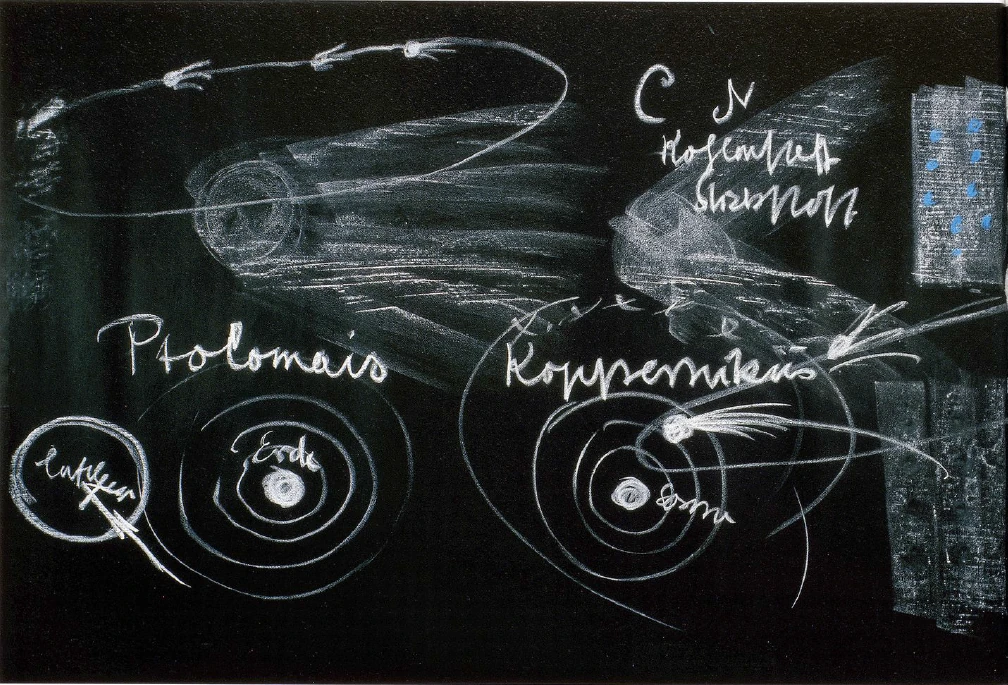
[ 3 ] When we look up at the starry sky, the Moon is the largest star and also the one closest to us. The Moon therefore has the influence on people on Earth that is easiest to perceive. And you have certainly heard before how the Moon stimulates people’s imagination. That is something everyone knows. But I have told you about other influences the Moon has, such as its effect on the reproduction of living beings and so on. Then we see other celestial bodies that behave in a similar way to the Moon. The Moon moves—you can see it moving—and the other stars that are similar to it also move. We call these stars that also move “wandering stars” or “planets.”
[ 4 ] Now, it also seems as though the Sun moves. In reality, it does move; but relative to our Earth, it does not move. It always remains at roughly the same distance and does not describe a circle around the Earth. The Sun is therefore referred to as a fixed star. And so are the other stars, except for those that clearly change their position.
[ 5 ] When you look up at the starry sky, you see roughly the same view that the starry sky reveals every night—especially on nights when there is moonlight. But there are changes in the starry sky. Especially during certain weeks in the summer, you can see one star after another—apparently—moving quickly and then disappearing: shooting stars. Such shooting stars can be seen in the sky at other times as well, but they are most frequently seen during certain weeks in the summer, when swarms of these little stars light up, streak rapidly across the sky, and then vanish.
[ 6 ] In addition to these, however, there are the stars that Mr. Erbsmehl just mentioned in his question: the comets. These comets appear only rarely; they also differ from the other stars in terms of their shape. They have a shape that looks something like this, for example: they have a sort of nucleus, and then they have a tail that trails behind them. Sometimes they even look as if they have two such tails trailing behind them. When one observes the other stars that move, their motion is relatively regular, and one always knows that at a certain time these other stars will appear, while at another time they are below the horizon and do not appear; whereas with these stars—the comets—one observes that they come and then go away again without one really knowing where they are actually going. So, compared to the other stars, they exhibit, so to speak, irregular movements.
[ 7 ] Well, people have always viewed these comets differently from other stars, and they played a particularly significant role among superstitious people. These superstitious people believed that when such a comet appeared, it signaled misfortune.
[ 8 ] This is hardly surprising, since anything that doesn't happen regularly causes people to be surprised and astonished. It doesn’t need to be taken all that seriously, because people also think that even with perfectly ordinary objects—which usually behave differently—there’s something significant about it when they behave in an unusual way. For example, if you drop a knife, it usually doesn’t get stuck in the ground but lands smoothly on the ground. That doesn’t mean anything, because you’re used to it. But if the knife happens to get stuck in the ground, superstitious people believe that it means something. When the moon appears—people are used to that; it doesn’t mean anything special to them. But when a star like that appears—especially one with a distinctive shape—then, yes, then that really does mean something special! So there’s no need to get worked up right away when superstitious people attribute significance to such things.
[ 9 ] Above all, we must now examine the matter scientifically. And in this regard, the following is certainly true. In times not too long ago, people relied more on what they saw in the sky and described the Earth as standing at the center of the world—I just want to explain their mental image of it—and that the Moon, Mercury, Venus, the Sun, and so on moved around the Earth, and that the entire starry sky, as one can indeed see—every star rises and sets again—moves. So you see the starry sky moving. If you stayed outside long enough, you would see how the so-called fixed stars appear to move across the sky. In ancient times, people accepted this because that’s what they saw, and they described it exactly as they saw it.
[ 10 ] Now, as you know, Copernicus came along in the 15th and 16th centuries and said: Not so! The Earth is not at the center; rather, the Sun is at the center, and Mercury, Venus, the Earth, and so on move around the Sun. - This made the Earth itself a planet. A completely different cosmological system, a completely different view of space, emerged. And just as the Sun does, the other fixed stars were now also thought to be stationary. Their motion is therefore only apparent.
[ 11 ] You see, gentlemen, the matter is this: I have already touched on this subject in connection with another question posed by Mr. Burle regarding the theory of relativity—whether there is any truth to these theories and to some others that have been put forward. For example, there was also a theory put forward by a certain Tycho Brahe, who said: Yes, the Sun stands still, but the Earth also stands still, and so on. — So there have been other cosmological systems as well; but we’ll consider these two: the old one, which goes back mainly to Ptolemy—the Ptolemaic system—and then the Copernican system, which goes back to Copernicus. So these are two cosmological systems. There is some truth to each. Specifically, if one examines the facts very closely, one cannot distinguish whether one or the other is correct.
[ 12 ] The matter is this, gentlemen: I told you back then that there are people who claim that when, for example, I drive up from Villa Hansi to the Goetheanum in a car, it is impossible to tell whether the car is moving or the Goetheanum is coming toward me! Well, of course, this cannot be distinguished by outward appearance alone, but only by the fact that the car wears out, that the car needs gasoline and the Goetheanum does not. One can distinguish it by its inner nature. Similarly, when you enter Basel, you can tell whether Basel is coming out to meet you or whether you are going in, because you get tired. So it can only be determined by its inner nature.
[ 13 ] This should simply show you that, in fact, every worldview is such that it can be right from one perspective and wrong from another. It is impossible to make an absolute judgment. That is simply the way it is! You really cannot determine which cosmological system is entirely correct and which is entirely wrong. You might say: “Yes, but these things are calculated, aren’t they?”—Well, you see, they are calculated, but the calculations you make are never entirely accurate! For example, when you calculate how fast a star is moving, you know that after a certain amount of time, it must be at a specific location in the sky. So you calculate where a star should be at a certain time, point the telescope in that direction; now it should be visible in the telescope. Often it isn’t, so you have to correct the formula again; and so it turns out that, in fact, no calculation is entirely accurate. The reality of the universe is that no calculation is entirely accurate! Why is that? Imagine you know a person quite well. Then you’ll tell yourself that if that person promises you something, you can count on it without a doubt. Suppose you know someone quite well; they’ve promised you that on May 20 at five o’clock in the afternoon, they’ll be at such-and-such a place. You can be there, too. You’ll be absolutely certain that they’ll be there, because you know them. But it can still happen that they don’t show up! And it’s the same with the universe. If you look at small things, you can say: You can count on things happening just as you know they will. So if I heat a stove, according to the laws of nature, it will spread warmth throughout the room. It’s not very likely that a fire would ever fail to produce heat in the room! But that stops, gentlemen, when we consider the vast scales of the universe. There, the situation becomes just as certain as it is for an individual human being—but also just as uncertain as it is for an individual human being. So that everything one calculates there always has a flaw somewhere. And where does this flaw come from? The flaw does not stem solely from the fact that these solar systems are not entirely self-contained. Suppose that, on the way here to see you, the person in question was particularly taken with something. He was delayed. If these planetary systems were such that nothing could occur within them other than what the sun, moon, and stars do, then one would be able to calculate them; one would know exactly where a star is at a given time, down to a thousandth of a second, because calculations can be made very precisely. But the calculations, as I have said, have a flaw. This stems solely from the fact that these systems are not allowed to exist entirely undisturbed in the cosmos; instead, comets intrude upon them and pass right through. And because these comets intrude from the cosmos, the cosmos provides this planetary system with something similar to what we get when we eat: the comet is a kind of nourishment for the planetary systems! And the fact is this: Whenever such a comet intrudes, the motion always changes slightly; and so one never arrives at a completely regular motion. The fact is therefore this, gentlemen: The irregularity in the motion or in the state of rest of the entire planetary system stems from the comets.
[ 14 ] Now, the comets themselves. You see, people claim: Yes, a comet like that comes from so far away that you can’t see it at first; when it gets close to the solar system, that’s when you start to see it (a drawing is made). So there you can see it. Now it moves on; you can still see it, then just a little bit more, and then it disappears. Well, what do people say about that? People say: “Well, that’s above the Earth—you can see it—but then the comet moves across like that, becomes invisible, and comes back again after a number of years.” That’s what people say.
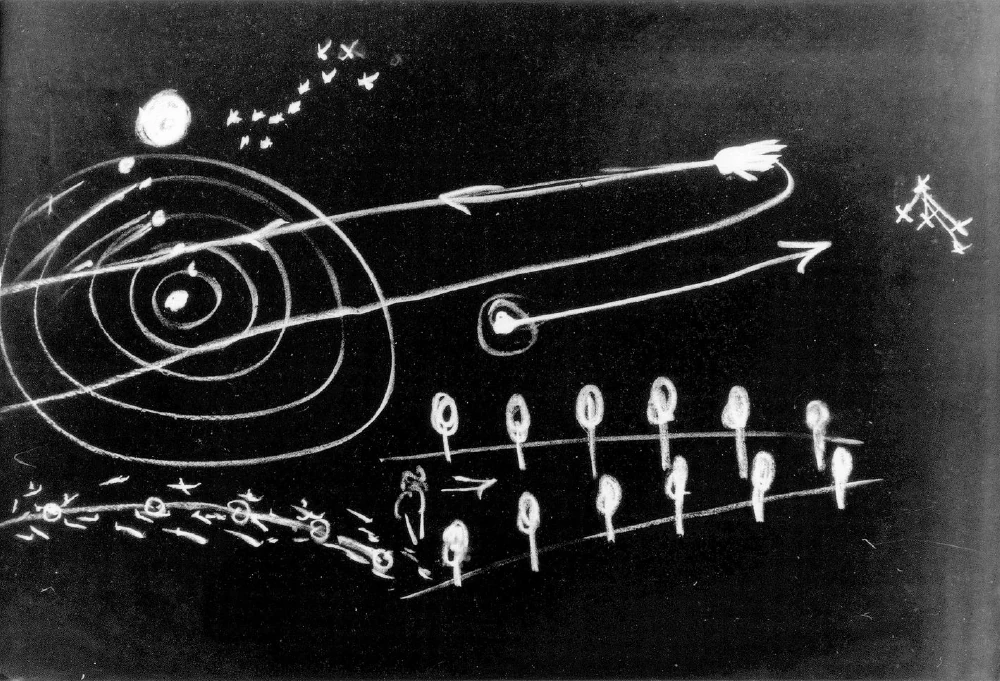
[ 15 ] If I were to draw the solar system for you, here we have the Sun; here are the planets. Now people have a mental image of the comet coming from far away, from outside the solar system, entering the Sun’s vicinity; and then you can’t see it anymore when it’s down there—and then it comes back again. So they have a mental image of the planets moving in a short ellipse, but the comet in a very long one. And when it enters the system and is directly overhead—so that you can look up at it—it remains visible; otherwise, it’s invisible, and then it comes back again. Halley’s Comet, named after its discoverer, appears every seventy-six years.
[ 16 ] Well, gentlemen, there is something here that Spiritual Science cannot follow based on its observations: namely, it is not true at all that the comet moves in that way! What is actually true is this: the comet first comes into being here, and there—if I may put it that way—it brings together the substance of the world; there the substance of the world gathers; there it comes into being (pointing to the drawing), continues on like this, and here it disappears again, dissolving. This line (ellipse) here does not actually exist at all. So we are dealing with a formation that comes into being at a certain distance and disappears again at a certain distance. Yes, what is actually happening there?
[ 17 ] Well, that makes one say: It’s not true that the Sun stands still! Relative to the Earth, it stands still, but relative to space, it moves at an enormous speed. The entire planetary system is racing through outer space, moving forward. The Sun is moving toward the constellation Hercules. You might ask, how do we know that the Sun is moving toward the constellation Hercules? You know, when you walk down an avenue and stand there, the trees up ahead seem farther apart, and then they seem to get closer and closer. Isn’t it true that when you look down a tree-lined avenue, the trees seem to get closer and closer; but if you keep walking in that direction, it’s as if those trees were moving apart? The space you see between two trees gets bigger and bigger. Now imagine: if the constellation Hercules is here, the stars in the constellation Hercules are at certain distances from one another. If our solar system were standing still, these distances would have to remain constant. But if the Sun and the other planets are moving toward it, the stars in Hercules must appear to be getting farther and farther apart; they must seem to be moving away from one another. And that is exactly what they do! For centuries, it has been observed that the distances within the constellation of Hercules are getting larger and larger. This shows that the Sun is indeed moving toward the constellation of Hercules. And just as we can calculate here—when using a sighting instrument to measure how close we pass by and how fast we’re moving (if one moves faster, the distance increases more rapidly than with another)—we can also calculate how the Sun is moving. The calculations are always performed with great precision. Thus, the entire planetary system, along with the Sun, is racing toward the constellation of Hercules.
[ 18 ] But this racing through space affects the planetary system just as it does when you work. When you work, you lose some of your substance, which you must then replenish. And so it is that when the planetary system races through space, it continually loses some of its substance. That must be replenished. That is why comets roam about; they collect the substance, and it is recaptured when the comet passes through the planetary system. In this way, the comets replenish the planetary system’s substance that has become unusable or has been expelled. But at the same time, these comets enter the planetary system and cause irregularities within it, so that one cannot actually calculate the movements.
[ 19 ] This also shows you that if you go far enough, things come to life in outer space! Such a planetary system is actually a living being; it must eat. And the comets are eaten!
[ 20 ] So what are these comets mainly made of? The most important substance within these comets is exactly what is needed within the planetary system—specifically, from the sky: they contain carbon and nitrogen. Of course, they also contain hydrogen and so on. But these two elements are especially important: carbon and nitrogen. We need nitrogen in the air, and it must be constantly replenished; we need carbon because all plants need it. And this is how the Earth truly obtains its elements from outer space! They are constantly being replenished.
[ 21 ] But the story doesn’t end there. You know, when you eat, you’re eating things that are still big on your plate; but you break them down, you chew them up. First, you cut them up. And you have to do that, because if—if it were possible—you were to swallow a large goose whole, it wouldn’t agree with you! You have to break it down. Likewise, you can’t swallow an entire calf’s head; only snakes can do that—humans can’t. It has to be broken down. Well, the planetary system does the same thing with its food. A comet like that can sometimes—not every one, but some—be swallowed whole, just like a snake. But there are also comets that are broken down as they enter. Then the comet disintegrates—just as, for example, the meteor shower in August breaks up into countless tiny stars that come down as shooting stars. For these shooting stars are all tiny fragments of comets hurtling down. And so you see not only the way in which cosmic nourishment enters the solar system, but at the same time you see how this cosmic nourishment is consumed by the Earth. In this way, one can truly examine the significance for the Earth of these comets that appear so irregularly.
[ 22 ] Well, you see, the thing is this—setting aside all superstition—: The comet, in turn, exerts its extraterrestrial influence on everything that happens on Earth, and this influence can actually be observed. It is indeed remarkable: You know there are good and bad vintages; but the good vintages actually stem from the fact that the Earth has become hungry. Then it entrusts its fertility more to the sun, and the sun is what determines the quality of the wine. Now, if the Earth has a good vintage one year, you can be almost certain that a comet will appear soon afterward, because the Earth was hungry again and needs nourishment for the next cycle. Then come poor vintages. When a good vintage comes again, a comet follows. The state of the earth’s substances is indeed connected to the way comets appear and do not appear.
[ 23 ] The question was then raised as to how the zodiac differs from the other fixed stars.
[ 24 ] Isn't it true that when you just look out into the vastness of the universe, you see countless stars? These stars seem to be scattered irregularly. But you can always make out groups called constellations.
[ 25 ] Well, what you overlook there is that some stars are closer to the Moon and others are farther away. When you look at these stars, you see the Moon—don’t you?—moving across the starry sky. But there are certain constellations that are positioned in such a way that the Moon always passes through them; it does not pass through the others. So, for example, if you look at the constellation of Hercules: the Moon does not pass through it. But if you look at the constellation of Leo, after a certain time the Moon always passes through the constellation of Leo. And so there are twelve constellations that are distinguished by the fact that they are, so to speak, the path taken by the Moon—and also by the Sun. So they are actually the markers of the path that the Sun appears to take—and the Moon actually does take—across the sky. So one can say: The twelve constellations—Aries, Taurus, Gemini, Cancer, Leo, Virgo, Libra, Scorpio, Sagittarius, Capricorn, Aquarius, and Pisces—are the Moon’s path; it always passes through them—but not through the other constellations. So one can always say: At a certain time, when the moon is in the sky, it is either in front of a constellation or between two, but these are constellations that belong to the zodiac.
[ 26 ] Well, gentlemen, just consider for a moment that everything in the sky—the stars—does indeed have an influence on the Earth as a whole and on human beings in particular. Human beings are truly not merely dependent on what is on Earth; rather, they are interconnected with the stars in the sky.
[ 27 ] Imagine any star or constellation out there: It rises in the evening, as they say, and sets in the morning. It’s always there, always exerting its influence on people. But imagine another constellation—let’s say, for example, Gemini or Leo: the Moon passes right over them. The moment the Moon passes by, it covers Gemini or Leo; then I see only the Moon, but I don’t see Gemini. So at that moment, they can’t exert any influence on the Earth, because their influence is obscured. So throughout the sky we have stars that are never obscured—neither by the Sun nor by the Moon—but which always exert their influence on Earth; in contrast, we have stars that the Moon passes in front of, and the Sun, too, appears to pass in front of; these are obscured again and again from time to time, and their influence ceases. And so we can say: Leo is a constellation in the zodiac; it has a certain influence on human beings. But when the moon is in front of it, it has no such influence; then the human being is free from Leo’s influence, and Leo’s influence does not affect him.
[ 28 ] Now imagine you’re standing there, feeling terribly lazy and not wanting to walk, but someone pushes you from behind, and you have to walk; that person is driving you forward—that is their influence. But now suppose I hold back that influence; he can’t push you—so the influence isn’t exerted on you; in that case, if you’re supposed to walk, you have to walk on your own!
[ 29 ] You see, human beings need these influences. So what’s the story here, gentlemen? Let’s be clear about this: The constellation Leo has a certain influence on human beings. The constellation exerts this influence as long as it is not obscured by the Moon or the Sun. But now let’s move on. Let’s draw another comparison with life. Let’s say you want to know something. Suppose you have a governess or a tutor, who usually knows everything; as a young boy, you’re too lazy to think for yourself, so you ask the tutor; he tells you—he even does your homework for you. But once the tutor has left—that is, when you don’t have a tutor at the moment and you’re still expected to do your assignments—you have to find the strength within yourself. You have to remember.
[ 30 ] Well, Leo exerts a constant influence on human beings; the only time this influence is absent is when the Moon obscures it. But when the Moon obscures Leo’s influence, then the human being must develop it from within themselves. So a person who, while the constellation is obscured by the Moon, can strongly develop this influence of Leo from within themselves is, so to speak, a Leo person. Anyone who can particularly develop the influence of the constellation Cancer when it is obscured is a Cancer person. Depending on their disposition, one person may develop one or the other more strongly. But you can see from this that the zodiac constellations are particularly distinctive: with them, the influence is sometimes exerted and sometimes not. The Moon, which passes through the constellations every four weeks, also ensures that within a four-week period, there is always a point in time when this influence is not exerted by any zodiac constellation; and the same is true for the other constellations. And because in ancient times people took this celestial influence very seriously, the zodiac was naturally more important to them than the other constellations. For the others always exert an influence; that does not change. But with the zodiac, one can say: That changes, depending on whether a sign of the zodiac is obscured or not. And for that reason, the zodiac’s effect on Earth has always been studied with particular attention. And now you can also see why the zodiac is more important for observing the starry sky than the other stars. — But from all this you will gather that mere calculation, as I told you a short while ago, cannot actually constitute the entirety of astronomical knowledge; rather, one must certainly delve into matters such as those I have explained to you here.
[ 31 ] The fact is that these days, when you talk about such things, you’re still regarded as a dreamer, as a half-fool, because people say: “Well, if you want to know something about the stars, you should go to the astronomers at the observatory; they know everything!” They know, there’s a sort of saying: Since a person’s gout is also influenced by all sorts of external factors, some people say that if someone has this ailment or gout, they should go to the observatory and have the matter regulated there. Well, people today look at you as if you were half-crazy when you try to say something about these things from a spiritual perspective. But the following things actually happen. Based on this knowledge derived from Spiritual Science, I was able to say in 1906 during a series of lectures in Paris: If all this is true about comets, if they really exist to fulfill these tasks, then there must be a compound of carbon and nitrogen in them. - That had not been known until then. And carbon and nitrogen together, in fact, form cyanide—hydrocyanic acid. Carbon and nitrogen, I said, must therefore also be found in comets. I said that in Paris in 1906. No one who did not recognize the significance of Spiritual Science needed to believe it at the time. But then, shortly thereafter, I was on a lecture tour in Sweden—and a very surprising piece of news appeared in all the newspapers: that cyan had also been discovered using a spectroscope in the comet that had appeared at that time.
[ 32 ] You see, people always say: “Well, if the anthroposophists know something, they should say something that can be confirmed later.” — Yes, countless such things have happened! Really, in 1906 I predicted that there is cyan in comets! The discovery was actually made right after that. And from this you can see that these things are indeed true, because you can verify them afterward if you just go about it the right way. But of course, when something like that happens again, people remain silent and sweep it under the rug because it doesn’t suit them. But it’s true nonetheless. So when it comes to comets—right down to their material composition, to the point that cyan is contained within them—one can say something based on spiritual insight that is then confirmed. And that is one such example.
[ 33 ] That is why I do not shy away from saying things that may seem quite absurd to people: that comets are formed here and then disappear there, gathering their matter here, and then vanishing again when they leave the planetary system. This is already evident from spiritual observation. In due course, physical observation will certainly confirm this as well. Today, however, we can only state this on the basis of spiritual observation.
[ 34 ] Much of what materialistic science claims today is utterly fantastical. For example, people have a mental image of the sun as a kind of ball of gas. It is not a ball of gas at all; in fact, it is something entirely different from a ball of gas. You see, gentlemen, if you have a bottle of seltzer water, there are little bubbles inside. Now someone might think: Well, there’s the seltzer water, and inside are the little bubbles—they’re things floating around in there. But that’s not how it really is; rather, there’s the seltzer water, and it’s hollow inside (he draws a diagram). There is less inside than in the rest of the water. Now, this is indeed carbon dioxide gas, and it is surrounded by water, but the gas is simply less dense than the water. In relation to the water, what is inside is a void, and compared to the water, one simply needs to consider the gas’s fineness. The sun, too, is a void in the universe, but it is thinner than any gas; it is very thin right where the sun is! Yes, even more than that, gentlemen: When you walk through the world, you are in space. But right where the sun is, space is also a void. What does that mean: Space is a void? What it means—that space is hollow—you can deduce from the following: When you use an air pump to evacuate air until the interior is a vacuum, if you then make an opening here, that vacuum immediately sucks in the outside air, and with a tremendous whistling sound, the outside air rushes in. With the Sun, the situation is such that what is there is, in every respect, a void—not merely of air, but also of heat—a void of everything. Now, this void is such that it is spiritually sealed off on all sides, and only through the sunspots can something occasionally shoot into it. Astronomers would be utterly astonished if they could actually travel up there in a “world car” or something similar, or in a “world ship”—it couldn’t be an airship, since air ceases to exist up there—but in a “world matter ship.” The astronomers would expect: Well, we’ll arrive up there, and when we do, we’ll enter a gas nebula like that, because the Sun is glowing gas.—And they’d only expect this glowing gas to burn them, for them to be consumed by the fire, since they’d be exposed to temperatures of many thousands of degrees. But you actually don’t have the chance to be consumed by the fire, because the Sun is also hollow when it comes to heat; there is no heat there either! You could endure all of that. You could even endure the heat if you were to travel up into the Sun in a giant spaceship. But there’s something else that’s unbearable: It’s similar to what would happen if air were let in through a tube—not let out, but let in—and you were instantly drawn into the sun, and immediately you’d be dust, completely scattered, because the sun is a void that sucks everything in; you’d be completely absorbed. It would be the surest way to disappear.
[ 35 ] Materialistic science, therefore, views the Sun entirely incorrectly. In relation to everything else, it is a void; and as a result, among the stars closest to us, it is actually the lightest object out there in outer space—the very lightest of all. The Moon is relatively heavy because it once broke away from the Earth and took with it precisely those heavy substances that the Earth could not use. Thus, the Sun and the Moon are complete opposites in this respect as well: the Sun is the lightest body in outer space, while the Moon is the most material body. It is, of course, lighter than the Earth because it is much smaller—if one were to weigh it—but in terms of what is called specific gravity, it is heavier. It follows, then, that with regard to the Sun—since it is the lightest body in outer space—the most spiritual essence emanates from it. And that is why I was able to tell you, in response to what Mr. Dollinger asked regarding the question of Christ: that the most spiritual essence emanates from the sun when we are born, because the sun is the most spiritual essence; the moon is the most material essence. And if the moon is the most material essence, then it has an influence on human beings that goes beyond the everyday in the material realm. You see, all the other stars besides the Moon naturally have their influence. And when we digest, when we see blood circulating—the stars have an influence on all of that. They have an influence on material processes. But if you have a mental image of yourself eating a piece of bread, the bread is gradually transformed into blood; something is being transformed into something else: a part of the human being is created—blood is created—when you transform the bread through the metabolic process. If you salt the bread, the salt enters the bones and is transformed. A part is always formed, because these materials are related only to certain parts of the human being. Everything on Earth can bring about only a part of the human being; thus, what is formed there must then remain within the human being. The Moon, however, has a strong material influence; therefore, it influences procreation: and not just a part, but the whole human being is formed! The Sun exerts an influence on the most spiritual aspects, while the Moon—because it is itself material—exerts an influence on the material. Thus, under the influence of the Moon, the human being creates itself or creates an image of itself. This is the contrast: the effects of the Sun, so to speak, constantly renew our thoughts and our powers of will. The moon has the effect of regenerating the material forces, of bringing forth the material human being anew. And between the moon and the sun stand the other stars, which bring about, in part, the other processes that occur within the human being.
[ 36 ] All of this is understandable. But whenever one considers astronomy, one must at the same time take human beings into account. You see, the astronomer says: What I see there with the naked eye does not impress me; I must look through a telescope. “Then I rely on the telescope; that is my instrument.”—Spiritual Science says: “Oh, what are you looking at with telescopes! Of course you see a lot there; we’ll acknowledge that, too; but the best instrument one can use to understand the universe is the human being himself.” Everything can be recognized in the human being. The human being himself is the best instrument, because everything is revealed in him. What is happening up there in Leo is reflected in the human being’s blood circulation. When the Moon is in Leo, this can be recognized from the human being’s blood circulation. What is happening up there in Aries is reflected in the human being’s hair growth. And when the Moon is in Aries, the hair grows more slowly, and so on. So everywhere, one can see in human beings what is happening in the universe. If, for example, a person develops jaundice, one must of course first look to medicine to find the cause within the body—that goes without saying; but why does a person ultimately develop jaundice? Because when the Moon covers the constellation of Capricorn, that person is particularly predisposed to develop the forces of Capricorn from within themselves.
[ 37 ] And so one can see everywhere: Human beings are the instrument through which one recognizes everything. If, for example, a person becomes insensitive to the influence of Aquarius—that is, when Aquarius is obscured by the Moon and the person cannot develop the forces of Aquarius from within—then they develop corns. In this way, one can see everywhere in human beings—as instruments—what is happening in the universe, provided one approaches it scientifically, not superstitiously. And thus, in this way, what Spiritual Science pursues is truly scientific. Of course, as many people think, it is vague; one cannot discern anything from what they think. The saying applies here: “When the rooster crows on the dungheap, the weather changes—or it stays the same.” —It is indeed just as many people think about the world: “When the rooster crows on the dungheap, the weather changes—or it stays the same.”
[ 38 ] But when one really delves into the matter, that is not the case; then one recognizes, through the human being—as the most perfect instrument one can have, more perfect than any other—what occurs in the universe. So it is not a matter of simply inventing the idea, but rather of studying what goes on within the human being. Of course, one must first understand how corns form—how they develop from the skin and so on—in order to figure out how this affects a person when the constellation Aquarius is obscured. But when one studies the matter in humans, one can study the entire universe through them.
[ 39 ] The next class is next Wednesday!